clutch YAMAHA TDM 900 2009 Owners Manual
[x] Cancel search | Manufacturer: YAMAHA, Model Year: 2009, Model line: TDM 900, Model: YAMAHA TDM 900 2009Pages: 94, PDF Size: 3.75 MB
Page 6 of 94
TABLE OF CONTENTS
SAFETY INFORMATION
...................1-1
DESCRIPTION
...................................2-1
Left view ...........................................2-1
Right view .........................................2-3
Controls and instruments..................2-5
INSTRUMENT AND CONTROL
FUNCTIONS
........................................3-1
Immobilizer system ..........................3-1
Main switch/steering lock .................3-2
Indicator and warning lights .............3-4
Tachometer unit ...............................3-6
Coolant temperature gauge .............3-7
Multi-function display .......................3-7
Anti-theft alarm (optional) ................3-9
Handlebar switches .........................3-9
Clutch lever ....................................3-10
Shift pedal ......................................3-11
Brake lever ....................................3-11
Brake pedal ...................................3-12
ABS (for ABS models) ...................3-12
Fuel tank cap .................................3-13
Fuel ................................................3-14
Fuel tank breather hose .................3-15
Catalytic converters .......................3-15
Seat ...............................................3-16
Storage compartment ....................3-17
Adjusting the front fork ...................3-17
Adjusting the shock absorber
assembly ....................................3-19Luggage strap holders .................. 3-20
Sidestand ...................................... 3-21
Ignition circuit cut-off system ......... 3-21
FOR YOUR SAFETY –
PRE-OPERATION CHECKS
.............. 4-1
OPERATION AND IMPORTANT
RIDING POINTS
.................................. 5-1
Starting the engine .......................... 5-1
Shifting ............................................ 5-2
Tips for reducing fuel consumption . 5-3
Engine break-in ............................... 5-3
Parking ............................................ 5-4
PERIODIC MAINTENANCE AND
ADJUSTMENT
.................................... 6-1
Owner’s tool kit ................................ 6-1
Periodic maintenance and
lubrication chart ........................... 6-2
Removing and installing cowlings
and panels ................................... 6-6
Checking the spark plugs ................ 6-7
Engine oil and oil filter element ....... 6-8
Coolant .......................................... 6-11
Replacing the air filter element ...... 6-12
Adjusting the engine idling
speed ......................................... 6-14
Checking the throttle cable free
play ............................................ 6-15
Valve clearance ............................. 6-15Tires .............................................. 6-15
Cast wheels .................................. 6-18
Adjusting the clutch lever free
play ............................................ 6-18
Adjusting the rear brake light
switch ......................................... 6-19
Checking the front and rear
brake pads ................................. 6-19
Checking the brake fluid level ....... 6-20
Changing the brake fluid ............... 6-21
Drive chain slack ........................... 6-22
Cleaning and lubricating the
drive chain ................................. 6-23
Checking and lubricating the
cables ........................................ 6-24
Checking and lubricating the
throttle grip and cable ................ 6-24
Checking and lubricating the
brake and shift pedals ............... 6-24
Checking and lubricating the
brake and clutch levers .............. 6-25
Checking and lubricating the
sidestand ................................... 6-25
Lubricating the rear suspension .... 6-25
Checking the front fork .................. 6-26
Checking the steering ................... 6-26
Checking the wheel bearings ........ 6-27
Battery ........................................... 6-27
Replacing the fuses ...................... 6-28
Replacing a headlight bulb ........... 6-30
Page 16 of 94
DESCRIPTION
2-5
1
2
3
4
5
6
7
8
9
EAU10430
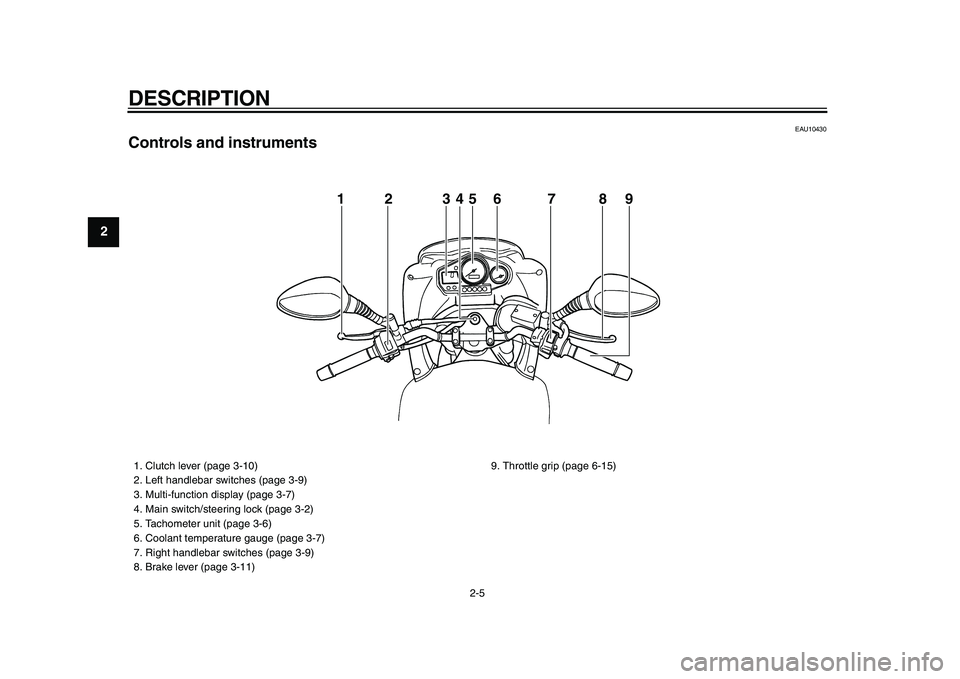
Controls and instruments
12345 6 7 8 9
1. Clutch lever (page 3-10)
2. Left handlebar switches (page 3-9)
3. Multi-function display (page 3-7)
4. Main switch/steering lock (page 3-2)
5. Tachometer unit (page 3-6)
6. Coolant temperature gauge (page 3-7)
7. Right handlebar switches (page 3-9)
8. Brake lever (page 3-11)9. Throttle grip (page 6-15)
Page 26 of 94

INSTRUMENT AND CONTROL FUNCTIONS
3-10
1
2
3
4
5
6
7
8
9
position. To cancel the turn signal
lights, push the switch in after it has re-
turned to the center position.
EAU12500
Horn switch “ ”
Press this switch to sound the horn.
EAU12660
Engine stop switch “ / ”
Set this switch to “ ” before starting
the engine. Set this switch to “ ” to
stop the engine in case of an emergen-
cy, such as when the vehicle overturns
or when the throttle cable is stuck.
EAU12711
Start switch “ ”
Push this switch to crank the engine
with the starter. See page 5-1 for start-
ing instructions prior to starting the en-
gine.
EAU44710
The engine trouble warning light and
ABS warning light (ABS model only)
will come on when the key is turned to
“ON” and the start switch is pushed, butthis does not indicate a malfunction.
EAU12733
Hazard switch “ ”
With the key in the “ON” or “ ” posi-
tion, use this switch to turn on the haz-
ard lights (simultaneous flashing of all
turn signal lights).
The hazard lights are used in case of
an emergency or to warn other drivers
when your vehicle is stopped where it
might be a traffic hazard.
NOTICE
ECA10061
Do not use the hazard lights for an
extended length of time with the en-
gine not running, otherwise the bat-
tery may discharge.
EAU12820
Clutch lever
The clutch lever is located at the left
handlebar grip. To disengage the
clutch, pull the lever toward the handle-
bar grip. To engage the clutch, release
the lever. The lever should be pulled
rapidly and released slowly for smooth
clutch operation.
The clutch lever is equipped with a
clutch switch, which is part of the igni-
tion circuit cut-off system. (See
page 3-21.)
1. Clutch lever
1
Page 27 of 94

INSTRUMENT AND CONTROL FUNCTIONS
3-11
2
34
5
6
7
8
9
EAU12870
Shift pedal
The shift pedal is located on the left
side of the engine and is used in com-
bination with the clutch lever when
shifting the gears of the 6-speed con-
stant-mesh transmission equipped on
this motorcycle.
EAU26823
Brake lever
The brake lever is located at the right
handlebar grip. To apply the front
brake, pull the lever toward the handle-
bar grip.
The brake lever is equipped with a
brake lever position adjusting dial. To
adjust the distance between the brake
lever and the handlebar grip, turn the
adjusting dial while holding the lever
pushed away from the handlebar grip.
Make sure that the appropriate settingon the adjusting dial is aligned with the
“” mark on the brake lever.
1. Shift pedal
1
1. Brake lever
2. Brake lever position adjusting dial
3. “ ” mark
4. Distance between brake lever and
handlebar grip
1 2
4
3
Page 37 of 94
INSTRUMENT AND CONTROL FUNCTIONS
3-21
2
34
5
6
7
8
9
EAU15301
Sidestand
The sidestand is located on the left side
of the frame. Raise the sidestand or
lower it with your foot while holding the
vehicle upright.
TIP
The built-in sidestand switch is part of
the ignition circuit cut-off system, which
cuts the ignition in certain situations.
(See further down for an explanation of
the ignition circuit cut-off system.)
WARNING
EWA10240
The vehicle must not be ridden with
the sidestand down, or if the side-
stand cannot be properly moved up
(or does not stay up), otherwise the
sidestand could contact the ground
and distract the operator, resulting
in a possible loss of control.
Yamaha’s ignition circuit cut-off
system has been designed to assist
the operator in fulfilling the respon-
sibility of raising the sidestand be-
fore starting off. Therefore, check
this system regularly as described
below and have a Yamaha dealer re-pair it if it does not function proper-
ly.
EAU44892
Ignition circuit cut-off system
The ignition circuit cut-off system (com-
prising the sidestand switch, clutch
switch and neutral switch) has the fol-
lowing functions.
●
It prevents starting when the trans-
mission is in gear and t
he side-
stand is up, but the clutch lever is
not pulled.
●
It prevents starting when the trans-
mission is in gear and the clutch le-
ver is pulled, but the sidestand is
still down.
●
It cuts the running engine when the
transmission is in gear and the sid-
estand is moved down.
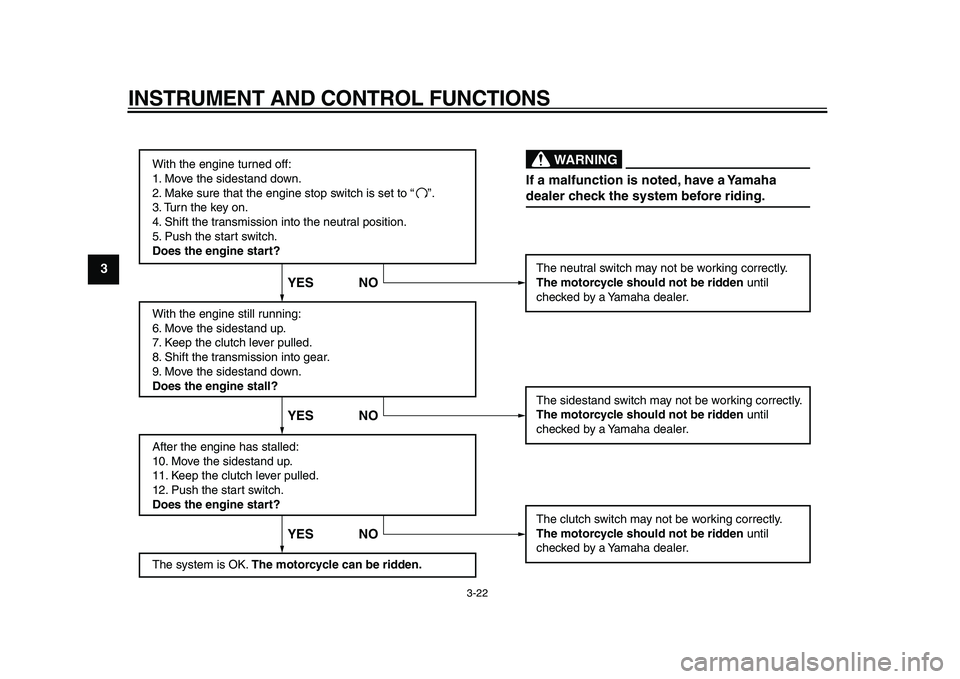
Periodically check the operation of the
ignition circuit cut-off system according
to the following procedure.
Page 38 of 94
INSTRUMENT AND CONTROL FUNCTIONS
3-22
1
2
3
4
5
6
7
8
9
With the engine turned off:
1. Move the sidestand down.
2. Make sure that the engine stop switch is set to “
3. Turn the key on.
4. Shift the transmission into the neutral position.
5. Push the start switch.
Does the engine start?
With the engine still running:
6. Move the sidestand up.
7. Keep the clutch lever pulled.
8. Shift the transmission into gear.
9. Move the sidestand down.
Does the engine stall?
After the engine has stalled:
10. Move the sidestand up.
11. Keep the clutch lever pulled.
12. Push the start switch.
Does the engine start?
The system is OK. The motorcycle can be ridden.The neutral switch may not be working correctly.
The motorcycle should not be ridden until
checked by a Yamaha dealer.
The sidestand switch may not be working correctly.
The motorcycle should not be ridden until
checked by a Yamaha dealer.
The clutch switch may not be working correctly.
The motorcycle should not be ridden until
checked by a Yamaha dealer.
YES NO YES NO YES NO
If a malfunction is noted, have a Yamaha
dealer check the system before riding.
WARNING
”.
Page 40 of 94
FOR YOUR SAFETY – PRE-OPERATION CHECKS
4-2
1
2
3
4
5
6
7
8
9
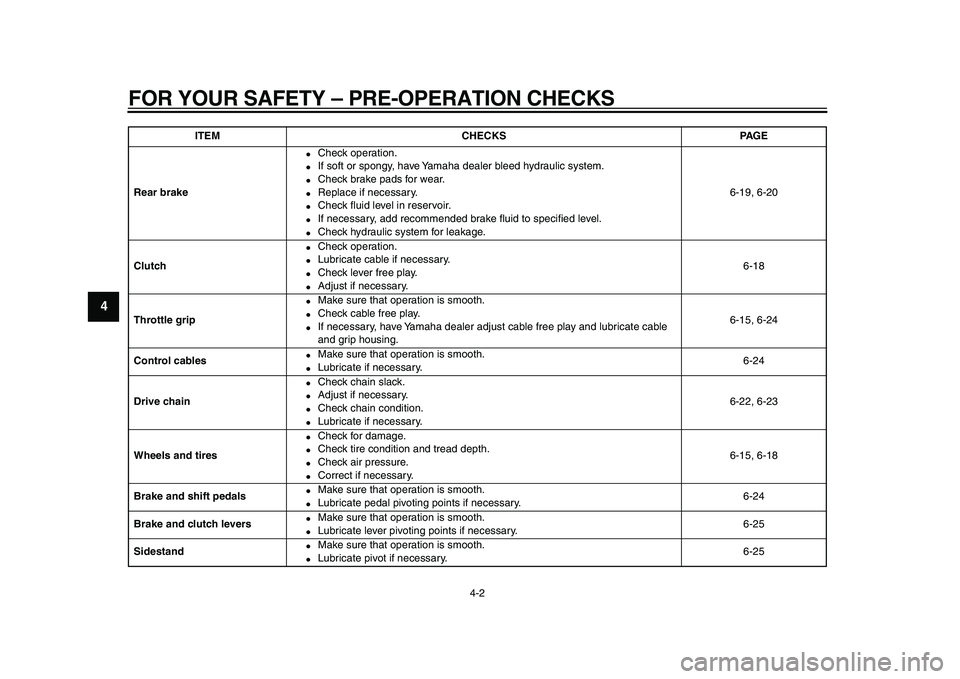
Rear brake
●
Check operation.
●
If soft or spongy, have Yamaha dealer bleed hydraulic system.
●
Check brake pads for wear.
●
Replace if necessary.
●
Check fluid level in reservoir.
●
If necessary, add recommended brake fluid to specified level.
●
Check hydraulic system for leakage.6-19, 6-20
Clutch
●
Check operation.
●
Lubricate cable if necessary.
●
Check lever free play.
●
Adjust if necessary.6-18
Throttle grip
●
Make sure that operation is smooth.
●
Check cable free play.
●
If necessary, have Yamaha dealer adjust cable free play and lubricate cable
and grip housing.6-15, 6-24
Control cables
●
Make sure that operation is smooth.
●
Lubricate if necessary.6-24
Drive chain
●
Check chain slack.
●
Adjust if necessary.
●
Check chain condition.
●
Lubricate if necessary.6-22, 6-23
Wheels and tires
●
Check for damage.
●
Check tire condition and tread depth.
●
Check air pressure.
●
Correct if necessary.6-15, 6-18
Brake and shift pedals
●
Make sure that operation is smooth.
●
Lubricate pedal pivoting points if necessary.6-24
Brake and clutch levers
●
Make sure that operation is smooth.
●
Lubricate lever pivoting points if necessary.6-25
Sidestand
●
Make sure that operation is smooth.
●
Lubricate pivot if necessary.6-25
ITEM CHECKS PAGE
Page 42 of 94
5-1
1
2
3
4
5
6
7
8
9
OPERATION AND IMPORTANT RIDING POINTS
EAU15951
Read the Owner’s Manual carefully to
become familiar with all controls. If
there is a control or function you do not
understand, ask your Yamaha dealer.
WARNING
EWA10271
Failure to familiarize yourself with
the controls can lead to loss of con-
trol, which could cause an accident
or injury.
EAU45310
TIP
This model is equipped with a lean an-
gle sensor to stop the engine in case of
a turnover. To start the engine after a
turnover, be sure to turn the main
switch to “OFF” and then to “ON”. Fail-
ing to do so will prevent the engine from
starting even though the engine will
crank when pushing the start switch.
EAU39893
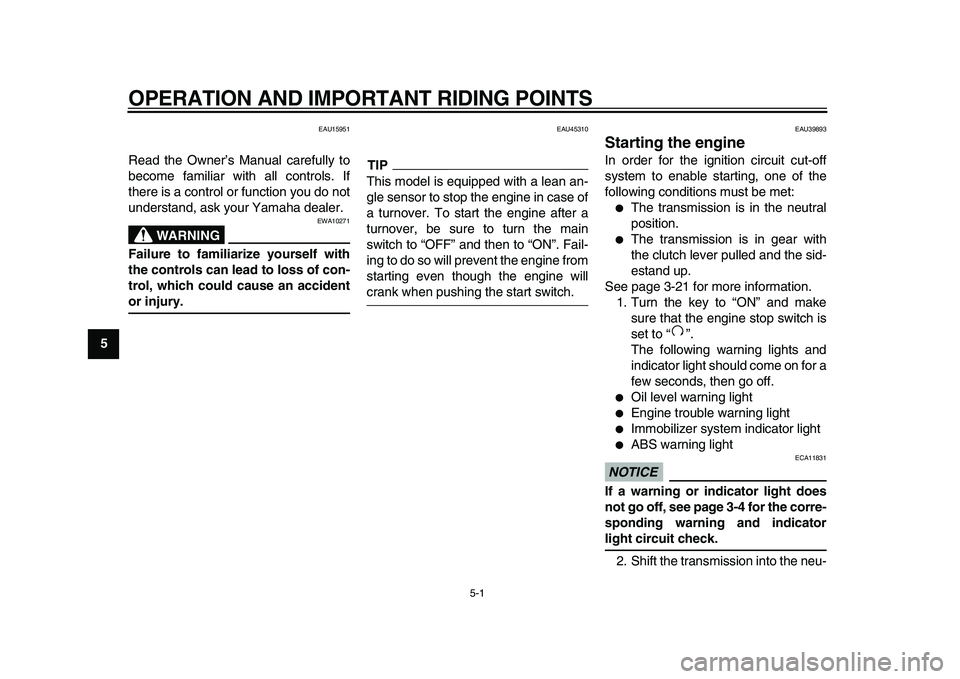
Starting the engine
In order for the ignition circuit cut-off
system to enable starting, one of the
following conditions must be met:
●
The transmission is in the neutral
position.
●
The transmission is in gear with
the clutch lever pulled and the sid-
estand up.
See page 3-21 for more information.
1. Turn the key to “ON” and make
sure that the engine stop switch is
set to “ ”.
The following warning lights and
indicator light should come on for a
few seconds, then go off.
●
Oil level warning light
●
Engine trouble warning light
●
Immobilizer system indicator light
●
ABS warning light
NOTICE
ECA11831
If a warning or indicator light does
not go off, see page 3-4 for the corre-
sponding warning and indicator
light circuit check.
2. Shift the transmission into the neu-
Page 43 of 94
OPERATION AND IMPORTANT RIDING POINTS
5-2
2
3
4
56
7
8
9
tral position. (See page 5-2.) The
neutral indicator light should come
on. If not, ask a Yamaha dealer to
check the electrical circuit.
3. Start the engine by pushing the
start switch.
NOTICE:
For maxi-
mum engine life, never acceler-
ate hard when the engine is
cold!
[ECA11041]
If the engine fails to start, release
the start switch, wait a few sec-
onds, and then try again. Each
starting attempt should be as short
as possible to preserve the bat-
tery. Do not crank the engine more
than 10 seconds on any one at-
tempt.
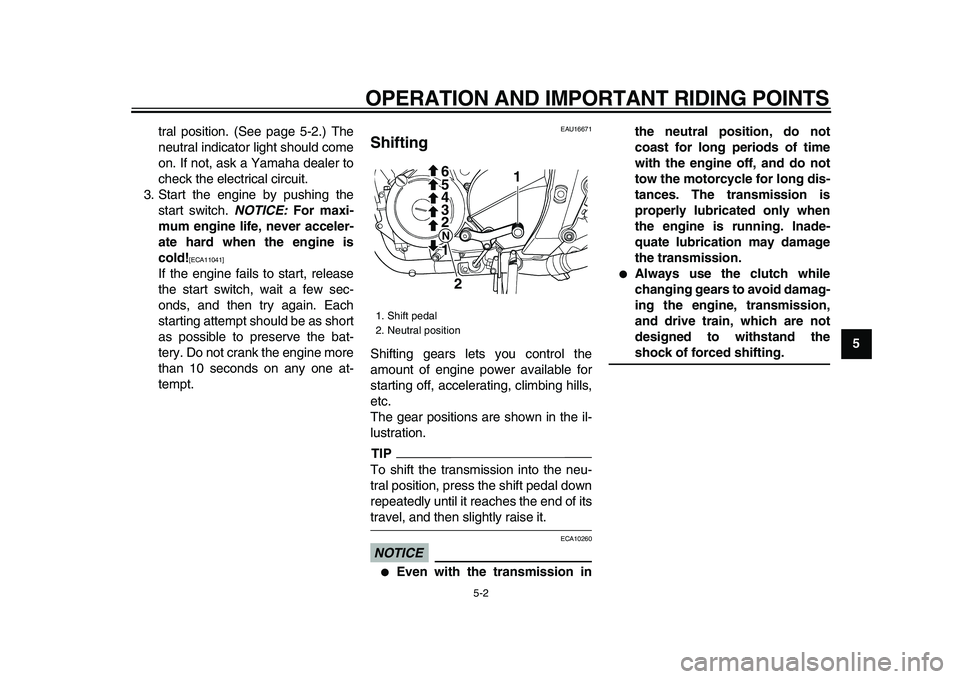
EAU16671
Shifting
Shifting gears lets you control the
amount of engine power available for
starting off, accelerating, climbing hills,
etc.
The gear positions are shown in the il-
lustration.
TIP
To shift the transmission into the neu-
tral position, press the shift pedal down
repeatedly until it reaches the end of its
travel, and then slightly raise it.
NOTICE
ECA10260
●
Even with the transmission inthe neutral position, do not
coast for long periods of time
with the engine off, and do not
tow the motorcycle for long dis-
tances. The transmission is
properly lubricated only when
the engine is running. Inade-
quate lubrication may damage
the transmission.
●
Always use the clutch while
changing gears to avoid damag-
ing the engine, transmission,
and drive train, which are not
designed to withstand the
shock of forced shifting.
1. Shift pedal
2. Neutral position
1
1 2 3
4 5 6
N2
Page 47 of 94
PERIODIC MAINTENANCE AND ADJUSTMENT
6-2
2
3
4
5
67
8
9
EAU1770A
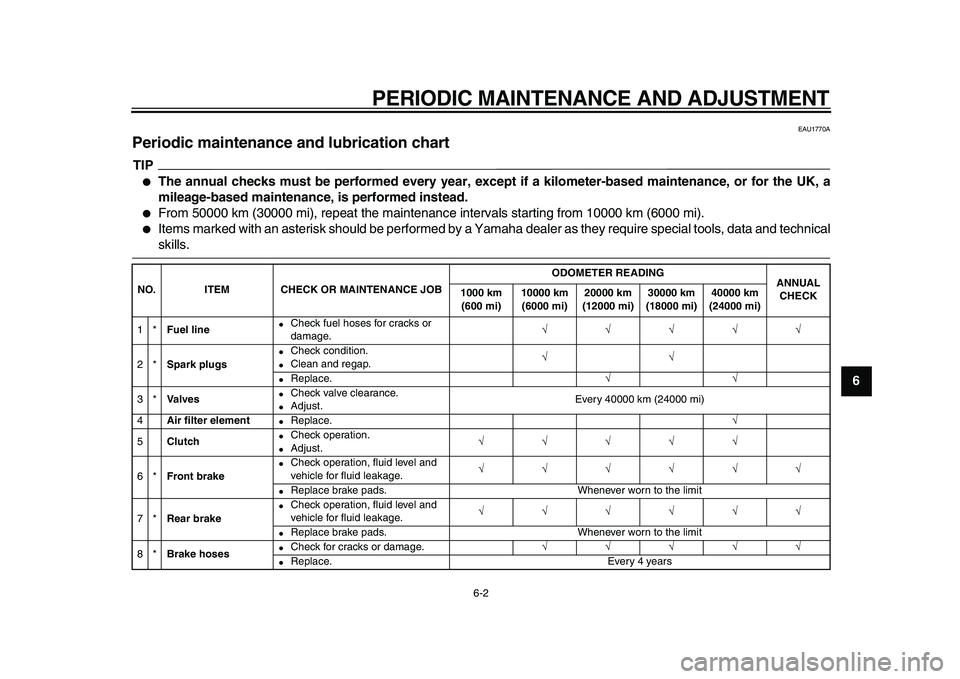
Periodic maintenance and lubrication chart
TIP
●
The annual checks must be performed every year, except if a kilometer-based maintenance, or for the UK, a
mileage-based maintenance, is performed instead.
●
From 50000 km (30000 mi), repeat the maintenance intervals starting from 10000 km (6000 mi).
●
Items marked with an asterisk should be performed by a Yamaha dealer as they require special tools, data and technical
skills.
NO. ITEM CHECK OR MAINTENANCE JOBODOMETER READING
ANNUAL
CHECK 1000 km
(600 mi)10000 km
(6000 mi)20000 km
(12000 mi)30000 km
(18000 mi)40000 km
(24000 mi)
1*
Fuel line
●
Check fuel hoses for cracks or
damage.
√√√√√
2*
Spark plugs
●
Check condition.
●
Clean and regap.
√√
●
Replace.
√√
3*
Valves
●
Check valve clearance.
●
Adjust.Every 40000 km (24000 mi)
4
Air filter element
●
Replace.
√
5
Clutch
●
Check operation.
●
Adjust.
√√√√√
6*
Front brake
●
Check operation, fluid level and
vehicle for fluid leakage.
√√√√√√
●
Replace brake pads. Whenever worn to the limit
7*
Rear brake
●
Check operation, fluid level and
vehicle for fluid leakage.
√√√√√√
●
Replace brake pads. Whenever worn to the limit
8*
Brake hoses
●
Check for cracks or damage.
√√√√√
●
Replace. Every 4 years