light YAMAHA TMAX 2012 User Guide
[x] Cancel search | Manufacturer: YAMAHA, Model Year: 2012, Model line: TMAX, Model: YAMAHA TMAX 2012Pages: 96, PDF Size: 3.82 MB
Page 31 of 96
INSTRUMENT AND CONTROL FUNCTIONS
3-16
234
5
6
7
8
9
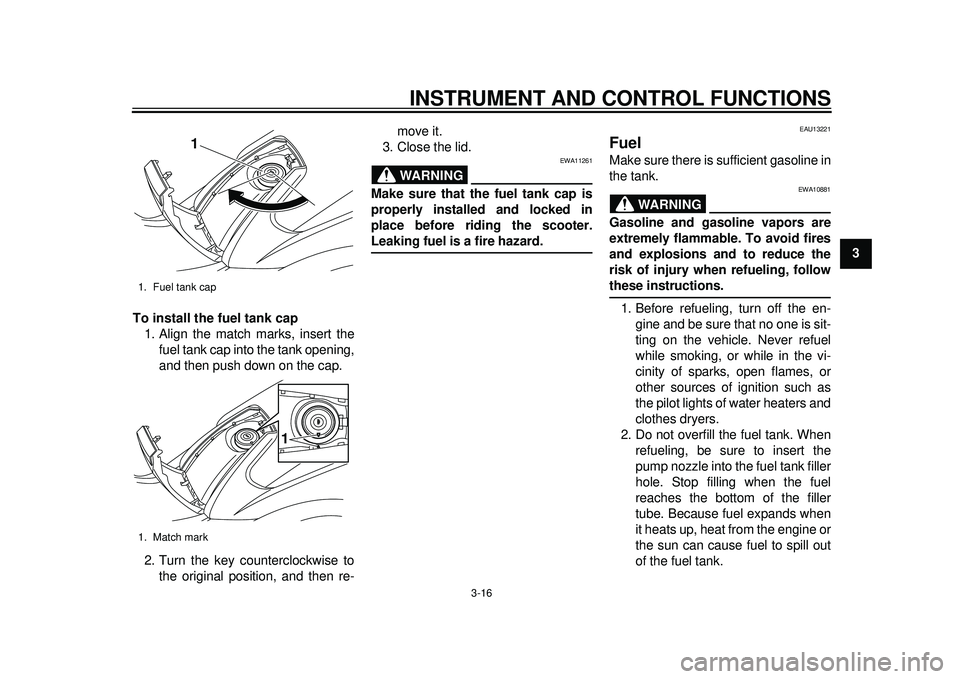
To install the fuel tank cap
1. Align the match marks, insert the fuel tank cap into the tank opening,
and then push down on the cap.
2. Turn the key counterclockwise to the original position, and then re- move it.
3. Close the lid.
WARNING
EWA11261
Make sure that the fuel tank cap is
properly installed and locked in
place before riding the scooter.Leaking fuel is a fire hazard.
EAU13221
Fuel Make sure there is sufficient gasoline in
the tank.
WARNING
EWA10881
Gasoline and gasoline vapors are
extremely flammable. To avoid fires
and explosions and to reduce the
risk of injury when refueling, followthese instructions.
1. Before refueling, turn off the en- gine and be sure that no one is sit-
ting on the vehicle. Never refuel
while smoking, or while in the vi-
cinity of sparks, open flames, or
other sources of ignition such as
the pilot lights of water heaters and
clothes dryers.
2. Do not overfill the fuel tank. When refueling, be sure to insert the
pump nozzle into the fuel tank filler
hole. Stop filling when the fuel
reaches the bottom of the filler
tube. Because fuel expands when
it heats up, heat from the engine or
the sun can cause fuel to spill out
of the fuel tank.
1. Fuel tank cap
1. Match mark
1
1
59C-9-E0.book 16 ページ 2011年9月11日 日曜日 午前9時27分
Page 36 of 96
INSTRUMENT AND CONTROL FUNCTIONS
3-21
1
23
4
5
6
7
8
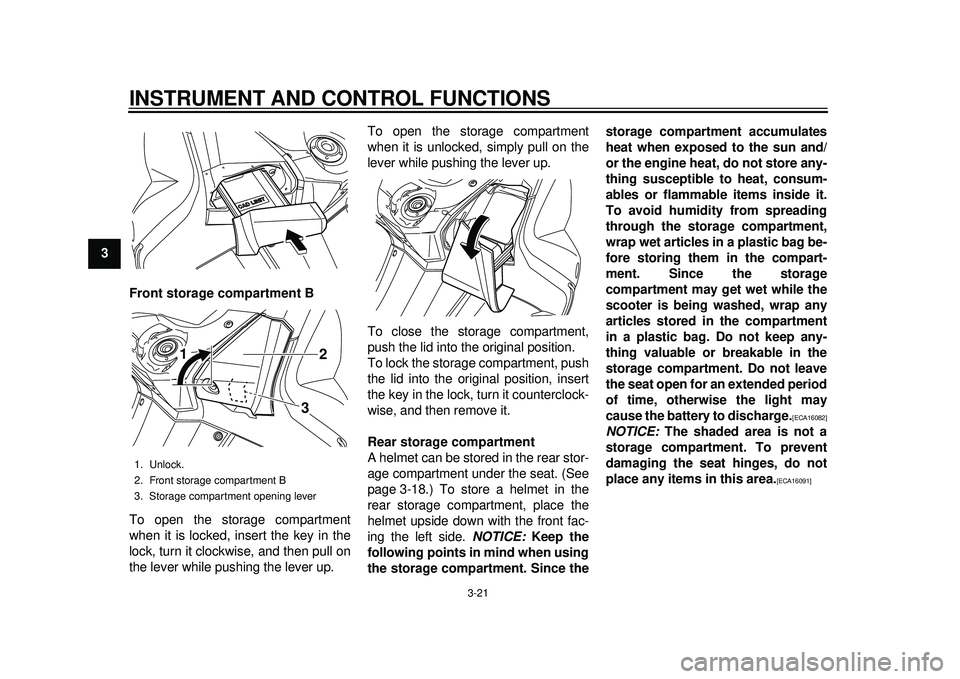
9Front storage compartment B
To open the storage compartment
when it is locked, insert the key in the
lock, turn it clockwise, and then pull on
the lever while pushing the lever up. To open the storage compartment
when it is unlocked, simply pull on the
lever while pushing the lever up.
To close the storage compartment,
push the lid into the original position.
To lock the storage compartment, push
the lid into the original position, insert
the key in the lock, turn it counterclock-
wise, and then remove it.
Rear storage compartment
A helmet can be stored in the rear stor-
age compartment under the seat. (See
page 3-18.) To store a helmet in the
rear storage compartment, place the
helmet upside down with the front fac-
ing the left side.
NOTICE: Keep the
following points in mind when using
the storage compartment. Since the storage compartment accumulates
heat when exposed to the sun and/
or the engine heat, do not store any-
thing susceptible to heat, consum-
ables or flammable items inside it.
To avoid humidity from spreading
through the storage compartment,
wrap wet articles in a plastic bag be-
fore storing them in the compart-
ment. Since the storage
compartment may get wet while the
scooter is being washed, wrap any
articles stored in the compartment
in a plastic bag. Do not keep any-
thing valuable or breakable in the
storage compartment. Do not leave
the seat open for an extended period
of time, otherwise the light may
cause the battery to discharge.
[ECA16082]
NOTICE:
The shaded area is not a
storage compartment. To prevent
damaging the seat hinges, do not
place any items in this area.
[ECA16091]
1. Unlock.
2. Front storage compartment B
3. Storage compartment opening lever
1 2
3
59C-9-E0.book 21 ページ 2011年9月11日 日曜日 午前9時27分
Page 37 of 96
INSTRUMENT AND CONTROL FUNCTIONS
3-22
234
5
6
7
8
9
TIP
Some helmets cannot be stored in
the rear storage compartment be-
cause of their size or shape.
Do not leave your scooter unat-tended with the seat open.
NOTICE
ECA11100
Do not leave the rider seat open for
an extended period of time, other-
wise the light may cause the batteryto discharge.
WARNING
EWA16120
Do not exceed the following loadinglimits:
Front storage compartment A:
0.15 kg (0.3 lb)
Front storage compartment B:
1 kg (2 lb)
Rear storage compartment: 5 kg
(11 lb)
Maximum load for the vehicle:198 kg (437 lb)
EAU52211
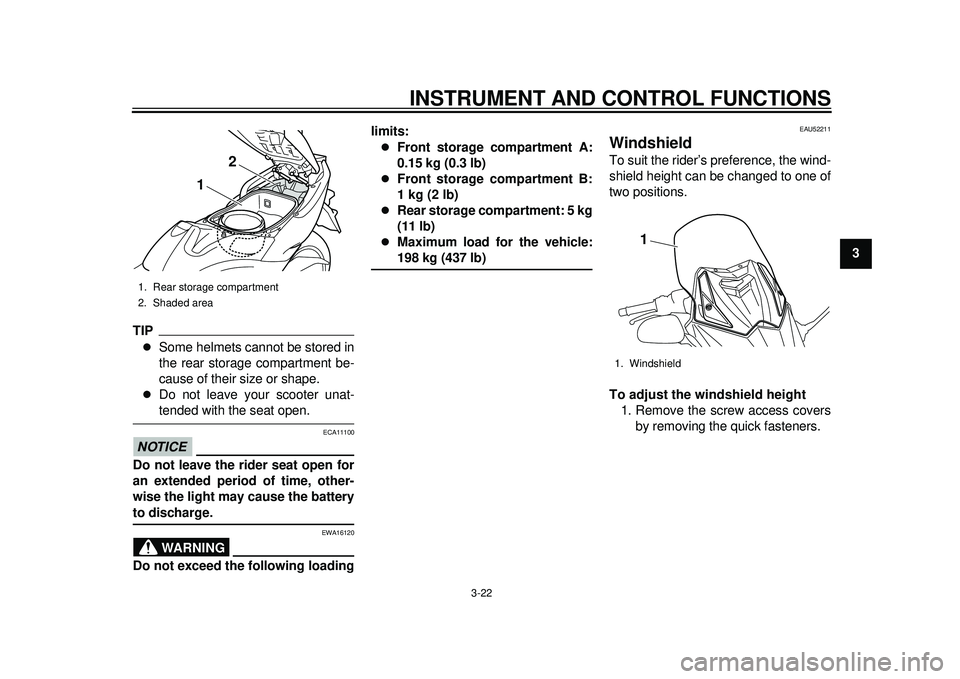
Windshield To suit the rider’s preference, the wind-
shield height can be changed to one of
two positions.
To adjust the windshield height
1. Remove the screw access covers by removing the quick fasteners.
1. Rear storage compartment
2. Shaded area
1
2
1. Windshield
1
59C-9-E0.book 22 ページ 2011年9月11日 日曜日 午前9時27分
Page 40 of 96
INSTRUMENT AND CONTROL FUNCTIONS
3-25
1
23
4
5
6
7
8
9
EAU15305
Sidestand The sidestand is located on the left side
of the frame. Raise the sidestand or
lower it with your foot while holding the
vehicle upright.TIPThe built-in sidestand switch is part of
the ignition circuit cut-off system, which
cuts the ignition in certain situations.
(See the following section for an expla-
nation of the ignition circuit cut-off sys-tem.)
WARNING
EWA10241
The vehicle must not be ridden with
the sidestand down, or if the side-
stand cannot be properly moved up
(or does not stay up), otherwise the
sidestand could contact the ground
and distract the operator, resulting
in a possible loss of control.
Yamaha’s ignition circuit cut-off
system has been designed to assist
the operator in fulfilling the respon-
sibility of raising the sidestand be-
fore starting off. Therefore, check
this system regularly and have aYamaha dealer repair it if it does not
function properly.
EAU45051
Ignition circuit
cut-off system The ignition circuit cut-off system (com-
prising the sidestand switch and brake
light switches) has the following func-
tions.
It prevents starting when the side-
stand is up, but neither brake is ap-
plied.
It prevents starting when either
brake is applied, but the sidestand
is still down.
It cuts the running engine when the
sidestand is moved down.
Periodically check the operation of the
ignition circuit cut-off system according
to the following procedure.
59C-9-E0.book 25 ページ 2011年9月11日 日曜日 午前9時27分
Page 43 of 96
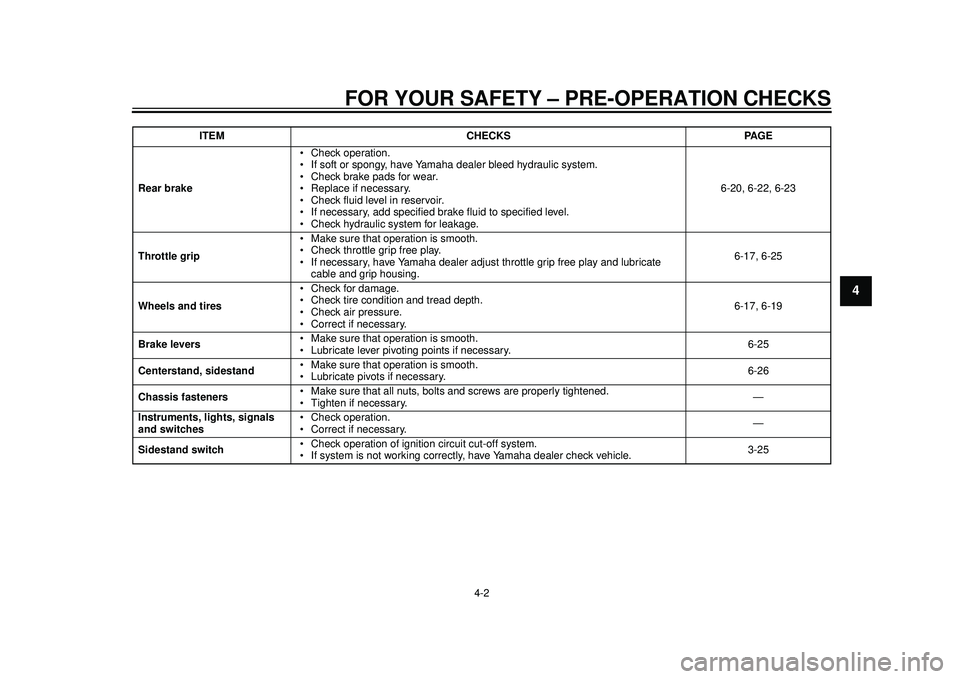
FOR YOUR SAFETY – PRE-OPERATION CHECKS
4-2
2
345
6
7
8
9
Rear brake Check operation.
If soft or spongy, have Yamaha dealer bleed hydraulic system.
Check brake pads for wear.
Replace if necessary.
Check fluid level in reservoir.
If necessary, add specified brak
e fluid to specified level.
Check hydraulic system for leakage. 6-20, 6-22, 6-23
Throttle grip Make sure that operation is smooth.
Check throttle grip free play.
If necessary, have Yamaha dealer adjust
throttle grip free play and lubricate
cable and grip housing. 6-17, 6-25
Wheels and tires Check for damage.
Check tire condition and tread depth.
Check air pressure.
Correct if necessary. 6-17, 6-19
Brake levers Make sure that operation is smooth.
Lubricate lever pivoting
points if necessary. 6-25
Centerstand, sidestand Make sure that operation is smooth.
Lubricate pivots if necessary. 6-26
Chassis fasteners Make sure that all nuts, bolts
and screws are properly tightened.
Tighten if necessary. —
Instruments, lights, signals
and switches Check operation.
Correct if necessary.
—
Sidestand switch Check operation of ignition circuit cut-off system.
If system is not working correctly, have Yamaha dealer check vehicle. 3-25
ITEM CHECKS PAGE
59C-9-E0.book 2 ページ 2011年9月11日 日曜日 午前9時27分
Page 44 of 96
5-1
1
2
3
45
6
7
8
9
OPERATION AND IMPORTANT RIDING POINTS
EAU15951
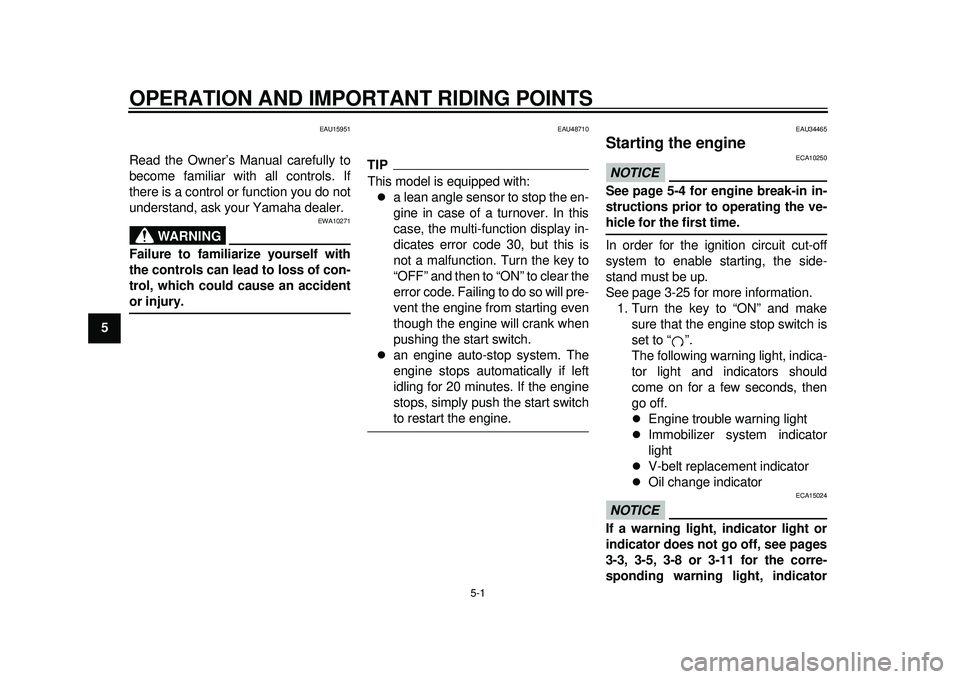
Read the Owner’s Manual carefully to
become familiar with all controls. If
there is a control or function you do not
understand, ask your Yamaha dealer.
WARNING
EWA10271
Failure to familiarize yourself with
the controls can lead to loss of con-
trol, which could cause an accidentor injury.
EAU48710
TIPThis model is equipped with:
a lean angle sensor to stop the en-
gine in case of a turnover. In this
case, the multi-function display in-
dicates error code 30, but this is
not a malfunction. Turn the key to
“OFF” and then to “ON” to clear the
error code. Failing to do so will pre-
vent the engine from starting even
though the engine will crank when
pushing the start switch.
an engine auto-stop system. The
engine stops automatically if left
idling for 20 minutes. If the engine
stops, simply push the start switchto restart the engine.
EAU34465
Starting the engine NOTICE
ECA10250
See page 5-4 for engine break-in in-
structions prior to operating the ve-hicle for the first time.
In order for the ignition circuit cut-off
system to enable starting, the side-
stand must be up.
See page 3-25 for more information.1. Turn the key to “ON” and make sure that the engine stop switch is
set to “ ”.
The following warning light, indica-
tor light and indicators should
come on for a few seconds, then
go off.
Engine trouble warning light
Immobilizer system indicator
light
V-belt replacement indicator
Oil change indicator
NOTICE
ECA15024
If a warning light, indicator light or
indicator does not go off, see pages
3-3, 3-5, 3-8 or 3-11 for the corre-
sponding warning light, indicator
59C-9-E0.book 1 ページ 2011年9月11日 日曜日 午前9時27分
Page 45 of 96

OPERATION AND IMPORTANT RIDING POINTS
5-2
2
3
456
7
8
9
light or indicator circuit check.
2. Close the throttle completely.
3. Start the engine by pushing the start switch while applying the front
or rear brake.
If the engine does not start, re-
lease the start switch, wait a few
seconds, and then try again. Each
starting attempt should be as short
as possible to preserve the bat-
tery. Do not crank the engine more
than 10 seconds on any one at-
tempt.NOTICE
ECA11042
For maximum engine life, never ac-
celerate hard when the engine iscold!
EAU45091
Starting off 1. While pulling the rear brake leverwith your left hand and holding the
grab bar with your right hand, push
the scooter off the centerstand.
2. Sit astride the seat, and then ad- just the rear view mirrors.
3. Switch the turn signals on.
4. Check for oncoming traffic, and then slowly turn the throttle grip (on
the right) in order to take off.
5. Switch the turn signals off.
EAU16780
Acceleration a nd deceleration The speed can be adjusted by opening
and closing the throttle. To increase the
speed, turn the throttle grip in direction
(a). To reduce the speed, turn the throt-
tle grip in direction (b).
1. Grab bar
1
(a)
(b)
59C-9-E0.book 2 ページ 2011年9月11日 日曜日 午前9時27分
Page 46 of 96
OPERATION AND IMPORTANT RIDING POINTS
5-3
1
2
3
45
6
7
8
9
EAU16793
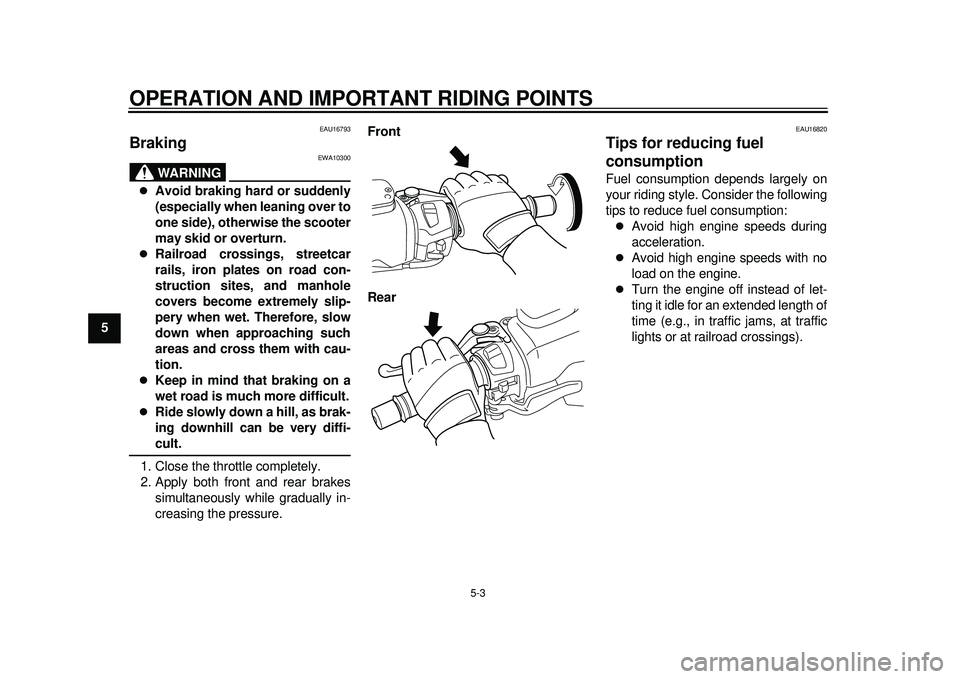
Braking
WARNING
EWA10300
Avoid braking hard or suddenly
(especially when leaning over to
one side), otherwise the scooter
may skid or overturn.
Railroad crossings, streetcar
rails, iron plates on road con-
struction sites, and manhole
covers become extremely slip-
pery when wet. Therefore, slow
down when approaching such
areas and cross them with cau-
tion.
Keep in mind that braking on a
wet road is much more difficult.
Ride slowly down a hill, as brak-
ing downhill can be very diffi-cult.
1. Close the throttle completely.
2. Apply both front and rear brakes simultaneously while gradually in-
creasing the pressure. Front
Rear
EAU16820
Tips for reducing fuel
consumption Fuel consumption depends largely on
your riding style. Consider the following
tips to reduce fuel consumption:
Avoid high engine speeds during
acceleration.
Avoid high engine speeds with no
load on the engine.
Turn the engine off instead of let-
ting it idle for an extended length of
time (e.g., in traffic jams, at traffic
lights or at railroad crossings).
59C-9-E0.book 3 ページ 2011年9月11日 日曜日 午前9時27分
Page 53 of 96
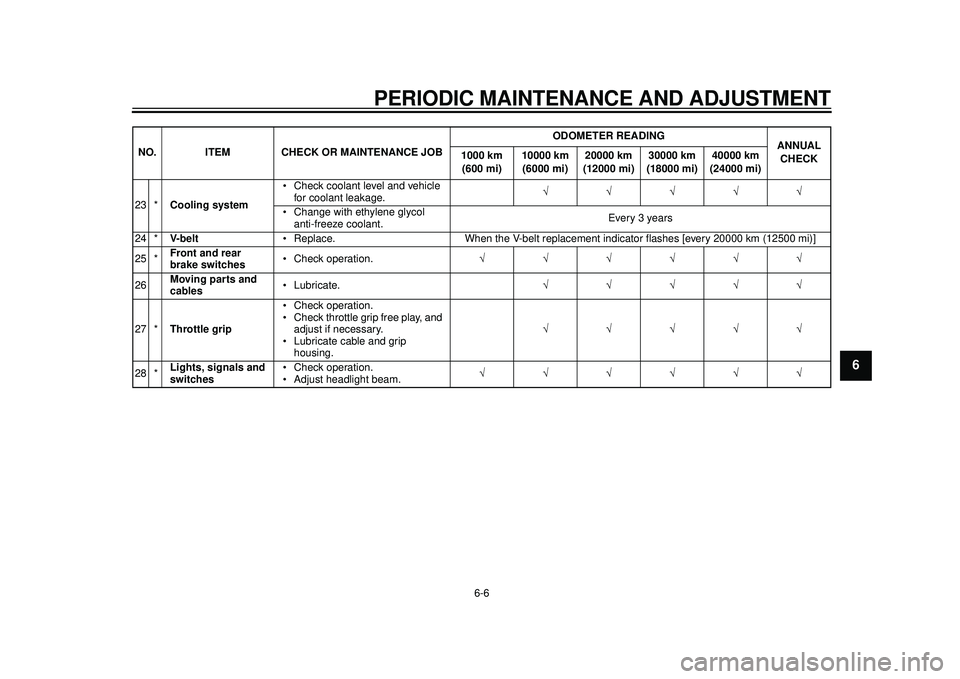
PERIODIC MAINTENANCE AND ADJUSTMENT
6-6
2
3
4
567
8
9
23 *Cooling system Check coolant level and vehicle
for coolant leakage.
Change with ethylene glycol anti-freeze coolant. Every 3 years
24 * V- b e l t Replace. When the V-belt replacement indicator flashes [every 20000 km (12500 mi)]
25 * Front and rear
brake switches Check operation.
26 Moving parts and
cables Lubricate.
27 * Throttle grip Check operation.
Check throttle grip free play, and
adjust if necessary.
Lubricate cable and grip housing.
28 * Lights, signals and
switches Check operation.
Adjust headlight beam.
NO. ITEM CHECK OR MAINTENANCE JOB
ODOMETER READING
ANNUAL
CHECK
1000 km
(600 mi) 10000 km
(6000 mi) 20000 km
(12000 mi) 30000 km
(18000 mi) 40000 km
(24000 mi)
59C-9-E0.book 6 ページ 2011年9月11日 日曜日 午前9時27分
Page 57 of 96
PERIODIC MAINTENANCE AND ADJUSTMENT
6-10
2
3
4
567
8
9
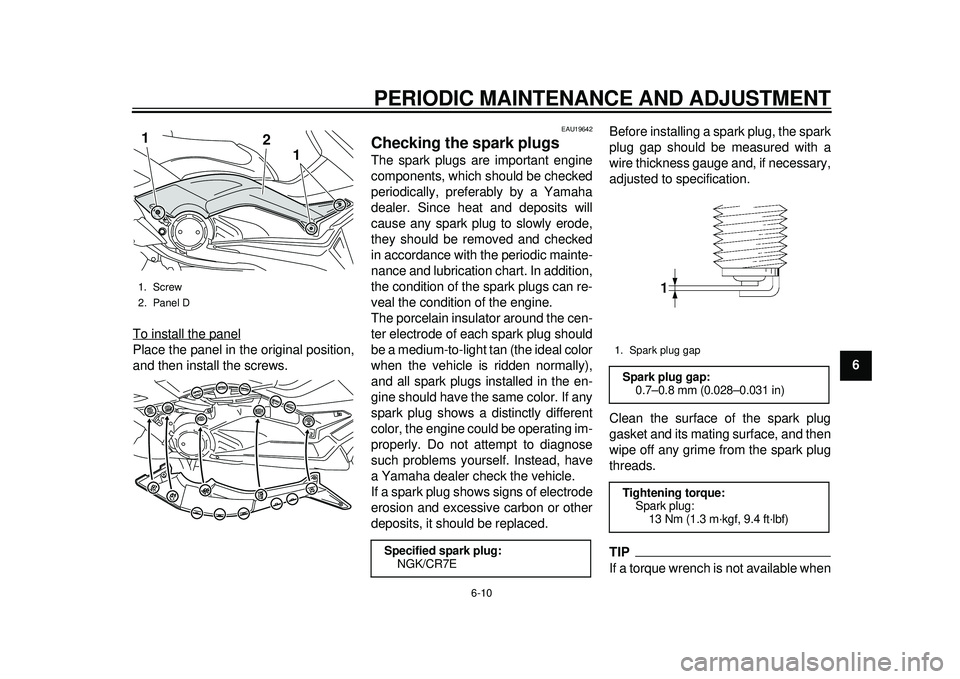
To install the panel
Place the panel in the original position,
and then install the screws.
EAU19642
Checking the spark plugs The spark plugs are important engine
components, which should be checked
periodically, preferably by a Yamaha
dealer. Since heat and deposits will
cause any spark pl
ug to slowly erode,
they should be removed and checked
in accordance with the periodic mainte-
nance and lubrication chart. In addition,
the condition of the spark plugs can re-
veal the condition of the engine.
The porcelain insulator around the cen-
ter electrode of each spark plug should
be a medium-to-light tan (the ideal color
when the vehicle is ridden normally),
and all spark plugs installed in the en-
gine should have the same color. If any
spark plug shows a distinctly different
color, the engine could be operating im-
properly. Do not attempt to diagnose
such problems yourself. Instead, have
a Yamaha dealer check the vehicle.
If a spark plug shows signs of electrode
erosion and excessive carbon or other
deposits, it should be replaced. Before installing a spark plug, the spark
plug gap should be measured with a
wire thickness gauge and, if necessary,
adjusted to specification.
Clean the surface of the spark plug
gasket and its mating surface, and then
wipe off any grime from the spark plug
threads.
TIPIf a torque wrench is not available when
1. Screw
2. Panel D
1
2
1
Specified spark plug:
NGK/CR7E
1. Spark plug gapSpark plug gap:0.7–0.8 mm (0.028–0.031 in)
Tightening torque: Spark plug:
13 Nm (1.3 m·kgf, 9.4 ft·lbf)
59C-9-E0.book 10 ページ 2011年9月11日 日曜日 午前9時27分