wheel YAMAHA TMAX 2012 Owners Manual
[x] Cancel search | Manufacturer: YAMAHA, Model Year: 2012, Model line: TMAX, Model: YAMAHA TMAX 2012Pages: 96, PDF Size: 3.82 MB
Page 2 of 96
Q Read this manual carefully before operating this vehicle. This manual should stay with this vehicle if it is sold.
EAU50920
General manager of quality assurance di v.
Date of issue: 1
Aug. 2002
Place of issue: Shizuoka, Japan
DECLARATION of CONFORMITY
YAMAHA MOTOR ELECTRONICS CO., LTD.1450-6, Mori, Mori-machi, Shuchi-gun, Shizuoka-ken, 437-0292 Japan
Company:
YAMAHA MOTOR ELECTRONICS CO., LT D.
We
Addr
ess: 1450-6, Mori, Mori-Machi, Shuchi-gun, Shizuoka-Ken, 437-0292 J apan
Kind of equipment: IMMOBILIZER Hereby declare that the product:
Type-designation: 5SL-00
is in compliance with following norm(s) or documents:
R&TTE Dir ective(1999/5/EC)
EN300 330-2 v1.3.1(2006-01), EN300 330-2 v1.5.1(2010-02)
EN60950-1:2006/A11:2009
Tw o or Three-Wheel Motor Vehicles Directive(97/24/EC: Chapter 8, EMC)
1
2
3
4 Version up the norm of EN60950 to EN60950-1
To
change company name
version up of the following norm:
• EN300 330-2 v1.1.1 to EN300 330-2 v1.3.1 and EN300 330-2 v1.5. 1
• EN60950-1:2001 to EN60950-1:2006/A11:2009
27 Fe b. 2006
1 Mar. 2007
8 Jul. 2010
Revision record
No. Contents
To change contact person and integrate type-designation. Date
9 Jun. 2005
Page 6 of 96
TABLE OF CONTENTSSAFETY INFORMATION .................. 1-1
Further safe-riding points ................ 1-5
DESCRIPTION .................................. 2-1
Left view .......................................... 2-1
Right view ........................................ 2-2
Controls and instrument s................. 2-3
INSTRUMENT AND CONTROL
FUNCTIONS ....................................... 3-1
Immobilizer system .... ..................... 3-1
Main switch/steering lock ................ 3-2
Indicator lights and warning light .... 3-3
Speedometer .................................. 3-4
Tachometer .................................... 3-4
Multi-function display ...................... 3-5
Anti-theft alarm (opti onal) ............. 3-12
Handlebar switches ...................... 3-12
Front brake lever .......................... 3-13
Rear brake lever ........................... 3-14
Rear brake lock lever .................... 3-15
Fuel tank cap ................................ 3-15
Fuel ............................................... 3-16
Catalytic converter ........................ 3-18
Seat .............................................. 3-18
Adjusting the rider backrest .......... 3-19
Helmet holder ............................... 3-20
Storage compartments ................. 3-20
Windshield .................................... 3-22
Rear view mirrors ......................... 3-24
Shock absorber assembly ............ 3-24 Sidestand ..................................... 3-25
Ignition circuit cut-o
ff system ........ 3-25
FOR YOUR SAFETY –
PRE-OPERATION CHECKS ............. 4-1
OPERATION AND IMPORTANT
RIDING POINTS ................................. 5-1
Starting the engine ......................... 5-1
Starting off ...................................... 5-2
Acceleration and deceleration ........ 5-2
Braking ........................................... 5-3
Tips for reducing fuel consumption ............................... 5-3
Engine break-in .............................. 5-4
Parking ........................................... 5-4
PERIODIC MAINTENANCE AND
ADJUSTMENT ................................... 6-1
Owner’s tool kit ............................... 6-2
Periodic maintenance chart for the emission contro l system ....... 6-3
General maintenance and
lubrication chart .......................... 6-4
Removing and installing panels ..... 6-8
Checking the spark plugs ............. 6-10
Engine oil and oil filter cartridge ... 6-11
Coolant ......................................... 6-14
Replacing the air filter element ..... 6-15
Adjusting the engine idling speed ........................................ 6-16 Checking the throttle grip free
play ............................................ 6-17
Valve clearance ............................ 6-17
Tires .............................................. 6-17
Cast wheels .................................. 6-19
Checking the front and rear brake lever free play .................. 6-20
Adjusting the rear brake lock
cable .......................................... 6-21
Checking the rear brake lock ........ 6-21
Checking the front and rear
brake pads ................................. 6-22
Checking the brake fluid level ....... 6-23
Changing the brake fluid ............... 6-24
Drive belt slack ............................. 6-24
Checking and lubricating the cables ........................................ 6-24
Checking and lubricating the throttle grip and cable ................ 6-25
Lubricating the front and rear
brake levers ............................... 6-25
Checking and lubricating the centerstand and sidestand ........ 6-26
Checking the front fork .................. 6-26
Checking the steering ................... 6-27
Checking the wheel bearings ........ 6-27
Battery .......................................... 6-28
Replacing the fuses ...................... 6-30
Replacing the headlight bulb ........ 6-31
Tail/brake light .............................. 6-3259C-9-E0.book 1 ページ 2011年9月11日 日曜日 午前9時27分
Page 9 of 96
1-2
1
SAFETY INFORMATION
ed by road and traffic conditions.
Always signal before turning or changing lanes. Make sure that
other motorists can see you.
The posture of the operator and
passenger is important for proper
control.
The operator should keep bothhands on the handlebar and
both feet on the operator foot-
rests during operation to main-
tain control of the scooter.
The passenger should always hold onto the operator, the seat
strap or grab bar, if equipped,
with both hands and keep both
feet on the passenger footrests.
Never carry a passenger unless
he or she can firmly place both
feet on the passenger footrests.
Never ride under the influence of
alcohol or other drugs.
This scooter is designed for
on-road use only. It is not suitable
for off-road use.
Protective Apparel
The majority of fatalities from scooter
accidents are the result of head inju- ries. The use of a safety helmet is the
single most critical factor in the preven-
tion or reduction of head injuries.
Always wear an approved helmet.
Wear a face shield or goggles.
Wind in your unprotected eyes
could contribute to an impairment
of vision that could delay seeing a
hazard.
The use of a jacket, substantial
shoes, trousers, gloves, etc., is ef-
fective in preventing or reducing
abrasions or lacerations.
Never wear loose-fitting clothes,
otherwise they could catch on the
control levers or wheels and cause
injury or an accident.
Always wear protective clothing
that covers your legs, ankles, and
feet. The engine or exhaust sys-
tem become very hot during or af-
ter operation and can cause burns.
A passenger should also observe
the above precautions.
Avoid Carbon Monoxide Poisoning
All engine exhaust contains carbon
monoxide, a deadly gas. Breathing car-
bon monoxide can cause headaches, dizziness, drowsiness, nausea, confu-
sion, and eventually death.
Carbon Monoxide is a colorless, odor-
less, tasteless gas which may be
present even if you do not see or smell
any engine exhaust. Deadly levels of
carbon monoxide can collect rapidly
and you can quickly be overcome and
unable to save yourself. Also, deadly
levels of carbon monoxide can linger
for hours or days in enclosed or poorly
ventilated areas. If you experience any
symptoms of carbon monoxide poison-
ing, leave the area immediately, get
fresh air, and SEEK MEDICAL TREAT-
MENT.
Do not run engine indoors. Even if
you try to ventilate engine exhaust
with fans or open windows and
doors, carbon monoxide can rap-
idly reach dangerous levels.
Do not run engine in poorly venti-
lated or partially enclosed areas
such as barns, garages, or car-
ports.
Do not run engine outdoors where
engine exhaust can be drawn into
a building through openings such
as windows and doors.
59C-9-E0.book 2 ページ 2011年9月11日 日曜日 午前9時27分
Page 11 of 96
1-4
1
SAFETY INFORMATION
You are responsible for injuries related
to changes in the vehicle.
Keep the following guidelines in mind,
as well as those provided under “Load-
ing” when mounting accessories.
Never install accessories or carry
cargo that would impair the perfor-
mance of your scooter. Carefully
inspect the accessory before using
it to make sure that it does not in
any way reduce ground clearance
or cornering clearance, limit sus-
pension travel, steering travel or
control operation, or obscure lights
or reflectors.
Accessories fitted to the handle-bar or the front fork area can
create instability due to improper
weight distribution or aerody-
namic changes. If accessories
are added to the handlebar or
front fork area, they must be as
lightweight as possible and
should be kept to a minimum.
Bulky or large accessories may seriously affect the stability of
the scooter due to aerodynamic
effects. Wind may attempt to lift
the scooter, or the scooter may become unstable in cross
winds. These accessories may
also cause instability when
passing or being passed by
large vehicles.
Certain accessories can dis- place the operator from his or
her normal riding position. This
improper position limits the free-
dom of movement of the opera-
tor and may limit control ability,
therefore, such accessories are
not recommended.
Use caution when adding electri-
cal accessories. If electrical acces-
sories exceed the capacity of the
scooter’s electrical system, an
electric failure could result, which
could cause a dangerous loss of
lights or engine power.
Aftermarket Ti res and Rims
The tires and rims that came with your
scooter were designed to match the
performance capabilities and to provide
the best combination of handling, brak-
ing, and comfort. Other tires, rims, siz-
es, and combinations may not be
appropriate. Refer to page 6-17 for tire specifications and more information on
replacing your tires.
Transporting the Scooter
Be sure to observe following instruc-
tions before transporting the scooter in
another vehicle.
Remove all loose items from the
scooter.
Point the front wheel straight
ahead on the trailer or in the truck
bed, and choke it in a rail to pre-
vent movement.
Secure the scooter with tie-downs
or suitable straps that are attached
to solid parts of the scooter, such
as the frame or upper front fork tri-
ple clamp (and not, for example, to
rubber-mounted handlebars or
turn signals, or parts that could
break). Choose the location for the
straps carefully so the straps will
not rub against painted surfaces
during transport.
The suspension should be com-
pressed somewhat by the
tie-downs, if possible, so that the
scooter will not bounce excessive-
ly during transport.
59C-9-E0.book 4 ページ 2011年9月11日 日曜日 午前9時27分
Page 30 of 96
INSTRUMENT AND CONTROL FUNCTIONS
3-15
1
23
4
5
6
7
8
9
EAU12962
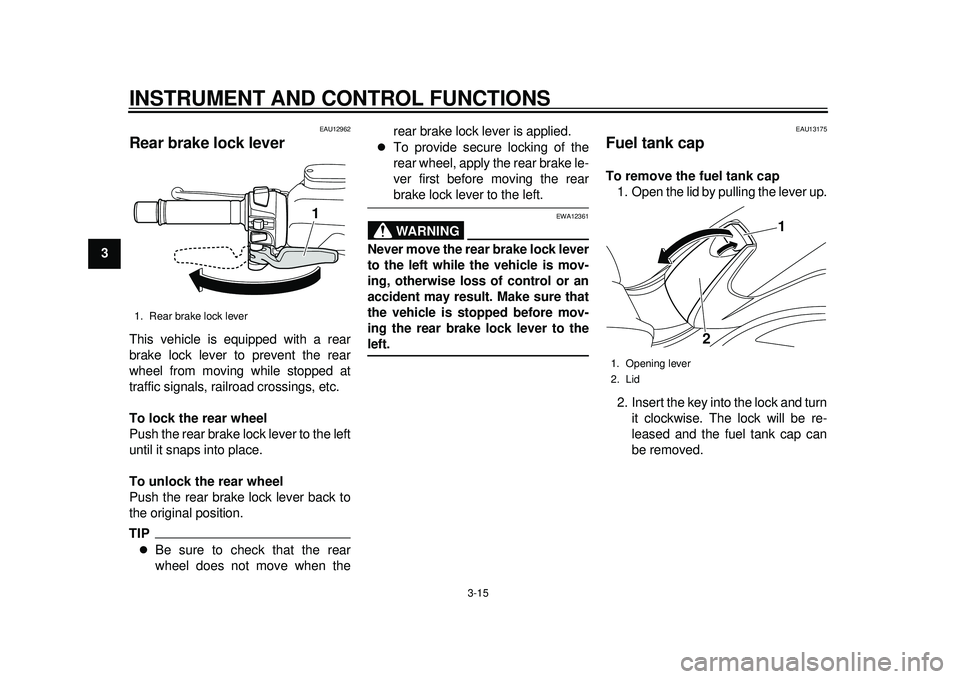
Rear brake lock lever This vehicle is equipped with a rear
brake lock lever to prevent the rear
wheel from moving while stopped at
traffic signals, railroad crossings, etc.
To lock the rear wheel
Push the rear brake lock lever to the left
until it snaps into place.
To unlock the rear wheel
Push the rear brake lock lever back to
the original position.TIP
Be sure to check that the rear
wheel does not move when therear brake lock lever is applied.
To provide secure locking of the
rear wheel, apply the rear brake le-
ver first before moving the rearbrake lock lever to the left.WARNING
EWA12361
Never move the rear brake lock lever
to the left while the vehicle is mov-
ing, otherwise loss of control or an
accident may result. Make sure that
the vehicle is stopped before mov-
ing the rear brake lock lever to theleft.
EAU13175
Fuel tank cap To remove the fuel tank cap
1. Open the lid by pulling the lever up.
2. Insert the key into the lock and turn it clockwise. The lock will be re-
leased and the fuel tank cap can
be removed.
1. Rear brake lock lever
1
1. Opening lever
2. Lid
1
2
59C-9-E0.book 15 ページ 2011年9月11日 日曜日 午前9時27分
Page 43 of 96
FOR YOUR SAFETY – PRE-OPERATION CHECKS
4-2
2
345
6
7
8
9
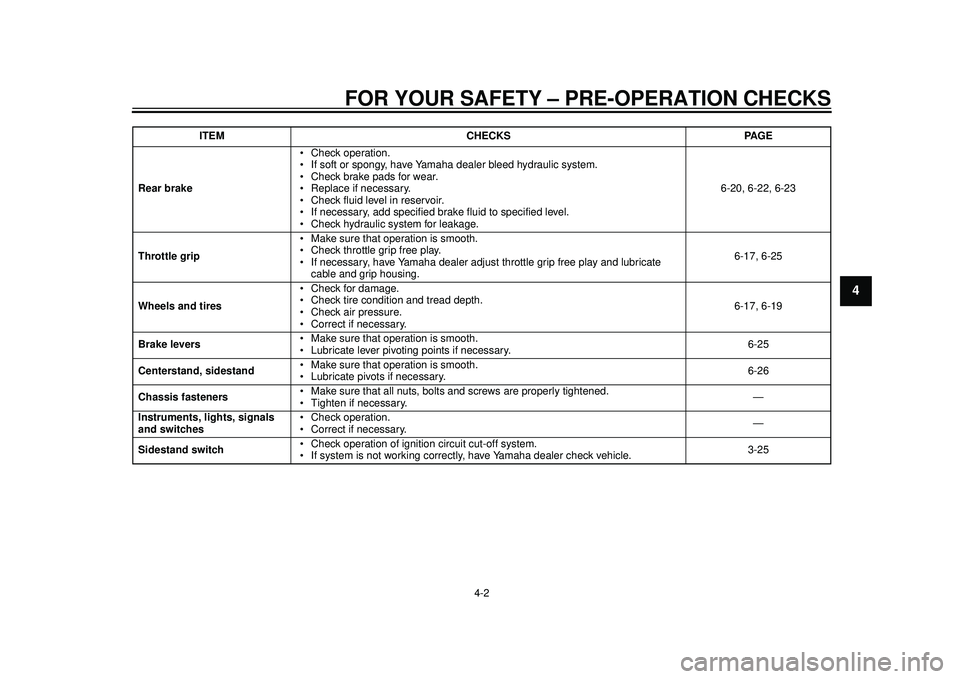
Rear brake Check operation.
If soft or spongy, have Yamaha dealer bleed hydraulic system.
Check brake pads for wear.
Replace if necessary.
Check fluid level in reservoir.
If necessary, add specified brak
e fluid to specified level.
Check hydraulic system for leakage. 6-20, 6-22, 6-23
Throttle grip Make sure that operation is smooth.
Check throttle grip free play.
If necessary, have Yamaha dealer adjust
throttle grip free play and lubricate
cable and grip housing. 6-17, 6-25
Wheels and tires Check for damage.
Check tire condition and tread depth.
Check air pressure.
Correct if necessary. 6-17, 6-19
Brake levers Make sure that operation is smooth.
Lubricate lever pivoting
points if necessary. 6-25
Centerstand, sidestand Make sure that operation is smooth.
Lubricate pivots if necessary. 6-26
Chassis fasteners Make sure that all nuts, bolts
and screws are properly tightened.
Tighten if necessary. —
Instruments, lights, signals
and switches Check operation.
Correct if necessary.
—
Sidestand switch Check operation of ignition circuit cut-off system.
If system is not working correctly, have Yamaha dealer check vehicle. 3-25
ITEM CHECKS PAGE
59C-9-E0.book 2 ページ 2011年9月11日 日曜日 午前9時27分
Page 51 of 96
PERIODIC MAINTENANCE AND ADJUSTMENT
6-4
2
3
4
567
8
9
EAU1770E
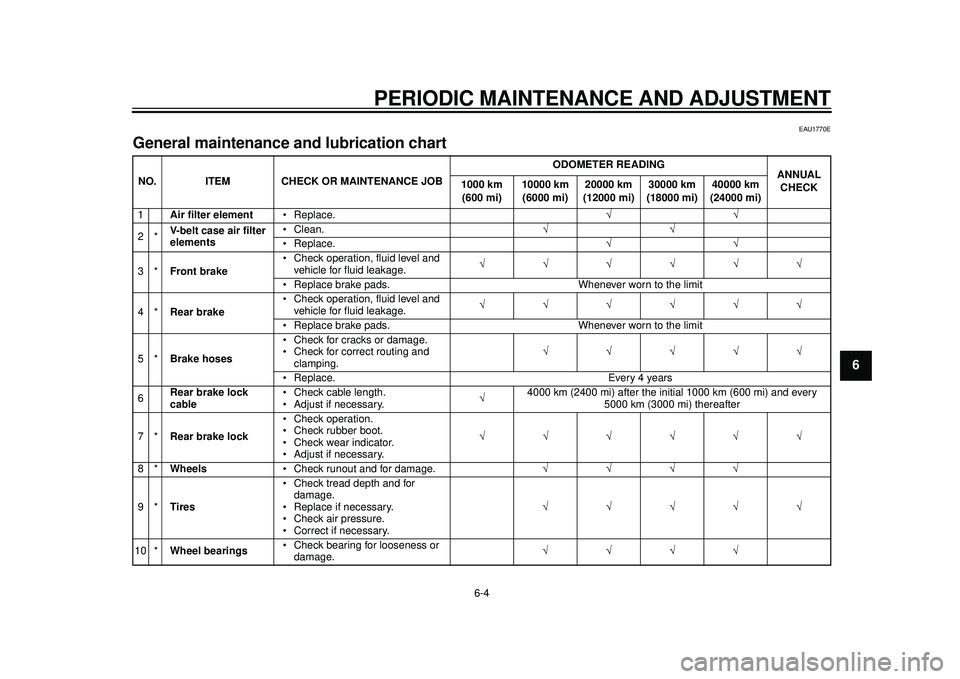
General maintenance and lubrication chart NO. ITEM CHECK OR MAINTENANCE JOB ODOMETER READING
ANNUAL
CHECK
1000 km
(600 mi) 10000 km
(6000 mi) 20000 km
(12000 mi) 30000 km
(18000 mi) 40000 km
(24000 mi)
1 Air filter element Replace.
2* V-belt case air filter
elements Clean.
Replace.
3* Front brake Check operation, fluid level and
vehicle for fluid leakage.
Replace brake pads. Whenever worn to the limit
4* Rear brake Check operation, fluid level and
vehicle for fluid leakage.
Replace brake pads. Whenever worn to the limit
5* Brake hoses Check for cracks or damage.
Check for correct routing and
clamping.
Replace. Every 4 years
6 Rear brake lock
cable Check cable length.
Adjust if necessary.
4000 km (2400 mi) after the initial 1000 km (600 mi) and every
5000 km (3000 mi) thereafter
7* Rear brake lock Check operation.
Check rubber boot.
Check wear indicator.
Adjust if necessary.
8* Wheels Check runout and for damage.
9* Tires Check tread depth and for
damage.
Replace if necessary.
Check air pressure.
Correct if necessary.
10 * Wheel bearings Check bearing for looseness or
damage.
59C-9-E0.book 4 ページ 2011年9月11日 日曜日 午前9時27分
Page 65 of 96
PERIODIC MAINTENANCE AND ADJUSTMENT
6-18
2
3
4
567
8
9
WARNING
EWA10511
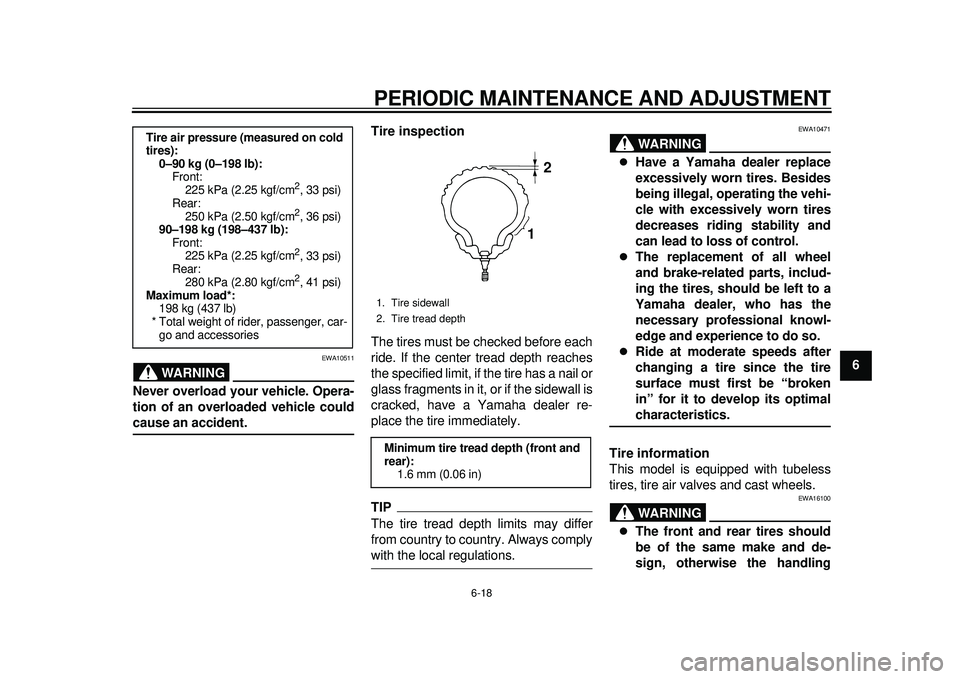
Never overload your vehicle. Opera-
tion of an overloaded vehicle couldcause an accident.Tire inspection
The tires must be checked before each
ride. If the center tread depth reaches
the specified limit, if the tire has a nail or
glass fragments in it, or if the sidewall is
cracked, have a Yamaha dealer re-
place the tire immediately.
TIPThe tire tread depth limits may differ
from country to country. Always complywith the local regulations.
WARNING
EWA10471
Have a Yamaha dealer replace
excessively worn tires. Besides
being illegal, operating the vehi-
cle with excessively worn tires
decreases riding stability and
can lead to loss of control.
The replacement of all wheel
and brake-related parts, includ-
ing the tires, should be left to a
Yamaha dealer, who has the
necessary professional knowl-
edge and experience to do so.
Ride at moderate speeds after
changing a tire since the tire
surface must first be “broken
in” for it to develop its optimalcharacteristics.
Tire information
This model is equipped with tubeless
tires, tire air valves and cast wheels.WARNING
EWA16100
The front and rear tires should
be of the same make and de-
sign, otherwise the handling
Tire air pressure (measured on cold
tires): 0–90 kg (0–198 lb): Front:
225 kPa (2.25 kgf/cm
2, 33 psi)
Rear: 250 kPa (2.50 kgf/cm2, 36 psi)
90–198 kg (198–437 lb): Front:225 kPa (2.25 kgf/cm2, 33 psi)
Rear: 280 kPa (2.80 kgf/cm2, 41 psi)
Maximum load*:
198 kg (437 lb)
* Total weight of rider, passenger, car- go and accessories
1. Tire sidewall
2. Tire tread depthMinimum tire tread depth (front and
rear):
1.6 mm (0.06 in)
1 2
59C-9-E0.book 18 ページ 2011年9月11日 日曜日 午前9時27分
Page 66 of 96
PERIODIC MAINTENANCE AND ADJUSTMENT
6-19
1
2
3
4
56
7
8
9characteristics of the vehicle
may be different, which could
lead to an accident.
Always make sure that the valve
caps are securely installed to
prevent air pressure leakage.
Use only the tire valves and
valve cores listed below toavoid tire deflation during a ride.
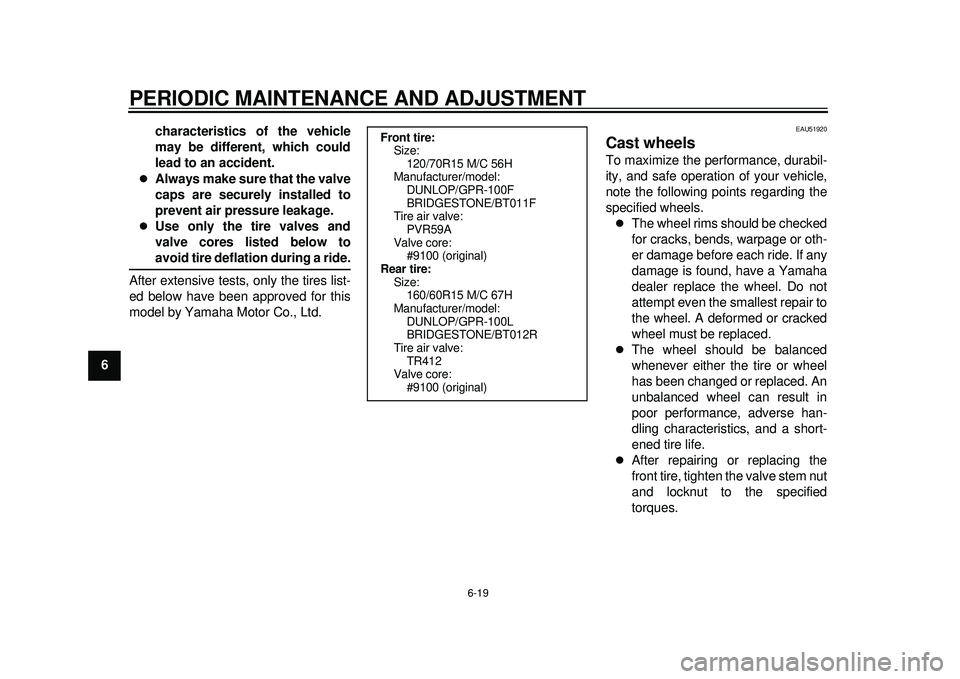
After extensive tests, only the tires list-
ed below have been approved for this
model by Yamaha Motor Co., Ltd.
EAU51920
Cast wheels To maximize the performance, durabil-
ity, and safe operation of your vehicle,
note the following points regarding the
specified wheels.
The wheel rims should be checked
for cracks, bends, warpage or oth-
er damage before each ride. If any
damage is found, have a Yamaha
dealer replace the wheel. Do not
attempt even the smallest repair to
the wheel. A deformed or cracked
wheel must be replaced.
The wheel should be balanced
whenever either the tire or wheel
has been changed or replaced. An
unbalanced wheel can result in
poor performance, adverse han-
dling characteristics, and a short-
ened tire life.
After repairing or replacing the
front tire, tighten the valve stem nut
and locknut to the specified
torques.
Front tire: Size:120/70R15 M/C 56H
Manufacturer/model:
DUNLOP/GPR-100F
BRIDGESTONE/BT011F
Tire air valve:
PVR59A
Valve core: #9100 (original)
Rear tire: Size:160/60R15 M/C 67H
Manufacturer/model: DUNLOP/GPR-100L
BRIDGESTONE/BT012R
Tire air valve: TR412
Valve core:
#9100 (original)
59C-9-E0.book 19 ページ 2011年9月11日 日曜日 午前9時27分
Page 68 of 96
PERIODIC MAINTENANCE AND ADJUSTMENT
6-21
1
2
3
4
56
7
8
9
EAU53030
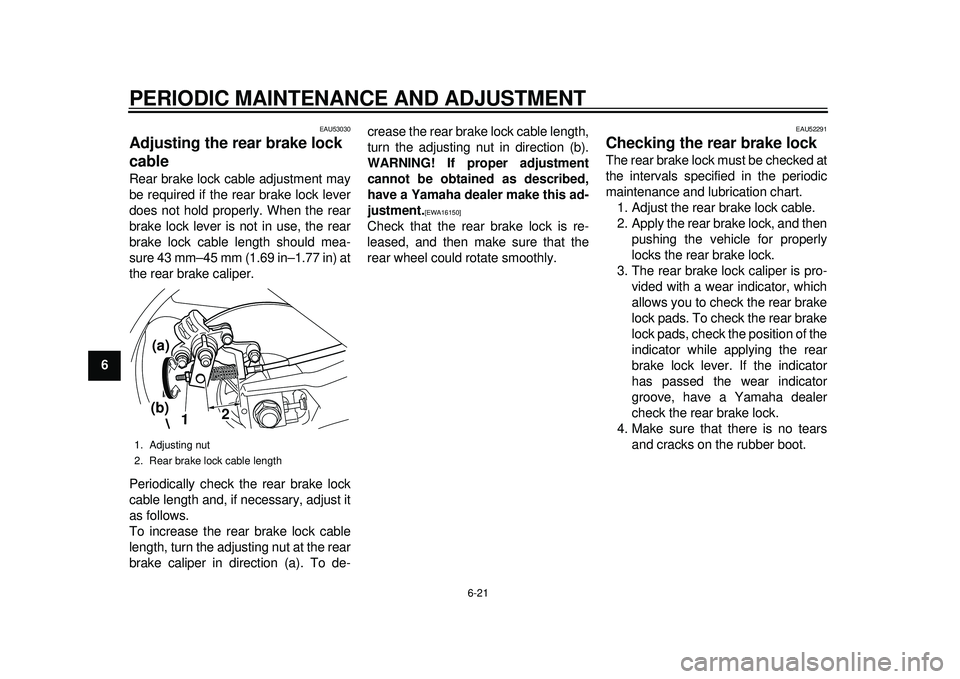
Adjusting the rear brake lock
cable Rear brake lock cable adjustment may
be required if the rear brake lock lever
does not hold properly. When the rear
brake lock lever is not in use, the rear
brake lock cable length should mea-
sure 43 mm–45 mm (1.69 in–1.77 in) at
the rear brake caliper.
Periodically check the rear brake lock
cable length and, if necessary, adjust it
as follows.
To increase the rear brake lock cable
length, turn the adjusting nut at the rear
brake caliper in direction (a). To de-crease the rear brake lock cable length,
turn the adjusting nut in direction (b).
WARNING! If proper adjustment
cannot be obtained as described,
have a Yamaha dealer make this ad-
justment.
[EWA16150]
Check that the rear brake lock is re-
leased, and then make sure that the
rear wheel could rotate smoothly.
EAU52291
Checking the rear brake lock The rear brake lock must be checked at
the intervals specified in the periodic
maintenance and lubrication chart.
1. Adjust the rear brake lock cable.
2. Apply the rear brake lock, and then pushing the vehicle for properly
locks the rear brake lock.
3. The rear brake lock caliper is pro- vided with a wear indicator, which
allows you to check the rear brake
lock pads. To check the rear brake
lock pads, check the position of the
indicator while applying the rear
brake lock lever. If the indicator
has passed the wear indicator
groove, have a Yamaha dealer
check the rear brake lock.
4. Make sure that there is no tears and cracks on the rubber boot.
1. Adjusting nut
2. Rear brake lock cable length
1
2
(a)
(b)
59C-9-E0.book 21 ページ 2011年9月11日 日曜日 午前9時27分