light YAMAHA TTR110 2013 Owners Manual
[x] Cancel search | Manufacturer: YAMAHA, Model Year: 2013, Model line: TTR110, Model: YAMAHA TTR110 2013Pages: 88, PDF Size: 2.02 MB
Page 23 of 88

SAFETY INFORMATION
2-4
2
ucts or having other modifications per-
formed to your vehicle that change any
of the vehicle’s design or operation
characteristics can put you and others
at greater risk of serious injury or death.
You are responsible for injuries related
to changes in the vehicle.
Keep the following guidelines in mind,
as well as those provided under “Load-
ing” when mounting accessories.
●
Never install accessories that
would impair the performance of
your motorcycle. Carefully inspect
the accessory before using it to
make sure that it does not in any
way reduce ground clearance or
cornering clearance, limit suspen-
sion travel, steering travel or con-
trol operation.
Accessories fitted to the handle- bar or the front fork area can
create instability due to improper
weight distribution. If accesso-
ries are added to the handlebar
or front fork area, they must be
as lightweight as possible and
should be kept to a minimum. Bulky or large accessories may
seriously affect the stability of
the motorcycle. Wind may at-
tempt to lift the motorcycle, or
the motorcycle may become un-
stable in cross winds.
Certain accessories can dis- place the operator from his or
her normal riding position. This
improper position limits the free-
dom of movement of the opera-
tor and may limit control ability,
therefore, such accessories are
not recommended.
●
Use caution when adding electri-
cal accessories. If electrical acces-
sories exceed the capacity of the
motorcycle’s electrical system, an
electric failure could result, which
could cause a dangerous loss of
lights or engine power.
Aftermarket Tires and Rims
The tires and rims that came with your
motorcycle were designed to match the
performance capabilities and to provide
the best combination of handling, brak-
ing, and comfort. Other tires, rims, siz-
es, and combinations may not be appropriate. Refer to page 7-15 for tire
specifications and more information on
replacing your tires.
Transporting the Motorcycle
Be sure to observe following instruc-
tions before transporting the motorcy-
cle in another vehicle.
●
Remove all loose items from the
motorcycle.
●
Check that the fuel cock (if
equipped) is in the “OFF” position
and that there are no fuel leaks.
●
Point the front wheel straight
ahead on the trailer or in the truck
bed, and choke it in a rail to pre-
vent movement.
●
Shift the transmission in gear (for
models with a manual transmis-
sion).
●
Secure the motorcycle with tie-
downs or suitable straps that are
attached to solid parts of the mo-
torcycle, such as the frame or up-
per front fork triple clamp (and not,
for example, to rubber-mounted
handlebars or turn signals, or parts
that could break). Choose the lo-
U5B685E0.book Page 4 Tuesday, July 10, 2012 5:06 PM
Page 30 of 88
INSTRUMENT AND CONTROL FUNCTIONS
4-3
4
EAU12941
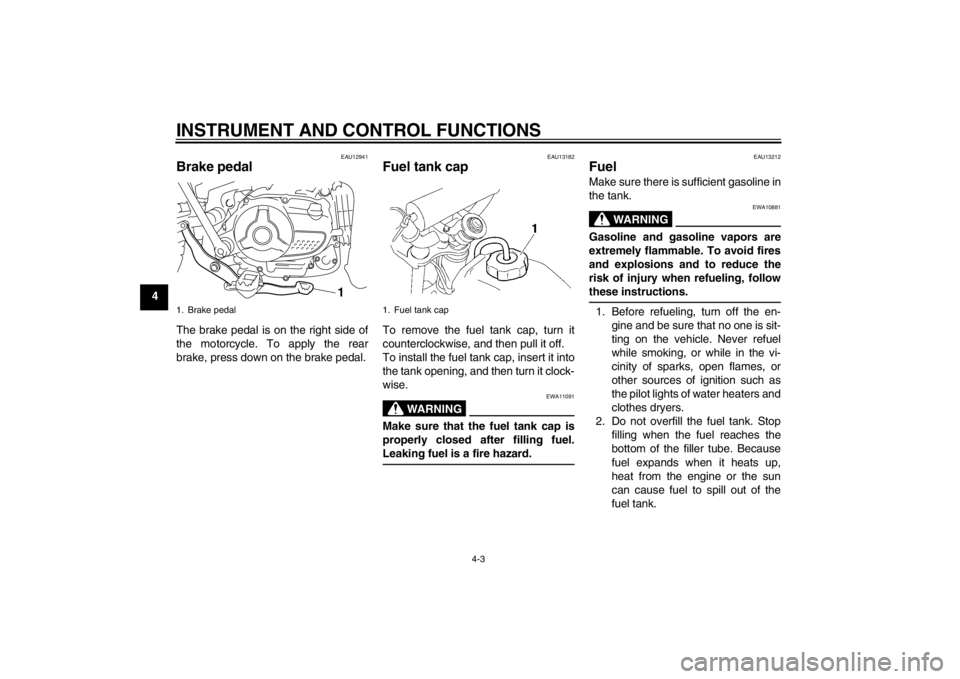
Brake pedal The brake pedal is on the right side of
the motorcycle. To apply the rear
brake, press down on the brake pedal.
EAU13182
Fuel tank cap To remove the fuel tank cap, turn it
counterclockwise, and then pull it off.
To install the fuel tank cap, insert it into
the tank opening, and then turn it clock-
wise.
WARNING
EWA11091
Make sure that the fuel tank cap is
properly closed after filling fuel.
Leaking fuel is a fire hazard.
EAU13212
Fuel Make sure there is sufficient gasoline in
the tank.
WARNING
EWA10881
Gasoline and gasoline vapors are
extremely flammable. To avoid fires
and explosions and to reduce the
risk of injury when refueling, follow
these instructions.1. Before refueling, turn off the en-gine and be sure that no one is sit-
ting on the vehicle. Never refuel
while smoking, or while in the vi-
cinity of sparks, open flames, or
other sources of ignition such as
the pilot lights of water heaters and
clothes dryers.
2. Do not overfill the fuel tank. Stop filling when the fuel reaches the
bottom of the filler tube. Because
fuel expands when it heats up,
heat from the engine or the sun
can cause fuel to spill out of the
fuel tank.
1. Brake pedal
1
1. Fuel tank cap
U5B685E0.book Page 3 Tuesday, July 10, 2012 5:06 PM
Page 35 of 88
INSTRUMENT AND CONTROL FUNCTIONS
4-8
4
EAU37650
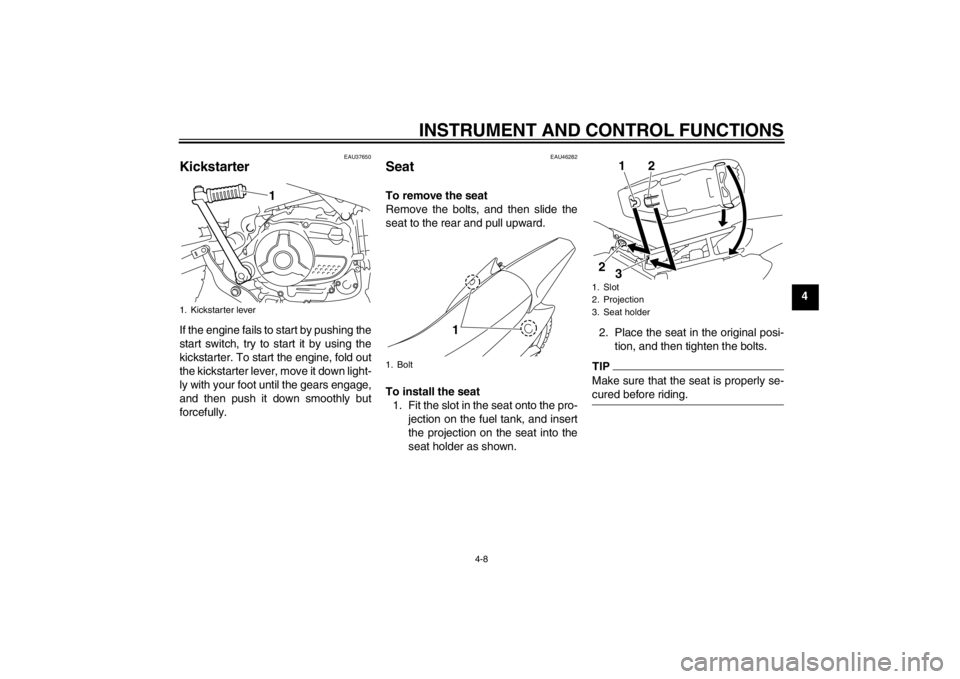
Kickstarter If the engine fails to start by pushing the
start switch, try to start it by using the
kickstarter. To start the engine, fold out
the kickstarter lever, move it down light-
ly with your foot until the gears engage,
and then push it down smoothly but
forcefully.
EAU46282
Seat To remove the seat
Remove the bolts, and then slide the
seat to the rear and pull upward.
To install the seat1. Fit the slot in the seat onto the pro- jection on the fuel tank, and insert
the projection on the seat into the
seat holder as shown. 2. Place the seat in the original posi-
tion, and then tighten the bolts.
TIPMake sure that the seat is properly se-
cured before riding.
1. Kickstarter lever
1
1. Bolt
1
1. Slot
2. Projection
3. Seat holder
21
2 3
U5B685E0.book Page 8 Tuesday, July 10, 2012 5:06 PM
Page 48 of 88

PERIODIC MAINTENANCE AND ADJUSTMENT
7-5
7
8 Drive chain Check chain slack/alignment and condition.
Adjust and lubricate chain with Yamaha chain and cable
lube thoroughly. Every ride
9 *Steering bearings Check bearing assemblies for looseness.
Moderately repack with lit
hium-soap-based grease. √√
10 *Chassis fasteners Check all chassis fitting and fasteners.
Correct if necessary. √√√
11 Brake lever pivot shaft Apply lithium-soap-based grease lightly. √√
12 Brake pedal pivot shaft Apply lithium-soap-based grease lightly. √√
13 Sidestand pivot Check operation.
Apply lithium-soap-based grease lightly. √√
14 *Front fork Check operation and for oil leakage.
Replace if necessary. √√
15 *Shock absorber assem-
bly Check operation and for oil leakage.
Replace if necessary.
√
16 *Control cables Apply Yamaha chain and cable lube or engine oil thor-
oughly. √√√
17 *Throttle grip Check operation.
Check throttle grip free play, and adjust if necessary.
Lubricate cable and grip housing. √√√
No. ITEM CHECKS AND MAINTENANCE JOBS
INITIAL ODOMETER READINGS
1000 km
(600 mi) or
1 month or 30 hours 3000 km
(1800 mi) or
6 months or 90 hours 5000 km
(3000 mi) or
12 months or 150 hours
U5B685E0.book Page 5 Tuesday, July 10, 2012 5:06 PM
Page 51 of 88
PERIODIC MAINTENANCE AND ADJUSTMENT
7-8
7
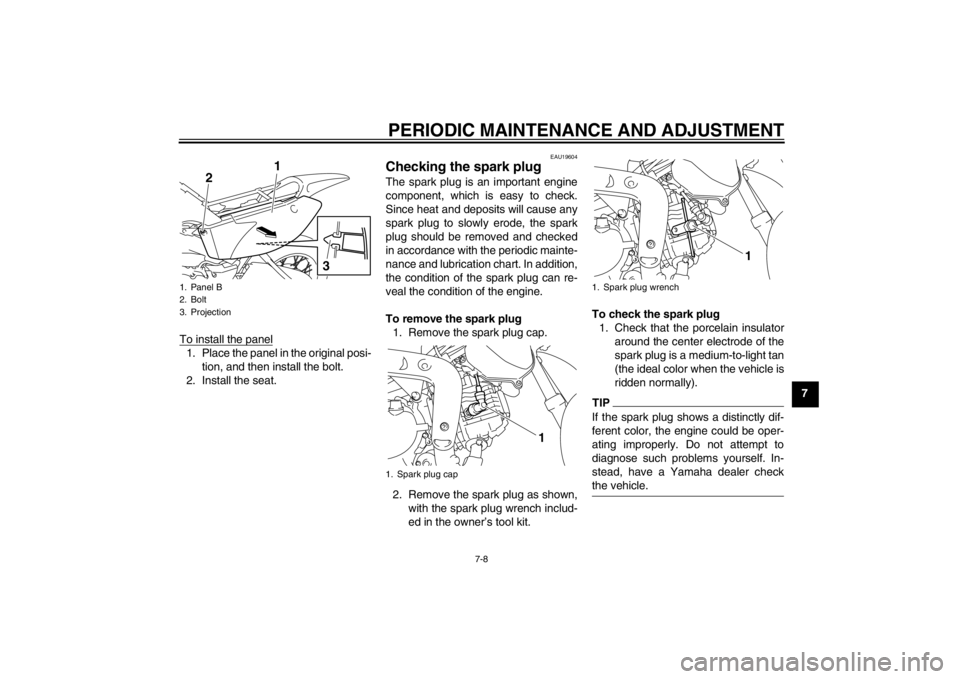
To install the panel
1. Place the panel in the original posi-
tion, and then install the bolt.
2. Install the seat.
EAU19604
Checking the spark plug The spark plug is an important engine
component, which is easy to check.
Since heat and deposits will cause any
spark plug to slowly erode, the spark
plug should be removed and checked
in accordance with the periodic mainte-
nance and lubrication chart. In addition,
the condition of the spark plug can re-
veal the condition of the engine.
To remove the spark plug 1. Remove the spark plug cap.
2. Remove the spark plug as shown, with the spark plug wrench includ-
ed in the owner’s tool kit. To check the spark plug
1. Check that the porcelain insulator around the center electrode of the
spark plug is a medium-to-light tan
(the ideal color when the vehicle is
ridden normally).
TIPIf the spark plug shows a distinctly dif-
ferent color, the engine could be oper-
ating improperly. Do not attempt to
diagnose such problems yourself. In-
stead, have a Yamaha dealer check
the vehicle.
1. Panel B
2. Bolt
3. Projection
3
1
2
1. Spark plug cap
1
1. Spark plug wrench
1
U5B685E0.book Page 8 Tuesday, July 10, 2012 5:06 PM
Page 52 of 88
PERIODIC MAINTENANCE AND ADJUSTMENT
7-9
72. Check the spark plug for electrode
erosion and excessive carbon or
other deposits, and replace it if
necessary.
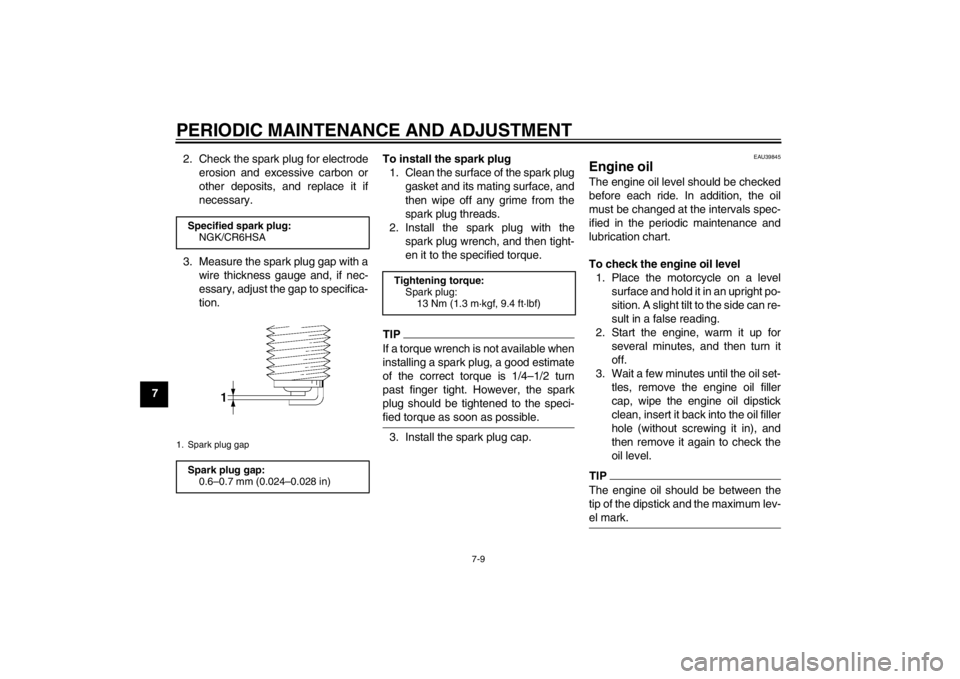
3. Measure the spark plug gap with a wire thickness gauge and, if nec-
essary, adjust the gap to specifica-
tion. To install the spark plug
1. Clean the surface of the spark plug gasket and its mating surface, and
then wipe off any grime from the
spark plug threads.
2. Install the spark plug with the spark plug wrench, and then tight-
en it to the specified torque.
TIPIf a torque wrench is not available when
installing a spark plug, a good estimate
of the correct torque is 1/4–1/2 turn
past finger tight. However, the spark
plug should be tightened to the speci-
fied torque as soon as possible.3. Install the spark plug cap.
EAU39845
Engine oil The engine oil level should be checked
before each ride. In addition, the oil
must be changed at the intervals spec-
ified in the periodic maintenance and
lubrication chart.
To check the engine oil level1. Place the motorcycle on a level surface and hold it in an upright po-
sition. A slight tilt to the side can re-
sult in a false reading.
2. Start the engine, warm it up for several minutes, and then turn it
off.
3. Wait a few minutes until the oil set- tles, remove the engine oil filler
cap, wipe the engine oil dipstick
clean, insert it back into the oil filler
hole (without screwing it in), and
then remove it again to check the
oil level.TIPThe engine oil should be between the
tip of the dipstick and the maximum lev-
el mark.
Specified spark plug:NGK/CR6HSA1. Spark plug gapSpark plug gap:0.6–0.7 mm (0.024–0.028 in)
Tightening torque:
Spark plug:13 Nm (1.3 m·kgf, 9.4 ft·lbf)
U5B685E0.book Page 9 Tuesday, July 10, 2012 5:06 PM
Page 56 of 88
PERIODIC MAINTENANCE AND ADJUSTMENT
7-13
7
EAU40421
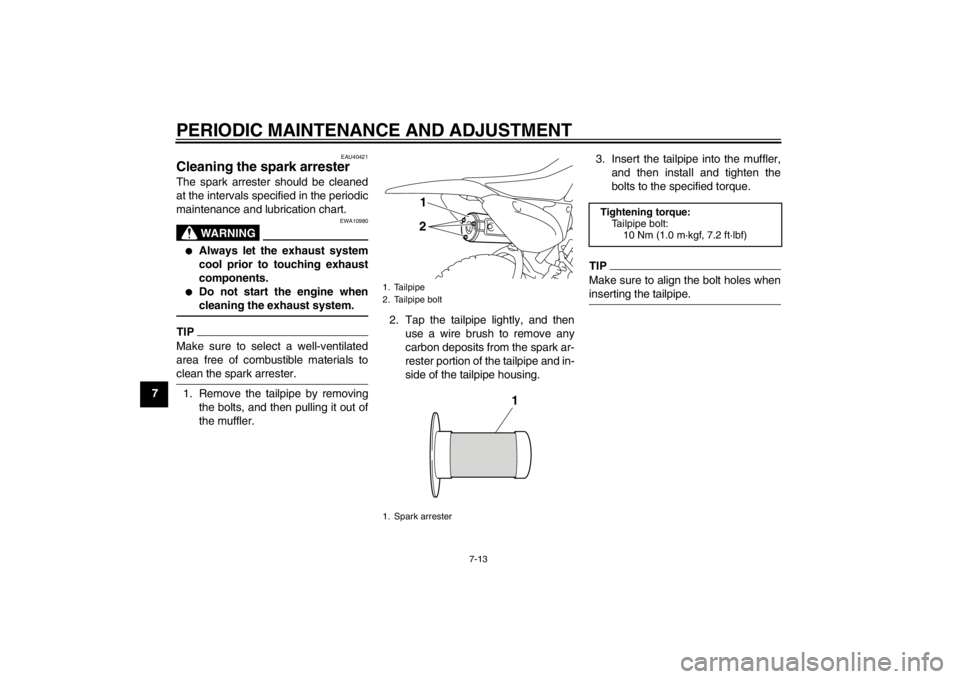
Cleaning the spark arrester The spark arrester should be cleaned
at the intervals specified in the periodic
maintenance and lubrication chart.
WARNING
EWA10980
●
Always let the exhaust system
cool prior to touching exhaust
components.
●
Do not start the engine when
cleaning the exhaust system.
TIPMake sure to select a well-ventilated
area free of combustible materials to
clean the spark arrester.1. Remove the tailpipe by removingthe bolts, and then pulling it out of
the muffler. 2. Tap the tailpipe lightly, and then
use a wire brush to remove any
carbon deposits from the spark ar-
rester portion of the tailpipe and in-
side of the tailpipe housing. 3. Insert the tailpipe into the muffler,
and then install and tighten the
bolts to the specified torque.
TIPMake sure to align the bolt holes when
inserting the tailpipe.
1. Tailpipe
2. Tailpipe bolt
1. Spark arrester
21
1
Tightening torque:
Tailpipe bolt:10 Nm (1.0 m·kgf, 7.2 ft·lbf)
U5B685E0.book Page 13 Tuesday, July 10, 2012 5:06 PM
Page 75 of 88
PERIODIC MAINTENANCE AND ADJUSTMENT
7-32
7
4. Lower the rear wheel so that it is
on the ground, and then put the
sidestand down.
5. Install the brake rod onto the brake camshaft lever, and then install the
brake pedal free play adjusting nut
onto the brake rod.
6. Connect the brake torque rod to the brake shoe plate by installing
the bolt and nut, and then tighten
the nut to the specified torque.
7. Insert a new cotter pin.
8. Adjust the drive chain slack. (See page 7-21.)
9. Tighten the axle nut to the speci- fied torque.
10. Adjust the brake pedal free play. (See page 7-19.)
EAU25851
Troubleshooting Although Yamaha motorcycles receive
a thorough inspection before shipment
from the factory, trouble may occur dur-
ing operation. Any problem in the fuel,
compression, or ignition systems, for
example, can cause poor starting and
loss of power.
The following troubleshooting chart
represents a quick and easy procedure
for checking these vital systems your-
self. However, should your motorcycle
require any repair, take it to a Yamaha
dealer, whose skilled technicians have
the necessary tools, experience, and
know-how to service the motorcycle
properly.
Use only genuine Yamaha replace-
ment parts. Imitation parts may look like
Yamaha parts, but they are often inferi-
or, have a shorter service life and can
lead to expensive repair bills.
WARNING
EWA15141
When checking the fuel system, do
not smoke, and make sure there are
no open flames or sparks in the ar-
ea, including pilot lights from water heaters or furnaces. Gasoline or
gasoline vapors can ignite or ex-
plode, causing severe injury or
property damage.
Tightening torque:
Brake torque rod nut:26 Nm (2.6 m·kgf, 19 ft·lbf)
Tightening torque: Axle nut:60 Nm (6.0 m·kgf, 43 ft·lbf)
U5B685E0.book Page 32 Tuesday, July 10, 2012 5:06 PM
Page 77 of 88
MOTORCYCLE CARE AND STORAGE
8-1
8
EAU37833
Matte color caution NOTICE
ECA15192
Some models are equipped with
matte colored finished parts. Be
sure to consult a Yamaha dealer for
advice on what products to use be-
fore cleaning the vehicle. Using a
brush, harsh chemical products or
cleaning compounds when cleaning
these parts will scratch or damage
their surface. Wax also should not
be applied to any matte colored fin-
ished parts.
EAU40465
Care While the open design of a motorcycle
reveals the attractiveness of the tech-
nology, it also makes it more vulnera-
ble. Rust and corrosion can develop
even if high-quality components are
used. A rusty exhaust pipe may go un-
noticed on a car, however, it detracts
from the overall appearance of a motor-
cycle. Frequent and proper care does
not only comply with the terms of the
warranty, but it will also keep your mo-
torcycle looking good, extend its life
and optimize its performance.
Before cleaning1. Cover the muffler outlet with a plastic bag after the engine has
cooled down.
2. Make sure that all caps and covers as well as all electrical couplers
and connectors, including the
spark plug cap, are tightly in-
stalled.
3. Remove extremely stubborn dirt, like oil burnt onto the crankcase,
with a degreasing agent and a
brush, but never apply such prod- ucts onto seals, gaskets, sprock-
ets, the drive chain and wheel
axles. Always rinse the dirt and de-
greaser off with water.
Cleaning
NOTICE
ECA10772
●
Avoid using strong acidic wheel
cleaners, especially on spoked
wheels. If such products are
used on hard-to-remove dirt, do
not leave the cleaner on the af-
fected area any longer than in-
structed. Also, thoroughly rinse
the area off with water, immedi-
ately dry it, and then apply a cor-
rosion protection spray.
●
Improper cleaning can damage
plastic parts (such as cowlings,
panels, windshields, headlight
lenses, meter lenses, etc.) and
the mufflers. Use only a soft,
clean cloth or sponge with wa-
ter to clean plastic. However, if
the plastic parts cannot be thor-
oughly cleaned with water, di-
luted mild detergent with water
may be used. Be sure to rinse
U5B685E0.book Page 1 Tuesday, July 10, 2012 5:06 PM
Page 78 of 88

MOTORCYCLE CARE AND STORAGE
8-2
8off any detergent residue using
plenty of water, as it is harmful
to plastic parts.
●
Do not use any harsh chemical
products on plastic parts. Be
sure to avoid using cloths or
sponges which have been in
contact with strong or abrasive
cleaning products, solvent or
thinner, fuel (gasoline), rust re-
movers or inhibitors, brake flu-
id, antifreeze or electrolyte.
●
Do not use high-pressure wash-
ers or steam-jet cleaners since
they cause water seepage and
deterioration in the following ar-
eas: seals (of wheel and swing-
arm bearings, fork and brakes),
electric components (couplers,
connectors, instruments,
switches and lights), breather
hoses and vents.
●
For motorcycles equipped with
a windshield: Do not use strong
cleaners or hard sponges as
they will cause dulling or
scratching. Some cleaning com-
pounds for plastic may leave
scratches on the windshield. Test the product on a small hid-
den part of the windshield to
make sure that it does not leave
any marks. If the windshield is
scratched, use a quality plastic
polishing compound after
washing.
After normal useRemove dirt with warm water, a mild
detergent, and a soft, clean sponge,
and then rinse thoroughly with clean
water. Use a toothbrush or bottlebrush
for hard-to-reach areas. Stubborn dirt
and insects will come off more easily if
the area is covered with a wet cloth for
a few minutes before cleaning.
After riding in the rain or near the seaSince sea salt is extremely corrosive,
carry out the following steps after each
ride in the rain or near the sea.
1. Clean the motorcycle with cold wa- ter and a mild detergent, after the
engine has cooled down.
NOTICE: Do not use warm water
since it increases the corrosive
action of the salt.
[ECA10791]
2. Apply a corrosion protection spray on all metal, including chrome- and
nickel-plated, surfaces to prevent
corrosion.
After cleaning 1. Dry the motorcycle with a chamois or an absorbing cloth.
2. Immediately dry the drive chain and lubricate it to prevent it from
rusting.
3. Use a chrome polish to shine chrome, aluminum and stainless-
steel parts, including the exhaust
system. (Even the thermally in-
duced discoloring of stainless-
steel exhaust systems can be re-
moved through polishing.)
4. To prevent corrosion, it is recom- mended to apply a corrosion pro-
tection spray on all metal,
including chrome- and nickel-plat-
ed, surfaces.
5. Use spray oil as a universal clean- er to remove any remaining dirt.
6. Touch up minor paint damage caused by stones, etc.
7. Wax all painted surfaces.
U5B685E0.book Page 2 Tuesday, July 10, 2012 5:06 PM