clutch YAMAHA TW125 2002 Owners Manual
[x] Cancel search | Manufacturer: YAMAHA, Model Year: 2002, Model line: TW125, Model: YAMAHA TW125 2002Pages: 88, PDF Size: 1.7 MB
Page 6 of 88

EAU00009
TABLE OF CONTENTS
GIVE SAFETY THE RIGHT OF WAY ............... 1-1
DESCRIPTION ................................................. 2-1
Left view ......................................................... 2-1
Right view ...................................................... 2-2
Controls and instruments ............................... 2-3
INSTRUMENT AND CONTROL FUNCTIONS . 3-1
Main switch .................................................... 3-1
Indicator lights ................................................ 3-1
Speedometer unit .......................................... 3-2
Handlebar switches ........................................ 3-2
Clutch lever .................................................... 3-4
Shift pedal ...................................................... 3-4
Brake lever ..................................................... 3-4
Brake pedal .................................................... 3-5
Fuel tank cap ................................................. 3-5
Fuel ................................................................ 3-6
Fuel cock ........................................................ 3-7
Starter (choke) knob ...................................... 3-8
Steering lock .................................................. 3-8
Seat ................................................................ 3-9
Helmet holder ................................................. 3-9
Shock absorber ............................................ 3-10
Carrier .......................................................... 3-10
Luggage strap holders ................................. 3-10
Sidestand ..................................................... 3-11Ignition circuit cut-off system ........................ 3-11
PRE-OPERATION CHECKS ............................ 4-1
Pre-operation check list ................................. 4-1
OPERATION AND IMPORTANT RIDING
POINTS ............................................................. 5-1
Starting the engine ......................................... 5-1
Starting a warm engine .................................. 5-2
Shifting ........................................................... 5-3
Recommended shift points
(for Switzerland only) .................................. 5-3
Tips for reducing fuel consumption ................ 5-4
Engine break-in .............................................. 5-4
Parking ........................................................... 5-5
PERIODIC MAINTENANCE AND MINOR
REPAIR ............................................................. 6-1
Owner’s tool kit .............................................. 6-1
Periodic maintenance and lubrication chart ... 6-2
Removing and installing panels ..................... 6-5
Checking the spark plug ................................ 6-7
Engine oil and oil filter element ...................... 6-9
Cleaning the air filter element and check
hose .......................................................... 6-12
Adjusting the carburetor ............................... 6-14
Adjusting the engine idling speed ................ 6-14
123
456
5RS-9-E0 (TW125) 7/30/01 6:02 PM Page 5
Page 7 of 88

Adjusting the throttle cable free play ............ 6-15
Adjusting the valve clearance ...................... 6-16
Tires ............................................................. 6-16
Spoke wheels ............................................... 6-18
Adjusting the clutch lever free play .............. 6-19
Adjusting the brake lever free play ............... 6-20
Adjusting the brake pedal position and
free play .................................................... 6-21
Adjusting the rear brake light switch ............ 6-22
Checking the front brake pads and
rear brake shoes ....................................... 6-23
Checking the brake fluid level ...................... 6-24
Changing the brake fluid .............................. 6-25
Drive chain slack .......................................... 6-25
Lubricating the drive chain ........................... 6-27
Checking and lubricating the cables ............ 6-27
Checking and lubricating the throttle grip
and cable .................................................. 6-28
Checking and lubricating the brake and
shift pedals ................................................ 6-28
Checking and lubricating the brake and
clutch levers .............................................. 6-29
Checking and lubricating the sidestand ....... 6-29
Lubricating the rear suspension ................... 6-30
Checking the front fork ................................. 6-30
Checking the steering .................................. 6-31
Checking the wheel bearings ....................... 6-31Battery .......................................................... 6-32
Replacing the fuse ....................................... 6-33
Replacing the headlight bulb ........................ 6-34
Replacing a turn signal light bulb ................. 6-36
Replacing the tail/brake light bulb ................ 6-36
Supporting the motorcycle ........................... 6-37
Front wheel .................................................. 6-38
Rear wheel ................................................... 6-40
Troubleshooting ........................................... 6-42
Troubleshooting chart .................................. 6-43
MOTORCYCLE CARE AND STORAGE .......... 7-1
Care ............................................................... 7-1
Storage .......................................................... 7-4
SPECIFICATIONS ............................................ 8-1
Conversion table ............................................ 8-5
CONSUMER INFORMATION ........................... 9-1
Identification numbers .................................... 9-1
Key identification number ............................... 9-1
Vehicle identification number ......................... 9-1
Model label ..................................................... 9-2
TABLE OF CONTENTS
789
5RS-9-E0 (TW125) 7/30/01 6:02 PM Page 6
Page 11 of 88
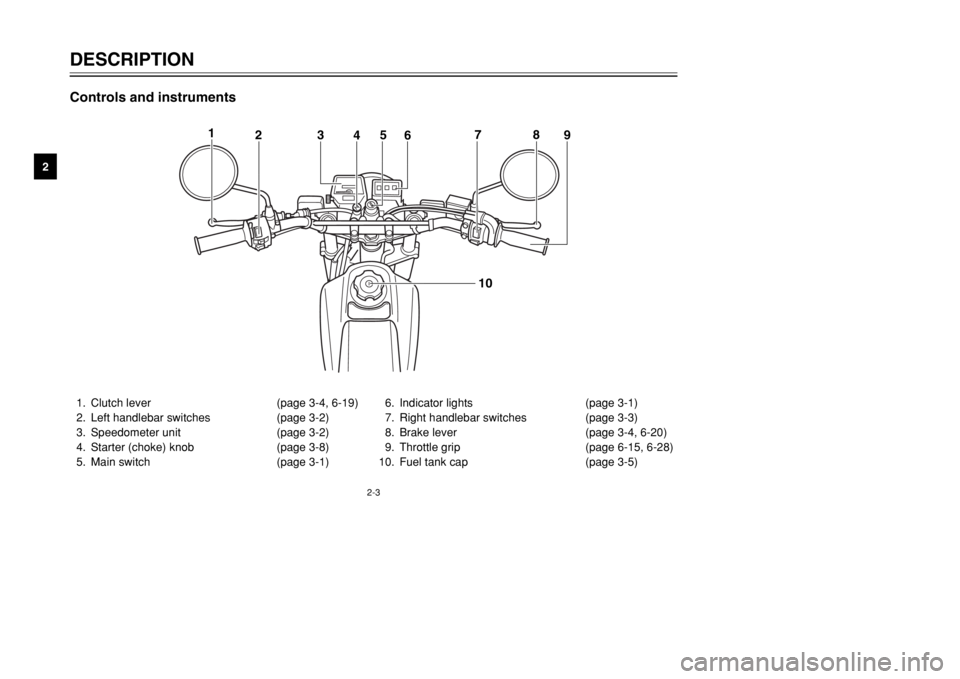
2-3
DESCRIPTION
2
Controls and instruments1. Clutch lever (page 3-4, 6-19)
2. Left handlebar switches (page 3-2)
3. Speedometer unit (page 3-2)
4. Starter (choke) knob (page 3-8)
5. Main switch (page 3-1)6. Indicator lights (page 3-1)
7. Right handlebar switches (page 3-3)
8. Brake lever (page 3-4, 6-20)
9. Throttle grip (page 6-15, 6-28)
10. Fuel tank cap (page 3-5)
1
23
45
678
9
10
5RS-9-E0 (TW125) 7/30/01 6:02 PM Page 10
Page 15 of 88

3-4
EAU00152
Clutch leverThe clutch lever is located at the left
handlebar grip. To disengage the
clutch, pull the lever toward the han-
dlebar grip. To engage the clutch,
release the lever. The lever should
be pulled rapidly and released slowly
for smooth clutch operation.
The clutch lever is equipped with a
clutch switch, which is part of the igni-
tion circuit cut-off system. (See page
3-11 for an explanation of the ignition
circuit cut-off system.)INSTRUMENT AND CONTROL FUNCTIONS
3
1
1. Clutch lever
EAU00158
Brake leverThe brake lever is located at the right
handlebar grip. To apply the front
brake, pull the lever toward the han-
dlebar grip.
1
1. Brake lever
EAU00157
Shift pedalThe shift pedal is located on the left
side of the engine and is used in
combination with the clutch lever
when shifting the gears of the
5-speed constant-mesh transmission
equipped on this motorcycle.
1
1. Shift pedal
5RS-9-E0 (TW125) 7/30/01 6:03 PM Page 14
Page 22 of 88

3-11
INSTRUMENT AND CONTROL FUNCTIONS
3
EAU00330
SidestandThe sidestand is located on the left
side of the frame. Raise the side-
stand or lower it with your foot while
holding the motorcycle upright.NOTE:
The built-in sidestand switch is part of
the ignition circuit cut-off system,
which cuts the ignition in certain situ-
ations. (See further down for an
explanation of the ignition circuit cut-
off system.)
EAU03720
Ignition circuit cut-off
systemThe ignition circuit cut-off system
(comprising the sidestand switch,
clutch switch and neutral switch) has
the following functions.
8It prevents starting when the
transmission is in gear and the
sidestand is up, but the clutch
lever is not pulled.
8It prevents starting when the
transmission is in gear and the
clutch lever is pulled, but the
sidestand is still down.
8It cuts the running engine when
the transmission is in gear and
the sidestand is moved down.
Periodically check the operation of
the ignition circuit cut-off system
according to the following procedure.
EW000045
wIf a malfunction is noted, have a
Yamaha dealer check the system
before riding.
EW000044
wThe motorcycle must not be ridden
with the sidestand down, or if the
sidestand cannot be properly
moved up (or does not stay up),
otherwise the sidestand could con-
tact the ground and distract the
operator, resulting in a possible
loss of control. Yamaha’s ignition
circuit cut-off system has been
designed to assist the operator in
fulfilling the responsibility of rais-
ing the sidestand before starting
off. Therefore, check this system
regularly as described below and
have a Yamaha dealer repair it if it
does not function properly.
5RS-9-E0 (TW125) 7/30/01 6:03 PM Page 21
Page 23 of 88

3-12
INSTRUMENT AND CONTROL FUNCTIONS
3
With the engine turned off:
1. Move the sidestand down.
2. Make sure that the engine stop switch is set to “
#”.
3. Turn the key to “ON”.
4. Shift the transmission into the neutral position.
5. Push the start switch.
Does the engine start?
The neutral switch may be defective.
The motorcycle should not be ridden until
checked by a Yamaha dealer.
With the engine still running:
6. Move the sidestand up.
7. Keep the clutch lever pulled.
8. Shift the transmission into gear.
9. Move the sidestand down.
Does the engine stall?After the engine has stalled:
10. Move the sidestand up.
11. Keep the clutch lever pulled.
12. Push the start switch.
Does the engine start?
The sidestand switch may be defective.
The motorcycle should not be ridden until
checked by a Yamaha dealer.The clutch switch may be defective.
The motorcycle should not be ridden until
checked by a Yamaha dealer.
NO
NOTE:This check is most reliable if performed with
a warmed-up engine.
YESYES NO
The system is OK. The motorcycle can be ridden.
YES NO
5RS-9-E0 (TW125) 7/30/01 6:03 PM Page 22
Page 25 of 88

4-2
PRE-OPERATION CHECKS
4
Clutch•Check operation.
•Lubricate cable if necessary.
•Check lever free play.
•Adjust if necessary.3-4, 6-19–6-20
Throttle grip•Make sure that operation is smooth.
•Check free play.
•If necessary, have Yamaha dealer make adjustment or lubricate.6-15, 6-28
Control cables•Make sure that operation is smooth.
•Lubricate if necessary.6-27
Drive chain•Check chain slack.
•Adjust if necessary.
•Check chain condition.
•Lubricate if necessary.6-25–6-27
Wheels and tires•Check for damage.
•Check tire condition and tread depth.
•Check air pressure.
•Correct if necessary.6-16–6-19
Brake and shift pedals•Make sure that operation is smooth.
•Lubricate pedal pivoting points if necessary.6-28
Brake and clutch levers•Make sure that operation is smooth.
•Lubricate lever pivoting points if necessary.6-29
Sidestand•Make sure that operation is smooth.
•Lubricate pivot if necessary.6-29 ITEM CHECKS PAGE
5RS-9-E0 (TW125) 7/30/01 6:03 PM Page 24
Page 27 of 88

5-1
EAU00372
OPERATION AND IMPORTANT RIDING POINTS
5
EAU00373
w8Become thoroughly familiar
with all operating controls and
their functions before riding.
Consult a Yamaha dealer
regarding any control or func-
tion that you do not thorough-
ly understand.
8Never start the engine or oper-
ate it in a closed area for any
length of time. Exhaust fumes
are poisonous, and inhaling
them can cause loss of con-
sciousness and death within a
short time. Always make sure
that there is adequate ventila-
tion.
8Before starting out, make sure
that the sidestand is up. If the
sidestand is not raised com-
pletely, it could contact the
ground and distract the opera-
tor, resulting in a possible loss
of control.
EAU03515
Starting the engineIn order for the ignition circuit cut-off
system to enable starting, one of the
following conditions must be met:
8The transmission is in the neutral
position.
8The transmission is in gear with
the clutch lever pulled and the
sidestand up.
EW000054
w8Before starting the engine,
check the function of the igni-
tion circuit cut-off system
according to the procedure
described on page 3-12.
8Never ride with the sidestand
down.
1. Turn the fuel cock lever to “ON”.
2. Turn the key to “ON” and make
sure that the engine stop switch
is set to “#”.
3. Shift the transmission into the
neutral position.NOTE:
When the transmission is in the neu-
tral position, the neutral indicator light
should be on, otherwise have a
Yamaha dealer check the electrical
circuit.
ON
FUEL
RES
OFF
1
ON
1. Arrow mark positioned over “ON”
5RS-9-E0 (TW125) 7/30/01 6:03 PM Page 26
Page 29 of 88

5-3
OPERATION AND IMPORTANT RIDING POINTS
5
EAU00423
ShiftingShifting gears lets you control the
amount of engine power available for
starting off, accelerating, climbing
hills, etc.
The gear positions are shown in the
illustration.NOTE:
To shift the transmission into the neu-
tral position, press the shift pedal
down repeatedly until it reaches the
end of its travel, and then slightly
raise it.
EC000048
cC8Even with the transmission in
the neutral position, do not
coast for long periods of time
with the engine off, and do not
tow the motorcycle for long
distances. The transmission is
properly lubricated only when
the engine is running.
Inadequate lubrication may
damage the transmission.
8Always use the clutch while
changing gears to avoid dam-
aging the engine, transmis-
sion, and drive train, which are
not designed to withstand the
shock of forced shifting.
EAU02941
Recommended shift points
(for Switzerland only)The recommended shift points during
acceleration are shown in the table
below.NOTE:
When shifting down two gears at a
time, reduce the speed accordingly
(e.g., down to 35 km/h when shifting
from 4th to 2nd gear).
1
N5
4
3
2
1
1. Shift pedal
N. Neutral position
Shift point
(km/h)
1st→2nd
2nd→3rd
3rd→4th
4th→5th23
36
50
60
5RS-9-E0 (TW125) 7/30/01 6:03 PM Page 28
Page 33 of 88

6-2
PERIODIC MAINTENANCE AND MINOR REPAIR
6
EAU03686
Periodic maintenance and lubrication chart
NOTE:
8The annual checks must be performed every year, except if a kilometer-based maintenance is performed instead.
8From 30,000 km, repeat the maintenance intervals starting from 6,000 km.
8Items marked with an asterisk should be performed by a Yamaha dealer as they require special tools, data and
technical skills.NO. ITEM CHECK OR MAINTENANCE JOBODOMETER READING (× 1,000 km)
ANNUAL
CHECK
1 6 12 18 24
1
*Fuel line•Check fuel hoses for cracks or damage.√√√√ √
2 Spark plug•Check condition.
•Clean and regap.√√
•Replace.√√
3*Valves•Check valve clearance.
•Adjust.√√√√
4 Air filter element•Clean.√√
•Replace.√√
5 Clutch•Check operation.
•Adjust.√√√√√
6*Front brake•Check operation, fluid level and vehicle for fluid leakage.
(See NOTE on page 6-4.)√√√√√ √
•Replace brake pads.Whenever worn to the limit
7*Rear brake•Check operation and adjust brake pedal free play.√√√√√ √
•Replace brake shoes.Whenever worn to the limit
8*Brake hose•Check for cracks or damage.√√√√ √
•Replace. (See NOTE on page 6-4.)Every 4 years
5RS-9-E0 (TW125) 7/30/01 6:03 PM Page 32