warning YAMAHA VIKING 2014 Owner's Manual
[x] Cancel search | Manufacturer: YAMAHA, Model Year: 2014, Model line: VIKING, Model: YAMAHA VIKING 2014Pages: 180, PDF Size: 3.78 MB
Page 58 of 180
4-26
4
5
6
7
8
9
10
11
12
13
14
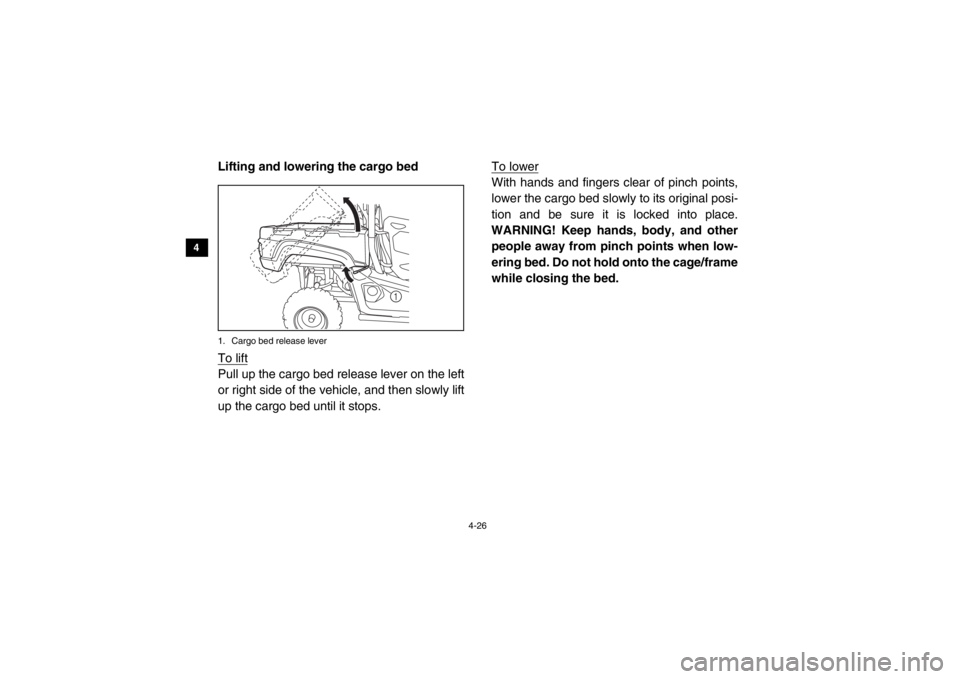
Lifting and lowering the cargo bed1. Cargo bed release leverTo liftPull up the cargo bed release lever on the left
or right side of the vehicle, and then slowly lift
up the cargo bed until it stops. To lower
With hands and fingers clear of pinch points,
lower the cargo bed slowly to its original posi-
tion and be sure it is locked into place.
WARNING! Keep hands, body, and other people away from pinch points when low-
ering bed. Do not hold onto the cage/frame
while closing the bed.
1
1XP7B_EE.book Page 26 Tuesday, February 4, 2014 3:40 PM
Page 59 of 180
4-27
1
2
34
5
6
7
8
9
10
11
12
13
14
5UG1B001 The front and rear shock absorber
assemblies
WARNING
These shock absorber assemblies contain
highly pressurized nitrogen gas. Read and
understand the following information be-
fore handling the shock absorber assem-
blies.●
Do not tamper with or attempt to open
the cylinder assemblies.
●
Do not subject the shock absorber as-
semblies to an open flame or other
high heat source. This may cause the
unit to explode due to excessive gas
pressure.
●
Do not deform or damage the cylin-
ders in any way. Cylinder damage will
result in poor damping performance.
●
Do not dispose of a damaged or worn
out shock absorber assembly your-
self. Take the shock absorber assem-
bly to a Yamaha dealer for any
service.
1XP7B_EE.book Page 27 Tuesday, February 4, 2014 3:40 PM
Page 63 of 180
5-1
1
2
3
45
6
7
8
9
10
11
12
13
14
EVU01200
1-FOR YOUR SAFETY – PRE-OPERATION CHECKS
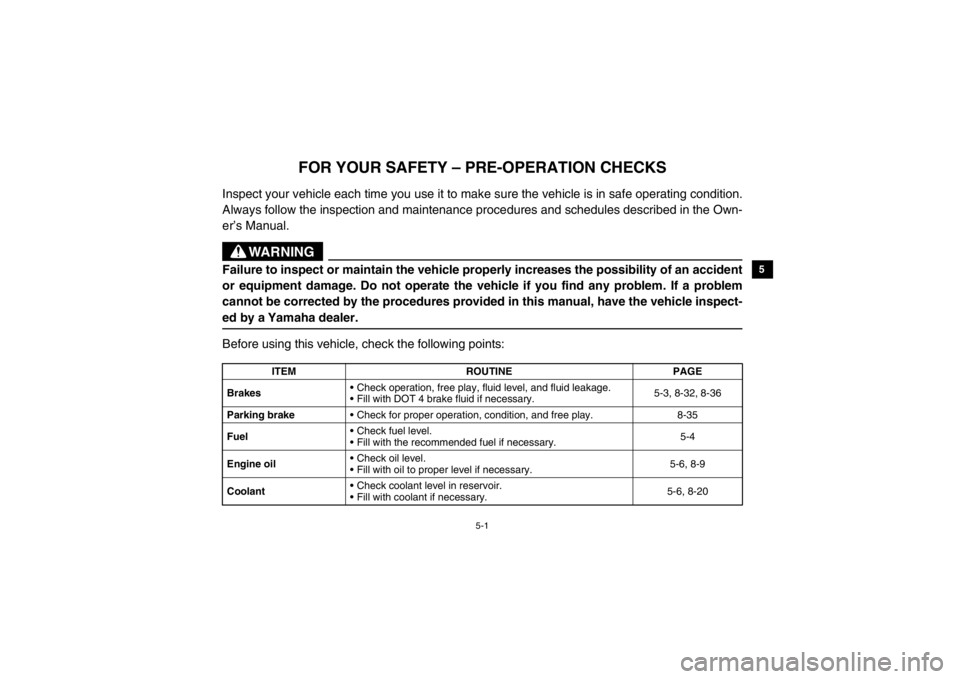
Inspect your vehicle each time you use it to make sure the vehicle is in safe operating condition.
Always follow the inspection and maintenance procedures and schedules described in the Own-
er’s Manual.
WARNING
Failure to inspect or maintain the vehicle properly increases the possibility of an accident
or equipment damage. Do not operate the vehicle if you find any problem. If a problem
cannot be corrected by the procedures provided in this manual, have the vehicle inspect-
ed by a Yamaha dealer.Before using this vehicle, check the following points:
ITEMROUTINE PAGE
Brakes Check operation, free play, fluid level, and fluid leakage.
Fill with DOT 4 brake fluid if necessary. 5-3, 8-32, 8-36
Parking brake Check for proper operation, condition, and free play. 8-35
Fuel Check fuel level.
Fill with the recommended fuel if necessary. 5-4
Engine oil Check oil level.
Fill with oil to proper level if necessary. 5-6, 8-9
Coolant Check coolant level in reservoir.
Fill with coolant if necessary. 5-6, 8-20
1XP7B_EE.book Page 1 Tuesday, February 4, 2014 3:40 PM
Page 66 of 180
5-4
5
6
7
8
9
10
11
12
13
14
EVU00400FuelMake sure there is sufficient fuel in the tank.
WARNING
Gasoline and gasoline vapors are ex-
tremely flammable. To avoid fires and ex-
plosions and to reduce the risk of injury
when refueling, follow these instructions.1. Before refueling, turn off the engine and be sure that no one is sitting in the vehi-
cle.
Never refuel while smoking, or while in
the vicinity of sparks, open flames, or oth-
er sources of ignition such as the pilot
lights of water heaters and clothes dry-
ers.
2. Do not overfill the fuel tank. Because fuel
expands when it heats up, heat from the
engine or the sun can cause fuel to spill
out of the fuel tank.
3. Wipe up any spilled fuel immediately. 4. Be sure the fuel tank cap is closed se-
curely.
WARNING
Gasoline is poisonous and can cause inju-
ry or death. Handle gasoline with care.
Never siphon gasoline by mouth. If you
should swallow some gasoline or inhale a
lot of gasoline vapor, or get some gasoline
in your eyes, see your doctor immediately.
If gasoline spills on your skin, wash with
soap and water. If gasoline spills on your
clothing, change your clothes.Your Yamaha engine has been designed to
use regular unleaded gasoline with a re-
search octane number of 91 or higher (95 or
higher for Europe). If knocking or pinging oc-
curs, use a different brand of gasoline or pre-
mium unleaded gasoline. Unleaded fuel will
give you longer spark plug life and reduced
maintenance cost.
1XP7B_EE.book Page 4 Tuesday, February 4, 2014 3:40 PM
Page 67 of 180

5-5
1
2
3
45
6
7
8
9
10
11
12
13
14
Portable fuel containers
If you carry a portable fuel container in the bed
of your Yamaha Viking, be sure to secure it
with the cap tightened before driving the vehi-
cle.
Always place a portable fuel container on the
ground before filling it. Before removing the
container cap, touch the container with the
fuel dispenser nozzle. Keep fuel dispenser
nozzle in contact with container inlet when fill-
ing. WARNING! Never refill a fuel container
in the bed of any vehicle. Fire may result
from a build-up of static electricity. The
discharge of this build-up while refueling
can cause a spark and ignite the gasoline.
Recommended fuel:
Regular unleaded gasoline only
For Europe:
Regular unleaded gasoline only with a re-
search octane number of 95 or higher
Fuel tank capacity: 36.7 L (9.70 US gal, 8.07 Imp.gal)
1XP7B_EE.book Page 5 Tuesday, February 4, 2014 3:40 PM
Page 70 of 180

5-8
5
6
7
8
9
10
11
12
13
14
A crash can damage the restraint systems in
your vehicle. A damaged restraint system
may not properly protect the person using it,
resulting in serious injury or death in a crash.
To help make sure your restraint systems are
working properly after a crash, have them in-
spected and any necessary replacements
made as soon as possible.Passenger handholdCheck that the handhold bar and its supports
are in good condition. Confirm that the locking
pins are securely fastened, and then push
and pull on the handhold to make sure that it
is not loose.EVU01230SteeringPark on level ground. Turn the steering wheel
right and left. Check for excessive free play,
abnormal noises, or a rough feeling. Have a
Yamaha dealer repair as necessary for proper operation.
EVU00470Fittings and fastenersAlways check the tightness of chassis fittings
and fasteners before a ride. Take the vehicle
to a Yamaha dealer or refer to the Service
Manual for correct tightening torque.Instruments, lights and switchesCheck that all instruments, lights and switches
are working properly. Correct if necessary.Control cablesWhen riding in cold weather, always make
sure all control cables work smoothly before
you begin riding. WARNING! Control cables
can freeze in cold weather and you could
be unable to control the vehicle.EVU00500TiresCheck tire pressure regularly to make sure it
is at the recommended specifications. Also
check for wear and damage.
1XP7B_EE.book Page 8 Tuesday, February 4, 2014 3:40 PM
Page 71 of 180

5-9
1
2
3
45
6
7
8
9
10
11
12
13
14
EVU00510Tire pressure
Use the tire pressure gauges to check and ad-
just tire pressures when the tires are cold. Tire
pressures must be equal on both sides.
WARNING! Operation of this vehicle with
improper tire pressure may cause severe
injury or death from loss of control or roll-
over. Tire pressure below the minimum
specified could also cause the tire to dis-
lodge from the rim under severe riding
conditions.
Set tire pressures to the following specifica-
tions:Recommended tire pressure:
Vehicle load:
0 – 300 kg (0 – 661 lb)Front:75 kPa (0.75 kgf/cm
2, 11 psi)
Rear: 90 kPa (0.90 kgf/cm2, 13 psi)
Vehicle load:
300 kg – maximum
(661 lb – maximum)Front:
75 kPa (0.75 kgf/cm2, 11 psi)
Rear: 125 kPa (1.25 kgf/cm2, 18 psi)
1XP7B_EE.book Page 9 Tuesday, February 4, 2014 3:40 PM
Page 74 of 180
6-1
6
7
8
9
10
11
12
13
14
EVU00530
1-OPERATION
Read the Owner’s Manual carefully to be-
come familiar with all controls. If there is a
control or function you do not understand, ask
your Yamaha dealer.
WARNING
Failure to familiarize yourself with the con-
trols can lead to loss of control, which
could cause an accident or injury.
Engine break-inThere is never a more important period in the
life of your vehicle than the period between 0
and 20 hours.
For this reason, we ask that you read the fol-
lowing material carefully. Because the engine
is brand new, you must not put an excessive
load on it for the first several hours of opera-
tion. During the first 20 hours, the various
parts in the engine wear and polish them-
selves to achieve the correct operating clear-
ances.
During this period, prolonged full-throttle oper-
ation or any condition that might result in ex-
cessive engine heating must be avoided.
However, momentary (2–3 seconds maxi-
mum) full-throttle operation under load does
not harm the engine.
1XP7B_EE.book Page 1 Tuesday, February 4, 2014 3:40 PM
Page 75 of 180
6-2
1
2
3
4
56
7
8
9
10
11
12
13
14
Each full-throttle acceleration sequence
should be followed with a substantial rest pe-
riod for the engine, by cruising at lower r/min
so the engine can rid itself of the temporary
build-up of heat. If any abnormality is noticed
during this period, consult a Yamaha dealer.
0–10 hours:
Avoid continuous operation above 1/2-throt-
tle. Allow a cooling-off period of 5 to 10 min-
utes after every hour of operation. Vary the
speed of the vehicle from time to time. Do not
operate it at one set throttle position.
10–20 hours:
Avoid prolonged operation above three-quar-
ter throttle.
After break-in:
The vehicle may now be operated normally.
5B410007Starting the engine1. Turn the key to “ ” (on).NOTICEThe coolant temperature warning light and
engine trouble warning light should come
on, then go off.
The EPS warning light should come on,
then go off when the engine is started.
If a warning light does not go off, see page
4-2 for the corresponding warning light
circuit check.2. Apply the brake pedal.
3. Shift the drive select lever into the neutralposition.
●
When the drive select lever is in the
neutral position, the neutral indicator
light should come on. If the neutral in-
dicator light does not come on, ask a
Yamaha dealer to inspect the electric circuit.
1XP7B_EE.book Page 2 Tuesday, February 4, 2014 3:40 PM
Page 78 of 180
6-5
6
7
8
9
10
11
12
13
14
Shifting: neutral to reverse
WARNING
Before you shift into reverse, make sure
there are no obstacles or people behind
you. When it is safe to proceed, go slowly.
Hitting an obstacle or person could result
in serious injury or death.1. Stop the vehicle, take your foot off the ac- celerator pedal, and check behind you.
2. Apply the brake pedal.
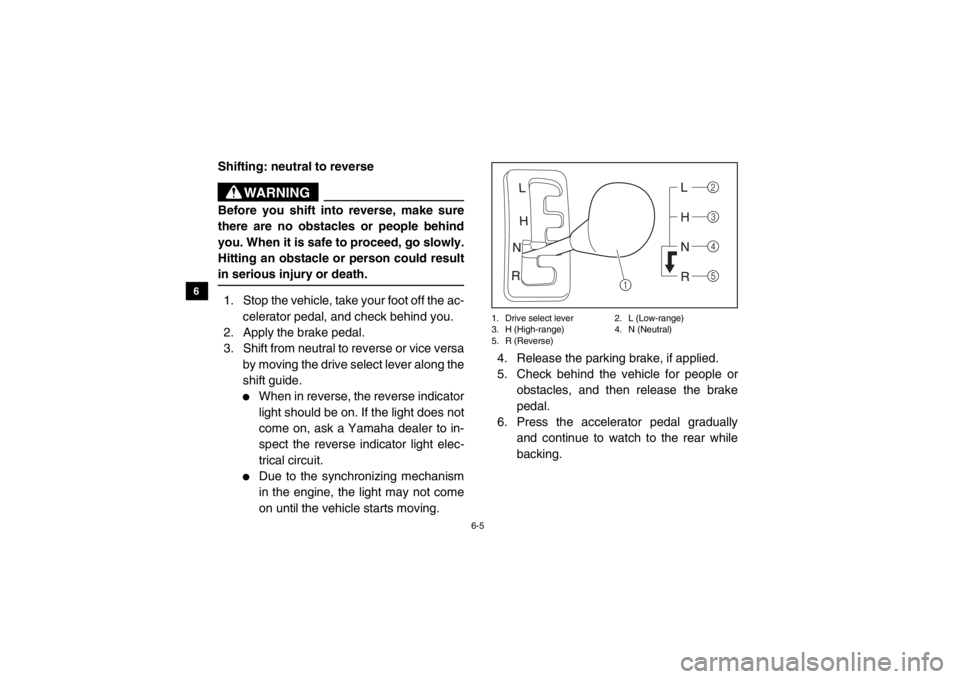
3. Shift from neutral to reverse or vice versa
by moving the drive select lever along the
shift guide.
●
When in reverse, the reverse indicator
light should be on. If the light does not
come on, ask a Yamaha dealer to in-
spect the reverse indicator light elec-
trical circuit.
●
Due to the synchronizing mechanism
in the engine, the light may not come
on until the vehicle starts moving.
1. Drive select lever 2. L (Low-range)
3. H (High-range) 4. N (Neutral)
5. R (Reverse)4. Release the parking brake, if applied.
5. Check behind the vehicle for people or obstacles, and then release the brake
pedal.
6. Press the accelerator pedal gradually and continue to watch to the rear while
backing.
1
2
5 4
3
1XP7B_EE.book Page 5 Tuesday, February 4, 2014 3:40 PM