warning YAMAHA VIKING 2014 Owner's Guide
[x] Cancel search | Manufacturer: YAMAHA, Model Year: 2014, Model line: VIKING, Model: YAMAHA VIKING 2014Pages: 180, PDF Size: 3.78 MB
Page 82 of 180
6-9
6
7
8
9
10
11
12
13
14
Prepare your load or trailer
WARNING
Improper loading or towing can increase
the risk of loss of control, an overturn, or
other accident:●
Do not exceed the Maximum Loading
Limits for the vehicle (see page 6-10
and vehicle labeling).
●
Keep weight in the cargo bed centered
side to side, and as low and as far for-
ward as possible. Top-heavy loads in-
crease the risk of overturn. Be sure
cargo is secured – a loose load could
change handling unexpectedly or
strike occupants.
●
Do not exceed the maximum tongue
weight.
●
Make sure the load does not interfere
with your control or ability to see
where you are going.
●
Tie down cargo in the trailer securely.
Make sure cargo in the trailer cannot
move around. A shifting load can
cause an accident.
Use the hooks equipped on the cargo bed to
tie down loads.
Choose a trailer hitch drawbar designed for
use with a 5 cm (2 in) receiver. (See page
4-28 for more information.)
1XP7B_EE.book Page 9 Tuesday, February 4, 2014 3:40 PM
Page 83 of 180
6-10
1
2
3
4
56
7
8
9
10
11
12
13
14
You can measure tongue weight with a bath-
room scale. Put the tongue of the loaded trail-
er on the scale with the tongue at hitch height.
Adjust the load in the trailer, if necessary, to
reduce the weight on hitch. If you are carrying
cargo and towing a trailer, include the tongue
weight in the maximum vehicle load limit.Operating when loaded with cargo or tow-
ing a trailer
Drive more slowly than you would without a
load. The more weight you carry, the slower
you should go. Although conditions vary, it is
good practice to keep the vehicle in low gear
whenever you are carrying heavier loads or
when towing a trailer.
WARNING
Carrying loads or towing a trailer can in-
crease the risk of loss of control, an over-
turn, or other accident. To reduce the risk
of an accident:●
Reduce speed, operate in low gear
only, and allow more room to stop. A
heavier vehicle takes longer to stop.
●
Avoid hills and rough terrain. Choose
terrain carefully. Use extreme caution
when towing or carrying a load on in-
clines.
●
Turn gradually and go slowly.
MAXIMUM LOADING LIMIT●
Vehicle loading limit (total weight of
cargo, operator, passengers and
accessories and tongue weight):
445 kg (981 lb)
●
Cargo bed: 272 kg (600 lb)
●
Trailer hitch:
Pulling load (total weight of trailer and
cargo): 680 kgf (1500 lbf)
Tongue weight (vertical weight on trailer
hitch point): 50 kgf (110 lbf)
1XP7B_EE.book Page 10 Tuesday, February 4, 2014 3:40 PM
Page 84 of 180

6-11
6
7
8
9
10
11
12
13
14
Pulling something other than a trailer
Yamaha recommends that loads be transport- ed in the bed or in a trailer. If you need to
move an object a short distance use a winch
and follow the winch manufacturer’s instruc-
tions.
If you choose to use something other than a
winch use extreme caution, follow the manu-
facturer’s instructions for that product, and
only attach to the hitch or hitch bracket of the
Viking. WARNING! Improperly pulling can
cause serious injury or death. Never ex-
ceed the pulling load limit of the Viking.
Avoid pulling on inclines.
Pulling objects on the ground can be more
hazardous than pulling a trailer. It may be dif-
ficult to predict how the load will affect vehicle
operation. That effect could also change de-
pending upon terrain or what obstacles might
be in the object’s path.1XP7B_EE.book Page 11 Tuesday, February 4, 2014 3:40 PM
Page 85 of 180
7-1
1
2
3
4
5
67
8
9
10
11
12
13
14
5B410010
1-
BASIC GUIDE FOR SAFE USE
As a Viking owner you are responsible for the
safe and proper operation of this vehicle.
Read this chapter and review the safety in-
structions in Chapter 2 before operating the
vehicle. Use these chapters and the labels on
the vehicle to instruct new operators and pas-
sengers. Do not allow anyone else to operate
the vehicle or ride as a passenger if you are
unsure that he/she is willing and able to follow
these instructions.
WARNING
Follow these instructions to reduce your
risk of an accident and to reduce the risk
of serious injury or death in the event of an
accident.
KNOW YOUR VEHICLEThis off-road vehicle will handle and maneu-
ver differently from cars, ATVs, go-carts, golf-
cars and grounds-keeping vehicles. The
Viking has higher ground clearance and other features to handle rugged terrain, and, as a
result, can overturn in situations where some
vehicles may not. This would include vehicles
made primarily for pavement, roads, im-
proved paths, or grounds-keeping. If you do
not use care in maneuvering the Viking, you
can cause it to roll over even on flat, open ar-
eas.
1XP7B_EE.book Page 1 Tuesday, February 4, 2014 3:40 PM
Page 88 of 180
7-4
7
8
9
10
11
12
13
14
Passenger requirements
This vehicle is designed for the operator and
two passengers. Allowing passengers to ride
improperly can lead to serious injury or death.
As the operator, you are responsible for your
passengers.●
Your passengers must be able to place
both feet on the floorboard while seated up-
right with their backs against the backrests.
●
Your passengers must be able to reach
and hold the passenger handhold.
●
Allow only two passengers in the vehicle
and only in the designated passenger
seats. Do not carry any other passengers.
Do not carry passengers in the cargo bed.
●
Do not allow someone to ride as a passen-
ger who has been using drugs or alcohol.
●
Do not allow children who need child safety
seats or booster seats in the Viking. The
seat belt is not designed to restrain auto-
motive child safety seats. Occupant protection system
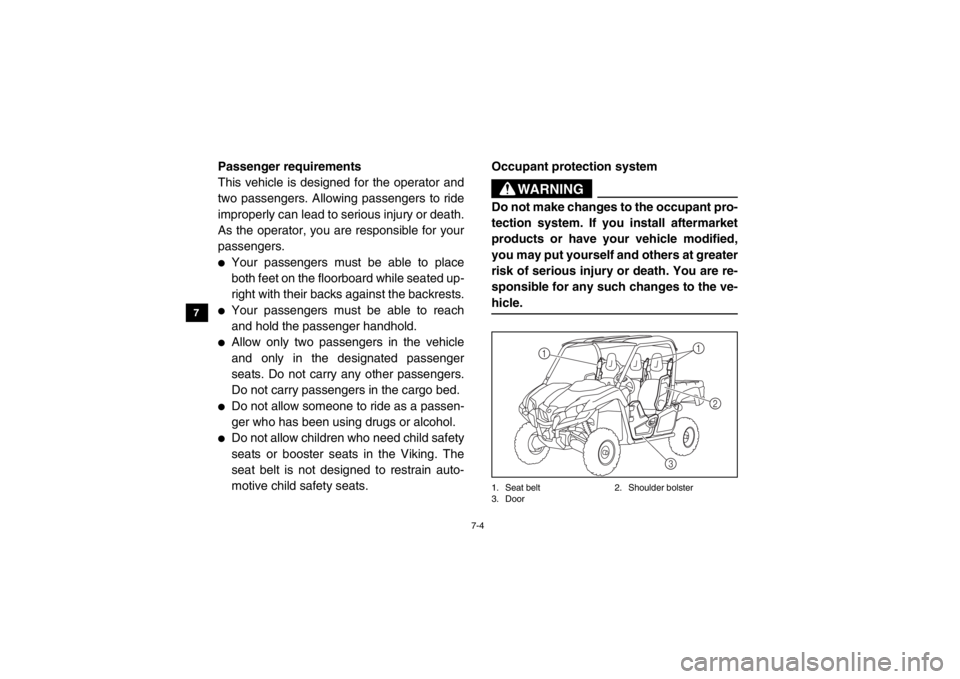
WARNING
Do not make changes to the occupant pro-
tection system. If you install aftermarket
products or have your vehicle modified,
you may put yourself and others at greater
risk of serious injury or death. You are re-
sponsible for any such changes to the ve-
hicle.1. Seat belt
2. Shoulder bolster
3. Door
2
3
1
1
1XP7B_EE.book Page 4 Tuesday, February 4, 2014 3:40 PM
Page 111 of 180
8-1
1
2
3
4
5
6
78
9
10
11
12
13
14
EVU006501-PERIODIC MAINTENANCE AND ADJUSTMENTPeriodic inspection, adjustment, and lubrica-
tion will keep your vehicle in the safest and
most efficient condition possible.
Safety is an obligation of the vehicle owner/
operator. The most important points of vehicle
inspection, adjustment, and lubrication are ex-
plained on the following pages.
WARNING
Failure to properly maintain the vehicle or
performing maintenance activities incor-
rectly may increase your risk of injury or
death during service or while using the ve-
hicle. If you are not familiar with vehicle
service, have a Yamaha dealer perform
service.
WARNING
Turn off the engine when performing main-
tenance unless otherwise specified.●
A running engine has moving parts
that can catch on body parts or cloth-
ing and electrical parts that can cause
shocks or fires.
●
Running the engine while servicing
can lead to eye injury, burns, fire, or
carbon monoxide poisoning – possi-
bly leading to death. See page 2-7 for
more information about carbon mon-
oxide.WARNING
Brake discs, calipers, drums, and linings
can become very hot during use. To avoid
possible burns, let brake components cool
before touching them.
1XP7B_EE.book Page 1 Tuesday, February 4, 2014 3:40 PM
Page 137 of 180
8-27
1
2
3
4
5
6
78
9
10
11
12
13
14
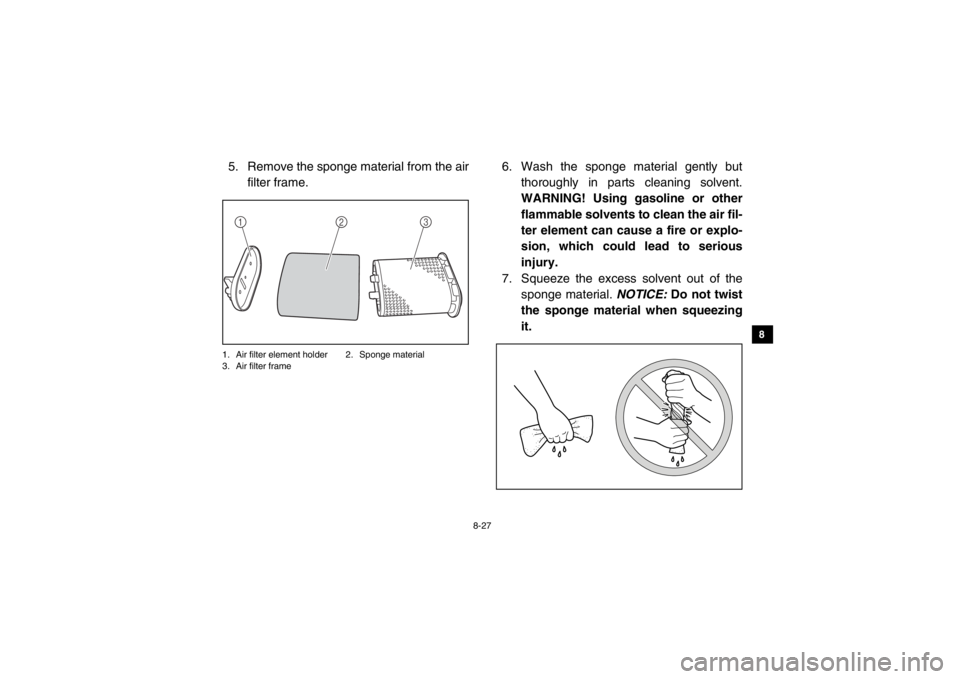
5. Remove the sponge material from the airfilter frame.1. Air filter element holder 2. Sponge material
3. Air filter frame
6. Wash the sponge material gently but thoroughly in parts cleaning solvent.
WARNING! Using gasoline or other
flammable solvents to clean the air fil-
ter element can cause a fire or explo-
sion, which could lead to serious
injury.
7. Squeeze the excess solvent out of the sponge material. NOTICE: Do not twist
the sponge material when squeezing
it.
3
2
1
1XP7B_EE.book Page 27 Tuesday, February 4, 2014 3:40 PM
Page 140 of 180
8-30
8
9
10
11
12
13
14
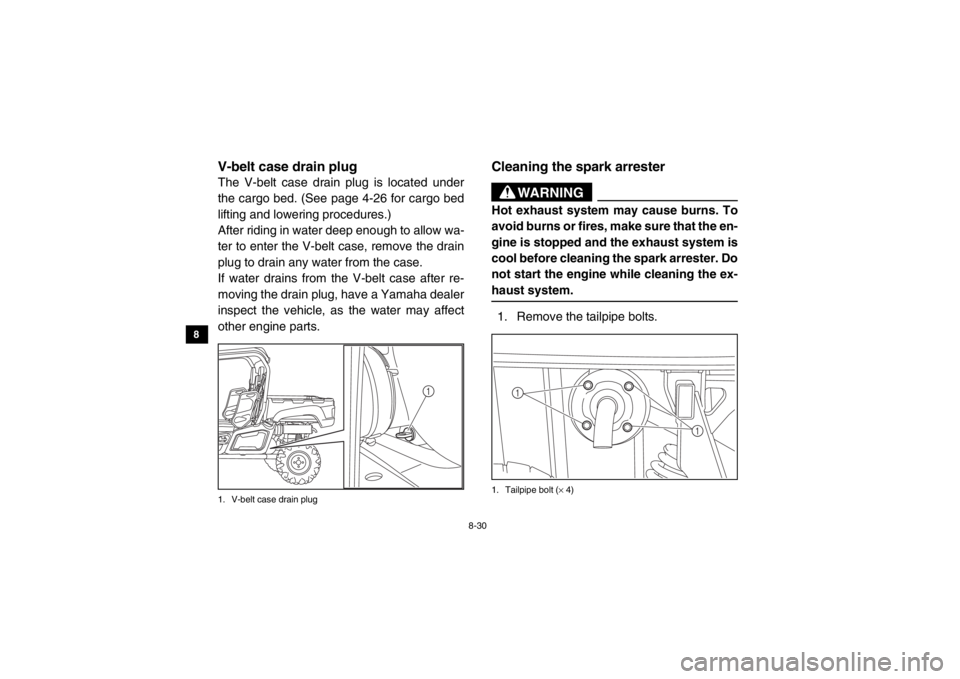
EVU00780V-belt case drain plugThe V-belt case drain plug is located under
the cargo bed. (See page 4-26 for cargo bed
lifting and lowering procedures.)
After riding in water deep enough to allow wa-
ter to enter the V-belt case, remove the drain
plug to drain any water from the case.
If water drains from the V-belt case after re-
moving the drain plug, have a Yamaha dealer
inspect the vehicle, as the water may affect
other engine parts.1. V-belt case drain plug
5B410018Cleaning the spark arrester
WARNING
Hot exhaust system may cause burns. To
avoid burns or fires, make sure that the en-
gine is stopped and the exhaust system is
cool before cleaning the spark arrester. Do
not start the engine while cleaning the ex-
haust system.1. Remove the tailpipe bolts.1. Tailpipe bolt ( × 4)
1
1
1
1XP7B_EE.book Page 30 Tuesday, February 4, 2014 3:40 PM
Page 142 of 180
8-32
8
9
10
11
12
13
14
BrakesReplacement of brake components requires
professional knowledge. Brake service should
be performed by a Yamaha dealer.
WARNING
Operating with improperly serviced or ad-
justed brakes could lead to a loss in brak-
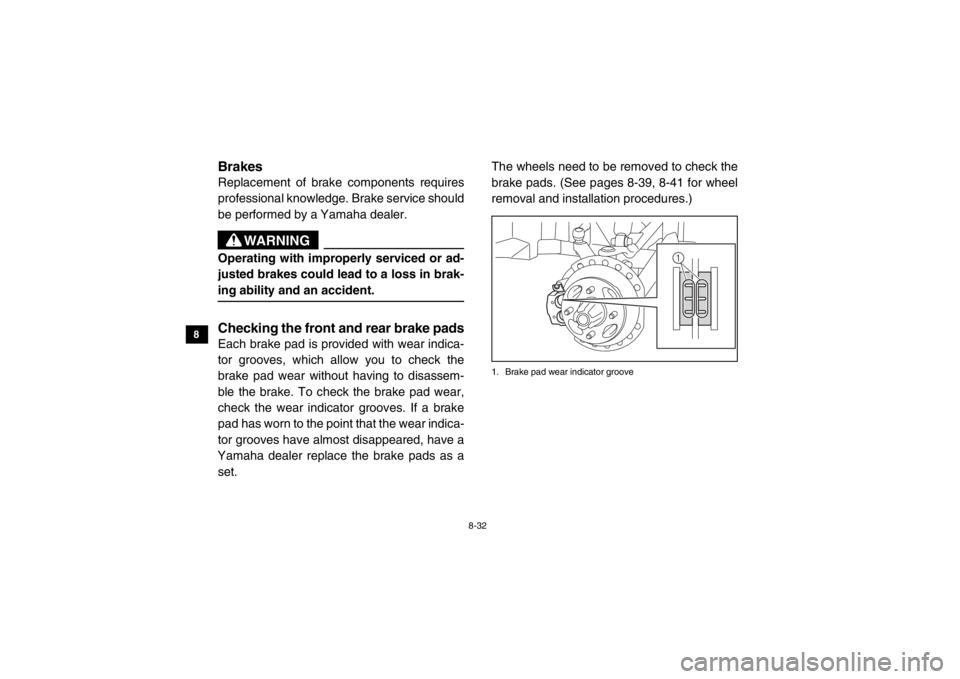
ing ability and an accident.5B410019Checking the front and rear brake padsEach brake pad is provided with wear indica-
tor grooves, which allow you to check the
brake pad wear without having to disassem-
ble the brake. To check the brake pad wear,
check the wear indicator grooves. If a brake
pad has worn to the point that the wear indica-
tor grooves have almost disappeared, have a
Yamaha dealer replace the brake pads as a
set. The wheels need to be removed to check the
brake pads. (See pages 8-39, 8-41 for wheel
removal and installation procedures.)
1. Brake pad wear indicator groove
1
1XP7B_EE.book Page 32 Tuesday, February 4, 2014 3:40 PM
Page 144 of 180
8-34
8
9
10
11
12
13
14
WARNING
Improper maintenance can result in loss of
braking ability. Observe these precau-
tions:●
Insufficient brake fluid may allow air
to enter the brake system, reducing
braking performance.
●
Clean the filler cap before removing.
Use only DOT 4 brake fluid from a
sealed container.
●
Use only the specified brake fluid;
otherwise, the rubber seals may dete-
riorate, causing leakage.
●
Refill with the same type of brake flu-
id. Adding a brake fluid other than
DOT 4 may result in a harmful chemi-
cal reaction.
●
Be careful that water does not enter
the brake fluid reservoir when refill-
ing. Water will significantly lower the
boiling point of the fluid and may re-
sult in vapor lock.
NOTICEBrake fluid may damage painted surfaces
or plastic parts. Always clean up spilled
fluid immediately.As the brake pads wear, it is normal for the
brake fluid level to gradually go down. A low
brake fluid level may indicate worn brake
pads and/or brake system leakage; therefore,
be sure to check the brake pads for wear and
the brake system for leakage. If the brake fluid
level goes down suddenly, have a Yamaha
dealer check the cause before further riding.EVU00860Brake fluid replacementComplete fluid replacement should be done
only by trained Yamaha service personnel.
Have a Yamaha dealer replace the following
components during periodic maintenance or
when they are damaged or leaking.●
Replace the oil seals every two years.
●
Replace the brake hoses every four years.
1XP7B_EE.book Page 34 Tuesday, February 4, 2014 3:40 PM