shock YAMAHA WR 250F 2007 User Guide
[x] Cancel search | Manufacturer: YAMAHA, Model Year: 2007, Model line: WR 250F, Model: YAMAHA WR 250F 2007Pages: 912, PDF Size: 23.95 MB
Page 316 of 912
3 - 105
INSP
ADJ
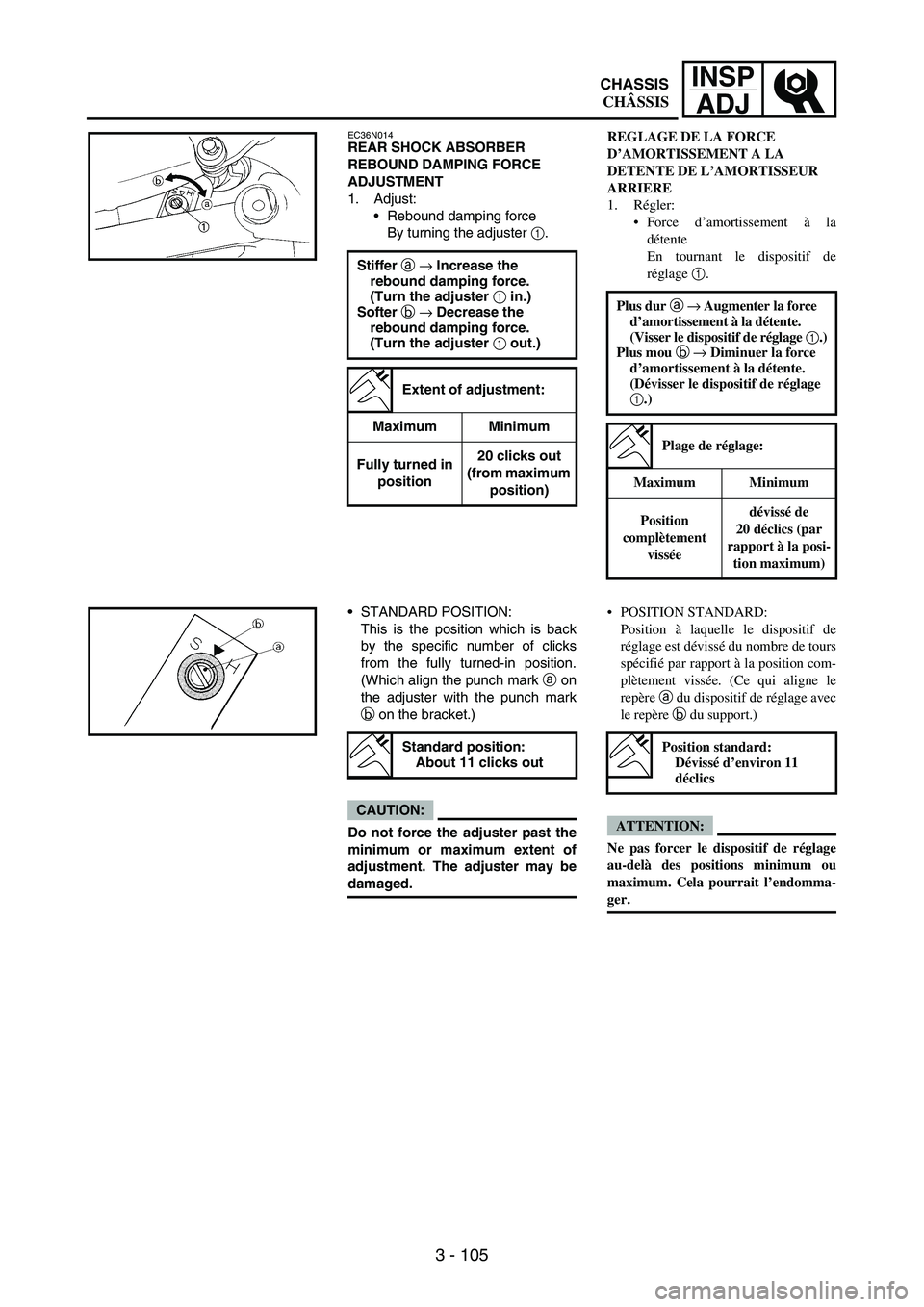
EC36N014REAR SHOCK ABSORBER
REBOUND DAMPING FORCE
ADJUSTMENT
1. Adjust:
Rebound damping force
By turning the adjuster
1.
Stiffer a → Increase the
rebound damping force.
(Turn the adjuster 1 in.)
Softer b → Decrease the
rebound damping force.
(Turn the adjuster 1 out.)
Extent of adjustment:
Maximum Minimum
Fully turned in
position20 clicks out
(from maximum
position)
STANDARD POSITION:
This is the position which is back
by the specific number of clicks
from the fully turned-in position.
(Which align the punch mark
a on
the adjuster with the punch mark
b on the bracket.)
CAUTION:
Do not force the adjuster past the
minimum or maximum extent of
adjustment. The adjuster may be
damaged.
Standard position:
About 11 clicks out
REGLAGE DE LA FORCE
D’AMORTISSEMENT A LA
DETENTE DE L’AMORTISSEUR
ARRIERE
1. Régler:
Force d’amortissement à la
détente
En tournant le dispositif de
réglage 1.
Plus dur a → Augmenter la force
d’amortissement à la détente.
(Visser le dispositif de réglage 1.)
Plus mou b → Diminuer la force
d’amortissement à la détente.
(Dévisser le dispositif de réglage
1.)
Plage de réglage:
Maximum Minimum
Position
complètement
visséedévissé de
20 déclics (par
rapport à la posi-
tion maximum)
POSITION STANDARD:
Position à laquelle le dispositif de
réglage est dévissé du nombre de tours
spécifié par rapport à la position com-
plètement vissée. (Ce qui aligne le
repère a du dispositif de réglage avec
le repère b du support.)
ATTENTION:
Ne pas forcer le dispositif de réglage
au-delà des positions minimum ou
maximum. Cela pourrait l’endomma-
ger.
Position standard:
Dévissé d’environ 11
déclics
CHASSIS
CHÂSSIS
Page 318 of 912
3 - 107
INSP
ADJ
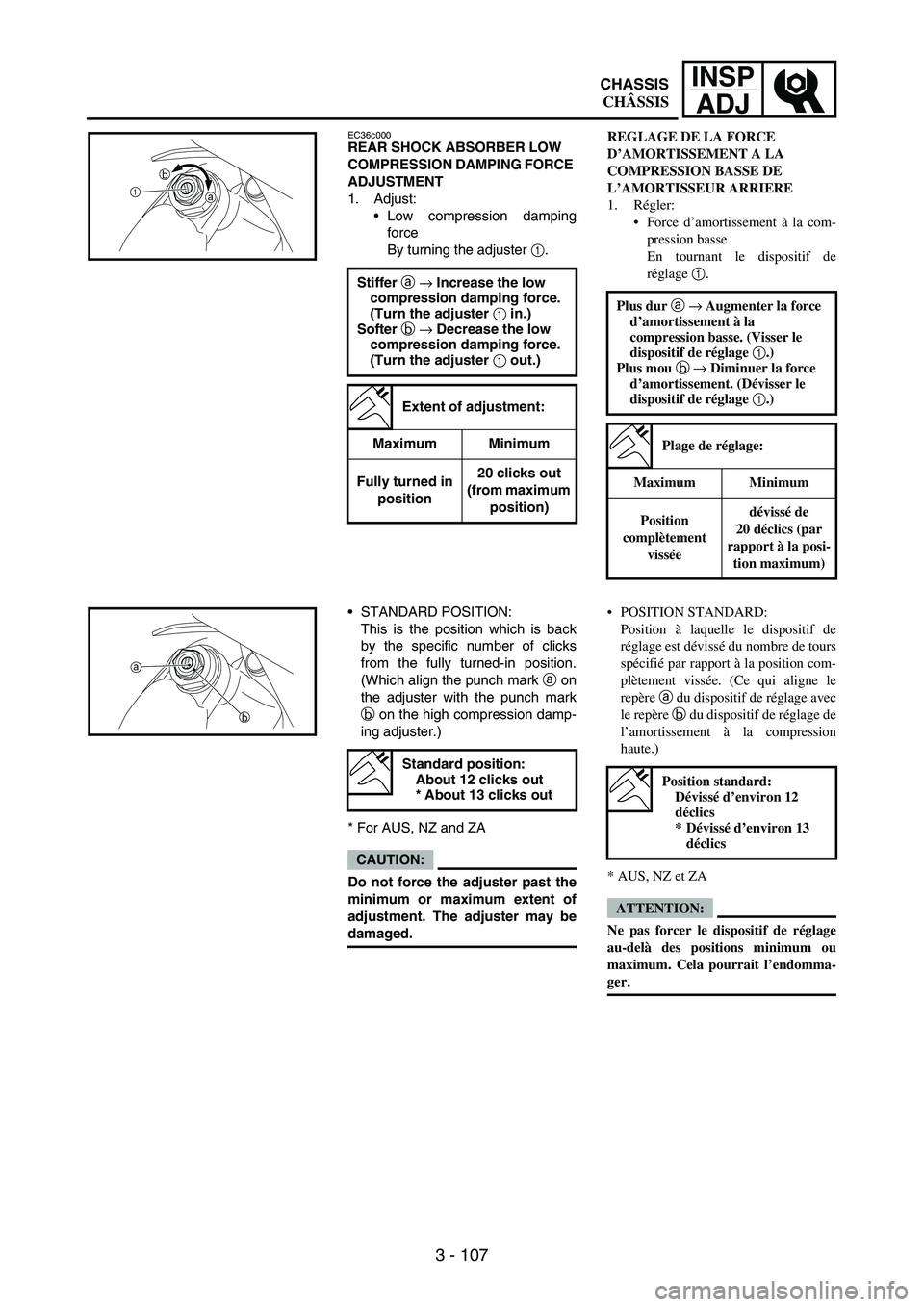
EC36c000REAR SHOCK ABSORBER LOW
COMPRESSION DAMPING FORCE
ADJUSTMENT
1. Adjust:
Low compression damping
force
By turning the adjuster
1.
Stiffer a → Increase the low
compression damping force.
(Turn the adjuster 1 in.)
Softer b → Decrease the low
compression damping force.
(Turn the adjuster 1 out.)
Extent of adjustment:
Maximum Minimum
Fully turned in
position20 clicks out
(from maximum
position)
1b
a
STANDARD POSITION:
This is the position which is back
by the specific number of clicks
from the fully turned-in position.
(Which align the punch mark
a on
the adjuster with the punch mark
b on the high compression damp-
ing adjuster.)
* For AUS, NZ and ZA
CAUTION:
Do not force the adjuster past the
minimum or maximum extent of
adjustment. The adjuster may be
damaged.
Standard position:
About 12 clicks out
* About 13 clicks out
a
b
REGLAGE DE LA FORCE
D’AMORTISSEMENT A LA
COMPRESSION BASSE DE
L’AMORTISSEUR ARRIERE
1. Régler:
Force d’amortissement à la com-
pression basse
En tournant le dispositif de
réglage 1.
Plus dur a → Augmenter la force
d’amortissement à la
compression basse. (Visser le
dispositif de réglage 1.)
Plus mou b → Diminuer la force
d’amortissement. (Dévisser le
dispositif de réglage 1.)
Plage de réglage:
Maximum Minimum
Position
complètement
visséedévissé de
20 déclics (par
rapport à la posi-
tion maximum)
POSITION STANDARD:
Position à laquelle le dispositif de
réglage est dévissé du nombre de tours
spécifié par rapport à la position com-
plètement vissée. (Ce qui aligne le
repère a du dispositif de réglage avec
le repère b du dispositif de réglage de
l’amortissement à la compression
haute.)
* AUS, NZ et ZA
ATTENTION:
Ne pas forcer le dispositif de réglage
au-delà des positions minimum ou
maximum. Cela pourrait l’endomma-
ger.
Position standard:
Dévissé d’environ 12
déclics
*Dévissé d’environ 13
déclics
CHASSIS
CHÂSSIS
Page 320 of 912
3 - 109
INSP
ADJ
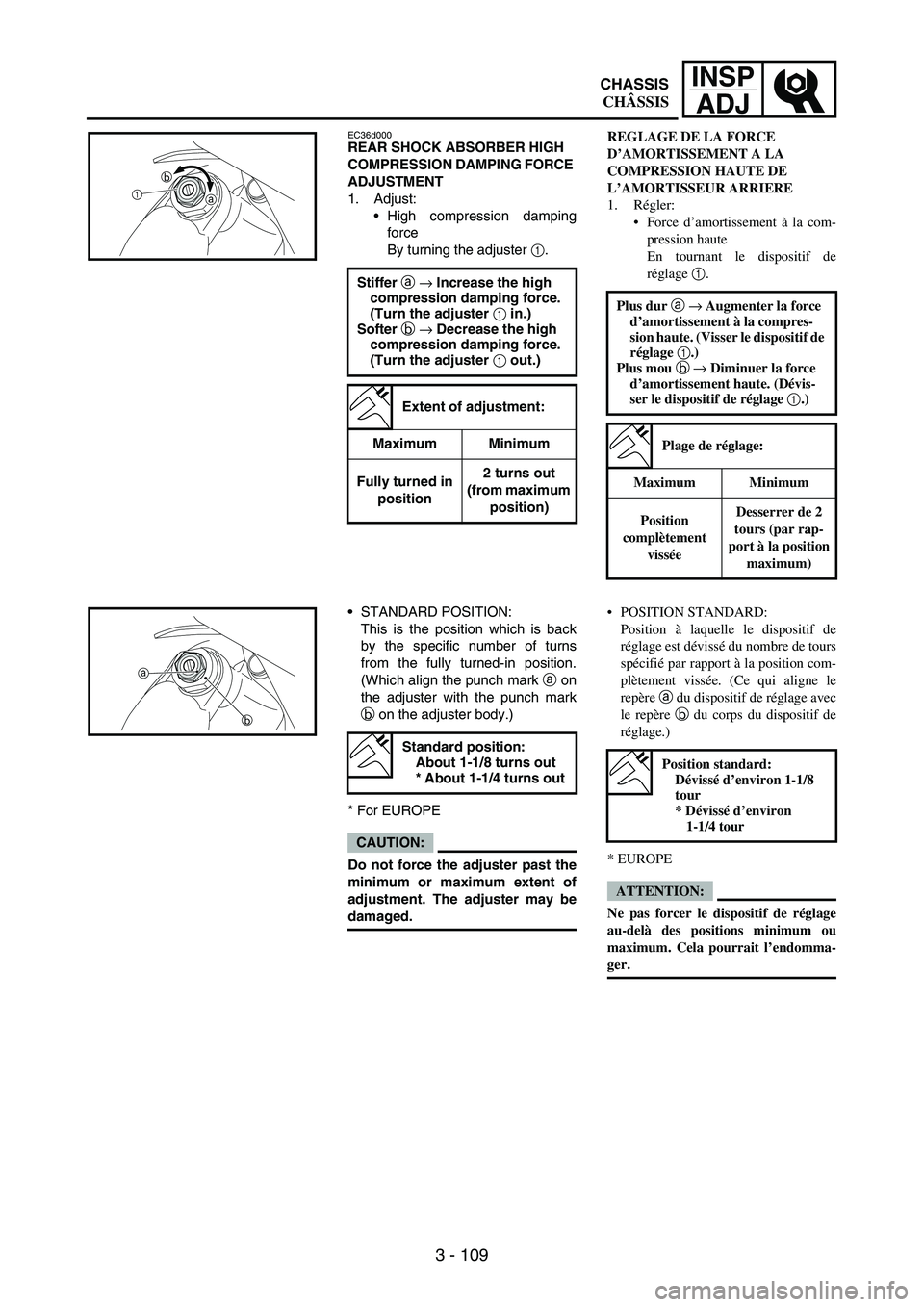
EC36d000REAR SHOCK ABSORBER HIGH
COMPRESSION DAMPING FORCE
ADJUSTMENT
1. Adjust:
High compression damping
force
By turning the adjuster
1.
Stiffer a → Increase the high
compression damping force.
(Turn the adjuster 1 in.)
Softer b → Decrease the high
compression damping force.
(Turn the adjuster 1 out.)
Extent of adjustment:
Maximum Minimum
Fully turned in
position2 turns out
(from maximum
position)
1ba
STANDARD POSITION:
This is the position which is back
by the specific number of turns
from the fully turned-in position.
(Which align the punch mark
a on
the adjuster with the punch mark
b on the adjuster body.)
* For EUROPE
CAUTION:
Do not force the adjuster past the
minimum or maximum extent of
adjustment. The adjuster may be
damaged.
Standard position:
About 1-1/8 turns out
* About 1-1/4 turns out
a
b
REGLAGE DE LA FORCE
D’AMORTISSEMENT A LA
COMPRESSION HAUTE DE
L’AMORTISSEUR ARRIERE
1. Régler:
Force d’amortissement à la com-
pression haute
En tournant le dispositif de
réglage 1.
Plus dur a → Augmenter la force
d’amortissement à la compres-
sion haute. (Visser le dispositif de
réglage 1.)
Plus mou b → Diminuer la force
d’amortissement haute. (Dévis-
ser le dispositif de réglage 1.)
Plage de réglage:
Maximum Minimum
Position
complètement
visséeDesserrer de 2
tours (par rap-
port à la position
maximum)
POSITION STANDARD:
Position à laquelle le dispositif de
réglage est dévissé du nombre de tours
spécifié par rapport à la position com-
plètement vissée. (Ce qui aligne le
repère a du dispositif de réglage avec
le repère b du corps du dispositif de
réglage.)
* EUROPE
ATTENTION:
Ne pas forcer le dispositif de réglage
au-delà des positions minimum ou
maximum. Cela pourrait l’endomma-
ger.
Position standard:
Dévissé d’environ 1-1/8
tour
* Dévissé d’environ
1-1/4 tour
CHASSIS
CHÂSSIS
Page 394 of 912
![YAMAHA WR 250F 2007 User Guide 4 - 35
TUNSETTING
Setting of spring after
replacement
After replacement, be sure to adjust
the spring to the set length [sunken
length 90 ~ 100 mm (3.5 ~ 3.9 in)]
and set it.
1. Use of soft spring
S](/img/51/52333/w960_52333-393.png "YAMAHA WR 250F 2007 User Guide 4 - 35
TUNSETTING
Setting of spring after
replacement
After replacement, be sure to adjust
the spring to the set length [sunken
length 90 ~ 100 mm (3.5 ~ 3.9 in)]
and set it.
1. Use of soft spring
S")
4 - 35
TUNSETTING
Setting of spring after
replacement
After replacement, be sure to adjust
the spring to the set length [sunken
length 90 ~ 100 mm (3.5 ~ 3.9 in)]
and set it.
1. Use of soft spring
Set the soft spring for less
rebound damping to compen-
sate for its less spring load.
Run with the rebound damping
adjuster one or two clicks on
the softer side and readjust it
to suit your preference.
2. Use of stiff spring
Set the soft spring for more
rebound damping to compen-
sate for its greater spring load.
Run with the rebound damping
adjuster one or two clicks on
the stiffer side and readjust it
to suit your preference.
*Adjusting the rebound damp-
ing will be followed more or
less by a change in the com-
pression damping. For correc-
tion, turn the low compression
damping adjuster on the softer
side.
CAUTION:
When using a rear shock absorber
other than currently installed, use
the one whose overall length a
does not exceed the standard as it
may result in faulty performance.
Never use one whose overall
length is greater than standard.
Length a
of standard
shock:
488.5 mm (19.23 in)
Réglage du ressort après
remplacement
Après avoir remplacé le ressort, veiller à
l’ajuster à la longueur recommandée
[profondeur 90 à 100 mm (3,5 à 3,9 in)]
et à le régler.
1. Ressort mou
Régler le ressort mou de manière
que la force d’amortissement à la
détente soit moindre afin de com-
penser son manque de raideur.
Après avoir, à l’aide du dispositif
de réglage, diminué la force
d’amortissement à la détente d’un
ou deux déclics, rouler avec la
moto puis effectuer un nouveau
réglage en fonction des préféren-
ces personnelles.
2. Ressort dur
Régler le ressort de manière à
augmenter la force d’amortisse-
ment à la détente afin de compen-
ser la plus grande raideur du
ressort. Après avoir, à l’aide du
dispositif de réglage, augmenté la
force d’amortissement à la
détente d’un ou deux déclics, rou-
ler avec la moto puis effectuer un
nouveau réglage en fonction des
préférences personnelles.
*Un réglage de la force d’amortis-
sement à la détente entraîne un
changement de la force de com-
pression. Pour corriger, dévisser
le dispositif de réglage de la force
de compression.
ATTENTION:
Lors du remplacement de l’amortis-
seur arrière, veiller à monter un
amortisseur dont la longueur totale a
ne dépasse pas la longueur standard
sous peine d’altérer les performances.
Ne jamais monter un amortisseur
dont la longueur totale est supérieure
à la longueur standard.
Longueur a de
l’amortisseur standard:
488,5 mm (19,23 in)
REGLAGE
Page 396 of 912
4 - 37
TUNSETTING
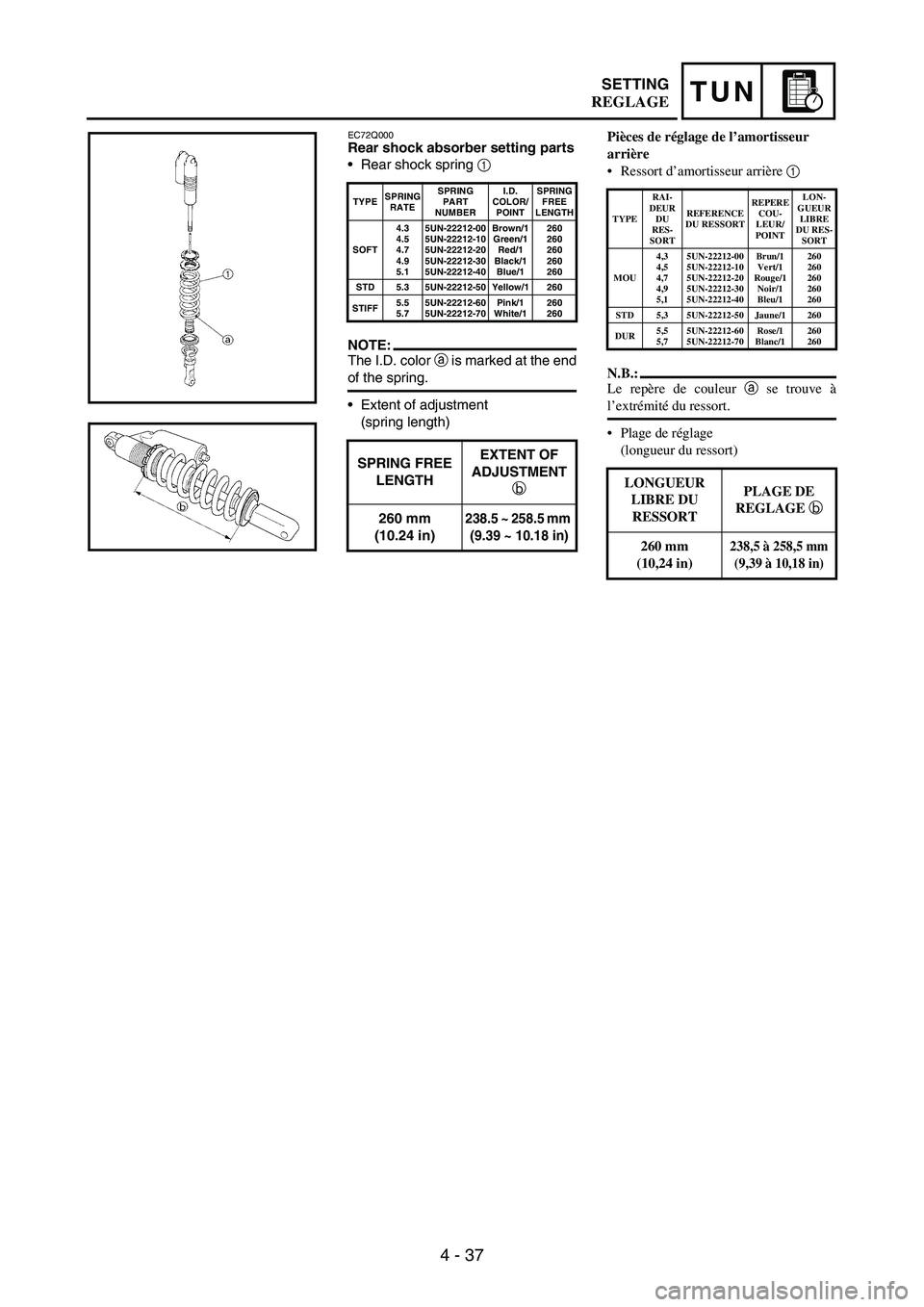
EC72Q000Rear shock absorber setting parts
Rear shock spring
1
NOTE:The I.D. color
a is marked at the end
of the spring.
Extent of adjustment
(spring length)
TYPESPRING
RATESPRING
PART
NUMBERI.D.
COLOR/
POINTSPRING
FREE
LENGTH
SOFT4.3
4.5
4.7
4.9
5.15UN-22212-00
5UN-22212-10
5UN-22212-20
5UN-22212-30
5UN-22212-40Brown/1
Green/1
Red/1
Black/1
Blue/1260
260
260
260
260
STD 5.3 5UN-22212-50 Yellow/1 260
STIFF5.5
5.75UN-22212-60
5UN-22212-70Pink/1
White/1260
260
SPRING FREE
LENGTHEXTENT OF
ADJUSTMENT
b
260 mm
(10.24 in)
238.5 ~ 258.5 mm
(9.39 ~ 10.18 in)
Pièces de réglage de l’amortisseur
arrière
Ressort d’amortisseur arrière 1
N.B.:
Le repère de couleur a se trouve à
l’extrémité du ressort.
Plage de réglage
(longueur du ressort)
TYPERAI-
DEUR
DU
RES-
SORTREFERENCE
DU RESSORTREPERE
COU-
LEUR/
POINTLON-
GUEUR
LIBRE
DU RES-
SORT
MOU4,3
4,5
4,7
4,9
5,15UN-22212-00
5UN-22212-10
5UN-22212-20
5UN-22212-30
5UN-22212-40Brun/1
Vert/1
Rouge/1
Noir/1
Bleu/1260
260
260
260
260
STD 5,3 5UN-22212-50 Jaune/1 260
DUR5,5
5,75UN-22212-60
5UN-22212-70Rose/1
Blanc/1260
260
LONGUEUR
LIBRE DU
RESSORT PLAGE DE
REGLAGE b
260 mm
(10,24 in)
238,5 à 258,5 mm
(9,39 à 10,18 in)
REGLAGE
Page 398 of 912
4 - 39
TUNSETTING
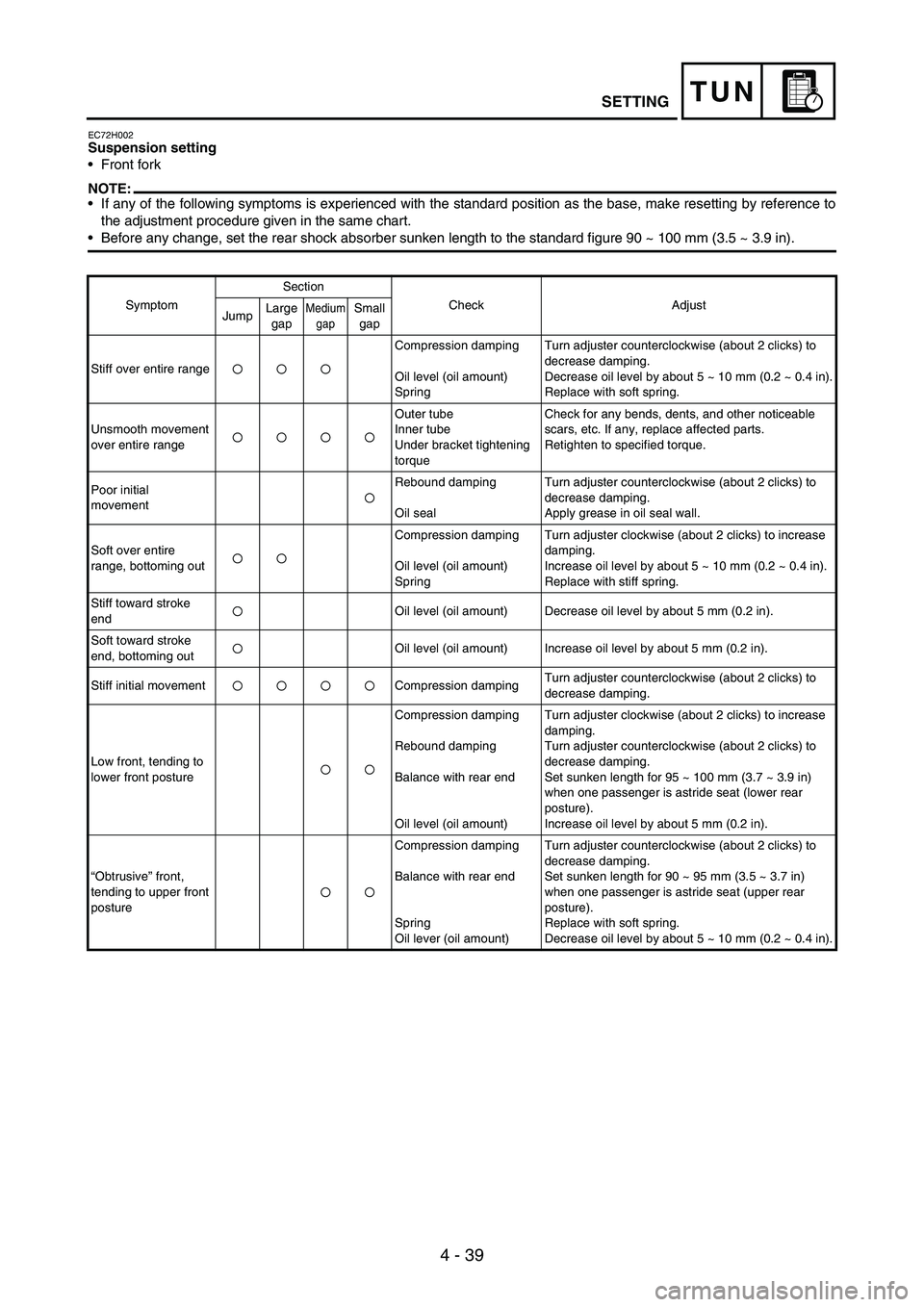
EC72H002Suspension setting
Front fork
NOTE:If any of the following symptoms is experienced with the standard position as the base, make resetting by reference to
the adjustment procedure given in the same chart.
Before any change, set the rear shock absorber sunken length to the standard figure 90 ~ 100 mm (3.5 ~ 3.9 in).
SymptomSection
Check Adjust
JumpLarge
gapMedium
gapSmall
gap
Stiff over entire rangeCompression damping
Oil level (oil amount)
SpringTurn adjuster counterclockwise (about 2 clicks) to
decrease damping.
Decrease oil level by about 5 ~ 10 mm (0.2 ~ 0.4 in).
Replace with soft spring.
Unsmooth movement
over entire rangeOuter tube
Inner tube
Under bracket tightening
torqueCheck for any bends, dents, and other noticeable
scars, etc. If any, replace affected parts.
Retighten to specified torque.
Poor initial
movementRebound damping
Oil sealTurn adjuster counterclockwise (about 2 clicks) to
decrease damping.
Apply grease in oil seal wall.
Soft over entire
range, bottoming outCompression damping
Oil level (oil amount)
SpringTurn adjuster clockwise (about 2 clicks) to increase
damping.
Increase oil level by about 5 ~ 10 mm (0.2 ~ 0.4 in).
Replace with stiff spring.
Stiff toward stroke
endOil level (oil amount) Decrease oil level by about 5 mm (0.2 in).
Soft toward stroke
end, bottoming outOil level (oil amount) Increase oil level by about 5 mm (0.2 in).
Stiff initial movement Compression dampingTurn adjuster counterclockwise (about 2 clicks) to
decrease damping.
Low front, tending to
lower front postureCompression damping
Rebound damping
Balance with rear end
Oil level (oil amount)Turn adjuster clockwise (about 2 clicks) to increase
damping.
Turn adjuster counterclockwise (about 2 clicks) to
decrease damping.
Set sunken length for 95 ~ 100 mm (3.7 ~ 3.9 in)
when one passenger is astride seat (lower rear
posture).
Increase oil level by about 5 mm (0.2 in).
“Obtrusive” front,
tending to upper front
postureCompression damping
Balance with rear end
Spring
Oil lever (oil amount)Turn adjuster counterclockwise (about 2 clicks) to
decrease damping.
Set sunken length for 90 ~ 95 mm (3.5 ~ 3.7 in)
when one passenger is astride seat (upper rear
posture).
Replace with soft spring.
Decrease oil level by about 5 ~ 10 mm (0.2 ~ 0.4 in).
Page 399 of 912
4 - 40
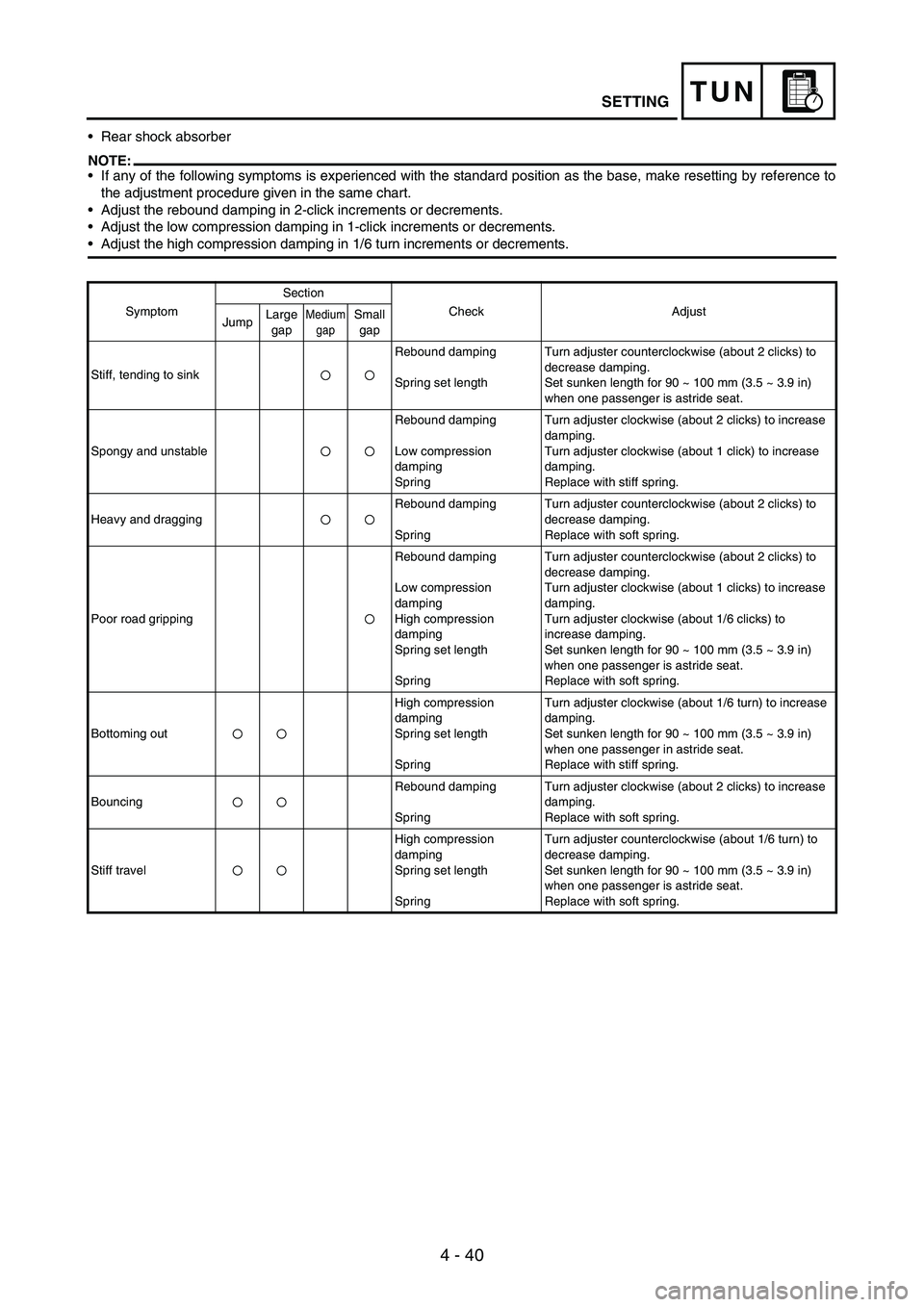
TUNSETTING
Rear shock absorber
NOTE:If any of the following symptoms is experienced with the standard position as the base, make resetting by reference to
the adjustment procedure given in the same chart.
Adjust the rebound damping in 2-click increments or decrements.
Adjust the low compression damping in 1-click increments or decrements.
Adjust the high compression damping in 1/6 turn increments or decrements.
SymptomSection
Check Adjust
JumpLarge
gapMedium
gapSmall
gap
Stiff, tending to sinkRebound damping
Spring set lengthTurn adjuster counterclockwise (about 2 clicks) to
decrease damping.
Set sunken length for 90 ~ 100 mm (3.5 ~ 3.9 in)
when one passenger is astride seat.
Spongy and unstableRebound damping
Low compression
damping
SpringTurn adjuster clockwise (about 2 clicks) to increase
damping.
Turn adjuster clockwise (about 1 click) to increase
damping.
Replace with stiff spring.
Heavy and draggingRebound damping
SpringTurn adjuster counterclockwise (about 2 clicks) to
decrease damping.
Replace with soft spring.
Poor road grippingRebound damping
Low compression
damping
High compression
damping
Spring set length
SpringTurn adjuster counterclockwise (about 2 clicks) to
decrease damping.
Turn adjuster clockwise (about 1 clicks) to increase
damping.
Turn adjuster clockwise (about 1/6 clicks) to
increase damping.
Set sunken length for 90 ~ 100 mm (3.5 ~ 3.9 in)
when one passenger is astride seat.
Replace with soft spring.
Bottoming outHigh compression
damping
Spring set length
SpringTurn adjuster clockwise (about 1/6 turn) to increase
damping.
Set sunken length for 90 ~ 100 mm (3.5 ~ 3.9 in)
when one passenger in astride seat.
Replace with stiff spring.
BouncingRebound damping
SpringTurn adjuster clockwise (about 2 clicks) to increase
damping.
Replace with soft spring.
Stiff travelHigh compression
damping
Spring set length
SpringTurn adjuster counterclockwise (about 1/6 turn) to
decrease damping.
Set sunken length for 90 ~ 100 mm (3.5 ~ 3.9 in)
when one passenger is astride seat.
Replace with soft spring.
Page 416 of 912
5 - 9
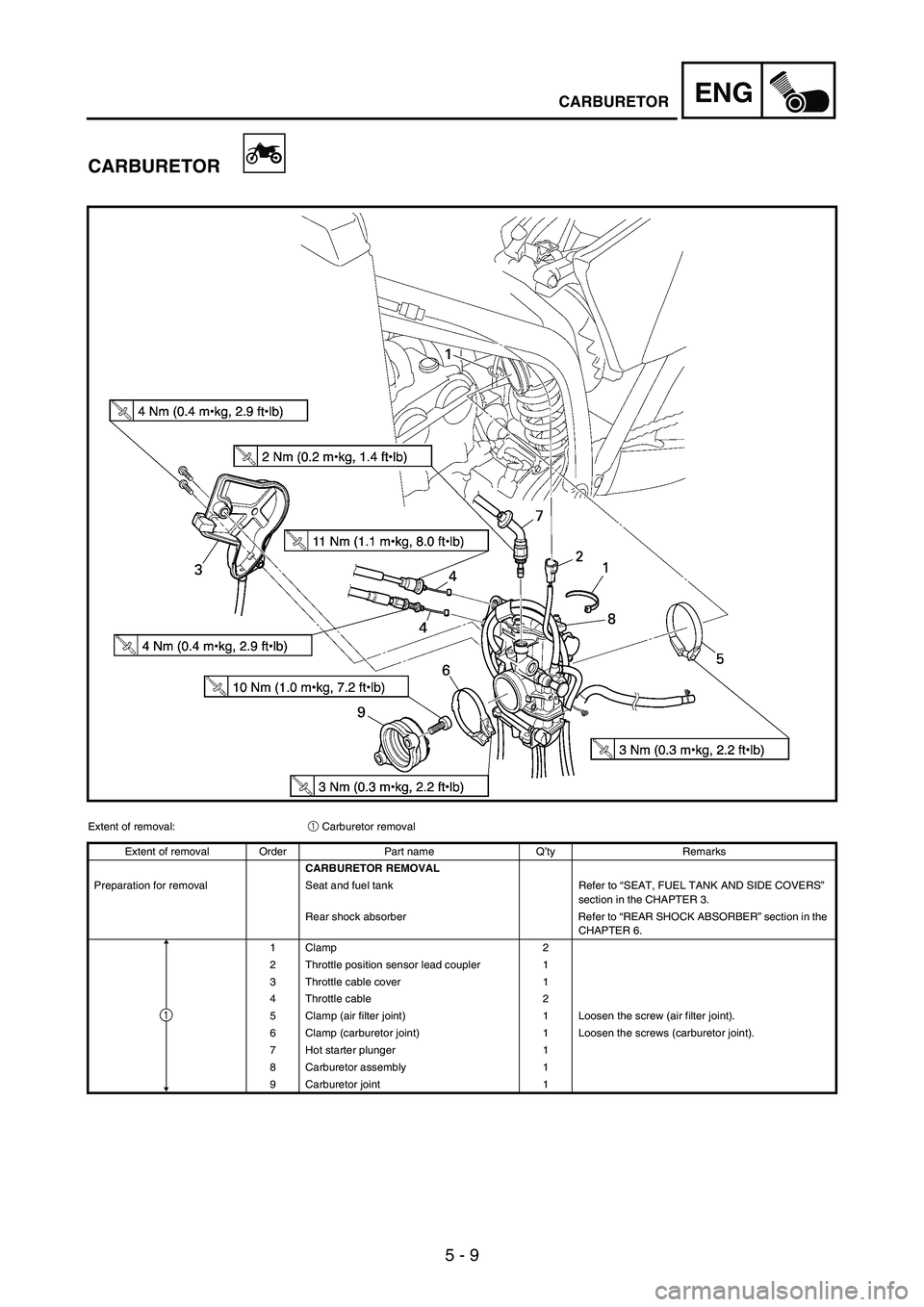
ENGCARBURETOR
CARBURETOR
Extent of removal:
1 Carburetor removal
Extent of removal Order Part name Q’ty Remarks
CARBURETOR REMOVAL
Preparation for removal Seat and fuel tank Refer to “SEAT, FUEL TANK AND SIDE COVERS”
section in the CHAPTER 3.
Rear shock absorber Refer to “REAR SHOCK ABSORBER” section in the
CHAPTER 6.
1 Clamp 2
2 Throttle position sensor lead coupler 1
3 Throttle cable cover 1
4 Throttle cable 2
5 Clamp (air filter joint) 1 Loosen the screw (air filter joint).
6 Clamp (carburetor joint) 1 Loosen the screws (carburetor joint).
7 Hot starter plunger 1
8 Carburetor assembly 1
9 Carburetor joint 1
1
Page 720 of 912
6 - 57
CHASFRONT BRAKE AND REAR BRAKE
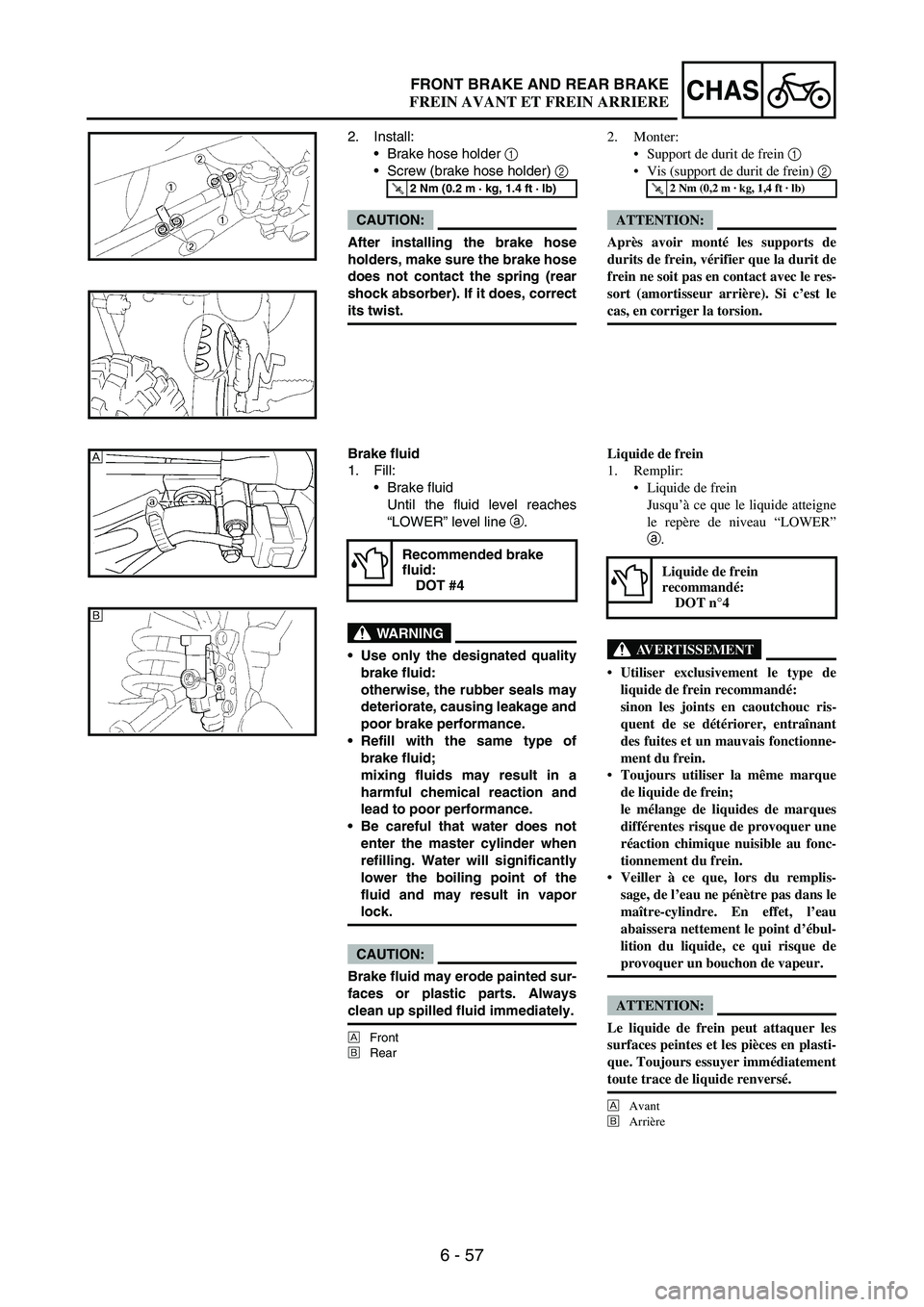
2. Install:
Brake hose holder
1
Screw (brake hose holder)
2
CAUTION:
After installing the brake hose
holders, make sure the brake hose
does not contact the spring (rear
shock absorber). If it does, correct
its twist.
T R..2 Nm (0.2 m · kg, 1.4 ft · lb)
Brake fluid
1. Fill:
Brake fluid
Until the fluid level reaches
“LOWER” level line
a.
WARNING
Use only the designated quality
brake fluid:
otherwise, the rubber seals may
deteriorate, causing leakage and
poor brake performance.
Refill with the same type of
brake fluid;
mixing fluids may result in a
harmful chemical reaction and
lead to poor performance.
Be careful that water does not
enter the master cylinder when
refilling. Water will significantly
lower the boiling point of the
fluid and may result in vapor
lock.
CAUTION:
Brake fluid may erode painted sur-
faces or plastic parts. Always
clean up spilled fluid immediately.
È
Front
É
Rear
Recommended brake
fluid:
DOT #4
È
É
2. Monter:
Support de durit de frein 1
Vis (support de durit de frein) 2
ATTENTION:
Après avoir monté les supports de
durits de frein, vérifier que la durit de
frein ne soit pas en contact avec le res-
sort (amortisseur arrière). Si c’est le
cas, en corriger la torsion.
T R..2 Nm (0,2 m · kg, 1,4 ft · lb)
Liquide de frein
1. Remplir:
Liquide de frein
Jusqu’à ce que le liquide atteigne
le repère de niveau “LOWER”
a.
AVERTISSEMENT
Utiliser exclusivement le type de
liquide de frein recommandé:
sinon les joints en caoutchouc ris-
quent de se détériorer, entraînant
des fuites et un mauvais fonctionne-
ment du frein.
Toujours utiliser la même marque
de liquide de frein;
le mélange de liquides de marques
différentes risque de provoquer une
réaction chimique nuisible au fonc-
tionnement du frein.
Veiller à ce que, lors du remplis-
sage, de l’eau ne pénètre pas dans le
maître-cylindre. En effet, l’eau
abaissera nettement le point d’ébul-
lition du liquide, ce qui risque de
provoquer un bouchon de vapeur.
ATTENTION:
Le liquide de frein peut attaquer les
surfaces peintes et les pièces en plasti-
que. Toujours essuyer immédiatement
toute trace de liquide renversé.
È
Avant
É
Arrière
Liquide de frein
recommandé:
DOT n°4
FREIN AVANT ET FREIN ARRIERE
Page 784 of 912

6 - 121
CHASSWINGARM
EC570000
SWINGARM
Extent of removal:
1 Swingarm removal
Extent of removal Order Part name Q’ty Remarks
SWINGARM REMOVAL
WARNING
Support the machine securely so there is nodanger of it falling over. Preparation for removal Hold the machine by placing the suitable
stand under the engine.
Brake hose holder
Refer to “FRONT BRAKE AND REAR BRAKE”
section.
Rear brake caliper
Bolt (brake pedal) Shift the brake pedal backward.
Drive chain
1 Drive chain support 1
2 Lower chain tensioner 1
3 Bolt (rear shock absorber-relay arm) 1 Hold the swingarm.
4 Bolt (connecting rod) 1
5 Pivot shaft 1
6 Swingarm 1
1