engine oil YAMAHA WR 250F 2009 User Guide
[x] Cancel search | Manufacturer: YAMAHA, Model Year: 2009, Model line: WR 250F, Model: YAMAHA WR 250F 2009Pages: 224, PDF Size: 13.93 MB
Page 33 of 224
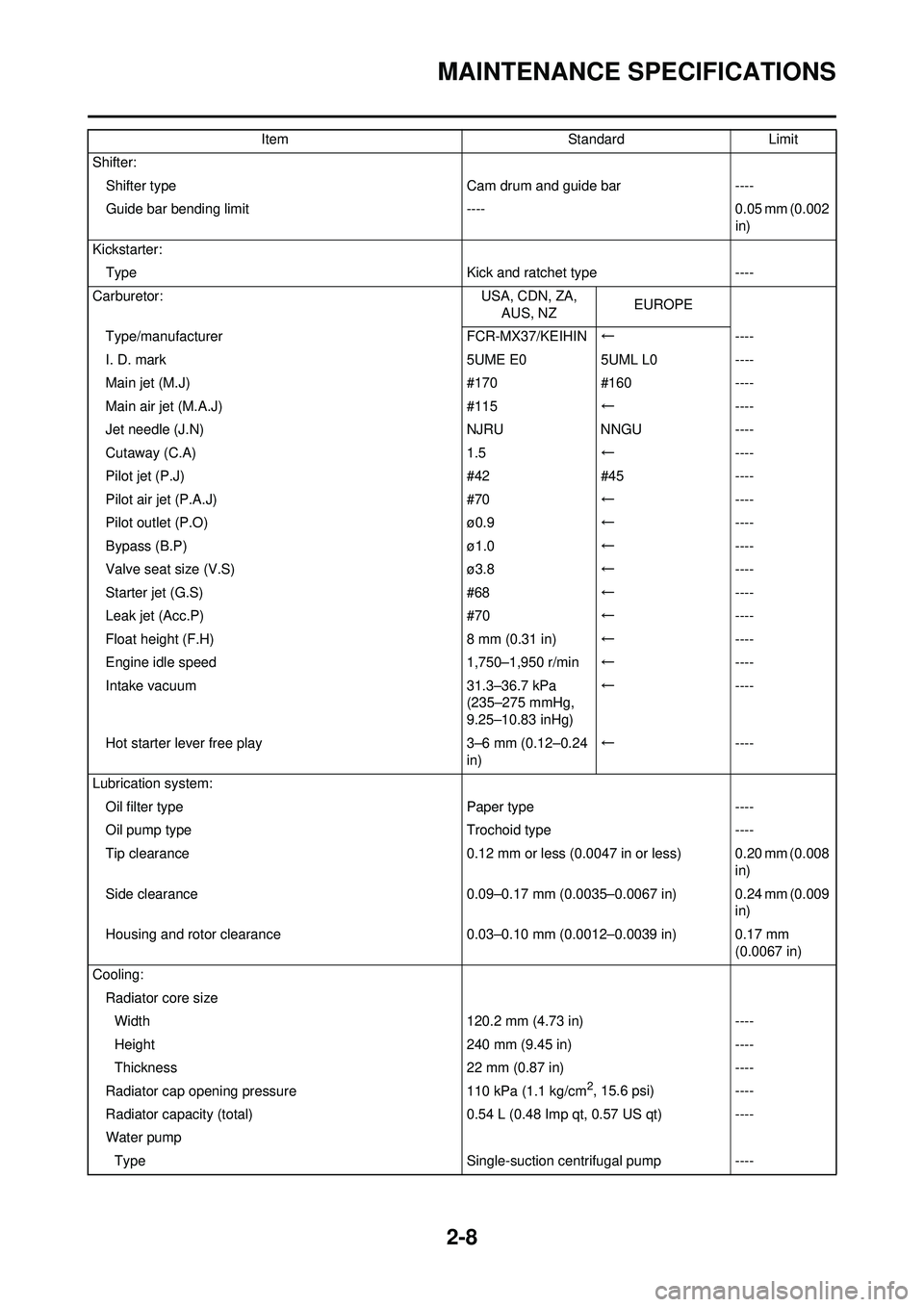
2-8
MAINTENANCE SPECIFICATIONS
Shifter:Shifter type Cam drum and guide bar----
Guide bar bending limit ----0.05 mm (0.002
in)
Kickstarter: Type Kick and ratchet type----
Carburetor: USA, CDN, ZA,
AUS, NZ EUROPE
Type/manufacturer FCR-MX37/KEIHIN← ----
I. D. mark 5UME E05UML L0 ----
Main jet (M.J) #170#160 ----
Main air jet (M.A.J) #115← ----
Jet needle (J.N) NJRUNNGU ----
Cutaway (C.A) 1.5← ----
Pilot jet (P.J) #42#45 ----
Pilot air jet (P.A.J) #70← ----
Pilot outlet (P.O) ø0.9← ----
Bypass (B.P) ø1.0← ----
Valve seat size (V.S) ø3.8← ----
Starter jet (G.S) #68← ----
Leak jet (Acc.P) #70← ----
Float height (F.H) 8 mm (0.31 in)← ----
Engine idle speed 1,750–1,950 r/min← ----
Intake vacuum 31.3–36.7 kPa
(235–275 mmHg,
9.25–10.83 inHg)←
----
Hot starter lever free play 3–6 mm (0.12–0.24
in) ←
----
Lubrication system: Oil filter type Paper type----
Oil pump type Trochoid type----
Tip clearance 0.12 mm or less (0.0047 in or less) 0.20 mm (0.008
in)
Side clearance 0.09–0.17 mm (0.0035–0.0067 in) 0.24 mm (0.009
in)
Housing and rotor clearance 0.03–0.10 mm (0.0012–0.0039 in) 0.17 mm
(0.0067 in)
Cooling: Radiator core sizeWidth 120.2 mm (4.73 in)----
Height 240 mm (9.45 in)----
Thickness 22 mm (0.87 in)----
Radiator cap opening pressure 110 kPa (1.1 kg/cm
2, 15.6 psi)----
Radiator capacity (total) 0.54 L (0.48 Imp qt, 0.57 US qt)----
Water pump Type Single-suction centrifugal pump----
Item
StandardLimit
Page 37 of 224

2-12
TIGHTENING TORQUES
TIGHTENING TORQUES
ENGINE
△- marked portion shall be checked for torque tightening after break-in or before each race.
Part to be tightened Thread size Q'tyTightening torque
Nm m•kg ft•lb
Spark plug M10S × 1.0 1 13 1.3 9.4
Camshaft cap M6 × 1.0 10 10 1.0 7.2
Cylinder head blind plug screw M12 × 1.0 1 28 2.8 20
Cylinder head (stud bolt) M6 × 1.0 2 7 0.7 5.1
Cylinder head (stud bolt) M8 × 1.25 1 15 1.5 11
Cylinder head (bolt) M9 × 1.25 4 38 3.8 27
Cylinder head (nut) M6 × 1.0 2 10 1.0 7.2
Cylinder head cover M6 × 1.0 2 10 1.0 7.2
Cylinder M6 × 1.0 1 10 1.0 7.2
Balancer weight M6 × 1.0 2 10 1.0 7.2
Balancer shaft driven gear M14 × 1.0 1 50 5.0 36
Timing chain guide (intake side) M6 × 1.0 2 10 1.0 7.2
Timing chain tensioner M6 × 1.0 2 10 1.0 7.2
Timing chain tensioner cap bolt M6 × 1.0 1 7 0.7 5.1
Impeller M8 × 1.25 1 14 1.4 10
Radiator hose clamp M6 × 1.0 10 2 0.2 1.4
Coolant drain bolt M6 × 1.0 1 10 1.0 7.2
Water pump housing M6 × 1.0 4 10 1.0 7.2
Radiator stay M6 × 1.0 6 10 1.0 7.2
Radiator M6 × 1.0 4 10 1.0 7.2
Radiator pipe M6 × 1.0 1 10 1.0 7.2
Oil pump cover M4 × 0.7 1 1.7 0.17 1.2
Oil pump M6 × 1.0 3 10 1.0 7.2
Oil filter element drain bolt M6 × 1.0 1 10 1.0 7.2
Oil filter element cover M6 × 1.0 2 10 1.0 7.2
Oil strainer (crankcase) M6 × 1.0 2 10 1.0 7.2
Oil delivery pipe 1 (M10) M10 × 1.25 1 20 2.0 14
Oil delivery pipe 1 (M8) M8 × 1.25 2 18 1.8 13
Oil hose M6 × 1.0 2 8 0.8 5.8
△ Oil hose clamp —2 2 0.2 1.4
Oil strainer (oil tank) M6 × 1.0 1 9 0.9 6.5
Oil tank drain bolt M8 × 1.25 1 18 1.8 13
Oil tank (upper) M6 × 1.0 1 7 0.7 5.1
Oil tank and frame M6 × 1.0 3 9 0.9 6.5
Oil pressure check bolt M6 × 1.0 1 10 1.0 7.2
Carburetor joint M6 × 1.0 2 10 1.0 7.2
Carburetor joint clamp M4 × 0.7 2 3 0.3 2.2
Air filter joint clamp M6 × 1.0 1 3 0.3 2.2
Page 54 of 224
3-1
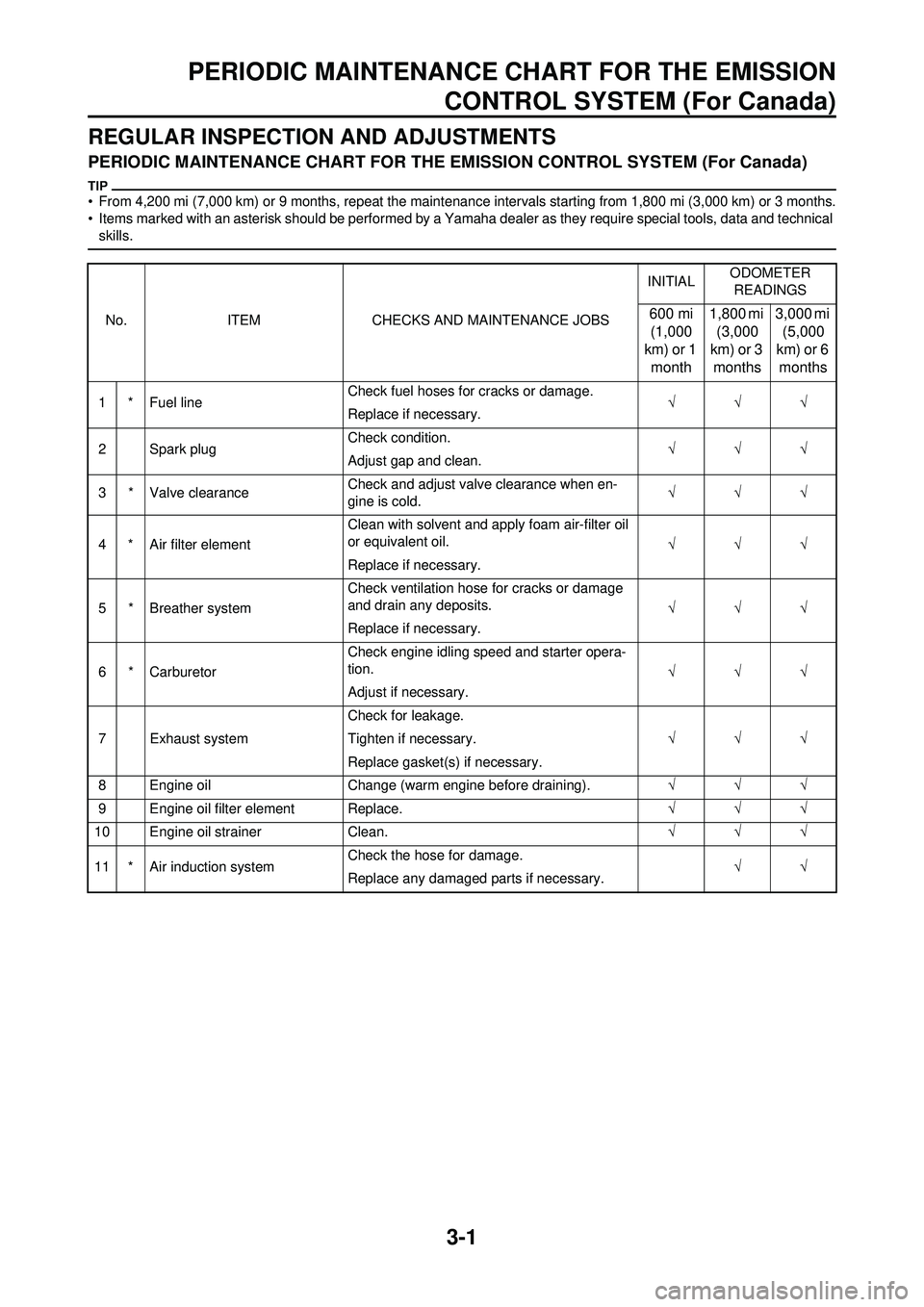
PERIODIC MAINTENANCE CHART FOR THE EMISSIONCONTROL SYSTEM (For Canada)
REGULAR INSPECTION AND ADJUSTMENTS
PERIODIC MAINTENANCE CHART FOR THE EMISSION CONTROL SYSTEM (For Canada)
• From 4,200 mi (7,000 km) or 9 months, repeat the maintenance intervals starting from 1,800 mi (3,000 km) or 3 months.
• Items marked with an asterisk should be performed by a Yamaha dealer as they require special tools, data and technical
skills.
No. ITEM CHECKS AND MAINTENANCE JOBS INITIAL
ODOMETER
READINGS600 mi (1,000
km) or 1 month 1,800 mi
(3,000
km) or 3 months 3,000 mi
(5,000
km) or 6 months
1*Fuel line Check fuel hoses for cracks or damage.
√√√
Replace if necessary.
2 Spark plug Check condition.
√√√
Adjust gap and clean.
3 * Valve clearance Check and adjust valve clearance when en-
gine is cold. √√√
4 * Air filter element Clean with solvent and apply foam air-filter oil
or equivalent oil.
√√√
Replace if necessary.
5 * Breather system Check ventilation hose for cracks or damage
and drain any deposits.
√√√
Replace if necessary.
6 * Carburetor Check engine idling speed and starter opera-
tion.
√√√
Adjust if necessary.
7 Exhaust system Check for leakage.
√√√
Tighten if necessary.
Replace gasket(s) if necessary.
8 Engine oil Change (warm engine before draining). √√√
9 Engine oil filter element Replace. √√√
10 Engine oil strainer Clean. √√√
11 * Air induction system Check the hose for damage.
√√
Replace any damaged parts if necessary.
Page 56 of 224
3-3
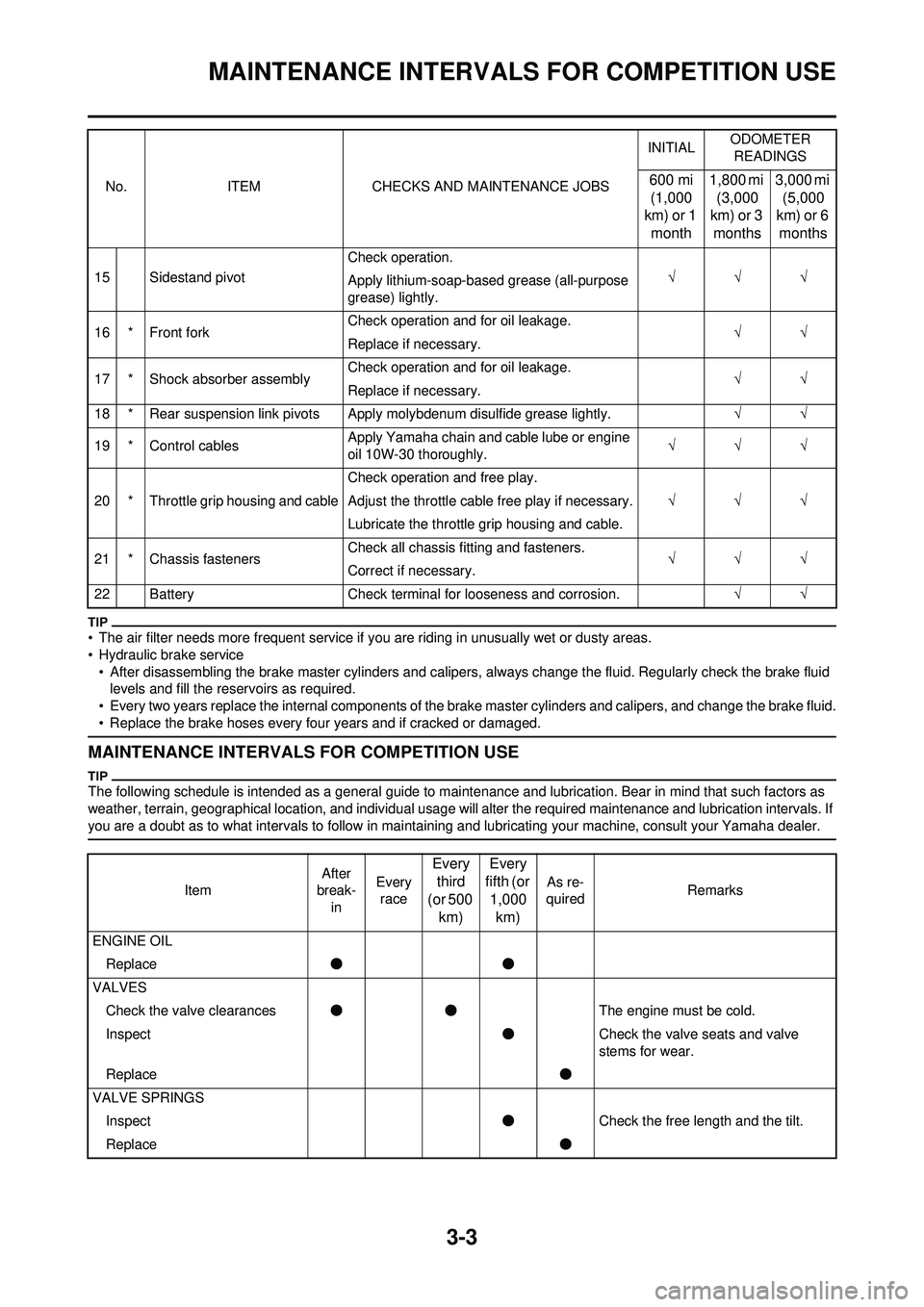
MAINTENANCE INTERVALS FOR COMPETITION USE
• The air filter needs more frequent service if you are riding in unusually wet or dusty areas.
• Hydraulic brake service• After disassembling the brake master cylinders and calipers, always change the fluid. Regularly check the brake fluid levels and fill the reservoirs as required.
• Every two years replace the internal components of the brake master cylinders and calipers, and change the brake fluid.
• Replace the brake hoses every four years and if cracked or damaged.
MAINTENANCE INTERVALS FOR COMPETITION USE
The following schedule is intended as a general guide to maintenance and lubrication. Bear in mind that such factors as
weather, terrain, geographical location, and individual usage will alter the required maintenance and lubrication intervals. If
you are a doubt as to what intervals to follow in maintaining and lubricating your machine, consult your Yamaha dealer.
15 Sidestand pivot Check operation.
√√√
Apply lithium-soap-based grease (all-purpose
grease) lightly.
16 * Front fork Check operation and for oil leakage.
√√
Replace if necessary.
17 * Shock absorber assembly Check operation and for oil leakage.
√√
Replace if necessary.
18 * Rear suspension link pivots Apply molybdenum disulfide grease lightly. √√
19 * Control cables Apply Yamaha chain and cable lube or engine
oil 10W-30 thoroughly. √√√
20 * Throttle grip housing and cable Check operation and free play.
√√√
Adjust the throttle cable free play if necessary.
Lubricate the throttle grip housing and cable.
21 * Chassis fasteners Check all chassis fitting and fasteners.
√√√
Correct if necessary.
22 Battery Check terminal for looseness and corrosion. √√
No.
ITEM CHECKS AND MAINTENANCE JOBS INITIAL
ODOMETER
READINGS
600 mi (1,000
km) or 1
month 1,800 mi
(3,000
km) or 3
months 3,000 mi
(5,000
km) or 6
months
Item After
break-
in Every
race
Every
third
(or 500 km) Every
fifth (or 1,000 km)
As re-
quired Remarks
ENGINE OIL Replace ●●
VALVES Check the valve clearances ●● The engine must be cold.
Inspect ●Check the valve seats and valve
stems for wear.
Replace ●
VALVE SPRINGS Inspect ●Check the free length and the tilt.
Replace ●
Page 58 of 224
3-5
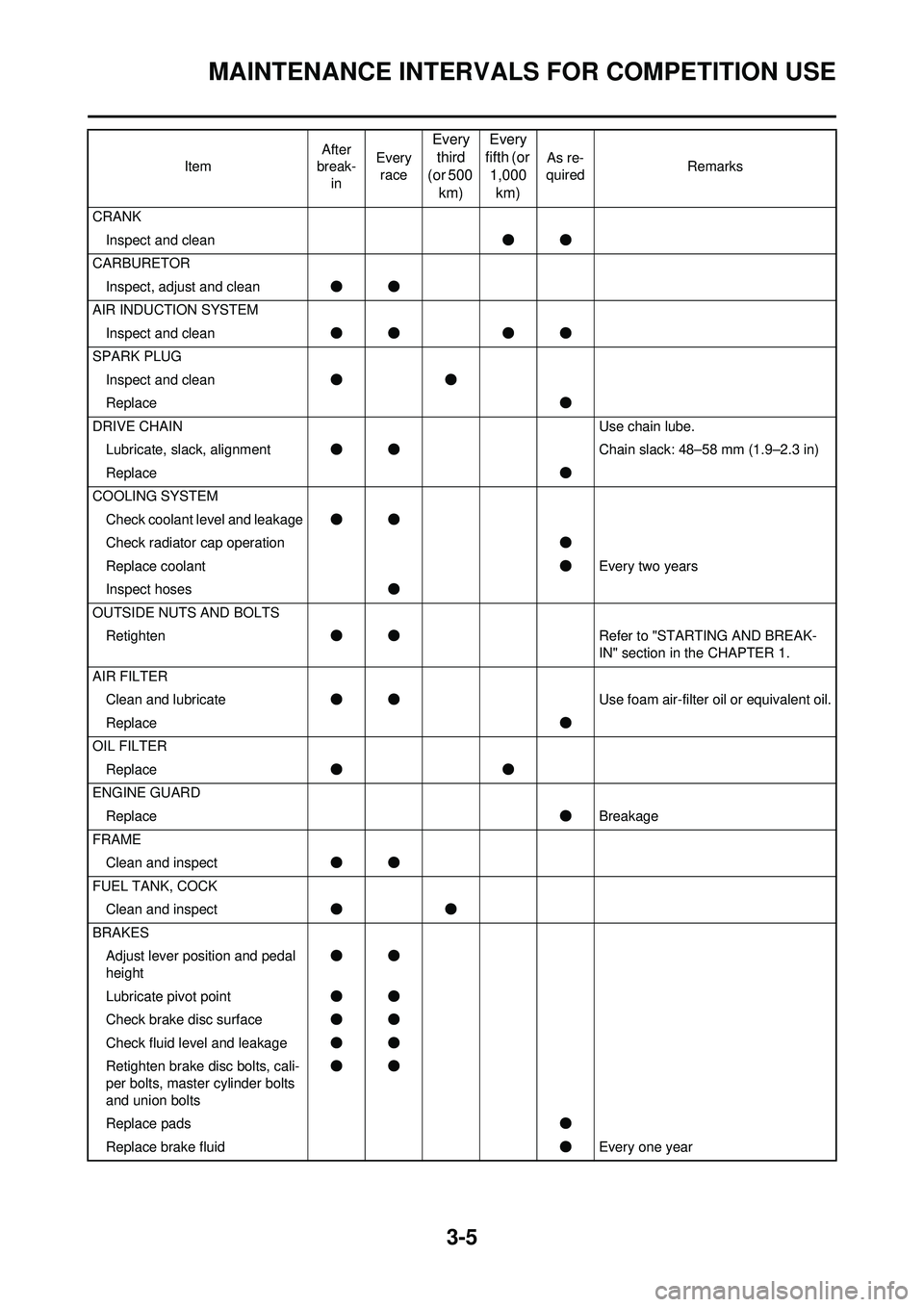
MAINTENANCE INTERVALS FOR COMPETITION USE
CRANKInspect and clean ●●
CARBURETOR Inspect, adjust and clean ●●
AIR INDUCTION SYSTEM Inspect and clean ●● ●●
SPARK PLUG Inspect and clean ●●
Replace ●
DRIVE CHAIN Use chain lube.
Lubricate, slack, alignment ●● Chain slack: 48–58 mm (1.9–2.3 in)
Replace ●
COOLING SYSTEM Check coolant level and leakage ●●
Check radiator cap operation ●
Replace coolant ●Every two years
Inspect hoses ●
OUTSIDE NUTS AND BOLTS Retighten ●● Refer to "STARTING AND BREAK-
IN" section in the CHAPTER 1.
AIR FILTER Clean and lubricate ●● Use foam air-filter oil or equivalent oil.
Replace ●
OIL FILTER Replace ●●
ENGINE GUARD Replace ●Breakage
FRAME Clean and inspect ●●
FUEL TANK, COCK Clean and inspect ●●
BRAKES Adjust lever position and pedal
height ●●
Lubricate pivot point ●●
Check brake disc surface ●●
Check fluid level and leakage ●●
Retighten brake disc bolts, cali-
per bolts, master cylinder bolts
and union bolts ●●
Replace pads ●
Replace brake fluid ●Every one year
Item
After
break-
in Every
race
Every third
(or 500 km) Every
fifth (or 1,000 km)
As re-
quired Remarks
Page 60 of 224
3-7
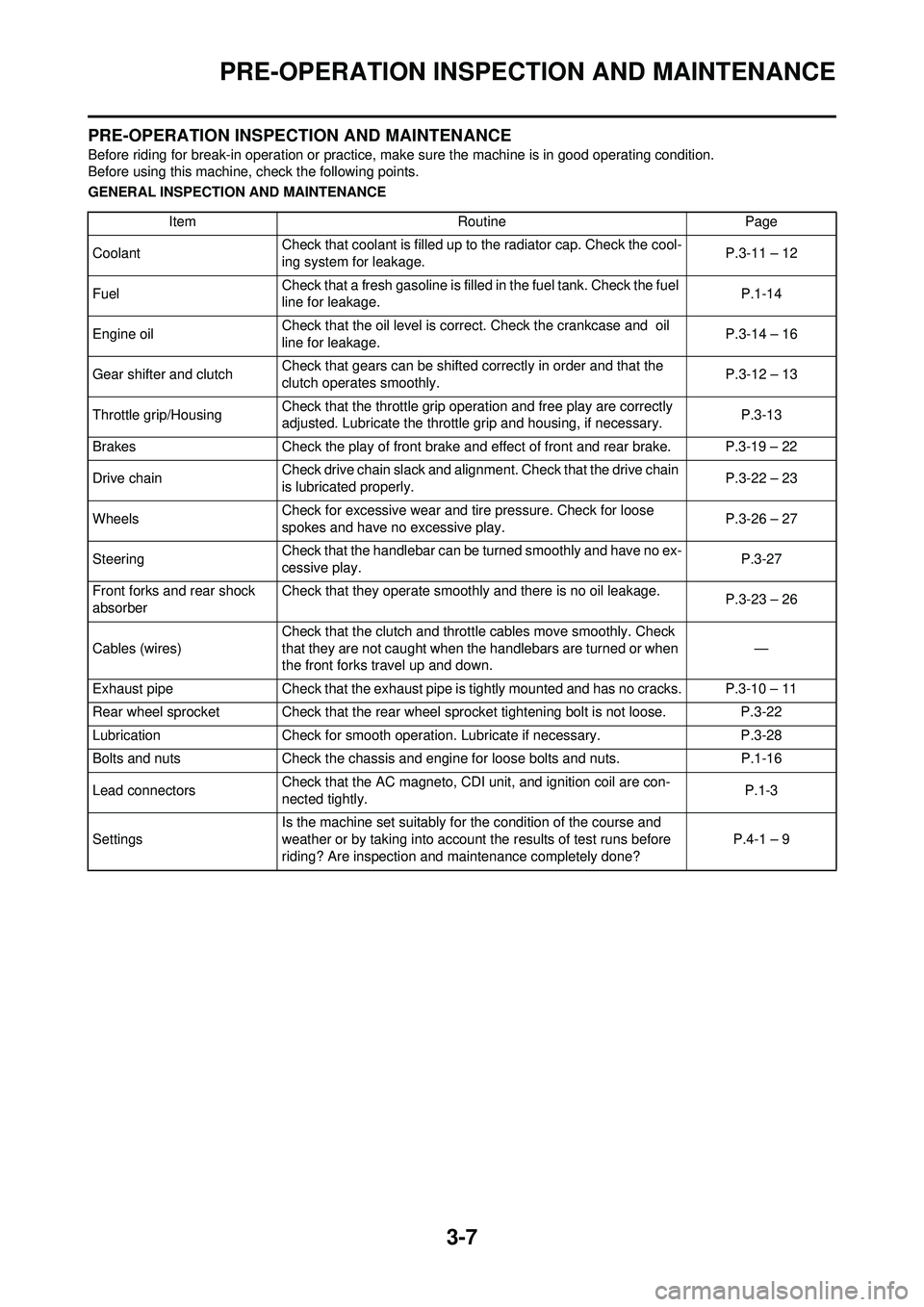
PRE-OPERATION INSPECTION AND MAINTENANCE
PRE-OPERATION INSPECTION AND MAINTENANCE
Before riding for break-in operation or practice, make sure the machine is in good operating condition.
Before using this machine, check the following points.
GENERAL INSPECTION AND MAINTENANCEItem RoutinePage
Coolant Check that coolant is filled up to the radiator cap. Check the cool-
ing system for leakage. P.3-11 – 12
Fuel Check that a fresh gasoline is filled in the fuel tank. Check the fuel
line for leakage.
P.1-14
Engine oil Check that the oil level is correct. Check the crankcase and oil
line for leakage. P.3-14 – 16
Gear shifter and clutch Check that gears can be shifted correctly in order and that the
clutch operates smoothly. P.3-12 – 13
Throttle grip/Housing Check that the throttle grip operation and free play are correctly
adjusted. Lubricate the throttle grip and housing, if necessary.
P.3-13
Brakes Check the play of front brake and effect of front and rear brake. P.3-19 – 22
Drive chain Check drive chain slack and alignment. Check that the drive chain
is lubricated properly. P.3-22 – 23
Wheels Check for excessive wear and tire pressure. Check for loose
spokes and have no excessive play. P.3-26 – 27
Steering Check that the handlebar can be turned smoothly and have no ex-
cessive play.
P.3-27
Front forks and rear shock
absorber Check that they operate smoothly and there is no oil leakage.
P.3-23 – 26
Cables (wires) Check that the clutch and throttle cables move smoothly. Check
that they are not caught when the handlebars are turned or when
the front forks travel up and down.
—
Exhaust pipe Check that the exhaust pipe is tightly mounted and has no cracks. P.3-10 – 11
Rear wheel sprocket Check that the rear wheel sprocket tightening bolt is not loose. P.3-22
Lubrication Check for smooth operation. Lubricate if necessary. P.3-28
Bolts and nuts Check the chassis and engine for loose bolts and nuts. P.1-16
Lead connectors Check that the AC magneto, CDI unit, and ignition coil are con-
nected tightly. P.1-3
Settings Is the machine set suitably for the condition of the course and
weather or by taking into account the results of test runs before
riding? Are inspection and maintenance completely done? P.4-1 – 9
Page 65 of 224
3-12
ENGINE
• Do not mix more than one type of ethylene glycol antifreeze con-
taining corrosion inhibitors for
aluminum engine.
• Do not use water containing im-
purities or oil.
Handling notes of coolant:
The coolant is harmful so it should be
handled with special care.
• When coolant splashes to your eye.
Thoroughly wash your eye with
water and see your doctor.
• When coolant splashes to your clothes.
Quickly wash it away with water
and then with soap.
• When coolant is swallowed. Quickly make him vomit and take
him to a doctor.
9. Install:
• Radiator capStart the engine and warm it up
for a several minutes.
10. Check: • Coolant levelCoolant level low →Add coolant.
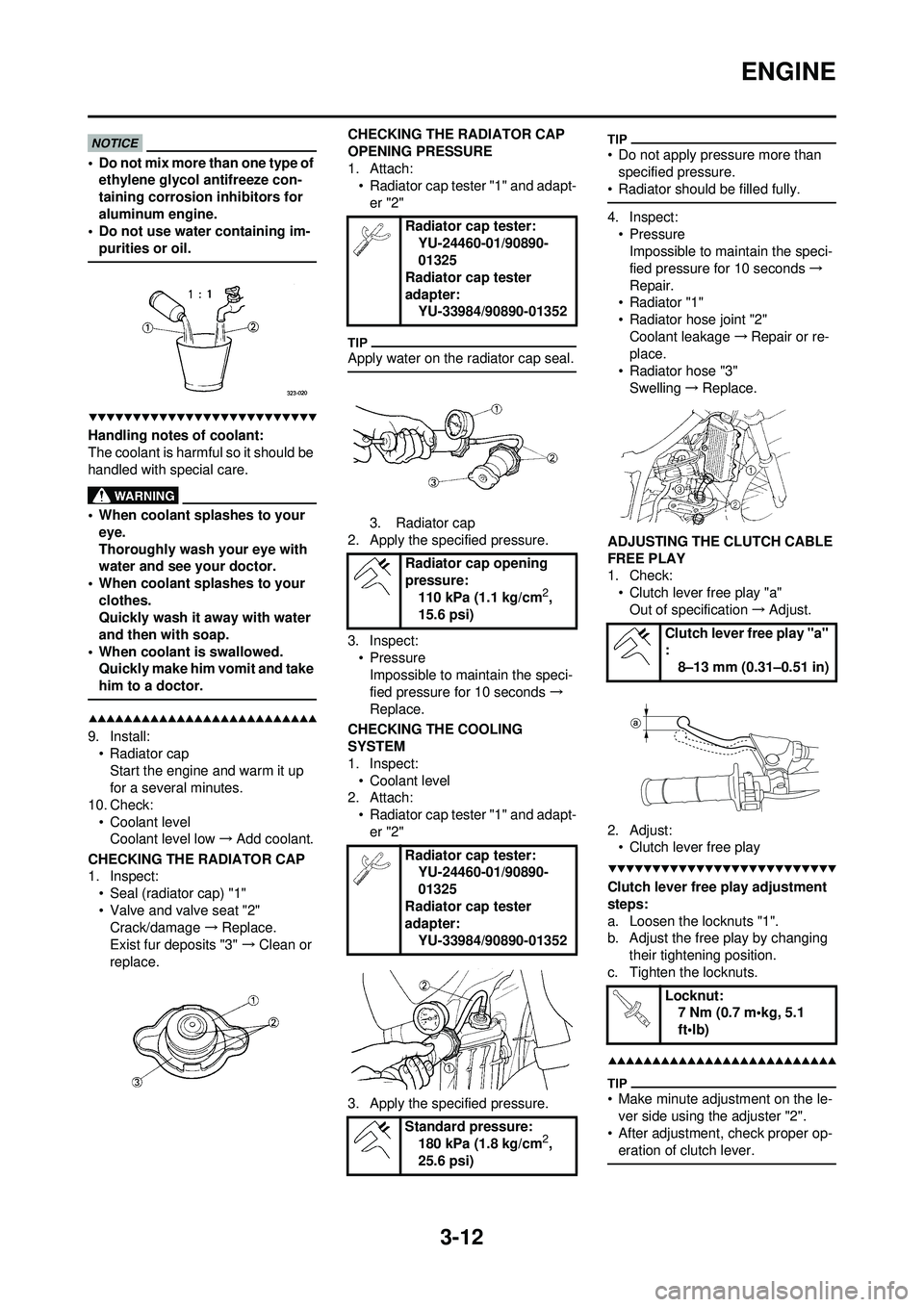
CHECKING THE RADIATOR CAP
1. Inspect: • Seal (radiator cap) "1"
• Valve and valve seat "2"Crack/damage →Replace.
Exist fur deposits "3" →Clean or
replace. CHECKING THE RADIATOR CAP
OPENING PRESSURE
1. Attach:
• Radiator cap tester "1" and adapt-
er "2"
Apply water on the radiator cap seal.
3. Radiator cap
2. Apply the specified pressure.
3. Inspect: •PressureImpossible to maintain the speci-
fied pressure for 10 seconds →
Replace.
CHECKING THE COOLING
SYSTEM
1. Inspect: • Coolant level
2. Attach:
• Radiator cap tester "1" and adapt-er "2"
3. Apply the specified pressure.
• Do not apply pressure more than specified pressure.
• Radiator should be filled fully.
4. Inspect: •PressureImpossible to maintain the speci-
fied pressure for 10 seconds →
Repair.
•Radiator "1"
• Radiator hose joint "2"
Coolant leakage →Repair or re-
place.
• Radiator hose "3" Swelling →Replace.
ADJUSTING THE CLUTCH CABLE
FREE PLAY
1. Check: • Clutch lever free play "a"Out of specification →Adjust.
2. Adjust: • Clutch lever free play
Clutch lever free play adjustment
steps:
a. Loosen the locknuts "1".
b. Adjust the free play by changing
their tightening position.
c. Tighten the locknuts.
• Make minute adjustment on the le- ver side using the adjuster "2".
• After adjustment, check proper op-
eration of clutch lever.
Radiator cap tester: YU-24460-01/90890-
01325
Radiator cap tester
adapter: YU-33984/90890-01352
Radiator cap opening
pressure: 110 kPa (1.1 kg/cm
2,
15.6 psi)
Radiator cap tester: YU-24460-01/90890-
01325
Radiator cap tester
adapter: YU-33984/90890-01352
Standard pressure: 180 kPa (1.8 kg/cm
2,
25.6 psi)
Clutch lever free play "a"
: 8–13 mm (0.31–0.51 in)
Locknut: 7 Nm (0.7 m•kg, 5.1
ft•lb)
Page 67 of 224
3-14
ENGINE
4. Clean:• Air filter elementClean them with solvent.
After cleaning, remove the remaining
solvent by squeezing the element.
• Do not twist the element when squeezing the element.
• Leaving too much of solvent in the element may result in poor
starting.
5. Inspect:• Air filter elementDamage →Replace.
6. Apply: • Foam-air-filter oil or equivalent oil to the element
• Squeeze out the excess oil. Ele-
ment should be wet but not drip-
ping.
• Wipe off the oil left on the element
surface using a clean dry cloth. (Ex-
cess oil in the element may ad-
versely affect engine starting.)
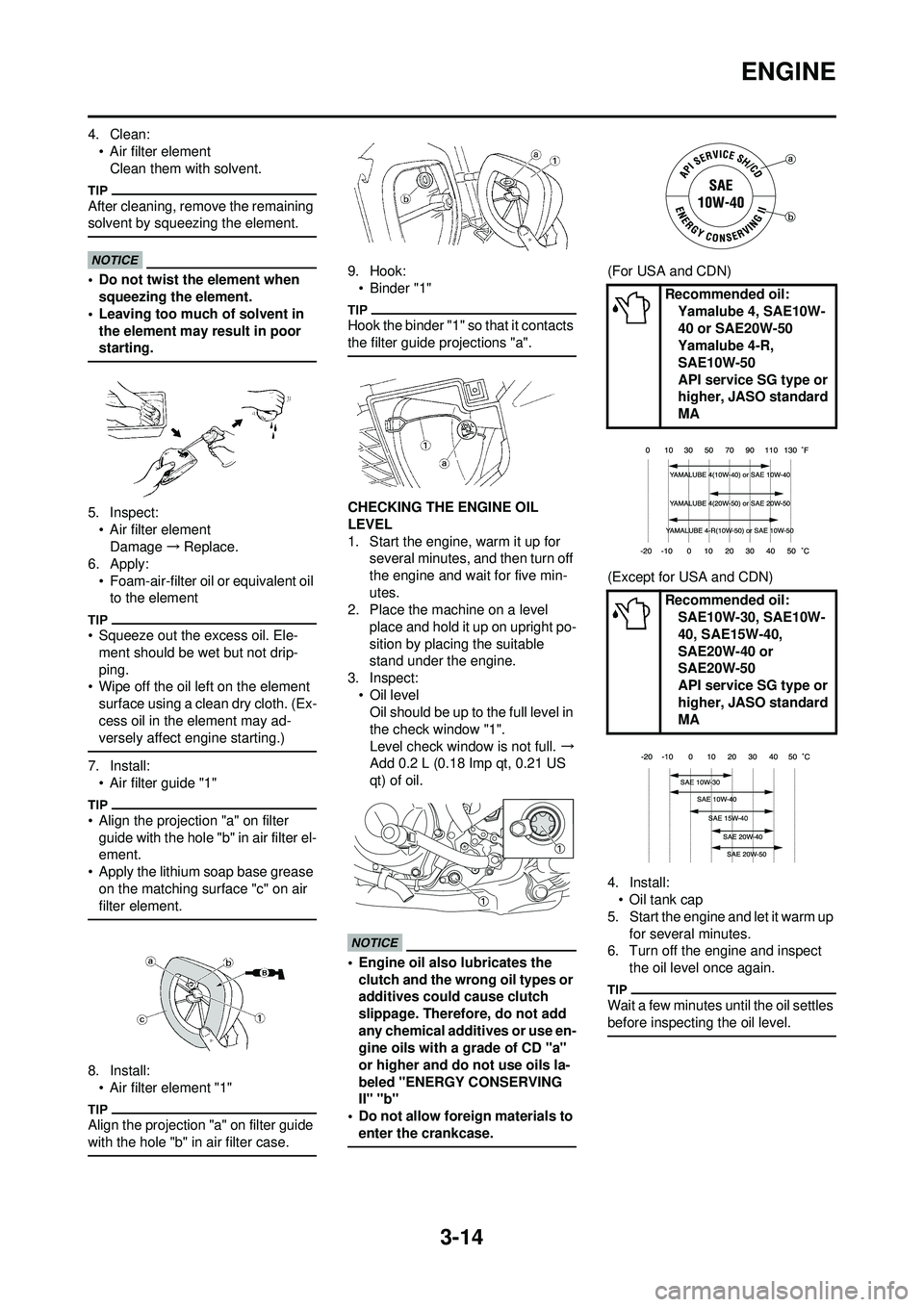
7. Install:• Air filter guide "1"
• Align the projection "a" on filter guide with the hole "b" in air filter el-
ement.
• Apply the lithium soap base grease on the matching surface "c" on air
filter element.
8. Install:• Air filter element "1"
Align the projection "a" on filter guide
with the hole "b" in air filter case.
9. Hook:• Binder "1"
Hook the binder "1" so that it contacts
the filter guide projections "a".
CHECKING THE ENGINE OIL
LEVEL
1. Start the engine, warm it up for several minutes, and then turn off
the engine and wait for five min-
utes.
2. Place the machine on a level
place and hold it up on upright po-
sition by placing the suitable
stand under the engine.
3. Inspect: • Oil levelOil should be up to the full level in
the check window "1".
Level check window is not full. →
Add 0.2 L (0.18 Imp qt, 0.21 US
qt) of oil.
• Engine oil also lubricates the
clutch and the wrong oil types or
additives could cause clutch
slippage. Therefore, do not add
any chemical additives or use en-
gine oils with a grade of CD "a"
or higher and do not use oils la-
beled "ENERGY CONSERVING
II" "b"
• Do not allow foreign materials to enter the crankcase.
(For USA and CDN)
(Except for USA and CDN)
4. Install:• Oil tank cap
5. Start the engine and let it warm up for several minutes.
6. Turn off the engine and inspect
the oil level once again.
Wait a few minutes until the oil settles
before inspecting the oil level.
Recommended oil:Yamalube 4, SAE10W-
40 or SAE20W-50
Yamalube 4-R,
SAE10W-50
API service SG type or
higher, JASO standard
MA
Recommended oil: SAE10W-30, SAE10W-
40, SAE15W-40,
SAE20W-40 or
SAE20W-50
API service SG type or
higher, JASO standard
MA
4
Page 68 of 224
3-15
ENGINE
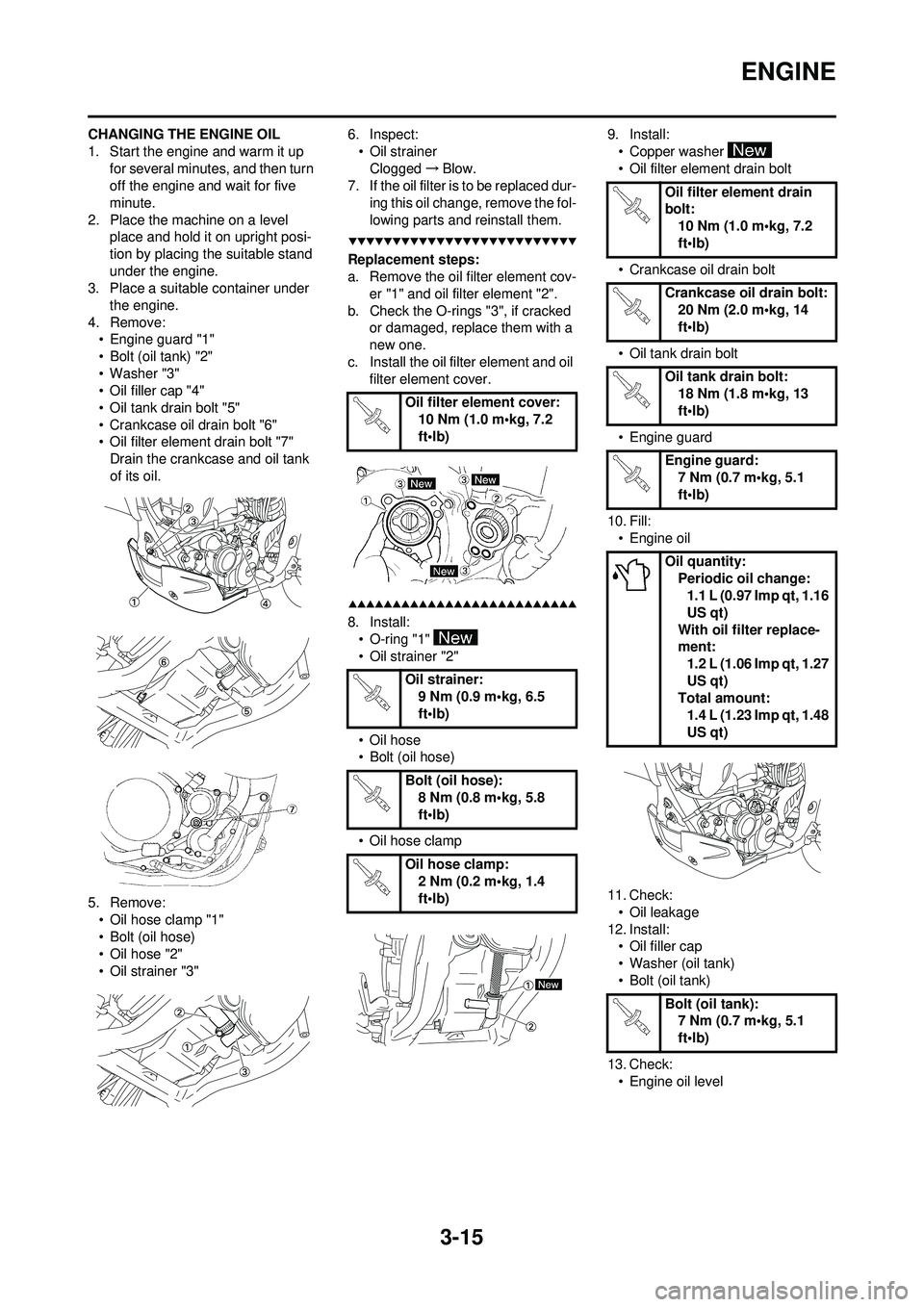
CHANGING THE ENGINE OIL
1. Start the engine and warm it up for several minutes, and then turn
off the engine and wait for five
minute.
2. Place the machine on a level place and hold it on upright posi-
tion by placing the suitable stand
under the engine.
3. Place a suitable container under
the engine.
4. Remove: • Engine guard "1"
• Bolt (oil tank) "2"
• Washer "3"
• Oil filler cap "4"
• Oil tank drain bolt "5"
• Crankcase oil drain bolt "6"
• Oil filter element drain bolt "7"
Drain the crankcase and oil tank
of its oil.
5. Remove: • Oil hose clamp "1"
• Bolt (oil hose)
•Oil hose "2"
• Oil strainer "3" 6. Inspect:
• Oil strainerClogged →Blow.
7. If the oil filter is to be replaced dur-
ing this oil change, remove the fol-
lowing parts and reinstall them.
Replacement steps:
a. Remove the oil filter element cov-er "1" and oil filter element "2".
b. Check the O-rings "3", if cracked or damaged, replace them with a
new one.
c. Install the oil filter element and oil filter element cover.
8. Install:
• O-ring "1"
• Oil strainer "2"
• Oil hose
• Bolt (oil hose)
• Oil hose clamp 9. Install:
• Copper washer
• Oil filter element drain bolt
• Crankcase oil drain bolt
• Oil tank drain bolt
• Engine guard
10. Fill: • Engine oil
11. Check: • Oil leakage
12. Install: • Oil filler cap
• Washer (oil tank)
• Bolt (oil tank)
13. Check: • Engine oil level
Oil filter element cover:
10 Nm (1.0 m•kg, 7.2
ft•lb)
Oil strainer: 9 Nm (0.9 m•kg, 6.5
ft•lb)
Bolt (oil hose): 8 Nm (0.8 m•kg, 5.8
ft•lb)
Oil hose clamp: 2 Nm (0.2 m•kg, 1.4
ft•lb)
Oil filter element drain
bolt:10 Nm (1.0 m•kg, 7.2
ft•lb)
Crankcase oil drain bolt: 20 Nm (2.0 m•kg, 14
ft•lb)
Oil tank drain bolt: 18 Nm (1.8 m•kg, 13
ft•lb)
Engine guard: 7 Nm (0.7 m•kg, 5.1
ft•lb)
Oil quantity: Periodic oil change:1.1 L (0.97 Imp qt, 1.16
US qt)
With oil filter replace-
ment: 1.2 L (1.06 Imp qt, 1.27
US qt)
Total amount:
1.4 L (1.23 Imp qt, 1.48
US qt)
Bolt (oil tank): 7 Nm (0.7 m•kg, 5.1
ft•lb)
Page 69 of 224
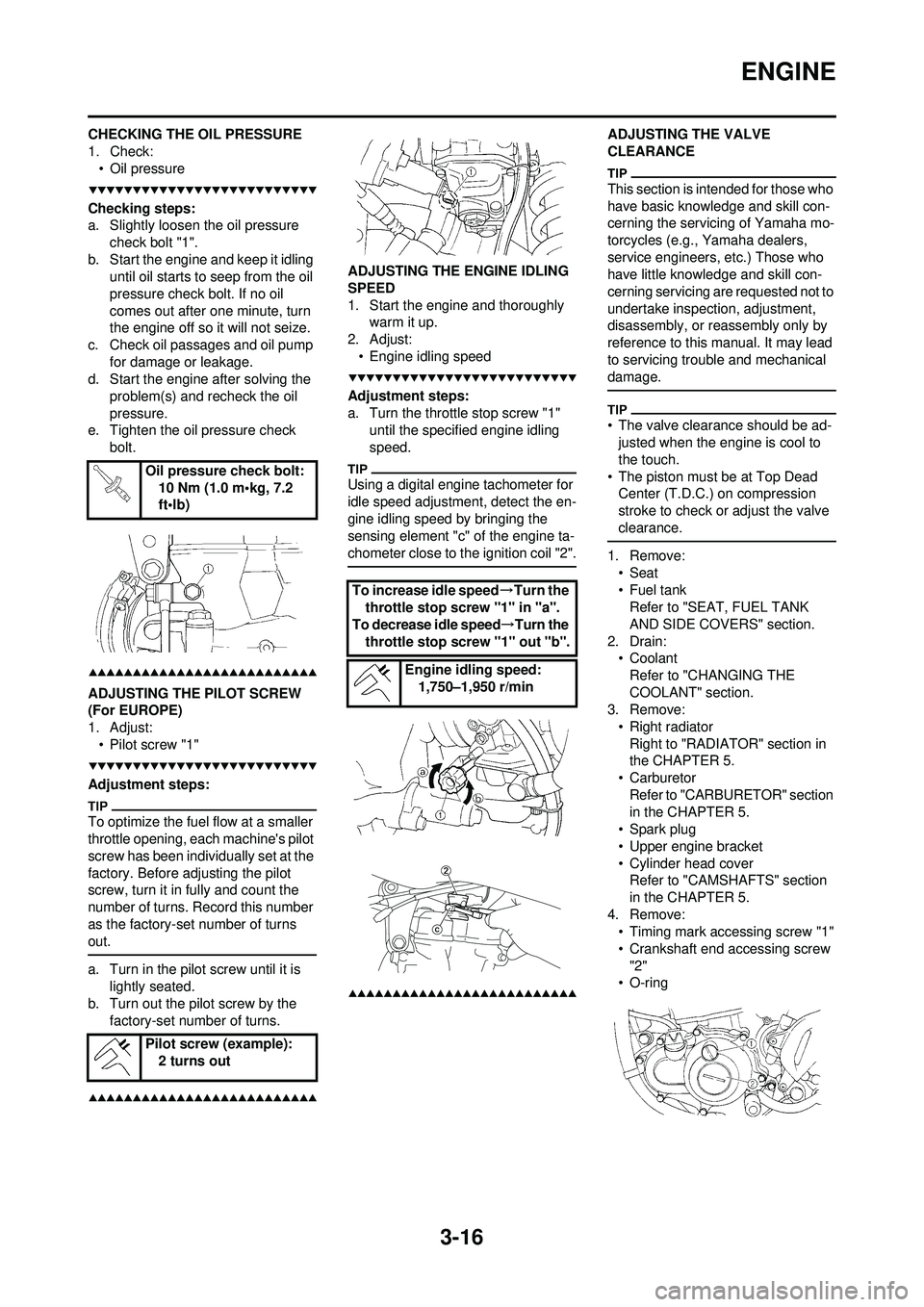
3-16
ENGINE
CHECKING THE OIL PRESSURE
1. Check:•Oil pressure
Checking steps:
a. Slightly loosen the oil pressure check bolt "1".
b. Start the engine and keep it idling until oil starts to seep from the oil
pressure check bolt. If no oil
comes out after one minute, turn
the engine off so it will not seize.
c. Check oil passages and oil pump for damage or leakage.
d. Start the engine after solving the
problem(s) and recheck the oil
pressure.
e. Tighten the oil pressure check
bolt.
ADJUSTING THE PILOT SCREW
(For EUROPE)
1. Adjust:• Pilot screw "1"
Adjustment steps:
To optimize the fuel flow at a smaller
throttle opening, each machine's pilot
screw has been individually set at the
factory. Before adjusting the pilot
screw, turn it in fully and count the
number of turns. Record this number
as the factory-set number of turns
out.
a. Turn in the pilot screw until it is lightly seated.
b. Turn out the pilot screw by the
factory-set number of turns.
ADJUSTING THE ENGINE IDLING
SPEED
1. Start the engine and thoroughly warm it up.
2. Adjust: • Engine idling speed
Adjustment steps:
a. Turn the throttle stop screw "1" until the specified engine idling
speed.
Using a digital engine tachometer for
idle speed adjustment, detect the en-
gine idling speed by bringing the
sensing element "c" of the engine ta-
chometer close to the ignition coil "2".
ADJUSTING THE VALVE
CLEARANCE
This section is intended for those who
have basic knowledge and skill con-
cerning the servicing of Yamaha mo-
torcycles (e.g., Yamaha dealers,
service engineers, etc.) Those who
have little knowledge and skill con-
cerning servicing are requested not to
undertake inspection, adjustment,
disassembly, or reassembly only by
reference to this manual. It may lead
to servicing trouble and mechanical
damage.
• The valve clearance should be ad-justed when the engine is cool to
the touch.
• The piston must be at Top Dead Center (T.D.C.) on compression
stroke to check or adjust the valve
clearance.
1. Remove:
•Seat
• Fuel tankRefer to "SEAT, FUEL TANK
AND SIDE COVERS" section.
2. Drain: • Coolant
Refer to "CHANGING THE
COOLANT" section.
3. Remove:
• Right radiatorRight to "RADIATOR" section in
the CHAPTER 5.
•Carburetor Refer to "CARBURETOR" section
in the CHAPTER 5.
• Spark plug
• Upper engine bracket
• Cylinder head cover Refer to "CAMSHAFTS" section
in the CHAPTER 5.
4. Remove: • Timing mark accessing screw "1"
• Crankshaft end accessing screw
"2"
• O-ring
Oil pressure check bolt:
10 Nm (1.0 m•kg, 7.2
ft•lb)
Pilot screw (example): 2 turns out
To increase idle speed →Turn the
throttle stop screw "1" in "a".
To decrease idle speed→Turn the
throttle stop screw "1" out "b".
Engine idling speed:1,750–1,950 r/min