maintenance YAMAHA WR 250F 2014 User Guide
[x] Cancel search | Manufacturer: YAMAHA, Model Year: 2014, Model line: WR 250F, Model: YAMAHA WR 250F 2014Pages: 230, PDF Size: 13.01 MB
Page 41 of 230

2-10
MAINTENANCE SPECIFICATIONS
ELECTRICALFront disc brake:
Disc outside dia.×Thickness 250 × 3.0 mm (9.84 × 0.12 in) 250 × 2.5 mm
(9.84 × 0.10 in)
Pad thickness 4.4 mm (0.17 in) 1.0 mm (0.04
in)
Master cylinder inside dia. 11.00 mm (0.43 in) ----
Caliper cylinder inside dia.27.00 mm (1.06 in) × 2 ----
Brake fluid type DOT #4 ----
Rear disc brake:
Disc outside dia.×Thickness 245 × 4.0 mm (9.65 × 0.16 in) 245 × 3.5 mm
(9.65 × 0.14 in)
Deflection limit ---- 0.15 mm
(0.006 in)
Pad thickness 6.4 mm (0.25 in) 1.0 mm (0.04
in)
Master cylinder inside dia. 11.0 mm (0.43 in) ----
Caliper cylinder inside dia.25.40 mm (1.00 in) × 1 ----
Brake fluid type DOT #4 ----
Brake lever and brake pedal:
Brake lever position 95 mm (3.74 in) ----
Brake pedal height (vertical height above footrest
top)10.0 mm (0.39 in) ----
Clutch lever free play (lever end) 8.0–13.0 mm (0.31–0.51 in) ----
Throttle grip free play 3.0–5.0 mm (0.12–0.20 in) ---- Item Standard Limit
Item Standard Limit
Ignition system:
Advancer type Electrical ----
CDI: AUS, NZ, ZA EUROPE
Pickup coil resistance (color) 248–372 Ωat 20 °C (68
°F) (White–Red)←----
CDI unit-model/manufacturer5UM-F1/YAMAHA 5UM-L1/YAMAHA ----
Ignition coil:
Model/manufacturer 5UL-10/DENSO ----
Minimum spark gap 6.0 mm (0.24 in) ----
Primary coil resistance 0.07–0.10 Ωat 20 °C (68 °F) ----
Secondary coil resistance 4.56–6.84 kΩat 20 °C (68 °F) ----
Charging system:
System type AC magneto ----
Model (stator)/manufacturer 5UM 30/YAMAHA ----
Normal output 14.0 V/120 W at 5,000 r/min ----
Charging coil resistance (color) 0.28–0.43 Ω at 20 °C (68 °F) (White–Ground) ----
Lighting coil resistance (color) 0.22–0.33 Ω at 20 °C (68 °F) (Yellow–Ground) ----
Page 42 of 230

2-11
MAINTENANCE SPECIFICATIONS
Rectifier/regulator:
Regulator type Semiconductor short circuit ----
Model/manufacture SH770AA/SHINDENGEN ----
Regulated voltage (AC) 12.5–13.5 V ----
Regulated voltage (DC) 14.0–15.0 V ----
Rectifier capacity (AC) 12.0 A ----
Rectifier capacity (DC) 8.0 A ----
Electric starting system:
Type Constant mesh ----
Starter motor:
Model/manufacturer 5UM01/YAMAHA ----
Operation voltage 12.0 V ----
Output 0.35 kW ----
Armature coil resistance 0.0189–0.0231 Ω at 20 °C (68 °F) ----
Brush overall length 7.0 mm (0.28 in) 3.50 mm (0.14
in)
Brush quantity 2 pcs. ----
Spring force 3.92–5.88 N (400–600 g, 14.11–21.17 oz) ----
Commutator diameter 17.6 mm (0.69 in) 16.6 mm (0.65
in)
Mica undercut (depth) 1.50 mm (0.06 in) ----
Starter relay:
Model/manufacturer RC19-042/MITSUBA ----
Amperage rating 180.0 A ----
Coil winding resistance 4.18–4.62 Ω at 20 °C (68 °F) ----
Starting circuit cut-off relay:
Model/manufacturer ACM33221 M38/MATSUSHITA ----
Coil winding resistance 75.6–92.5 Ω at 20 °C (68 °F) ----
Fuse (amperage×quantity):
Main fuse 10.0 A × 1 ----
Reserve fuse 10.0 A × 1 ----Item Standard Limit
Page 60 of 230

3-1
MAINTENANCE INTERVALS FOR COMPETITION USE
REGULAR INSPECTION AND ADJUSTMENTS
MAINTENANCE INTERVALS FOR COMPETITION USE
• The following schedule is intended as a general guide to maintenance and lubrication. Bear in mind that such factors as
weather, terrain, geographical location, and individual usage will alter the required maintenance and lubrication intervals.
If you are a doubt as to what intervals to follow in maintaining and lubricating your machine, consult your Yamaha dealer.
• Periodic inspection is essential in making full use of the machine performance. The service life of the parts varies sub-
stantially according to the environment in which the machine runs (e.g., rain, dirt, etc.). Therefore, earlier inspection is
required by reference to the list below.
ItemAfter
break-
inEvery
race
Every
third
(or 500
km)Every
fifth (or
1,000
km)
As re-
quiredRemarks
ENGINE OIL
Replace●●
VALVES
Check the valve clearances●●The engine must be cold.
Inspect●Check the valve seats and valve
stems for wear.
Replace●
VALVE SPRINGS
Inspect●Check the free length and the tilt.
Replace●
VALVE LIFTERS
Inspect●Check for scratches and wear.
Replace●
CAMSHAFTS Inspect the camshaft surface.
Inspect●Inspect the decompression system.
Replace●
CAMSHAFT SPROCKETS
Inspect●Check for wear on the teeth and for
damage.
Replace●
PISTON
Inspect●●Inspect crack.
Clean●Inspect carbon deposits and eliminate
them.
Replace●It is recommended that the piston pin
and ring are also replaced at the same
time.
PISTON RING
Inspect●Check ring end gap.
Replace●●
PISTON PIN
Inspect●
Replace●
CYLINDER HEAD Inspect carbon deposits and eliminate
them.
Inspect and clean●Change gasket.
Page 61 of 230

3-2
MAINTENANCE INTERVALS FOR COMPETITION USE
CYLINDER
Inspect and clean●Inspect score marks.
Replace●Inspect wear.
CLUTCH
Inspect and adjust●●Inspect housing, friction plate, clutch
plate and spring.
Replace●
TRANSMISSION
Inspect●
Replace bearing●
SHIFT FORK, SHIFT CAM,
GUIDE BAR
Inspect●Inspect wear.
ROTOR NUT
Retighten●●
MUFFLER
Inspect and retighten●●
Clean●
Replace●
CRANK
Inspect and clean●●
CARBURETOR
Inspect, adjust and clean●●
AIR INDUCTION SYSTEM
Inspect and clean●● ●●
SPARK PLUG
Inspect and clean●●
Replace●
DRIVE CHAIN Use chain lube.
Lubricate, slack, alignment●●Chain slack: 48.0–58.0 mm (1.89–
2.28 in)
Replace●
COOLING SYSTEM
Check coolant level and leakage●●
Check radiator cap operation●
Replace coolant●Every two years
Inspect hoses●
OUTSIDE NUTS AND BOLTS
Retighten●●Refer to "STARTING AND BREAK-
IN" section in the CHAPTER 1.
AIR FILTER
Clean and lubricate●●Use foam air-filter oil or equivalent oil.
Replace● ItemAfter
break-
inEvery
race
Every
third
(or 500
km)Every
fifth (or
1,000
km)
As re-
quiredRemarks
3
Page 62 of 230

3-3
MAINTENANCE INTERVALS FOR COMPETITION USE
OIL FILTER
Replace●●
ENGINE GUARD
Replace●Breakage
FRAME
Clean and inspect●●
FUEL TANK, COCK
Clean and inspect●●
BRAKES
Adjust lever position and pedal
height●●
Lubricate pivot point●●
Check brake disc surface●●
Check fluid level and leakage●●
Retighten brake disc bolts, cali-
per bolts, master cylinder bolts
and union bolts●●
Replace pads●
Replace brake fluid●Every one year
FRONT FORKS
Inspect and adjust●●
Replace oil●●Suspension oil "S1"
Replace oil seal●
FRONT FORK OIL SEAL AND
DUST SEAL
Clean and lube●●Lithium base grease
PROTECTOR GUIDE
Replace●
REAR SHOCK ABSORBER
Inspect and adjust●●
Lube●(After
rain
ride)●Molybdenum disulfide grease
Retighten●●
DRIVE CHAIN GUIDE AND
ROLLERS
Inspect●●
SWINGARM
Inspect, lube and retighten●●Molybdenum disulfide grease
RELAY ARM, CONNECTING
ROD
Inspect, lube and retighten●●Molybdenum disulfide grease
SIDESTAND
Lubricate●Lithium base grease ItemAfter
break-
inEvery
race
Every
third
(or 500
km)Every
fifth (or
1,000
km)
As re-
quiredRemarks
Page 63 of 230

3-4
MAINTENANCE INTERVALS FOR COMPETITION USE
STEERING HEAD
Inspect free play and retighten●●
Clean and lube●Lithium base grease
Replace bearing●
TIRE, WHEELS
Inspect air pressure, wheel run-
out, tire wear and spoke loose-
ness●●
Retighten sprocket bolt●●
Inspect bearings●
Replace bearings●
Lubricate●Lithium base grease
THROTTLE, CONTROL CABLE
Check routing and connection●●
Lubricate●●Yamaha cable lube or SAE 10W-40
motor oil
HOT STARTER, CLUTCH LEVER
Inspect free play●
BATTERY
Check terminal for looseness
and corrosion● ItemAfter
break-
inEvery
race
Every
third
(or 500
km)Every
fifth (or
1,000
km)
As re-
quiredRemarks
Page 64 of 230

3-5
PRE-OPERATION INSPECTION AND MAINTENANCE
PRE-OPERATION INSPECTION AND MAINTENANCE
Before riding for break-in operation or practice, make sure the machine is in good operating condition.
Before using this machine, check the following points.
GENERAL INSPECTION AND MAINTENANCE
Item Routine Page
CoolantCheck that coolant is filled up to the radiator cap. Check the cool-
ing system for leakage.P.3-9 – 10
FuelCheck that a fresh gasoline is filled in the fuel tank. Check the fuel
line for leakage.P.1-18
Engine oilCheck that the oil level is correct. Check the crankcase and oil
line for leakage.P.3-12 – 13
Gear shifter and clutchCheck that gears can be shifted correctly in order and that the
clutch operates smoothly.P.3-10 – 11
Throttle grip/HousingCheck that the throttle grip operation and free play are correctly
adjusted. Lubricate the throttle grip and housing, if necessary.P.3-11
Brakes Check the play of front brake and effect of front and rear brake. P.3-17 – 20
Drive chainCheck drive chain slack and alignment. Check that the drive chain
is lubricated properly.P.3-20 – 21
WheelsCheck for excessive wear and tire pressure. Check for loose
spokes and have no excessive play.P.3-24
SteeringCheck that the handlebar can be turned smoothly and have no ex-
cessive play.P.3-24 – 25
Front forks and rear shock
absorberCheck that they operate smoothly and there is no oil leakage.
P.3-21 – 24
Cables (wires)Check that the clutch and throttle cables move smoothly. Check
that they are not caught when the handlebars are turned or when
the front forks travel up and down.—
Exhaust pipe Check that the exhaust pipe is tightly mounted and has no cracks. P.3-8 – 9
Rear wheel sprocket Check that the rear wheel sprocket tightening bolt is not loose. P.3-20
Lubrication Check for smooth operation. Lubricate if necessary. P.3-26
Bolts and nuts Check the chassis and engine for loose bolts and nuts. P.1-20
Lead connectorsCheck that the AC magneto, CDI unit, and ignition coil are con-
nected tightly.P.1-6
SettingsIs the machine set suitably for the condition of the course and
weather or by taking into account the results of test runs before
riding? Are inspection and maintenance completely done?P.4-1 – 10
Page 70 of 230
3-11
ENGINE
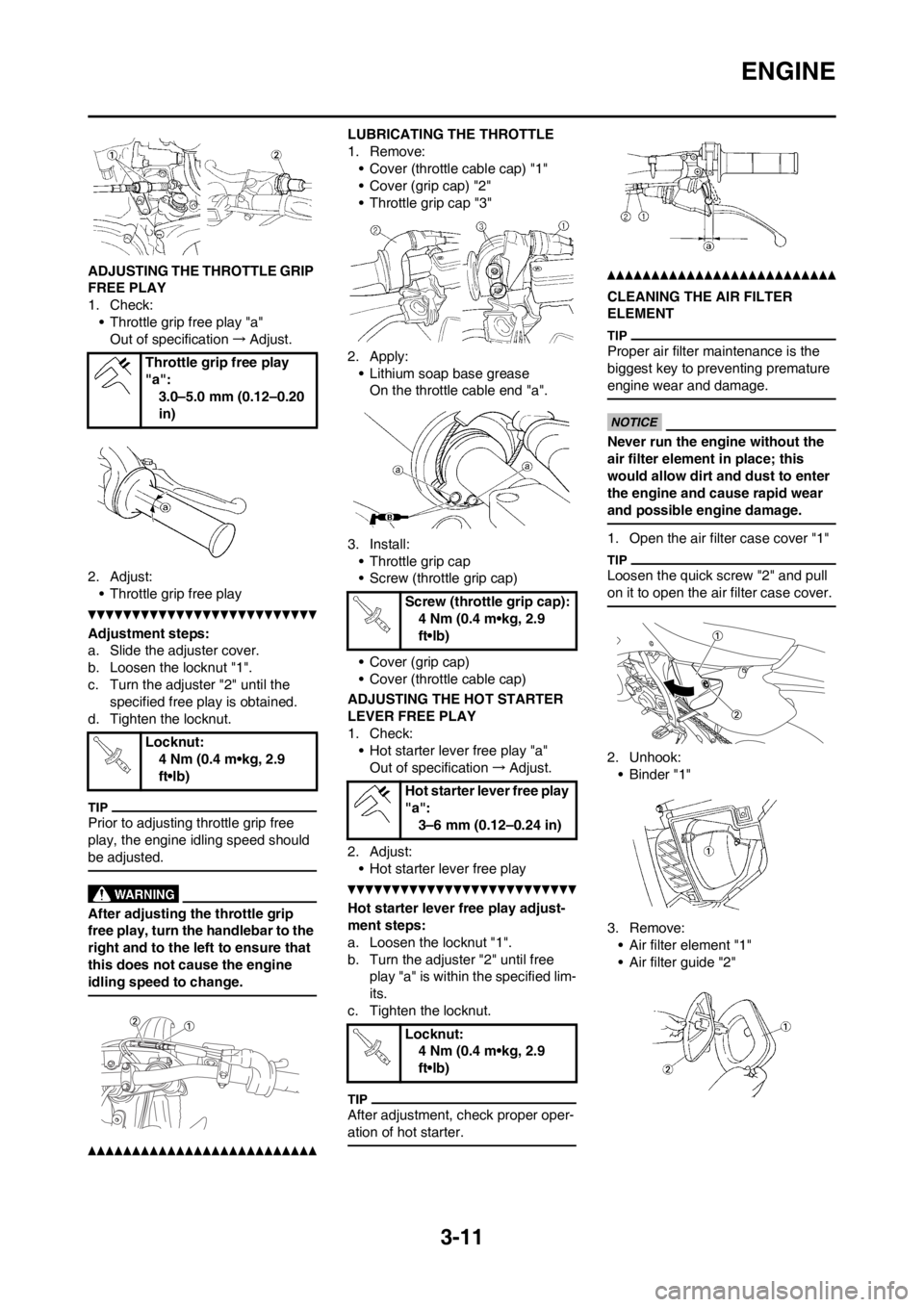
ADJUSTING THE THROTTLE GRIP
FREE PLAY
1. Check:
• Throttle grip free play "a"
Out of specification→Adjust.
2. Adjust:
• Throttle grip free play
Adjustment steps:
a. Slide the adjuster cover.
b. Loosen the locknut "1".
c. Turn the adjuster "2" until the
specified free play is obtained.
d. Tighten the locknut.
Prior to adjusting throttle grip free
play, the engine idling speed should
be adjusted.
After adjusting the throttle grip
free play, turn the handlebar to the
right and to the left to ensure that
this does not cause the engine
idling speed to change.
LUBRICATING THE THROTTLE
1. Remove:
• Cover (throttle cable cap) "1"
• Cover (grip cap) "2"
• Throttle grip cap "3"
2. Apply:
• Lithium soap base grease
On the throttle cable end "a".
3. Install:
• Throttle grip cap
• Screw (throttle grip cap)
• Cover (grip cap)
• Cover (throttle cable cap)
ADJUSTING THE HOT STARTER
LEVER FREE PLAY
1. Check:
• Hot starter lever free play "a"
Out of specification→Adjust.
2. Adjust:
• Hot starter lever free play
Hot starter lever free play adjust-
ment steps:
a. Loosen the locknut "1".
b. Turn the adjuster "2" until free
play "a" is within the specified lim-
its.
c. Tighten the locknut.
After adjustment, check proper oper-
ation of hot starter.
CLEANING THE AIR FILTER
ELEMENT
Proper air filter maintenance is the
biggest key to preventing premature
engine wear and damage.
Never run the engine without the
air filter element in place; this
would allow dirt and dust to enter
the engine and cause rapid wear
and possible engine damage.
1. Open the air filter case cover "1"
Loosen the quick screw "2" and pull
on it to open the air filter case cover.
2. Unhook:
•Binder "1"
3. Remove:
• Air filter element "1"
• Air filter guide "2" Throttle grip free play
"a":
3.0–5.0 mm (0.12–0.20
in)
Locknut:
4 Nm (0.4 m•kg, 2.9
ft•lb)
Screw (throttle grip cap):
4 Nm (0.4 m•kg, 2.9
ft•lb)
Hot starter lever free play
"a":
3–6 mm (0.12–0.24 in)
Locknut:
4 Nm (0.4 m•kg, 2.9
ft•lb)