oil pressure YAMAHA WR 250F 2014 Owners Manual
[x] Cancel search | Manufacturer: YAMAHA, Model Year: 2014, Model line: WR 250F, Model: YAMAHA WR 250F 2014Pages: 230, PDF Size: 13.01 MB
Page 31 of 230
1-21
CLEANING AND STORAGE
CLEANING AND STORAGE
CLEANING
Frequent cleaning of your machine
will enhance its appearance, maintain
good overall performance, and ex-
tend the life of many components.
1. Before washing the machine,
block off the end of the exhaust
pipe to prevent water from enter-
ing. A plastic bag secured with a
rubber band may be used for this
purpose.
2. If the engine is excessively
greasy, apply some degreaser to
it with a paint brush. Do not apply
degreaser to the chain, sprockets,
or wheel axles.
3. Rinse the dirt and degreaser off
with a garden hose; use only
enough pressure to do the job.
Do not use high-pressure washers
or steam-jet cleaners since they
cause water seepage and deterio-
ration seals.
4. After the majority of the dirt has
been hosed off, wash all surfaces
with warm water and a mild deter-
gent. Use an old toothbrush to
clean hard-to-reach places.
5. Rinse the machine off immediate-
ly with clean water, and dry all
surfaces with a soft towel or cloth.
6. Immediately after washing, re-
move excess water from the
chain with a paper towel and lubri-
cate the chain to prevent rust.
7. Clean the seat with a vinyl uphol-
stery cleaner to keep the cover
pliable and glossy.
8. Automotive wax may be applied
to all painted or chromed surfac-
es. Avoid combination cleaner-
waxes, as they may contain abra-
sives.
9. After completing the above, start
the engine and allow it to idle for
several minutes.STORAGE
If your machine is to be stored for 60
days or more, some preventive mea-
sures must be taken to avoid deterio-
ration. After cleaning the machine
thoroughly, prepare it for storage as
follows:
1. Drain the fuel tank, fuel lines, and
the carburetor float bowl.
2. Remove the spark plug, pour a ta-
blespoon of SAE 10W-40 motor
oil in the spark plug hole, and re-
install the plug. With the engine
stop switch pushed in, kick the en-
gine over several times to coat the
cylinder walls with oil.
3. Remove the drive chain, clean it
thoroughly with solvent, and lubri-
cate it. Reinstall the chain or store
it in a plastic bag tied to the frame.
4. Lubricate all control cables.
5. Block the frame up to raise the
wheels off the ground.
6. Tie a plastic bag over the exhaust
pipe outlet to prevent moisture
from entering.
7. If the machine is to be stored in a
humid or salt-air environment,
coat all exposed metal surfaces
with a film of light oil. Do not apply
oil to rubber parts or the seat cov-
er.
Make any necessary repairs before
the machine is stored.
Page 39 of 230

2-8
MAINTENANCE SPECIFICATIONS
CHASSISCarburetor: ZA, AUS, NZ EUROPE
Type/manufacturer FCR-MX37/KEIHIN←----
I. D. mark 5UME E0 5UML L0 ----
Main jet (M.J) #170 #160 ----
Main air jet (M.A.J) #115←----
Jet needle (J.N) NJRU NNGU ----
Cutaway (C.A) 1.5←----
Pilot jet (P.J) #42 #45 ----
Pilot air jet (P.A.J) #70←----
Pilot outlet (P.O) ø0.9←----
Bypass (B.P) ø1.0←----
Valve seat size (V.S) ø3.8←----
Starter jet (G.S) #68←----
Leak jet (Acc.P) #70←----
Float height (F.H) 8.0 mm (0.31 in)←----
Engine idle speed 1,750–1,950 r/min←----
Intake vacuum 31.0–37.0 kPa
(233–278 mmHg,
9.2–10.9 inHg)←----
Hot starter lever free play 3–6 mm (0.12–0.24
in)←----
Lubrication system:
Oil filter type Paper type ----
Oil pump type Trochoid type ----
Tip clearance 0.12 mm or less (0.0047 in or less) 0.20 mm (0.008
in)
Side clearance 0.090–0.170 mm (0.0035–0.0067 in) 0.24 mm
(0.0094 in)
Housing and rotor clearance 0.03–0.10 mm (0.0012–0.0039 in) 0.17 mm
(0.0067 in)
Cooling:
Radiator core size
Width 120.2 mm (4.73 in) ----
Height 240.0 mm (9.45 in) ----
Thickness 22.0 mm (0.87 in) ----
Radiator cap opening pressure 95.0–125.0 kPa (0.95–1.25 kg/cm
2, 13.8–
18.1 psi)----
Radiator capacity (total) 0.54 L (0.48 Imp qt, 0.57 US qt) ----
Water pump
Type Single-suction centrifugal pump ----Item Standard Limit
Item Standard Limit
Steering system:
Steering bearing typeTaper roller bearing ----
Page 40 of 230

2-9
MAINTENANCE SPECIFICATIONS
Front suspension:
Front fork travel 300.0 mm (11.81 in) ----
Fork spring free length 460.0 mm (18.11 in) 455.0 mm
(17.91 in)
Spring rate, STD K = 4.40 N/mm (0.45 kg/mm, 25.12 lb/in) ----
Optional spring/spacer Yes ----
Oil capacity 648.0 cm
3 (22.85 lmp oz, 21.91 US oz) ----
Oil level 132.0 mm (5.20 in) ----
tube and damper rod fully compressed without
spring.)95.0–150.0 mm (3.74–5.91 in) ----
Oil grade Suspension oil "S1" ----
Inner tube outer diameter 48 mm (1.89 in) ----
Front fork top end 5 mm (0.20 in) ----
Rear suspension: AUS, NZ, ZA EUROPE
Shock absorber travel 130.0 mm (5.12 in)←----
Spring free length 260.0 mm (10.24 in)←----
Fitting length 245.0 mm (9.65 in) 248.5 mm (9.78 in) ----
Preload length
(0.06–0.87 in)←----
Spring rate, STD K = 52.00 N/mm (5.30
kg/mm, 296.92 lb/in)←----
Optional spring Yes←----
Enclosed gas pressure 1,000 kPa (10.0 kg/cm
2,
142.2 psi)←----
Swingarm:
Swingarm free play limit
End ---- 1.0 mm (0.04
in)
Wheel: ZA AUS, NZ, EUROPE
Front wheel type Spoke wheel←----
Rear wheel type Spoke wheel←----
Front rim size/material 21 × 1.60/Aluminum←----
Rear rim size/material 18 × 1.85/Aluminum18 × 2.15/Aluminum ----
Rim runout limit:
Radial ---- ---- 2.0 mm (0.08
in)
Lateral ---- ---- 2.0 mm (0.08
in)
Drive chain:
Type/manufacturer DID520VM2/DAIDO ----
Number of links 113 links + joint ----
Chain slack 48.0–58.0 mm (1.89–2.28 in) ----
Chain length (15 links) ---- 239.3 mm
(9.42 in) Item Standard Limit
Page 43 of 230

2-12
TIGHTENING TORQUES
TIGHTENING TORQUES
ENGINE
△- marked portion shall be checked for torque tightening after break-in or before each race.
ItemThread
sizeQ'ty Tightening torque Remarks
Spark plug M10S 1 13 Nm (1.3 m•kg, 9.4 ft•lb)
Camshaft cap M6 10 10 Nm (1.0 m•kg, 7.2 ft•lb)
Cylinder head blind plug screw M12 1 28 Nm (2.8 m•kg, 20 ft•lb)
Cylinder head (stud bolt) M6 2 7 Nm (0.7 m•kg, 5.1 ft•lb)
Cylinder head (stud bolt) M8 1 15 Nm (1.5 m•kg, 11 ft•lb)
Cylinder head (bolt) M9 4 38 Nm (3.8 m•kg, 27 ft•lb)
Cylinder head (nut) M6 2 10 Nm (1.0 m•kg, 7.2 ft•lb)
Cylinder head cover M6 2 10 Nm (1.0 m•kg, 7.2 ft•lb)
Cylinder M6 1 10 Nm (1.0 m•kg, 7.2 ft•lb)
Balancer weight M6 2 10 Nm (1.0 m•kg, 7.2 ft•lb)
Balancer shaft driven gear M14 1 50 Nm (5.0 m•kg, 36 ft•lb) Lock washer
Timing chain guide (intake side) M6 2 10 Nm (1.0 m•kg, 7.2 ft•lb)
Timing chain tensioner M6 2 10 Nm (1.0 m•kg, 7.2 ft•lb)
Timing chain tensioner cap bolt M6 1 7 Nm (0.7 m•kg, 5.1 ft•lb)
Impeller M8 1 14 Nm (1.4 m•kg, 10 ft•lb)
Radiator hose clamp M6 10 2 Nm (0.2 m•kg, 1.4 ft•lb)
Coolant drain bolt M6 1 10 Nm (1.0 m•kg, 7.2 ft•lb)Copper
washer
Water pump housing M6 4 10 Nm (1.0 m•kg, 7.2 ft•lb)
Radiator stay M6 6 10 Nm (1.0 m•kg, 7.2 ft•lb)
Radiator M6 4 10 Nm (1.0 m•kg, 7.2 ft•lb)
Radiator pipe M6 1 10 Nm (1.0 m•kg, 7.2 ft•lb)
Oil pump cover M4 1 1.7 Nm (0.17 m•kg, 1.2 ft•lb)
Oil pump M6 3 10 Nm (1.0 m•kg, 7.2 ft•lb)
Oil filter element drain bolt M6 1 10 Nm (1.0 m•kg, 7.2 ft•lb)
Oil filter element cover M6 2 10 Nm (1.0 m•kg, 7.2 ft•lb)
Oil strainer (crankcase) M6 2 10 Nm (1.0 m•kg, 7.2 ft•lb)
Oil delivery pipe 1 (M10) M10 1 20 Nm (2.0 m•kg, 14 ft•lb)Copper
washer
Oil delivery pipe 1 (M8) M8 2 18 Nm (1.8 m•kg, 13 ft•lb)Copper
washer
△Oil hose M6 3 8 Nm (0.8 m•kg, 5.8 ft•lb)
Oil hose clamp — 2 2 Nm (0.2 m•kg, 1.4 ft•lb)
Oil strainer (oil tank) M6 1 9 Nm (0.9 m•kg, 6.5 ft•lb)
Oil tank drain bolt M8 1 18 Nm (1.8 m•kg, 13 ft•lb)
Oil tank (upper) M6 1 7 Nm (0.7 m•kg, 5.1 ft•lb)
Oil tank and frame M6 3 9 Nm (0.9 m•kg, 6.5 ft•lb)
Oil pressure check bolt M6 1 10 Nm (1.0 m•kg, 7.2 ft•lb)
Carburetor joint M6 2 10 Nm (1.0 m•kg, 7.2 ft•lb)
Carburetor joint clamp M4 2 3 Nm (0.3 m•kg, 2.2 ft•lb)
Air filter joint clamp M6 1 3 Nm (0.3 m•kg, 2.2 ft•lb)
Page 63 of 230

3-4
MAINTENANCE INTERVALS FOR COMPETITION USE
STEERING HEAD
Inspect free play and retighten●●
Clean and lube●Lithium base grease
Replace bearing●
TIRE, WHEELS
Inspect air pressure, wheel run-
out, tire wear and spoke loose-
ness●●
Retighten sprocket bolt●●
Inspect bearings●
Replace bearings●
Lubricate●Lithium base grease
THROTTLE, CONTROL CABLE
Check routing and connection●●
Lubricate●●Yamaha cable lube or SAE 10W-40
motor oil
HOT STARTER, CLUTCH LEVER
Inspect free play●
BATTERY
Check terminal for looseness
and corrosion● ItemAfter
break-
inEvery
race
Every
third
(or 500
km)Every
fifth (or
1,000
km)
As re-
quiredRemarks
Page 64 of 230

3-5
PRE-OPERATION INSPECTION AND MAINTENANCE
PRE-OPERATION INSPECTION AND MAINTENANCE
Before riding for break-in operation or practice, make sure the machine is in good operating condition.
Before using this machine, check the following points.
GENERAL INSPECTION AND MAINTENANCE
Item Routine Page
CoolantCheck that coolant is filled up to the radiator cap. Check the cool-
ing system for leakage.P.3-9 – 10
FuelCheck that a fresh gasoline is filled in the fuel tank. Check the fuel
line for leakage.P.1-18
Engine oilCheck that the oil level is correct. Check the crankcase and oil
line for leakage.P.3-12 – 13
Gear shifter and clutchCheck that gears can be shifted correctly in order and that the
clutch operates smoothly.P.3-10 – 11
Throttle grip/HousingCheck that the throttle grip operation and free play are correctly
adjusted. Lubricate the throttle grip and housing, if necessary.P.3-11
Brakes Check the play of front brake and effect of front and rear brake. P.3-17 – 20
Drive chainCheck drive chain slack and alignment. Check that the drive chain
is lubricated properly.P.3-20 – 21
WheelsCheck for excessive wear and tire pressure. Check for loose
spokes and have no excessive play.P.3-24
SteeringCheck that the handlebar can be turned smoothly and have no ex-
cessive play.P.3-24 – 25
Front forks and rear shock
absorberCheck that they operate smoothly and there is no oil leakage.
P.3-21 – 24
Cables (wires)Check that the clutch and throttle cables move smoothly. Check
that they are not caught when the handlebars are turned or when
the front forks travel up and down.—
Exhaust pipe Check that the exhaust pipe is tightly mounted and has no cracks. P.3-8 – 9
Rear wheel sprocket Check that the rear wheel sprocket tightening bolt is not loose. P.3-20
Lubrication Check for smooth operation. Lubricate if necessary. P.3-26
Bolts and nuts Check the chassis and engine for loose bolts and nuts. P.1-20
Lead connectorsCheck that the AC magneto, CDI unit, and ignition coil are con-
nected tightly.P.1-6
SettingsIs the machine set suitably for the condition of the course and
weather or by taking into account the results of test runs before
riding? Are inspection and maintenance completely done?P.4-1 – 10
Page 69 of 230
3-10
ENGINE
• Do not mix more than one type of
ethylene glycol antifreeze con-
taining corrosion inhibitors for
aluminum engine.
• Do not use water containing im-
purities or oil.
Handling notes of coolant:
The coolant is harmful so it should be
handled with special care.
• When coolant splashes to your
eye.
Thoroughly wash your eye with
water and see your doctor.
• When coolant splashes to your
clothes.
Quickly wash it away with water
and then with soap.
• When coolant is swallowed.
Quickly make him vomit and take
him to a doctor.
9. Install:
• Radiator cap
Start the engine and warm it up
for a several minutes.
10. Check:
• Coolant level
Coolant level low→Add coolant.
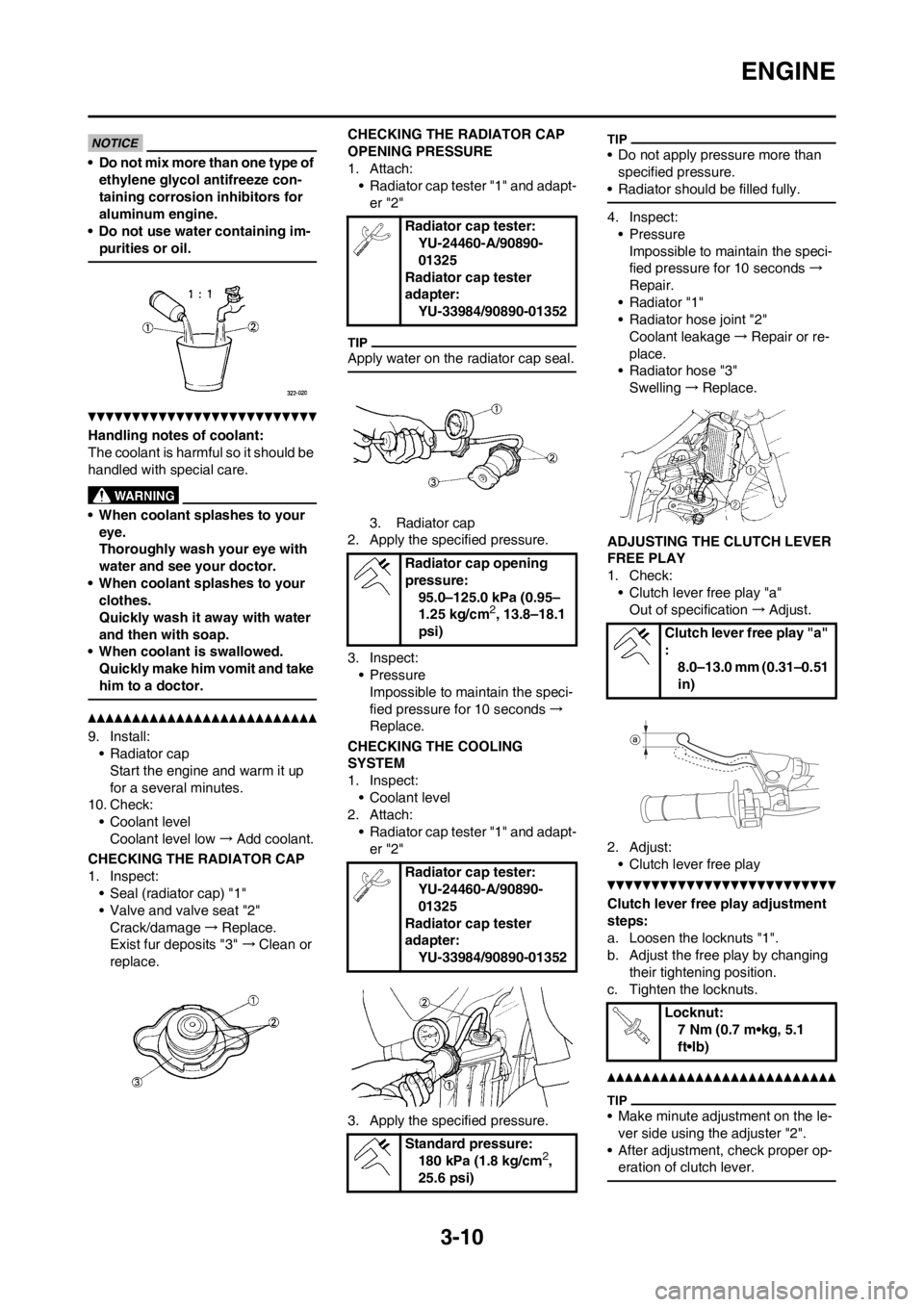
CHECKING THE RADIATOR CAP
1. Inspect:
• Seal (radiator cap) "1"
• Valve and valve seat "2"
Crack/damage→Replace.
Exist fur deposits "3" →Clean or
replace.CHECKING THE RADIATOR CAP
OPENING PRESSURE
1. Attach:
• Radiator cap tester "1" and adapt-
er "2"
Apply water on the radiator cap seal.
3. Radiator cap
2. Apply the specified pressure.
3. Inspect:
•Pressure
Impossible to maintain the speci-
fied pressure for 10 seconds→
Replace.
CHECKING THE COOLING
SYSTEM
1. Inspect:
• Coolant level
2. Attach:
• Radiator cap tester "1" and adapt-
er "2"
3. Apply the specified pressure.
• Do not apply pressure more than
specified pressure.
• Radiator should be filled fully.
4. Inspect:
• Pressure
Impossible to maintain the speci-
fied pressure for 10 seconds→
Repair.
•Radiator "1"
• Radiator hose joint "2"
Coolant leakage→Repair or re-
place.
• Radiator hose "3"
Swelling→Replace.
ADJUSTING THE CLUTCH LEVER
FREE PLAY
1. Check:
• Clutch lever free play "a"
Out of specification→Adjust.
2. Adjust:
• Clutch lever free play
Clutch lever free play adjustment
steps:
a. Loosen the locknuts "1".
b. Adjust the free play by changing
their tightening position.
c. Tighten the locknuts.
• Make minute adjustment on the le-
ver side using the adjuster "2".
• After adjustment, check proper op-
eration of clutch lever.
Radiator cap tester:
YU-24460-A/90890-
01325
Radiator cap tester
adapter:
YU-33984/90890-01352
Radiator cap opening
pressure:
95.0–125.0 kPa (0.95–
1.25 kg/cm
2, 13.8–18.1
psi)
Radiator cap tester:
YU-24460-A/90890-
01325
Radiator cap tester
adapter:
YU-33984/90890-01352
Standard pressure:
180 kPa (1.8 kg/cm
2,
25.6 psi)
Clutch lever free play "a"
:
8.0–13.0 mm (0.31–0.51
in)
Locknut:
7 Nm (0.7 m•kg, 5.1
ft•lb)
Page 72 of 230
3-13
ENGINE
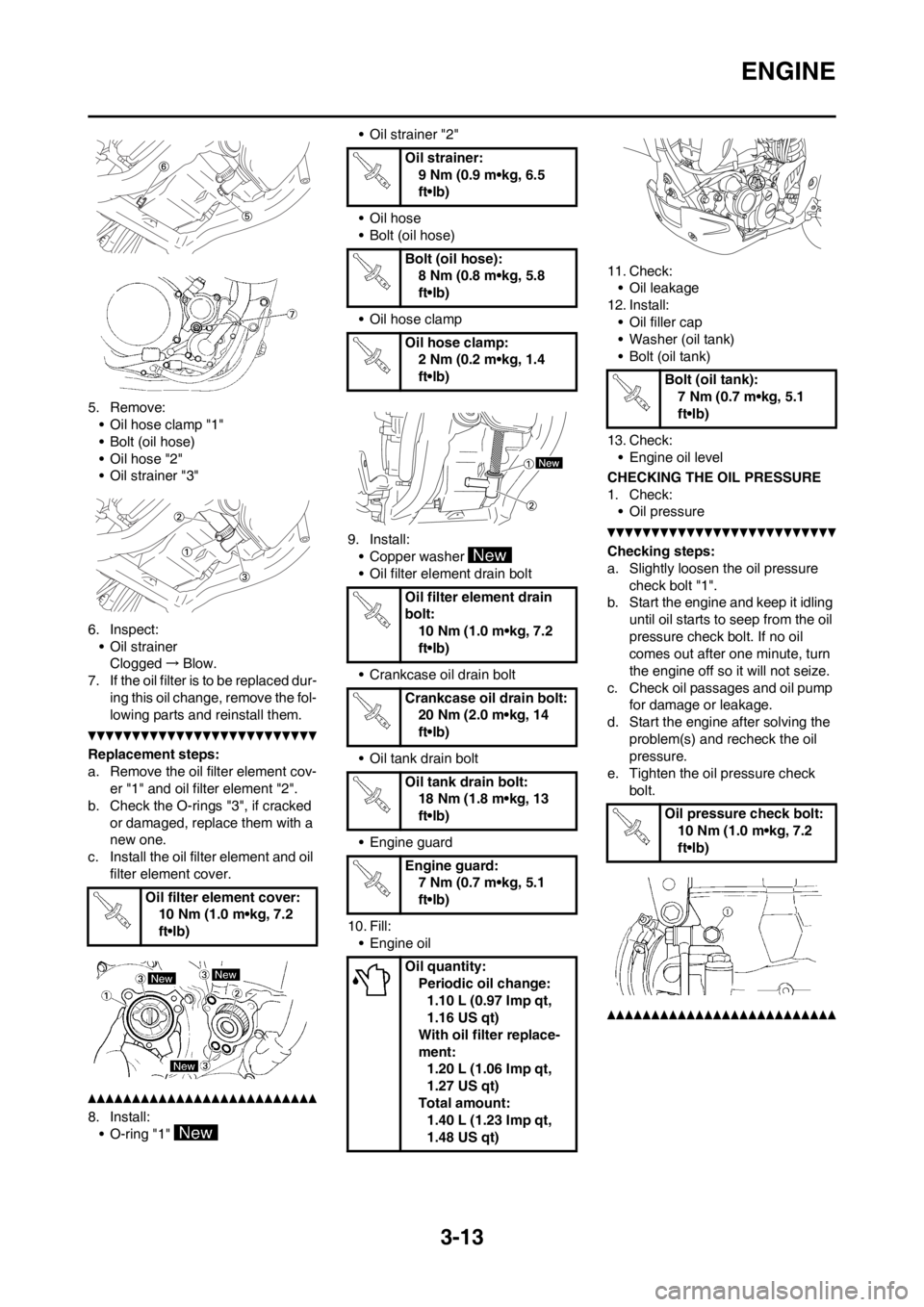
5. Remove:
• Oil hose clamp "1"
• Bolt (oil hose)
• Oil hose "2"
• Oil strainer "3"
6. Inspect:
• Oil strainer
Clogged→Blow.
7. If the oil filter is to be replaced dur-
ing this oil change, remove the fol-
lowing parts and reinstall them.
Replacement steps:
a. Remove the oil filter element cov-
er "1" and oil filter element "2".
b. Check the O-rings "3", if cracked
or damaged, replace them with a
new one.
c. Install the oil filter element and oil
filter element cover.
8. Install:
• O-ring "1" • Oil strainer "2"
• Oil hose
• Bolt (oil hose)
• Oil hose clamp
9. Install:
• Copper washer
• Oil filter element drain bolt
• Crankcase oil drain bolt
• Oil tank drain bolt
• Engine guard
10. Fill:
• Engine oil11. Check:
• Oil leakage
12. Install:
• Oil filler cap
• Washer (oil tank)
• Bolt (oil tank)
13. Check:
• Engine oil level
CHECKING THE OIL PRESSURE
1. Check:
• Oil pressure
Checking steps:
a. Slightly loosen the oil pressure
check bolt "1".
b. Start the engine and keep it idling
until oil starts to seep from the oil
pressure check bolt. If no oil
comes out after one minute, turn
the engine off so it will not seize.
c. Check oil passages and oil pump
for damage or leakage.
d. Start the engine after solving the
problem(s) and recheck the oil
pressure.
e. Tighten the oil pressure check
bolt.
Oil filter element cover:
10 Nm (1.0 m•kg, 7.2
ft•lb)
Oil strainer:
9 Nm (0.9 m•kg, 6.5
ft•lb)
Bolt (oil hose):
8 Nm (0.8 m•kg, 5.8
ft•lb)
Oil hose clamp:
2 Nm (0.2 m•kg, 1.4
ft•lb)
Oil filter element drain
bolt:
10 Nm (1.0 m•kg, 7.2
ft•lb)
Crankcase oil drain bolt:
20 Nm (2.0 m•kg, 14
ft•lb)
Oil tank drain bolt:
18 Nm (1.8 m•kg, 13
ft•lb)
Engine guard:
7 Nm (0.7 m•kg, 5.1
ft•lb)
Oil quantity:
Periodic oil change:
1.10 L (0.97 Imp qt,
1.16 US qt)
With oil filter replace-
ment:
1.20 L (1.06 Imp qt,
1.27 US qt)
Total amount:
1.40 L (1.23 Imp qt,
1.48 US qt)
Bolt (oil tank):
7 Nm (0.7 m•kg, 5.1
ft•lb)
Oil pressure check bolt:
10 Nm (1.0 m•kg, 7.2
ft•lb)
Page 79 of 230
3-20
CHASSIS
CHECKING THE BRAKE FLUID
LEVEL
1. Place the brake master cylinder
so that its top is in a horizontal po-
sition.
2. Inspect:
• Brake fluid level
Fluid at lower level→Fill up.
• Use only designated quality
brake fluid to avoid poor brake
performance.
• Refill with same type and brand
of brake fluid; mixing fluids
could result in poor brake perfor-
mance.
• Be sure that water or other con-
taminants do not enter master
cylinder when refilling.
• Clean up spilled fluid immediate-
ly to avoid erosion of painted
surfaces or plastic parts.
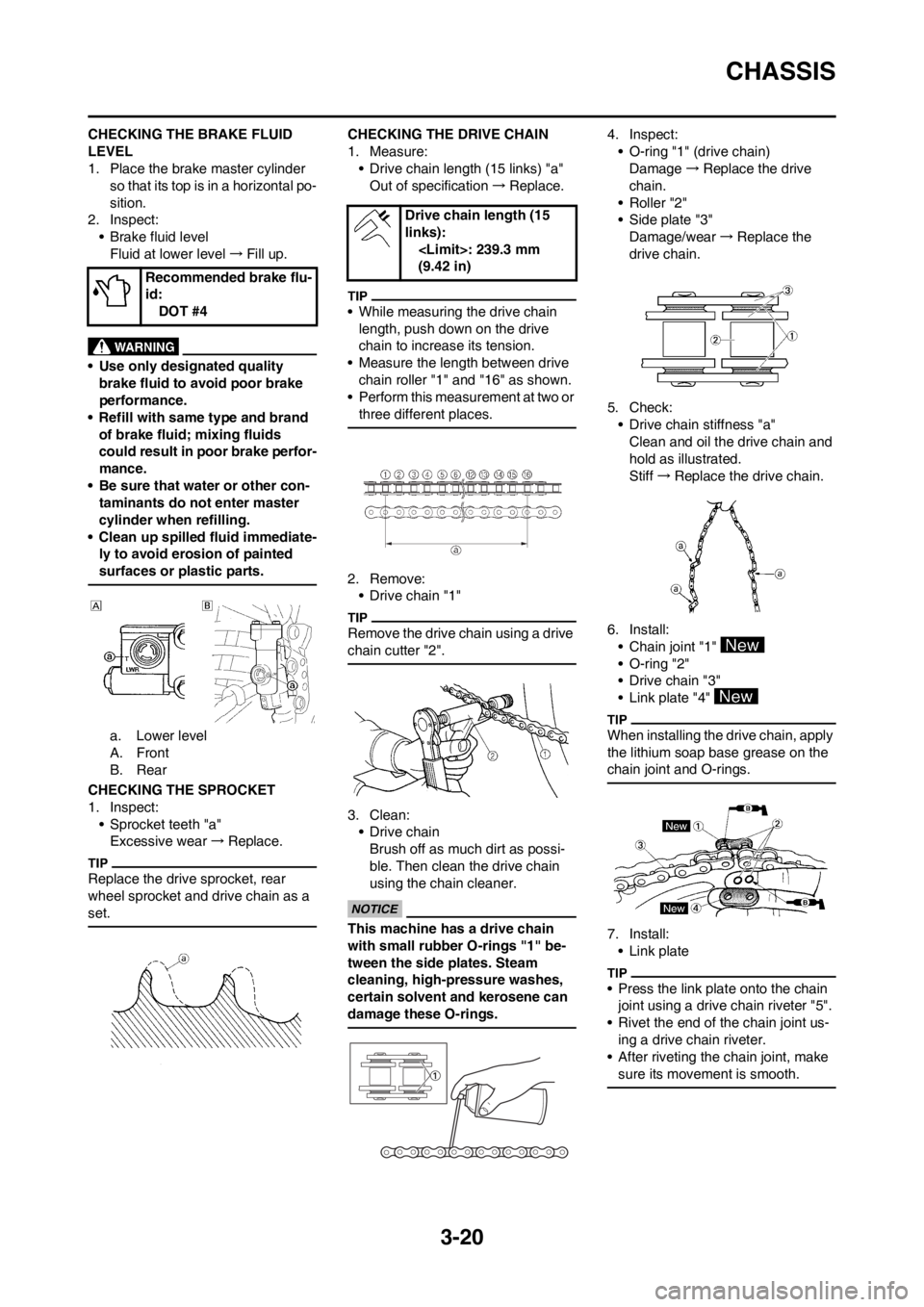
a. Lower level
A. Front
B. Rear
CHECKING THE SPROCKET
1. Inspect:
• Sprocket teeth "a"
Excessive wear→Replace.
Replace the drive sprocket, rear
wheel sprocket and drive chain as a
set.
CHECKING THE DRIVE CHAIN
1. Measure:
• Drive chain length (15 links) "a"
Out of specification→Replace.
• While measuring the drive chain
length, push down on the drive
chain to increase its tension.
• Measure the length between drive
chain roller "1" and "16" as shown.
• Perform this measurement at two or
three different places.
2. Remove:
• Drive chain "1"
Remove the drive chain using a drive
chain cutter "2".
3. Clean:
• Drive chain
Brush off as much dirt as possi-
ble. Then clean the drive chain
using the chain cleaner.
This machine has a drive chain
with small rubber O-rings "1" be-
tween the side plates. Steam
cleaning, high-pressure washes,
certain solvent and kerosene can
damage these O-rings.
4. Inspect:
• O-ring "1" (drive chain)
Damage→Replace the drive
chain.
•Roller "2"
• Side plate "3"
Damage/wear→Replace the
drive chain.
5. Check:
• Drive chain stiffness "a"
Clean and oil the drive chain and
hold as illustrated.
Stiff→Replace the drive chain.
6. Install:
• Chain joint "1"
• O-ring "2"
• Drive chain "3"
• Link plate "4"
When installing the drive chain, apply
the lithium soap base grease on the
chain joint and O-rings.
7. Install:
• Link plate
• Press the link plate onto the chain
joint using a drive chain riveter "5".
• Rivet the end of the chain joint us-
ing a drive chain riveter.
• After riveting the chain joint, make
sure its movement is smooth.
Recommended brake flu-
id:
DOT #4
Drive chain length (15
links):
(9.42 in)
Page 80 of 230
3-21
CHASSIS
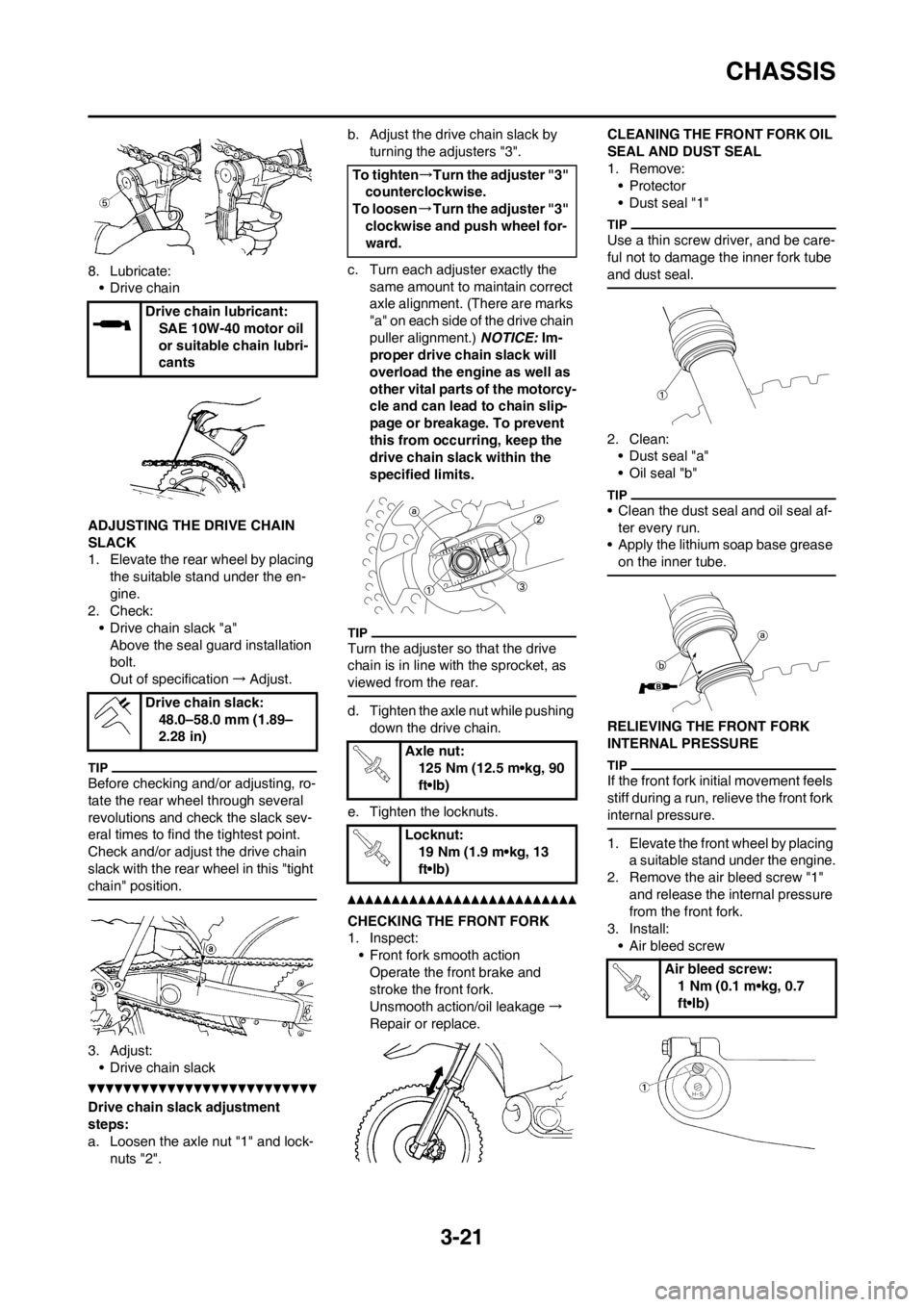
8. Lubricate:
• Drive chain
ADJUSTING THE DRIVE CHAIN
SLACK
1. Elevate the rear wheel by placing
the suitable stand under the en-
gine.
2. Check:
• Drive chain slack "a"
Above the seal guard installation
bolt.
Out of specification→Adjust.
Before checking and/or adjusting, ro-
tate the rear wheel through several
revolutions and check the slack sev-
eral times to find the tightest point.
Check and/or adjust the drive chain
slack with the rear wheel in this "tight
chain" position.
3. Adjust:
• Drive chain slack
Drive chain slack adjustment
steps:
a. Loosen the axle nut "1" and lock-
nuts "2".b. Adjust the drive chain slack by
turning the adjusters "3".
c. Turn each adjuster exactly the
same amount to maintain correct
axle alignment. (There are marks
"a" on each side of the drive chain
puller alignment.) NOTICE: Im-
proper drive chain slack will
overload the engine as well as
other vital parts of the motorcy-
cle and can lead to chain slip-
page or breakage. To prevent
this from occurring, keep the
drive chain slack within the
specified limits.
Turn the adjuster so that the drive
chain is in line with the sprocket, as
viewed from the rear.
d. Tighten the axle nut while pushing
down the drive chain.
e. Tighten the locknuts.
CHECKING THE FRONT FORK
1. Inspect:
• Front fork smooth action
Operate the front brake and
stroke the front fork.
Unsmooth action/oil leakage→
Repair or replace.CLEANING THE FRONT FORK OIL
SEAL AND DUST SEAL
1. Remove:
•Protector
• Dust seal "1"
Use a thin screw driver, and be care-
ful not to damage the inner fork tube
and dust seal.
2. Clean:
• Dust seal "a"
• Oil seal "b"
• Clean the dust seal and oil seal af-
ter every run.
• Apply the lithium soap base grease
on the inner tube.
RELIEVING THE FRONT FORK
INTERNAL PRESSURE
If the front fork initial movement feels
stiff during a run, relieve the front fork
internal pressure.
1. Elevate the front wheel by placing
a suitable stand under the engine.
2. Remove the air bleed screw "1"
and release the internal pressure
from the front fork.
3. Install:
• Air bleed screw Drive chain lubricant:
SAE 10W-40 motor oil
or suitable chain lubri-
cants
Drive chain slack:
48.0–58.0 mm (1.89–
2.28 in)
To tighten→Turn the adjuster "3"
counterclockwise.
To loosen→Turn the adjuster "3"
clockwise and push wheel for-
ward.
Axle nut:
125 Nm (12.5 m•kg, 90
ft•lb)
Locknut:
19 Nm (1.9 m•kg, 13
ft•lb)
Air bleed screw:
1 Nm (0.1 m•kg, 0.7
ft•lb)