engine YAMAHA WR 250F 2015 Owners Manual
[x] Cancel search | Manufacturer: YAMAHA, Model Year: 2015, Model line: WR 250F, Model: YAMAHA WR 250F 2015Pages: 430, PDF Size: 14.14 MB
Page 386 of 430
FUEL INJECTION SYSTEM
9-52
TIP
Before troubleshooting, disconnect the starter motor lead from the starter relay.
TIP
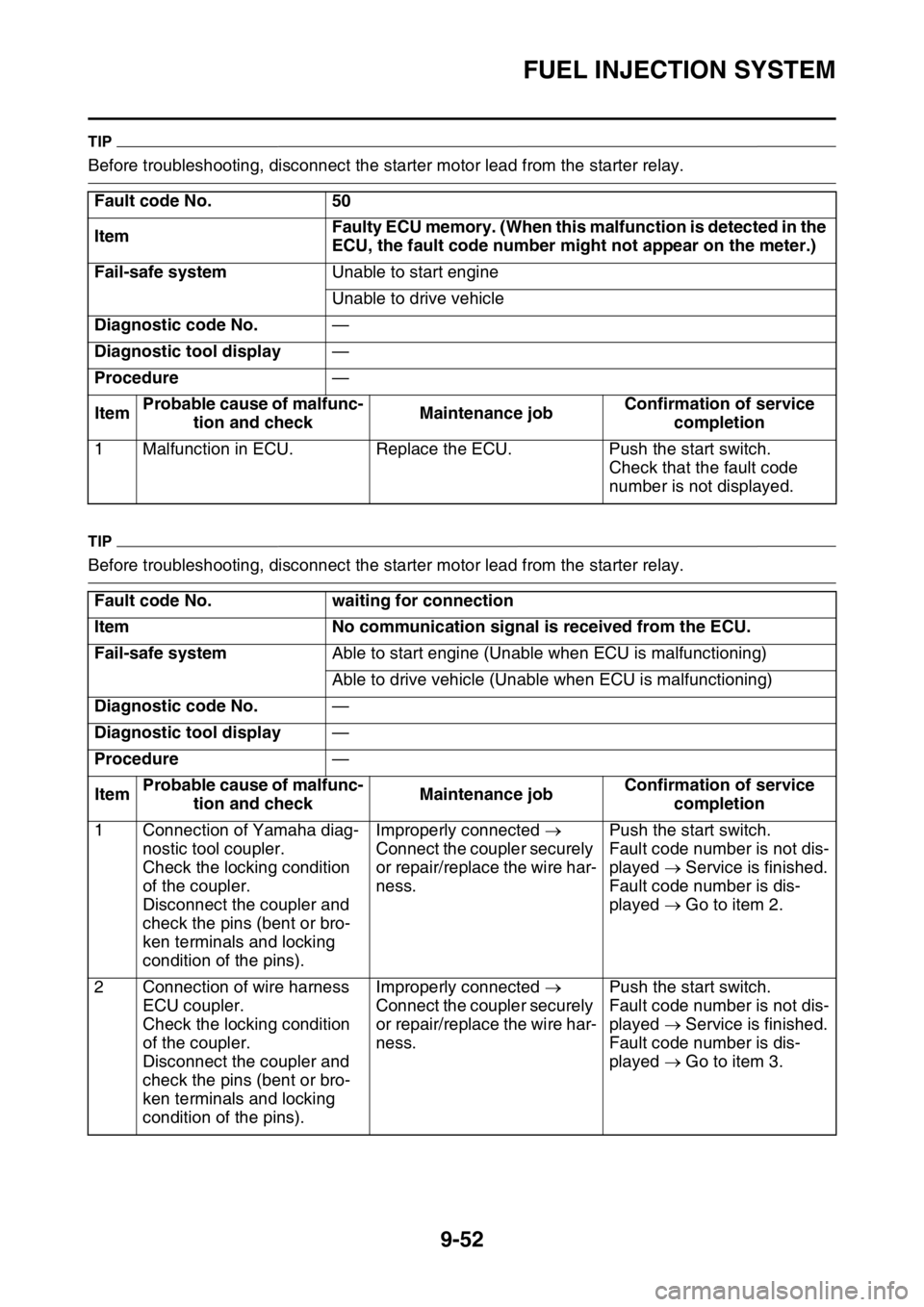
Before troubleshooting, disconnect the starter motor lead from the starter relay. Fault code No. 50
ItemFaulty ECU memory. (When this malfunction is detected in the
ECU, the fault code number might not appear on the meter.)
Fail-safe systemUnable to start engine
Unable to drive vehicle
Diagnostic code No.—
Diagnostic tool display—
Procedure—
ItemProbable cause of malfunc-
tion and checkMaintenance jobConfirmation of service
completion
1 Malfunction in ECU. Replace the ECU. Push the start switch.
Check that the fault code
number is not displayed.
Fault code No. waiting for connection
Item No communication signal is received from the ECU.
Fail-safe systemAble to start engine (Unable when ECU is malfunctioning)
Able to drive vehicle (Unable when ECU is malfunctioning)
Diagnostic code No.—
Diagnostic tool display—
Procedure—
ItemProbable cause of malfunc-
tion and checkMaintenance jobConfirmation of service
completion
1 Connection of Yamaha diag-
nostic tool coupler.
Check the locking condition
of the coupler.
Disconnect the coupler and
check the pins (bent or bro-
ken terminals and locking
condition of the pins).Improperly connected
Connect the coupler securely
or repair/replace the wire har-
ness.Push the start switch.
Fault code number is not dis-
played Service is finished.
Fault code number is dis-
played Go to item 2.
2 Connection of wire harness
ECU coupler.
Check the locking condition
of the coupler.
Disconnect the coupler and
check the pins (bent or bro-
ken terminals and locking
condition of the pins).Improperly connected
Connect the coupler securely
or repair/replace the wire har-
ness.Push the start switch.
Fault code number is not dis-
played Service is finished.
Fault code number is dis-
played Go to item 3.
Page 387 of 430

FUEL INJECTION SYSTEM
9-53
TIP
Before troubleshooting, disconnect the starter motor lead from the starter motor. 3 Wire harness continuity. Open or short circuit Re-
place the wire harness.
light green–light greenPush the start switch.
Fault code number is not dis-
played Service is finished.
Fault code number is dis-
played Go to item 4.
4 Yamaha diagnostic tool mal-
function.Replace the Yamaha diag-
nostic tool.Push the start switch.
Fault code number is not dis-
played Service is finished.
Fault code number is dis-
played Go to item 5.
5 Malfunction in ECU. Replace the ECU.
Fault code No. Er-2
ItemSignals from the ECU cannot be received within the specified
period of time.
Fail-safe systemAble to start engine
Able to drive vehicle
Diagnostic code No.—
Diagnostic tool display—
Procedure—
ItemProbable cause of malfunc-
tion and checkMaintenance jobConfirmation of service
completion
1 Connection of Yamaha diag-
nostic tool coupler.
Check the locking condition
of the coupler.
Disconnect the coupler and
check the pins (bent or bro-
ken terminals and locking
condition of the pins).Improperly connected
Connect the coupler securely
or repair/replace the wire har-
ness.Push the start switch.
Fault code number is not dis-
played Service is finished.
Fault code number is dis-
played Go to item 2.
2 Connection of wire harness
ECU coupler.
Check the locking condition
of the coupler.
Disconnect the coupler and
check the pins (bent or bro-
ken terminals and locking
condition of the pins).Improperly connected
Connect the coupler securely
or repair/replace the wire har-
ness.Push the start switch.
Fault code number is not dis-
played Service is finished.
Fault code number is dis-
played Go to item 3.
3 Wire harness continuity. Open or short circuit Re-
place the wire harness.
light green–light greenPush the start switch.
Fault code number is not dis-
played Service is finished.
Fault code number is dis-
played Go to item 4. Fault code No. waiting for connection
Item No communication signal is received from the ECU.
Page 388 of 430

FUEL INJECTION SYSTEM
9-54
TIP
Before troubleshooting, disconnect the starter motor lead from the starter motor. 4 Yamaha diagnostic tool mal-
function.Replace the Yamaha diag-
nostic tool.Push the start switch.
Fault code number is not dis-
played Service is finished.
Fault code number is dis-
played Go to item 5.
5 Malfunction in ECU. Replace the ECU.
Fault code No. Er-3
Item Data from the ECU cannot be received correctly.
Fail-safe systemAble to start engine
Able to drive vehicle
Diagnostic code No.—
Diagnostic tool display—
Procedure—
ItemProbable cause of malfunc-
tion and checkMaintenance jobConfirmation of service
completion
1 Connection of Yamaha diag-
nostic tool coupler.
Check the locking condition
of the coupler.
Disconnect the coupler and
check the pins (bent or bro-
ken terminals and locking
condition of the pins).Improperly connected
Connect the coupler securely
or repair/replace the wire har-
ness.Push the start switch.
Fault code number is not dis-
played Service is finished.
Fault code number is dis-
played Go to item 2.
2 Connection of wire harness
ECU coupler.
Check the locking condition
of the coupler.
Disconnect the coupler and
check the pins (bent or bro-
ken terminals and locking
condition of the pins).Improperly connected
Connect the coupler securely
or repair/replace the wire har-
ness.Push the start switch.
Fault code number is not dis-
played Service is finished.
Fault code number is dis-
played Go to item 3.
3 Wire harness continuity. Open or short circuit Re-
place the wire harness.
light green–light greenPush the start switch.
Fault code number is not dis-
played Service is finished.
Fault code number is dis-
played Go to item 4.
4 Yamaha diagnostic tool mal-
function.Replace the Yamaha diag-
nostic tool.Push the start switch.
Fault code number is not dis-
played Service is finished.
Fault code number is dis-
played Go to item 5.
5 Malfunction in ECU. Replace the ECU. Fault code No. Er-2
ItemSignals from the ECU cannot be received within the specified
period of time.
Page 389 of 430

FUEL INJECTION SYSTEM
9-55
TIP
Before troubleshooting, disconnect the starter motor lead from the starter relay.
Fault code No. Er-4
ItemRegistered data cannot be received from the Yamaha diagnos-
tic tool.
Fail-safe systemAble to start engine
Able to drive vehicle
Diagnostic code No.—
Diagnostic tool display—
Procedure—
ItemProbable cause of malfunc-
tion and checkMaintenance jobConfirmation of service
completion
1 Connection of Yamaha diag-
nostic tool coupler.
Check the locking condition
of the coupler.
Disconnect the coupler and
check the pins (bent or bro-
ken terminals and locking
condition of the pins).Improperly connected
Connect the coupler securely
or repair/replace the wire har-
ness.Push the start switch.
Fault code number is not dis-
played Service is finished.
Fault code number is dis-
played Go to item 2.
2 Connection of wire harness
ECU coupler.
Check the locking condition
of the coupler.
Disconnect the coupler and
check the pins (bent or bro-
ken terminals and locking
condition of the pins).Improperly connected
Connect the coupler securely
or repair/replace the wire har-
ness.Push the start switch.
Fault code number is not dis-
played Service is finished.
Fault code number is dis-
played Go to item 3.
3 Wire harness continuity. Open or short circuit Re-
place the wire harness.
light green–light greenPush the start switch.
Fault code number is not dis-
played Service is finished.
Fault code number is dis-
played Go to item 4.
4 Yamaha diagnostic tool mal-
function.Replace the Yamaha diag-
nostic tool.Push the start switch.
Fault code number is not dis-
played Service is finished.
Fault code number is dis-
played Go to item 5.
5 Malfunction in ECU. Replace the ECU.
Page 391 of 430

FUEL PUMP SYSTEM
9-57
1. Joint connector
2. Joint connector
9. Battery
10.Frame ground
11.Starter relay
12.Main fuse
22.ECU (engine control unit)
26.Fuel pump
30.Joint connector
36.Engine stop switch
48.Frame ground
Page 392 of 430
FUEL PUMP SYSTEM
9-58
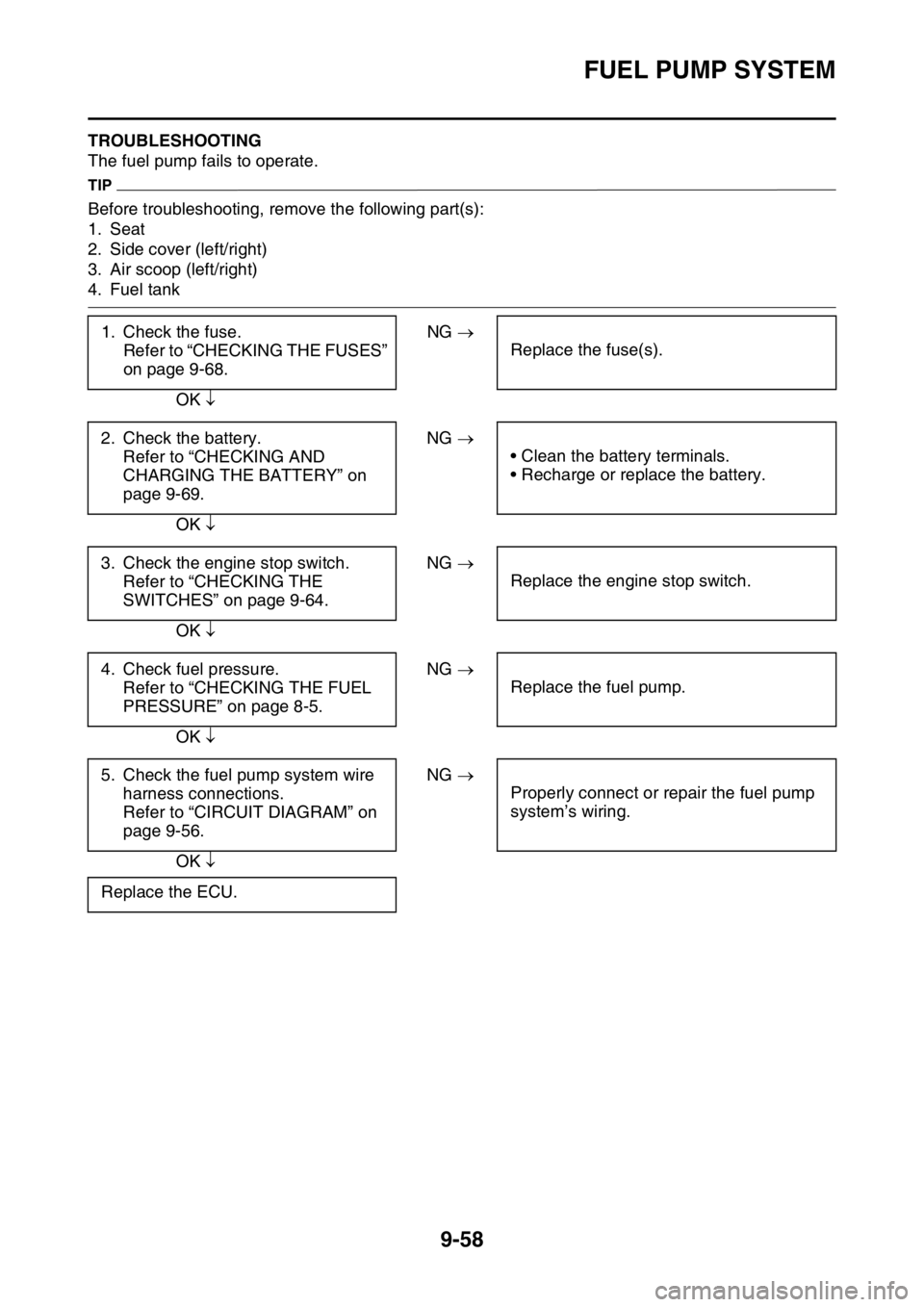
EAS2GB2382TROUBLESHOOTING
The fuel pump fails to operate.
TIP
Before troubleshooting, remove the following part(s):
1. Seat
2. Side cover (left/right)
3. Air scoop (left/right)
4. Fuel tank
1. Check the fuse.
Refer to “CHECKING THE FUSES”
on page 9-68.NG
Replace the fuse(s).
OK
2. Check the battery.
Refer to “CHECKING AND
CHARGING THE BATTERY” on
page 9-69.NG
• Clean the battery terminals.
• Recharge or replace the battery.
OK
3. Check the engine stop switch.
Refer to “CHECKING THE
SWITCHES” on page 9-64.NG
Replace the engine stop switch.
OK
4. Check fuel pressure.
Refer to “CHECKING THE FUEL
PRESSURE” on page 8-5.NG
Replace the fuel pump.
OK
5. Check the fuel pump system wire
harness connections.
Refer to “CIRCUIT DIAGRAM” on
page 9-56.NG
Properly connect or repair the fuel pump
system’s wiring.
OK
Replace the ECU.
Page 395 of 430

ELECTRICAL COMPONENTS
9-61
1. Rectifier/regulator
2. Clutch switch
3. Ignition coil
4. ECU (engine control unit)
5. Fuel sender
6. Fuel pump
7. Battery
8. Resistor
9. Neutral switch
10.Radiator fan motor
11.Injector
Page 399 of 430

ELECTRICAL COMPONENTS
9-65
1. Engine stop switch
2. Neutral switch
3. Clutch switch
4. Start switch
Page 404 of 430
ELECTRICAL COMPONENTS
9-70
▲▲▲▲▲▲▲▲▲▲▲▲▲▲▲▲▲▲▲▲▲▲▲▲▲▲▲▲▲▲▲▲
5. Charge:
• Battery
(refer to the appropriate charging method)
EWA
WARNING
Do not quick charge a battery.
ECA
NOTICE
• Do not use a high-rate battery charger
since it forces a high-amperage current
into the battery quickly and can cause bat-
tery overheating and battery plate dam-
age.
• If it is impossible to regulate the charging
current on the battery charger, be careful
not to overcharge the battery.• When charging a battery, be sure to re-
move it from the vehicle. (If charging has
to be done with the battery mounted on the
vehicle, disconnect the negative battery
lead from the battery terminal.)
• To reduce the chance of sparks, do not
plug in the battery charger until the battery
charger leads are connected to the bat-
tery.
• Before removing the battery charger lead
clips from the battery terminals, be sure to
turn off the battery charger.
• Make sure the battery charger lead clips
are in full contact with the battery terminal
and that they are not shorted. A corroded
battery charger lead clip may generate
heat in the contact area and a weak clip
spring may cause sparks.
• If the battery becomes hot to the touch at
any time during the charging process, dis-
connect the battery charger and let the
battery cool before reconnecting it. Hot
batteries can explode!
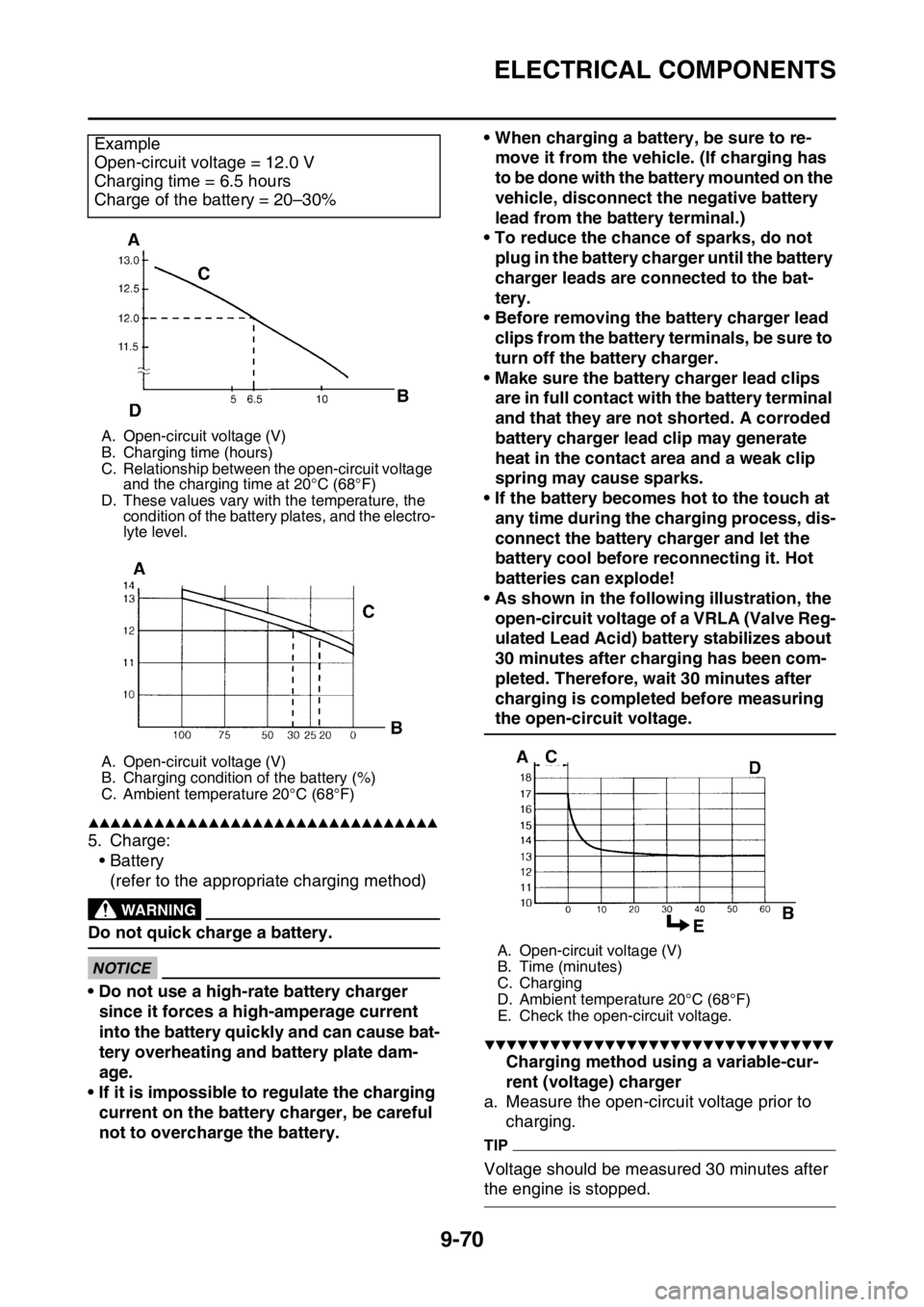
• As shown in the following illustration, the
open-circuit voltage of a VRLA (Valve Reg-
ulated Lead Acid) battery stabilizes about
30 minutes after charging has been com-
pleted. Therefore, wait 30 minutes after
charging is completed before measuring
the open-circuit voltage.
▼▼▼▼▼▼▼▼▼▼▼▼▼▼▼▼▼▼▼▼▼▼▼▼▼▼▼▼▼▼▼▼
Charging method using a variable-cur-
rent (voltage) charger
a. Measure the open-circuit voltage prior to
charging.
TIP
Voltage should be measured 30 minutes after
the engine is stopped. Example
Open-circuit voltage = 12.0 V
Charging time = 6.5 hours
Charge of the battery = 20–30%
A. Open-circuit voltage (V)
B. Charging time (hours)
C. Relationship between the open-circuit voltage
and the charging time at 20°C (68°F)
D. These values vary with the temperature, the
condition of the battery plates, and the electro-
lyte level.
A. Open-circuit voltage (V)
B. Charging condition of the battery (%)
C. Ambient temperature 20°C (68°F)
A. Open-circuit voltage (V)
B. Time (minutes)
C. Charging
D. Ambient temperature 20°C (68°F)
E. Check the open-circuit voltage.
Page 405 of 430
ELECTRICAL COMPONENTS
9-71
b. Connect a charger and ammeter to the bat-tery and start charging.
TIP
Set the charging voltage to 16–17 V.If the set-
ting is lower, charging will be insufficient. If too
high, the battery will be over-charged.
c. Make sure that the current is higher than the standard charging current written on the bat-
tery.
TIP
If the current is lower than the standard charg-
ing current written on the battery, set the charg-
ing voltage adjust dial at 20–24 V and monitor
the amperage for 3–5 minutes to check the bat-
tery.
d. Adjust the voltage so that the current is at
the standard charging level.
e. Set the time according to the charging time suitable for the open-circuit voltage.
f. If charging requires more than 5 hours, it is advisable to check the charging current after
a lapse of 5 hours. If there is any change in
the amperage, readjust the voltage to obtain
the standard charging current.
g. Measure the battery open-circuit voltage af-
ter leaving the battery unused for more than
30 minutes.
▲▲▲▲▲▲▲▲▲▲▲▲▲▲▲▲▲▲▲▲▲▲▲▲▲▲▲▲▲▲▲▲
▼▼▼▼▼▼▼▼▼▼▼▼▼▼▼▼▼▼▼▼▼▼▼▼▼▼▼▼▼▼▼▼
Charging method using a constant volt-
age charger
a. Measure the open-circuit voltage prior to charging.
TIP
Voltage should be measured 30 minutes after
the engine is stopped.
b. Connect a charger and ammeter to the bat-tery and start charging.
c. Make sure that the current is higher than the
standard charging current written on the bat-
tery.
TIP
If the current is lower than the standard charg-
ing current written on the battery, this type of
battery charger cannot charge the VRLA (Valve
Regulated Lead Acid) battery. A variable volt-
age charger is recommended.
d. Charge the battery until the battery’s charg-ing voltage is 15 V.
TIP
Set the charging time at 20 hours (maximum).
e. Measure the battery open-circuit voltage af-ter leaving the battery unused for more than
30 minutes.
▲▲▲▲▲▲▲▲▲▲▲▲▲▲▲▲▲▲▲▲▲▲▲▲▲▲▲▲▲▲▲▲
6. Install:
• Battery terminals
7. Connect:
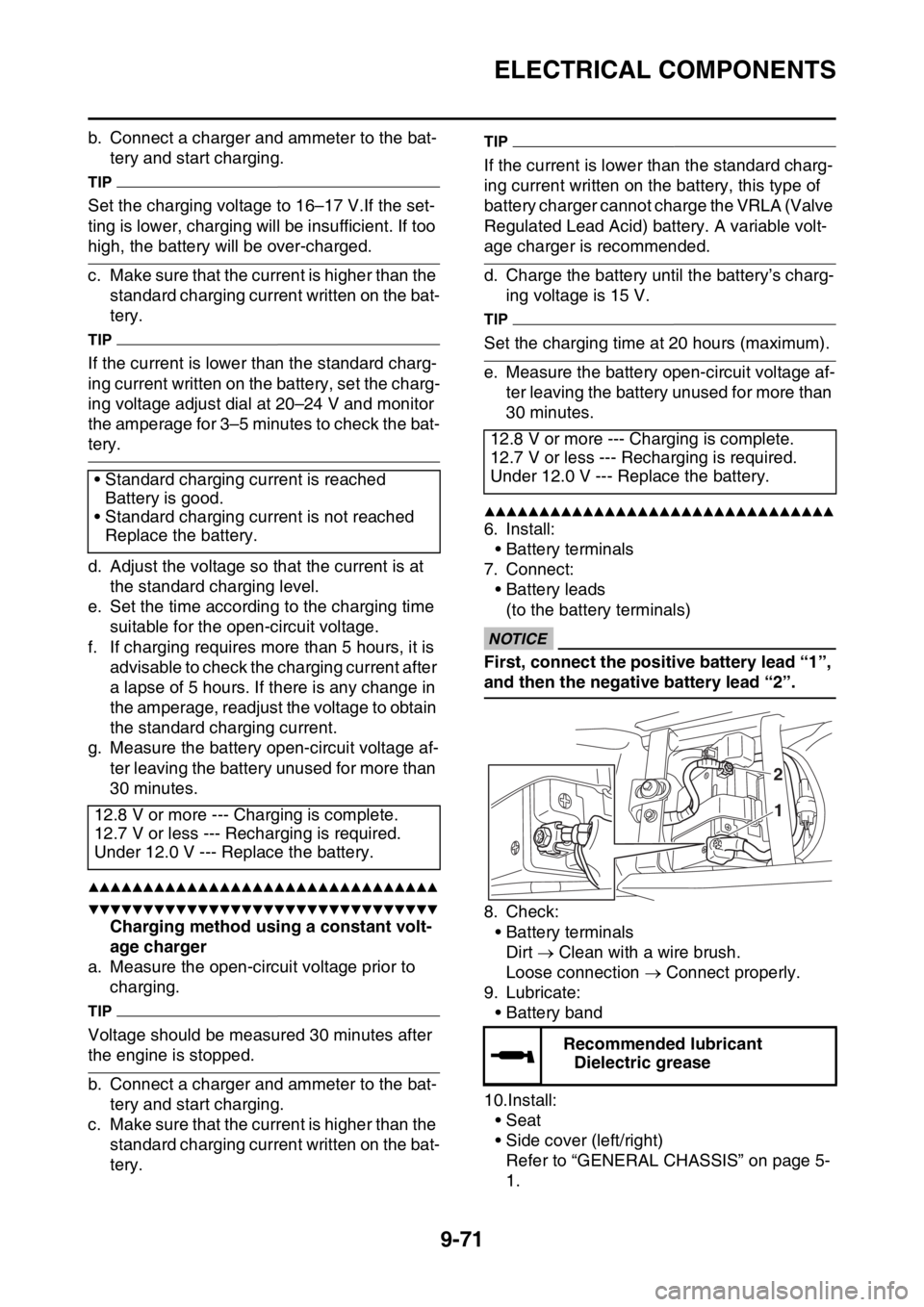
• Battery leads(to the battery terminals)
ECA
NOTICE
First, connect the positive battery lead “1”,
and then the negative battery lead “2”.
8. Check:• Battery terminalsDirt Clean with a wire brush.
Loose connection Connect properly.
9. Lubricate: • Battery band
10.Install: • Seat
• Side cover (left/right)
Refer to “GENERAL CHASSIS” on page 5-
1.
• Standard charging current is reached
Battery is good.
• Standard charging current is not reached Replace the battery.
12.8 V or more --- Charging is complete.
12.7 V or less --- Recharging is required.
Under 12.0 V --- Replace the battery.
12.8 V or more --- Charging is complete.
12.7 V or less --- Recharging is required.
Under 12.0 V --- Replace the battery.
Recommended lubricantDielectric grease
2
1