oil type YAMAHA WR 250F 2015 User Guide
[x] Cancel search | Manufacturer: YAMAHA, Model Year: 2015, Model line: WR 250F, Model: YAMAHA WR 250F 2015Pages: 430, PDF Size: 14.14 MB
Page 120 of 430
ENGINE
3-16
4. Install:
• Exhaust pipe protector
EAS2GB2097CHECKING THE FUEL LINE
1. Remove:
• Seat
• Side cover (left/right)
• Air scoop (left/right)
Refer to “GENERAL CHASSIS” on page 5-
1.
• Fuel tank
Refer to “FUEL TANK” on page 8-1.
2. Check:
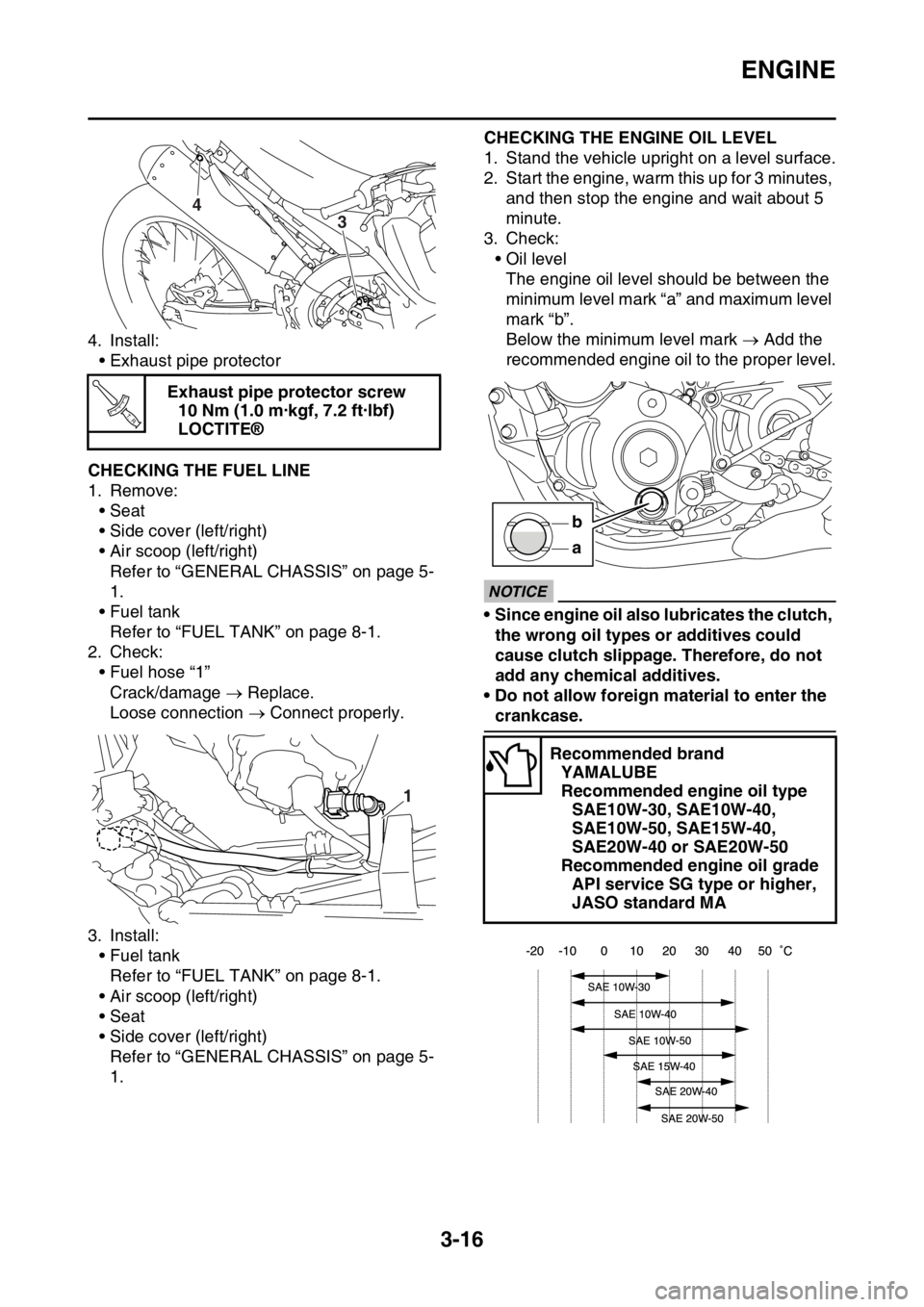
• Fuel hose “1”
Crack/damage Replace.
Loose connection Connect properly.
3. Install:
• Fuel tank
Refer to “FUEL TANK” on page 8-1.
• Air scoop (left/right)
• Seat
• Side cover (left/right)
Refer to “GENERAL CHASSIS” on page 5-
1.
EAS2GB2098
CHECKING THE ENGINE OIL LEVEL
1. Stand the vehicle upright on a level surface.
2. Start the engine, warm this up for 3 minutes,
and then stop the engine and wait about 5
minute.
3. Check:
• Oil level
The engine oil level should be between the
minimum level mark “a” and maximum level
mark “b”.
Below the minimum level mark Add the
recommended engine oil to the proper level.
ECA
NOTICE
• Since engine oil also lubricates the clutch,
the wrong oil types or additives could
cause clutch slippage. Therefore, do not
add any chemical additives.
• Do not allow foreign material to enter the
crankcase. Exhaust pipe protector screw
10 Nm (1.0 m·kgf, 7.2 ft·lbf)
LOCTITE®
4
3
T R..
1
Recommended brand
YAMALUBE
Recommended engine oil type
SAE10W-30, SAE10W-40,
SAE10W-50, SAE15W-40,
SAE20W-40 or SAE20W-50
Recommended engine oil grade
API service SG type or higher,
JASO standard MA
a b
Page 125 of 430
ENGINE
3-21
d. Select an adjusting pad with a proper valve
clearance from the adjusting pad selection
table.
TIP
• There are 25 types of adjusting pads, ranging
from 1.20 mm (0.0472 in) to 2.40 mm (0.0945
in), in increments of 0.05 mm (0.0020 in).
• The field where the number on the originally
installed adjusting pad and the measured
valve clearance intersect shows the adjusting
pad number to replace.
Example:
Pad number = 148
Rounded value = 150
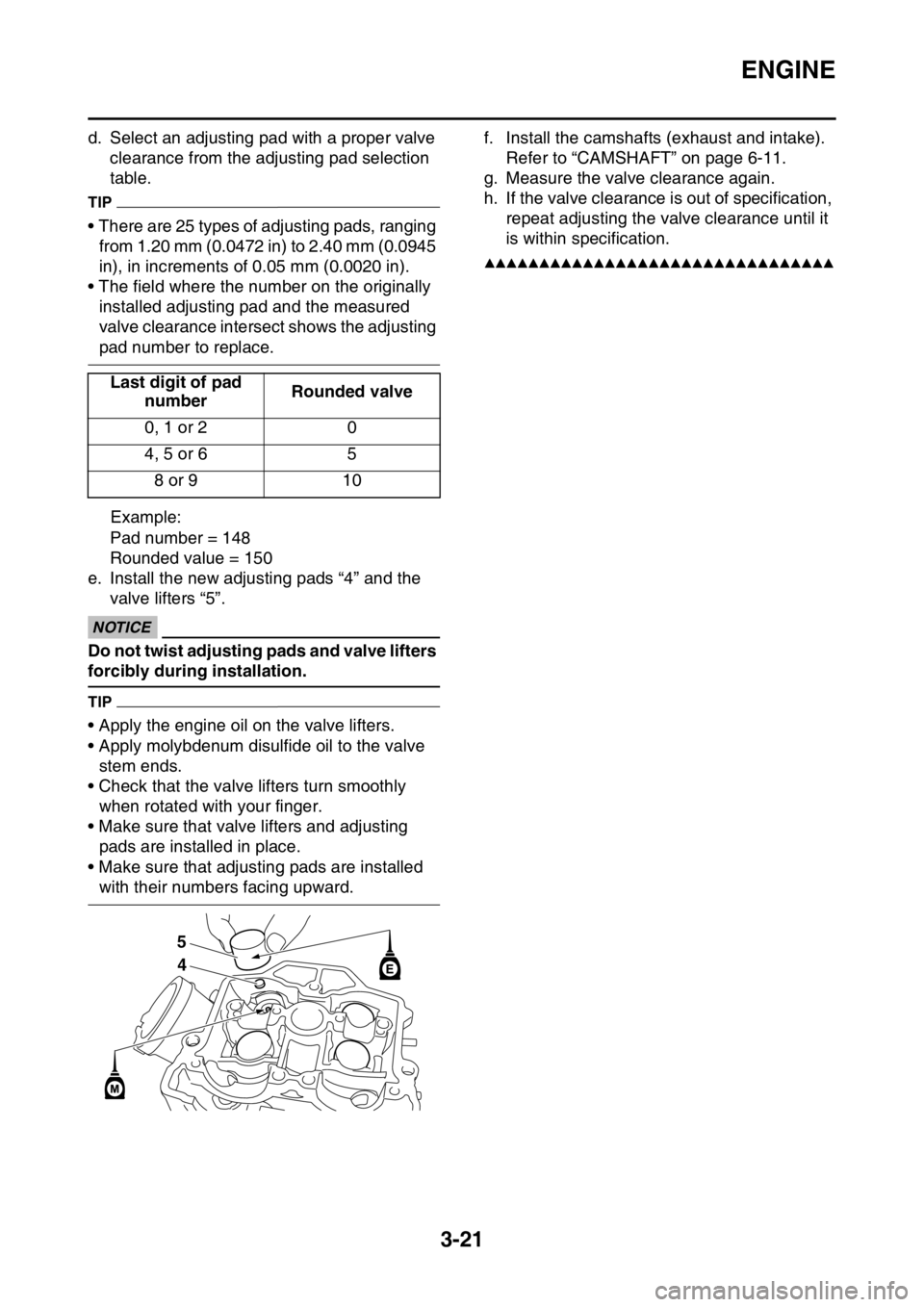
e. Install the new adjusting pads “4” and the
valve lifters “5”.
ECA
NOTICE
Do not twist adjusting pads and valve lifters
forcibly during installation.
TIP
• Apply the engine oil on the valve lifters.
• Apply molybdenum disulfide oil to the valve
stem ends.
• Check that the valve lifters turn smoothly
when rotated with your finger.
• Make sure that valve lifters and adjusting
pads are installed in place.
• Make sure that adjusting pads are installed
with their numbers facing upward.f. Install the camshafts (exhaust and intake).
Refer to “CAMSHAFT” on page 6-11.
g. Measure the valve clearance again.
h. If the valve clearance is out of specification,
repeat adjusting the valve clearance until it
is within specification.
▲▲▲▲▲▲▲▲▲▲▲▲▲▲▲▲▲▲▲▲▲▲▲▲▲▲▲▲▲▲▲▲
Last digit of pad
numberRounded valve
0, 1 or 2 0
4, 5 or 6 5
8 or 9 10
4 5
Page 134 of 430
CHASSIS
3-30
EWA
WARNING
• Use only the designated brake fluid. Other
brake fluids may cause the rubber seals to
deteriorate, causing leakage and poor
brake performance.
• Refill with the same type of brake fluid that
is already in the system. Mixing brake flu-
ids may result in a harmful chemical reac-
tion, leading to poor brake performance.
• When refilling, be careful that water does
not enter the brake fluid reservoir. Water
will significantly lower the boiling point of
the brake fluid and could cause vapor
lock.
ECA
NOTICE
Brake fluid may damage painted surfaces
and plastic parts. Therefore, always clean
up any spilt brake fluid immediately.
EAS2GB2112ADJUSTING THE DRIVE CHAIN SLACKECA
NOTICE
A drive chain that is too tight will overload
the engine and other vital parts, and one
that is too loose can skip and damage the
swingarm or cause an accident. Therefore,
keep the drive chain slack within the speci-
fied limits.
1. Use a suitable stand to raise the rear wheel
off the ground.
EWA
WARNING
Securely support the vehicle so that there is
no danger of it falling over.
2. Shift the transmission into the neutral posi-
tion.
3. Pull the drive chain up above the drive chain
guide installation bolt with a force of about
50 N (5.0 kgf, 36 lbf).
4. Check:
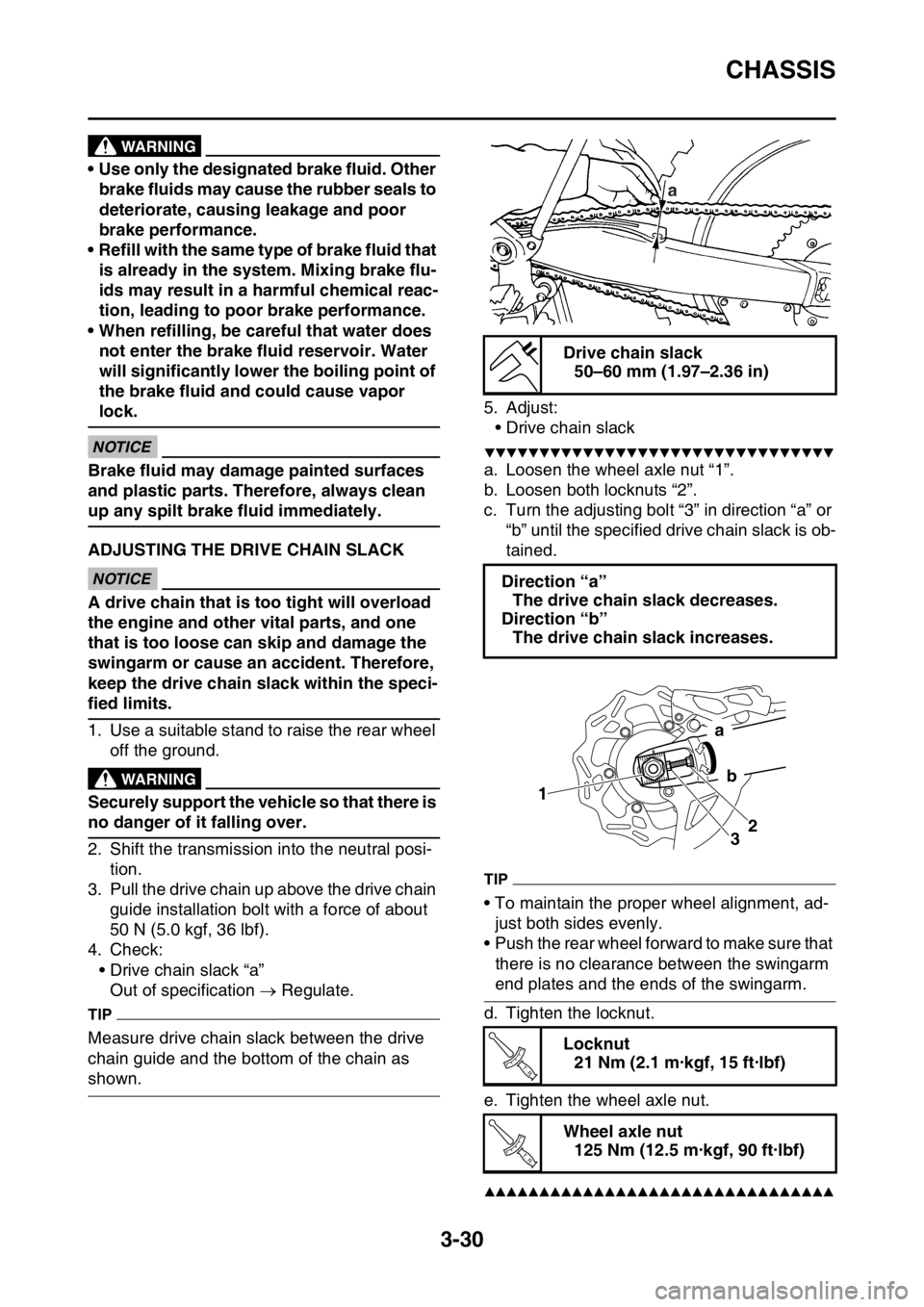
• Drive chain slack “a”
Out of specification Regulate.
TIP
Measure drive chain slack between the drive
chain guide and the bottom of the chain as
shown.5. Adjust:
• Drive chain slack
▼▼▼▼▼▼▼▼▼▼▼▼▼▼▼▼▼▼▼▼▼▼▼▼▼▼▼▼▼▼▼▼
a. Loosen the wheel axle nut “1”.
b. Loosen both locknuts “2”.
c. Turn the adjusting bolt “3” in direction “a” or
“b” until the specified drive chain slack is ob-
tained.
TIP
• To maintain the proper wheel alignment, ad-
just both sides evenly.
• Push the rear wheel forward to make sure that
there is no clearance between the swingarm
end plates and the ends of the swingarm.
d. Tighten the locknut.
e. Tighten the wheel axle nut.
▲▲▲▲▲▲▲▲▲▲▲▲▲▲▲▲▲▲▲▲▲▲▲▲▲▲▲▲▲▲▲▲
Drive chain slack
50–60 mm (1.97–2.36 in)
Direction “a”
The drive chain slack decreases.
Direction “b”
The drive chain slack increases.
Locknut
21 Nm (2.1 m·kgf, 15 ft·lbf)
Wheel axle nut
125 Nm (12.5 m·kgf, 90 ft·lbf)
a
1
32
a
b
T R..
T R..
Page 177 of 430
FRONT BRAKE
5-19
3. Install:
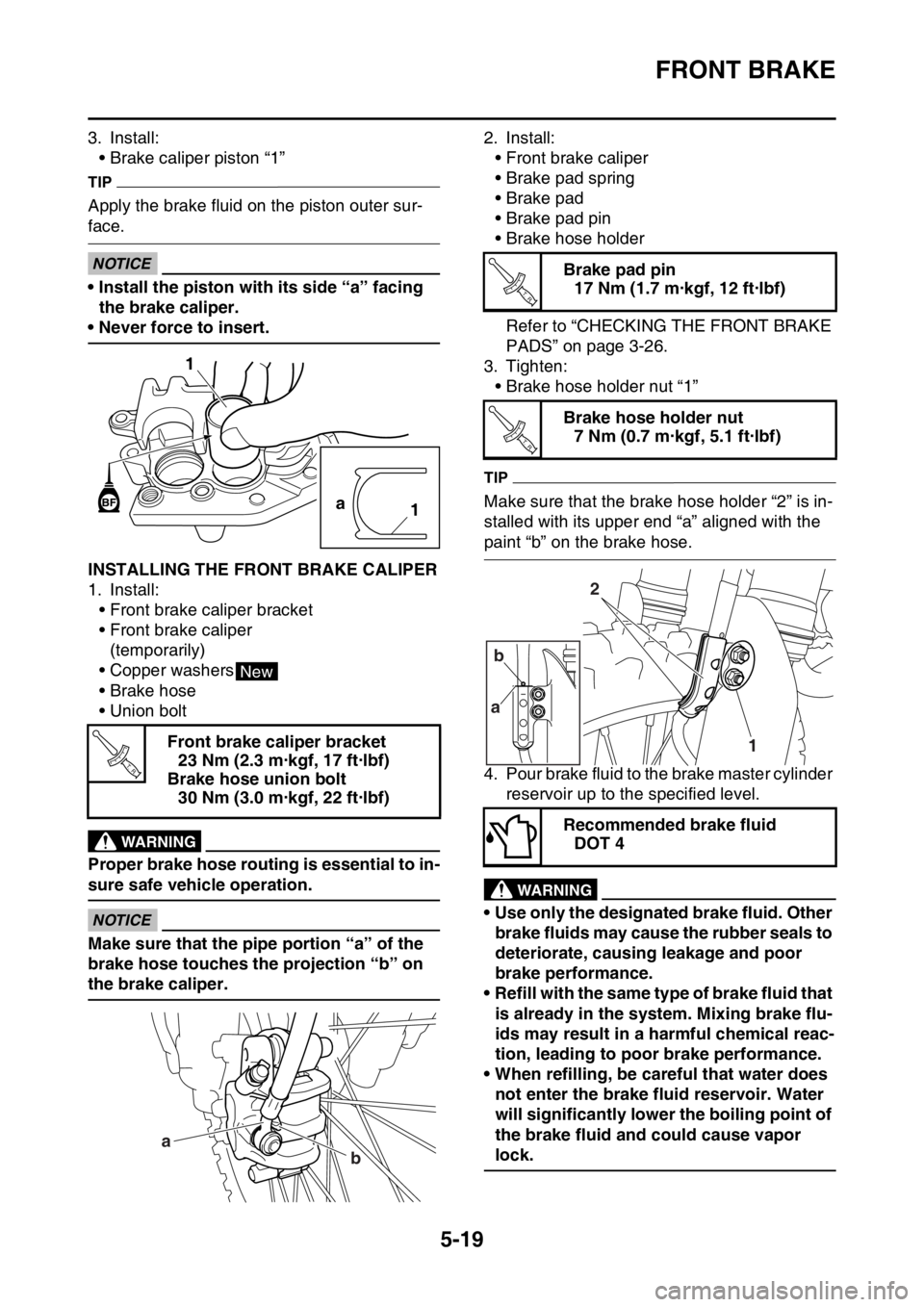
• Brake caliper piston “1”
TIP
Apply the brake fluid on the piston outer sur-
face.
ECA
NOTICE
• Install the piston with its side “a” facing
the brake caliper.
• Never force to insert.
EAS2GB2177INSTALLING THE FRONT BRAKE CALIPER
1. Install:
• Front brake caliper bracket
• Front brake caliper
(temporarily)
• Copper washers
• Brake hose
• Union bolt
EWA
WARNING
Proper brake hose routing is essential to in-
sure safe vehicle operation.
ECA
NOTICE
Make sure that the pipe portion “a” of the
brake hose touches the projection “b” on
the brake caliper.2. Install:
• Front brake caliper
• Brake pad spring
• Brake pad
• Brake pad pin
• Brake hose holder
Refer to “CHECKING THE FRONT BRAKE
PADS” on page 3-26.
3. Tighten:
• Brake hose holder nut “1”
TIP
Make sure that the brake hose holder “2” is in-
stalled with its upper end “a” aligned with the
paint “b” on the brake hose.
4. Pour brake fluid to the brake master cylinder
reservoir up to the specified level.
EWA
WARNING
• Use only the designated brake fluid. Other
brake fluids may cause the rubber seals to
deteriorate, causing leakage and poor
brake performance.
• Refill with the same type of brake fluid that
is already in the system. Mixing brake flu-
ids may result in a harmful chemical reac-
tion, leading to poor brake performance.
• When refilling, be careful that water does
not enter the brake fluid reservoir. Water
will significantly lower the boiling point of
the brake fluid and could cause vapor
lock.
ECA
Front brake caliper bracket
23 Nm (2.3 m·kgf, 17 ft·lbf)
Brake hose union bolt
30 Nm (3.0 m·kgf, 22 ft·lbf)
1
a
1
New
T R..
a
b
Brake pad pin
17 Nm (1.7 m·kgf, 12 ft·lbf)
Brake hose holder nut
7 Nm (0.7 m·kgf, 5.1 ft·lbf)
Recommended brake fluid
DOT 4
T R..
T R..
1 2
b
a
Page 180 of 430
FRONT BRAKE
5-22
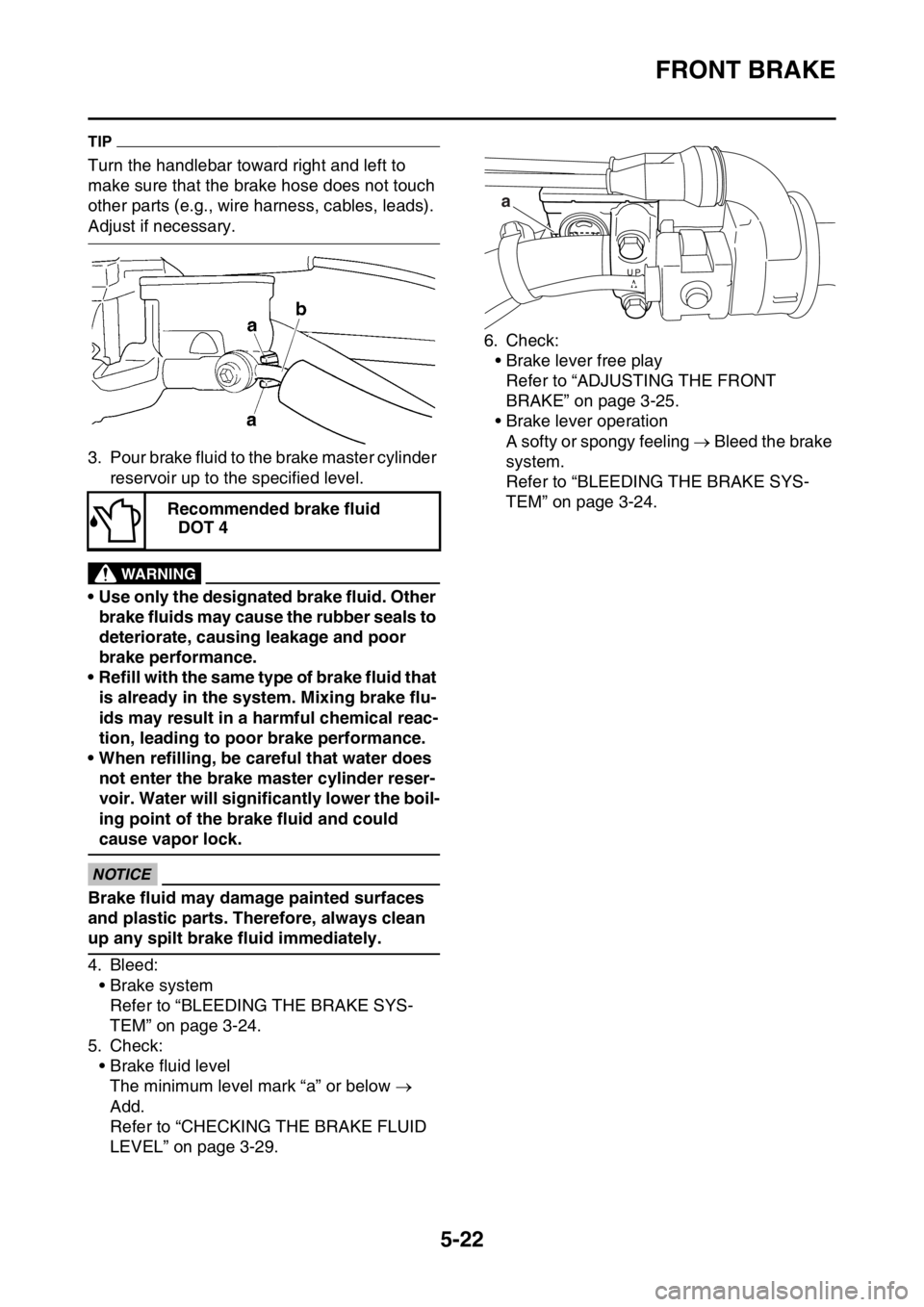
TIP
Turn the handlebar toward right and left to
make sure that the brake hose does not touch
other parts (e.g., wire harness, cables, leads).
Adjust if necessary.
3. Pour brake fluid to the brake master cylinder
reservoir up to the specified level.
EWA
WARNING
• Use only the designated brake fluid. Other
brake fluids may cause the rubber seals to
deteriorate, causing leakage and poor
brake performance.
• Refill with the same type of brake fluid that
is already in the system. Mixing brake flu-
ids may result in a harmful chemical reac-
tion, leading to poor brake performance.
• When refilling, be careful that water does
not enter the brake master cylinder reser-
voir. Water will significantly lower the boil-
ing point of the brake fluid and could
cause vapor lock.
ECA
NOTICE
Brake fluid may damage painted surfaces
and plastic parts. Therefore, always clean
up any spilt brake fluid immediately.
4. Bleed:
• Brake system
Refer to “BLEEDING THE BRAKE SYS-
TEM” on page 3-24.
5. Check:
• Brake fluid level
The minimum level mark “a” or below
Add.
Refer to “CHECKING THE BRAKE FLUID
LEVEL” on page 3-29.6. Check:
• Brake lever free play
Refer to “ADJUSTING THE FRONT
BRAKE” on page 3-25.
• Brake lever operation
A softy or spongy feeling Bleed the brake
system.
Refer to “BLEEDING THE BRAKE SYS-
TEM” on page 3-24.
Recommended brake fluid
DOT 4
a
Page 188 of 430
REAR BRAKE
5-30
EWA
WARNING
• Use only the designated brake fluid. Other
brake fluids may cause the rubber seals to
deteriorate, causing leakage and poor
brake performance.
• Refill with the same type of brake fluid that
is already in the system. Mixing brake flu-
ids may result in a harmful chemical reac-
tion, leading to poor brake performance.
• When refilling, be careful that water does
not enter the brake fluid reservoir. Water
will significantly lower the boiling point of
the brake fluid and could cause vapor
lock.
ECA
NOTICE
Brake fluid may damage painted surfaces
and plastic parts. Therefore, always clean
up any spilt brake fluid immediately.
5. Bleed:
• Brake system
Refer to “BLEEDING THE BRAKE SYS-
TEM” on page 3-24.
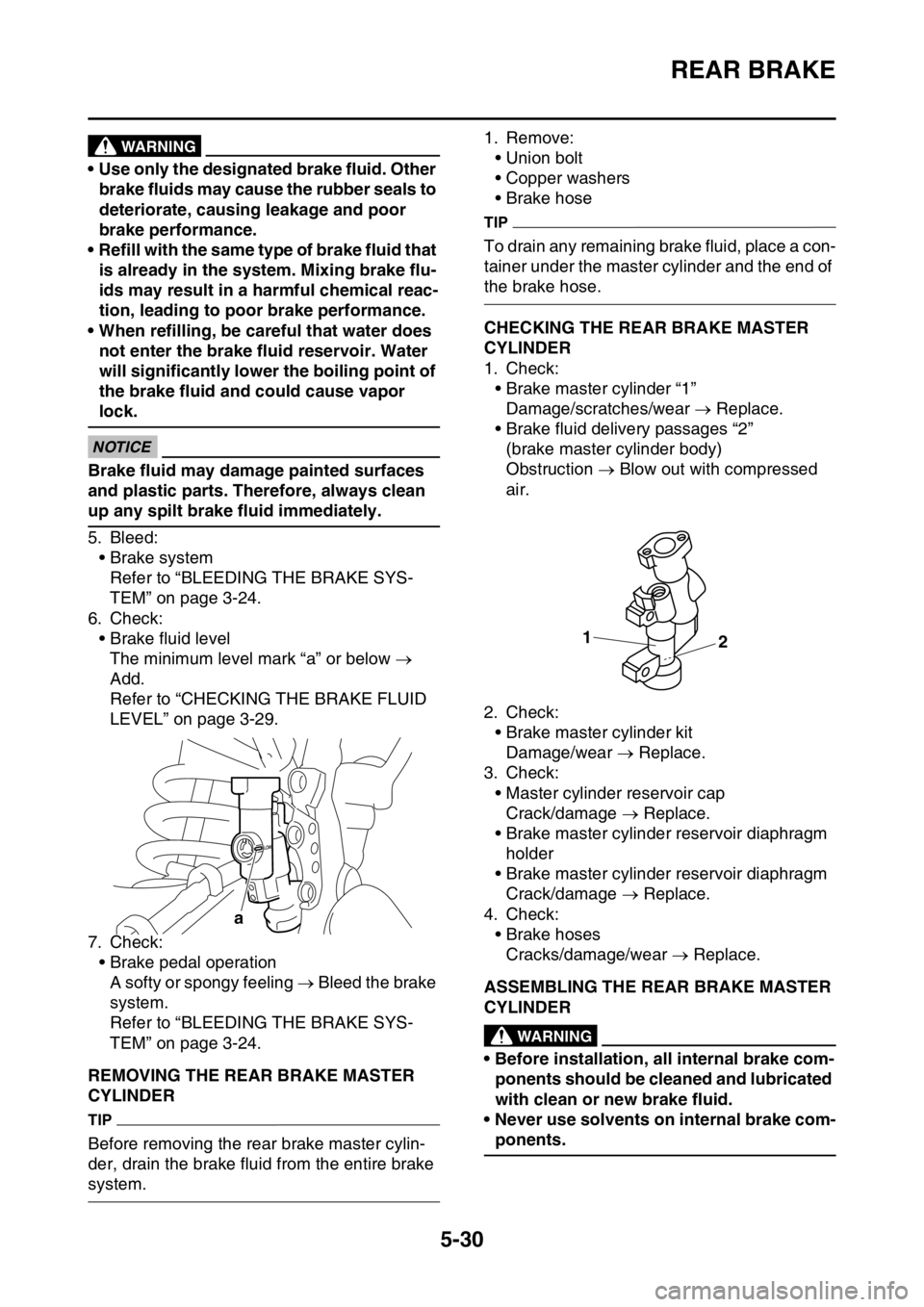
6. Check:
• Brake fluid level
The minimum level mark “a” or below
Add.
Refer to “CHECKING THE BRAKE FLUID
LEVEL” on page 3-29.
7. Check:
• Brake pedal operation
A softy or spongy feeling Bleed the brake
system.
Refer to “BLEEDING THE BRAKE SYS-
TEM” on page 3-24.
EAS2GB2191REMOVING THE REAR BRAKE MASTER
CYLINDER
TIP
Before removing the rear brake master cylin-
der, drain the brake fluid from the entire brake
system.1. Remove:
• Union bolt
• Copper washers
• Brake hose
TIP
To drain any remaining brake fluid, place a con-
tainer under the master cylinder and the end of
the brake hose.
EAS2GB2192CHECKING THE REAR BRAKE MASTER
CYLINDER
1. Check:
• Brake master cylinder “1”
Damage/scratches/wear Replace.
• Brake fluid delivery passages “2”
(brake master cylinder body)
Obstruction Blow out with compressed
air.
2. Check:
• Brake master cylinder kit
Damage/wear Replace.
3. Check:
• Master cylinder reservoir cap
Crack/damage Replace.
• Brake master cylinder reservoir diaphragm
holder
• Brake master cylinder reservoir diaphragm
Crack/damage Replace.
4. Check:
• Brake hoses
Cracks/damage/wear Replace.
EAS2GB2193ASSEMBLING THE REAR BRAKE MASTER
CYLINDER
EWA
WARNING
• Before installation, all internal brake com-
ponents should be cleaned and lubricated
with clean or new brake fluid.
• Never use solvents on internal brake com-
ponents.
a
1
2
Page 190 of 430
REAR BRAKE
5-32
2. Pour brake fluid to the brake fluid reservoir
up to the specified level.
EWA
WARNING
• Use only the designated brake fluid. Other
brake fluids may cause the rubber seals to
deteriorate, causing leakage and poor
brake performance.
• Refill with the same type of brake fluid that
is already in the system. Mixing brake flu-
ids may result in a harmful chemical reac-
tion, leading to poor brake performance.
• When refilling, be careful that water does
not enter the brake fluid reservoir. Water
will significantly lower the boiling point of
the brake fluid and could cause vapor
lock.
ECA
NOTICE
Brake fluid may damage painted surfaces
and plastic parts. Therefore, always clean
up any spilt brake fluid immediately.
3. Bleed:
• Brake system
Refer to “BLEEDING THE BRAKE SYS-
TEM” on page 3-24.
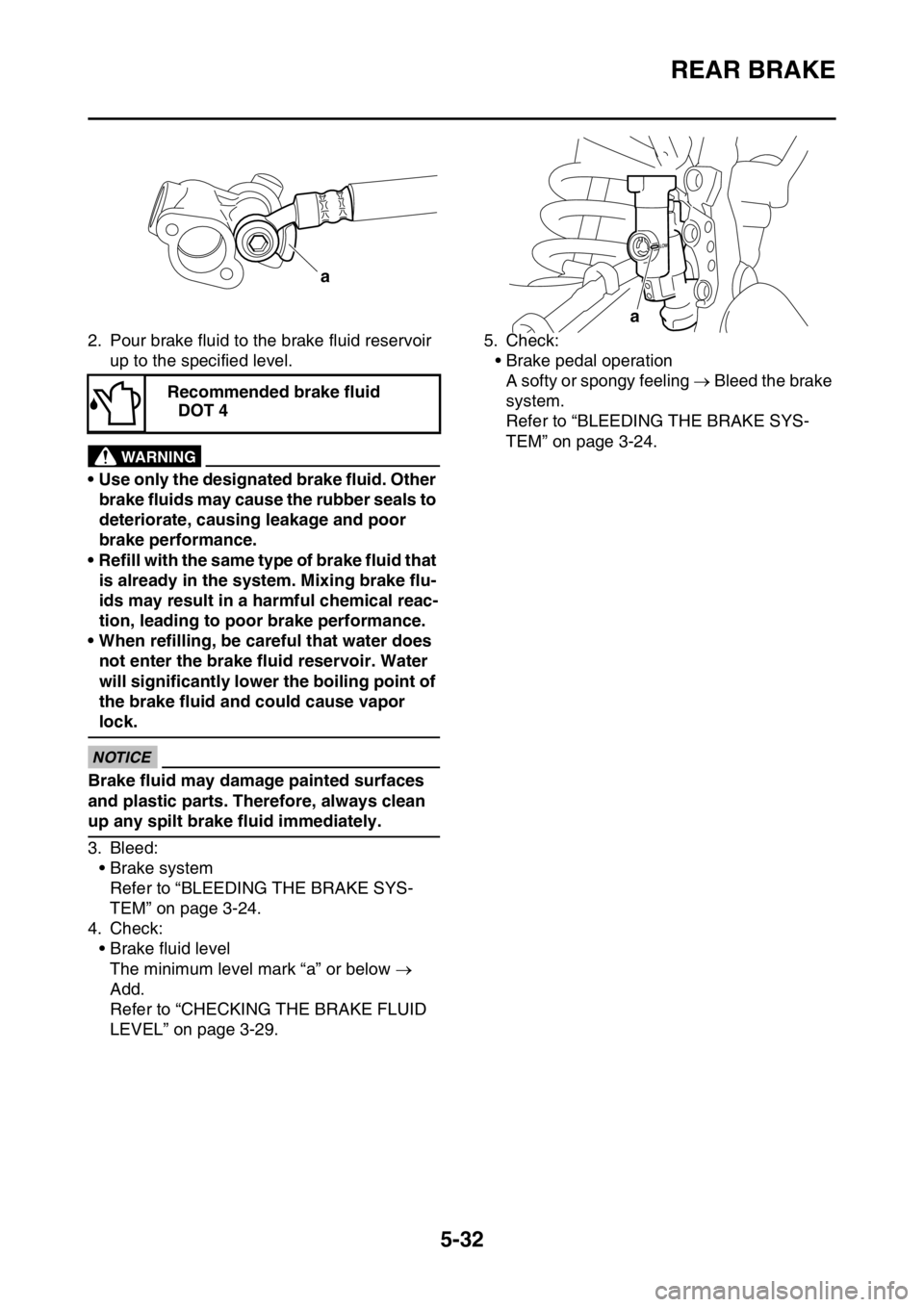
4. Check:
• Brake fluid level
The minimum level mark “a” or below
Add.
Refer to “CHECKING THE BRAKE FLUID
LEVEL” on page 3-29.5. Check:
• Brake pedal operation
A softy or spongy feeling Bleed the brake
system.
Refer to “BLEEDING THE BRAKE SYS-
TEM” on page 3-24. Recommended brake fluid
DOT 4
a
a
Page 365 of 430

FUEL INJECTION SYSTEM
9-31
ECU detects an abnormal signal from a sensor
If the ECU detects an abnormal signal from a sensor while the vehicle is being driven, the ECU illu-
minates the engine trouble warning light and provides the engine with alternate operating instructions
that are appropriate for the type of malfunction.
When an abnormal signal is received from a sensor, the ECU processes the specified values that are
programmed for each sensor in order to provide the engine with alternate operating instructions that
enable the engine to continue operating or stop operating, depending on the conditions.
EAS2GB2377TROUBLESHOOTING METHOD
The engine operation is not normal and the engine trouble warning light comes on.
1. Check:
• Fault code number
▼▼▼▼▼▼▼▼▼▼▼▼▼▼▼▼▼▼▼▼▼▼▼▼▼▼▼▼▼▼▼▼▼▼▼▼▼▼▼▼▼▼▼▼▼▼▼▼▼▼▼▼▼▼▼▼▼▼▼▼▼▼▼▼▼▼▼▼
a. Connect the Yamaha diagnostic tool. Refer to “YAMAHA DIAGNOSTIC TOOL” on page 9-32.
b. Check the fault code number displayed on the Yamaha diagnostic tool.
c. Identify the faulty system with the fault code number.
d. Identify the probable cause of the malfunction.
▲▲▲▲▲▲▲▲▲▲▲▲▲▲▲▲▲▲▲▲▲▲▲▲▲▲▲▲▲▲▲▲▲▲▲▲▲▲▲▲▲▲▲▲▲▲▲▲▲▲▲▲▲▲▲▲▲▲▲▲▲▲▲▲▲▲▲▲
2. Check and repair the probable cause of the malfunction.
3. Perform the reinstatement action for the fuel injection system. Refer to “Confirmation of service
completion” in the appropriate table in “TROUBLESHOOTING DETAILS” on page 9-35.
4. After pushing the engine stop switch, push the start switch to check whether the fault code no. is
displayed.
TIP
If another fault code number is displayed, repeat steps (1) to (4) until no fault code number is dis-
played.
5. Erase the malfunction history in the diagnostic mode. Refer to “SENSOR OPERATION TABLE”
(Diagnostic code No.62).
TIP
Turning off the meter light will not erase the malfunction history.
The engine operation is not normal, but the engine trouble warning light does not come on.
1. Check the operation of the following sensors and actuators in the diagnostic mode. Refer to
“TROUBLESHOOTING DETAILS” on page 9-35.
If a malfunction is detected in the sensors or actuators, repair or replace all faulty parts.
If no malfunction is detected in the sensors and actuators, check and repair the inner parts of the
engine.Fault code No. No fault code No.
Check and repair. Refer to “TROUBLESHOOT-
ING DETAILS” on page 9-35.
Monitor the operation of the sensors and actua-
tors in the diagnostic mode. Refer to “TROU-
BLESHOOTING DETAILS” on page 9-35 and
“LIST OF SELF-DIAGNOSTIC AND FAIL-SAFE
ACTIONS” on page 10-5.Check and repair.
01: Throttle position sensor signal (throttle angle)
30: Ignition coil
36: Injector
Page 401 of 430
ELECTRICAL COMPONENTS
9-67
EAS27990CHECKING THE BULBS AND BULB SOCK-
ETS
TIP
Do not check any of the lights that use LEDs.
Check each bulb and bulb socket for damage
or wear, proper connections, and also for con-
tinuity between the terminals.
Damage/wear Repair or replace the bulb,
bulb socket or both.
Improperly connected Properly connect.
No continuity Repair or replace the bulb,
bulb socket or both.
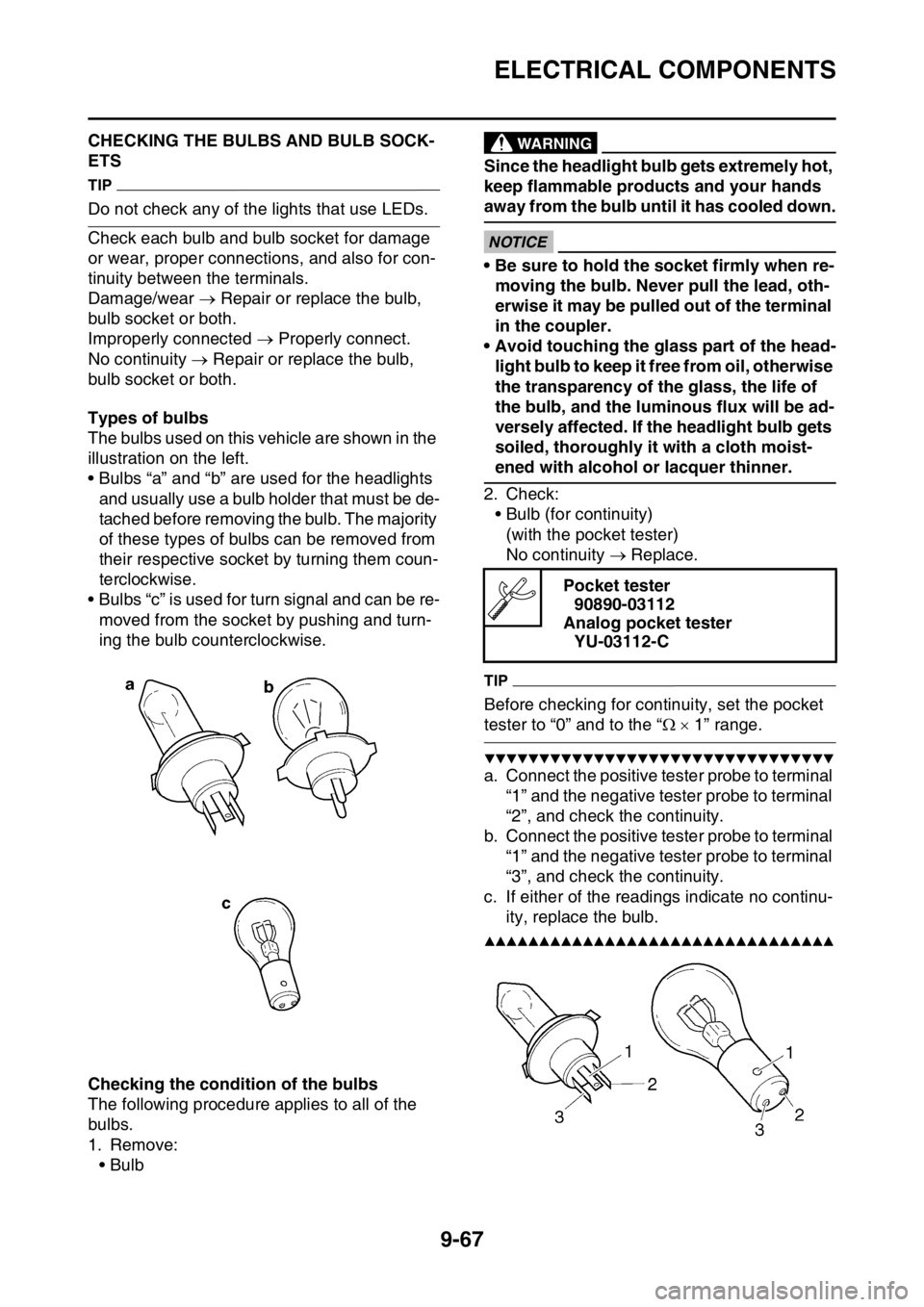
Types of bulbs
The bulbs used on this vehicle are shown in the
illustration on the left.
• Bulbs “a” and “b” are used for the headlights
and usually use a bulb holder that must be de-
tached before removing the bulb. The majority
of these types of bulbs can be removed from
their respective socket by turning them coun-
terclockwise.
• Bulbs “c” is used for turn signal and can be re-
moved from the socket by pushing and turn-
ing the bulb counterclockwise.
Checking the condition of the bulbs
The following procedure applies to all of the
bulbs.
1. Remove:
•Bulb
EWA
WARNING
Since the headlight bulb gets extremely hot,
keep flammable products and your hands
away from the bulb until it has cooled down.
ECA
NOTICE
• Be sure to hold the socket firmly when re-
moving the bulb. Never pull the lead, oth-
erwise it may be pulled out of the terminal
in the coupler.
• Avoid touching the glass part of the head-
light bulb to keep it free from oil, otherwise
the transparency of the glass, the life of
the bulb, and the luminous flux will be ad-
versely affected. If the headlight bulb gets
soiled, thoroughly it with a cloth moist-
ened with alcohol or lacquer thinner.
2. Check:
• Bulb (for continuity)
(with the pocket tester)
No continuity Replace.
TIP
Before checking for continuity, set the pocket
tester to “0” and to the “ 1” range.
▼▼▼▼▼▼▼▼▼▼▼▼▼▼▼▼▼▼▼▼▼▼▼▼▼▼▼▼▼▼▼▼
a. Connect the positive tester probe to terminal
“1” and the negative tester probe to terminal
“2”, and check the continuity.
b. Connect the positive tester probe to terminal
“1” and the negative tester probe to terminal
“3”, and check the continuity.
c. If either of the readings indicate no continu-
ity, replace the bulb.
▲▲▲▲▲▲▲▲▲▲▲▲▲▲▲▲▲▲▲▲▲▲▲▲▲▲▲▲▲▲▲▲
Pocket tester
90890-03112
Analog pocket tester
YU-03112-C