plug YAMAHA WR 250F 2015 Owner's Manual
[x] Cancel search | Manufacturer: YAMAHA, Model Year: 2015, Model line: WR 250F, Model: YAMAHA WR 250F 2015Pages: 430, PDF Size: 14.14 MB
Page 181 of 430
REAR BRAKE
5-23
EAS2GB2182
REAR BRAKE
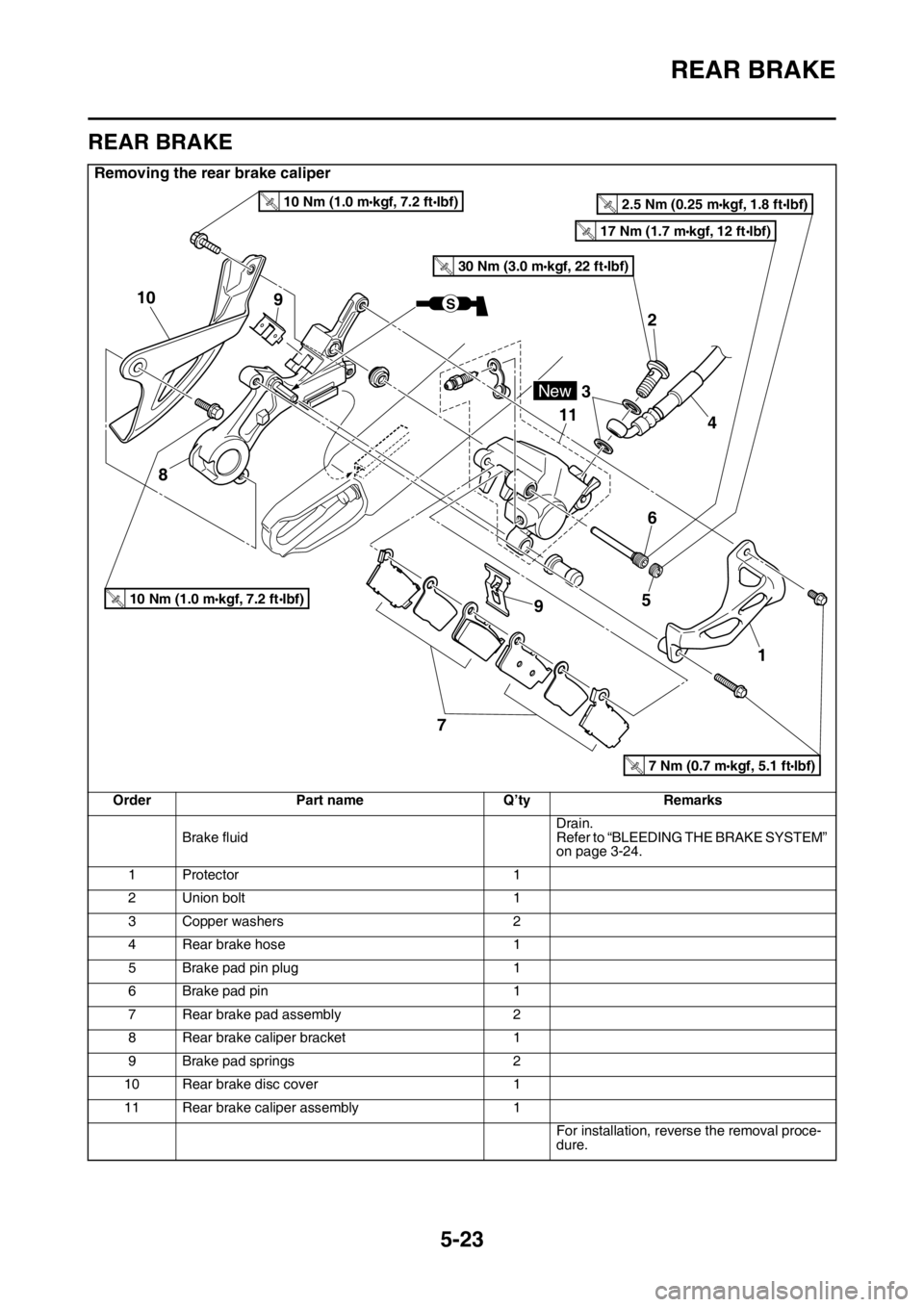
Removing the rear brake caliper
Order Part name Q’ty Remarks
Brake fluidDrain.
Refer to “BLEEDING THE BRAKE SYSTEM”
on page 3-24.
1 Protector 1
2 Union bolt 1
3 Copper washers 2
4 Rear brake hose 1
5 Brake pad pin plug 1
6 Brake pad pin 1
7 Rear brake pad assembly 2
8 Rear brake caliper bracket 1
9 Brake pad springs 2
10 Rear brake disc cover 1
11 Rear brake caliper assembly 1
For installation, reverse the removal proce-
dure.
2
3
4 11
56
79
1
8
9 10
2.5 Nm (0.25 m•kgf, 1.8 ft•Ibf)T.R.
10 Nm (1.0 m•kgf, 7.2 ft•Ibf)T.R.
10 Nm (1.0 m•kgf, 7.2 ft•Ibf)T.R.
17 Nm (1.7 m•kgf, 12 ft•Ibf)T.R.
30 Nm (3.0 m•kgf, 22 ft•Ibf)T.R.
New
S
7 Nm (0.7 m•kgf, 5.1 ft•Ibf)T.R.
Page 187 of 430
REAR BRAKE
5-29
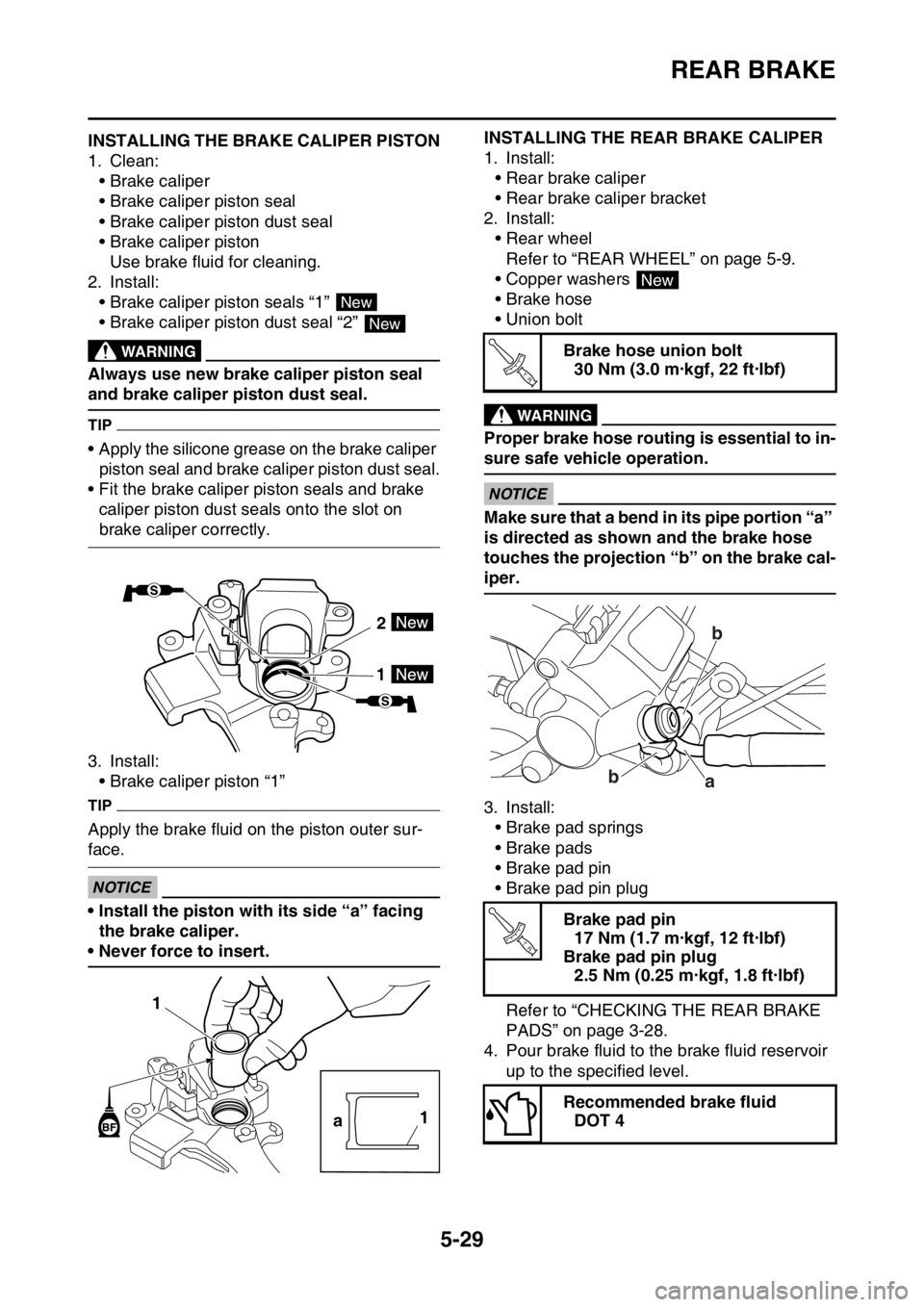
EAS2GB2189INSTALLING THE BRAKE CALIPER PISTON
1. Clean:
• Brake caliper
• Brake caliper piston seal
• Brake caliper piston dust seal
• Brake caliper piston
Use brake fluid for cleaning.
2. Install:
• Brake caliper piston seals “1”
• Brake caliper piston dust seal “2”
EWA
WARNING
Always use new brake caliper piston seal
and brake caliper piston dust seal.
TIP
• Apply the silicone grease on the brake caliper
piston seal and brake caliper piston dust seal.
• Fit the brake caliper piston seals and brake
caliper piston dust seals onto the slot on
brake caliper correctly.
3. Install:
• Brake caliper piston “1”
TIP
Apply the brake fluid on the piston outer sur-
face.
ECA
NOTICE
• Install the piston with its side “a” facing
the brake caliper.
• Never force to insert.
EAS2GB2190
INSTALLING THE REAR BRAKE CALIPER
1. Install:
• Rear brake caliper
• Rear brake caliper bracket
2. Install:
• Rear wheel
Refer to “REAR WHEEL” on page 5-9.
• Copper washers
• Brake hose
• Union bolt
EWA
WARNING
Proper brake hose routing is essential to in-
sure safe vehicle operation.
ECA
NOTICE
Make sure that a bend in its pipe portion “a”
is directed as shown and the brake hose
touches the projection “b” on the brake cal-
iper.
3. Install:
• Brake pad springs
• Brake pads
• Brake pad pin
• Brake pad pin plug
Refer to “CHECKING THE REAR BRAKE
PADS” on page 3-28.
4. Pour brake fluid to the brake fluid reservoir
up to the specified level.
New
New
2
1
1
a1
Brake hose union bolt
30 Nm (3.0 m·kgf, 22 ft·lbf)
Brake pad pin
17 Nm (1.7 m·kgf, 12 ft·lbf)
Brake pad pin plug
2.5 Nm (0.25 m·kgf, 1.8 ft·lbf)
Recommended brake fluid
DOT 4
New
T R..
b
b
a
T R..
Page 242 of 430
CAMSHAFT
6-11
EAS2GB2239
CAMSHAFT
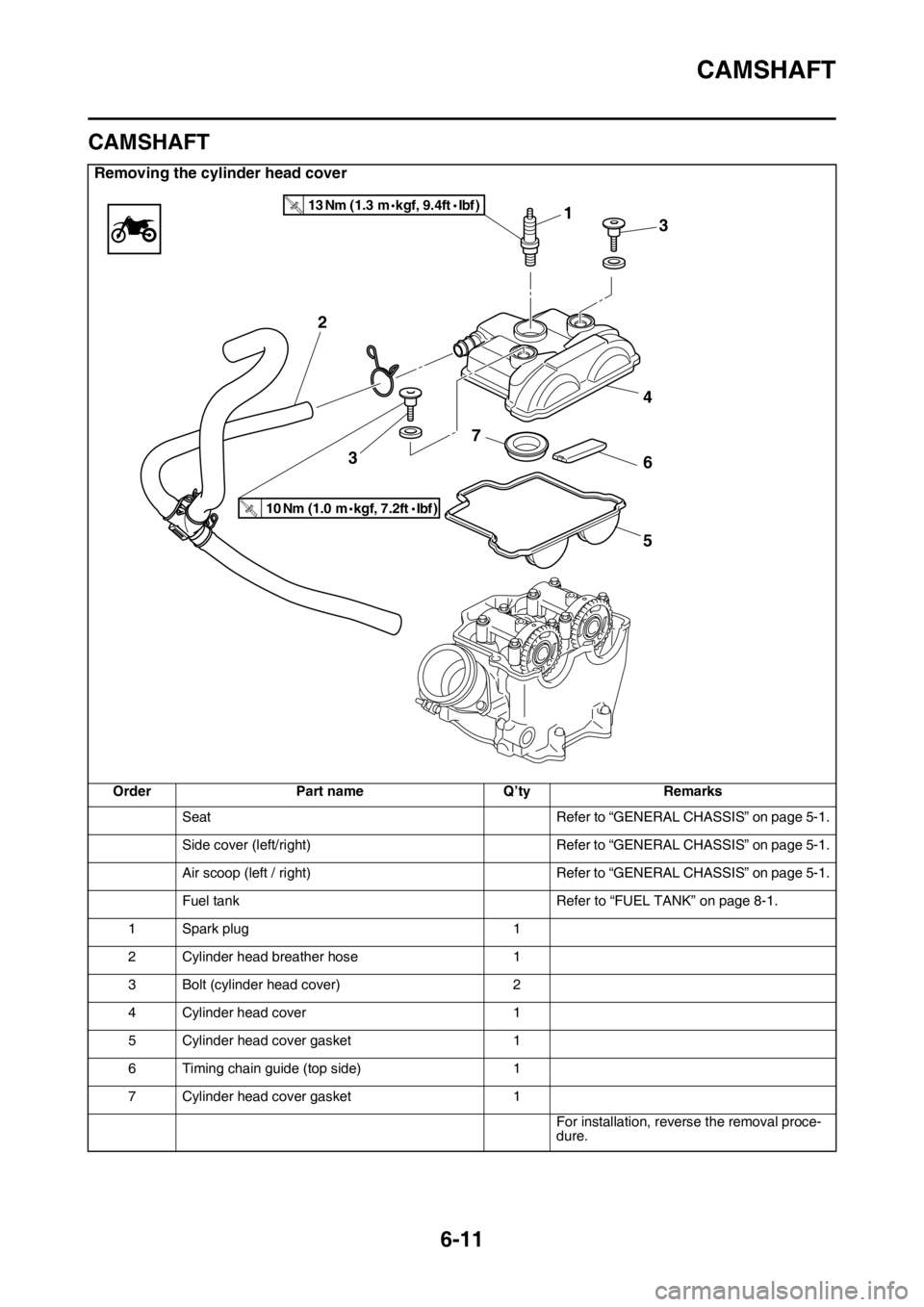
Removing the cylinder head cover
Order Part name Q’ty Remarks
Seat Refer to “GENERAL CHASSIS” on page 5-1.
Side cover (left/right) Refer to “GENERAL CHASSIS” on page 5-1.
Air scoop (left / right) Refer to “GENERAL CHASSIS” on page 5-1.
Fuel tank Refer to “FUEL TANK” on page 8-1.
1 Spark plug 1
2 Cylinder head breather hose 1
3 Bolt (cylinder head cover) 2
4 Cylinder head cover 1
5 Cylinder head cover gasket 1
6 Timing chain guide (top side) 1
7 Cylinder head cover gasket 1
For installation, reverse the removal proce-
dure.
1
4
6 7
5 2
3
10 Nm (1.0 m kgf, 7.2 ft Ibf )T.R.
13 Nm (1.3 m kgf, 9.4 ft Ibf )T.R.
3
Page 248 of 430
CAMSHAFT
6-17
▲▲▲▲▲▲▲▲▲▲▲▲▲▲▲▲▲▲▲▲▲▲▲▲▲▲▲▲▲▲▲▲
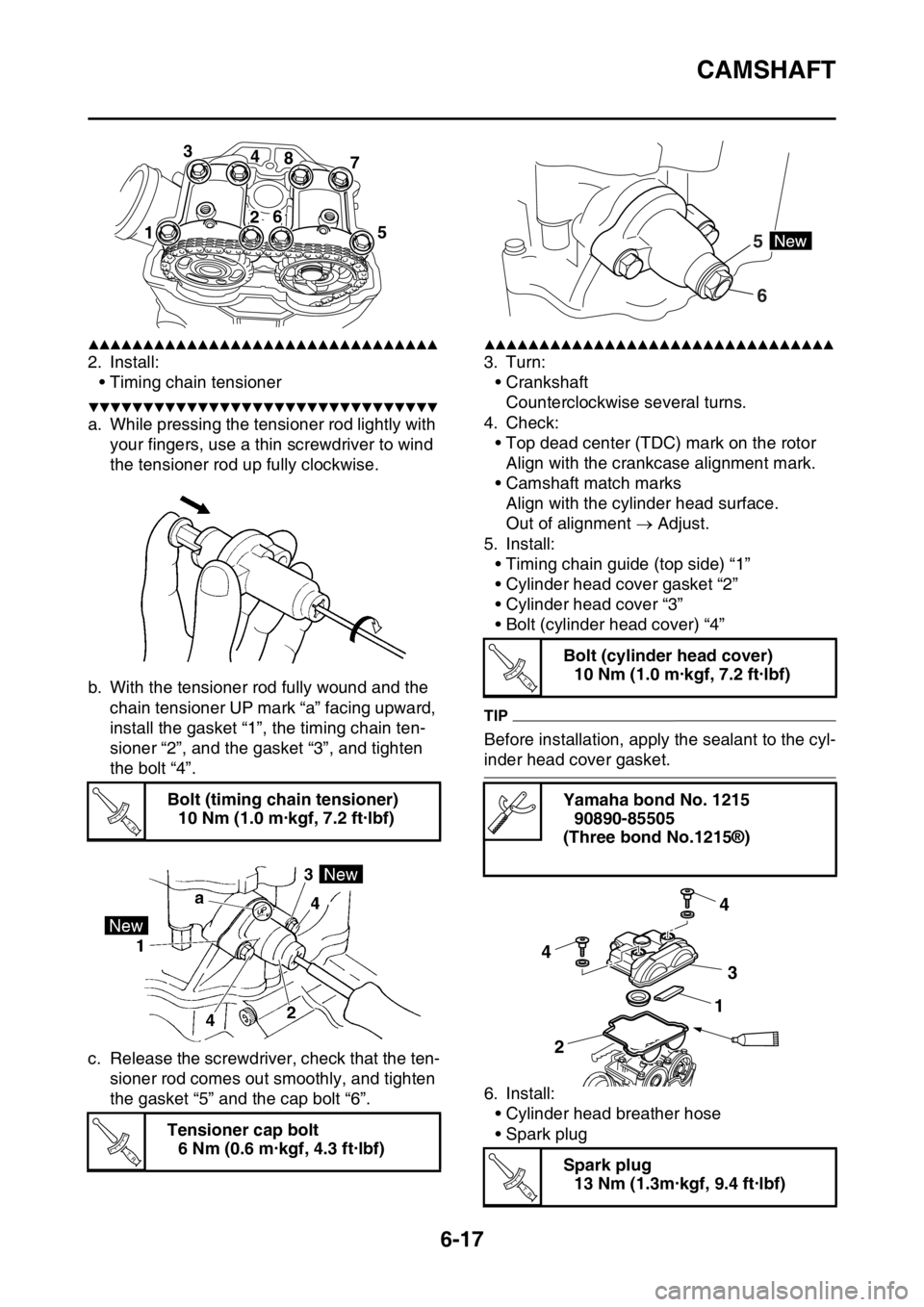
2. Install:
• Timing chain tensioner
▼▼▼▼▼▼▼▼▼▼▼▼▼▼▼▼▼▼▼▼▼▼▼▼▼▼▼▼▼▼▼▼
a. While pressing the tensioner rod lightly with
your fingers, use a thin screwdriver to wind
the tensioner rod up fully clockwise.
b. With the tensioner rod fully wound and the
chain tensioner UP mark “a” facing upward,
install the gasket “1”, the timing chain ten-
sioner “2”, and the gasket “3”, and tighten
the bolt “4”.
c. Release the screwdriver, check that the ten-
sioner rod comes out smoothly, and tighten
the gasket “5” and the cap bolt “6”.
▲▲▲▲▲▲▲▲▲▲▲▲▲▲▲▲▲▲▲▲▲▲▲▲▲▲▲▲▲▲▲▲
3. Turn:
• Crankshaft
Counterclockwise several turns.
4. Check:
• Top dead center (TDC) mark on the rotor
Align with the crankcase alignment mark.
• Camshaft match marks
Align with the cylinder head surface.
Out of alignment Adjust.
5. Install:
• Timing chain guide (top side) “1”
• Cylinder head cover gasket “2”
• Cylinder head cover “3”
• Bolt (cylinder head cover) “4”
TIP
Before installation, apply the sealant to the cyl-
inder head cover gasket.
6. Install:
• Cylinder head breather hose
• Spark plug Bolt (timing chain tensioner)
10 Nm (1.0 m·kgf, 7.2 ft·lbf)
Tensioner cap bolt
6 Nm (0.6 m·kgf, 4.3 ft·lbf)
3
4
8
7
15
26
T R..
T R..
Bolt (cylinder head cover)
10 Nm (1.0 m·kgf, 7.2 ft·lbf)
Yamaha bond No. 1215
90890-85505
(Three bond No.1215®)
Spark plug
13 Nm (1.3m·kgf, 9.4 ft·lbf)
6 5
T R..
4
4
3
21
T R..
Page 251 of 430
CYLINDER HEAD
6-20
EAS2GB2247REMOVING THE CYLINDER HEAD
1. Remove:
• Intake camshaft
• Exhaust camshaft
Refer to “REMOVING THE CAMSHAFT” on
page 6-13.
2. Remove:
• Cylinder head nuts
• Cylinder head bolts
TIP
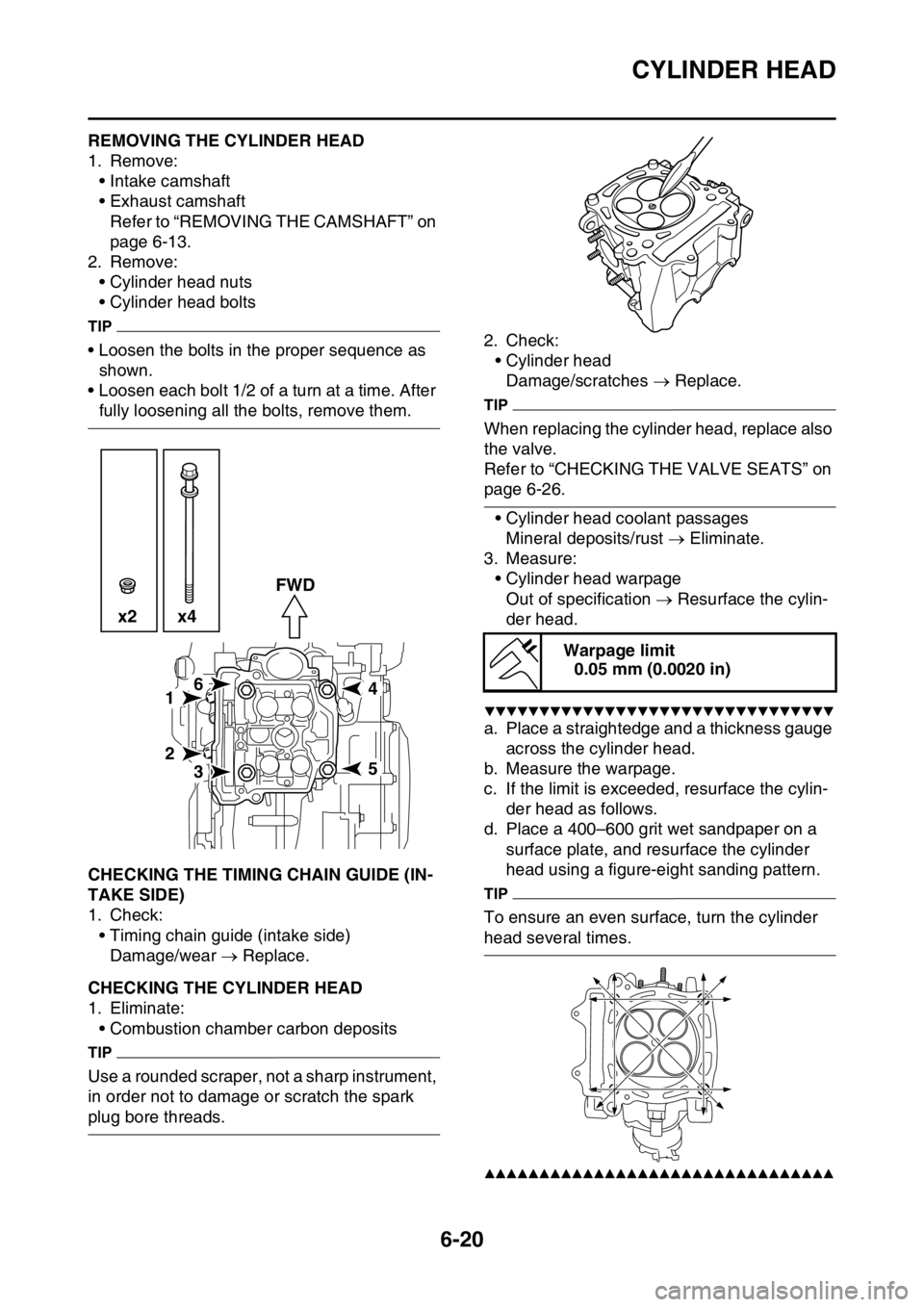
• Loosen the bolts in the proper sequence as
shown.
• Loosen each bolt 1/2 of a turn at a time. After
fully loosening all the bolts, remove them.
EAS2GB2248CHECKING THE TIMING CHAIN GUIDE (IN-
TAKE SIDE)
1. Check:
• Timing chain guide (intake side)
Damage/wear Replace.
EAS2GB2249CHECKING THE CYLINDER HEAD
1. Eliminate:
• Combustion chamber carbon deposits
TIP
Use a rounded scraper, not a sharp instrument,
in order not to damage or scratch the spark
plug bore threads.2. Check:
• Cylinder head
Damage/scratches Replace.
TIP
When replacing the cylinder head, replace also
the valve.
Refer to “CHECKING THE VALVE SEATS” on
page 6-26.
• Cylinder head coolant passages
Mineral deposits/rust Eliminate.
3. Measure:
• Cylinder head warpage
Out of specification Resurface the cylin-
der head.
▼▼▼▼▼▼▼▼▼▼▼▼▼▼▼▼▼▼▼▼▼▼▼▼▼▼▼▼▼▼▼▼
a. Place a straightedge and a thickness gauge
across the cylinder head.
b. Measure the warpage.
c. If the limit is exceeded, resurface the cylin-
der head as follows.
d. Place a 400–600 grit wet sandpaper on a
surface plate, and resurface the cylinder
head using a figure-eight sanding pattern.
TIP
To ensure an even surface, turn the cylinder
head several times.
▲▲▲▲▲▲▲▲▲▲▲▲▲▲▲▲▲▲▲▲▲▲▲▲▲▲▲▲▲▲▲▲
61
2
35
4 x2 x4FWD
Warpage limit
0.05 mm (0.0020 in)
Page 334 of 430

ELECTRICAL COMPONENTS....................................................................... 9-60
CHECKING THE SWITCHES .................................................................. 9-64
CHECKING THE BULBS AND BULB SOCKETS .................................... 9-67
CHECKING THE FUSES ......................................................................... 9-68
CHECKING AND CHARGING THE BATTERY ........................................ 9-69
CHECKING THE RELAYS ....................................................................... 9-72
CHECKING THE DIODE .......................................................................... 9-73
CHECKING THE IGNITION SPARK GAP................................................ 9-73
CHECKING THE SPARK PLUG CAP ...................................................... 9-73
CHECKING THE IGNITION COIL ............................................................ 9-74
CHECKING THE CRANKSHAFT POSITION SENSOR........................... 9-74
CHECKING THE LEAN ANGLE SENSOR............................................... 9-75
CHECKING THE STARTER MOTOR OPERATION ................................ 9-75
CHECKING THE STATOR COIL ............................................................. 9-76
CHECKING THE RECTIFIER/REGULATOR ........................................... 9-76
CHECKING THE SPEED SENSOR ......................................................... 9-77
CHECKING THE FUEL SENDER ............................................................ 9-77
CHECKING THE RESISTER ................................................................... 9-77
CHECKING THE RADIATOR FAN MOTOR ............................................ 9-78
CHECKING THE COOLANT TEMPERATURE SENSOR........................ 9-78
CHECKING THE THROTTLE POSITION SENSOR ................................ 9-79
CHECKING THE THROTTLE POSITION SENSOR INPUT VOLTAGE .. 9-79
CHECKING THE INTAKE AIR PRESSURE SENSOR ............................ 9-80
CHECKING THE INTAKE AIR TEMPERATURE SENSOR ..................... 9-80
CHECKING THE FUEL INJECTOR ......................................................... 9-81
Page 337 of 430

IGNITION SYSTEM
9-3
1. Joint connector
2. Joint connector
4. AC magneto
9. Battery
10.Frame ground
11.Starter relay
12.Main fuse
22.ECU (engine control unit)
23.Ignition coil
24.Spark plug
30.Joint connector
35.Lean angle sensor
36.Engine stop switch
48.Frame ground
Page 338 of 430

IGNITION SYSTEM
9-4
EAS2GB2361TROUBLESHOOTING
The ignition system fails to operate (no spark or intermittent spark).
TIP
Before troubleshooting, remove the following part (s):
1. Seat
2. Side cover (left/right)
3. Air scoop (left/right)
4. Fuel tank
5. Fuel tank
1. Check the fuse.
Refer to “CHECKING THE FUSES”
on page 9-68.NG
Replace the fuse(s).
OK
2. Check the battery.
Refer to “CHECKING AND
CHARGING THE BATTERY” on
page 9-69.NG
• Clean the battery terminals.
• Recharge or replace the battery.
OK
3. Check the spark plug.
Refer to “CHECKING THE FUSES”
on page 9-68.NG
Re-gap or replace the spark plug.
OK
4. Check the ignition spark gap.
Refer to “CHECKING THE IGNI-
TION SPARK GAP” on page 9-73.OK
The ignition system is normal.
NG
5. Check the ignition coil.
Refer to “CHECKING THE IGNI-
TION COIL” on page 9-74.NG
Replace the ignition coil.
OK
6. Check the crankshaft position sen-
sor.
Refer to “CHECKING THE CRANK-
SHAFT POSITION SENSOR” on
page 9-74.NG
Replace the stator assembly.
OK
7. Check the engine stop switch.
Refer to “CHECKING THE
SWITCHES” on page 9-64.NG
Replace the engine stop switch.
OK
Page 404 of 430
ELECTRICAL COMPONENTS
9-70
▲▲▲▲▲▲▲▲▲▲▲▲▲▲▲▲▲▲▲▲▲▲▲▲▲▲▲▲▲▲▲▲
5. Charge:
• Battery
(refer to the appropriate charging method)
EWA
WARNING
Do not quick charge a battery.
ECA
NOTICE
• Do not use a high-rate battery charger
since it forces a high-amperage current
into the battery quickly and can cause bat-
tery overheating and battery plate dam-
age.
• If it is impossible to regulate the charging
current on the battery charger, be careful
not to overcharge the battery.• When charging a battery, be sure to re-
move it from the vehicle. (If charging has
to be done with the battery mounted on the
vehicle, disconnect the negative battery
lead from the battery terminal.)
• To reduce the chance of sparks, do not
plug in the battery charger until the battery
charger leads are connected to the bat-
tery.
• Before removing the battery charger lead
clips from the battery terminals, be sure to
turn off the battery charger.
• Make sure the battery charger lead clips
are in full contact with the battery terminal
and that they are not shorted. A corroded
battery charger lead clip may generate
heat in the contact area and a weak clip
spring may cause sparks.
• If the battery becomes hot to the touch at
any time during the charging process, dis-
connect the battery charger and let the
battery cool before reconnecting it. Hot
batteries can explode!
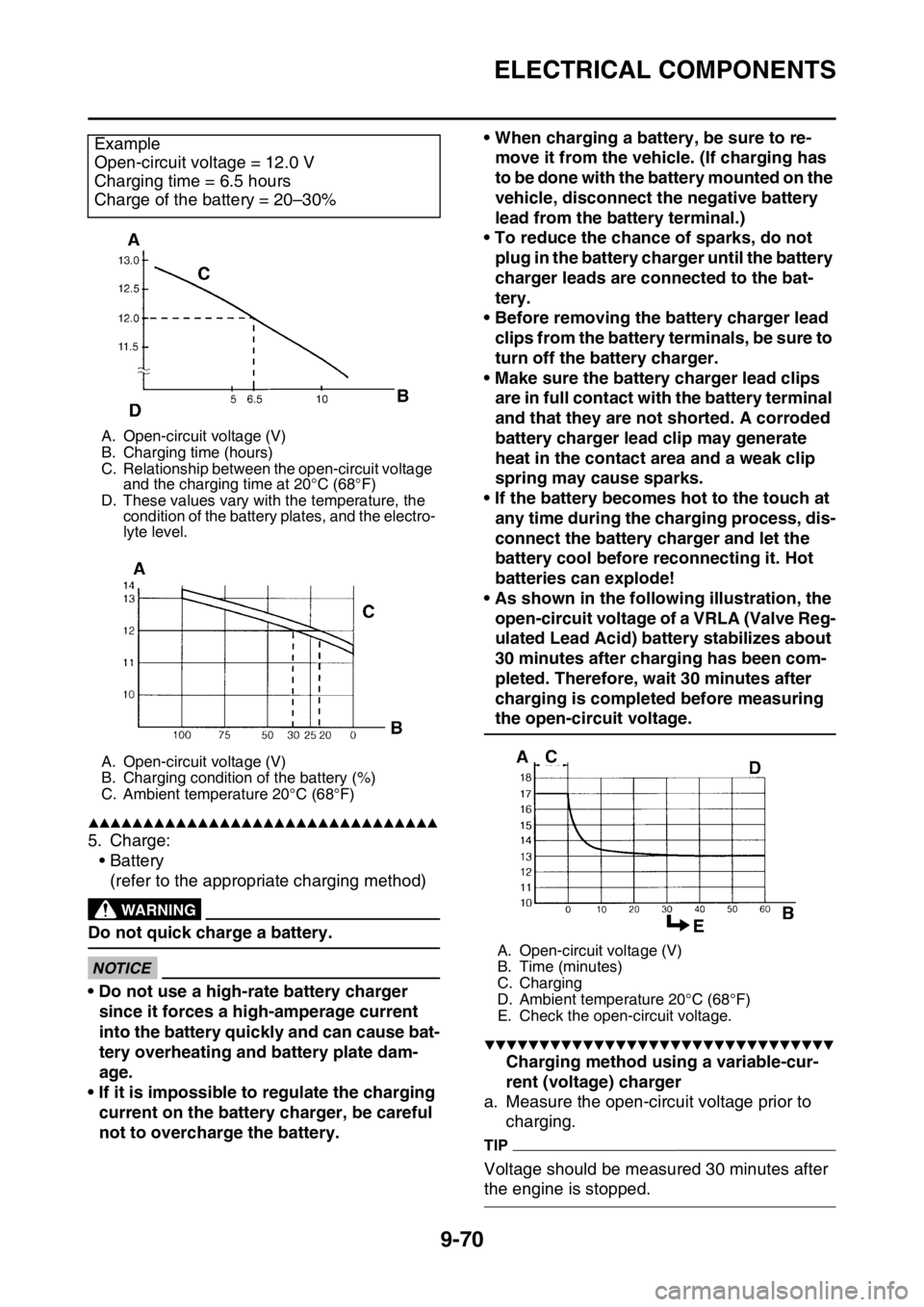
• As shown in the following illustration, the
open-circuit voltage of a VRLA (Valve Reg-
ulated Lead Acid) battery stabilizes about
30 minutes after charging has been com-
pleted. Therefore, wait 30 minutes after
charging is completed before measuring
the open-circuit voltage.
▼▼▼▼▼▼▼▼▼▼▼▼▼▼▼▼▼▼▼▼▼▼▼▼▼▼▼▼▼▼▼▼
Charging method using a variable-cur-
rent (voltage) charger
a. Measure the open-circuit voltage prior to
charging.
TIP
Voltage should be measured 30 minutes after
the engine is stopped. Example
Open-circuit voltage = 12.0 V
Charging time = 6.5 hours
Charge of the battery = 20–30%
A. Open-circuit voltage (V)
B. Charging time (hours)
C. Relationship between the open-circuit voltage
and the charging time at 20°C (68°F)
D. These values vary with the temperature, the
condition of the battery plates, and the electro-
lyte level.
A. Open-circuit voltage (V)
B. Charging condition of the battery (%)
C. Ambient temperature 20°C (68°F)
A. Open-circuit voltage (V)
B. Time (minutes)
C. Charging
D. Ambient temperature 20°C (68°F)
E. Check the open-circuit voltage.
Page 407 of 430
ELECTRICAL COMPONENTS
9-73
EAS2GB2389CHECKING THE DIODE
1. Check:
•Diode
Out of specification Replace.
TIP
The pocket tester and the analog pocket tester
readings are shown in the following table.
▼▼▼▼▼▼▼▼▼▼▼▼▼▼▼▼▼▼▼▼▼▼▼▼▼▼▼▼▼▼▼▼
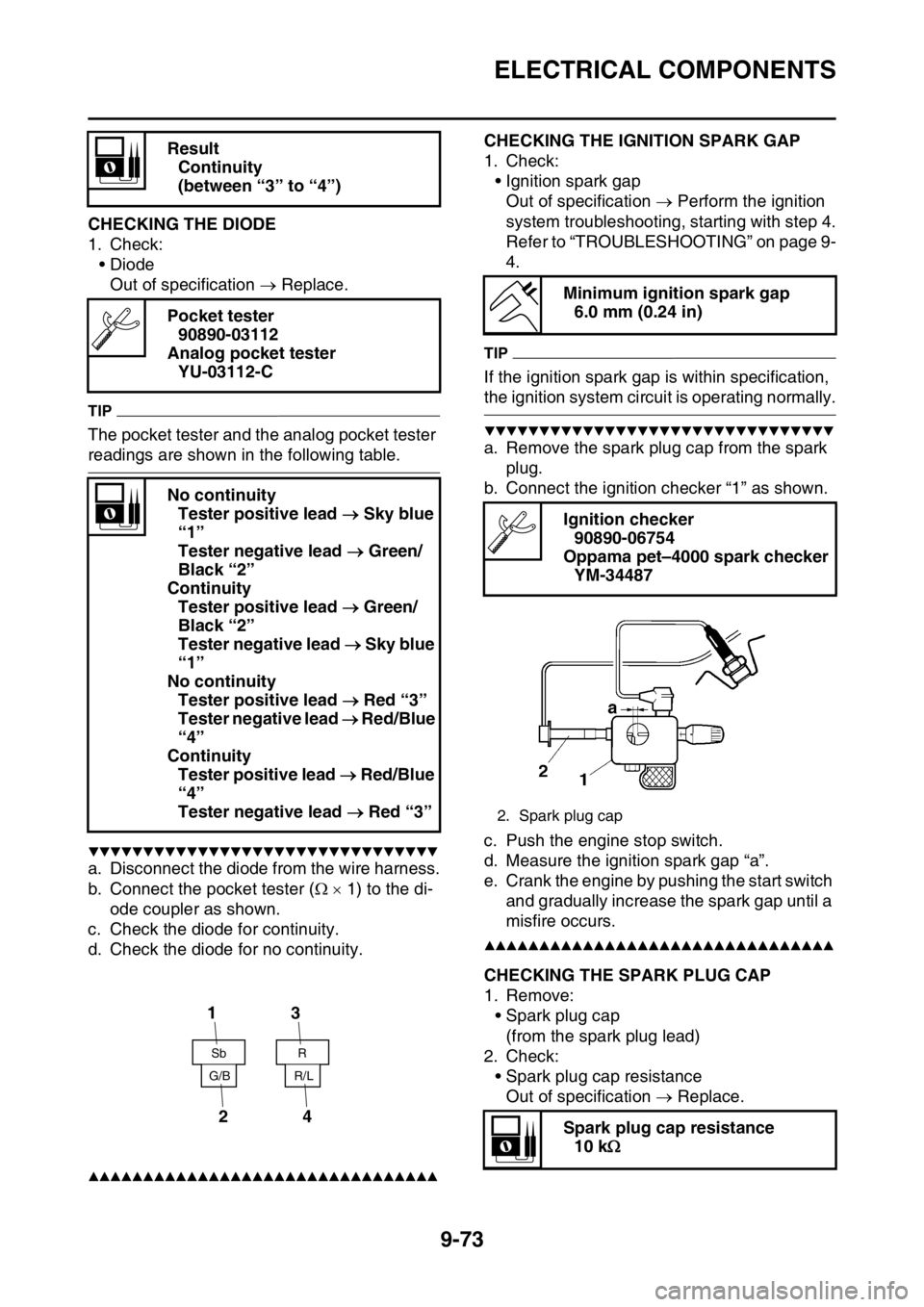
a. Disconnect the diode from the wire harness.
b. Connect the pocket tester ( 1) to the di-
ode coupler as shown.
c. Check the diode for continuity.
d. Check the diode for no continuity.
▲▲▲▲▲▲▲▲▲▲▲▲▲▲▲▲▲▲▲▲▲▲▲▲▲▲▲▲▲▲▲▲
EAS2GB2390CHECKING THE IGNITION SPARK GAP
1. Check:
• Ignition spark gap
Out of specification Perform the ignition
system troubleshooting, starting with step 4.
Refer to “TROUBLESHOOTING” on page 9-
4.
TIP
If the ignition spark gap is within specification,
the ignition system circuit is operating normally.
▼▼▼▼▼▼▼▼▼▼▼▼▼▼▼▼▼▼▼▼▼▼▼▼▼▼▼▼▼▼▼▼
a. Remove the spark plug cap from the spark
plug.
b. Connect the ignition checker “1” as shown.
c. Push the engine stop switch.
d. Measure the ignition spark gap “a”.
e. Crank the engine by pushing the start switch
and gradually increase the spark gap until a
misfire occurs.
▲▲▲▲▲▲▲▲▲▲▲▲▲▲▲▲▲▲▲▲▲▲▲▲▲▲▲▲▲▲▲▲
EAS2GB2391CHECKING THE SPARK PLUG CAP
1. Remove:
• Spark plug cap
(from the spark plug lead)
2. Check:
• Spark plug cap resistance
Out of specification Replace. Result
Continuity
(between “3” to “4”)
Pocket tester
90890-03112
Analog pocket tester
YU-03112-C
No continuity
Tester positive lead Sky blue
“1”
Tester negative lead Green/
Black “2”
Continuity
Tester positive lead Green/
Black “2”
Tester negative lead Sky blue
“1”
No continuity
Tester positive lead Red “3”
Tester negative lead Red/Blue
“4”
Continuity
Tester positive lead Red/Blue
“4”
Tester negative lead Red “3”
2
1
4
3
R Sb
G/B R/L
Minimum ignition spark gap
6.0 mm (0.24 in)
Ignition checker
90890-06754
Oppama pet–4000 spark checker
YM-34487
2. Spark plug cap
Spark plug cap resistance
10 k