radiator YAMAHA WR 250F 2015 Owner's Manual
[x] Cancel search | Manufacturer: YAMAHA, Model Year: 2015, Model line: WR 250F, Model: YAMAHA WR 250F 2015Pages: 430, PDF Size: 14.14 MB
Page 315 of 430
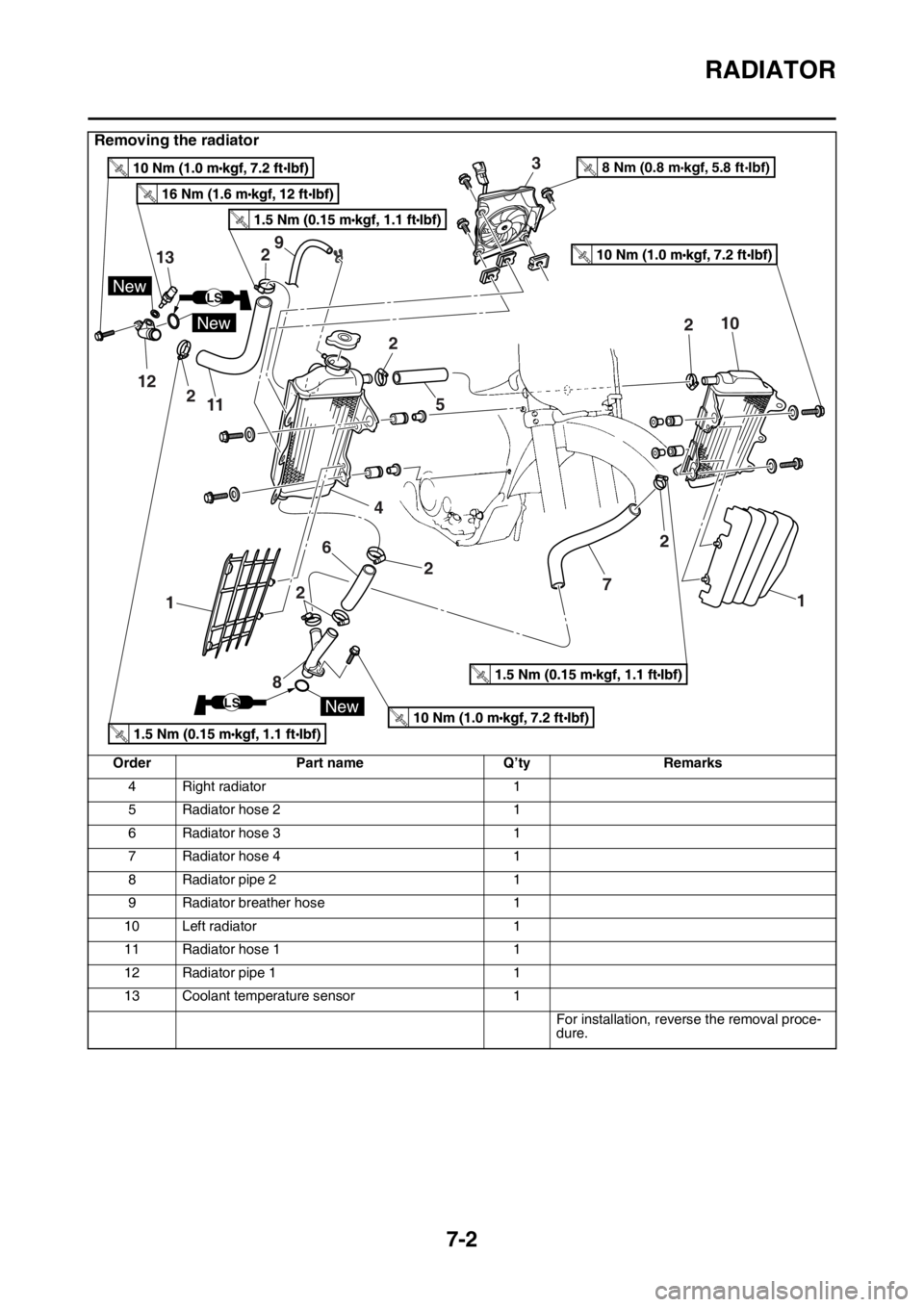
RADIATOR
7-2
4 Right radiator 1
5 Radiator hose 2 1
6 Radiator hose 3 1
7 Radiator hose 4 1
8 Radiator pipe 2 1
9 Radiator breather hose 1
10 Left radiator 1
11 Radiator hose 1 1
12 Radiator pipe 1 1
13 Coolant temperature sensor 1
For installation, reverse the removal proce-
dure.
Removing the radiator
Order Part name Q’ty Remarks
12
13
New
New
New
LS
LS
3
458 Nm (0.8 m kgf, 5.8 ft Ibf)T.R.
6
7
89
10
112
2
2
2 22 2
1
1
Page 316 of 430
RADIATOR
7-3
EAS2GB2332HANDLING NOTEEWA
WARNING
If coolant seems hot, do not remove the ra-
diator cap.
EAS2GB2333CHECKING THE RADIATOR
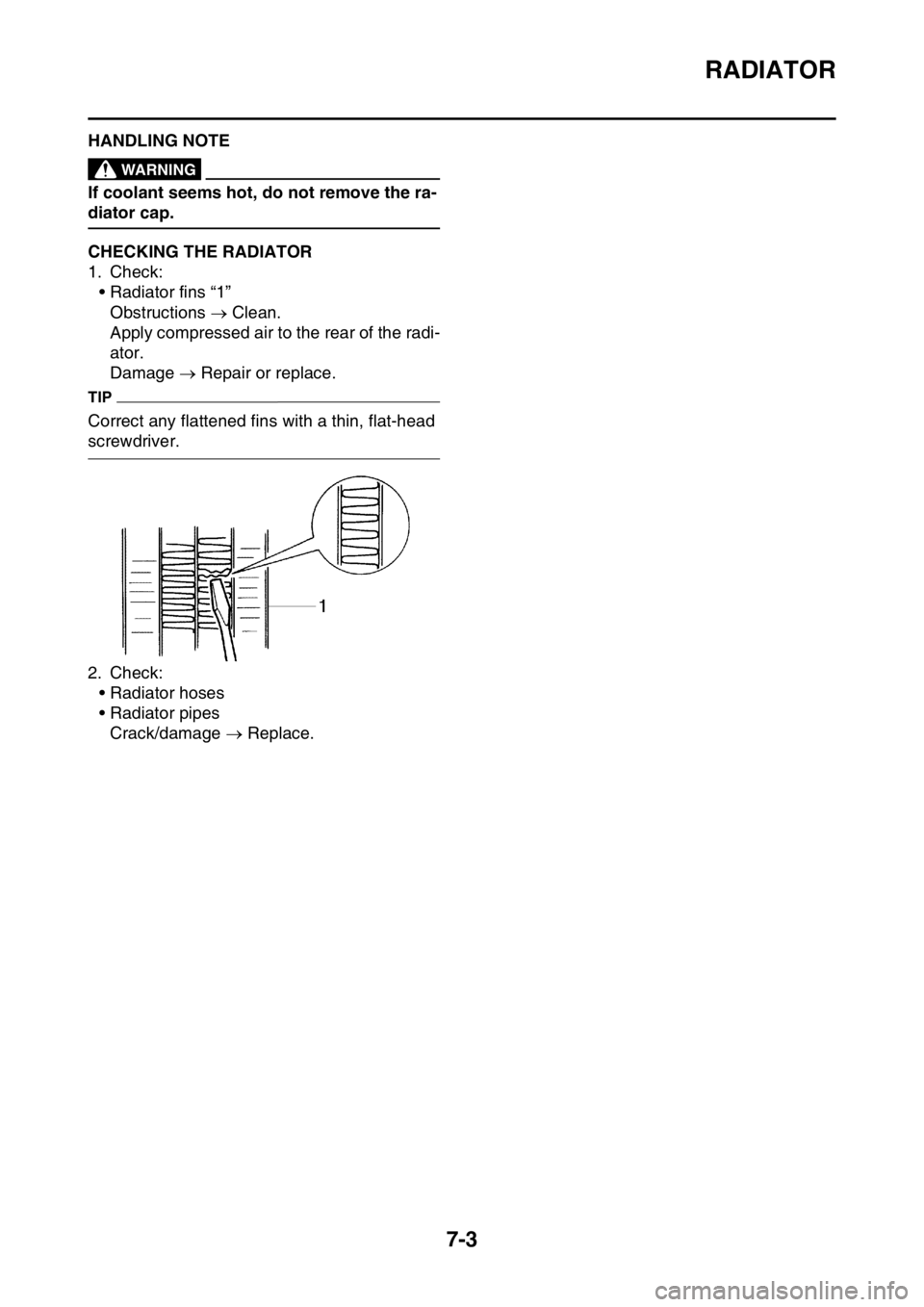
1. Check:
• Radiator fins “1”
Obstructions Clean.
Apply compressed air to the rear of the radi-
ator.
Damage Repair or replace.
TIP
Correct any flattened fins with a thin, flat-head
screwdriver.
2. Check:
• Radiator hoses
• Radiator pipes
Crack/damage Replace.
Page 334 of 430

ELECTRICAL COMPONENTS....................................................................... 9-60
CHECKING THE SWITCHES .................................................................. 9-64
CHECKING THE BULBS AND BULB SOCKETS .................................... 9-67
CHECKING THE FUSES ......................................................................... 9-68
CHECKING AND CHARGING THE BATTERY ........................................ 9-69
CHECKING THE RELAYS ....................................................................... 9-72
CHECKING THE DIODE .......................................................................... 9-73
CHECKING THE IGNITION SPARK GAP................................................ 9-73
CHECKING THE SPARK PLUG CAP ...................................................... 9-73
CHECKING THE IGNITION COIL ............................................................ 9-74
CHECKING THE CRANKSHAFT POSITION SENSOR........................... 9-74
CHECKING THE LEAN ANGLE SENSOR............................................... 9-75
CHECKING THE STARTER MOTOR OPERATION ................................ 9-75
CHECKING THE STATOR COIL ............................................................. 9-76
CHECKING THE RECTIFIER/REGULATOR ........................................... 9-76
CHECKING THE SPEED SENSOR ......................................................... 9-77
CHECKING THE FUEL SENDER ............................................................ 9-77
CHECKING THE RESISTER ................................................................... 9-77
CHECKING THE RADIATOR FAN MOTOR ............................................ 9-78
CHECKING THE COOLANT TEMPERATURE SENSOR........................ 9-78
CHECKING THE THROTTLE POSITION SENSOR ................................ 9-79
CHECKING THE THROTTLE POSITION SENSOR INPUT VOLTAGE .. 9-79
CHECKING THE INTAKE AIR PRESSURE SENSOR ............................ 9-80
CHECKING THE INTAKE AIR TEMPERATURE SENSOR ..................... 9-80
CHECKING THE FUEL INJECTOR ......................................................... 9-81
Page 359 of 430

COOLING SYSTEM
9-25
1. Joint connector
2. Joint connector
3. Joint connector
7. Main relay
9. Battery
10.Frame ground
11.Starter relay
12.Main fuse
22.ECU (engine control unit)
27.Radiator fan motor relay
28.Radiator fan motor fuse
29.Radiator fan motor
30.Joint connector
32.Coolant temperature sensor
48.Frame ground
Page 360 of 430

COOLING SYSTEM
9-26
EAS2GB2373TROUBLESHOOTING
The radiator fan motor fails to turn.
TIP
Before troubleshooting, remove the following part(s):
1. Seat
2. Side cover (left)
3. Air scoop (left/right)
4. Fuel tank
1. Check the fuse.
Refer to “CHECKING THE FUSES”
on page 9-68.NG
Replace the fuse(s).
OK
2. Check the battery.
Refer to “CHECKING AND
CHARGING THE BATTERY” on
page 9-69.NG
• Clean the battery terminals.
• Recharge or replace the battery.
OK
3. Check the main relay.
Refer to “CHECKING THE RE-
LAYS” on page 9-72.NG
Replace the main relay.
OK
4. Check the radiator fan motor.
Refer to “CHECKING THE RADIA-
TOR FAN MOTOR” on page 9-78.NG
Replace the radiator fan motor.
OK
5. Check the radiator fan motor relay.
Refer to “CHECKING THE RE-
LAYS” on page 9-72.NG
Replace the radiator fan motor relay.
OK
6. Check the coolant temperature sen-
sor.
Refer to “CHECKING THE COOL-
ANT TEMPERATURE SENSOR”
on page 9-78.NG
Replace the coolant temperature sensor.
OK
7. Check the entire cooling system’s
wiring.
Refer to “CIRCUIT DIAGRAM” on
page 9-16.NG
Properly connect or repair the cooling sys-
tem’s wiring.
OK
Replace the ECU.
Page 395 of 430

ELECTRICAL COMPONENTS
9-61
1. Rectifier/regulator
2. Clutch switch
3. Ignition coil
4. ECU (engine control unit)
5. Fuel sender
6. Fuel pump
7. Battery
8. Resistor
9. Neutral switch
10.Radiator fan motor
11.Injector
Page 397 of 430

ELECTRICAL COMPONENTS
9-63
1. Intake air temperature sensor
2. Intake air pressure sensor
3. Throttle position sensor
4. Starter relay
5. Main fuse
6. Headlight relay
7. Starting circuit cut-off relay
8. Lean angle sensor
9. Radiator fan motor fuse
10.Radiator fan motor relay
11.Main relay
12.Coolant temperature sensor
Page 402 of 430
ELECTRICAL COMPONENTS
9-68
Checking the condition of the bulb sockets
The following procedure applies to all of the
bulb sockets.
1. Check:
• Bulb socket (for continuity)
(with the pocket tester)
No continuity Replace.
TIP
Check each bulb socket for continuity in the
same manner as described in the bulb section;
however, note the following.
▼▼▼▼▼▼▼▼▼▼▼▼▼▼▼▼▼▼▼▼▼▼▼▼▼▼▼▼▼▼▼▼
a. Install a good bulb into the bulb socket.
b. Connect the pocket tester probes to the re-
spective leads of the bulb socket.
c. Check the bulb socket for continuity. If any of
the readings indicate no continuity, replace
the bulb socket.
▲▲▲▲▲▲▲▲▲▲▲▲▲▲▲▲▲▲▲▲▲▲▲▲▲▲▲▲▲▲▲▲
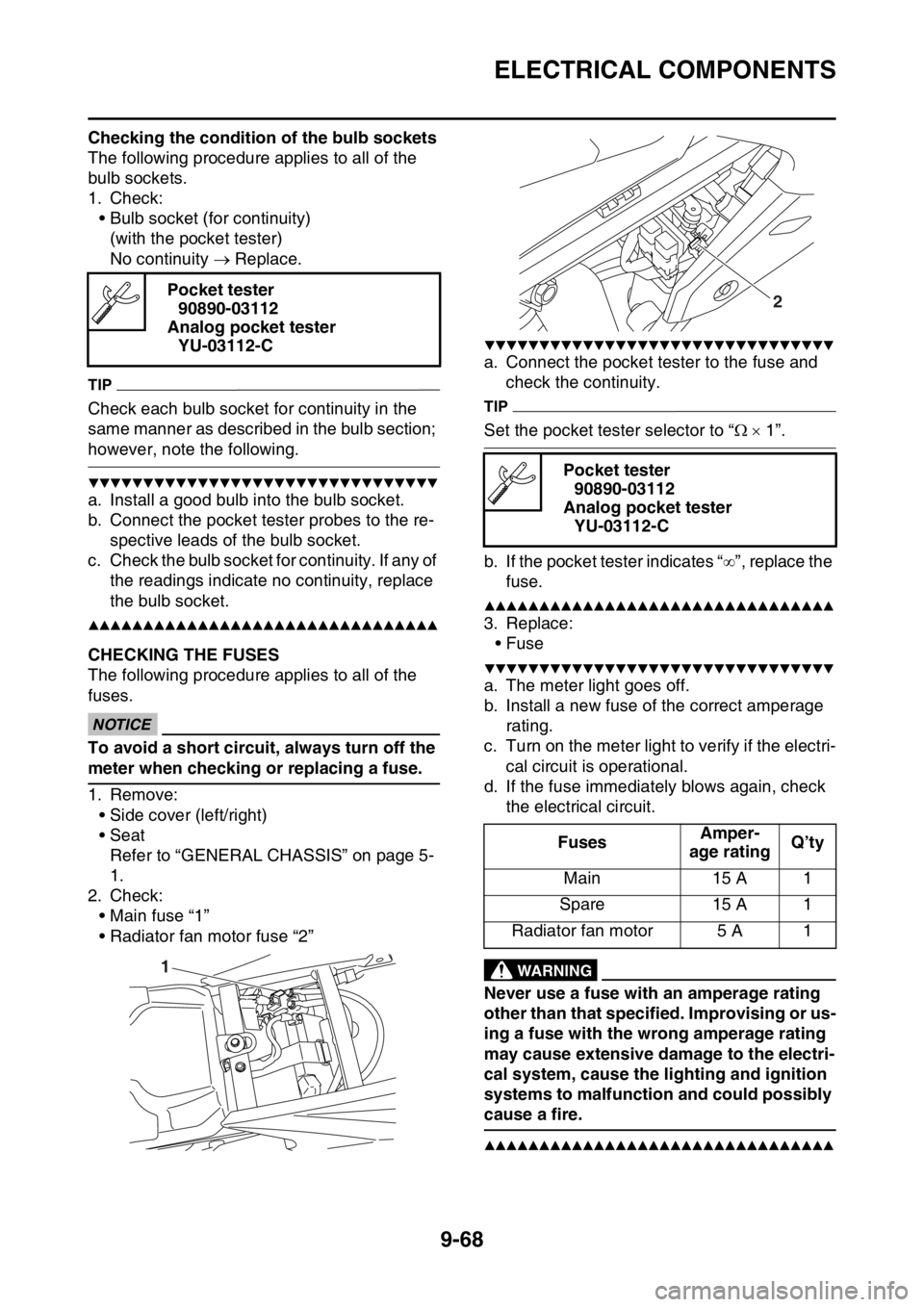
EAS2GB2386CHECKING THE FUSES
The following procedure applies to all of the
fuses.
ECA
NOTICE
To avoid a short circuit, always turn off the
meter when checking or replacing a fuse.
1. Remove:
• Side cover (left/right)
• Seat
Refer to “GENERAL CHASSIS” on page 5-
1.
2. Check:
• Main fuse “1”
• Radiator fan motor fuse “2”
▼▼▼▼▼▼▼▼▼▼▼▼▼▼▼▼▼▼▼▼▼▼▼▼▼▼▼▼▼▼▼▼
a. Connect the pocket tester to the fuse and
check the continuity.
TIP
Set the pocket tester selector to “ 1”.
b. If the pocket tester indicates “”, replace the
fuse.
▲▲▲▲▲▲▲▲▲▲▲▲▲▲▲▲▲▲▲▲▲▲▲▲▲▲▲▲▲▲▲▲
3. Replace:
• Fuse
▼▼▼▼▼▼▼▼▼▼▼▼▼▼▼▼▼▼▼▼▼▼▼▼▼▼▼▼▼▼▼▼
a. The meter light goes off.
b. Install a new fuse of the correct amperage
rating.
c. Turn on the meter light to verify if the electri-
cal circuit is operational.
d. If the fuse immediately blows again, check
the electrical circuit.
EWA
WARNING
Never use a fuse with an amperage rating
other than that specified. Improvising or us-
ing a fuse with the wrong amperage rating
may cause extensive damage to the electri-
cal system, cause the lighting and ignition
systems to malfunction and could possibly
cause a fire.
▲▲▲▲▲▲▲▲▲▲▲▲▲▲▲▲▲▲▲▲▲▲▲▲▲▲▲▲▲▲▲▲
Pocket tester
90890-03112
Analog pocket tester
YU-03112-C
1
Pocket tester
90890-03112
Analog pocket tester
YU-03112-C
FusesAmper-
age ratingQ’ty
Main 15 A 1
Spare 15 A 1
Radiator fan motor 5 A 1
2
Page 406 of 430
ELECTRICAL COMPONENTS
9-72
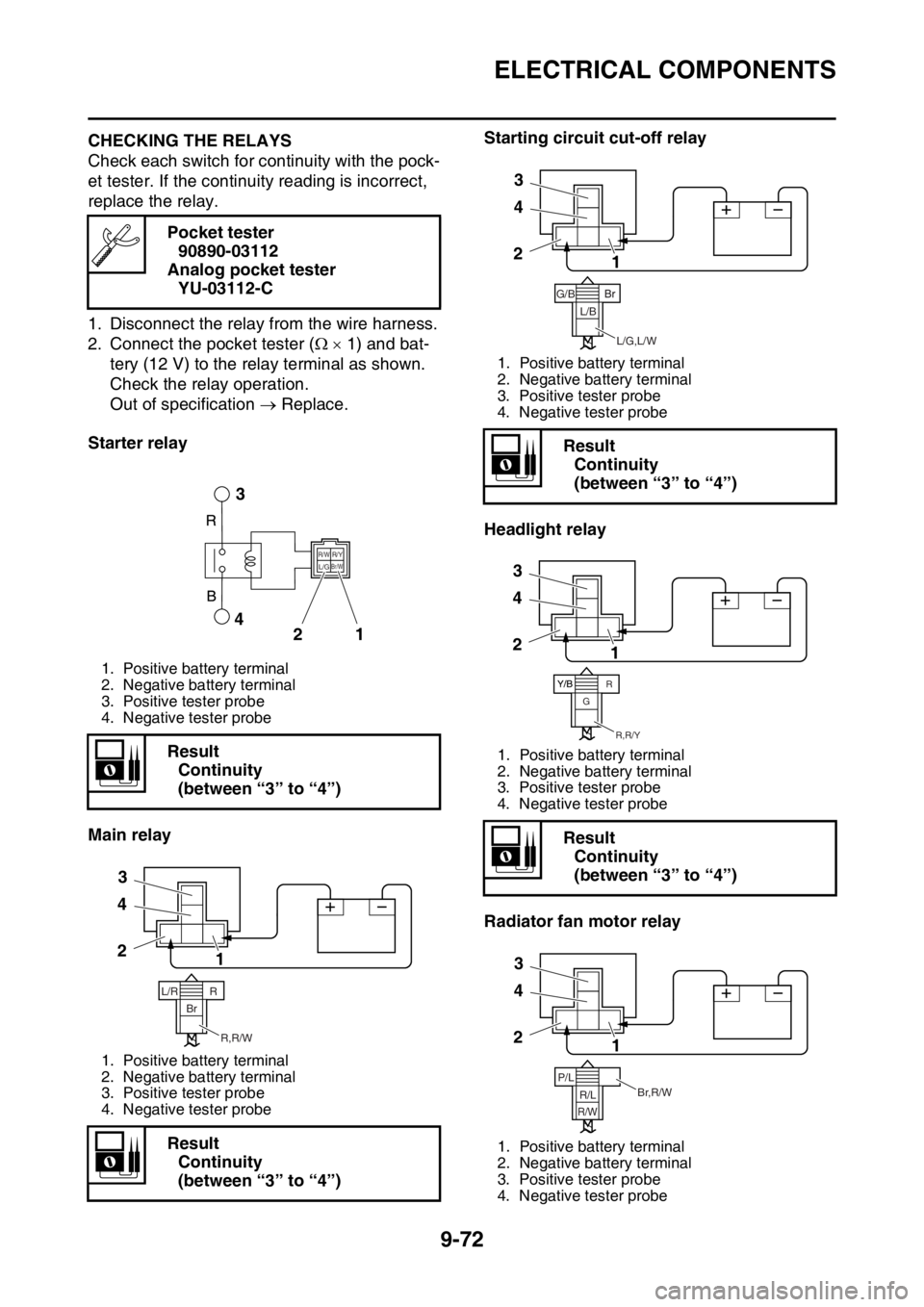
EAS2GB2388CHECKING THE RELAYS
Check each switch for continuity with the pock-
et tester. If the continuity reading is incorrect,
replace the relay.
1. Disconnect the relay from the wire harness.
2. Connect the pocket tester ( 1) and bat-
tery (12 V) to the relay terminal as shown.
Check the relay operation.
Out of specification Replace.
Starter relay
Main relayStarting circuit cut-off relay
Headlight relay
Radiator fan motor relay Pocket tester
90890-03112
Analog pocket tester
YU-03112-C
1. Positive battery terminal
2. Negative battery terminal
3. Positive tester probe
4. Negative tester probe
Result
Continuity
(between “3” to “4”)
1. Positive battery terminal
2. Negative battery terminal
3. Positive tester probe
4. Negative tester probe
Result
Continuity
(between “3” to “4”)
21 3
4
R/WBr/WR/YL/G
1 23
4
L/R
BrR
R,R/W
1. Positive battery terminal
2. Negative battery terminal
3. Positive tester probe
4. Negative tester probe
Result
Continuity
(between “3” to “4”)
1. Positive battery terminal
2. Negative battery terminal
3. Positive tester probe
4. Negative tester probe
Result
Continuity
(between “3” to “4”)
1. Positive battery terminal
2. Negative battery terminal
3. Positive tester probe
4. Negative tester probe
1 23
4
G/B
L/B
L/G,L/W
1 23
4
R,R/Y
GR
1 23
4
P/L
R/L
R/W
Br,R/W
Page 412 of 430
ELECTRICAL COMPONENTS
9-78
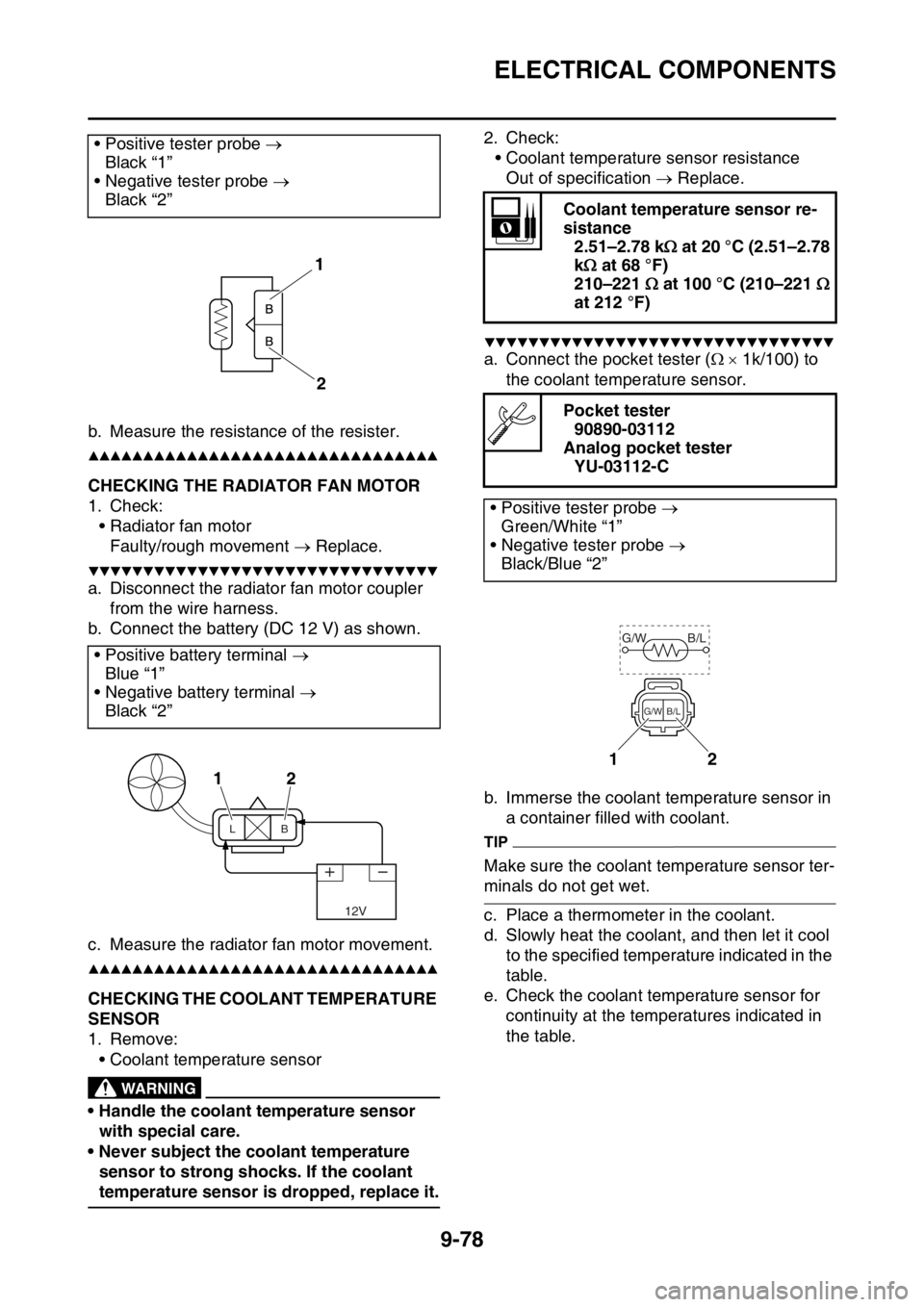
b. Measure the resistance of the resister.
▲▲▲▲▲▲▲▲▲▲▲▲▲▲▲▲▲▲▲▲▲▲▲▲▲▲▲▲▲▲▲▲
EAS2GB2400CHECKING THE RADIATOR FAN MOTOR
1. Check:
• Radiator fan motor
Faulty/rough movement Replace.
▼▼▼▼▼▼▼▼▼▼▼▼▼▼▼▼▼▼▼▼▼▼▼▼▼▼▼▼▼▼▼▼
a. Disconnect the radiator fan motor coupler
from the wire harness.
b. Connect the battery (DC 12 V) as shown.
c. Measure the radiator fan motor movement.
▲▲▲▲▲▲▲▲▲▲▲▲▲▲▲▲▲▲▲▲▲▲▲▲▲▲▲▲▲▲▲▲
EAS2GB2401CHECKING THE COOLANT TEMPERATURE
SENSOR
1. Remove:
• Coolant temperature sensor
EWA
WARNING
• Handle the coolant temperature sensor
with special care.
• Never subject the coolant temperature
sensor to strong shocks. If the coolant
temperature sensor is dropped, replace it.2. Check:
• Coolant temperature sensor resistance
Out of specification Replace.
▼▼▼▼▼▼▼▼▼▼▼▼▼▼▼▼▼▼▼▼▼▼▼▼▼▼▼▼▼▼▼▼
a. Connect the pocket tester ( 1k/100) to
the coolant temperature sensor.
b. Immerse the coolant temperature sensor in
a container filled with coolant.
TIP
Make sure the coolant temperature sensor ter-
minals do not get wet.
c. Place a thermometer in the coolant.
d. Slowly heat the coolant, and then let it cool
to the specified temperature indicated in the
table.
e. Check the coolant temperature sensor for
continuity at the temperatures indicated in
the table. • Positive tester probe
Black “1”
• Negative tester probe
Black “2”
• Positive battery terminal
Blue “1”
• Negative battery terminal
Black “2”
1
2
12
12V
LB
Coolant temperature sensor re-
sistance
2.51–2.78 k at 20 °C (2.51–2.78
k at 68 °F)
210–221 at 100 °C (210–221
at 212 °F)
Pocket tester
90890-03112
Analog pocket tester
YU-03112-C
• Positive tester probe
Green/White “1”
• Negative tester probe
Black/Blue “2”
12
G/W B/L
B/L G/W