oil YAMAHA WR 400F 2000 Workshop Manual
[x] Cancel search | Manufacturer: YAMAHA, Model Year: 2000, Model line: WR 400F, Model: YAMAHA WR 400F 2000Pages: 654, PDF Size: 60.12 MB
Page 328 of 654
4 - 33
ENG
VALVES AND VALVE SPRINGS
3. Inspect:
l
Valve face
Pitting/wear
®
Grind the face.
l
Valve stem end
Mushroom shape or diameter larger
than the body of the stem
®
Replace.
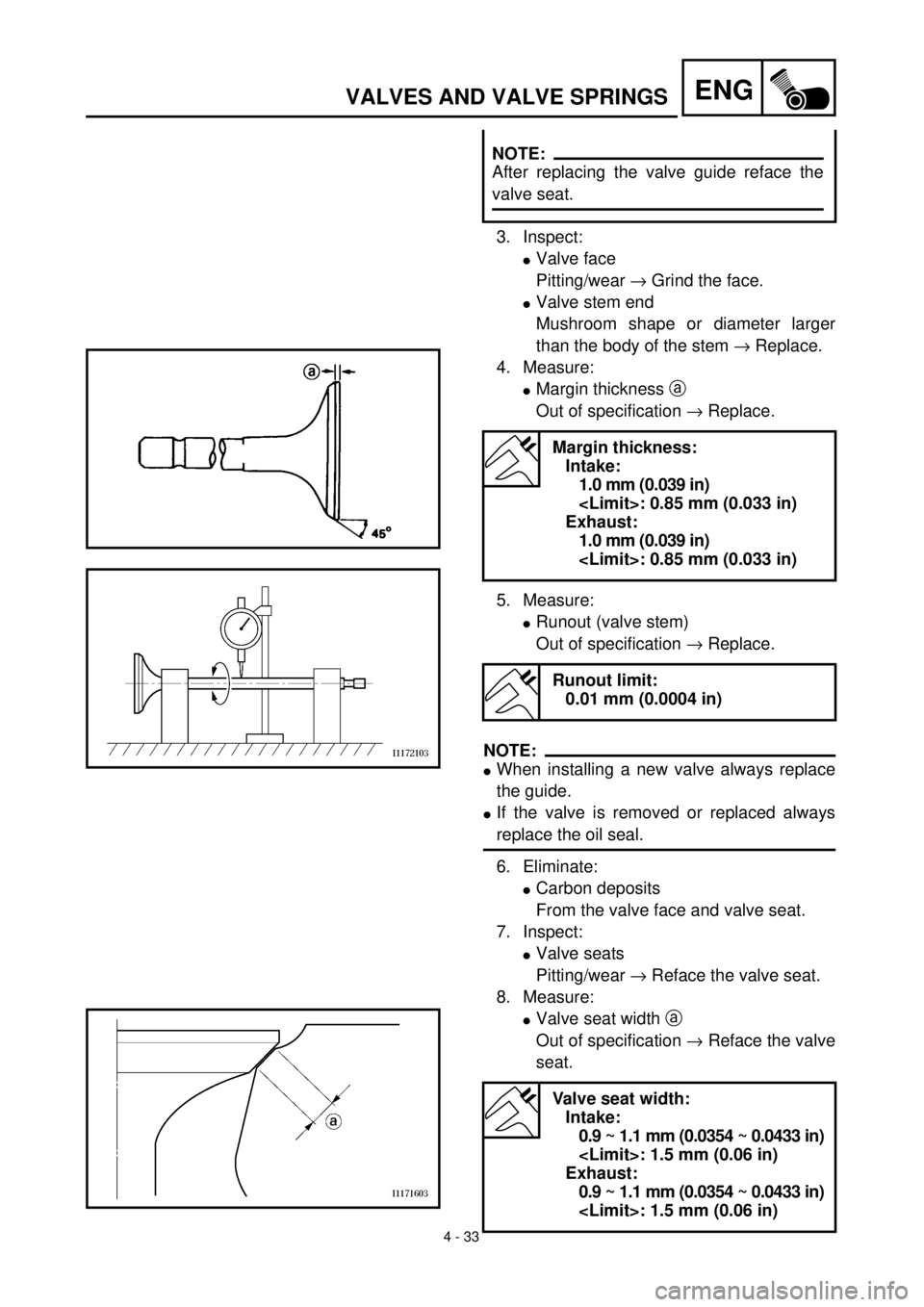
4. Measure:
l
Margin thickness
a
Out of specification
®
Replace.
5. Measure:
l
Runout (valve stem)
Out of specification
®
Replace.
NOTE:
l
When installing a new valve always replace
the guide.
l
If the valve is removed or replaced always
replace the oil seal.
6. Eliminate:
l
Carbon deposits
From the valve face and valve seat.
7. Inspect:
l
Valve seats
Pitting/wear
®
Reface the valve seat.
8. Measure:
l
Valve seat width
a
Out of specification
®
Reface the valve
seat.
Margin thickness:
Intake:
1.0 mm (0.039 in)
Exhaust:
1.0 mm (0.039 in)
Runout limit:
0.01 mm (0.0004 in)
Valve seat width:
Intake:
0.9 ~ 1.1 mm (0.0354 ~ 0.0433 in)
Exhaust:
0.9 ~ 1.1 mm (0.0354 ~ 0.0433 in)
NOTE:
After replacing the valve guide reface the
valve seat.
Page 330 of 654
4 - 34
ENG
VALVES AND VALVE SPRINGS
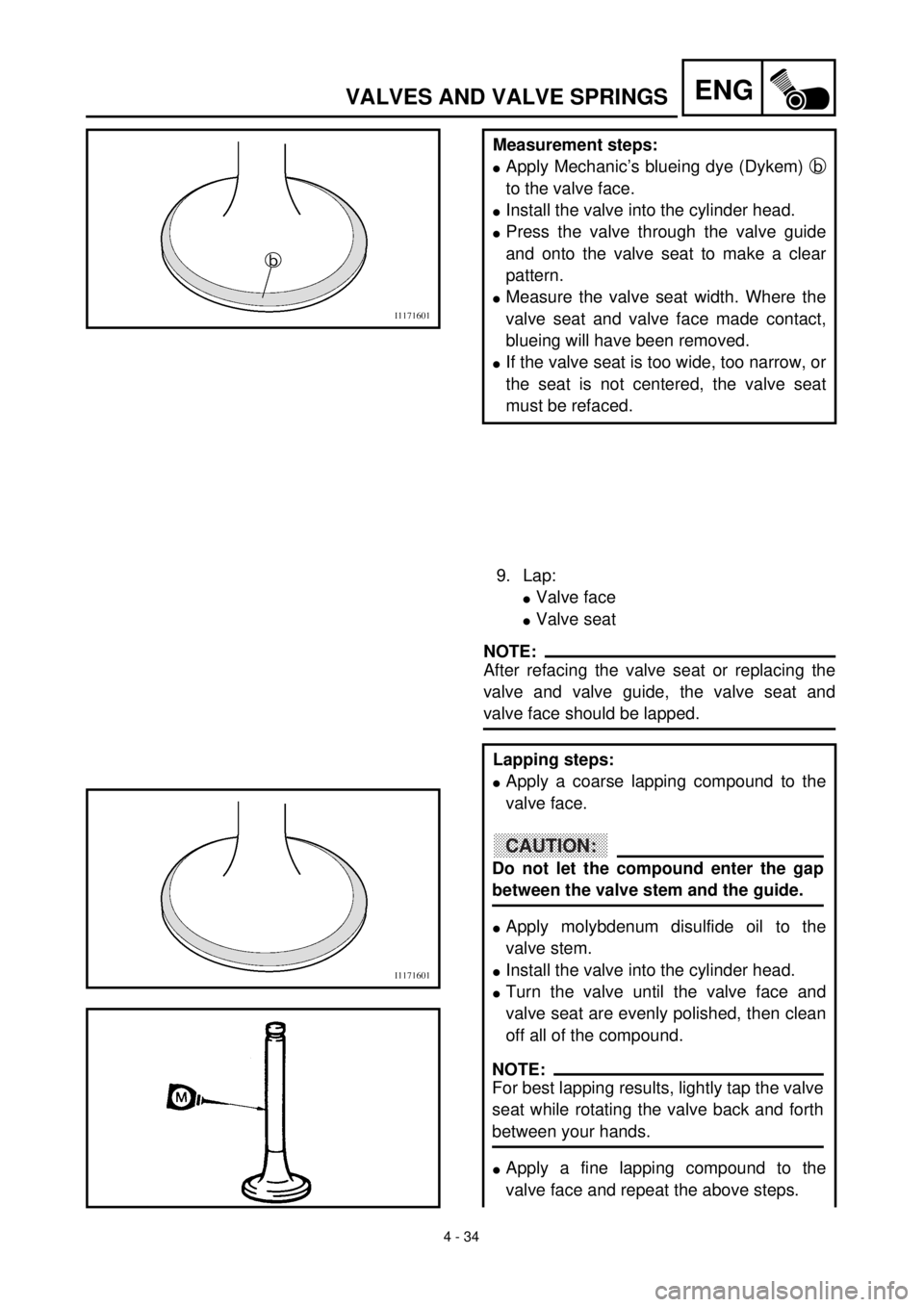
Measurement steps:
l
Apply Mechanic’s blueing dye (Dykem)
b
to the valve face.
l
Install the valve into the cylinder head.
l
Press the valve through the valve guide
and onto the valve seat to make a clear
pattern.
l
Measure the valve seat width. Where the
valve seat and valve face made contact,
blueing will have been removed.
l
If the valve seat is too wide, too narrow, or
the seat is not centered, the valve seat
must be refaced.
9. Lap:
l
Valve face
l
Valve seat
NOTE:
After refacing the valve seat or replacing the
valve and valve guide, the valve seat and
valve face should be lapped.
Lapping steps:
l
Apply a coarse lapping compound to the
valve face.
l
Apply molybdenum disulfide oil to the
valve stem.
l
Install the valve into the cylinder head.
l
Turn the valve until the valve face and
valve seat are evenly polished, then clean
off all of the compound.
l
Apply a fine lapping compound to the
valve face and repeat the above steps.
CAUTION:
Do not let the compound enter the gap
between the valve stem and the guide.
NOTE:
For best lapping results, lightly tap the valve
seat while rotating the valve back and forth
between your hands.
Page 334 of 654
4 - 36
ENGVALVES AND VALVE SPRINGS
Valve lifter
1. Inspect:
lValve lifter
Scratches/damage ® Replace both lift-
ers and cylinder head.
ASSEMBLY AND INSTALLATION
1. Apply:
lMolybdenum disulfide oil
Onto the valve stem and valve stem
seal.
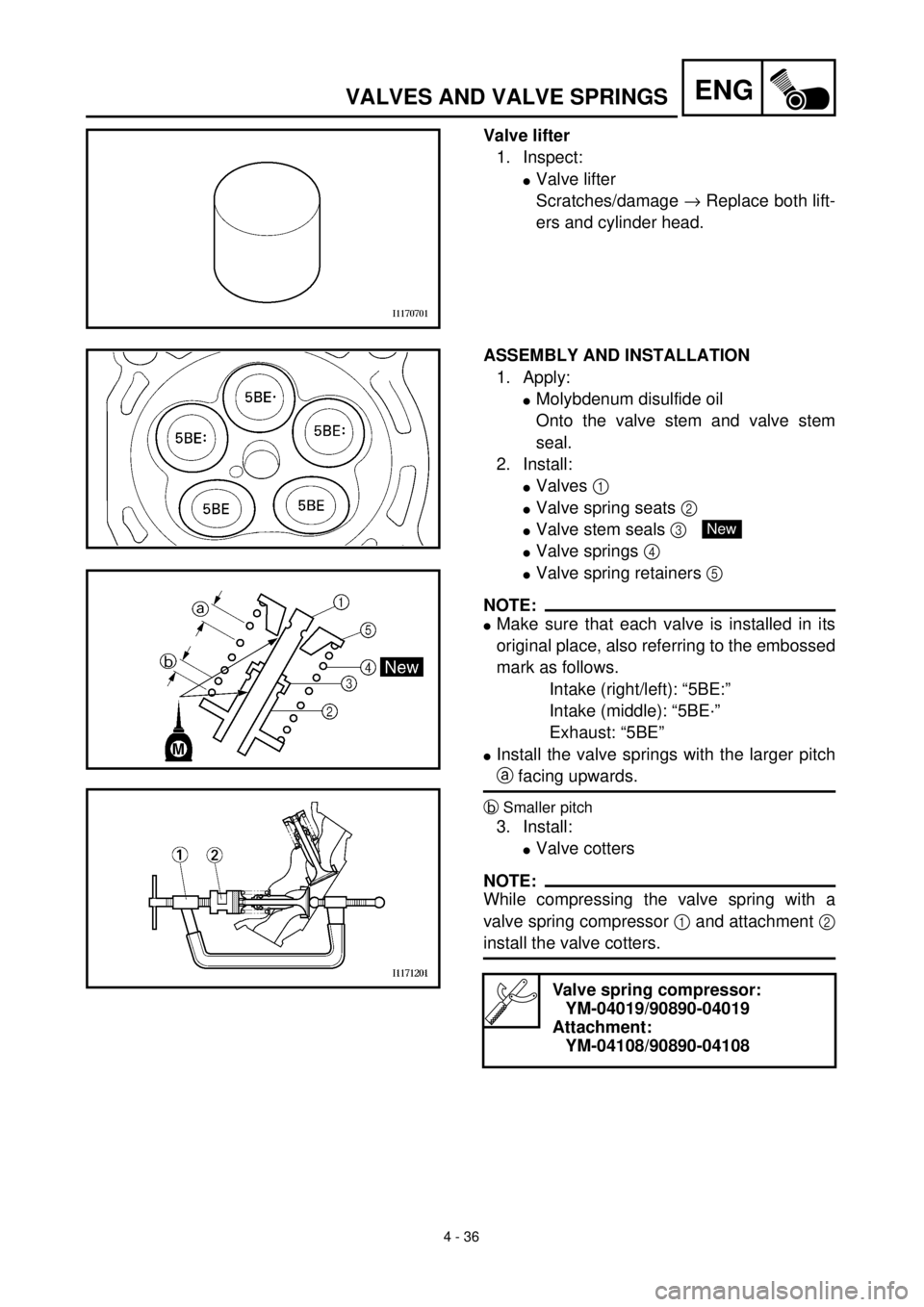
2. Install:
lValves 1
lValve spring seats 2
lValve stem seals 3
lValve springs 4
lValve spring retainers 5
NOTE:
lMake sure that each valve is installed in its
original place, also referring to the embossed
mark as follows.
Intake (right/left): “5BE:”
Intake (middle): “5BE·”
Exhaust: “5BE”
lInstall the valve springs with the larger pitch
a facing upwards.
bSmaller pitch
3. Install:
lValve cotters
NOTE:
While compressing the valve spring with a
valve spring compressor 1 and attachment 2
install the valve cotters.
Valve spring compressor:
YM-04019/90890-04019
Attachment:
YM-04108/90890-04108
New
Page 336 of 654
4 - 37
ENGVALVES AND VALVE SPRINGS
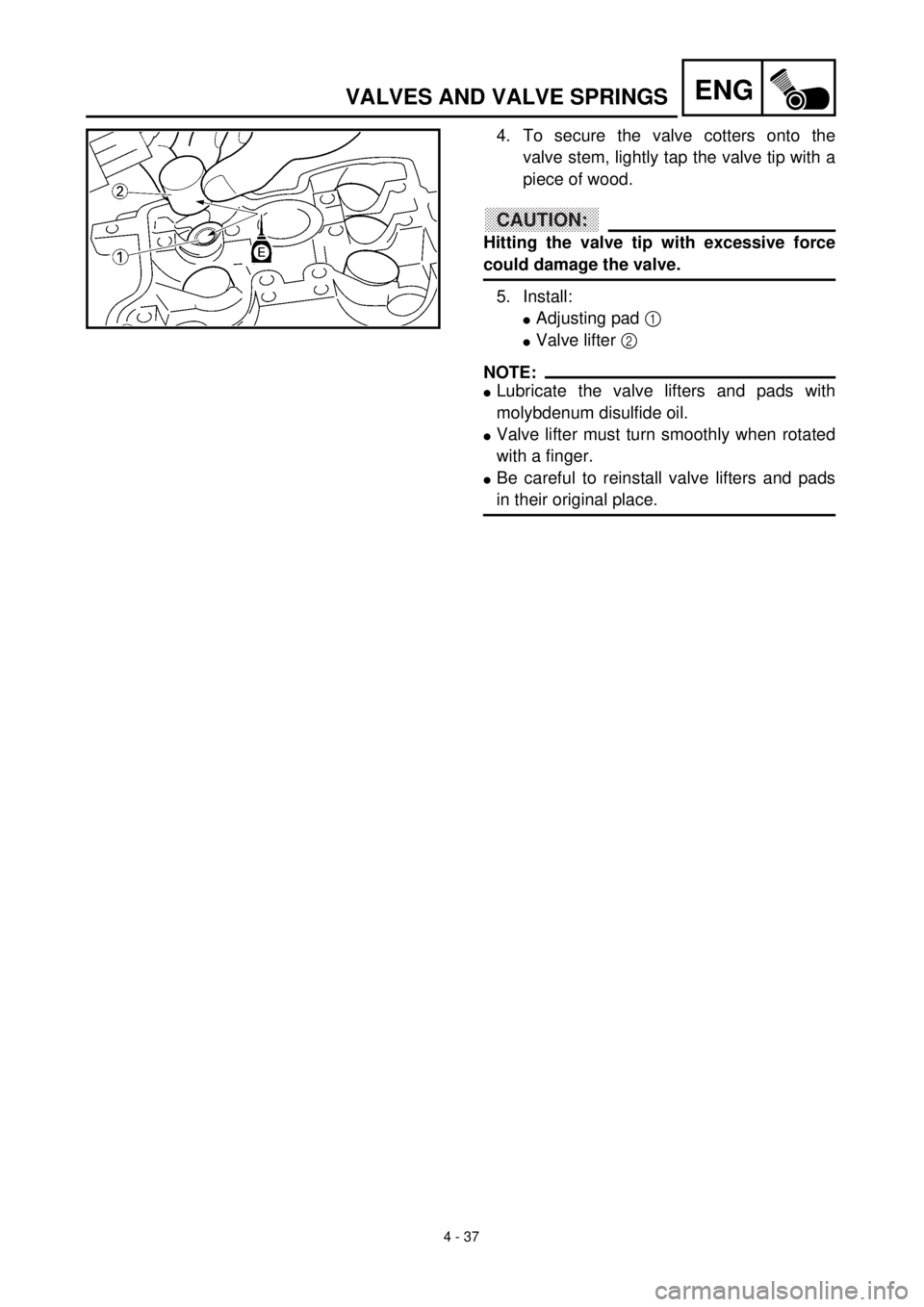
4. To secure the valve cotters onto the
valve stem, lightly tap the valve tip with a
piece of wood.
CAUTION:
Hitting the valve tip with excessive force
could damage the valve.
5. Install:
lAdjusting pad 1
lValve lifter 2
NOTE:
lLubricate the valve lifters and pads with
molybdenum disulfide oil.
lValve lifter must turn smoothly when rotated
with a finger.
lBe careful to reinstall valve lifters and pads
in their original place.
Page 344 of 654
4 - 41
ENGCYLINDER AND PISTON
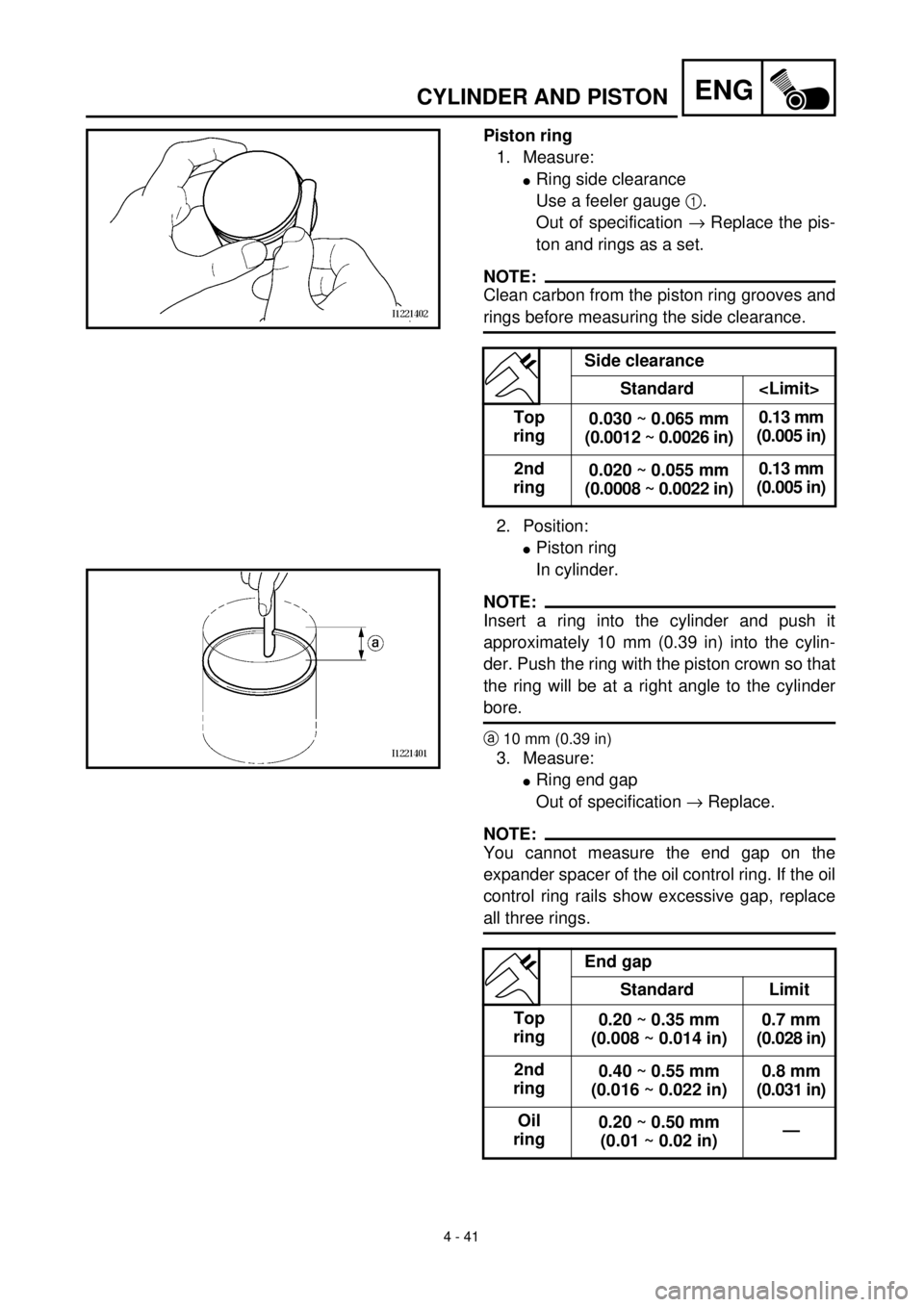
Piston ring
1. Measure:
lRing side clearance
Use a feeler gauge 1.
Out of specification ® Replace the pis-
ton and rings as a set.
NOTE:
Clean carbon from the piston ring grooves and
rings before measuring the side clearance.
2. Position:
lPiston ring
In cylinder.
NOTE:
Insert a ring into the cylinder and push it
approximately 10 mm (0.39 in) into the cylin-
der. Push the ring with the piston crown so that
the ring will be at a right angle to the cylinder
bore.
a10 mm (0.39 in)
3. Measure:
lRing end gap
Out of specification ® Replace.
NOTE:
You cannot measure the end gap on the
expander spacer of the oil control ring. If the oil
control ring rails show excessive gap, replace
all three rings.
Side clearance
Standard
Top
ring0.030 ~ 0.065 mm
(0.0012 ~ 0.0026 in)0.13 mm
(0.005 in)
2nd
ring0.020 ~ 0.055 mm
(0.0008 ~ 0.0022 in)0.13 mm
(0.005 in)
End gap
Standard Limit
Top
ring0.20 ~ 0.35 mm
(0.008 ~ 0.014 in)0.7 mm
(0.028 in)
2nd
ring0.40 ~ 0.55 mm
(0.016 ~ 0.022 in)0.8 mm
(0.031 in)
Oil
ring0.20 ~ 0.50 mm
(0.01 ~ 0.02 in)—
Page 346 of 654
4 - 42
ENGCYLINDER AND PISTON
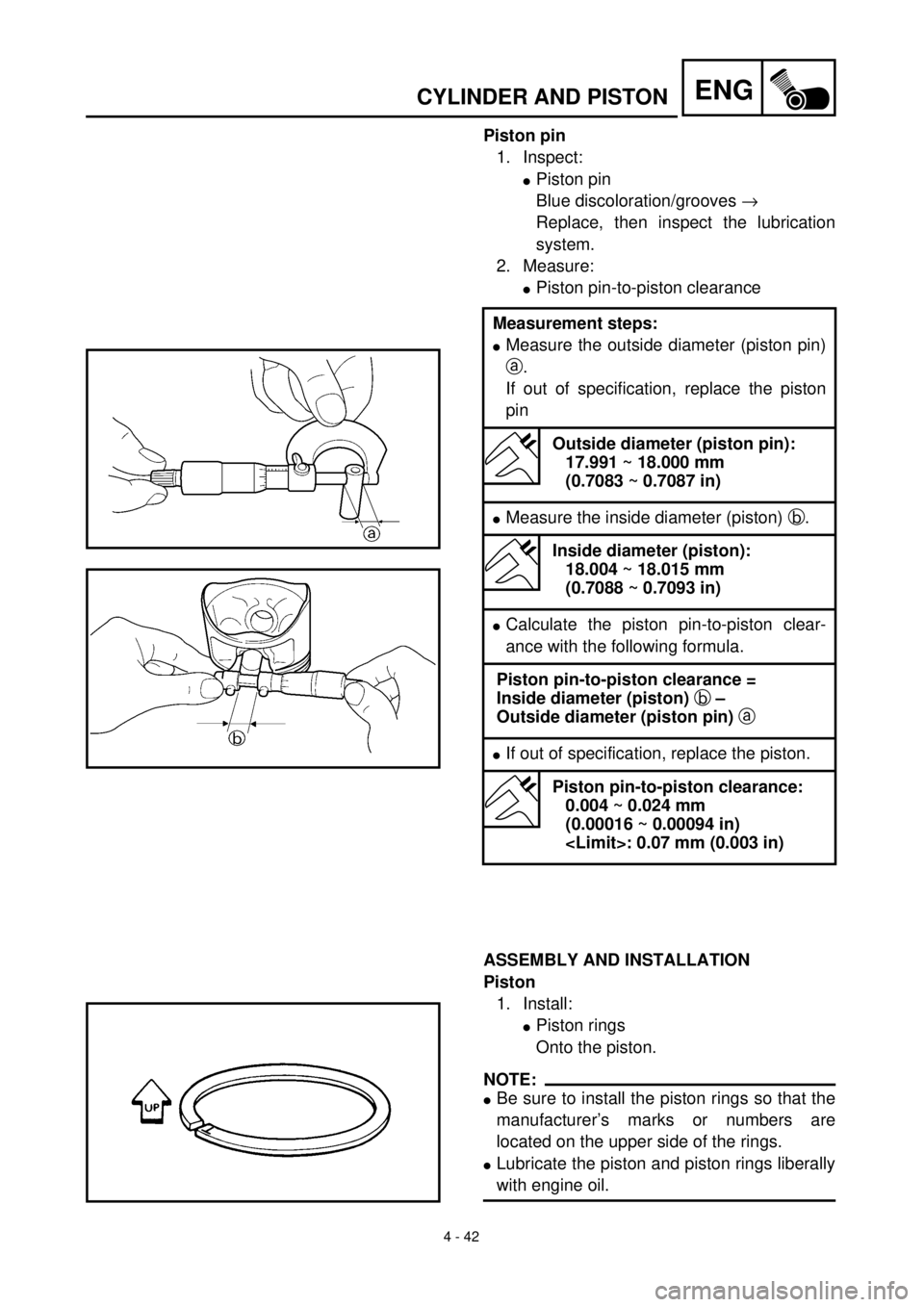
Piston pin
1. Inspect:
lPiston pin
Blue discoloration/grooves ®
Replace, then inspect the lubrication
system.
2. Measure:
lPiston pin-to-piston clearance
Measurement steps:
lMeasure the outside diameter (piston pin)
a.
If out of specification, replace the piston
pin
Outside diameter (piston pin):
17.991 ~ 18.000 mm
(0.7083 ~ 0.7087 in)
lMeasure the inside diameter (piston) b.
Inside diameter (piston):
18.004 ~ 18.015 mm
(0.7088 ~ 0.7093 in)
lCalculate the piston pin-to-piston clear-
ance with the following formula.
Piston pin-to-piston clearance =
Inside diameter (piston) b –
Outside diameter (piston pin) a
lIf out of specification, replace the piston.
Piston pin-to-piston clearance:
0.004 ~ 0.024 mm
(0.00016 ~ 0.00094 in)
ASSEMBLY AND INSTALLATION
Piston
1. Install:
lPiston rings
Onto the piston.
NOTE:
lBe sure to install the piston rings so that the
manufacturer’s marks or numbers are
located on the upper side of the rings.
lLubricate the piston and piston rings liberally
with engine oil.
Page 348 of 654
4 - 43
ENGCYLINDER AND PISTON
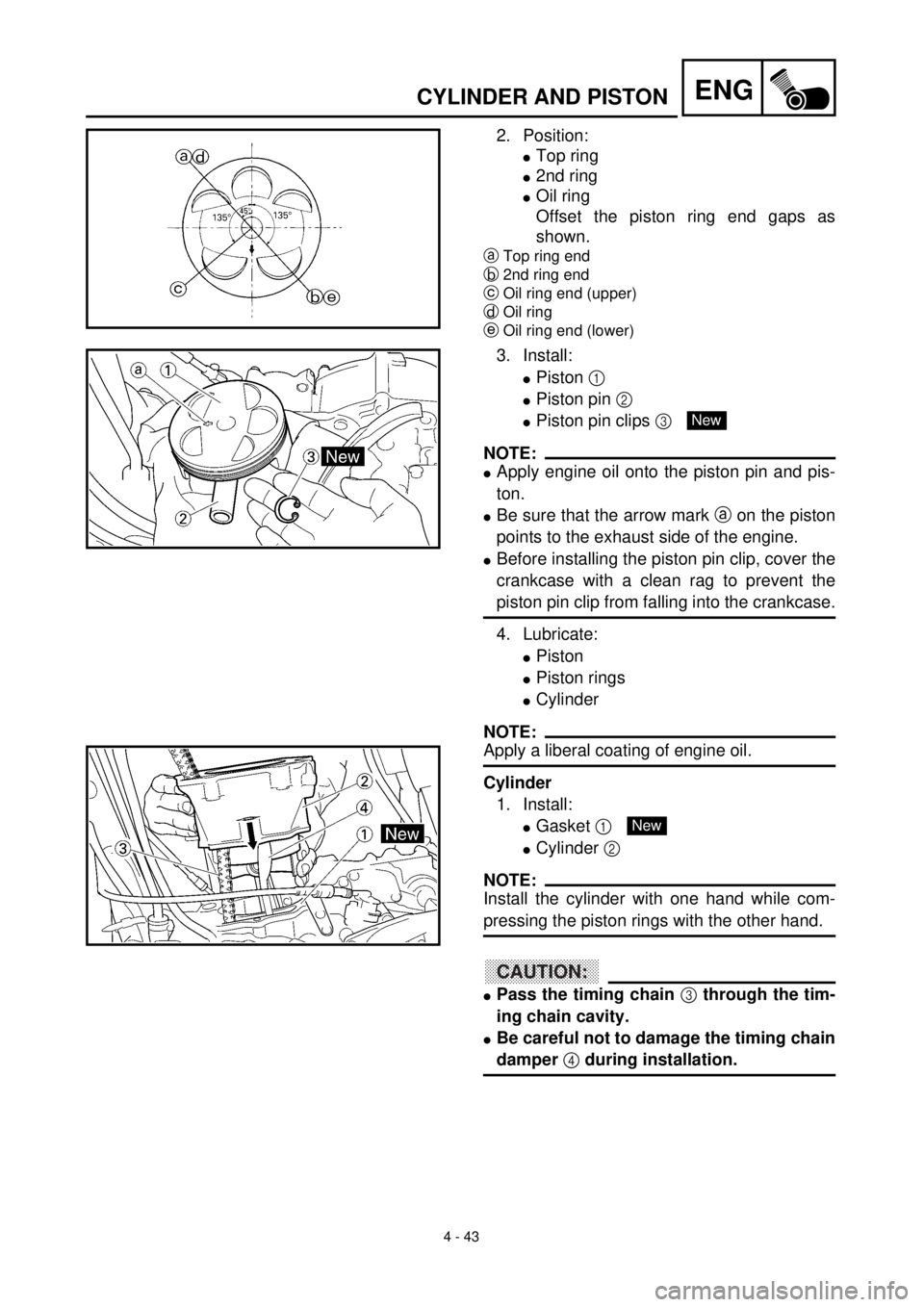
2. Position:
lTop ring
l2nd ring
lOil ring
Offset the piston ring end gaps as
shown.
aTop ring end
b2nd ring end
cOil ring end (upper)
dOil ring
eOil ring end (lower)
3. Install:
lPiston 1
lPiston pin 2
lPiston pin clips 3
NOTE:
lApply engine oil onto the piston pin and pis-
ton.
lBe sure that the arrow mark a on the piston
points to the exhaust side of the engine.
lBefore installing the piston pin clip, cover the
crankcase with a clean rag to prevent the
piston pin clip from falling into the crankcase.
4. Lubricate:
lPiston
lPiston rings
lCylinder
NOTE:
Apply a liberal coating of engine oil.
Cylinder
1. Install:
lGasket 1
lCylinder 2
NOTE:
Install the cylinder with one hand while com-
pressing the piston rings with the other hand.
CAUTION:
lPass the timing chain 3 through the tim-
ing chain cavity.
lBe careful not to damage the timing chain
damper 4 during installation.
New
New
Page 350 of 654
ENG
4 - 44
CLUTCH
CLUTCH
CLUTCH
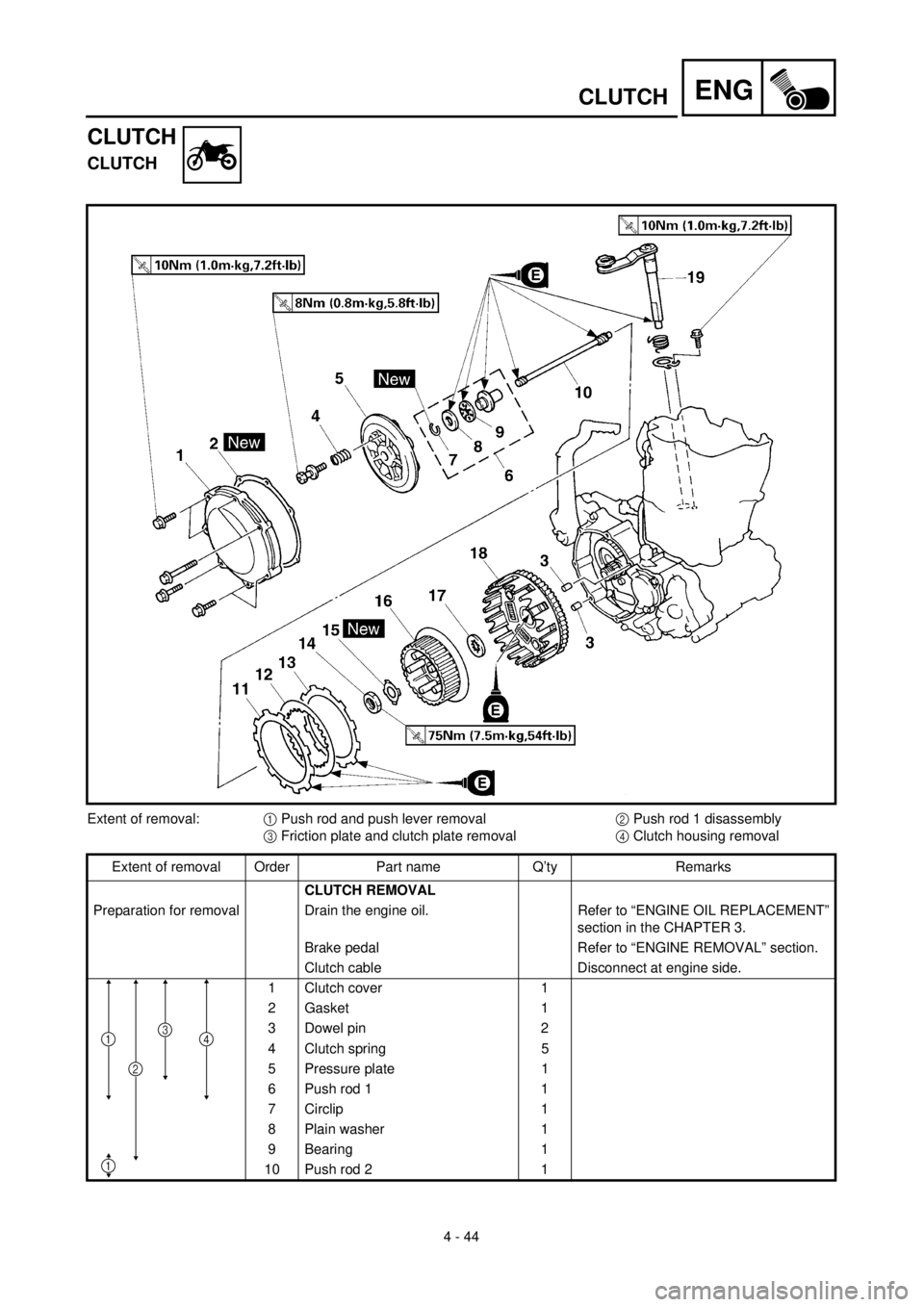
Extent of removal:1 Push rod and push lever removal2 Push rod 1 disassembly
3 Friction plate and clutch plate removal4 Clutch housing removal
Extent of removal Order Part name Q’ty Remarks
CLUTCH REMOVAL
Preparation for removal Drain the engine oil. Refer to “ENGINE OIL REPLACEMENT”
section in the CHAPTER 3.
Brake pedal Refer to “ENGINE REMOVAL” section.
Clutch cable Disconnect at engine side.
1 Clutch cover 1
2 Gasket 1
3 Dowel pin 2
4 Clutch spring 5
5 Pressure plate 1
6 Push rod 1 1
7 Circlip 1
8 Plain washer 1
9 Bearing 1
10 Push rod 2 1
4
1
1
2
3
Page 356 of 654
4 - 47
ENGCLUTCH
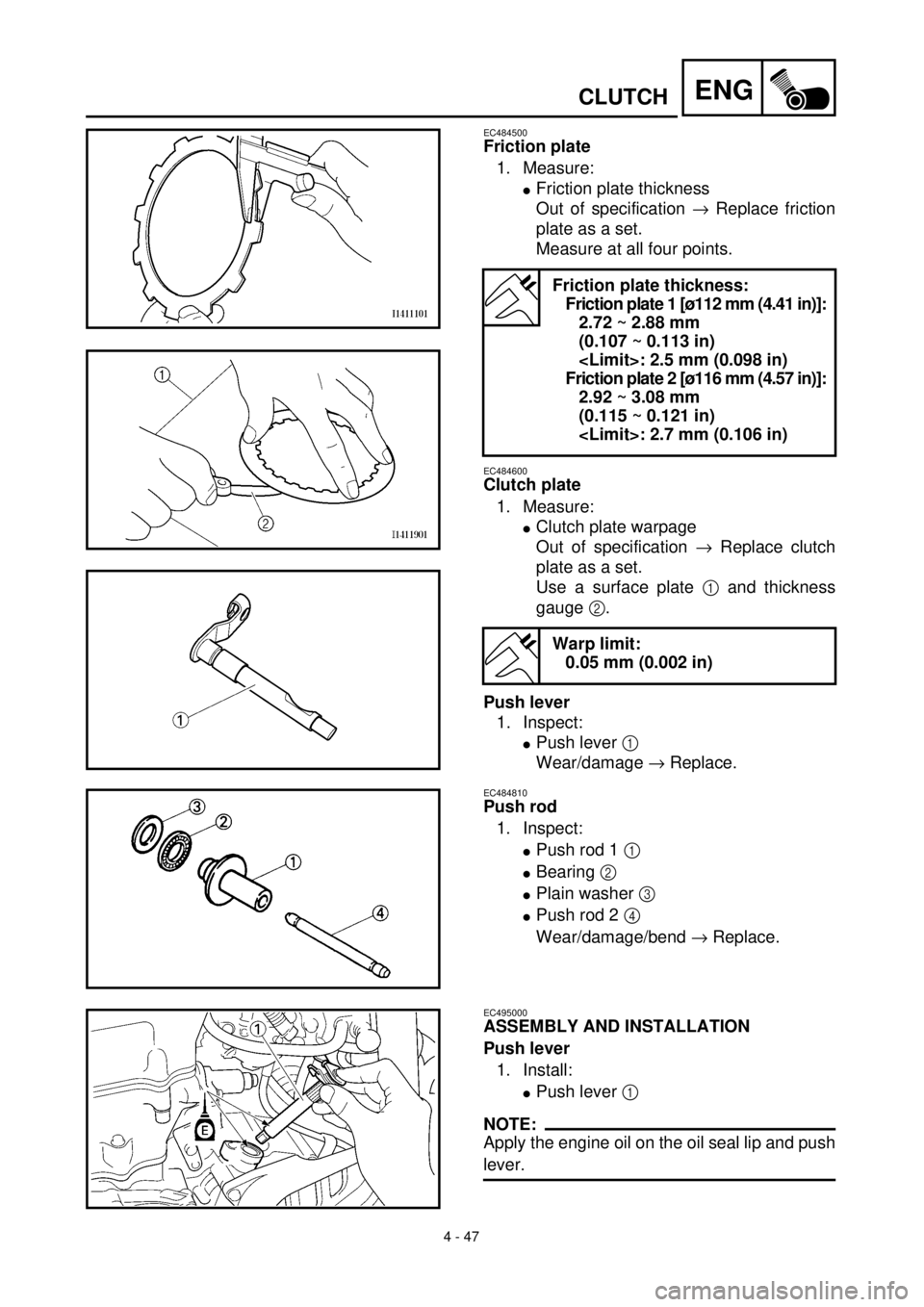
EC484500
Friction plate
1. Measure:
lFriction plate thickness
Out of specification ® Replace friction
plate as a set.
Measure at all four points.
EC484600
Clutch plate
1. Measure:
lClutch plate warpage
Out of specification ® Replace clutch
plate as a set.
Use a surface plate 1 and thickness
gauge 2.
Push lever
1. Inspect:
lPush lever 1
Wear/damage ® Replace.
Friction plate thickness:
Friction plate 1 [ø112 mm (4.41 in)]:
2.72 ~ 2.88 mm
(0.107 ~ 0.113 in)
Friction plate 2 [ø116 mm (4.57 in)]:
2.92 ~ 3.08 mm
(0.115 ~ 0.121 in)
Warp limit:
0.05 mm (0.002 in)
EC484810
Push rod
1. Inspect:
lPush rod 1 1
lBearing 2
lPlain washer 3
lPush rod 2 4
Wear/damage/bend ® Replace.
EC495000
ASSEMBLY AND INSTALLATION
Push lever
1. Install:
lPush lever 1
NOTE:
Apply the engine oil on the oil seal lip and push
lever.
Page 357 of 654
ENG
4 - 47
EMBRAYAGE
KUPPLUNG
EMBRAGUE
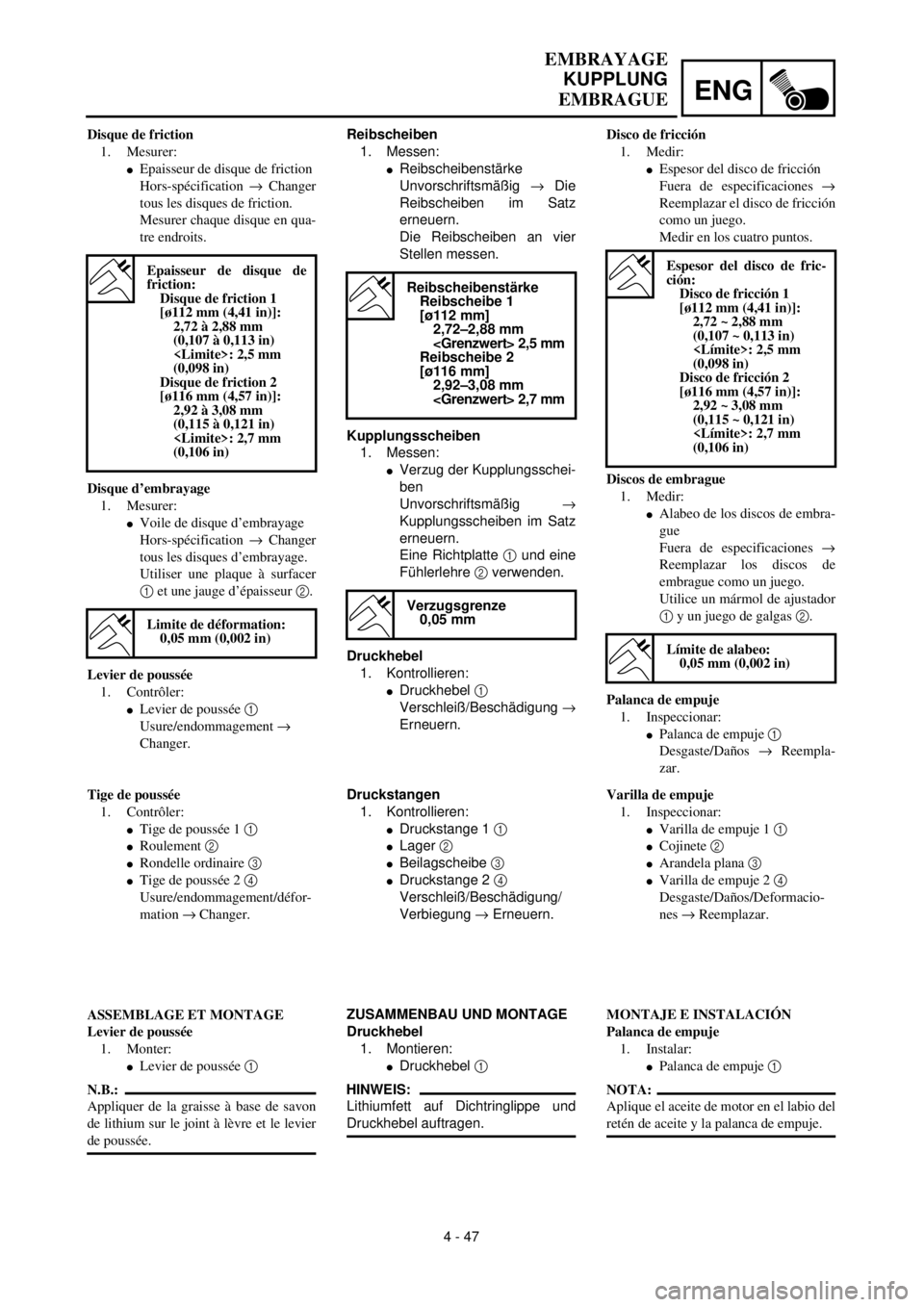
Reibscheiben
1. Messen:
l
Reibscheibenstärke
Unvorschriftsmäßig
®
Die
Reibscheiben im Satz
erneuern.
Die Reibscheiben an vier
Stellen messen.
Kupplungsscheiben
1. Messen:
l
Verzug der Kupplungsschei-
ben
Unvorschriftsmäßig
®
Kupplungsscheiben im Satz
erneuern.
Eine Richtplatte
1
und eine
Fühlerlehre
2
verwenden.
Druckhebel
1. Kontrollieren:
l
Druckhebel
1
Verschleiß/Beschädigung
®
Erneuern.
Reibscheibenstärke
Reibscheibe 1
[ø112 mm]
2,72–2,88 mm
Reibscheibe 2
[ø116 mm]
2,92–3,08 mm
Verzugsgrenze
0,05 mm
Druckstangen
1. Kontrollieren:
l
Druckstange 1
1
l
Lager
2
l
Beilagscheibe
3
l
Druckstange 2
4
Verschleiß/Beschädigung/
Verbiegung
®
Erneuern.
ZUSAMMENBAU UND MONTAGE
Druckhebel
1. Montieren:
l
Druckhebel
1
HINWEIS:
Lithiumfett auf Dichtringlippe und
Druckhebel auftragen.
Disque de friction
1. Mesurer:
l
Epaisseur de disque de friction
Hors-spécification
®
Changer
tous les disques de friction.
Mesurer chaque disque en qua-
tre endroits.
Disque d’embrayage
1. Mesurer:
l
Voile de disque d’embrayage
Hors-spécification
®
Changer
tous les disques d’embrayage.
Utiliser une plaque à surfacer
1
et une jauge d’épaisseur
2
.
Levier de poussée
1. Contrôler:
l
Levier de poussée
1
Usure/endommagement
®
Changer.
Epaisseur de disque de
friction:
Disque de friction 1
[ø112 mm (4,41 in)]:
2,72 à 2,88 mm
(0,107 à 0,113 in)
(0,098 in)
Disque de friction 2
[ø116 mm (4,57 in)]:
2,92 à 3,08 mm
(0,115 à 0,121 in)
(0,106 in)
Limite de déformation:
0,05 mm (0,002 in)
Tige de poussée
1. Contrôler:
l
Tige de poussée 1
1
l
Roulement
2
l
Rondelle ordinaire
3
l
Tige de poussée 2
4
Usure/endommagement/défor-
mation
®
Changer.
ASSEMBLAGE ET MONTAGE
Levier de poussée
1. Monter:
l
Levier de poussée
1
N.B.:
Appliquer de la graisse à base de savon
de lithium sur le joint à lèvre et le levier
de poussée.
Disco de fricción
1. Medir:
l
Espesor del disco de fricción
Fuera de especificaciones
®
Reemplazar el disco de fricción
como un juego.
Medir en los cuatro puntos.
Discos de embrague
1. Medir:
l
Alabeo de los discos de embra-
gue
Fuera de especificaciones
®
Reemplazar los discos de
embrague como un juego.
Utilice un mármol de ajustador
1
y un juego de galgas
2
.
Palanca de empuje
1. Inspeccionar:
l
Palanca de empuje
1
Desgaste/Daños
®
Reempla-
zar.
Espesor del disco de fric-
ción:
Disco de fricción 1
[ø112 mm (4,41 in)]:
2,72 ~ 2,88 mm
(0,107 ~ 0,113 in)
(0,098 in)
Disco de fricción 2
[ø116 mm (4,57 in)]:
2,92 ~ 3,08 mm
(0,115 ~ 0,121 in)
(0,106 in)
Límite de alabeo:
0,05 mm (0,002 in)
Varilla de empuje
1. Inspeccionar:
l
Varilla de empuje 1
1
l
Cojinete
2
l
Arandela plana
3
l
Varilla de empuje 2
4
Desgaste/Daños/Deformacio-
nes
®
Reemplazar.
MONTAJE E INSTALACIÓN
Palanca de empuje
1. Instalar:
l
Palanca de empuje
1
NOTA:
Aplique el aceite de motor en el labio del
retén de aceite y la palanca de empuje.