checking oil YAMAHA WR 450F 2016 User Guide
[x] Cancel search | Manufacturer: YAMAHA, Model Year: 2016, Model line: WR 450F, Model: YAMAHA WR 450F 2016Pages: 426, PDF Size: 10.86 MB
Page 162 of 426
REAR WHEEL
5-10
EAS2GC1161REMOVING THE REAR WHEEL
1. Use a suitable stand to raise the rear wheel off the ground.
EWA
WARNING
Securely support the vehicle so that there is
no danger of it falling over.
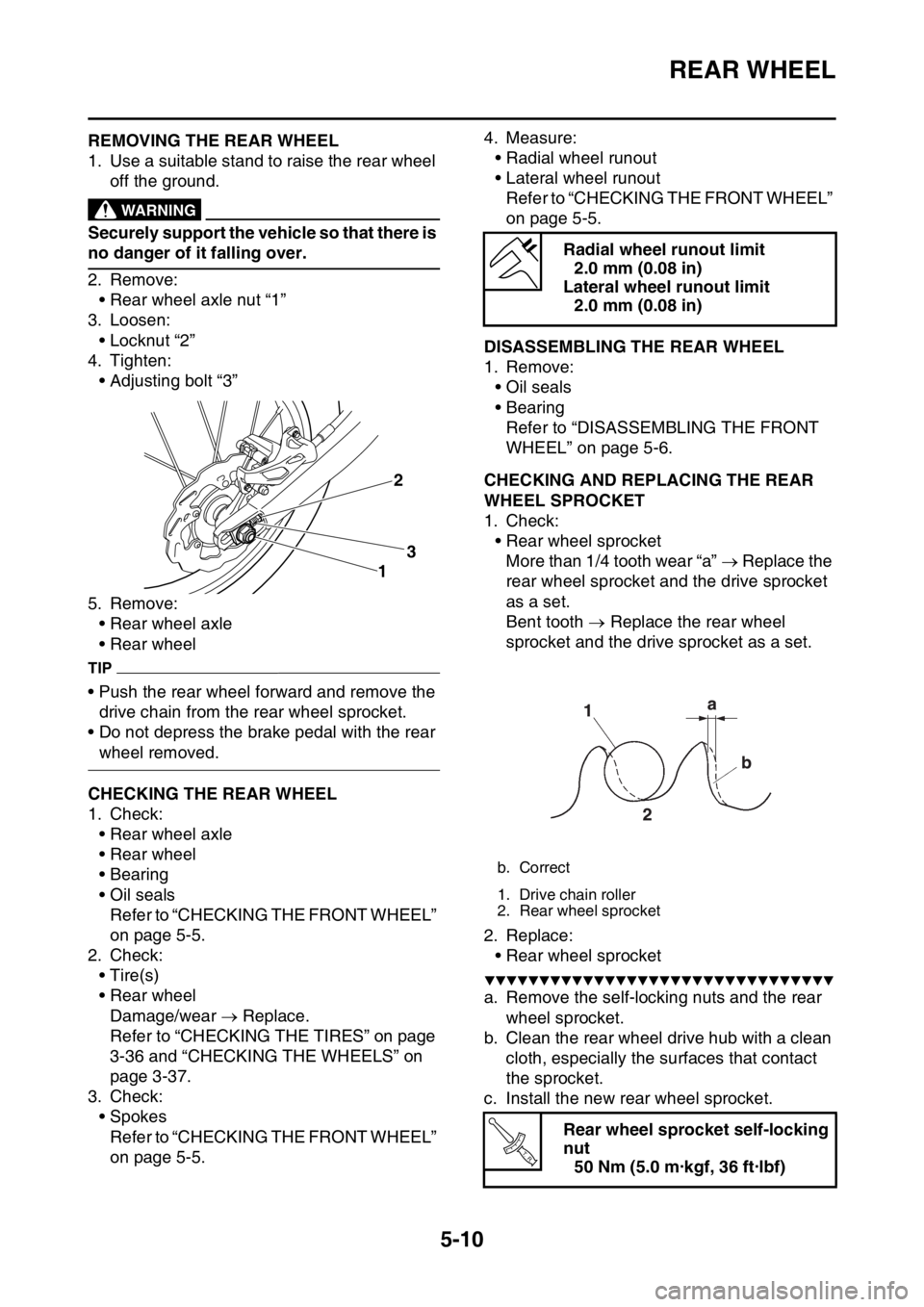
2. Remove:• Rear wheel axle nut “1”
3. Loosen:
• Locknut “2”
4. Tighten: • Adjusting bolt “3”
5. Remove: • Rear wheel axle
• Rear wheel
TIP
• Push the rear wheel forward and remove the drive chain from the rear wheel sprocket.
• Do not depress the brake pedal with the rear
wheel removed.
EAS2GC1162CHECKING THE REAR WHEEL
1. Check:
• Rear wheel axle
• Rear wheel
• Bearing
• Oil sealsRefer to “CHECKING THE FRONT WHEEL”
on page 5-5.
2. Check: •Tire(s)
• Rear wheelDamage/wear Replace.
Refer to “CHECKING THE TIRES” on page
3-36 and “CHECKING THE WHEELS” on
page 3-37.
3. Check: • Spokes
Refer to “CHECKING THE FRONT WHEEL”
on page 5-5. 4. Measure:
• Radial wheel runout
• Lateral wheel runoutRefer to “CHECKING THE FRONT WHEEL”
on page 5-5.
EAS2GC1163DISASSEMBLING THE REAR WHEEL
1. Remove:• Oil seals
• Bearing
Refer to “DISASSEMBLING THE FRONT
WHEEL” on page 5-6.
EAS2GC1164CHECKING AND REPLACING THE REAR
WHEEL SPROCKET
1. Check:• Rear wheel sprocketMore than 1/4 tooth wear “a” Replace the
rear wheel sprocket and the drive sprocket
as a set.
Bent tooth Replace the rear wheel
sprocket and the drive sprocket as a set.
2. Replace: • Rear wheel sprocket
▼▼▼▼▼▼▼▼▼▼▼▼▼▼▼▼▼▼▼▼▼▼▼▼▼▼▼▼▼▼▼▼
a. Remove the self-locking nuts and the rear wheel sprocket.
b. Clean the rear wheel drive hub with a clean
cloth, especially the surfaces that contact
the sprocket.
c. Install the new rear wheel sprocket.
3
1 2
Radial wheel runout limit
2.0 mm (0.08 in)
Lateral wheel runout limit 2.0 mm (0.08 in)
b. Correct
1. Drive chain roller
2. Rear wheel sprocket
Rear wheel sprocket self-locking
nut50 Nm (5.0 m·kgf, 36 ft·lbf)
T R..
Page 171 of 426
FRONT BRAKE
5-19
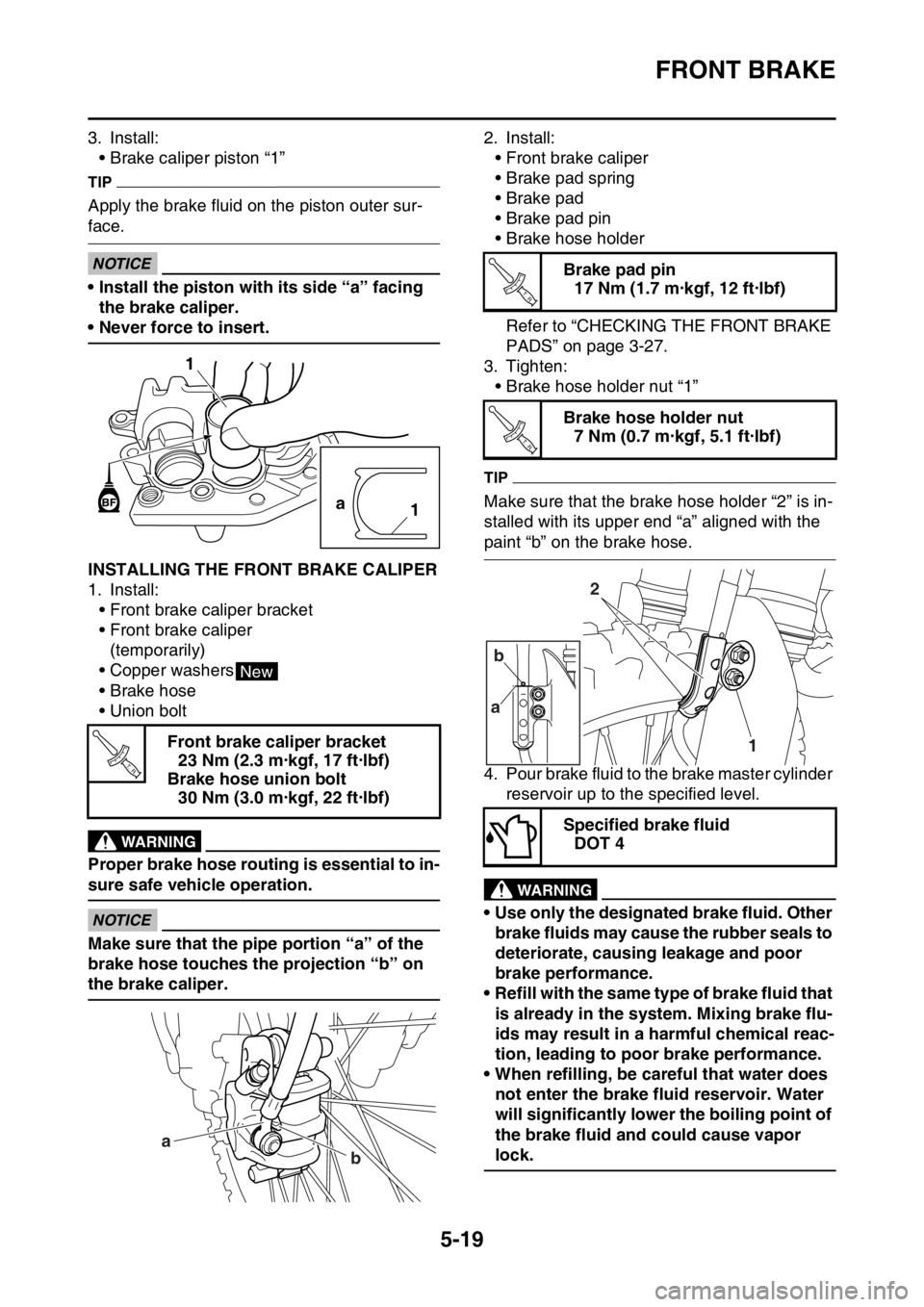
3. Install:• Brake caliper piston “1”
TIP
Apply the brake fluid on the piston outer sur-
face.
ECA
NOTICE
• Install the piston with its side “a” facing the brake caliper.
• Never force to insert.
EAS2GC1175INSTALLING THE FRONT BRAKE CALIPER
1. Install:• Front brake caliper bracket
• Front brake caliper(temporarily)
• Copper washers
• Brake hose
• Union bolt
EWA
WARNING
Proper brake hose routing is essential to in-
sure safe vehicle operation.
ECA
NOTICE
Make sure that the pipe portion “a” of the
brake hose touches the projection “b” on
the brake caliper. 2. Install:
• Front brake caliper
• Brake pad spring
• Brake pad
• Brake pad pin
• Brake hose holder
Refer to “CHECKING THE FRONT BRAKE
PADS” on page 3-27.
3. Tighten: • Brake hose holder nut “1”
TIP
Make sure that the brake hose holder “2” is in-
stalled with its upper end “a” aligned with the
paint “b” on the brake hose.
4. Pour brake fluid to the brake master cylinder reservoir up to the specified level.
EWA
WARNING
• Use only the designated brake fluid. Other
brake fluids may cause the rubber seals to
deteriorate, causing leakage and poor
brake performance.
• Refill with the same type of brake fluid that
is already in the system. Mixing brake flu-
ids may result in a harmful chemical reac-
tion, leading to poor brake performance.
• When refilling, be careful that water does not enter the brake fluid reservoir. Water
will significantly lower the boiling point of
the brake fluid and could cause vapor
lock.
ECA
Front brake caliper bracket23 Nm (2.3 m·kgf, 17 ft·lbf)
Brake hose union bolt 30 Nm (3.0 m·kgf, 22 ft·lbf)
1
a1
New
T R..
a
b
Brake pad pin
17 Nm (1.7 m·kgf, 12 ft·lbf)
Brake hose holder nut 7 Nm (0.7 m·kgf, 5.1 ft·lbf)
Specified brake fluid DOT 4
T R..
T R..
1
2
b
a
Page 174 of 426
FRONT BRAKE
5-22
TIP
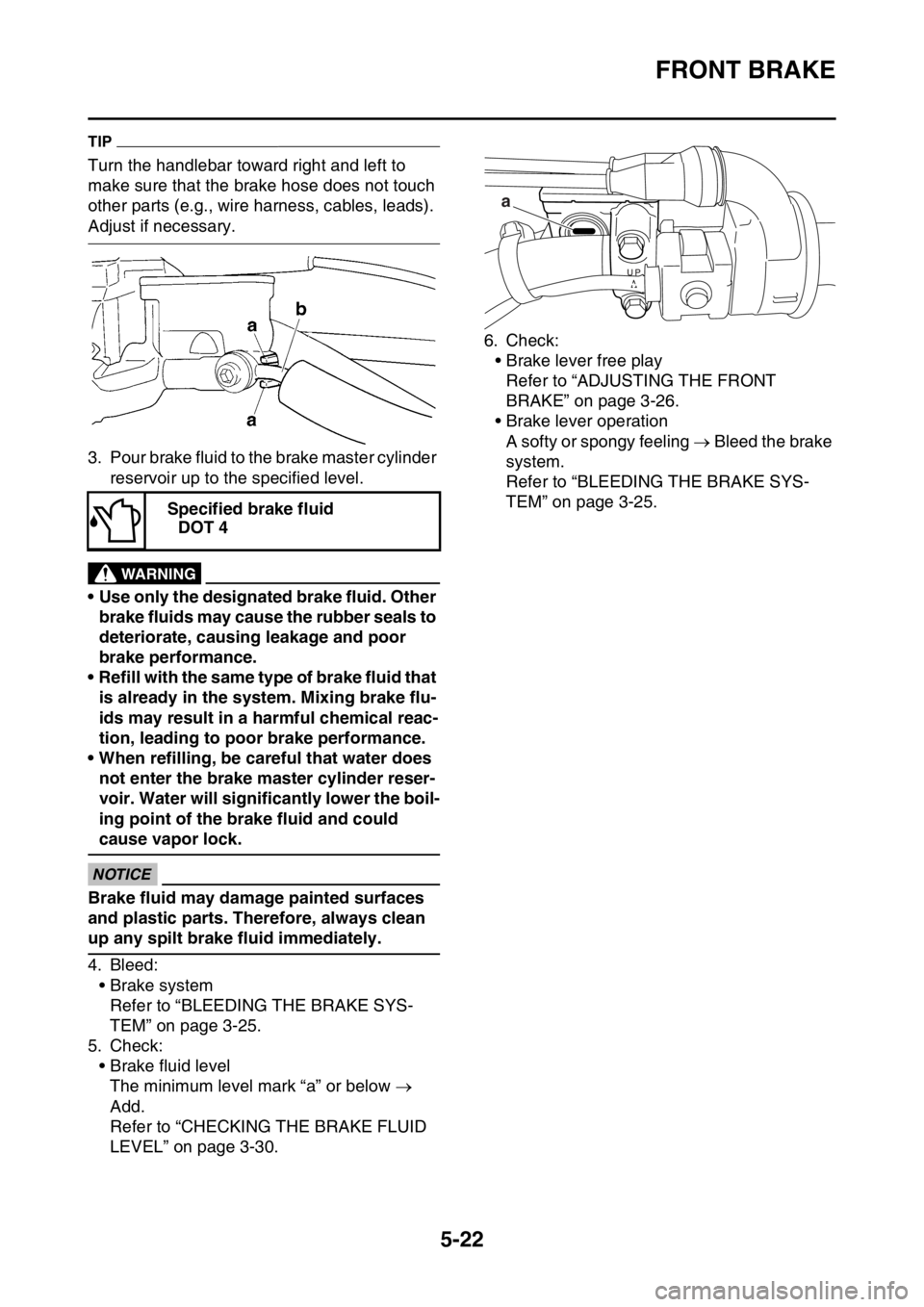
Turn the handlebar toward right and left to
make sure that the brake hose does not touch
other parts (e.g., wire harness, cables, leads).
Adjust if necessary.
3. Pour brake fluid to the brake master cylinder reservoir up to the specified level.
EWA
WARNING
• Use only the designated brake fluid. Other brake fluids may cause the rubber seals to
deteriorate, causing leakage and poor
brake performance.
• Refill with the same type of brake fluid that is already in the system. Mixing brake flu-
ids may result in a harmful chemical reac-
tion, leading to poor brake performance.
• When refilling, be careful that water does not enter the brake master cylinder reser-
voir. Water will significantly lower the boil-
ing point of the brake fluid and could
cause vapor lock.
ECA
NOTICE
Brake fluid may damage painted surfaces
and plastic parts. Therefore, always clean
up any spilt brake fluid immediately.
4. Bleed:
• Brake systemRefer to “BLEEDING THE BRAKE SYS-
TEM” on page 3-25.
5. Check: • Brake fluid level
The minimum level mark “a” or below
Add.
Refer to “CHECKING THE BRAKE FLUID
LEVEL” on page 3-30. 6. Check:
• Brake lever free play
Refer to “ADJUSTING THE FRONT
BRAKE” on page 3-26.
• Brake lever operation
A softy or spongy feeling Bleed the brake
system.
Refer to “BLEEDING THE BRAKE SYS-
TEM” on page 3-25.
Specified brake fluid
DOT 4
a
Page 182 of 426
REAR BRAKE
5-30
WARNING
• Use only the designated brake fluid. Other brake fluids may cause the rubber seals to
deteriorate, causing leakage and poor
brake performance.
• Refill with the same type of brake fluid that is already in the system. Mixing brake flu-
ids may result in a harmful chemical reac-
tion, leading to poor brake performance.
• When refilling, be careful that water does
not enter the brake fluid reservoir. Water
will significantly lower the boiling point of
the brake fluid and could cause vapor
lock.
ECA
NOTICE
Brake fluid may damage painted surfaces
and plastic parts. Therefore, always clean
up any spilt brake fluid immediately.
5. Bleed:• Brake system
Refer to “BLEEDING THE BRAKE SYS-
TEM” on page 3-25.
6. Check:
• Brake fluid levelThe minimum level mark “a” or below
Add.
Refer to “CHECKING THE BRAKE FLUID
LEVEL” on page 3-30.
7. Check: • Brake pedal operationA softy or spongy feeling Bleed the brake
system.
Refer to “BLEEDING THE BRAKE SYS-
TEM” on page 3-25.
EAS2GC1189REMOVING THE REAR BRAKE MASTER
CYLINDER
TIP
Before removing the rear brake master cylin-
der, drain the brake fluid from the entire brake
system. 1. Remove:
• Union bolt
• Copper washers
• Brake hose
TIP
To drain any remaining brake fluid, place a con-
tainer under the master cylinder and the end of
the brake hose.
EAS2GC1190CHECKING THE REAR BRAKE MASTER
CYLINDER
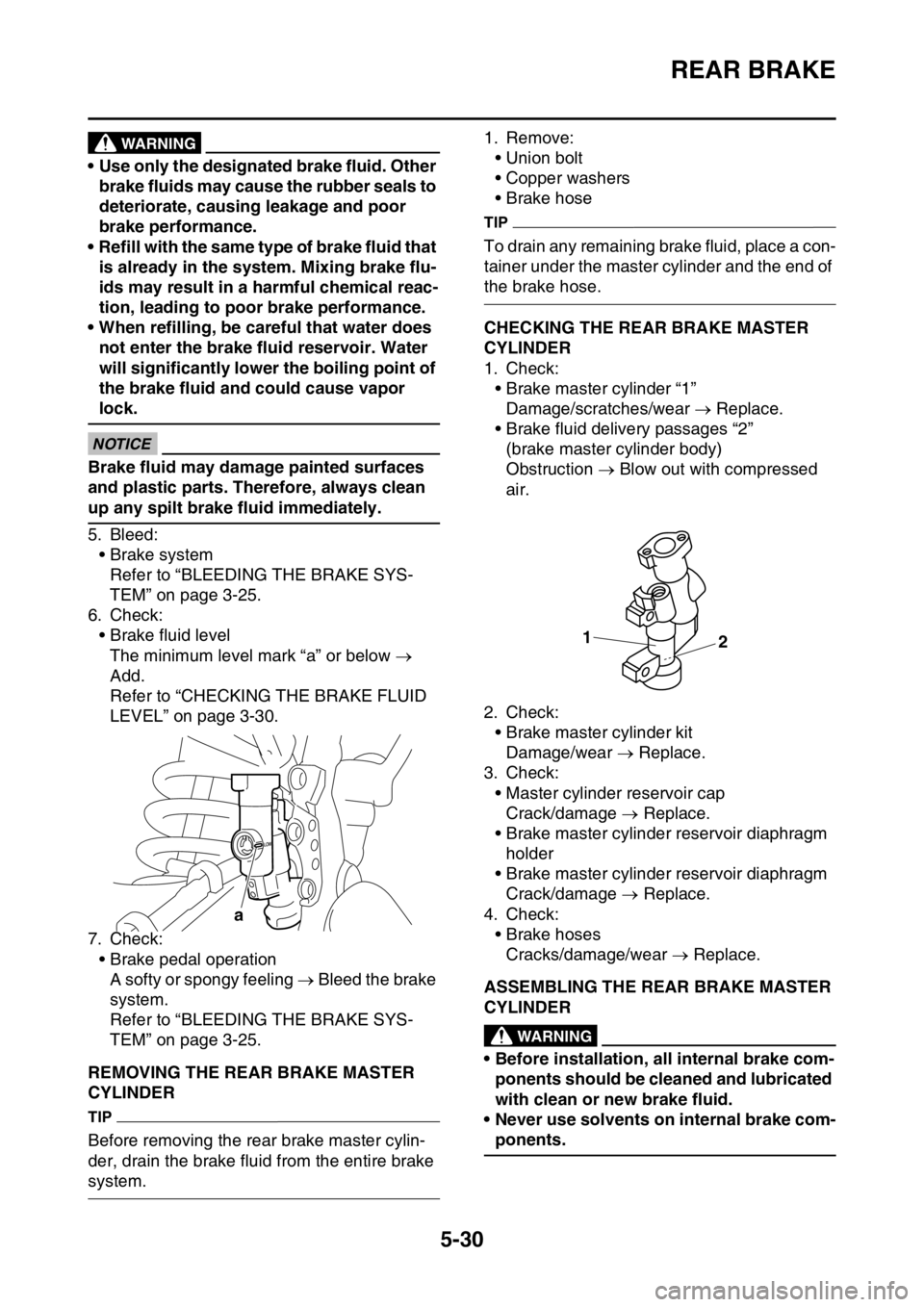
1. Check:• Brake master cylinder “1”
Damage/scratches/wear Replace.
• Brake fluid delivery passages “2” (brake master cylinder body)
Obstruction Blow out with compressed
air.
2. Check: • Brake master cylinder kit
Damage/wear Replace.
3. Check: • Master cylinder reservoir capCrack/damage Replace.
• Brake master cylinder reservoir diaphragm holder
• Brake master cylinder reservoir diaphragm
Crack/damage Replace.
4. Check: • Brake hoses
Cracks/damage/wear Replace.
EAS2GC1191ASSEMBLING THE REAR BRAKE MASTER
CYLINDER
EWA
WARNING
• Before installation, all internal brake com-
ponents should be cleaned and lubricated
with clean or new brake fluid.
• Never use solvents on internal brake com-
ponents.
a
1 2
Page 184 of 426
REAR BRAKE
5-32
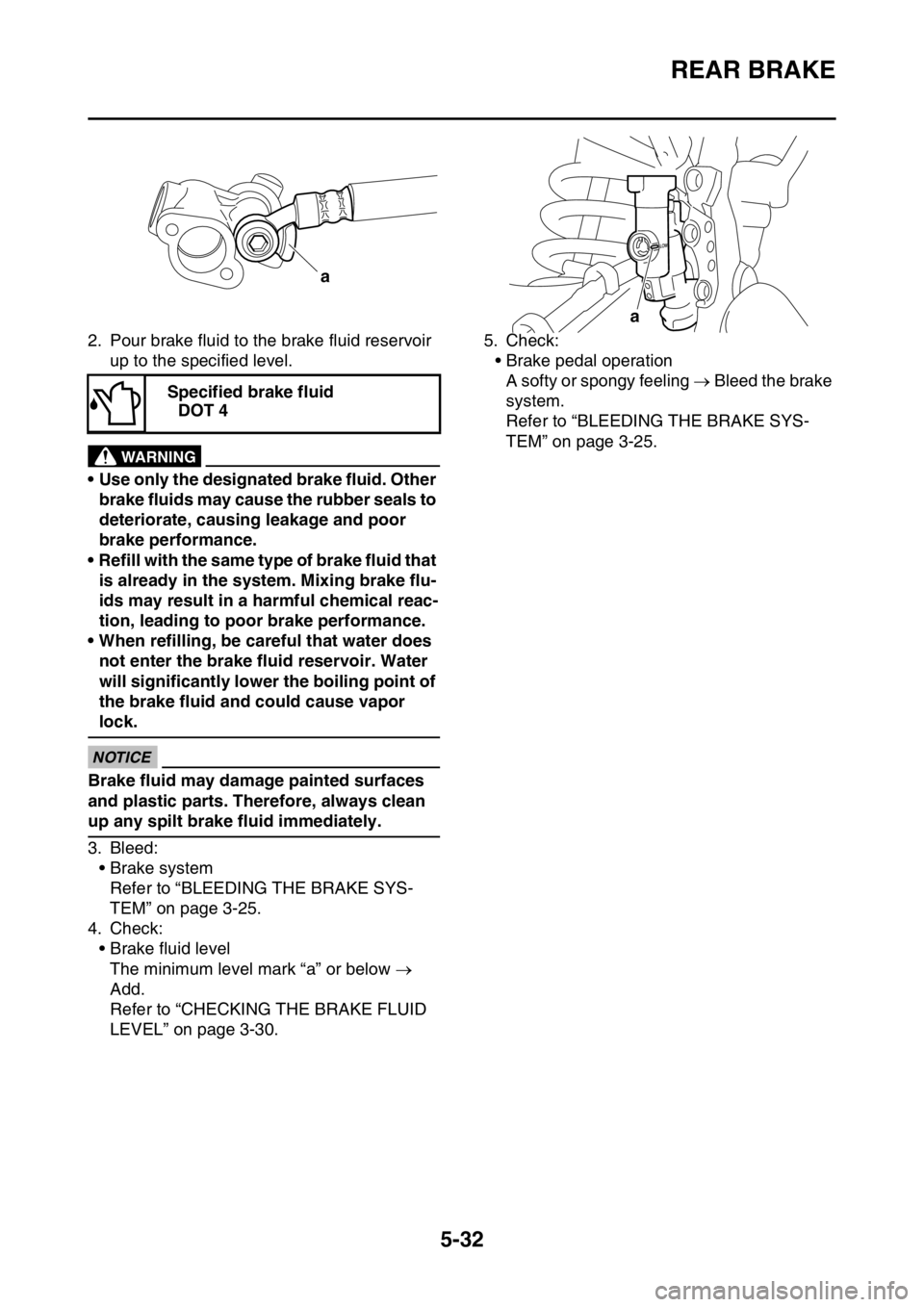
2. Pour brake fluid to the brake fluid reservoir up to the specified level.
EWA
WARNING
• Use only the designated brake fluid. Other
brake fluids may cause the rubber seals to
deteriorate, causing leakage and poor
brake performance.
• Refill with the same type of brake fluid that is already in the system. Mixing brake flu-
ids may result in a harmful chemical reac-
tion, leading to poor brake performance.
• When refilling, be careful that water does not enter the brake fluid reservoir. Water
will significantly lower the boiling point of
the brake fluid and could cause vapor
lock.
ECA
NOTICE
Brake fluid may damage painted surfaces
and plastic parts. Therefore, always clean
up any spilt brake fluid immediately.
3. Bleed:
• Brake systemRefer to “BLEEDING THE BRAKE SYS-
TEM” on page 3-25.
4. Check: • Brake fluid level
The minimum level mark “a” or below
Add.
Refer to “CHECKING THE BRAKE FLUID
LEVEL” on page 3-30. 5. Check:
• Brake pedal operation
A softy or spongy feeling Bleed the brake
system.
Refer to “BLEEDING THE BRAKE SYS-
TEM” on page 3-25.
Specified brake fluid
DOT 4
a
a
Page 195 of 426
FRONT FORK
5-43
▲▲▲▲▲▲▲▲▲▲▲▲▲▲▲▲▲▲▲▲▲▲▲▲▲▲▲▲▲▲▲▲
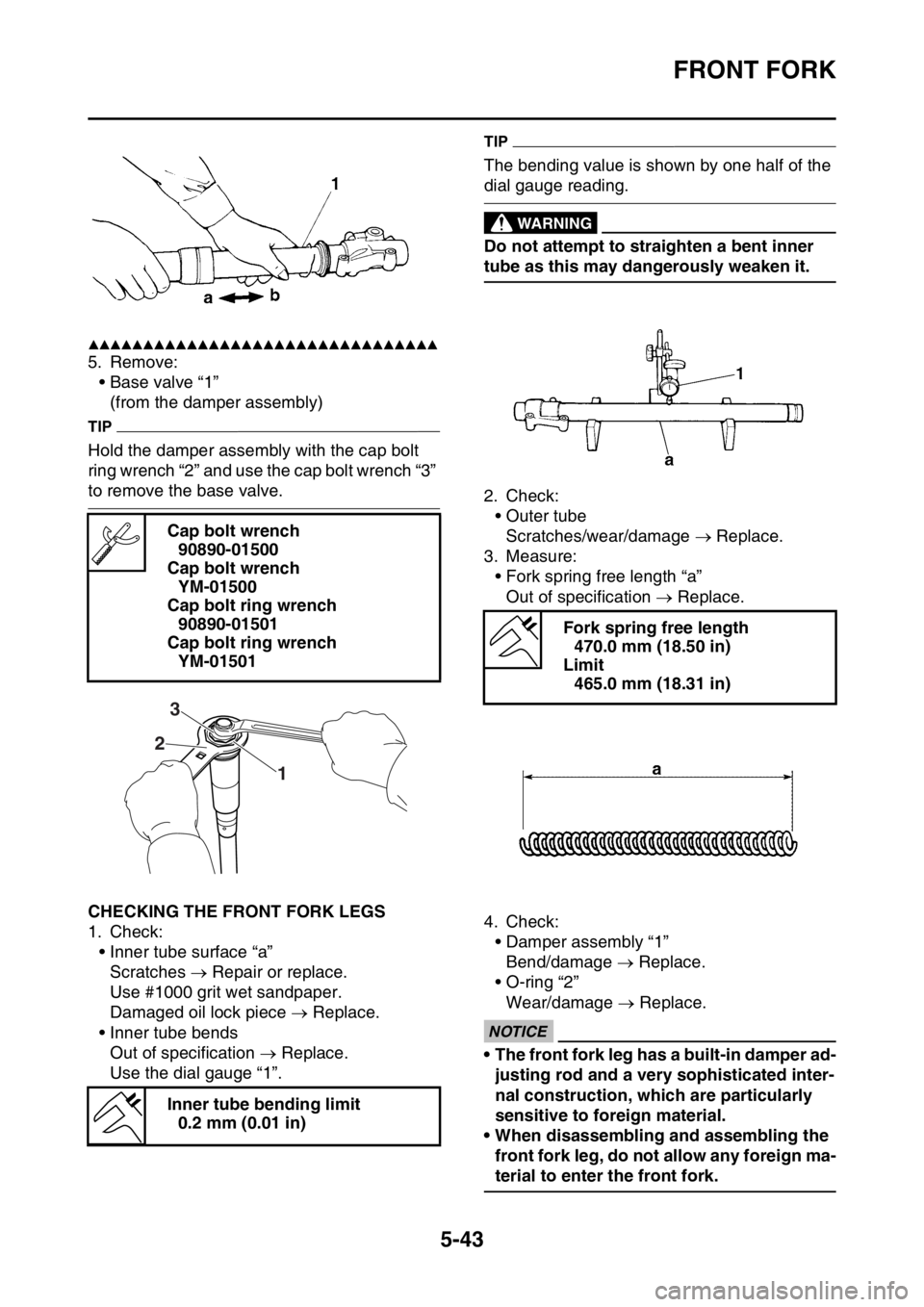
5. Remove:• Base valve “1”
(from the damper assembly)
TIP
Hold the damper assembly with the cap bolt
ring wrench “2” and use the cap bolt wrench “3”
to remove the base valve.
EAS2GC1200CHECKING THE FRONT FORK LEGS
1. Check:• Inner tube surface “a”Scratches Repair or replace.
Use #1000 grit wet sandpaper.
Damaged oil lock piece Replace.
• Inner tube bends Out of specification Replace.
Use the dial gauge “1”.
TIP
The bending value is shown by one half of the
dial gauge reading.
EWA
WARNING
Do not attempt to straighten a bent inner
tube as this may dangerously weaken it.
2. Check:
• Outer tubeScratches/wear/damage Replace.
3. Measure:
• Fork spring free length “a”Out of specification Replace.
4. Check: • Damper assembly “1”Bend/damage Replace.
• O-ring “2” Wear/damage Replace.
ECA
NOTICE
• The front fork leg has a built-in damper ad-
justing rod and a very sophisticated inter-
nal construction, which are particularly
sensitive to foreign material.
• When disassembling and assembling the
front fork leg, do not allow any foreign ma-
terial to enter the front fork.
Cap bolt wrench
90890-01500
Cap bolt wrench YM-01500
Cap bolt ring wrench 90890-01501
Cap bolt ring wrench YM-01501
Inner tube bending limit 0.2 mm (0.01 in)
1
2 3
Fork spring free length
470.0 mm (18.50 in)
Limit 465.0 mm (18.31 in)
Page 214 of 426
REAR SHOCK ABSORBER ASSEMBLY
5-62
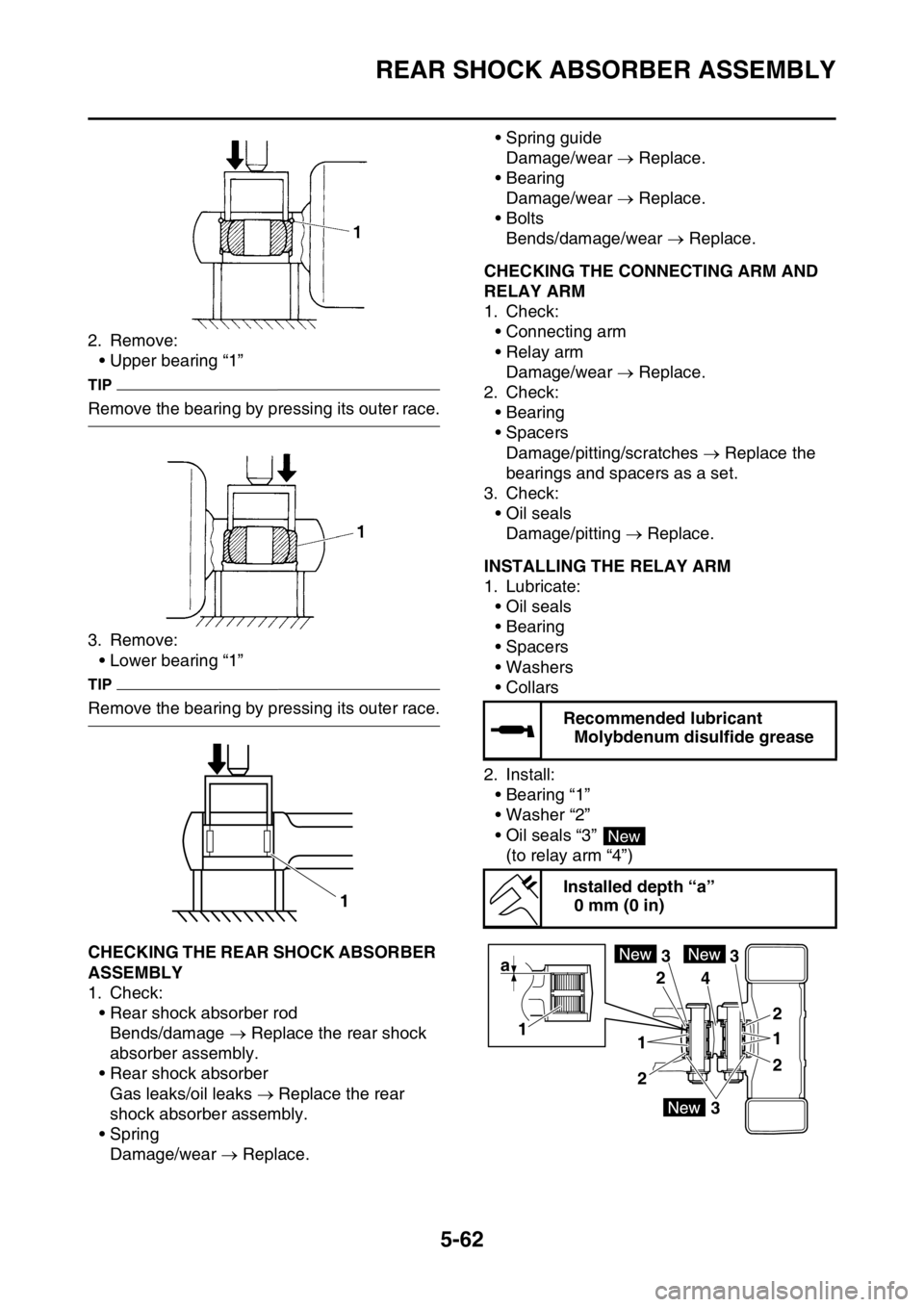
2. Remove:• Upper bearing “1”
TIP
Remove the bearing by pressing its outer race.
3. Remove:
• Lower bearing “1”
TIP
Remove the bearing by pressing its outer race.
EAS2GC1212CHECKING THE REAR SHOCK ABSORBER
ASSEMBLY
1. Check:• Rear shock absorber rod
Bends/damage Replace the rear shock
absorber assembly.
• Rear shock absorber
Gas leaks/oil leaks Replace the rear
shock absorber assembly.
•Spring
Damage/wear Replace. • Spring guide
Damage/wear Replace.
• Bearing
Damage/wear Replace.
•Bolts Bends/damage/wear Replace.
EAS2GC1213CHECKING THE CONNECTING ARM AND
RELAY ARM
1. Check:
• Connecting arm
• Relay arm
Damage/wear Replace.
2. Check: • Bearing
• Spacers
Damage/pitting/scratches Replace the
bearings and spacers as a set.
3. Check: • Oil sealsDamage/pitting Replace.
EAS2GC1214INSTALLING THE RELAY ARM
1. Lubricate:
• Oil seals
• Bearing
• Spacers
• Washers
•Collars
2. Install: • Bearing “1”
• Washer “2”
• Oil seals “3” (to relay arm “4”)
1
Recommended lubricantMolybdenum disulfide grease
Installed depth “a” 0 mm (0 in)
New
3
3
43
2 2
2 2
a
1 1 1
Page 218 of 426
SWINGARM
5-66
EAS2GC1217REMOVING THE SWINGARM
1. Use a suitable stand to raise the rear wheel off the ground.
EWA
WARNING
Securely support the vehicle so that there is
no danger of it falling over.
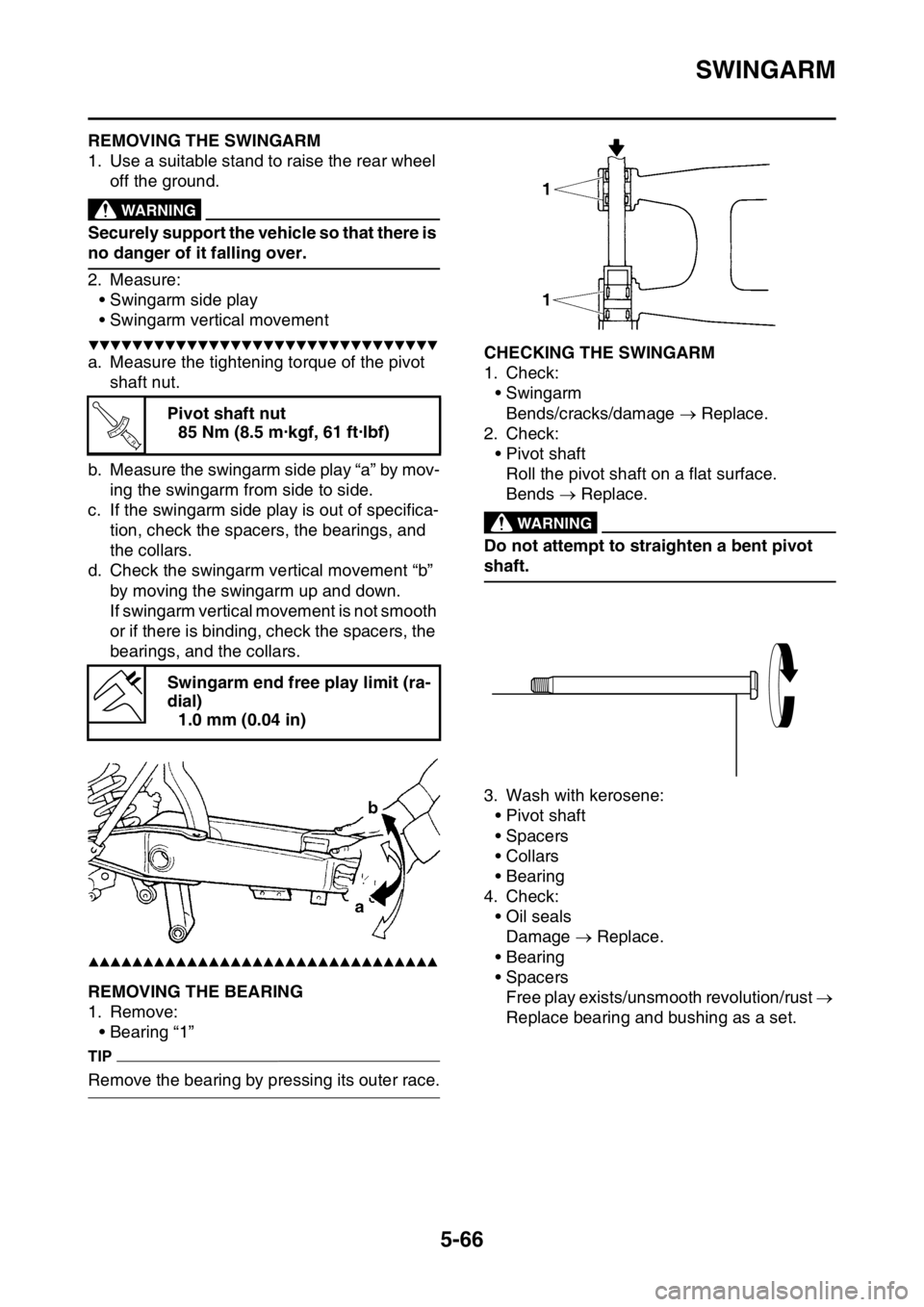
2. Measure:• Swingarm side play
• Swingarm vertical movement
▼▼▼▼▼▼▼▼▼▼▼▼▼▼▼▼▼▼▼▼▼▼▼▼▼▼▼▼▼▼▼▼
a. Measure the tightening torque of the pivot shaft nut.
b. Measure the swingarm side play “a” by mov- ing the swingarm from side to side.
c. If the swingarm side play is out of specifica- tion, check the spacers, the bearings, and
the collars.
d. Check the swingarm vertical movement “b” by moving the swingarm up and down.
If swingarm vertical movement is not smooth
or if there is binding, check the spacers, the
bearings, and the collars.
▲▲▲▲▲▲▲▲▲▲▲▲▲▲▲▲▲▲▲▲▲▲▲▲▲▲▲▲▲▲▲▲
EAS2GC1218REMOVING THE BEARING
1. Remove:• Bearing “1”
TIP
Remove the bearing by pressing its outer race.
EAS2GC1219CHECKING THE SWINGARM
1. Check:• Swingarm
Bends/cracks/damage Replace.
2. Check: • Pivot shaft
Roll the pivot shaft on a flat surface.
Bends Replace.
EWA
WARNING
Do not attempt to straighten a bent pivot
shaft.
3. Wash with kerosene:
• Pivot shaft
• Spacers
•Collars
• Bearing
4. Check: • Oil seals
Damage Replace.
• Bearing
• Spacers Free play exists/unsmooth revolution/rust
Replace bearing and bushing as a set.
Pivot shaft nut
85 Nm (8.5 m·kgf, 61 ft·lbf)
Swingarm end free play limit (ra-
dial) 1.0 mm (0.04 in)
T R..
Page 226 of 426

CLUTCH......................................................................................................... 6-41
REMOVING THE CLUTCH ...................................................................... 6-44
CHECKING THE FRICTION PLATES...................................................... 6-44
CHECKING THE CLUTCH PLATES ........................................................ 6-44
CHECKING THE CLUTCH SPRINGS...................................................... 6-44
CHECKING THE CLUTCH HOUSING ..................................................... 6-45
CHECKING THE CLUTCH BOSS ............................................................ 6-45
CHECKING THE PRESSURE PLATE ..................................................... 6-45
CHECKING THE PUSH LEVER SHAFT .................................................. 6-45
CHECKING THE CLUTCH PUSH RODS ................................................ 6-45
CHECKING THE PRIMARY DRIVE GEAR .............................................. 6-45
CHECKING THE PRIMARY DRIVEN GEAR ........................................... 6-46
INSTALLING THE OIL SEAL ................................................................... 6-46
INSTALLING THE RIGHT CRANKCASE COVER ................................... 6-46
INSTALLING THE CLUTCH ..................................................................... 6-46
INSTALLING THE KICKSTAR TER LEVER ............................................. 6-49
KICKSTATER ................................................................................................. 6-50
REMOVING THE KICK SHA FT ASSEMBLY ........................................... 6-51
CHECKING THE KICK SHAFT AND RATCHET WHEEL ........................ 6-51
CHECKING THE KICK GEAR, KICK IDLE GEAR AND RATCHET
WHEEL .................................................................................................... 6-51
INSTALLING THE KICK SHAFT ASSEMBLY .......................................... 6-51
INSTALLING THE KICK IDLE GEAR ....................................................... 6-52
SHIFT SHAFT ................................................................................................. 6-53
REMOVING THE SHIFT GUIDE AND SHIFT LEVER ASSEMBLY ......... 6-54
REMOVING THE SEGMENT ................................................................... 6-54
CHECKING THE SHIFT SHAFT .............................................................. 6-54
CHECKING THE SHIFT GUIDE AND SHIFT LEVER ASSEMBLY ......... 6-54
CHECKING THE STOPPER LEVER ....................................................... 6-54
INSTALLING THE STOPPE R LEVER ............................. ........................ 6-55
INSTALLING THE SEGMENT.................................................................. 6-55
INSTALLING THE SHIFT GUIDE AND SHIFT LEVER ASSEMBLY ....... 6-55
INSTALLING THE SHIFT SHAFT ............................................................ 6-56
INSTALLING THE SHIFT PEDAL ............................................................ 6-56
OIL PUMP AND BALANCER GEAR ............................................................. 6-57
REMOVING THE BALANCER ................................................................. 6-59
CHECKING THE PRIMARY DRIVE GEAR, BALANCER SHAFT DRIVE GEAR, AND BALANCER WEIGHT GEAR .................................. 6-59
CHECKING THE BALANCER .................................................................. 6-59
CHECKING THE OIL PUMP .................................................................... 6-59
ASSEMBLING THE OIL PUMP ................................................................ 6-60
INSTALLING THE OIL PUMP AND BALANCER GEAR .......................... 6-61
Page 227 of 426

GENERATOR AND STARTER CLUTCH....................................................... 6-63
REMOVING THE GENERATOR .............................................................. 6-65
CHECKING THE STARTER CLUTCH ..................................................... 6-65
INSTALLING THE STARTER CLUTCH ................................................... 6-66
INSTALLING THE GENERATOR............................................................. 6-67
CRANKCASE ................................................................................................. 6-69
DISASSEMBLING THE CRANKC ASE..................................................... 6-72
REMOVING THE CRANKCASE BEARING ............................................. 6-72
CHECKING THE TIMING CHAIN, TIMING CHAIN GUIDE, OIL
STRAINER .............................................................................................. 6-72
CHECKING THE CRANKCASE ............................................................... 6-72
INSTALLING THE OIL SEAL ................................................................... 6-73
ASSEMBLING THE CRANKCASE........................................................... 6-73
CRANKSHAFT ASSEMBLY AND BALANCER SHAFT ............................... 6-74
REMOVING THE BALANCER SHAFT..................................................... 6-75
REMOVING THE CRANKSHAFT ASSEMBLY ........................................ 6-75
CHECKING THE CRANKSHA FT ASSEMBLY......................................... 6-75
INSTALLING THE CRANKSHA FT ASSEMBLY....................................... 6-76
TRANSMISSION ............................................................................................. 6-77
REMOVING THE TRANSMISSION ......................................................... 6-78
CHECKING THE SHIFT FORKS.............................................................. 6-78
CHECKING THE SHIFT DRUM ASSEMBLY ........................................... 6-79
CHECKING THE TRANSMISSION .......................................................... 6-79
INSTALLING THE TRANSMISSION ........................................................ 6-79