warning light YAMAHA XJ6-S 2012 User Guide
[x] Cancel search | Manufacturer: YAMAHA, Model Year: 2012, Model line: XJ6-S, Model: YAMAHA XJ6-S 2012Pages: 102, PDF Size: 2.68 MB
Page 44 of 102
OPERATION AND IMPORTANT RIDING POINTS
5-2
5
NOTICE
ECA11833
If a warning or indicator light does
not come on initially when the key is
turned to “ON”, or if a warning or in-
dicator light remains on, see page
3-4 for the corresponding warning
and indicator light circuit check.2. Shift the transmission into the neu-tral position. The neutral indicator
light should come on. If not, ask a
Yamaha dealer to check the elec-
trical circuit.
3. Start the engine by pushing the start switch.
If the engine fails to start, release
the start switch, wait a few sec-
onds, and then try again. Each
starting attempt should be as short
as possible to preserve the bat-
tery. Do not crank the engine more
than 10 seconds on any one at-
tempt.NOTICE
ECA11042
For maximum engine life, never ac-
celerate hard when the engine is
cold!
EAU16671
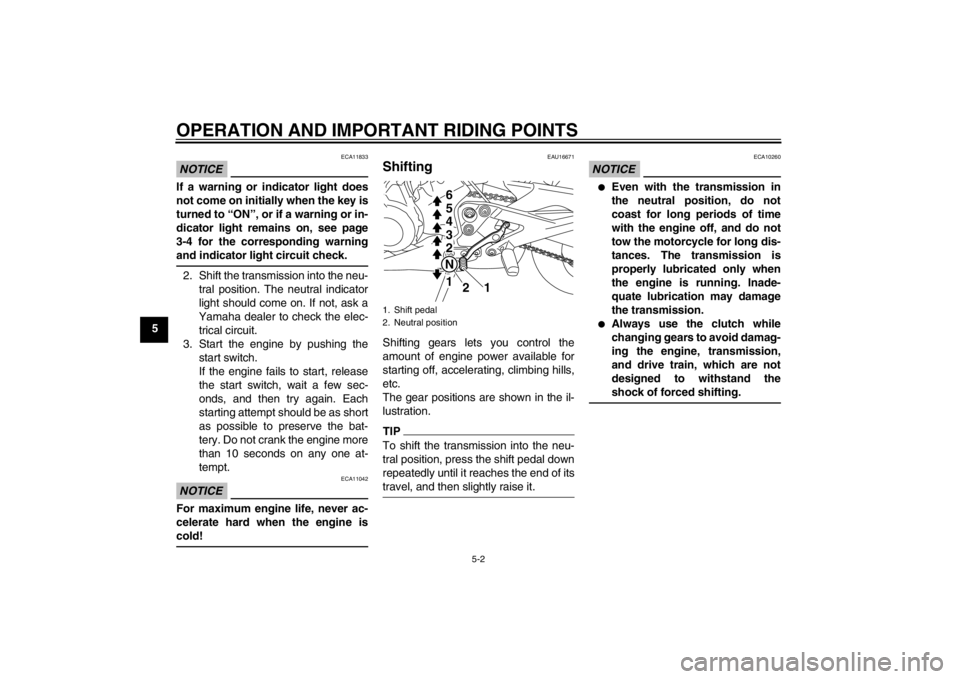
Shifting Shifting gears lets you control the
amount of engine power available for
starting off, accelerating, climbing hills,
etc.
The gear positions are shown in the il-
lustration.TIPTo shift the transmission into the neu-
tral position, press the shift pedal down
repeatedly until it reaches the end of its
travel, and then slightly raise it.
NOTICE
ECA10260
●
Even with the transmission in
the neutral position, do not
coast for long periods of time
with the engine off, and do not
tow the motorcycle for long dis-
tances. The transmission is
properly lubricated only when
the engine is running. Inade-
quate lubrication may damage
the transmission.
●
Always use the clutch while
changing gears to avoid damag-
ing the engine, transmission,
and drive train, which are not
designed to withstand the
shock of forced shifting.
1. Shift pedal
2. Neutral position
1
N
2 3
4
5
6
1
2
U1PWEAE0.book Page 2 Tuesda
y, February 7, 2012 4:21 PM
Page 60 of 102

PERIODIC MAINTENANCE AND ADJUSTMENT
6-14
610. Start the engine, and then let it idle
for several minutes while checking
it for oil leakage. If oil is leaking, im-
mediately turn the engine off and
check for the cause.
TIPAfter the engine is started, the engine
oil level warning light should go off if the
oil level is sufficient.NOTICE
ECA10401
If the oil level warning light flickers
or remains on even if the oil level is
correct, immediately turn the engine
off and have a Yamaha dealer check
the vehicle.11. Turn the engine off, wait a few min-utes until the oil settles, and then
check the oil level and correct it if
necessary.
12. Install the cowling.
EAU20070
Coolant The coolant level should be checked
before each ride. In addition, the cool-
ant must be changed at the intervals
specified in the periodic maintenance
and lubrication chart.
EAU47560
To check the coolant level 1. Place the vehicle on the center- stand.TIP●
The coolant level must be checked
on a cold engine since the level
varies with engine temperature.
●
Make sure that the vehicle is posi-
tioned straight up when checking
the coolant level. A slight tilt to the
side can result in a false reading.
2. Check the coolant level in the cool-ant reservoir.TIPThe coolant should be between the
minimum and maximum level marks.
3. If the coolant is at or below theminimum level mark, remove the
coolant reservoir breather hose
from the guide, and then remove
the coolant reservoir cap.1. Coolant reservoir
2. Maximum level mark
3. Minimum level mark
1
2
3
U1PWEAE0.book Page 14 Tuesday, February 7, 2012 4:21 PM
Page 82 of 102
PERIODIC MAINTENANCE AND ADJUSTMENT
6-36
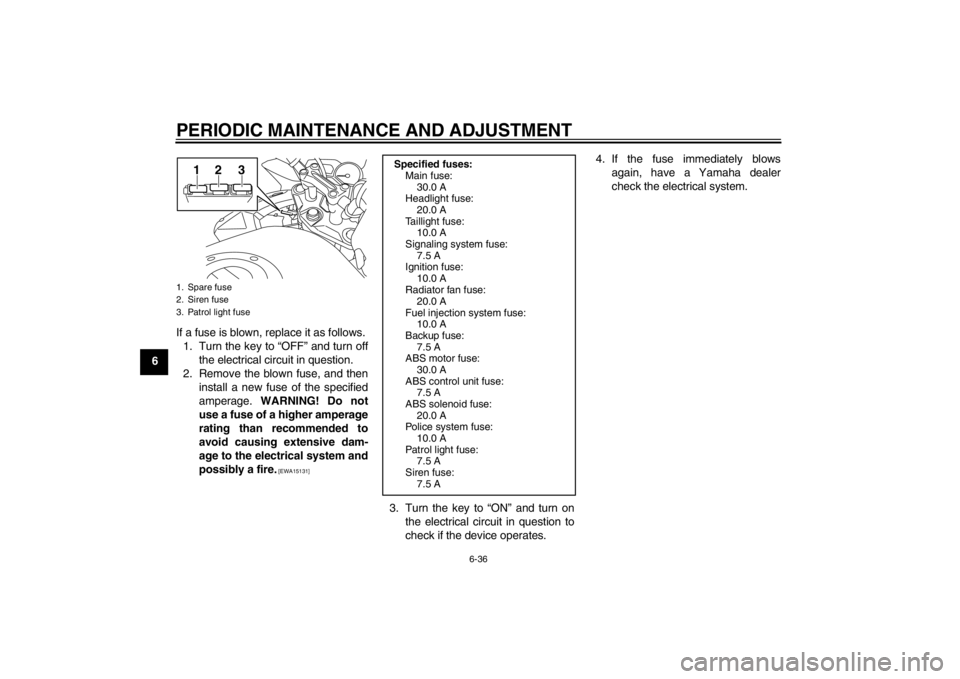
6If a fuse is blown, replace it as follows.
1. Turn the key to “OFF” and turn off the electrical circuit in question.
2. Remove the blown fuse, and then install a new fuse of the specified
amperage. WARNING! Do not
use a fuse of a higher amperage
rating than recommended to
avoid causing extensive dam-
age to the electrical system and
possibly a fire.
[EWA15131]
3. Turn the key to “ON” and turn on the electrical circuit in question to
check if the device operates. 4. If the fuse immediately blows
again, have a Yamaha dealer
check the electrical system.
1. Spare fuse
2. Siren fuse
3. Patrol light fuse
12 3
Specified fuses:Main fuse:
30.0 A
Headlight fuse:
20.0 A
Taillight fuse: 10.0 A
Signaling system fuse: 7.5 A
Ignition fuse:
10.0 A
Radiator fan fuse: 20.0 A
Fuel injection system fuse: 10.0 A
Backup fuse:
7.5 A
ABS motor fuse: 30.0 A
ABS control unit fuse: 7.5 A
ABS solenoid fuse:
20.0 A
Police system fuse: 10.0 A
Patrol light fuse: 7.5 A
Siren fuse:
7.5 A
U1PWEAE0.book Page 36 Tuesday, February 7, 2012 4:21 PM
Page 86 of 102
PERIODIC MAINTENANCE AND ADJUSTMENT
6-40
6
EAU39020
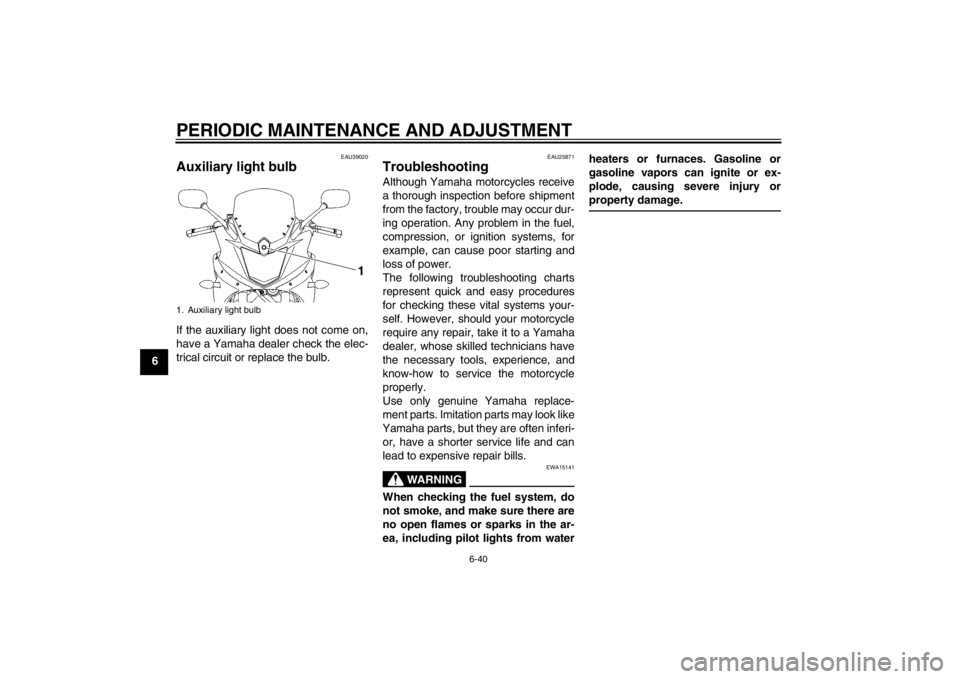
Auxiliary light bulb If the auxiliary light does not come on,
have a Yamaha dealer check the elec-
trical circuit or replace the bulb.
EAU25871
Troubleshooting Although Yamaha motorcycles receive
a thorough inspection before shipment
from the factory, trouble may occur dur-
ing operation. Any problem in the fuel,
compression, or ignition systems, for
example, can cause poor starting and
loss of power.
The following troubleshooting charts
represent quick and easy procedures
for checking these vital systems your-
self. However, should your motorcycle
require any repair, take it to a Yamaha
dealer, whose skilled technicians have
the necessary tools, experience, and
know-how to service the motorcycle
properly.
Use only genuine Yamaha replace-
ment parts. Imitation parts may look like
Yamaha parts, but they are often inferi- or, have a shorter service life and can
lead to expensive repair bills.
WARNING
EWA15141
When checking the fuel system, do
not smoke, and make sure there are
no open flames or sparks in the ar-
ea, including pilot lights from water heaters or furnaces. Gasoline or
gasoline vapors can ignite or ex-
plode, causing severe injury or
property damage.
1. Auxiliary light bulb
1
U1PWEAE0.book Page 40 Tuesday, February 7, 2012 4:21 PM
Page 92 of 102

MOTORCYCLE CARE AND STORAGE
7-3
74. To prevent corrosion, it is recom-
mended to apply a corrosion pro-
tection spray on all metal,
including chrome- and nickel-plat-
ed, surfaces.
5. Use spray oil as a universal clean- er to remove any remaining dirt.
6. Touch up minor paint damage caused by stones, etc.
7. Wax all painted surfaces.
8. Let the motorcycle dry completely before storing or covering it.
WARNING
EWA11131
Contaminants on the brakes or tires
can cause loss of control.●
Make sure that there is no oil or
wax on the brakes or tires.
●
If necessary, clean the brake
discs and brake linings with a
regular brake disc cleaner or ac-
etone, and wash the tires with
warm water and a mild deter-
gent. Before riding at higher
speeds, test the motorcycle’s
braking performance and cor-
nering behavior.
NOTICE
ECA10800
●
Apply spray oil and wax spar-
ingly and make sure to wipe off
any excess.
●
Never apply oil or wax to any
rubber and plastic parts, but
treat them with a suitable care
product.
●
Avoid using abrasive polishing
compounds as they will wear
away the paint.
TIP●
Consult a Yamaha dealer for ad-
vice on what products to use.
●
Washing, rainy weather or humid
climates can cause the headlight
lens to fog. Turning the headlight
on for a short period of time will
help remove the moisture from the
lens.
EAU26182
Storage Short-term
Always store your motorcycle in a cool,
dry place and, if necessary, protect it
against dust with a porous cover. Be
sure the engine and the exhaust sys-
tem are cool before covering the motor-
cycle.NOTICE
ECA10810
●
Storing the motorcycle in a
poorly ventilated room or cover-
ing it with a tarp, while it is still
wet, will allow water and humid-
ity to seep in and cause rust.
●
To prevent corrosion, avoid
damp cellars, stables (because
of the presence of ammonia)
and areas where strong chemi-
cals are stored.
Long-term
Before storing your motorcycle for sev-
eral months:1. Follow all the instructions in the “Care” section of this chapter.
U1PWEAE0.book Page 3 Tuesda y, February 7, 2012 4:21 PM
Page 96 of 102

SPECIFICATIONS
8-3
8
Voltage, capacity:12 V, 10.0 AhHeadlight:Bulb type:
Halogen bulbBulb voltage, wattage × quantity:Headlight:
12 V, 60.0 W/55.0 W × 1
Tail/brake light:
12 V, 5.0 W/21.0 W × 1
Front turn signal light: 12 V, 10.0 W × 2
Rear turn signal light: 12 V, 10.0 W × 2
Auxiliary light:
12 V, 5.0 W × 1
License plate light: 12 V, 5.0 W × 1
Meter lighting: LED
Neutral indicator light:
LED
High beam indicator light: LED
Oil level warning light: LED
Turn signal indicator light:
LED
Coolant temperature warning light: LED
Engine trouble warning light: LED
ABS warning light:
LED Immobilizer system indicator light:
LED
Fuses:Main fuse:
30.0 A
Headlight fuse: 20.0 A
Taillight fuse: 10.0 A
Signaling system fuse:
7.5 A
Ignition fuse: 10.0 A
Radiator fan fuse: 20.0 A
Fuel injection system fuse:
10.0 A
ABS control unit fuse: 7.5 A
ABS motor fuse: 30.0 A
ABS solenoid fuse:
20.0 A
Patrol light fuse: 7.5 A
Siren fuse: 7.5 A
Police system fuse:
10.0 A
Backup fuse: 7.5 A
U1PWEAE0.book Page 3 Tuesda y, February 7, 2012 4:21 PM
Page 98 of 102

INDEXAABS ....................................................... 3-15
ABS warning light.................................... 3-7
Air filter element, replacing ................... 6-18
Anti-theft alarm (optional)...................... 3-11
Auxiliary light bulb ................................. 6-40BBattery................................................... 6-34
Brake and clutch levers, checking and lubricating ..................... 6-31
Brake and shift pedals, checking and lubricating ..................... 6-30
Brake fluid, changing ............................ 6-27
Brake fluid level, checking .................... 6-26
Brake lever ............................................ 3-14
Brake lever free play, checking ............. 6-24
Brake light switches .............................. 6-25
Brake pedal ........................................... 3-14CCables, checking and lubricating .......... 6-29
Care ........................................................ 7-1
Carrier ................................................... 3-22
Catalytic converter ................................ 3-18
Centerstand and sidestand, checking and lubricating ..................... 6-31
Clutch lever ........................................... 3-13
Clutch lever free play, adjusting ............ 6-23
Coolant.................................................. 6-14
Coolant temperature warning light .......... 3-4
Cowlings and panels, removing and installing ......................... 6-8DDimmer switch ...................................... 3-12
Drive chain, cleaning and lubricating .... 6-29 Drive chain slack .................................. 6-27
EEngine break-in ...................................... 5-3
Engine guards and
rear guards,
checking ............................................. 6-43
Engine idling speed .............................. 6-19
Engine oil and oil filter cartridge ........... 6-11
Engine stop switch................................ 3-12
Engine trouble warning light ................... 3-7FFront and rear brake pads, checking .... 6-25
Front fork, checking .............................. 6-32
Fuel....................................................... 3-16
Fuel consumption, tips for reducing........ 5-3
Fuel tank breather hose and
overflow hose ..................................... 3-17
Fuel tank cap ........................................ 3-16
Fuses, replacing ................................... 6-35HHandlebar switches .............................. 3-12
Hazard switch ....................................... 3-13
Headlight bulb, replacing ...................... 6-37
High beam indicator light ........................ 3-4
Horn switch ........................................... 3-12IIdentification numbers ............................ 9-1
Ignition circuit cut-off system ................ 3-23
Immobilizer system ................................. 3-1
Immobilizer system indicator light........... 3-7
Indicator lights and warning lights .......... 3-4LLicense plate light bulb, replacing ........ 6-39MMain switch/steering lock........................ 3-2 Maintenance and lubrication, periodic..... 6-4
Maintenance, emission control system ... 6-3
Matte color, caution ................................. 7-1
Model label .............................................. 9-1
Multi-function meter unit .......................... 3-8
NNeutral indicator light .............................. 3-4OOil level warning light .............................. 3-4PParking .................................................... 5-4
Part locations .......................................... 2-1
Pass switch ........................................... 3-12
Patrol switch .......................................... 3-13RRear view mirrors .................................. 3-19SSafety information ................................... 1-1
Seat ....................................................... 3-18
Shifting .................................................... 5-2
Shift pedal ............................................. 3-14
Shock absorber assembly, adjusting .... 3-21
Sidecases.............................................. 3-20
Sidestand .............................................. 3-22
Siren switch ........................................... 3-13
Spark plugs, checking ........................... 6-10
Specifications .......................................... 8-1
Starting the engine .................................. 5-1
Start switch............................................ 3-12
Steering, checking................................. 6-33
Storage.................................................... 7-3
Swingarm pivots, lubricating ................. 6-32TTail/brake light bulb, replacing .............. 6-38
U1PWEAE0.book Page 1 Tuesda
y, February 7, 2012 4:21 PM