warning YAMAHA XJR 1300 2016 User Guide
[x] Cancel search | Manufacturer: YAMAHA, Model Year: 2016, Model line: XJR 1300, Model: YAMAHA XJR 1300 2016Pages: 98, PDF Size: 2.59 MB
Page 27 of 98
Instrument and control functions
3-12
3
EAU12944
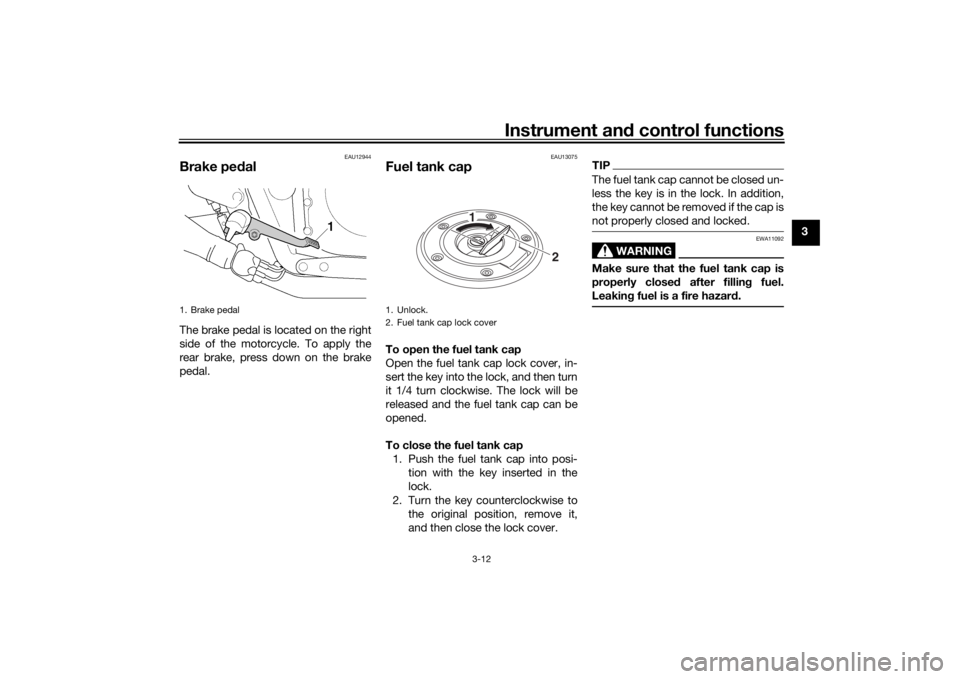
Brake ped alThe brake pedal is located on the right
side of the motorcycle. To apply the
rear brake, press down on the brake
pedal.
EAU13075
Fuel tank capTo open the fuel tank cap
Open the fuel tank cap lock cover, in-
sert the key into the lock, and then turn
it 1/4 turn clockwise. The lock will be
released and the fuel tank cap can be
opened.
To close the fuel tank cap
1. Push the fuel tank cap into posi- tion with the key inserted in the
lock.
2. Turn the key counterclockwise to the original position, remove it,
and then close the lock cover.
TIPThe fuel tank cap cannot be closed un-
less the key is in the lock. In addition,
the key cannot be removed if the cap is
not properly closed and locked.
WARNING
EWA11092
Make sure that the fuel tank cap is
properly close d after fillin g fuel.
Leakin g fuel is a fire hazar d.
1. Brake pedal
1. Unlock.
2. Fuel tank cap lock cover
2
1
U2PNE1E0.book Page 12 Monday, December 28, 2015 11:03 AM
Page 28 of 98
Instrument and control functions
3-13
3
EAU13213
FuelMake sure there is sufficient gasoline in
the tank.
WARNING
EWA10882
Gasoline an d g asoline vapors are
extremely flammab le. To avoid fires
an d explosions an d to re duce the
risk of injury when refuelin g, follow
these instructions.1. Before refueling, turn off the en- gine and be sure that no one is sit-
ting on the vehicle. Never refuel
while smoking, or while in the vi-
cinity of sparks, open flames, or
other sources of ignition such as
the pilot lights of water heaters
and clothes dryers.
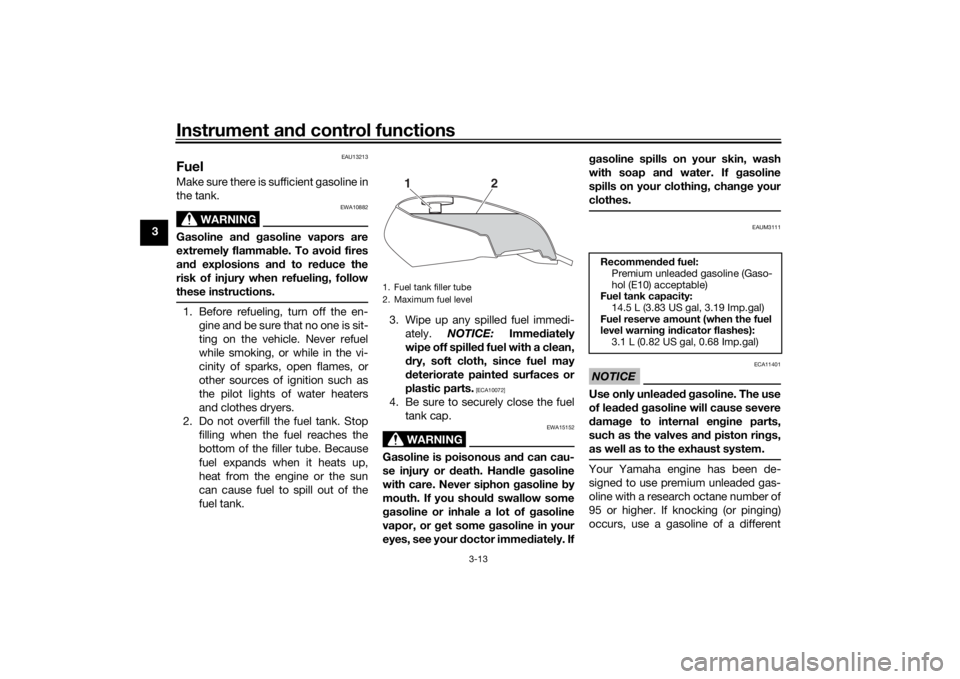
2. Do not overfill the fuel tank. Stop filling when the fuel reaches the
bottom of the filler tube. Because
fuel expands when it heats up,
heat from the engine or the sun
can cause fuel to spill out of the
fuel tank. 3. Wipe up any spilled fuel immedi-
ately. NOTICE: Immediately
wipe off spille d fuel with a clean,
d ry, soft cloth, since fuel may
d eteriorate painted surfaces or
plastic parts.
[ECA10072]
4. Be sure to securely close the fuel tank cap.
WARNING
EWA15152
Gasoline is poisonous an d can cau-
se injury or death. Han dle gasoline
with care. Never siphon gasoline by
mouth. If you shoul d swallow some
g asoline or inhale a lot of g asoline
vapor, or g et some gasoline in your
eyes, see your d octor immediately. If g
asoline spills on your skin, wash
with soap an d water. If gasoline
spills on your clothin g, chan ge your
clothes.
EAUM3111
NOTICE
ECA11401
Use only unlea ded g asoline. The use
of lea ded g asoline will cause severe
d amag e to internal en gine parts,
such as the valves an d piston rin gs,
as well as to the exhaust system.Your Yamaha engine has been de-
signed to use premium unleaded gas-
oline with a research octane number of
95 or higher. If knocking (or pinging)
occurs, use a gasoline of a different
1. Fuel tank filler tube
2. Maximum fuel level
12
Recommen ded fuel:
Premium unleaded gasoline (Gaso-
hol (E10) acceptable)
Fuel tank capacity:
14.5 L (3.83 US gal, 3.19 Imp.gal)
Fuel reserve amount (when the fuel
level warnin g in dicator flashes):
3.1 L (0.82 US gal, 0.68 Imp.gal)
U2PNE1E0.book Page 13 Monday, December 28, 2015 11:03 AM
Page 29 of 98
Instrument and control functions
3-14
3
brand. Use of unleaded fuel will extend
spark plug life and reduce mainte-
nance costs.
Gasohol
There are two types of gasohol: gaso-
hol containing ethanol and that con-
taining methanol. Gasohol containing
ethanol can be used if the ethanol con-
tent does not exceed 10% (E10). Gas-
ohol containing methanol is not
recommended by Yamaha because it
can cause damage to the fuel system
or vehicle performance problems.
EAU51172
Fuel tank
breather hose an d
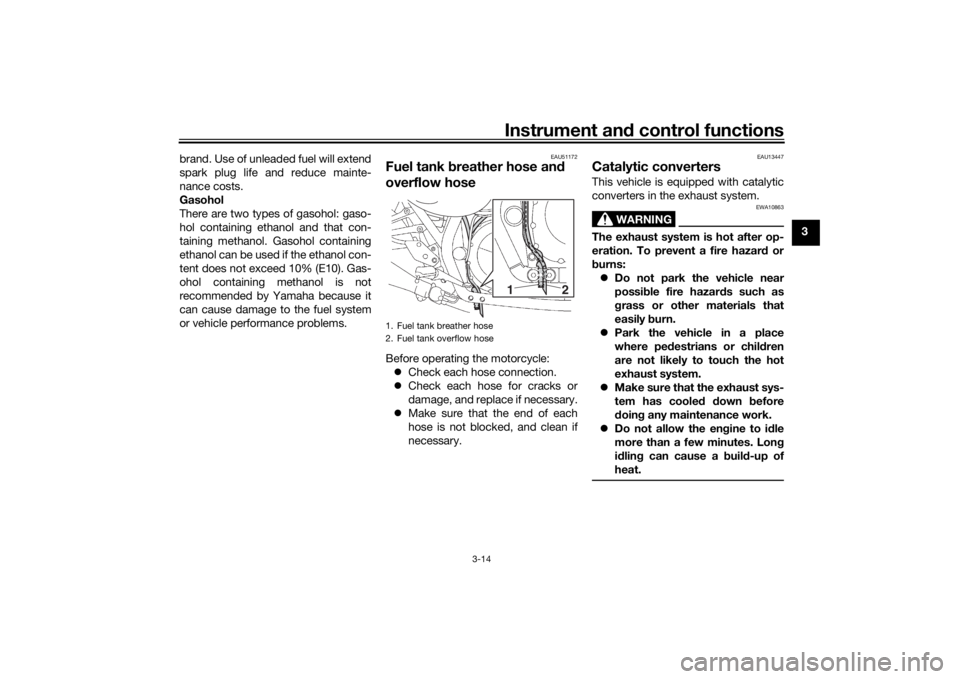
overflow hoseBefore operating the motorcycle:
Check each hose connection.
Check each hose for cracks or
damage, and replace if necessary.
Make sure that the end of each
hose is not blocked, and clean if
necessary.
EAU13447
Catalytic converters This vehicle is equipped with catalytic
converters in the exhaust system.
WARNING
EWA10863
The exhaust system is hot after op-
eration. To prevent a fire hazar d or
b urns:
Do not park the vehicle near
possi ble fire hazar ds such as
g rass or other materials that
easily burn.
Park the vehicle in a place
where pe destrians or child ren
are not likely to touch the hot
exhaust system.
Make sure that the exhaust sys-
tem has coole d down before
d oin g any maintenance work.
Do not allow the en gine to i dle
more than a few minutes. Lon g
i d lin g can cause a b uild-up of
heat.
1. Fuel tank breather hose
2. Fuel tank overflow hose
2
1
U2PNE1E0.book Page 14 Monday, December 28, 2015 11:03 AM
Page 31 of 98
Instrument and control functions
3-16
3
EAU14744
A djustin g the front fork
WARNING
EWA10181
Always a djust both fork le gs equally,
otherwise poor han dlin g an d loss of
sta bility may result.This front fork is equipped with spring
preload adjusting bolts, rebound
damping force adjusting screws and
compression damping force adjusting
screws.NOTICE
ECA10102
To avoi d d amag ing the mechanism,
d o not attempt to turn b eyond the
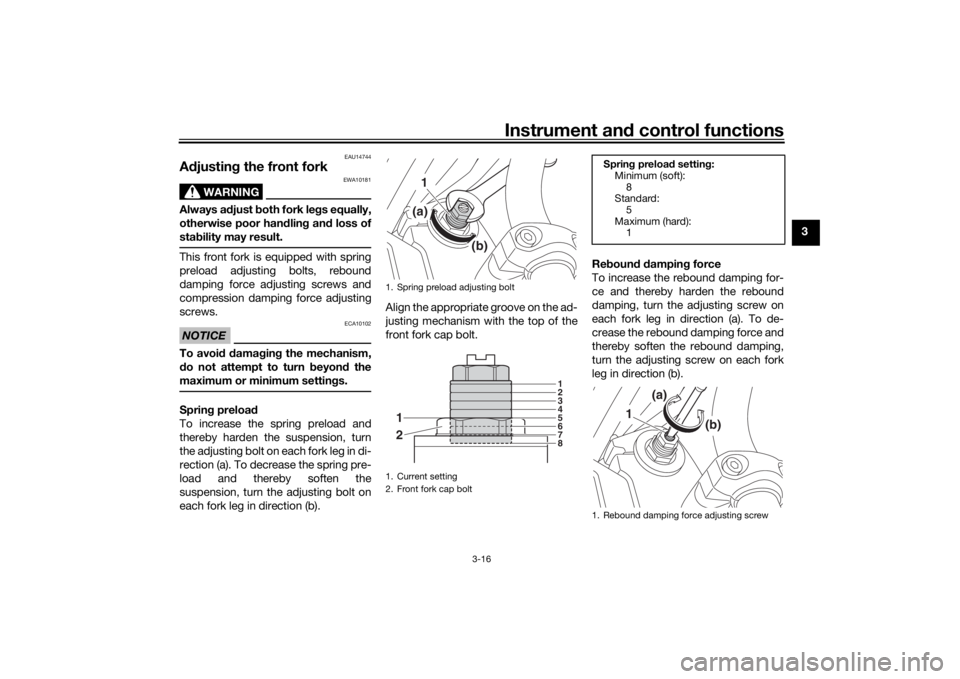
maximum or minimum settin gs.Sprin g preloa d
To increase the spring preload and
thereby harden the suspension, turn
the adjusting bolt on each fork leg in di-
rection (a). To decrease the spring pre-
load and thereby soften the
suspension, turn the adjusting bolt on
each fork leg in direction (b). Align the appropriate groove on the ad-
justing mechanism with the top of the
front fork cap bolt.
Re
boun d d ampin g force
To increase the rebound damping for-
ce and thereby harden the rebound
damping, turn the adjusting screw on
each fork leg in direction (a). To de-
crease the rebound damping force and
thereby soften the rebound damping,
turn the adjusting screw on each fork
leg in direction (b).
1. Spring preload adjusting bolt
1. Current setting
2. Front fork cap bolt
1(a)
(b)
2 1
1
2
3
4
5
6
7
8
Sprin g preloa d settin g:
Minimum (soft):
8
Standard:
5
Maximum (hard): 1
1. Rebound damping force adjusting screw
1
(a)
(b)
U2PNE1E0.book Page 16 Monday, December 28, 2015 11:03 AM
Page 33 of 98
Instrument and control functions
3-18
3
EAU43257
A djustin g the shock a bsor ber
assemb ly
WARNING
EWA10211
Always a djust both shock a bsor ber
assem blies equally, otherwise poor
han dlin g an d loss of sta bility may re-
sult.Each shock absorber assembly is
equipped with a spring preload adjust-
ing ring and rebound and compression
damping force adjusting knobs.
Sprin g preloa d
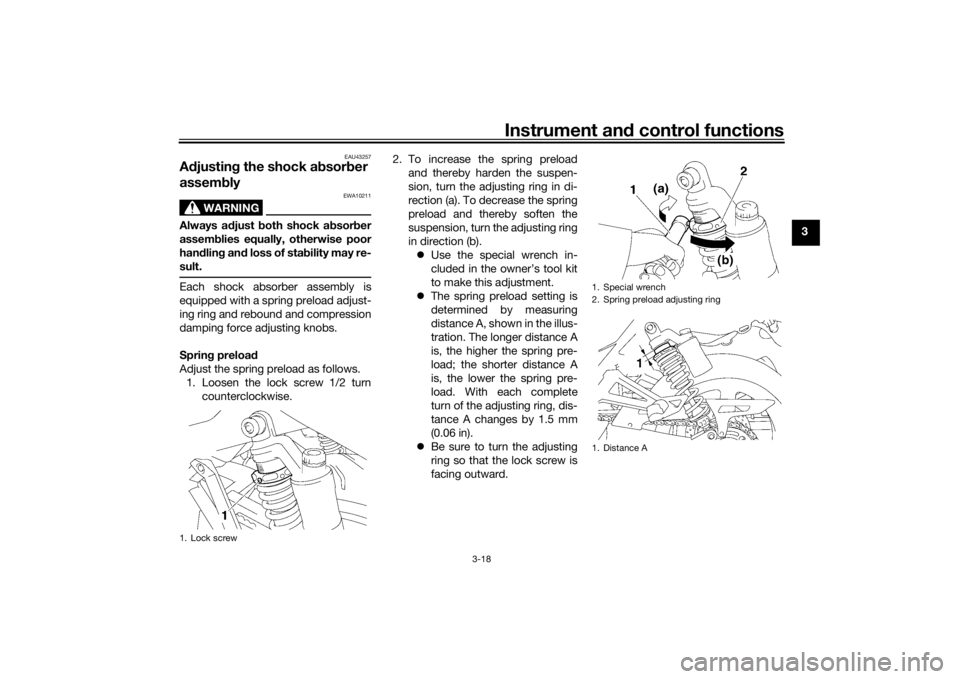
Adjust the spring preload as follows. 1. Loosen the lock screw 1/2 turn counterclockwise. 2. To increase the spring preload
and thereby harden the suspen-
sion, turn the adjusting ring in di-
rection (a). To decrease the spring
preload and thereby soften the
suspension, turn the adjusting ring
in direction (b). Use the special wrench in-
cluded in the owner’s tool kit
to make this adjustment.
The spring preload setting is
determined by measuring
distance A, shown in the illus-
tration. The longer distance A
is, the higher the spring pre-
load; the shorter distance A
is, the lower the spring pre-
load. With each complete
turn of the adjusting ring, dis-
tance A changes by 1.5 mm
(0.06 in).
Be sure to turn the adjusting
ring so that the lock screw is
facing outward.1. Lock screw
1. Special wrench
2. Spring preload adjusting ring
1. Distance A
U2PNE1E0.book Page 18 Monday, December 28, 2015 11:03 AM
Page 35 of 98
Instrument and control functions
3-20
3
TIPTo obtain a precise adjustment, it is
advisable to check the actual total
number of clicks or turns of each
damping force adjusting mechanism.
This adjustment range may not exactly
match the specifications listed due to
small differences in production.
WARNING
EWA10232
These shock ab sorber assem blies
contain hi ghly pressurize d nitro gen
g as. Rea d an d un derstan d the fol-
lowin g information before han dlin g
the shock ab sorber assem blies.
Do not tamper with or attempt
to open the cylin der assem blies.
Do not su bject the shock a b-
sor ber assem blies to an open
flame or other hi gh heat source.
This may cause the unit to ex-
plod e due to excessive gas
pressure.
Do not d eform or damag e the
cylin ders in any way. Cylin der
d amag e will result in poor
d ampin g performance.
Do not dispose of a d amaged or
worn-out shock ab sorber as-
se
m bly yourself. Take the shock
a b sor ber assem bly to a Yamaha
d ealer for any service.
EAU15211
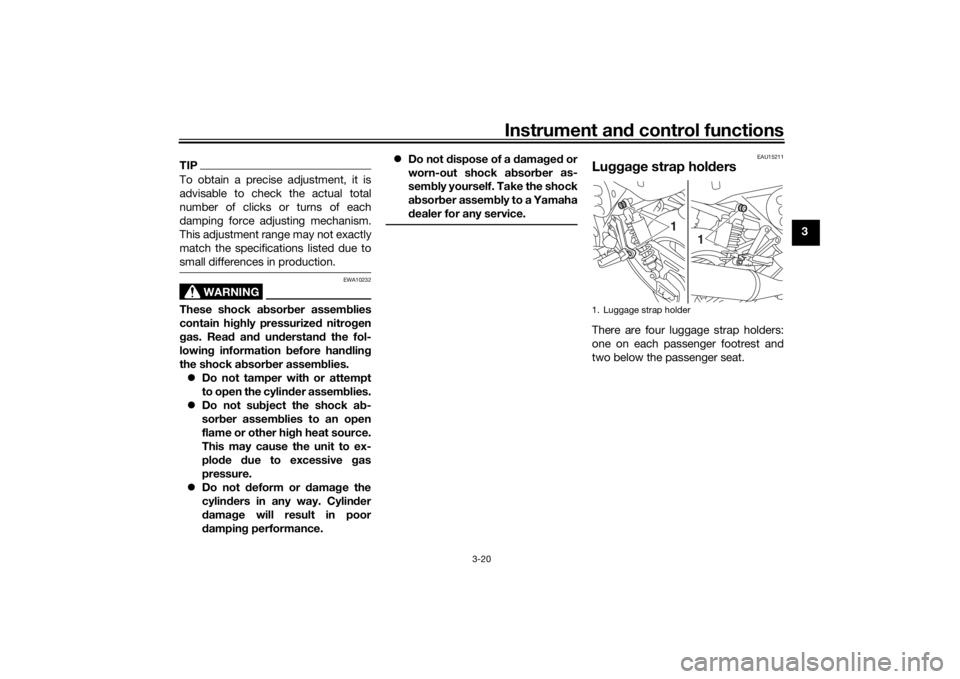
Lu gga ge strap hol dersThere are four luggage strap holders:
one on each passenger footrest and
two below the passenger seat.1. Luggage strap holder
1
1
U2PNE1E0.book Page 20 Monday, December 28, 2015 11:03 AM
Page 36 of 98
Instrument and control functions
3-21
3
EAU15283
EXUP systemThis model is equipped with Yamaha’s
EXUP (EXhaust Ultimate Power valve)
system. This system boosts engine
power by means of a valve that regu-
lates the inner diameter of the exhaust
pipe. The EXUP system valve is con-
stantly adjusted in accordance with the
engine speed by a computer-con-
trolled servomotor.NOTICE
ECA10192
The EXUP system has been set
an d extensively teste d at the
Yamaha factory. Chan gin g
these settin gs without sufficient
technical knowle dge may result
in poor performance of or dam-
a g e to the en gine.
If the EXUP system cannot b e
hear d when the main switch is
turne d on, have a Yamaha d eal-
er check it.
EAU15306
Si destan dThe sidestand is located on the left
side of the frame. Raise the sidestand
or lower it with your foot while holding
the vehicle upright.TIPThe built-in sidestand switch is part of
the ignition circuit cut-off system,
which cuts the ignition in certain situa-
tions. (See the following section for an
explanation of the ignition circuit cut-
off system.)
WARNING
EWA10242
The vehicle must not be ri dden with
the si destan d d own, or if the si de-
stan d cannot b e properly moved up
(or does not stay up), otherwise the
si destan d coul d contact the g round
an d d istract the operator, resultin g
in a possi ble loss of control.
Yamaha’s ig nition circuit cut-off
system has been desi gne d to assist
the operator in fulfillin g the respon-
si bility of raisin g the si destan d b e-
fore startin g off. Therefore, check this system reg
ularly and have a
Yamaha dealer repair it if it does not
function properly.
U2PNE1E0.book Page 21 Monday, December 28, 2015 11:03 AM
Page 38 of 98
Instrument and control functions
3-23
3
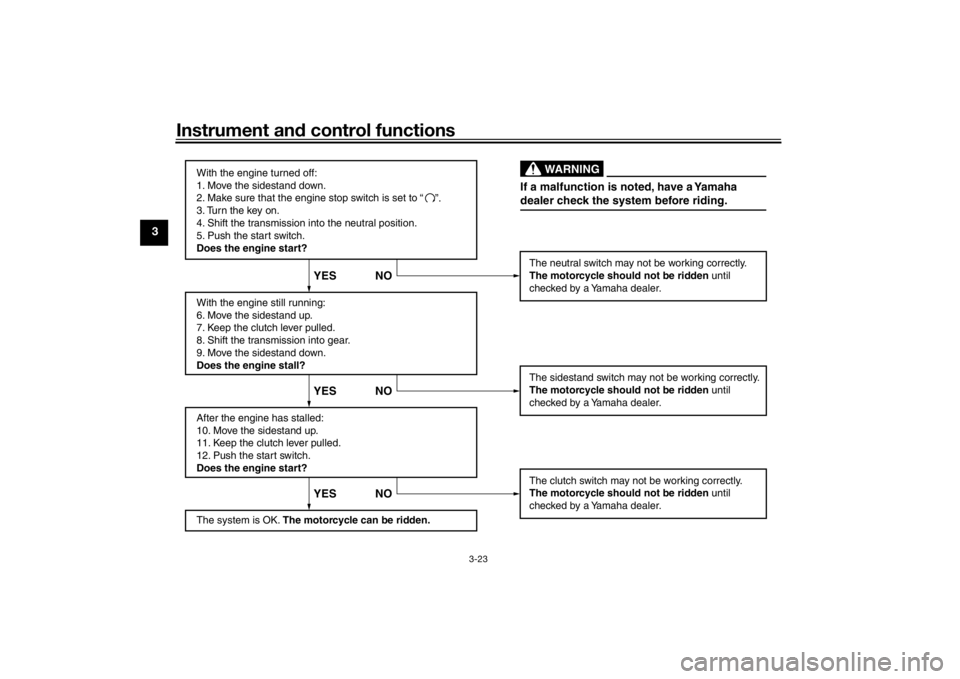
With the engine turned off:
1. Move the sidestand down.
2. Make sure that the engine stop switch is set to “
3. Turn the key on.
4. Shift the transmission into the neutral position.
5. Push the start switch.
Does the engine start?
With the engine still running:
6. Move the sidestand up.
7. Keep the clutch lever pulled.
8. Shift the transmission into gear.
9. Move the sidestand down.
Does the engine stall?
After the engine has stalled:
10. Move the sidestand up.
11. Keep the clutch lever pulled.
12. Push the start switch.
Does the engine start?
The system is OK. The motorcycle can be ridden. The neutral switch may not be working correctly.
The motorcycle should not be ridden
until
checked by a Yamaha dealer.
The sidestand switch may not be working correctly.
The motorcycle should not be ridden until
checked by a Yamaha dealer.
The clutch switch may not be working correctly.
The motorcycle should not be ridden until
checked by a Yamaha dealer.
YES NO YES NO YES NO
If a malfunction is noted, have a Yamaha
dealer check the system before riding.
WARNING
”.
U2PNE1E0.book Page 23 Monday, December 28, 2015 11:03 AM
Page 39 of 98
For your safety – pre-operation checks
4-1
4
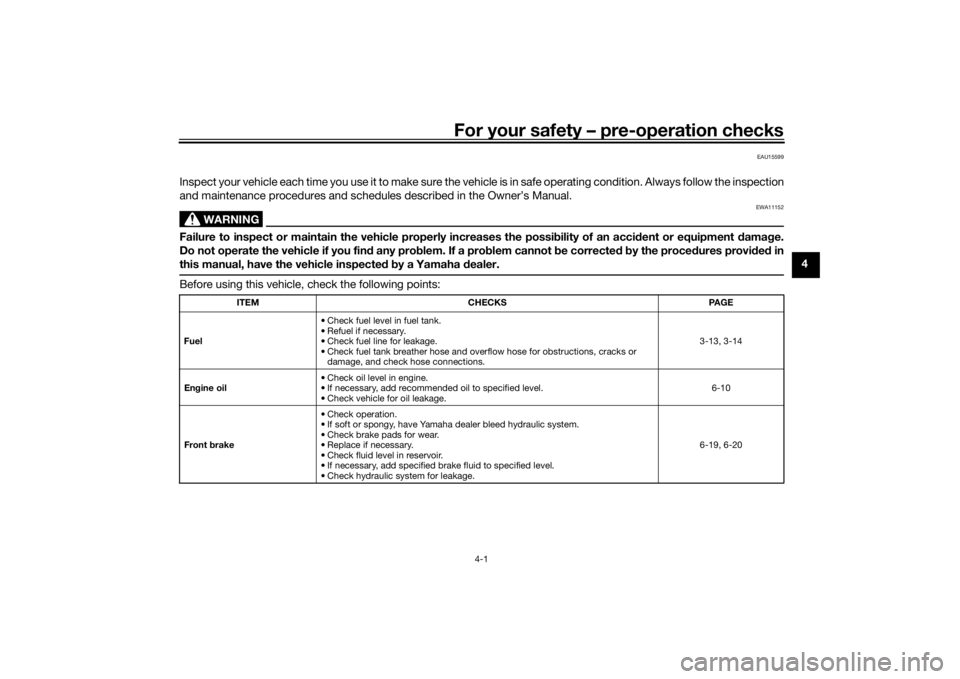
EAU15599
Inspect your vehicle each time you use it to make sure the vehicle is in safe operating condition. Always follow the inspection
and maintenance procedures and schedules described in the Owner’s Manual.
WARNING
EWA11152
Failure to inspect or maintain the vehicle properly increases the possibility of an accident or equipment d amage.
Do not operate the vehicle if you fin d any pro blem. If a pro blem cannot b e corrected b y the proce dures provi ded in
this manual, have the vehicle inspecte d b y a Yamaha dealer.Before using this vehicle, check the following points:
ITEM CHECKS PAGE
Fuel • Check fuel level in fuel tank.
• Refuel if necessary.
• Check fuel line for leakage.
• Check fuel tank breather hose and overflow hose for obstructions, cracks or
damage, and check hose connections. 3-13, 3-14
En gine oil • Check oil level in engine.
• If necessary, add recommended oil to specified level.
• Check vehicle for oil leakage. 6-10
Front brake • Check operation.
• If soft or spongy, have Yamaha dealer bleed hydraulic system.
• Check brake pads for wear.
• Replace if necessary.
• Check fluid level in reservoir.
• If necessary, add specified brake fluid to specified level.
• Check hydraulic system for leakage. 6-19, 6-20
U2PNE1E0.book Page 1 Monday, December 28, 2015 11:03 AM
Page 42 of 98
Operation and important rid ing points
5-1
5
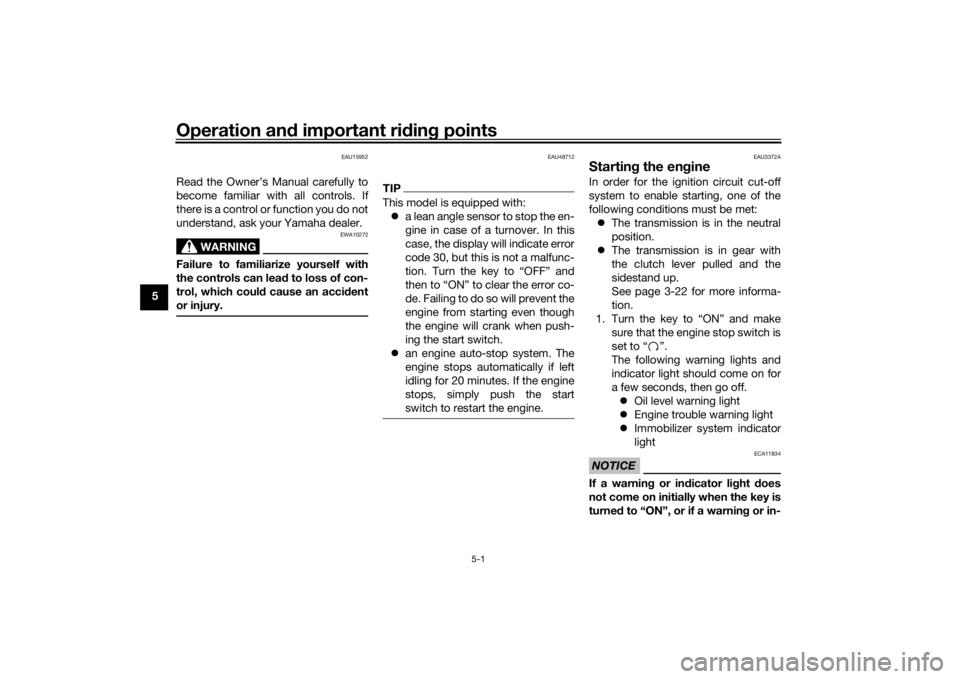
EAU15952
Read the Owner’s Manual carefully to
become familiar with all controls. If
there is a control or function you do not
understand, ask your Yamaha dealer.
WARNING
EWA10272
Failure to familiarize yourself with
the controls can lead to loss of con-
trol, which coul d cause an acci dent
or injury.
EAU48712
TIPThis model is equipped with: a lean angle sensor to stop the en-
gine in case of a turnover. In this
case, the display will indicate error
code 30, but this is not a malfunc-
tion. Turn the key to “OFF” and
then to “ON” to clear the error co-
d e . F ai l in g to do s o wi ll pr e v e nt the
engine from starting even though
the engine will crank when push-
ing the start switch.
an engine auto-stop system. The
engine stops automatically if left
idling for 20 minutes. If the engine
stops, simply push the start
switch to restart the engine.
EAU3372A
Startin g the en gineIn order for the ignition circuit cut-off
system to enable starting, one of the
following conditions must be met:
The transmission is in the neutral
position.
The transmission is in gear with
the clutch lever pulled and the
sidestand up.
See page 3-22 for more informa-
tion.
1. Turn the key to “ON” and make sure that the engine stop switch is
set to “ ”.
The following warning lights and
indicator light should come on for
a few seconds, then go off. Oil level warning light
Engine trouble warning light
Immobilizer system indicator
lightNOTICE
ECA11834
If a warnin g or in dicator li ght does
not come on initially when the key is
turne d to “ON”, or if a warning or in-
U2PNE1E0.book Page 1 Monday, December 28, 2015 11:03 AM