fuel YAMAHA XMAX 125 2008 User Guide
[x] Cancel search | Manufacturer: YAMAHA, Model Year: 2008, Model line: XMAX 125, Model: YAMAHA XMAX 125 2008Pages: 88, PDF Size: 2.61 MB
Page 28 of 88
ECA10070
CAUTION:
Immediately wipe off spilled fuel
with a clean, dry, soft cloth, since
fuel may deteriorate painted surfa-
ces or plastic parts.
EAU33500
ECA11400
CAUTION:
Use only unleaded gasoline. The
use of leaded gasoline will cause
severe damage to internal engine
parts, such as the valves and piston
rings, as well as to the exhaust sys-
tem.
Your Yamaha engine has been desig-
ned to use regular unleaded gasoline
with a research octane number of 91or higher. If knocking (or pinging)
occurs, use a gasoline of a different
brand or premium unleaded fuel. Use
of unleaded fuel will extend spark
plug life and reduce maintenance
costs.
EAU13442
Catalytic converters
This vehicle is equipped with catalytic
converters in the exhaust system.
EWA10860
s s
WARNING
The exhaust system is hot after
operation. Make sure that the
exhaust system has cooled down
before doing any maintenance
work.
ECA10700
CAUTION:
The following precautions must be
observed to prevent a fire hazard or
other damages.
●Use only unleaded gasoline.
The use of leaded gasoline will
cause unrepairable damage to
the catalytic converter.
●Never park the vehicle near
possible fire hazards such as
grass or other materials that
easily burn.
●Do not allow the engine to idle
too long.
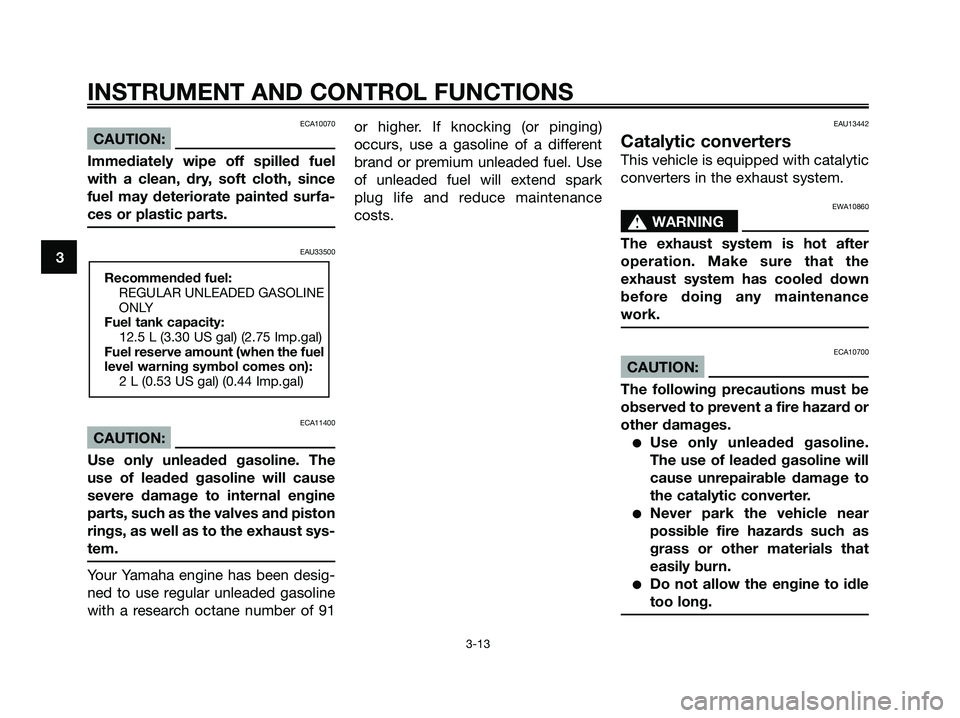
Recommended fuel:
REGULAR UNLEADED GASOLINE
ONLY
Fuel tank capacity:
12.5 L (3.30 US gal) (2.75 Imp.gal)
Fuel reserve amount (when the fuel
level warning symbol comes on):
2 L (0.53 US gal) (0.44 Imp.gal)
INSTRUMENT AND CONTROL FUNCTIONS
3-13
3
1B9-F8199-E2.qxd 13/11/07 12:18 Página 28
Page 36 of 88
EAU15605
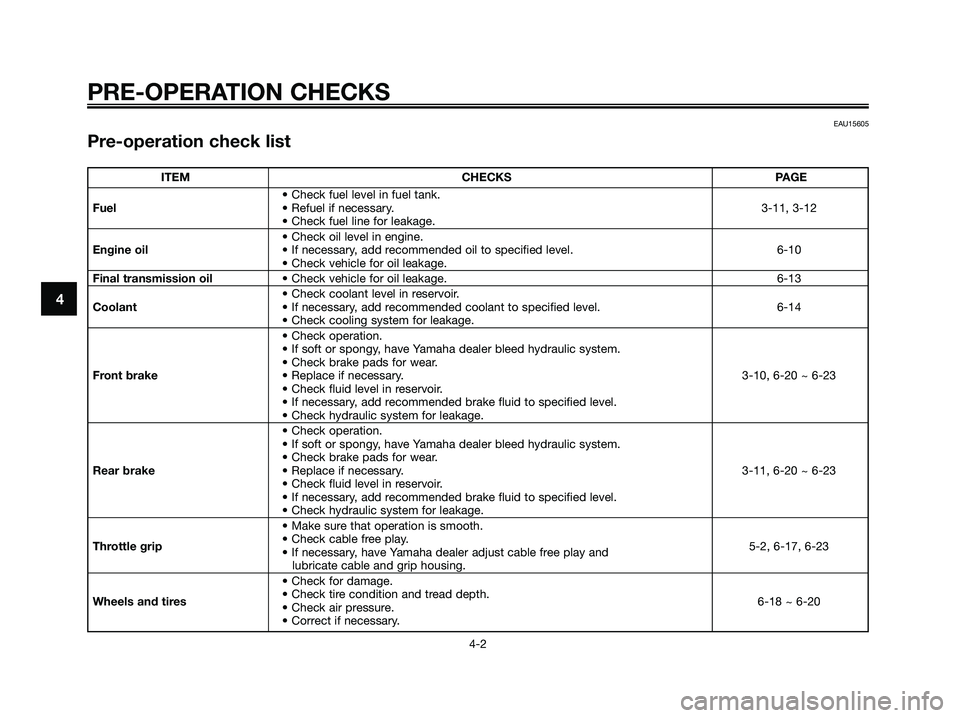
Pre-operation check list
PRE-OPERATION CHECKS
4-2
4
ITEM CHECKS PAGE
• Check fuel level in fuel tank.
Fuel• Refuel if necessary. 3-11, 3-12
• Check fuel line for leakage.
• Check oil level in engine.
Engine oil• If necessary, add recommended oil to specified level. 6-10
• Check vehicle for oil leakage.
Final transmission oil• Check vehicle for oil leakage. 6-13
• Check coolant level in reservoir.
Coolant• If necessary, add recommended coolant to specified level. 6-14
• Check cooling system for leakage.
• Check operation.
• If soft or spongy, have Yamaha dealer bleed hydraulic system.
• Check brake pads for wear.
Front brake• Replace if necessary. 3-10, 6-20 ~ 6-23
• Check fluid level in reservoir.
• If necessary, add recommended brake fluid to specified level.
• Check hydraulic system for leakage.
• Check operation.
• If soft or spongy, have Yamaha dealer bleed hydraulic system.
• Check brake pads for wear.
Rear brake• Replace if necessary. 3-11, 6-20 ~ 6-23
• Check fluid level in reservoir.
• If necessary, add recommended brake fluid to specified level.
• Check hydraulic system for leakage.
• Make sure that operation is smooth.
Throttle grip• Check cable free play.
5-2, 6-17, 6-23
• If necessary, have Yamaha dealer adjust cable free play and
lubricate cable and grip housing.
• Check for damage.
Wheels and tires• Check tire condition and tread depth.
6-18 ~ 6-20
• Check air pressure.
• Correct if necessary.
1B9-F8199-E2.qxd 13/11/07 12:18 Página 36
Page 38 of 88
EAU15980
EWA10870
s s
WARNING
●Become thoroughly familiar
with all operating controls and
their functions before riding.
Consult a Yamaha dealer
regarding any control or func-
tion that you do not thoroughly
understand.
●Never start the engine or ope-
rate it in a closed area for any
length of time. Exhaust fumes
are poisonous, and inhaling
them can cause loss of cons-
ciousness and death within a
short time. Always make sure
that there is adequate ventila-
tion.
●For safety, always start the
engine with the centerstand
down.
EAUM2230
Starting the engineECA10250
CAUTION:
See page 5-4 for engine break-in
instructions prior to operating the
vehicle for the first time.
In order for the ignition circuit cut-off
system to enable starting, the sides-
tand must be up.
EWA10290
s s
WARNING
●Before starting the engine,
check the function of the igni-
tion circuit cut-off system
according to the procedure
described on page 3-18.
●Never ride with the sidestand
down.
1. Turn the key to “ON”.ECAM1080
CAUTION:
The following warning lights and
indicator light should come on for a
few seconds, then go off.
●Fuel level warning light
●Engine trouble warning light
●Immobilizer system indicator
lightIf a warning or indicator light does
not go off, see page 3-3 for the
corresponding warning and indica-
tor light circuit check.
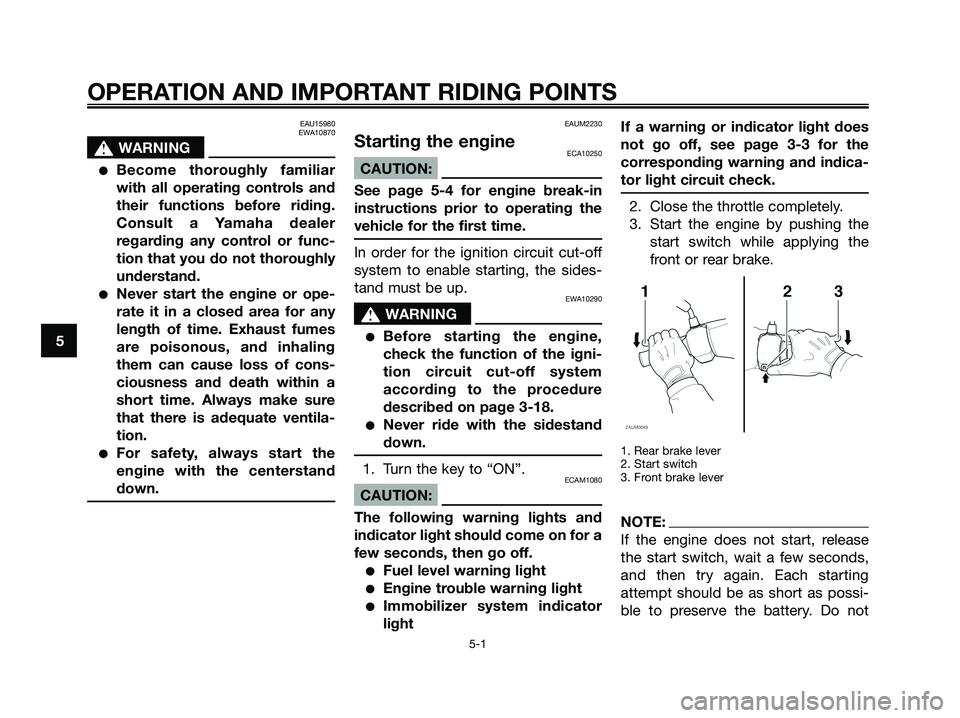
2. Close the throttle completely.
3. Start the engine by pushing the
start switch while applying the
front or rear brake.
1. Rear brake lever
2. Start switch
3. Front brake lever
NOTE:
If the engine does not start, release
the start switch, wait a few seconds,
and then try again. Each starting
attempt should be as short as possi-
ble to preserve the battery. Do not
OPERATION AND IMPORTANT RIDING POINTS
5-1
5
1B9-F8199-E2.qxd 13/11/07 12:18 Página 38
Page 40 of 88
EAU16792
Braking
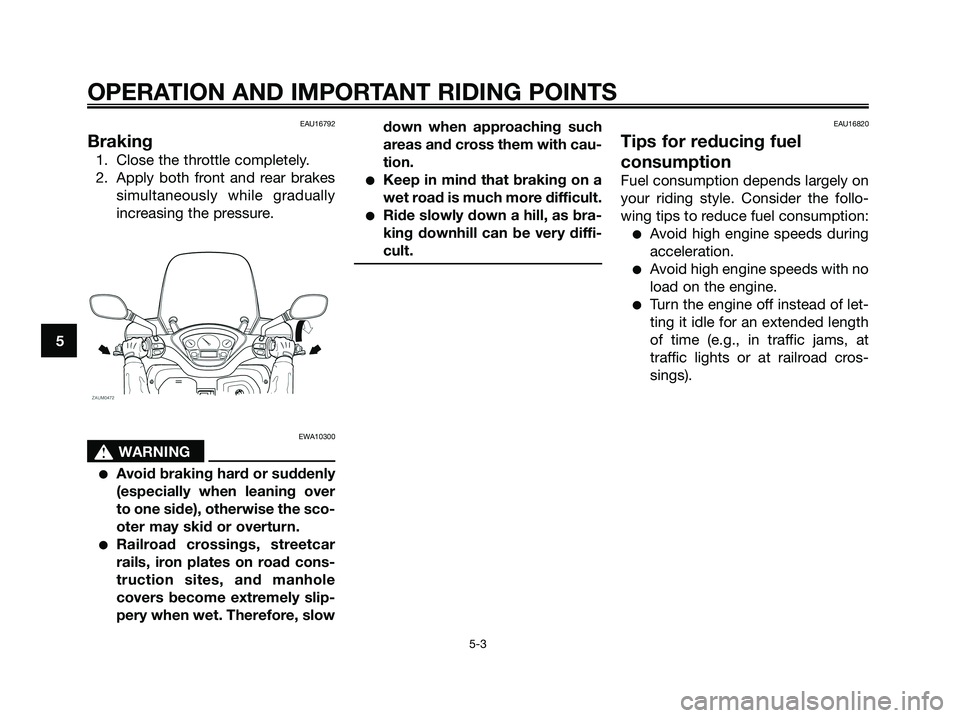
1. Close the throttle completely.
2. Apply both front and rear brakes
simultaneously while gradually
increasing the pressure.
EWA10300
s s
WARNING
●Avoid braking hard or suddenly
(especially when leaning over
to one side), otherwise the sco-
oter may skid or overturn.
●Railroad crossings, streetcar
rails, iron plates on road cons-
truction sites, and manhole
covers become extremely slip-
pery when wet. Therefore, slowdown when approaching such
areas and cross them with cau-
tion.
●Keep in mind that braking on a
wet road is much more difficult.
●Ride slowly down a hill, as bra-
king downhill can be very diffi-
cult.
EAU16820
Tips for reducing fuel
consumption
Fuel consumption depends largely on
your riding style. Consider the follo-
wing tips to reduce fuel consumption:
●Avoid high engine speeds during
acceleration.
●Avoid high engine speeds with no
load on the engine.
●Turn the engine off instead of let-
ting it idle for an extended length
of time (e.g., in traffic jams, at
traffic lights or at railroad cros-
sings).
OPERATION AND IMPORTANT RIDING POINTS
5-3
5
1B9-F8199-E2.qxd 13/11/07 12:18 Página 40
Page 44 of 88

EAU17715
Periodic maintenance and lubrication chart
NOTE:
●The annual checks must be performed every year, except if a kilometer-based maintenance, or for the UK,
a mileage-based maintenance, is performed instead.
●From 30000 km (17500 mi), repeat the maintenance intervals starting from 6000 km (3500 mi).
●Items marked with an asterisk should be performed by a Yamaha dealer as they require special tools, data and
technical skills.
PERIODIC MAINTENANCE AND MINOR REPAIR
6-3
6
ODOMETER READING
ANNUAL
NO. ITEM CHECK OR MAINTENANCE JOB
1000 km 6000 km 12000 km 18000 km 24000 kmCHECK
(600 mi) (3500 mi) (7000 mi) (10500 mi) (14000 mi)
1*Fuel line• Check fuel hoses for cracks or damage.√√√√ √
• Check condition.
2Spark plug• Clean and regap.√√
• Replace.√√
3*Valves• Check valve clearance.
• Adjust.√√√√
4Air filter element• Replace.√√
5V-belt case air filter
element• Clean.√√√√
• Check operation, fluid level and vehicle for fluid
6*Front brakeleakage.√√√√√ √
• Replace brake pads. Whenever worn to the limit
1B9-F8199-E2.qxd 13/11/07 12:18 Página 44
Page 45 of 88
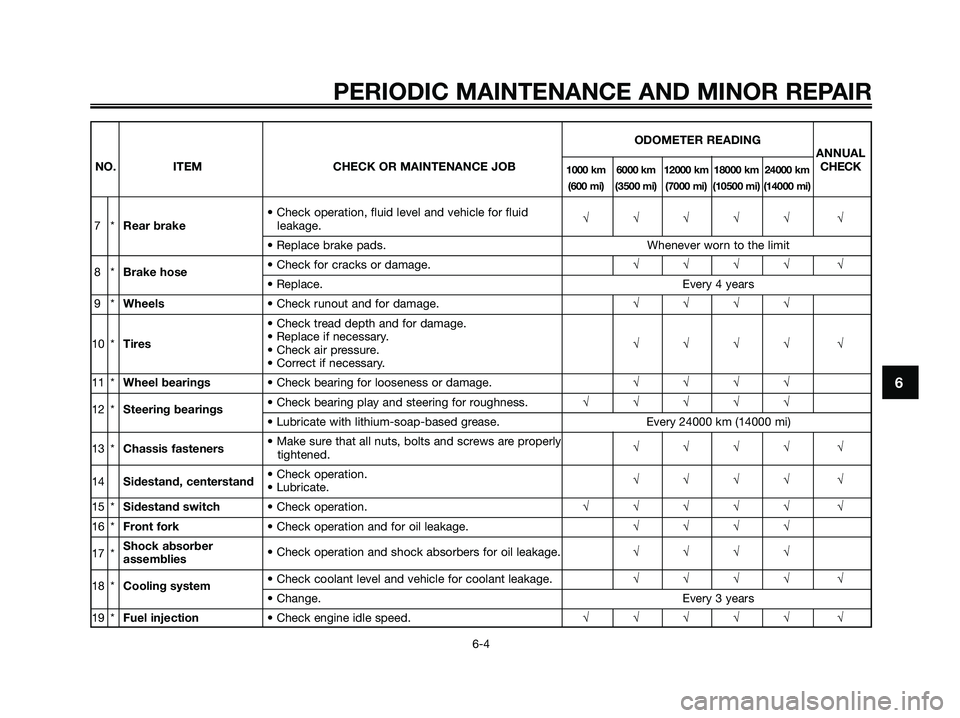
ODOMETER READING
ANNUAL
NO. ITEM CHECK OR MAINTENANCE JOB
1000 km 6000 km 12000 km 18000 km 24000 kmCHECK
(600 mi) (3500 mi) (7000 mi) (10500 mi) (14000 mi)
• Check operation, fluid level and vehicle for fluid 7*Rear brakeleakage.√√√√√ √
• Replace brake pads. Whenever worn to the limit
8*Brake hose• Check for cracks or damage.√√√√ √• Replace. Every 4 years
9*Wheels• Check runout and for damage.√√√√
• Check tread depth and for damage.
10 *Tires• Replace if necessary.
√√√√ √
• Check air pressure.
• Correct if necessary.
11 *Wheel bearings• Check bearing for looseness or damage.√√√√
12 *Steering bearings• Check bearing play and steering for roughness.√√√√√• Lubricate with lithium-soap-based grease. Every 24000 km (14000 mi)
13 *Chassis fasteners• Make sure that all nuts, bolts and screws are properly
tightened.√√√√ √
14Sidestand, centerstand• Check operation.
• Lubricate.√√√√ √
15 *Sidestand switch• Check operation.√√√√√ √
16 *Front fork• Check operation and for oil leakage.√√√√
17 *Shock absorber
assemblies• Check operation and shock absorbers for oil leakage.√√√√
18 *Cooling system• Check coolant level and vehicle for coolant leakage.√√√√ √• Change. Every 3 years
19 *Fuel injection• Check engine idle speed.√√√√√ √
PERIODIC MAINTENANCE AND MINOR REPAIR
6-4
6
1B9-F8199-E2.qxd 13/11/07 12:18 Página 45
Page 58 of 88
EAUS1290
Adjusting the throttle cable
free play
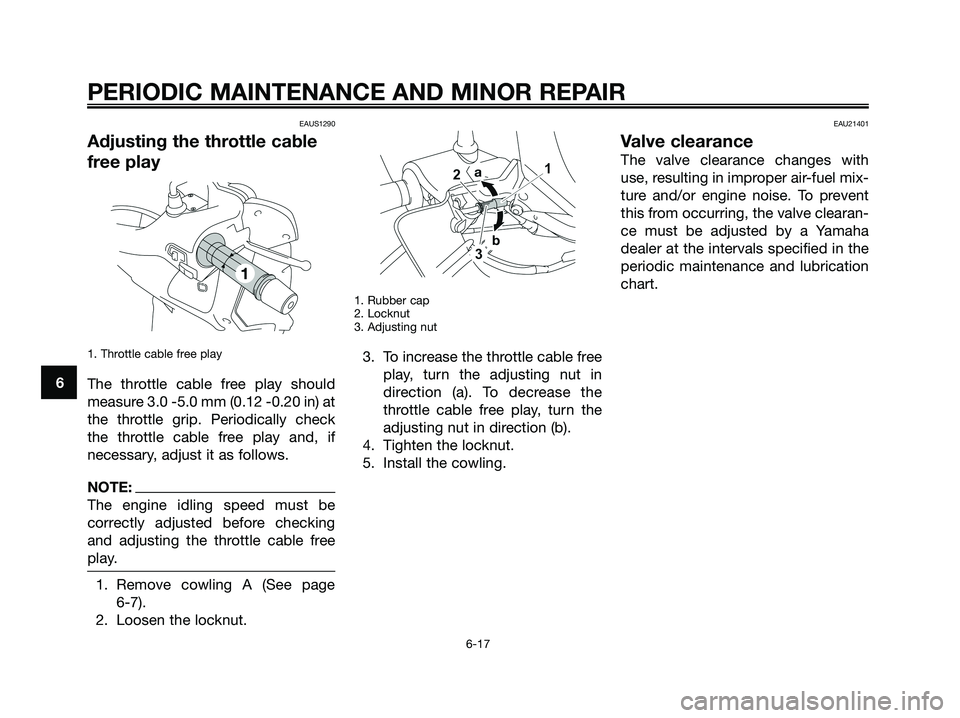
1. Throttle cable free play
The throttle cable free play should
measure 3.0 -5.0 mm (0.12 -0.20 in) at
the throttle grip. Periodically check
the throttle cable free play and, if
necessary, adjust it as follows.
NOTE:
The engine idling speed must be
correctly adjusted before checking
and adjusting the throttle cable free
play.
1. Remove cowling A (See page
6-7).
2. Loosen the locknut.
1. Rubber cap
2. Locknut
3. Adjusting nut
3. To increase the throttle cable free
play, turn the adjusting nut in
direction (a). To decrease the
throttle cable free play, turn the
adjusting nut in direction (b).
4. Tighten the locknut.
5. Install the cowling.
EAU21401
Valve clearance
The valve clearance changes with
use, resulting in improper air-fuel mix-
ture and/or engine noise. To prevent
this from occurring, the valve clearan-
ce must be adjusted by a Yamaha
dealer at the intervals specified in the
periodic maintenance and lubrication
chart.
PERIODIC MAINTENANCE AND MINOR REPAIR
6-17
6
1B9-F8199-E2.qxd 13/11/07 12:18 Página 58
Page 73 of 88

EAUM2200
Replacing the license plate
light bulb
1. Remove the socket (together
with the bulb) by pulling it out.
1. License plate light unit
2. Remove the defective bulb by
pulling it out.
3. Insert a new bulb into the socket.
4. Install the socket (together with
the bulb) by pushing it in.
EAUM2211
Replacing an auxiliary light
bulb
This model is equipped with two auxi-
liary lights. If an auxiliary light bulb
burns out, replace it as follows.
1. Remove the cowling B.
2. Remove the socket (together
with the bulb) by pulling it out.
1. Auxiliary light bulb socket
3. Remove the defective bulb by
pulling it out.
4. Insert a new bulb into the socket.
5. Install the socket (together with
the bulb) by pushing it in.
6. Install the cowling B.
EAU25880
Troubleshooting
Although Yamaha scooters receive a
thorough inspection before shipment
from the factory, trouble may occur
during operation. Any problem in the
fuel, compression, or ignition sys-
tems, for example, can cause poor
starting and loss of power.
The following troubleshooting charts
represent quick and easy procedures
for checking these vital systems your-
self. However, should your scooter
require any repair, take it to a Yamaha
dealer, whose skilled technicians
have the necessary tools, experience,
and know-how to service the scooter
properly.
Use only genuine Yamaha replace-
ment parts. Imitation parts may look
like Yamaha parts, but they are often
inferior, have a shorter service life and
can lead to expensive repair bills.
PERIODIC MAINTENANCE AND MINOR REPAIR
6-32
6
1B9-F8199-E2.qxd 13/11/07 12:18 Página 73
Page 74 of 88

PERIODIC MAINTENANCE AND MINOR REPAIR
6-33
6
EAU42130
Troubleshooting charts
Starting problems or poor engine performanceEWA10840
s s
WARNING
Keep away open flames and do not smoke while checking or working on the fuel system.
Check the fuel level in
the fuel tank.
1. FuelThere is enough fuel.
There is no fuel.Check the compression.
Supply fuel.
The engine does not start.
Check the compression.
Operate the electric starter.
2. CompressionThere is compression.
There is no compression.Check the ignition.
Have a Yamaha dealer
check the vehicle.
Remove the spark plug
and check the electrodes.
3. IgnitionWipe off with a dry cloth and correct the
spark plug gap, or replace the spark plug.
Have a Yamaha dealer check the vehicle.
The engine does not start.
Have a Yamaha dealer
check the vehicle.
The engine does not start.
Check the battery.
Operate the electric starter.
4. BatteryThe engine turns over
quickly.
The engine turns over
slowly.The battery is good.
Check the battery lead connections,
and charge the battery if necessary.
Dry
We tOperate the electric starter.
1B9-F8199-E2.qxd 13/11/07 12:18 Página 74
Page 76 of 88

EAU26091
Care
While the open design of a scooter
reveals the attractiveness of the tech-
nology, it also makes it more vulnera-
ble. Rust and corrosion can develop
even if high-quality components are
used. A rusty exhaust pipe may go
unnoticed on a car, however, it
detracts from the overall appearance
of a scooter. Frequent and proper
care does not only comply with the
terms of the warranty, but it will also
keep your scooter looking good,
extend its life and optimize its perfor-
mance.
Before cleaning
1. Cover the muffler outlet with a
plastic bag after the engine has
cooled down.
2. Make sure that all caps and
covers as well as all electrical
couplers and connectors, inclu-
ding the spark plug cap, are
tightly installed.
3. Remove extremely stubborn dirt,
like oil burnt onto the crankcase,
with a degreasing agent and a
brush, but never apply such pro-ducts onto seals, gaskets and
wheel axles. Always rinse the dirt
and degreaser off with water.
Cleaning
ECA10781
CAUTION:
●Avoid using strong acidic whe-
el cleaners, especially on spo-
ked wheels. If such products
are used on hard-to-remove
dirt, do not leave the cleaner on
the affected area any longer
than instructed. Also, tho-
roughly rinse the area off with
water, immediately dry it, and
then apply a corrosion protec-
tion spray.
●Improper cleaning can damage
plastic parts such as cowlings,
panels, windshields, headlight
lenses, meter lenses, etc. Use
only a soft, clean cloth or spon-
ge with mild detergent and
water to clean plastic.
●Do not use any harsh chemical
products on plastic parts. Be
sure to avoid using cloths or
sponges which have been in
contact with strong or abrasivecleaning products, solvent or
thinner, fuel (gasoline), rust
removers or inhibitors, brake
fluid, antifreeze or electrolyte.
●Do not use high-pressure was-
hers or steam-jet cleaners sin-
ce they cause water seepage
and deterioration in the follo-
wing areas: seals (of wheel and
swingarm bearings, fork and
brakes), electric components
(couplers, connectors, instru-
ments, switches and lights),
breather hoses and vents.
●For scooters equipped with a
windshield: Do not use strong
cleaners or hard sponges as
they will cause dulling or scrat-
ching. Some cleaning com-
pounds for plastic may leave
scratches on the windshield.
Test the product on a small hid-
den part of the windshield to
make sure that it does not lea-
ve any marks. If the windshield
is scratched, use a quality
plastic polishing compound
after washing.
SCOOTER CARE AND STORAGE
7-1
7
1B9-F8199-E2.qxd 13/11/07 12:18 Página 76