check oil YAMAHA XMAX 250 2009 Owners Manual
[x] Cancel search | Manufacturer: YAMAHA, Model Year: 2009, Model line: XMAX 250, Model: YAMAHA XMAX 250 2009Pages: 92, PDF Size: 4.7 MB
Page 6 of 92
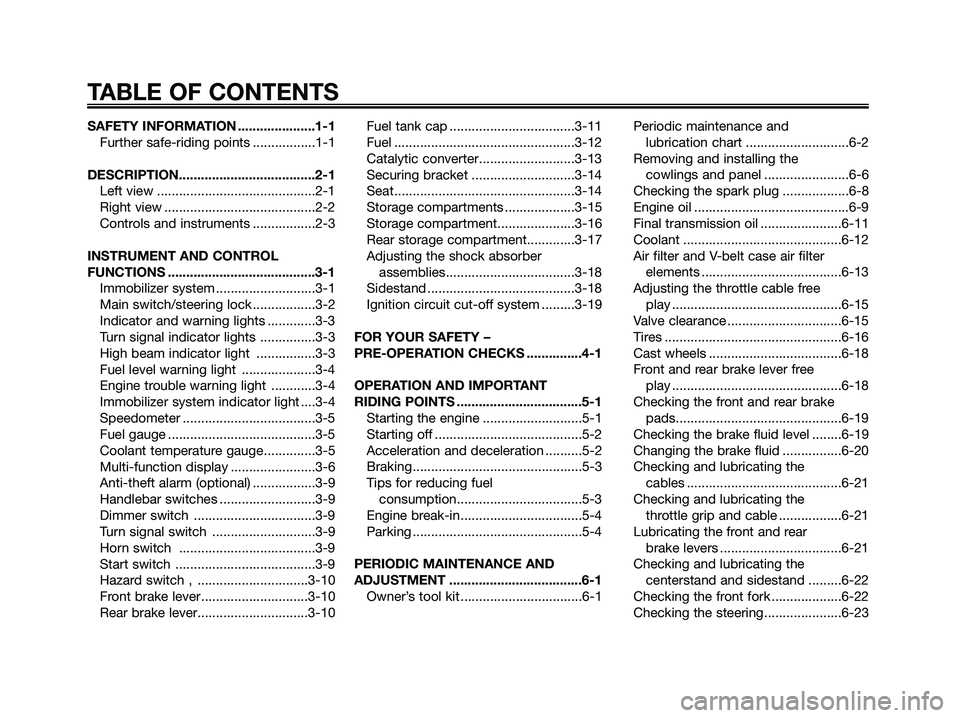
SAFETY INFORMATION .....................1-1
Further safe-riding points .................1-1
DESCRIPTION.....................................2-1
Left view ...........................................2-1
Right view .........................................2-2
Controls and instruments .................2-3
INSTRUMENT AND CONTROL
FUNCTIONS ........................................3-1
Immobilizer system ...........................3-1
Main switch/steering lock .................3-2
Indicator and warning lights .............3-3
Turn signal indicator lights ...............3-3
High beam indicator light ................3-3
Fuel level warning light ....................3-4
Engine trouble warning light ............3-4
Immobilizer system indicator light ....3-4
Speedometer ....................................3-5
Fuel gauge ........................................3-5
Coolant temperature gauge..............3-5
Multi-function display .......................3-6
Anti-theft alarm (optional) .................3-9
Handlebar switches ..........................3-9
Dimmer switch .................................3-9
Turn signal switch ............................3-9
Horn switch .....................................3-9
Start switch ......................................3-9
Hazard switch , ..............................3-10
Front brake lever.............................3-10
Rear brake lever..............................3-10Fuel tank cap ..................................3-11
Fuel .................................................3-12
Catalytic converter..........................3-13
Securing bracket ............................3-14
Seat.................................................3-14
Storage compartments ...................3-15
Storage compartment.....................3-16
Rear storage compartment.............3-17
Adjusting the shock absorber
assemblies...................................3-18
Sidestand ........................................3-18
Ignition circuit cut-off system .........3-19
FOR YOUR SAFETY –
PRE-OPERATION CHECKS ...............4-1
OPERATION AND IMPORTANT
RIDING POINTS ..................................5-1
Starting the engine ...........................5-1
Starting off ........................................5-2
Acceleration and deceleration ..........5-2
Braking..............................................5-3
Tips for reducing fuel
consumption..................................5-3
Engine break-in.................................5-4
Parking ..............................................5-4
PERIODIC MAINTENANCE AND
ADJUSTMENT ....................................6-1
Owner’s tool kit .................................6-1Periodic maintenance and
lubrication chart ............................6-2
Removing and installing the
cowlings and panel .......................6-6
Checking the spark plug ..................6-8
Engine oil ..........................................6-9
Final transmission oil ......................6-11
Coolant ...........................................6-12
Air filter and V-belt case air filter
elements ......................................6-13
Adjusting the throttle cable free
play ..............................................6-15
Valve clearance ...............................6-15
Tires ................................................6-16
Cast wheels ....................................6-18
Front and rear brake lever free
play ..............................................6-18
Checking the front and rear brake
pads.............................................6-19
Checking the brake fluid level ........6-19
Changing the brake fluid ................6-20
Checking and lubricating the
cables ..........................................6-21
Checking and lubricating the
throttle grip and cable .................6-21
Lubricating the front and rear
brake levers .................................6-21
Checking and lubricating the
centerstand and sidestand .........6-22
Checking the front fork ...................6-22
Checking the steering.....................6-23
TABLE OF CONTENTS
1C0-F8199-E5.QXD 3/10/08 05:56 Página 6
Page 14 of 92
EAU10420
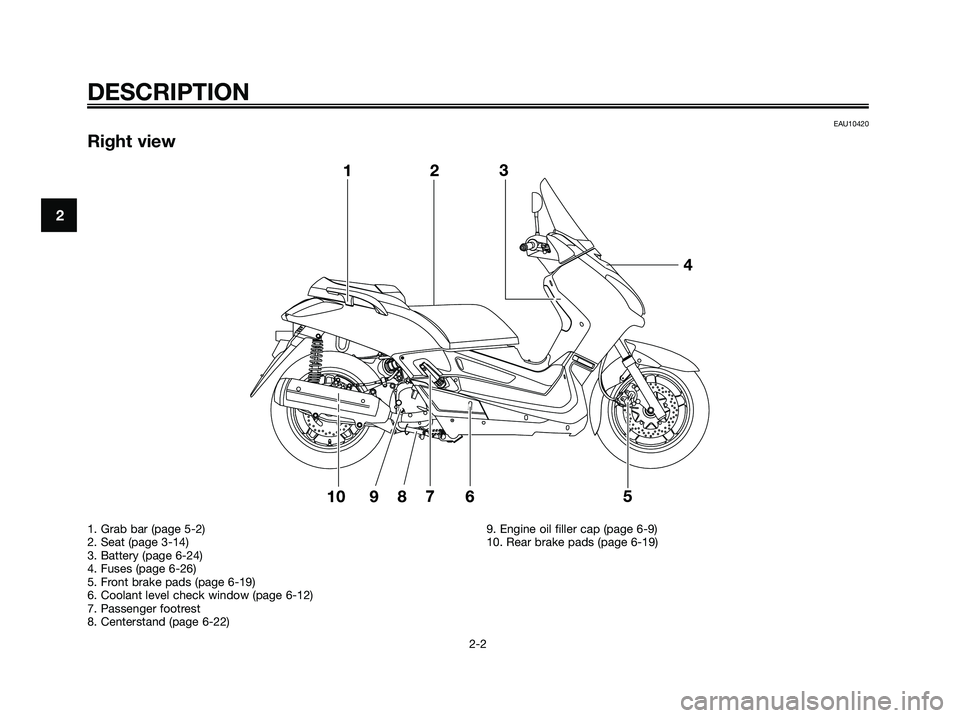
Right view
DESCRIPTION
2-2
2
1. Grab bar (page 5-2)
2. Seat (page 3-14)
3. Battery (page 6-24)
4. Fuses (page 6-26)
5. Front brake pads (page 6-19)
6. Coolant level check window (page 6-12)
7. Passenger footrest
8. Centerstand (page 6-22)9. Engine oil filler cap (page 6-9)
10. Rear brake pads (page 6-19)
1C0-F8199-E5.QXD 3/10/08 05:56 Página 14
Page 37 of 92
FOR YOUR SAFETY – PRE-OPERATION CHECKS
4-2
4
EAU15605
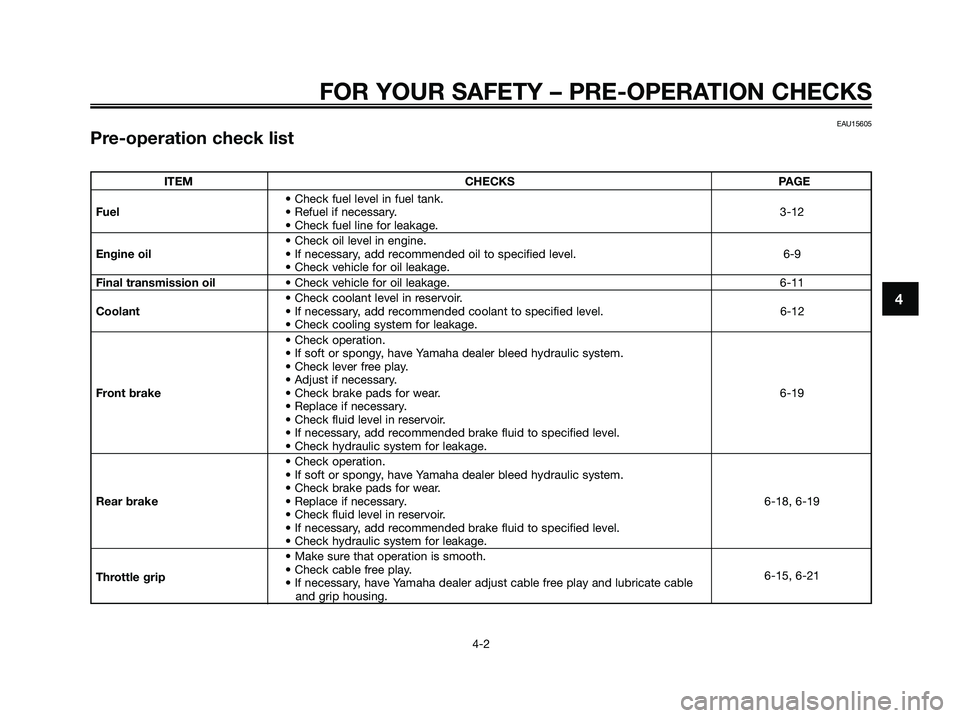
Pre-operation check list
ITEM CHECKS PAGE
• Check fuel level in fuel tank.
Fuel• Refuel if necessary.3-12
• Check fuel line for leakage.
• Check oil level in engine.
Engine oil• If necessary, add recommended oil to specified level. 6-9
• Check vehicle for oil leakage.
Final transmission oil• Check vehicle for oil leakage. 6-11
• Check coolant level in reservoir.
Coolant• If necessary, add recommended coolant to specified level. 6-12
• Check cooling system for leakage.
• Check operation.
• If soft or spongy, have Yamaha dealer bleed hydraulic system.
• Check lever free play.
• Adjust if necessary.
Front brake• Check brake pads for wear. 6-19
• Replace if necessary.
• Check fluid level in reservoir.
• If necessary, add recommended brake fluid to specified level.
• Check hydraulic system for leakage.
• Check operation.
• If soft or spongy, have Yamaha dealer bleed hydraulic system.
• Check brake pads for wear.
Rear brake• Replace if necessary. 6-18, 6-19
• Check fluid level in reservoir.
• If necessary, add recommended brake fluid to specified level.
• Check hydraulic system for leakage.
• Make sure that operation is smooth.
Throttle grip• Check cable free play.
• If necessary, have Yamaha dealer adjust cable free play and lubricate cable 6-15, 6-21
and grip housing.
1C0-F8199-E5.QXD 3/10/08 05:56 Página 37
Page 42 of 92
EAU16841
Engine break-in
There is never a more important
period in the life of your engine than
the period between 0 and 1600 km
(1000 mi). For this reason, you should
read the following material carefully.
Since the engine is brand new, do not
put an excessive load on it for the first
1600 km (1000 mi). The various parts
in the engine wear and polish them-
selves to the correct operating clea-
rances. During this period, prolonged
full-throttle operation or any condition
that might result in engine overhea-
ting must be avoided.
EAUM2011
0–1000 km (0–600 mi)
●Avoid prolonged operation above
1/3 throttle. NOTICE:After 1000
km (600 mi) of operation, be
sure to replace the engine oil
and final transmission oil.
[ECA11661]
1000–1600 km (600–1000 mi)
●Avoid prolonged operation above
1/2 throttle.
1600 km (1000 mi) and beyond
●The vehicle can now be operated
normally.
ECA10270
NOTICE
If any engine trouble should occur
during the engine break-in period,
immediately have a Yamaha dealer
check the vehicle.
EAU17213
Parking
When parking, stop the engine, and
then remove the key from the main
switch.
EWA10311
s s
WARNING
●Since the engine and exhaust
system can become very hot,
park in a place where pedes-
trians or children are not likely
to touch them and be burned.
●Do not park on a slope or on
soft ground, otherwise the
vehicle may overturn, increa-
sing the risk of a fuel leak and
fire.
●Do not park near grass or other
flammable materials which
might catch fire.
OPERATION AND IMPORTANT RIDING POINTS
5-4
5
1C0-F8199-E5.QXD 3/10/08 05:56 Página 42
Page 46 of 92
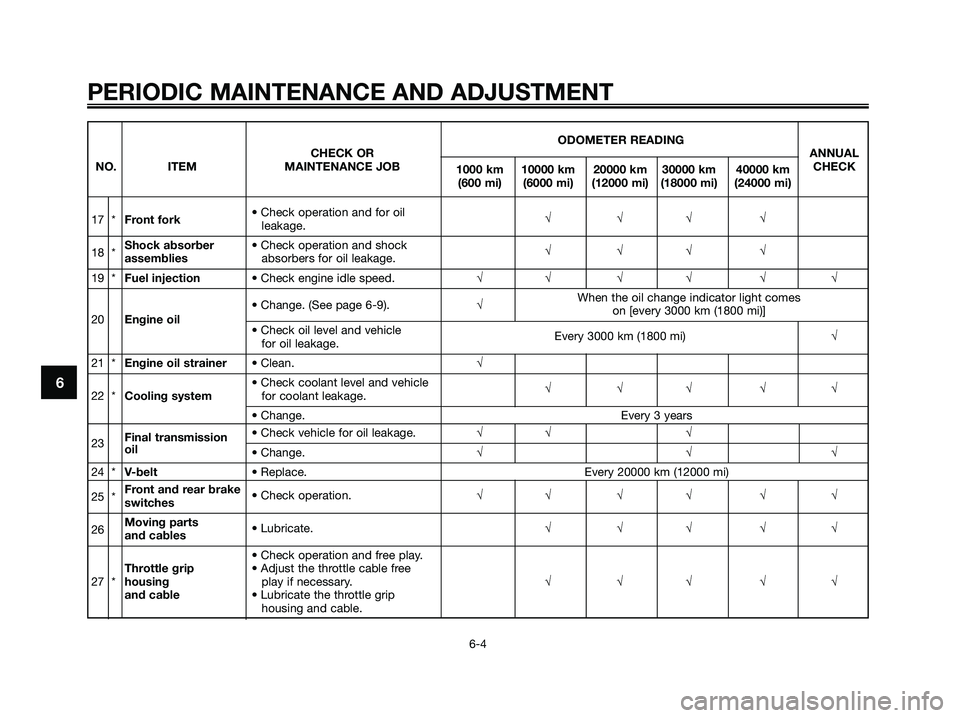
PERIODIC MAINTENANCE AND ADJUSTMENT
6-4
6
ODOMETER READING
CHECK OR ANNUAL
NO. ITEM MAINTENANCE JOB
1000 km 10000 km 20000 km 30000 km 40000 kmCHECK
(600 mi) (6000 mi) (12000 mi) (18000 mi) (24000 mi)
17 *Front fork• Check operation and for oil
leakage.√√√ √
18 *Shock absorber • Check operation and shock
assembliesabsorbers for oil leakage.√√√ √
19 *Fuel injection• Check engine idle speed.√√ √√ √ √
20Engine oil• Change. (See page 6-9). √When the oil change indicator light comes
on [every 3000 km (1800 mi)]
• Check oil level and vehicle
for oil leakage.Every 3000 km (1800 mi)√
21 *Engine oil strainer• Clean.√
• Check coolant level and vehicle
22 *Cooling systemfor coolant leakage.√√√ √√
• Change. Every 3 years
23Final transmission • Check vehicle for oil leakage.√√ √oil
• Change.√√√
24 *V-belt• Replace. Every 20000 km (12000 mi)
25 *Front and rear brake
switches• Check operation.√√ √√ √ √
26Moving parts
and cables• Lubricate.√√√ √√
• Check operation and free play.
Throttle grip • Adjust the throttle cable free
27 *housingplay if necessary.√√√ √√
and cable• Lubricate the throttle grip
housing and cable.
1C0-F8199-E5.QXD 3/10/08 05:56 Página 46
Page 51 of 92
2. Check the spark plug for electro-
de erosion and excessive carbon
or other deposits, and replace it if
necessary.
To install the spark plug
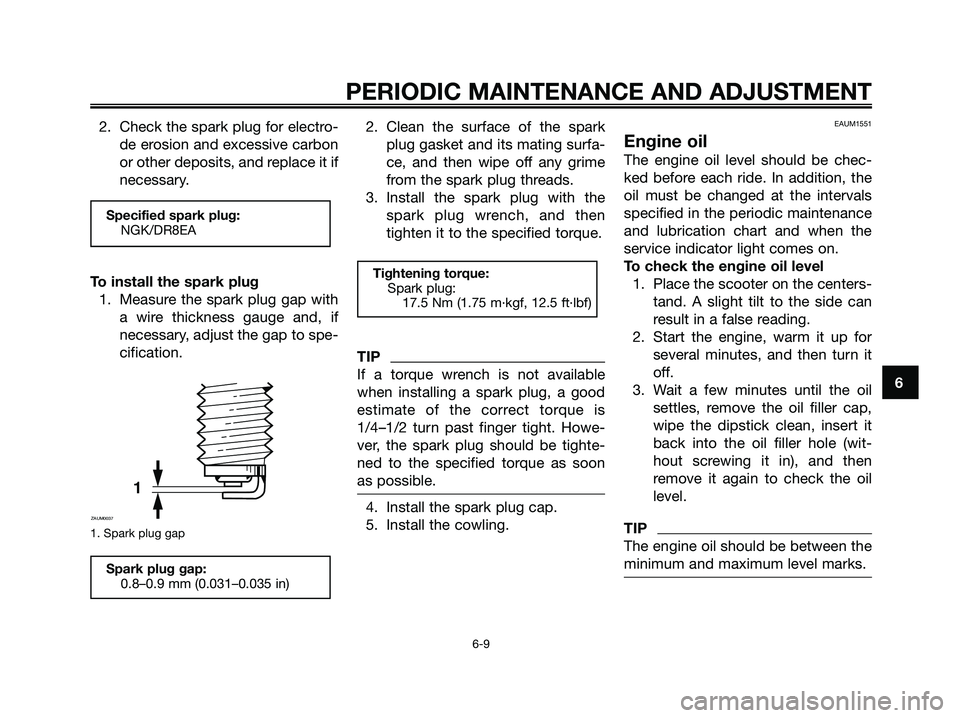
1. Measure the spark plug gap with
a wire thickness gauge and, if
necessary, adjust the gap to spe-
cification.
1. Spark plug gap
2. Clean the surface of the spark
plug gasket and its mating surfa-
ce, and then wipe off any grime
from the spark plug threads.
3. Install the spark plug with the
spark plug wrench, and then
tighten it to the specified torque.
TIP
If a torque wrench is not available
when installing a spark plug, a good
estimate of the correct torque is
1/4–1/2 turn past finger tight. Howe-
ver, the spark plug should be tighte-
ned to the specified torque as soon
as possible.
4. Install the spark plug cap.
5. Install the cowling.
EAUM1551
Engine oil
The engine oil level should be chec-
ked before each ride. In addition, the
oil must be changed at the intervals
specified in the periodic maintenance
and lubrication chart and when the
service indicator light comes on.
To check the engine oil level
1. Place the scooter on the centers-
tand. A slight tilt to the side can
result in a false reading.
2. Start the engine, warm it up for
several minutes, and then turn it
off.
3. Wait a few minutes until the oil
settles, remove the oil filler cap,
wipe the dipstick clean, insert it
back into the oil filler hole (wit-
hout screwing it in), and then
remove it again to check the oil
level.
TIP
The engine oil should be between the
minimum and maximum level marks.
Tightening torque:
Spark plug:
17.5 Nm (1.75 m·kgf, 12.5 ft·lbf)
Spark plug gap:
0.8–0.9 mm (0.031–0.035 in)
1
ZAUM0037
Specified spark plug:
NGK/DR8EA
PERIODIC MAINTENANCE AND ADJUSTMENT
6-9
6
1C0-F8199-E5.QXD 3/10/08 05:56 Página 51
Page 52 of 92
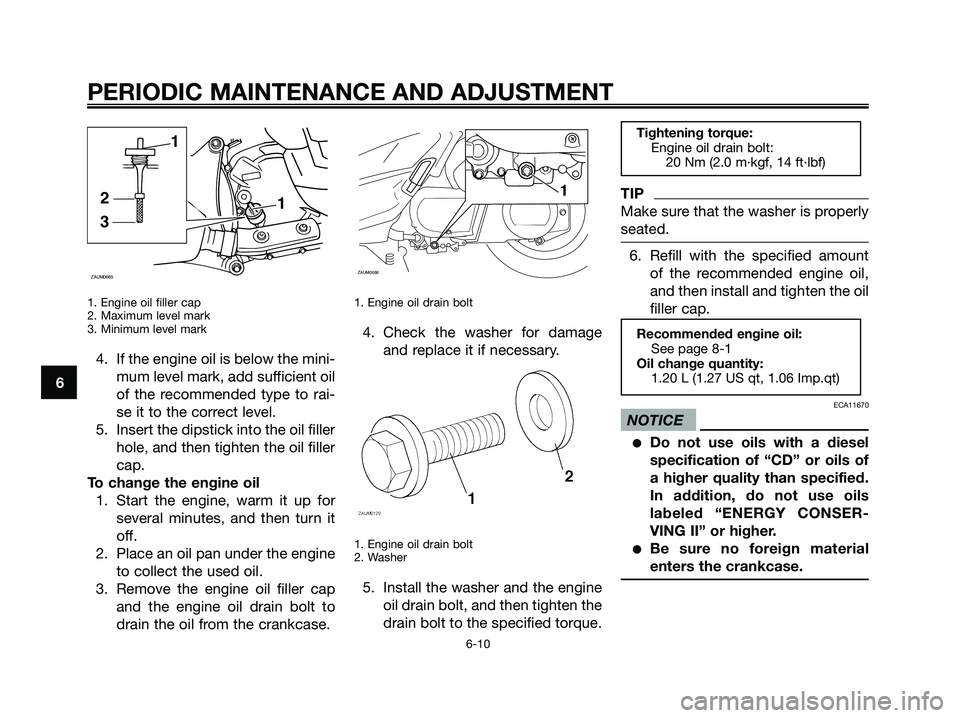
1. Engine oil filler cap
2. Maximum level mark
3. Minimum level mark
4. If the engine oil is below the mini-
mum level mark, add sufficient oil
of the recommended type to rai-
se it to the correct level.
5. Insert the dipstick into the oil filler
hole, and then tighten the oil filler
cap.
To change the engine oil
1. Start the engine, warm it up for
several minutes, and then turn it
off.
2. Place an oil pan under the engine
to collect the used oil.
3. Remove the engine oil filler cap
and the engine oil drain bolt to
drain the oil from the crankcase.
1. Engine oil drain bolt
4. Check the washer for damage
and replace it if necessary.
1. Engine oil drain bolt
2. Washer
5. Install the washer and the engine
oil drain bolt, and then tighten the
drain bolt to the specified torque.
TIP
Make sure that the washer is properly
seated.
6. Refill with the specified amount
of the recommended engine oil,
and then install and tighten the oil
filler cap.
ECA11670
NOTICE
●Do not use oils with a diesel
specification of “CD” or oils of
a higher quality than specified.
In addition, do not use oils
labeled “ENERGY CONSER-
VING II” or higher.
●Be sure no foreign material
enters the crankcase.
Recommended engine oil:
See page 8-1
Oil change quantity:
1.20 L (1.27 US qt, 1.06 Imp.qt)
Tightening torque:
Engine oil drain bolt:
20 Nm (2.0 m·kgf, 14 ft·lbf)
11
ZAUM0686
1
3
2
1
ZAUM0685
PERIODIC MAINTENANCE AND ADJUSTMENT
6-10
6
1C0-F8199-E5.QXD 3/10/08 05:56 Página 52
Page 53 of 92
7. Start the engine, and then let it
idle for several minutes while
checking it for oil leakage. If oil is
leaking, immediately turn the
engine off and check for the cau-
se.
8. Reset the oil change indicator.
(See page 3-6). EAU20064
Final transmission oil
The final transmission case must be
checked for oil leakage before each
ride. If any leakage is found, have a
Yamaha dealer check and repair the
scooter. In addition, the final trans-
mission oil must be changed as
follows at the intervals specified in the
periodic maintenance and lubrication
chart.
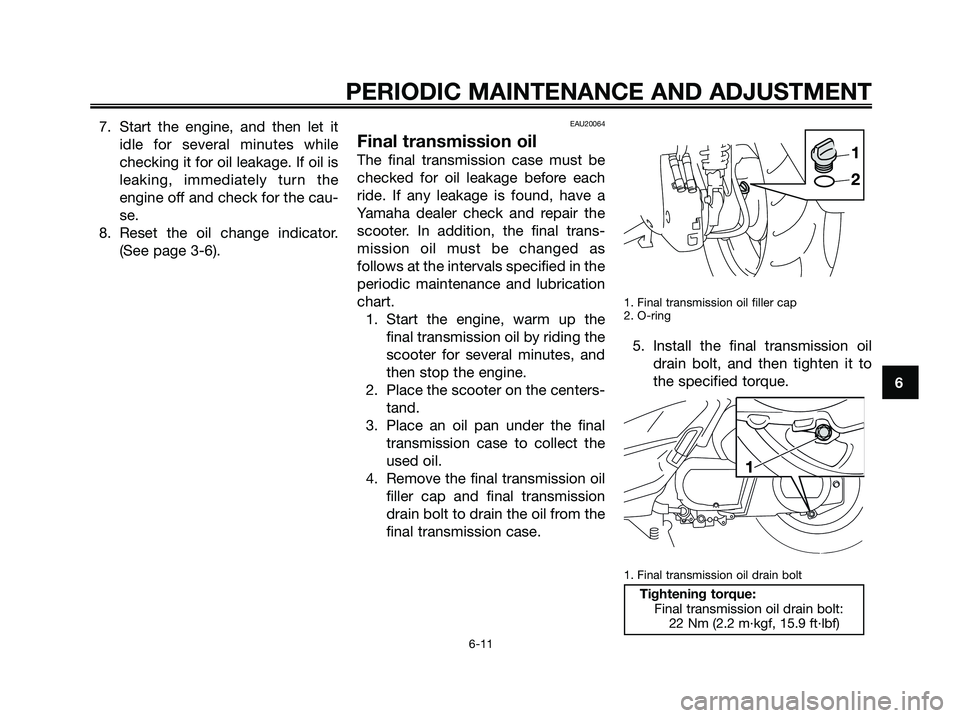
1. Start the engine, warm up the
final transmission oil by riding the
scooter for several minutes, and
then stop the engine.
2. Place the scooter on the centers-
tand.
3. Place an oil pan under the final
transmission case to collect the
used oil.
4. Remove the final transmission oil
filler cap and final transmission
drain bolt to drain the oil from the
final transmission case.
1. Final transmission oil filler cap
2. O-ring
5. Install the final transmission oil
drain bolt, and then tighten it to
the specified torque.
1. Final transmission oil drain bolt
Tightening torque:
Final transmission oil drain bolt:
22 Nm (2.2 m·kgf, 15.9 ft·lbf)
PERIODIC MAINTENANCE AND ADJUSTMENT
6-11
6
1C0-F8199-E5.QXD 3/10/08 05:56 Página 53
Page 54 of 92
6. Refill with the specified amount
of the recommended final trans-
mission oil, and then install and
tighten the oil filler cap. WAR-
NING! Make sure that no
foreign material enters the final
transmission case. Make sure
that no oil gets on the tire or
wheel.
[EWA11311]
7. Check the final transmission case
for oil leakage. If oil is leaking,
check for the cause.
EAU20070
Coolant
The coolant level should be checked
before each ride. In addition, the coo-
lant must be changed at the intervals
specified in the periodic maintenance
and lubrication chart.
EAUS1274
To check the coolant level
1. Place the vehicle on a level surfa-
ce and hold it in an upright posi-
tion.
TIP
●The coolant level must be chec-
ked on a cold engine since the
level varies with engine tempera-
ture.
●Make sure that the vehicle is
positioned straight up when
checking the coolant level. A
slight tilt to the side can result in
a false reading.
2. Check the coolant level through
the check window.
TIP
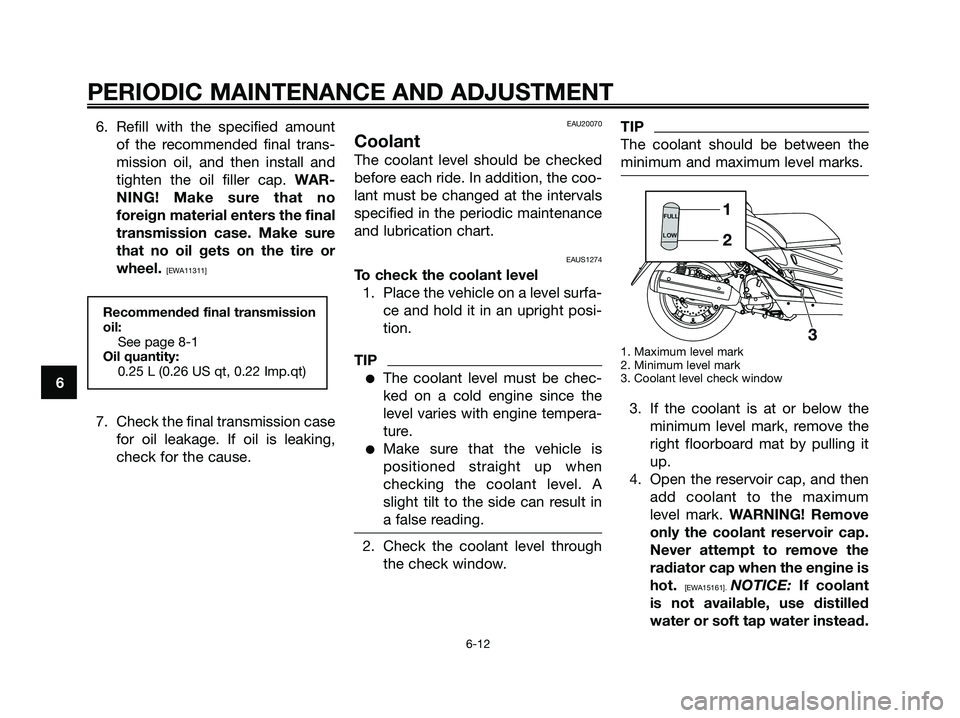
The coolant should be between the
minimum and maximum level marks.
1. Maximum level mark
2. Minimum level mark
3. Coolant level check window
3. If the coolant is at or below the
minimum level mark, remove the
right floorboard mat by pulling it
up.
4. Open the reservoir cap, and then
add coolant to the maximum
level mark. WARNING! Remove
only the coolant reservoir cap.
Never attempt to remove the
radiator cap when the engine is
hot.
[EWA15161]. NOTICE: If coolant
is not available, use distilled
water or soft tap water instead.
FULL
LOW
Recommended final transmission
oil:
See page 8-1
Oil quantity:
0.25 L (0.26 US qt, 0.22 Imp.qt)
PERIODIC MAINTENANCE AND ADJUSTMENT
6-12
6
1C0-F8199-E5.QXD 3/10/08 05:56 Página 54
Page 62 of 92
Insufficient brake fluid may allow air
to enter the brake system, possibly
causing it to become ineffective.
Before riding, check that the brake
fluid is above the minimum level mark
and replenish if necessary. A low bra-
ke fluid level may indicate worn brake
pads and/or brake system leakage. If
the brake fluid level is low, be sure to
check the brake pads for wear and
the brake system for leakage.
Observe these precautions:
●When checking the fluid level,
make sure that the top of the bra-
ke fluid reservoir is level.
●Use only the recommended qua-
lity brake fluid, otherwise the rub-
ber seals may deteriorate, cau-
sing leakage and poor braking
performance.
●Refill with the same type of brake
fluid. Mixing fluids may result in a
harmful chemical reaction and
lead to poor braking performan-
ce.
●Be careful that water does not
enter the brake fluid reservoir
when refilling. Water will signifi-
cantly lower the boiling point of
the fluid and may result in vapor
lock.
●Brake fluid may deteriorate pain-
ted surfaces or plastic parts.
Always clean up spilled fluid
immediately.
●As the brake pads wear, it is nor-
mal for the brake fluid level to
gradually go down. However, if
the brake fluid level goes down
suddenly, have a Yamaha dealer
check the cause.
EAU22721
Changing the brake fluid
Have a Yamaha dealer change the
brake fluid at the intervals specified in
the TIP after the periodic maintenan-
ce and lubrication chart. In addition,
have the oil seals of the brake master
cylinder and caliper as well as the
brake hose replaced at the intervals
listed below or whenever they are
damaged or leaking.
●Oil seals: Replace every two
years.
●Brake hose: Replace every four
years.
Recommended brake fluid:
DOT 4
PERIODIC MAINTENANCE AND ADJUSTMENT
6-20
6
1C0-F8199-E5.QXD 3/10/08 05:56 Página 62