brake light YAMAHA XVS250 2001 Owners Manual
[x] Cancel search | Manufacturer: YAMAHA, Model Year: 2001, Model line: XVS250, Model: YAMAHA XVS250 2001Pages: 88, PDF Size: 10.38 MB
Page 7 of 88
EAU00009
TABLE OF CONTENTS
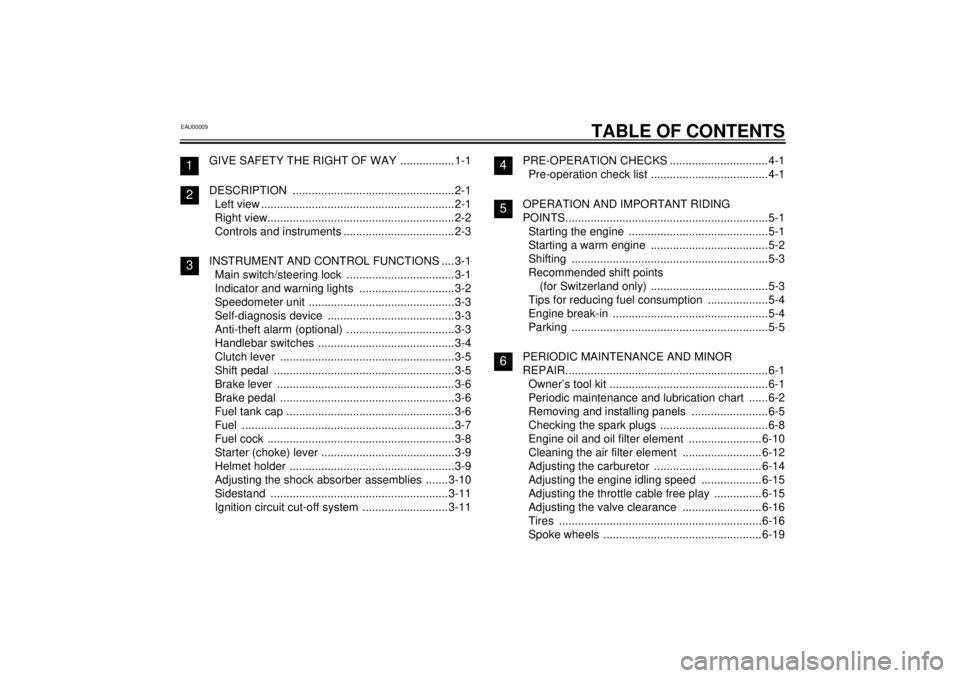
GIVE SAFETY THE RIGHT OF WAY .................1-1
DESCRIPTION ...................................................2-1
Left view ............................................................. 2-1
Right view...........................................................2-2
Controls and instruments ................................... 2-3
INSTRUMENT AND CONTROL FUNCTIONS ....3-1
Main switch/steering lock ..................................3-1
Indicator and warning lights ..............................3-2
Speedometer unit ..............................................3-3
Self-diagnosis device ........................................3-3
Anti-theft alarm (optional) ..................................3-3
Handlebar switches ...........................................3-4
Clutch lever .......................................................3-5
Shift pedal .........................................................3-5
Brake lever ........................................................3-6
Brake pedal .......................................................3-6
Fuel tank cap .....................................................3-6
Fuel ...................................................................3-7
Fuel cock ...........................................................3-8
Starter (choke) lever ..........................................3-9
Helmet holder ....................................................3-9
Adjusting the shock absorber assemblies ....... 3-10
Sidestand ........................................................ 3-11
Ignition circuit cut-off system ........................... 3-11PRE-OPERATION CHECKS ...............................4-1
Pre-operation check list .....................................4-1
OPERATION AND IMPORTANT RIDING
POINTS................................................................5-1
Starting the engine ............................................5-1
Starting a warm engine .....................................5-2
Shifting ..............................................................5-3
Recommended shift points
(for Switzerland only) .....................................5-3
Tips for reducing fuel consumption ...................5-4
Engine break-in .................................................5-4
Parking ..............................................................5-5
PERIODIC MAINTENANCE AND MINOR
REPAIR................................................................6-1
Owner’s tool kit ..................................................6-1
Periodic maintenance and lubrication chart ......6-2
Removing and installing panels ........................6-5
Checking the spark plugs ..................................6-8
Engine oil and oil filter element .......................6-10
Cleaning the air filter element .........................6-12
Adjusting the carburetor ..................................6-14
Adjusting the engine idling speed ...................6-15
Adjusting the throttle cable free play ...............6-15
Adjusting the valve clearance .........................6-16
Tires ................................................................6-16
Spoke wheels ..................................................6-19
123
456
E_5kr.book Page 1 Tuesday, September 12, 2000 4:46 PM
Page 8 of 88

TABLE OF CONTENTS
Adjusting the clutch lever free play ................. 6-19
Adjusting the brake lever free play .................. 6-20
Adjusting the brake pedal position and
free play ....................................................... 6-20
Adjusting the rear brake light switch ............... 6-22
Checking the front brake pads and
rear brake shoes ......................................... 6-22
Checking the brake fluid level ......................... 6-23
Changing the brake fluid ................................. 6-24
Drive chain slack ............................................. 6-24
Lubricating the drive chain .............................. 6-26
Checking and lubricating the cables ............... 6-27
Checking and lubricating the brake and
shift pedals .................................................. 6-27
Checking and lubricating the brake and
clutch levers ................................................ 6-28
Checking and lubricating the sidestand .......... 6-28
Checking the front fork .................................... 6-28
Checking the steering ..................................... 6-29
Checking the wheel bearings .......................... 6-30
Battery ............................................................. 6-30
Replacing the fuses ........................................ 6-32
Replacing the headlight bulb ........................... 6-33
Replacing the tail/brake light bulb ................... 6-35
Replacing a turn signal light bulb .................... 6-36
Supporting the motorcycle .............................. 6-36
Front wheel ..................................................... 6-37
Rear wheel ...................................................... 6-39Troubleshooting .............................................. 6-40
Troubleshooting chart ..................................... 6-41
MOTORCYCLE CARE AND STORAGE ............. 7-1
Care .................................................................. 7-1
Storage ............................................................. 7-4
SPECIFICATIONS ............................................... 8-1
Specifications .................................................... 8-1
Conversion table ............................................... 8-5
CONSUMER INFORMATION.............................. 9-1
Identification numbers ....................................... 9-1
Key identification number .................................. 9-1
Vehicle identification number ............................ 9-1
Model label ........................................................ 9-2
789
E_5kr.book Page 2 Tuesday, September 12, 2000 4:46 PM
Page 26 of 88

PRE-OPERATION CHECKS
4-2
4
Control cables• Make sure that operation is smooth.
• Lubricate if necessary.6-27
Drive chain• Check chain slack.
• Adjust if necessary.
• Check chain condition.
• Lubricate if necessary.6-24–6-25
Wheels and tires• Check for damage.
• Check tire condition and tread depth.
• Check air pressure.
• Correct if necessary.6-16–6-19
Brake and shift pedals• Make sure that operation is smooth.
• Lubricate pedal pivoting points if necessary.6-27
Brake and clutch levers• Make sure that operation is smooth.
• Lubricate lever pivoting points if necessary.6-28
Sidestand• Make sure that operation is smooth.
• Lubricate pivot if necessary.6-28
Chassis fasteners• Make sure that all nuts, bolts and screws are properly tightened.
• Tighten if necessary.—
Instruments, lights, signals
and switches• Check operation.
• Correct if necessary.—
Sidestand switch• Check operation of ignition circuit cut-off system.
• If system is defective, have Yamaha dealer check vehicle.3-11 ITEM CHECKS PAGE
E_5kr.book Page 2 Tuesday, September 12, 2000 4:46 PM
Page 36 of 88
PERIODIC MAINTENANCE AND MINOR REPAIR
6-4
6
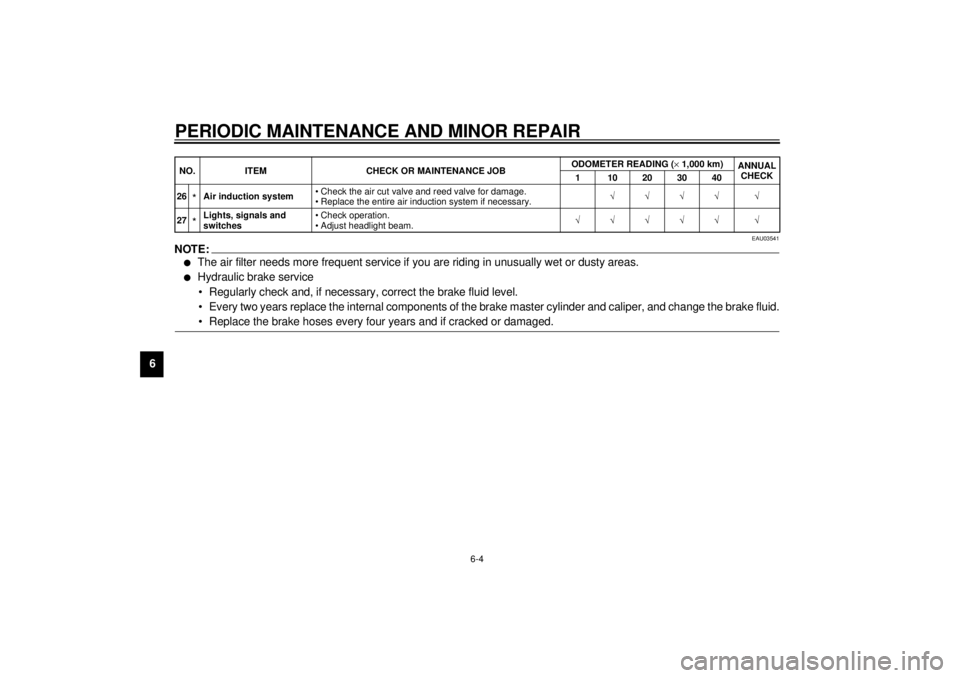
EAU03541
NOTE:_l
The air filter needs more frequent service if you are riding in unusually wet or dusty areas.
l
Hydraulic brake service
• Regularly check and, if necessary, correct the brake fluid level.
• Every two years replace the internal components of the brake master cylinder and caliper, and change the brake fluid.
• Replace the brake hoses every four years and if cracked or damaged.
_26
*Air induction system• Check the air cut valve and reed valve for damage.
• Replace the entire air induction system if necessary.ÖÖÖÖ Ö
27*Lights, signals and
switches• Check operation.
• Adjust headlight beam.ÖÖÖÖÖ Ö NO. ITEM CHECK OR MAINTENANCE JOBODOMETER READING (´1,000 km)
ANNUAL
CHECK
1 10203040
E_5kr.book Page 4 Tuesday, September 12, 2000 4:46 PM
Page 53 of 88
PERIODIC MAINTENANCE AND MINOR REPAIR
6-21
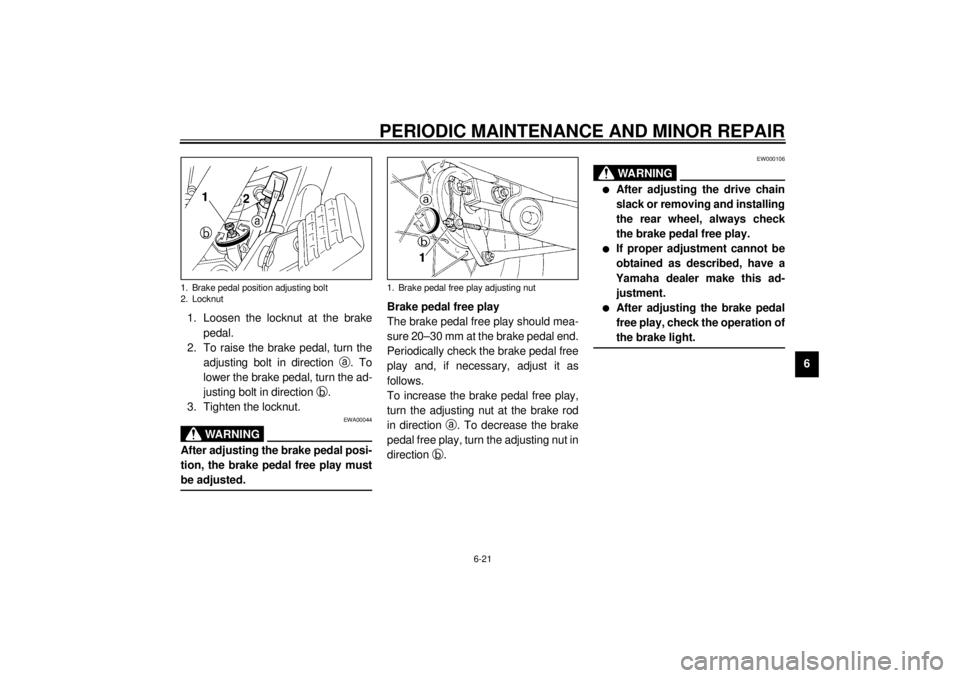
6 1. Loosen the locknut at the brake
pedal.
2. To raise the brake pedal, turn the
adjusting bolt in direction
a. To
lower the brake pedal, turn the ad-
justing bolt in direction
b.
3. Tighten the locknut.
EWA00044
WARNING
_ After adjusting the brake pedal posi-
tion, the brake pedal free play must
be adjusted. _
Brake pedal free play
The brake pedal free play should mea-
sure 20–30 mm at the brake pedal end.
Periodically check the brake pedal free
play and, if necessary, adjust it as
follows.
To increase the brake pedal free play,
turn the adjusting nut at the brake rod
in direction
a. To decrease the brake
pedal free play, turn the adjusting nut in
direction
b.
EW000106
WARNING
_ l
After adjusting the drive chain
slack or removing and installing
the rear wheel, always check
the brake pedal free play.
l
If proper adjustment cannot be
obtained as described, have a
Yamaha dealer make this ad-
justment.
l
After adjusting the brake pedal
free play, check the operation of
the brake light.
_
1. Brake pedal position adjusting bolt
2. Locknut
1. Brake pedal free play adjusting nut
E_5kr.book Page 21 Tuesday, September 12, 2000 4:46 PM
Page 54 of 88
PERIODIC MAINTENANCE AND MINOR REPAIR
6-22
6
EAU00713
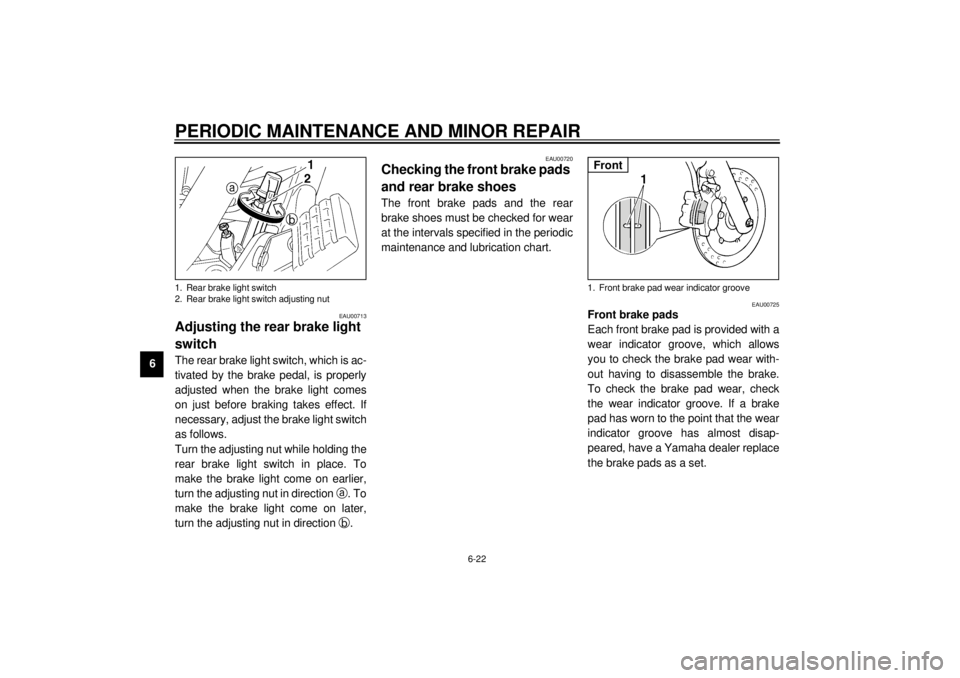
Adjusting the rear brake light
switch The rear brake light switch, which is ac-
tivated by the brake pedal, is properly
adjusted when the brake light comes
on just before braking takes effect. If
necessary, adjust the brake light switch
as follows.
Turn the adjusting nut while holding the
rear brake light switch in place. To
make the brake light come on earlier,
turn the adjusting nut in direction
a. To
make the brake light come on later,
turn the adjusting nut in direction
b.
EAU00720
Checking the front brake pads
and rear brake shoes The front brake pads and the rear
brake shoes must be checked for wear
at the intervals specified in the periodic
maintenance and lubrication chart.
EAU00725
Front brake pads
Each front brake pad is provided with a
wear indicator groove, which allows
you to check the brake pad wear with-
out having to disassemble the brake.
To check the brake pad wear, check
the wear indicator groove. If a brake
pad has worn to the point that the wear
indicator groove has almost disap-
peared, have a Yamaha dealer replace
the brake pads as a set.
1. Rear brake light switch
2. Rear brake light switch adjusting nut
1. Front brake pad wear indicator grooveFront
E_5kr.book Page 22 Tuesday, September 12, 2000 4:46 PM
Page 58 of 88
PERIODIC MAINTENANCE AND MINOR REPAIR
6-26
6
EC000096
CAUTION:_ Improper drive chain slack will over-
load the engine as well as other vital
parts of the motorcycle and can lead
to chain slippage or breakage. To
prevent this from occurring, keep
the drive chain slack within the
specified limits. _3. Tighten both locknuts, and then
tighten the axle nut to the specified
torque.
4. Adjust the brake pedal free play.
(See page 6-21 for brake pedal
free play adjustment procedures.)
EW000103
WARNING
_ After adjusting the brake pedal free
play, check the operation of the
brake light. _
EAU03006
Lubricating the drive chain The drive chain must be cleaned and
lubricated at the intervals specified in
the periodic maintenance and lubrica-
tion chart, otherwise it will quickly wear
out, especially when riding in dusty or
wet areas. Service the drive chain as
follows.
EC000097
CAUTION:_ The drive chain must be lubricated
after washing the motorcycle or
riding in the rain. _1. Clean the drive chain with kero-
sene and a small soft brush.
ECA00053
CAUTION:_ To prevent damaging the O-rings,
do not clean the drive chain with
steam cleaners, high-pressure
washers or inappropriate solvents. _
2. Wipe the drive chain dry.
3. Thoroughly lubricate the drive
chain with a special O-ring chain
lubricant.
ECA00052
CAUTION:_ Do not use engine oil or any other
lubricants for the drive chain, as
they may contain substances that
could damage the O-rings. _
Tightening torque:
Axle nut:
104 Nm (10.4 m·kg)
E_5kr.book Page 26 Tuesday, September 12, 2000 4:46 PM
Page 67 of 88
PERIODIC MAINTENANCE AND MINOR REPAIR
6-35
6
EAU01623
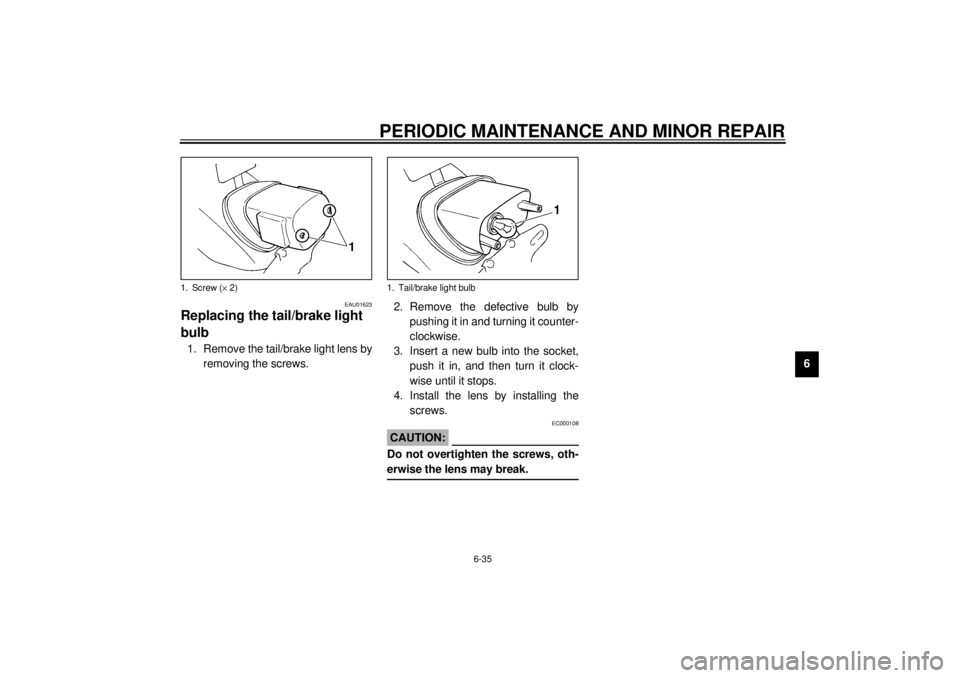
Replacing the tail/brake light
bulb 1. Remove the tail/brake light lens by
removing the screws.2. Remove the defective bulb by
pushing it in and turning it counter-
clockwise.
3. Insert a new bulb into the socket,
push it in, and then turn it clock-
wise until it stops.
4. Install the lens by installing the
screws.
EC000108
CAUTION:_ Do not overtighten the screws, oth-
erwise the lens may break. _
1. Screw (´ 2)
1. Tail/brake light bulb
E_5kr.book Page 35 Tuesday, September 12, 2000 4:46 PM
Page 72 of 88
PERIODIC MAINTENANCE AND MINOR REPAIR
6-40
6
EAU03190
To install the rear wheel
1. Insert the wheel axle from the left-
hand side, and then install the
drive chain onto the rear sprocket.
2. Install the axle nut, and then lower
the rear wheel so that it is on the
ground.
3. Install the brake rod onto the brake
camshaft lever, and then install
the brake pedal free play adjusting
nut onto the brake rod.
4. Connect the brake torque rod to
the brake shoe plate by installing
the bolt and the nut, and then tight-
en the bolt to the specified torque.
5. Adjust the drive chain slack. (See
page 6-25 for drive chain slack ad-
justment procedures.)6. Tighten the axle nut to the speci-
fied torque.
7. Adjust the brake pedal position
and free play. (See page 6-20 for
brake pedal position and free play
adjustment procedures.)
EW000103
WARNING
_ After adjusting the brake pedal free
play, check the operation of the
brake light. _
EAU01008
Troubleshooting Although Yamaha motorcycles receive
a thorough inspection before shipment
from the factory, trouble may occur dur-
ing operation. Any problem in the fuel,
compression, or ignition systems, for
example, can cause poor starting and
loss of power.
The following troubleshooting chart
represents a quick and easy procedure
for checking these vital systems your-
self. However, should your motorcycle
require any repair, take it to a Yamaha
dealer, whose skilled technicians have
the necessary tools, experience, and
know-how to service the motorcycle
properly.
Use only genuine Yamaha replace-
ment parts. Imitation parts may look
like Yamaha parts, but they are often
inferior, have a shorter service life and
can lead to expensive repair bills. Tightening torque:
Brake torque rod bolt:
23 Nm (2.3 m·kg)
Tightening torque:
Axle nut:
104 Nm (10.4 m·kg)
E_5kr.book Page 40 Tuesday, September 12, 2000 4:46 PM
Page 75 of 88
MOTORCYCLE CARE AND STORAGE
7-2
7
l
Do not use any harsh chemical
products on plastic parts. Be
sure to avoid using cloths or
sponges which have been in
contact with strong or abrasive
cleaning products, solvent or
thinner, fuel (gasoline), rust re-
movers or inhibitors, brake flu-
id, antifreeze or electrolyte.
l
Do not use high-pressure wash-
ers or steam-jet cleaners since
they cause water seepage and
deterioration in the following ar-
eas: seals (of wheel and swing-
arm bearings, fork and brakes),
electric components (couplers,
connectors, instruments, switch-
es and lights), breather hoses
and vents.
l
For motorcycles equipped with
a windshield: Do not use strong
cleaners or hard sponges as
they will cause dulling or
scratching. Some cleaning
compounds for plastic may
leave scratches on the wind-
shield. Test the product on a
small hidden part of the wind-
shield to make sure that it does
not leave any marks. If the wind-
shield is scratched, use a quali-
ty plastic polishing compound
after washing.
_After normal useRemove dirt with warm water, a mild
detergent, and a soft, clean sponge,
and then rinse thoroughly with clean
water. Use a toothbrush or bottlebrush
for hard-to-reach areas. Stubborn dirt
and insects will come off more easily if
the area is covered with a wet cloth for
a few minutes before cleaning.After riding in the rain, near the sea or
on salt-sprayed roadsSince sea salt or salt sprayed on roads
during winter are extremely corrosive in
combination with water, carry out the
following steps after each ride in the
rain, near the sea or on salt-sprayed
roads.NOTE:_ Salt sprayed on roads in the winter may
remain well into spring. _1. Clean the motorcycle with cold
water and a mild detergent, after
the engine has cooled down.
ECA00012
CAUTION:_ Do not use warm water since it in-
creases the corrosive action of the
salt. _2. After drying the motorcycle, apply
a corrosion protection spray on all
metal, including chrome- and nick-
el-plated, surfaces to prevent
corrosion.
E_5kr.book Page 2 Tuesday, September 12, 2000 4:46 PM