fuel YAMAHA YBR250 2007 User Guide
[x] Cancel search | Manufacturer: YAMAHA, Model Year: 2007, Model line: YBR250, Model: YAMAHA YBR250 2007Pages: 74, PDF Size: 2.67 MB
Page 45 of 74
6-12
6
PERIODIC MAINTENANCE AND MINOR REPAIR
EAU21311
Checking the engine idling
speedThe engine idling speed must be
checked as follow and, if necessary,
adjusted by a Yamaha dealer at the
intervals specified in the periodic
maintenance and lubrication chart.
Start the engine and warm it up for
several minutes at 1000-2000 r/min while
occasionally revving it to 4000-5000 r/
min.The engine is warm when it quickly
responds to the throttle.Engine idling speed:1.300 - 1.500 r/min.
EAU21382
Checking the throttle cable
free play
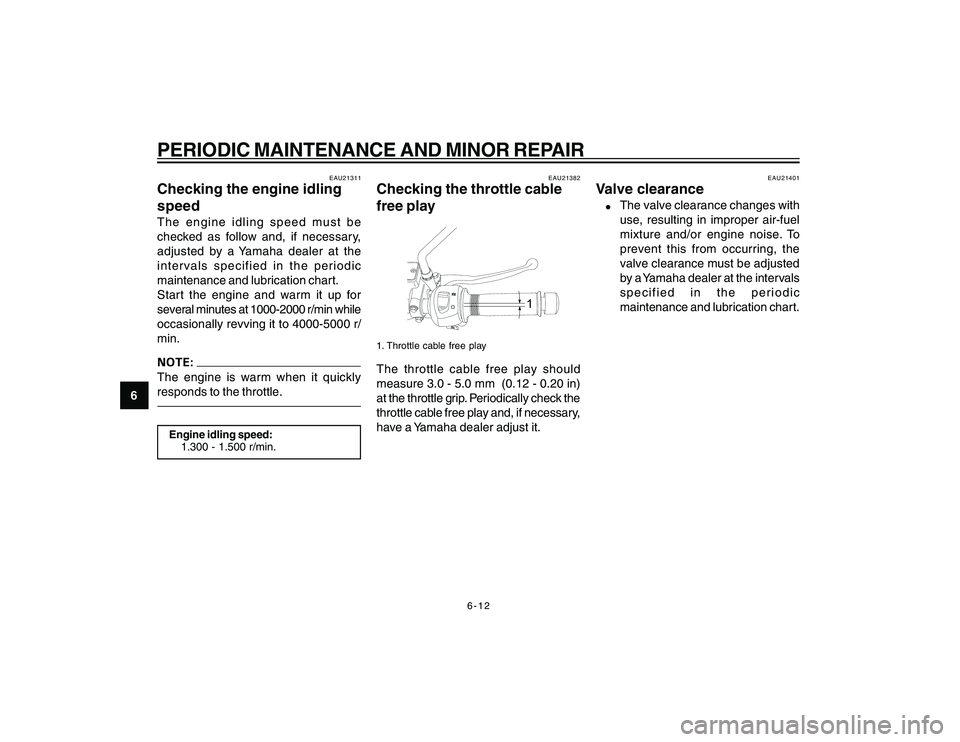
1
1. Throttle cable free playThe throttle cable free play should
measure 3.0 - 5.0 mm (0.12 - 0.20 in)
at the throttle grip. Periodically check the
throttle cable free play and, if necessary,
have a Yamaha dealer adjust it.
EAU21401
Valve clearancel
The valve clearance changes with
use, resulting in improper air-fuel
mixture and/or engine noise. To
prevent this from occurring, the
valve clearance must be adjusted
by a Yamaha dealer at the intervals
specified in the periodic
maintenance and lubrication chart.
cap 6.pmd 24/1/2007, 14:37
12
Page 59 of 74
6-26
6
PERIODIC MAINTENANCE AND MINOR REPAIR
EAU23624
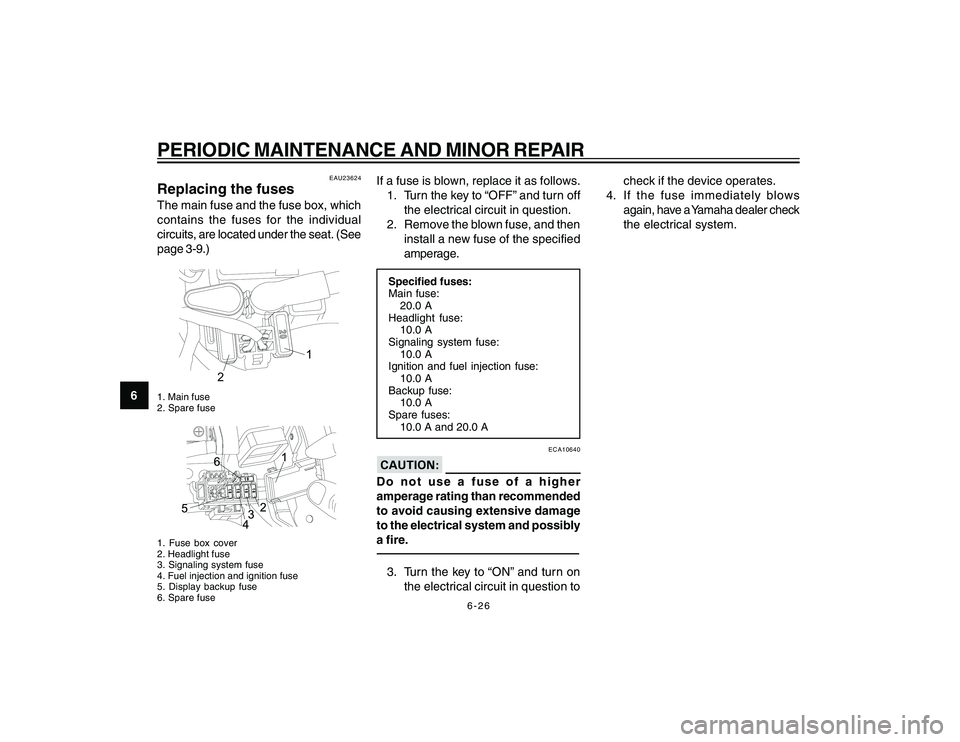
Replacing the fusesThe main fuse and the fuse box, which
contains the fuses for the individual
circuits, are located under the seat. (See
page 3-9.)
20
1
2
1. Main fuse
2. Spare fuse1. Fuse box cover
2. Headlight fuse
3. Signaling system fuse
4. Fuel injection and ignition fuse
5. Display backup fuse
6. Spare fuse
If a fuse is blown, replace it as follows.
1. Turn the key to “OFF” and turn off the electrical circuit in question.
2. Remove the blown fuse, and then install a new fuse of the specified
amperage.Specified fuses:
Main fuse:20.0 A
Headlight fuse: 10.0 A
Signaling system fuse:
10.0 A
Ignition and fuel injection fuse: 10.0 A
Backup fuse: 10.0 A
Spare fuses:
10.0 A and 20.0 A
ECA10640
Do not use a fuse of a higher
amperage rating than recommended
to avoid causing extensive damage
to the electrical system and possibly
a fire.3. Turn the key to “ON” and turn on
the electrical circuit in question to check if the device operates.
4. If the fuse immediately blows again, have a Yamaha dealer check
the electrical system.
cap 6.pmd 24/1/2007, 14:38
26
Page 64 of 74
6-31
6
PERIODIC MAINTENANCE AND MINOR REPAIR
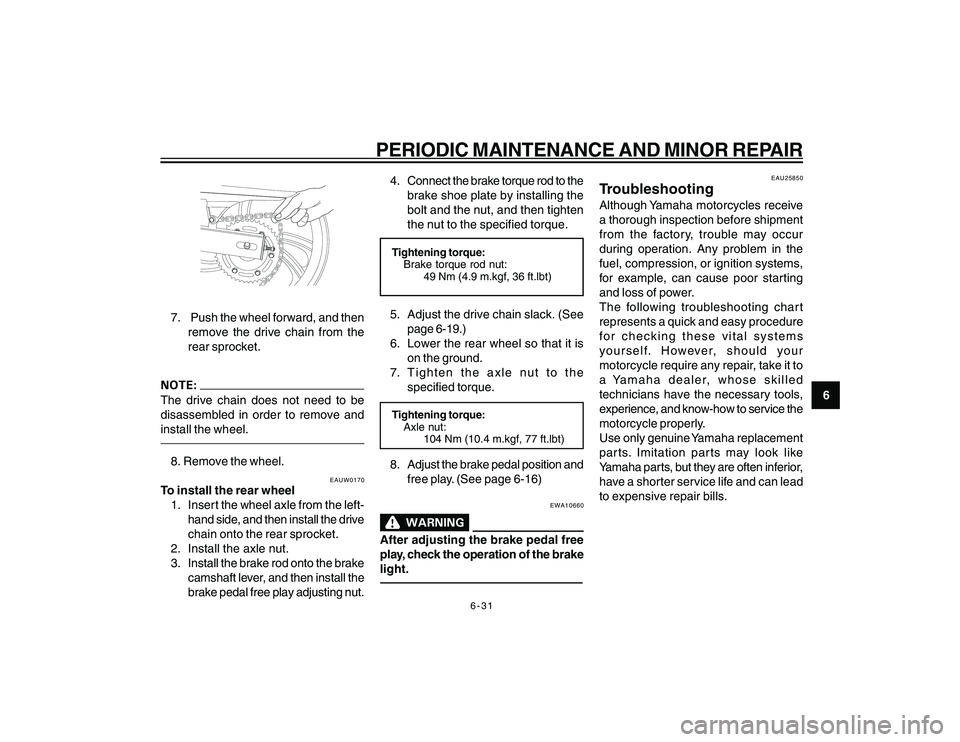
7. Push the wheel forward, and thenremove the drive chain from the
rear sprocket.The drive chain does not need to be
disassembled in order to remove and
install the wheel.8. Remove the wheel.
EAUW0170
To install the rear wheel1. Insert the wheel axle from the left- hand side, and then install the drive
chain onto the rear sprocket.
2. Install the axle nut.
3. Install the brake rod onto the brake camshaft lever, and then install the
brake pedal free play adjusting nut. 4. Connect the brake torque rod to the
brake shoe plate by installing the
bolt and the nut, and then tighten
the nut to the specified torque.
Tightening torque:Brake torque rod nut: 49 Nm (4.9 m.kgf, 36 ft.lbt)5. Adjust the drive chain slack. (See
page 6-19.)
6. Lower the rear wheel so that it is on the ground.
7. Tighten the axle nut to the specified torque.Tightening torque:Axle nut: 104 Nm (10.4 m.kgf, 77 ft.lbt)8. Adjust the brake pedal position and
free play. (See page 6-16)
EWA10660
After adjusting the brake pedal free
play, check the operation of the brake
light.
EAU25850
TroubleshootingAlthough Yamaha motorcycles receive
a thorough inspection before shipment
from the factory, trouble may occur
during operation. Any problem in the
fuel, compression, or ignition systems,
for example, can cause poor starting
and loss of power.
The following troubleshooting chart
represents a quick and easy procedure
for checking these vital systems
yourself. However, should your
motorcycle require any repair, take it to
a Yamaha dealer, whose skilled
technicians have the necessary tools,
experience, and know-how to service the
motorcycle properly.
Use only genuine Yamaha replacement
parts. Imitation parts may look like
Yamaha parts, but they are often inferior,
have a shorter service life and can lead
to expensive repair bills.
cap 6.pmd 24/1/2007, 14:38
31
Page 65 of 74

6-32
6
PERIODIC MAINTENANCE AND MINOR REPAIR
EAU25901
Troubleshooting chart
EWA10840
Keep away open flames and do not smoke while checking or working on the \
fuel system.
Check the fuel level in
the fuel tank.1. Fuel
There is enough fuel.There is no fuel.
Check the compression.
Supply fuel.
The engine does not start.
Check the compression.
Operate the electric starter.2. Compression
There is compression.
There is no compression.
Check the ignition. Have a Yamaha dealer
check the vehicle.
Remove the spark plug
and check the electrodes.3. Ignition
Wipe off with a dry cloth and correct the
spark plug gap, or replace the spark plug.
Have a Yamaha dealer check the vehicle.
The engine does not start.
Have a Yamaha dealer
check the vehicle.
The engine does not start.
Check the battery.
Operate the electric starter.4. Battery
The engine turns over
quickly.
The engine turns over
slowly.
The battery is good.Check the battery lead connections,
and charge the battery if necessary.
DryWet
Open the throttle halfway and operate
the electric starter.
cap 6.pmd 24/1/2007, 14:38
32
Page 66 of 74
7-1MOTORCYCLE CARE AND STORAGE
7
EAU26001
CareWhile the open design of a motorcycle
reveals the attractiveness of the
technology, it also makes it more
vulnerable. Rust and corrosion can
develop even if high-quality components
are used. A rusty exhaust pipe may go
unnoticed on a car, however, it detracts
from the overall appearance of a
motorcycle. Frequent and proper care
does not only comply with the terms of
the warranty, but it will also keep your
motorcycle looking good, extend its life
and optimize its performance.
Before cleaning1. Cover the muffler outlet with a plastic bag after the engine has
cooled down.
2. Make sure that all caps and covers as well as all electrical couplers
and connectors, including the spark
plug cap, are tightly installed.
3. Remove extremely stubborn dirt, like oil burnt onto the crankcase,
with a degreasing agent and a
brush, but never apply such
products onto seals, gaskets, sprockets, the drive chain and
wheel axles. Always rinse the dirt
and degreaser off with water.
Cleaning
ECA10770
l
l l
l
l
Avoid using strong acidic wheel
cleaners, especially on spoked
wheels. If such products are
used on hard-to-remove dirt, do
not leave the cleaner on the
affected area any longer than
instructed. Also, thoroughly
rinse the area off with water,
immediately dry it, and then
apply a corrosion protection
spray.
l
l l
l
l
Improper cleaning can damage
windshields, cowlings, panels
and other plastic parts. Use only
a soft, clean cloth or sponge with
mild detergent and water to
clean plastic.
l
l l
l
l
Do not use any harsh chemical
products on plastic parts. Be
sure to avoid using cloths or
sponges which have been in
contact with strong or abrasive
cleaning products, solvent or thinner, fuel (gasoline), rust
removers or inhibitors, brake
fluid, antifreeze or electrolyte.
l
l l
l
l
Do not use high-pressure
washers or steam-jet cleaners
since they cause water seepage
and deterioration in the
following areas: seals (of wheel
and swingarm bearings, fork
and brakes), electric
components (couplers,
connectors, instruments,
switches and lights), breather
hoses and vents.
l
l l
l
l
For motorcycles equipped with
a windshield: Do not use strong
cleaners or hard sponges as
they will cause dulling or
scratching. Some cleaning
compounds for plastic may
leave scratches on the
windshield. Test the product on
a small hidden part of the
windshield to make sure that it
does not leave any marks. If the
windshield is scratched, use a
quality plastic polishing
compound after washing.
cap 7.pmd 24/1/2007, 14:38
1
Page 68 of 74
7-3MOTORCYCLE CARE AND STORAGE
7
rubber and plastic parts, but treat
them with a suitable care
product.
l
l l
l
l
Avoid using abrasive polishing
compounds as they will wear
away the paint.
Consult a Yamaha dealer for advice on
what products to use.
EAUM1900
StorageShort-term
Always store your motorcycle in a cool,
dry place and, if necessary, protect it
against dust with a porous cover.
ECA10810
l
l l
l
l
Storing the motorcycle in a
poorly ventilated room or
covering it with a tarp, while it
is still wet, will allow water and
humidity to seep in and cause
rust.
l
l l
l
l
To prevent corrosion, avoid
damp cellars, stables (because
of the presence of ammonia) and
areas where strong chemicals
are stored.
Long-term
Before storing your motorcycle for
several months:
1. Follow all the instructions in the “Care” section of this chapter.
2. Fill up the fuel tank and add fuel stabilizer (if available) to prevent
the fuel tank from rusting and the
fuel from deteriorating. 3. Perform the following steps to
protect the cylinder, piston rings,
etc. from corrosion.
a. Remove the spark plug cap and spark plug.
b. Pour a teaspoonful of engine oil into the spark plug bore.
c. Install the spark plug cap onto the spark plug, and then place the
spark plug on the cylinder head so
that the electrodes are grounded.
(This will limit sparking during the
next step.)
d. Turn the engine over several times with the starter. (This will coat the
cylinder wall with oil.)
e. Remove the spark plug cap from the spark plug, and then install the
spark plug and the spark plug cap.
EWA10950
To prevent damage or injury from
sparking, make sure to ground the
spark plug electrodes while turning
the engine over.4. Lubricate all control cables and thepivoting points of all levers and
cap 7.pmd 24/1/2007, 14:38
3
Page 70 of 74
8-1
SPECIFICATIONS
8
Dimensions:Overall length:2025 mm (79.7 in)
Overall width: 745 mm (29.3 in)
Overall height:
1065 mm (41.9 in)
Seat height:
805 mm (31.7 in)
Wheelbase: 1360 mm (53.5 in)
Ground clearance:
190 mm (7.5 in)
Minimum turning radius:
2395 mm (94.3 in)Weight:With oil and fuel:154.0 kg (339 lb)Engine:Engine type:Air cooled 4-stroke, SOHC
Cylinder arrangement: Forward-inclined single cylinder
Displacement:
249.0 cm
3 (15.2 cu.in)
Bore x stroke:
74.0 x 58.0 mm (2.91 x 2.28 in)
Compression ratio: 9.80:1
Starting system:
Electric starter
Lubrication system:
Wet sump
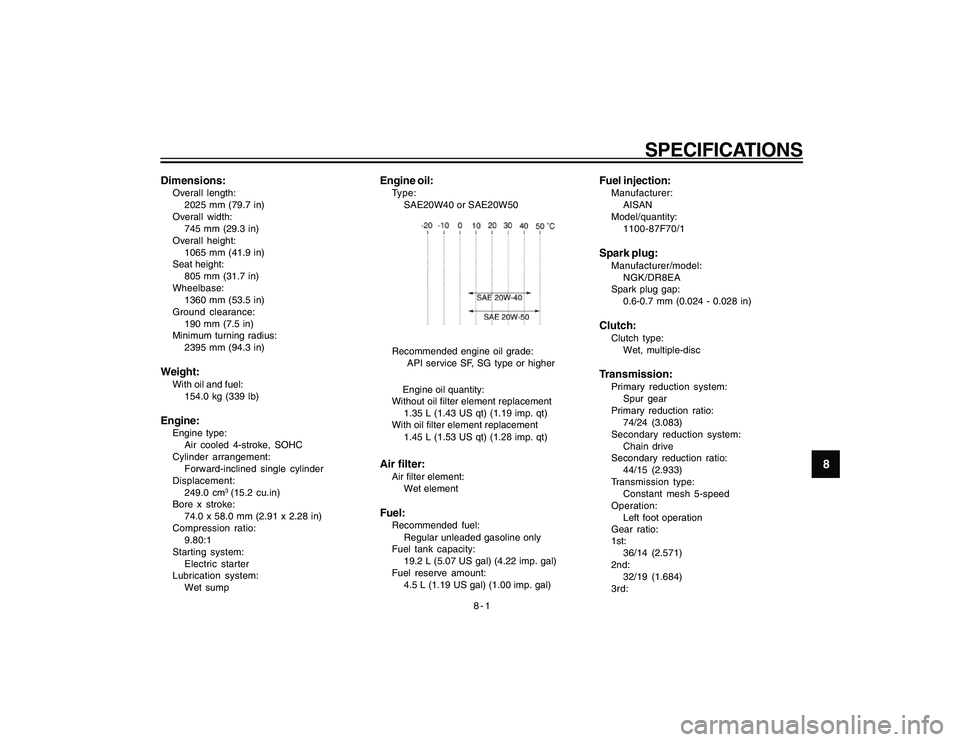
Engine oil:Type:SAE20W40 or SAE20W50Recommended engine oil grade: API service SF, SG type or higher
Engine oil quantity:
Without oil filter element replacement 1.35 L (1.43 US qt) (1.19 imp. qt)
With oil filter element replacement
1.45 L (1.53 US qt) (1.28 imp. qt)Air filter:Air filter element:Wet elementFuel:Recommended fuel:Regular unleaded gasoline only
Fuel tank capacity:
19.2 L (5.07 US gal) (4.22 imp. gal)
Fuel reserve amount:
4.5 L (1.19 US gal) (1.00 imp. gal)
Fuel injection:Manufacturer:AISAN
Model/quantity: 1100-87F70/1Spark plug:Manufacturer/model:NGK/DR8EA
Spark plug gap:
0.6-0.7 mm (0.024 - 0.028 in)Clutch:Clutch type:Wet, multiple-discTransmission:Primary reduction system:Spur gear
Primary reduction ratio:
74/24 (3.083)
Secondary reduction system: Chain drive
Secondary reduction ratio:
44/15 (2.933)
Transmission type:
Constant mesh 5-speed
Operation: Left foot operation
Gear ratio:
1st:
36/14 (2.571)
2nd:
32/19 (1.684)
3rd:
cap 8.pmd 24/1/2007, 14:38
1
Page 72 of 74
8-3
SPECIFICATIONS
8
Headlight:Bulb type:Halogen bulbBulb voltage, wattage x quantityHeadlight: 12 V, 35 W/35.0 W x 1
Tail brake light: 12 V, 5.0 W/21.0 W x 1
Front turn signal light:
12 V, 10.0 W x 2
Rear turn signal light:
12 V, 10.0 W x 2
Position light: 12 V, 5.0 W
Meter lighting:
14 V, 2.0 W x 2
Neutral indicator light:
14 V, 1.4 W x 1
Turn signal indicator light: 14 V, 1.4 W x 2
High beam indicator light:
14 V, 1.4 W x 1
Engine trouble warning light:
LEDFuses:Main fuse:20.0 A
Headlight fuse: 10.0 A
Signaling system fuse:
10.0 A
Ignition and fuel injection fuse:
10.0 A Backup fuse:
10.0 A
Spare fuses:
10.0 A and 20.0 A
cap 8.pmd 24/1/2007, 14:38
3