brake YAMAHA YBR250 2007 Owners Manual
[x] Cancel search | Manufacturer: YAMAHA, Model Year: 2007, Model line: YBR250, Model: YAMAHA YBR250 2007Pages: 74, PDF Size: 2.67 MB
Page 5 of 74
TABLE OF CONTENTESSAFETY INFORMATION .................... 1-1
DESCRIPTION ................................... 2-1Left view ........................................ 2 - 1
Right view ...................................... 2 - 2
Controls and instruments ............. 2 - 3
INSTRUMENT AND CONTROL
FUNCTIONS ....................................... 3-1 Main switch/steering lock ............. 3 - 1
Indicator and warning lights ........ 3 - 2
Speedometer ................................. 3 - 2
Tachometer .................................... 3 - 3
Multi-function display ................... 3 - 3
Handlebar switches ...................... 3 - 4
Clutch lever ................................... 3 - 5
Shift pedal ..................................... 3 - 6
Brake lever .................................... 3 - 6
Brake pedal ................................... 3 - 6
Fuel tank cap ................................. 3 - 7
Fuel ................................................ 3 - 7
Catalytic converter ........................ 3 - 8
Seat ................................................ 3 - 9
Helmet holder ................................ 3 - 9
Storage compartment .................3-10
Adjusting the shock aborber
assemblies ............................... 3-10
Luggage strap holders ...............3-11
Sidestand ..................................... 3-11
Ignition circuit cut-off system .....3-12 PRE-OPERATION CHECKS .............. 4-1
Pre-operation check list ............... 4 - 2
OPERATION AND IMPORTANT
RIDING POINTS ................................. 5-1 Starting the engine ....................... 5 - 1
Shifting ........................................... 5 - 2
Tips for reducing fuel
consumption .............................. 5 - 3
Engine break-in ............................ 5 - 3
Parking .......................................... 5 - 4
PERIODIC MAINTENANCE AND
MINOR REPAIR .................................. 6-1 Owner’s tool kit .............................. 6 - 1
Periodic maintenance and lubrication chart ......................... 6 - 2
Removing and installing the cowling and panels ................... 6 - 6
Checking the spark plug .............. 6 - 7
Engine oil and oil filter element ... 6-8
Cleaning the air filter element ... 6-11
Checking the engine idling
speed ........................................ 6-12
Checking the throttle cable free play .................................... 6-12
Valve clearance .. ........................6-12
Tires ............................................. 6-13
Cast wheels ................................. 6-15
Adjusting the clutch lever free play .................................... 6-15Adjusting the brake pedal
position and free play .............6-16
Adjusting the rear brake light switch ........................................ 6-17
Checking the front brake pads
and rear brake shoes ..............6-17
Checking the front brake fluid level .......................................... 6-18
Changing the brake fluid ...........6-18
Drive chain slack ........................6-19
Cleaning and lubricating the
drive chain ............................... 6-20
Checking and lubricating the cables ....................................... 6-21
Checking and lubricating the throttle grip and cable .............6-21
Checking and lubricating the
brake and clutch levers ...........6-21
Checking and lubricating the brake and shift pedals ............6-22
Checking and lubricating the sidestand .................................. 6-22
Lubricating the rear
suspension .............................. 6-23
Checking the front fork ...............6-23
Checking the steering ................6-24
Checking the wheel bearings ....6-24
Battery .......................................... 6-24
Replacing the fuses ....................6-26
Replacing the headlight bulb ....6-27
Replacing a turn signal light bulb or the tail/brake light bulb .......6-28
indice.pmd 24/1/2007, 14:37
1
Page 12 of 74
2-2
2
DESCRIPTION
EAU10420
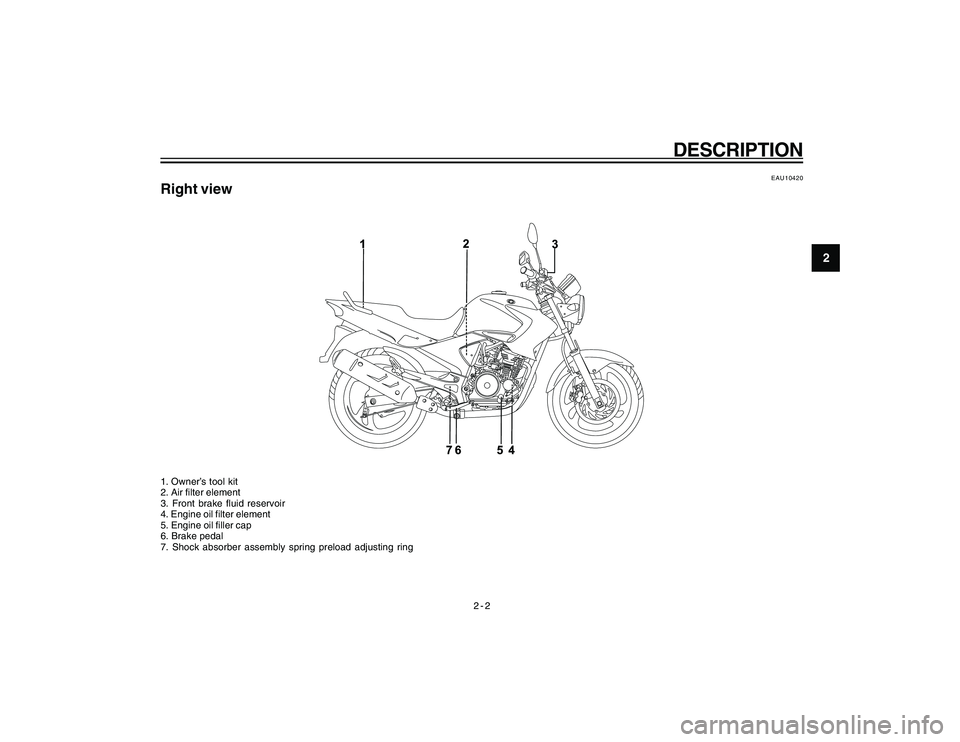
Right view1. Owner’s tool kit
2. Air filter element
3. Front brake fluid reservoir
4. Engine oil filter element
5. Engine oil filler cap
6. Brake pedal
7. Shock absorber assembly spring preload adjusting ring
cap 2.pmd24/1/2007, 14:37
2
Page 13 of 74
2-3
2
DESCRIPTION
EAU10430
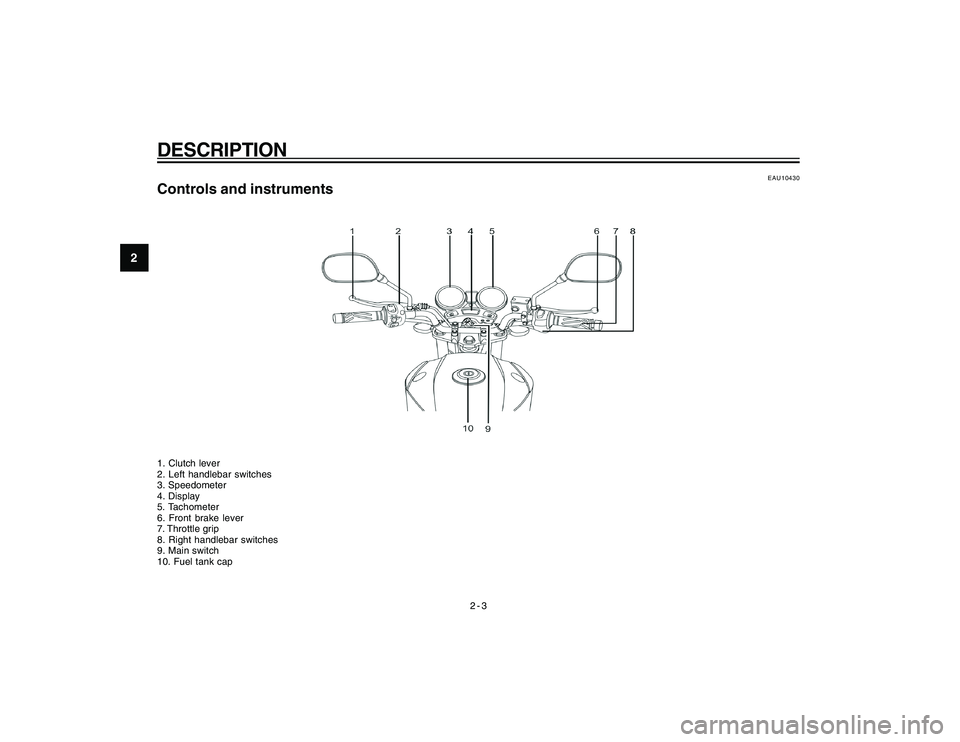
Controls and instruments1. Clutch lever
2. Left handlebar switches
3. Speedometer
4. Display
5. Tachometer
6. Front brake lever
7. Throttle grip
8. Right handlebar switches
9. Main switch
10. Fuel tank cap
cap 2.pmd24/1/2007, 14:37
3
Page 19 of 74
3-6
3
INSTRUMENT AND CONTROL FUNCTIONS
EAU12870
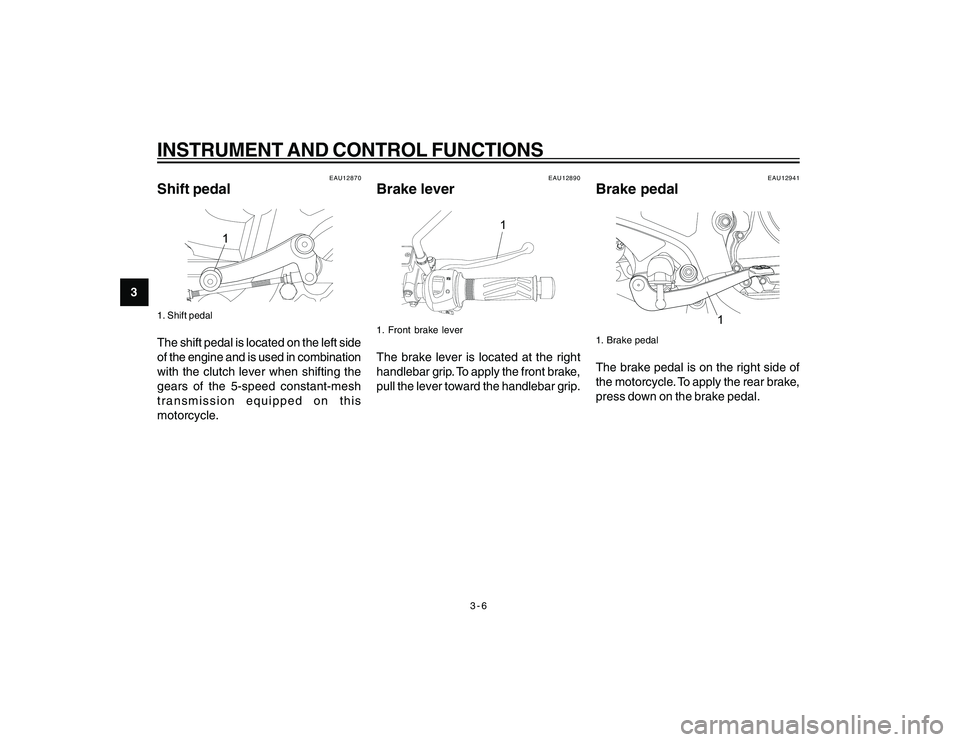
Shift pedal1. Shift pedalThe shift pedal is located on the left side
of the engine and is used in combination
with the clutch lever when shifting the
gears of the 5-speed constant-mesh
transmission equipped on this
motorcycle.
EAU12890
Brake lever
1
1. Front brake leverThe brake lever is located at the right
handlebar grip. To apply the front brake,
pull the lever toward the handlebar grip.
EAU12941
Brake pedal
1
1. Brake pedalThe brake pedal is on the right side of
the motorcycle. To apply the rear brake,
press down on the brake pedal.
cap 3.pmd24/1/2007, 14:37
6
Page 38 of 74

6-5
6
PERIODIC MAINTENANCE AND MINOR REPAIR
EAU18660
l
The air filter needs more frequent service if you are riding in unusuall\
y wet or dusty areas.
l
Hydraulic brake servicel
Regularly check and, if necessary, correct the brake fluid level.
l
Every two years replace the internal components of the brake master cylinder and caliper, and change the brake
fluid.
l
Replace the brake hoses every four years and if cracked or damaged.
cap 6.pmd24/1/2007, 14:37
5
Page 47 of 74
6-14
6
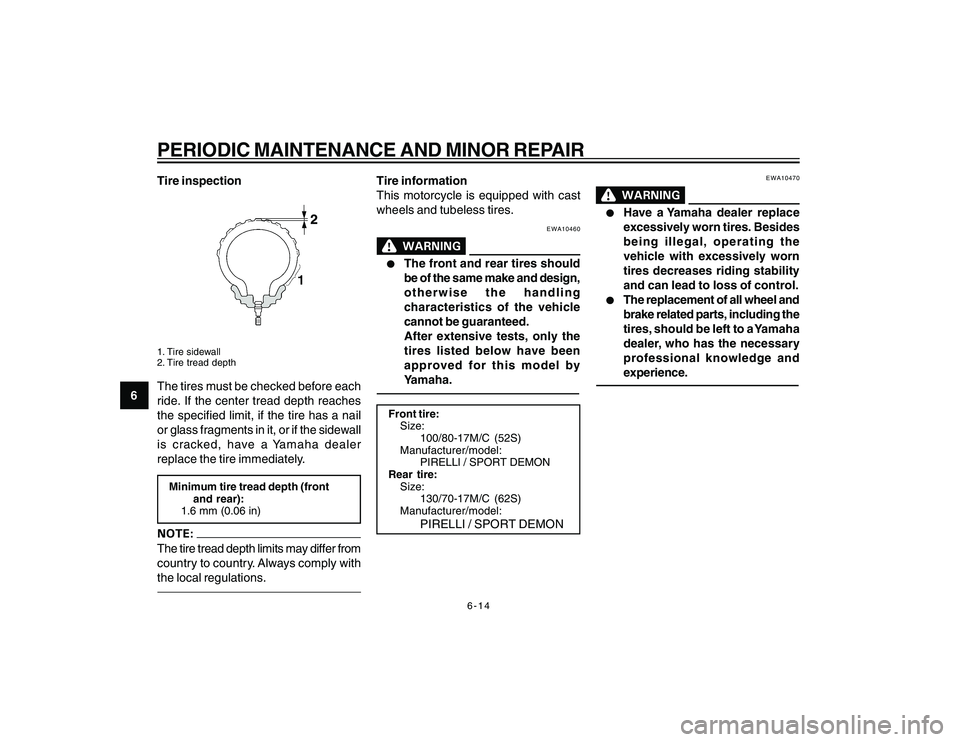
PERIODIC MAINTENANCE AND MINOR REPAIRTire inspection1. Tire sidewall
2. Tire tread depthThe tires must be checked before each
ride. If the center tread depth reaches
the specified limit, if the tire has a nail
or glass fragments in it, or if the sidewall
is cracked, have a Yamaha dealer
replace the tire immediately.Minimum tire tread depth (frontand rear):
1.6 mm (0.06 in)The tire tread depth limits may differ from
country to country. Always comply with
the local regulations.
Tire information
This motorcycle is equipped with cast
wheels and tubeless tires.
EWA10460
l
l l
l
l
The front and rear tires should
be of the same make and design,
otherwise the handling
characteristics of the vehicle
cannot be guaranteed.
After extensive tests, only the
tires listed below have been
approved for this model by
Yamaha.
Front tire:
Size: 100/80-17M/C (52S)
Manufacturer/model: PIRELLI / SPORT DEMON
Rear tire:
Size: 130/70-17M/C (62S)
Manufacturer/model:
PIRELLI / SPORT DEMON
EWA10470
l
l l
l
l
Have a Yamaha dealer replace
excessively worn tires. Besides
being illegal, operating the
vehicle with excessively worn
tires decreases riding stability
and can lead to loss of control.
l
l l
l
l
The replacement of all wheel and
brake related parts, including the
tires, should be left to a Yamaha
dealer, who has the necessary
professional knowledge and
experience.
cap 6.pmd 24/1/2007, 14:37
14
Page 49 of 74
6-16
6
PERIODIC MAINTENANCE AND MINOR REPAIR
EAU22192
Adjusting the brake pedal
position and free play
EWA10670
It is advisable to have a Yamaha dealer
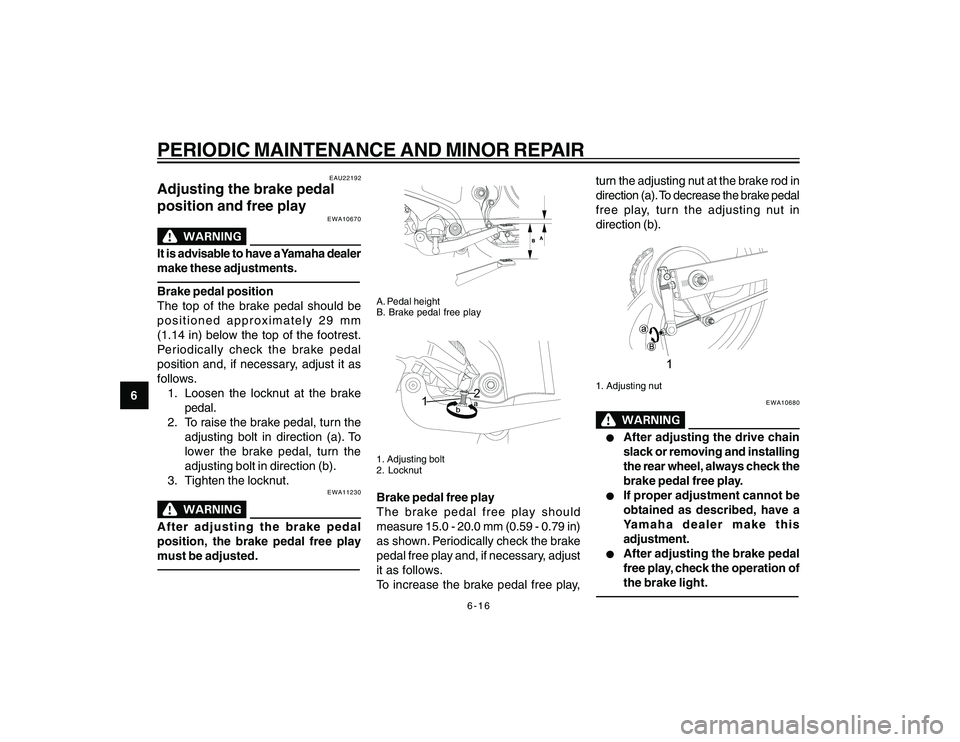
make these adjustments.Brake pedal position
The top of the brake pedal should be
positioned approximately 29 mm
(1.14 in) below the top of the footrest.
Periodically check the brake pedal
position and, if necessary, adjust it as
follows.1. Loosen the locknut at the brake pedal.
2. To raise the brake pedal, turn the adjusting bolt in direction (a). To
lower the brake pedal, turn the
adjusting bolt in direction (b).
3. Tighten the locknut.
EWA11230
After adjusting the brake pedal
position, the brake pedal free play
must be adjusted.
A. Pedal height
B. Brake pedal free play
1 2
1. Adjusting bolt
2. LocknutBrake pedal free play
The brake pedal free play should
measure 15.0 - 20.0 mm (0.59 - 0.79 in)
as shown. Periodically check the brake
pedal free play and, if necessary, adjust
it as follows.
To increase the brake pedal free play, turn the adjusting nut at the brake rod in
direction (a). To decrease the b
rake pedal
free play, turn the adjusting nut in
direction (b).
1. Adjusting nut
EWA10680
l
l l
l
l
After adjusting the drive chain
slack or removing and installing
the rear wheel, always check the
brake pedal free play.
l
l l
l
l
If proper adjustment cannot be
obtained as described, have a
Yamaha dealer make this
adjustment.
l
l l
l
l
After adjusting the brake pedal
free play, check the operation of
the brake light.
cap 6.pmd 24/1/2007, 14:37
16
Page 50 of 74
6-17
6
PERIODIC MAINTENANCE AND MINOR REPAIR
EAU22270
Adjusting the rear brake light
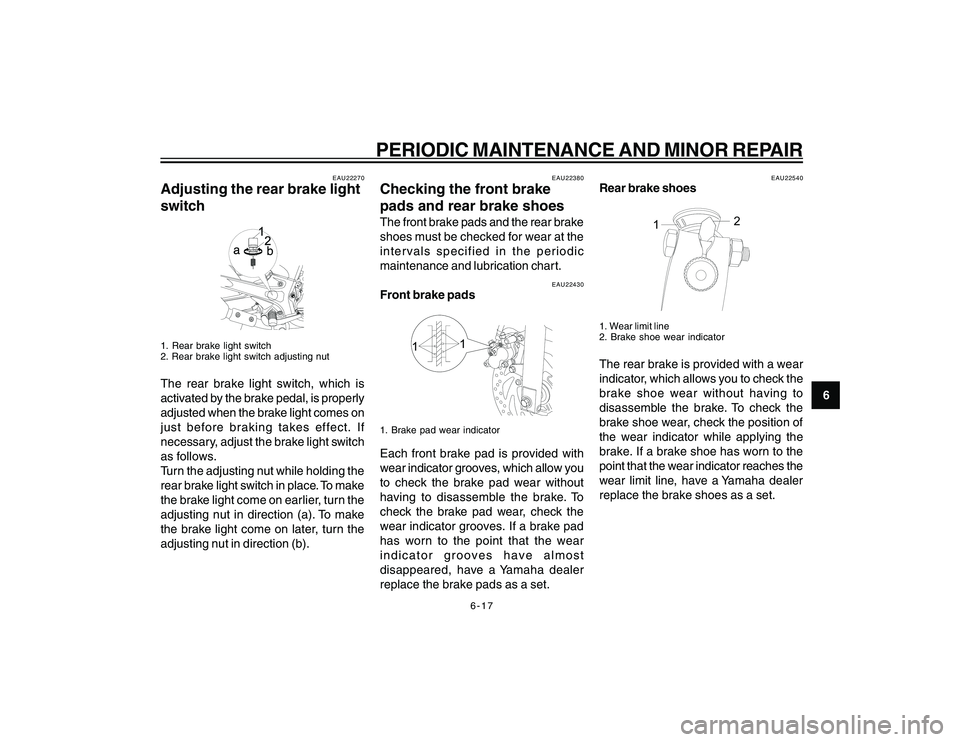
switch1. Rear brake light switch
2. Rear brake light switch adjusting nutThe rear brake light switch, which is
activated by the brake pedal, is properly
adjusted when the brake light comes on
just before braking takes effect. If
necessary, adjust the brake light switch
as follows.
Turn the adjusting nut while holding the
rear brake light switch in place. To make
the brake light come on earlier, turn the
adjusting nut in direction (a). To make
the brake light come on later, turn the
adjusting nut in direction (b).
EAU22380
Checking the front brake
pads and rear brake shoesThe front brake pads and the rear brake
shoes must be checked for wear at the
intervals specified in the periodic
maintenance and lubrication chart.
EAU22430
Front brake pads
11
1. Brake pad wear indicatorEach front brake pad is provided with
wear indicator grooves, which allow you
to check the brake pad wear without
having to disassemble the brake. To
check the brake pad wear, check the
wear indicator grooves. If a brake pad
has worn to the point that the wear
indicator grooves have almost
disappeared, have a Yamaha dealer
replace the brake pads as a set.
EAU22540
Rear brake shoes
1 2
1. Wear limit line
2. Brake shoe wear indicatorThe rear brake is provided with a wear
indicator, which allows you to check the
brake shoe wear without having to
disassemble the brake. To check the
brake shoe wear, check the position of
the wear indicator while applying the
brake. If a brake shoe has worn to the
point that the wear indicator reaches the
wear limit line, have a Yamaha dealer
replace the brake shoes as a set.
cap 6.pmd
24/1/2007, 14:38
17
Page 51 of 74
6-18
6
PERIODIC MAINTENANCE AND MINOR REPAIR
EAU37001
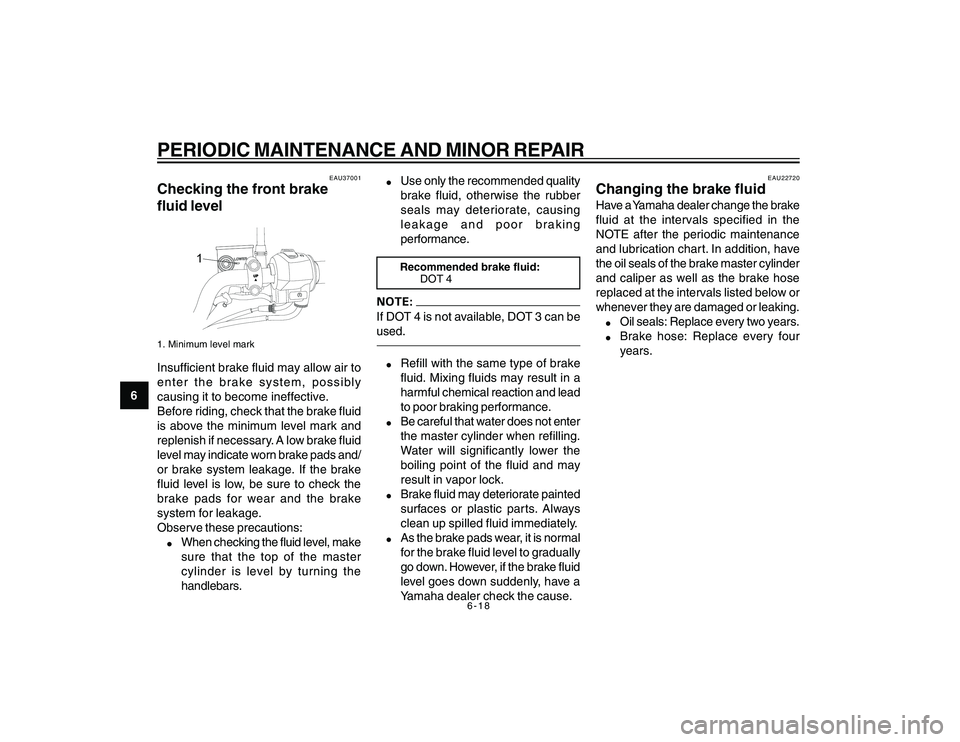
Checking the front brake
fluid level
LOWERLOWER
UP
1
1. Minimum level markInsufficient brake fluid may allow air to
enter the brake system, possibly
causing it to become ineffective.
Before riding, check that the brake fluid
is above the minimum level mark and
replenish if necessary. A low brake fluid
level may indicate worn brake pads and/
or brake system leakage. If the brake
fluid level is low, be sure to check the
brake pads for wear and the brake
system for leakage.
Observe these precautions:l
When checking the fluid level, make
sure that the top of the master
cylinder is level by turning the
handlebars.
l
Use only the recommended quality
brake fluid, otherwise the rubber
seals may deteriorate, causing
leakage and poor braking
performance.Recommended brake fluid: DOT 4
If DOT 4 is not available, DOT 3 can be
used.l
Refill with the same type of brake
fluid. Mixing fluids may result in a
harmful chemical reaction and lead
to poor braking performance.
l
Be careful that water does not enter
the master cylinder when refilling.
Water will significantly lower the
boiling point of the fluid and may
result in vapor lock.
l
Brake fluid may deteriorate painted
surfaces or plastic parts. Always
clean up spilled fluid immediately.
l
As the brake pads wear, it is normal
for the brake fluid level to gradually
go down. However, if the brake fluid
level goes down suddenly, have a
Yamaha dealer check the cause.
EAU22720
Changing the brake fluidHave a Yamaha dealer change the brake
fluid at the intervals specified in the
NOTE after the periodic maintenance
and lubrication chart. In addition, have
the oil seals of the brake master cylinder
and caliper as well as the brake hose
replaced at the intervals listed below or
whenever they are damaged or leaking.l
Oil seals: Replace every two years.
l
Brake hose: Replace every four
years.
cap 6.pmd 24/1/2007, 14:38
18
Page 52 of 74
6-19
6
PERIODIC MAINTENANCE AND MINOR REPAIR
EAU22760
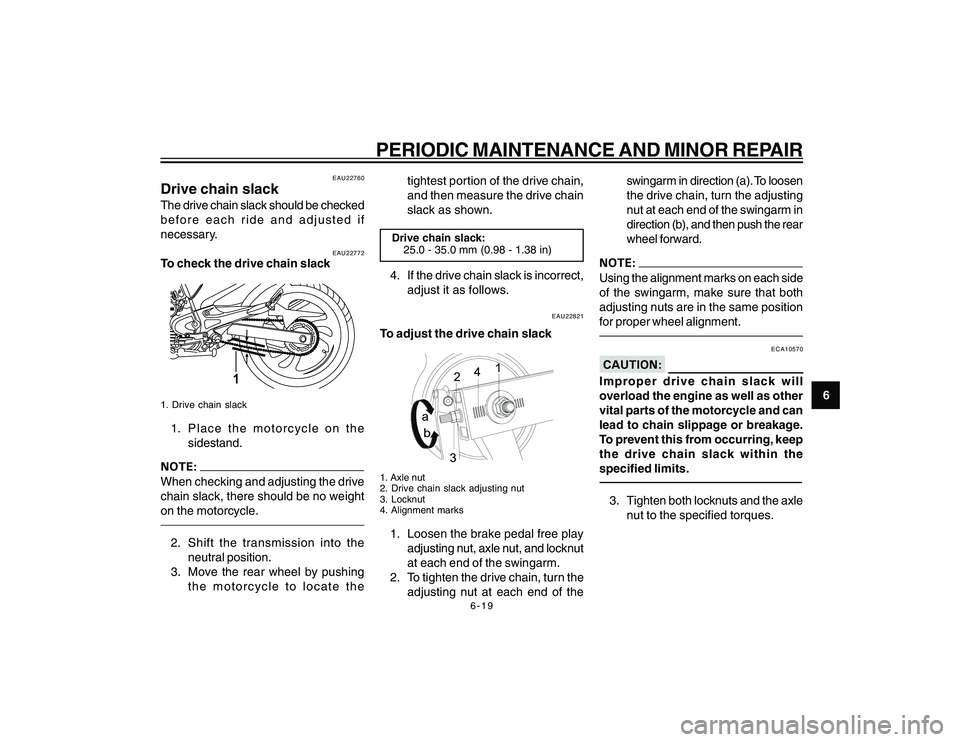
Drive chain slackThe drive chain slack should be checked
before each ride and adjusted if
necessary.
EAU22772
To check the drive chain slack
1
1. Drive chain slack1. Place the motorcycle on thesidestand.When checking and adjusting the drive
chain slack, there should be no weight
on the motorcycle.2. Shift the transmission into theneutral position.
3. Move the rear wheel by pushing the motorcycle to locate the tightest portion of the drive chain,
and then measure the drive chain
slack as shown.
Drive chain slack:
25.0 - 35.0 mm (0.98 - 1.38 in)4. If the drive chain slack is incorrect,
adjust it as follows.
EAU22821
To adjust the drive chain slack1. Axle nut
2. Drive chain slack adjusting nut
3. Locknut
4. Alignment marks1. Loosen the brake pedal free playadjusting nut, axle nut, and locknut
at each end of the swingarm.
2. To tighten the drive chain, turn the adjusting nut at each end of the swingarm in direction (a). To loosen
the drive chain, turn the adjusting
nut at each end of the swingarm in
direction (b), and then push the rear
wheel forward.
Using the alignment marks on each side
of the swingarm, make sure that both
adjusting nuts are in the same position
for proper wheel alignment.
ECA10570
Improper drive chain slack will
overload the engine as well as other
vital parts of the motorcycle and can
lead to chain slippage or breakage.
To prevent this from occurring, keep
the drive chain slack within the
specified limits.3. Tighten both locknuts and the axle
nut to the specified torques.
cap 6.pmd 24/1/2007, 14:38
19