tire YAMAHA YFM400F 2001 User Guide
[x] Cancel search | Manufacturer: YAMAHA, Model Year: 2001, Model line: YFM400F, Model: YAMAHA YFM400F 2001Pages: 426, PDF Size: 21.5 MB
Page 140 of 426

5-27
Yuki_Data:Yuki_data:Yuki:Yuki_1:ATV:HM00B061_YFM400FWA-61:YFM600-5.frame
EL
l
Recommended tire pressure
Front 25 kPa (0.25 kg/cm
2, 0.25 bar)
Rear 25 kPa (0.25 kg/cm2, 0.25 bar)
l
Check and adjust tire pressures when the
tires are cold.
l
Tire pressures must be equal on both
sides.
3. Tire pressure below the minimum speci-
fied could cause the tire to dislodge from
the rim under severe riding conditions.
The following are minimums:
Front 22 kPa (0.22 kg/cm
2, 0.22 bar)
Rear 22 kPa (0.22 kg/cm2, 0.22 bar)
4. Use no more than the following pressures
when seating the tire beads.
Front 250 kPa (2.5 kg/cm2, 2.5 bar)
Rear 250 kPa (2.5 kg/cm2, 2.5 bar)
Higher pressures may cause the tire to
burst. Inflate the tires very slowly and
carefully. Fast inflation could cause the tire
to burst.
Page 142 of 426
5-29
Yuki_Data:Yuki_data:Yuki:Yuki_1:ATV:HM00B061_YFM400FWA-61:YFM600-5.frame
EL
EBU00159
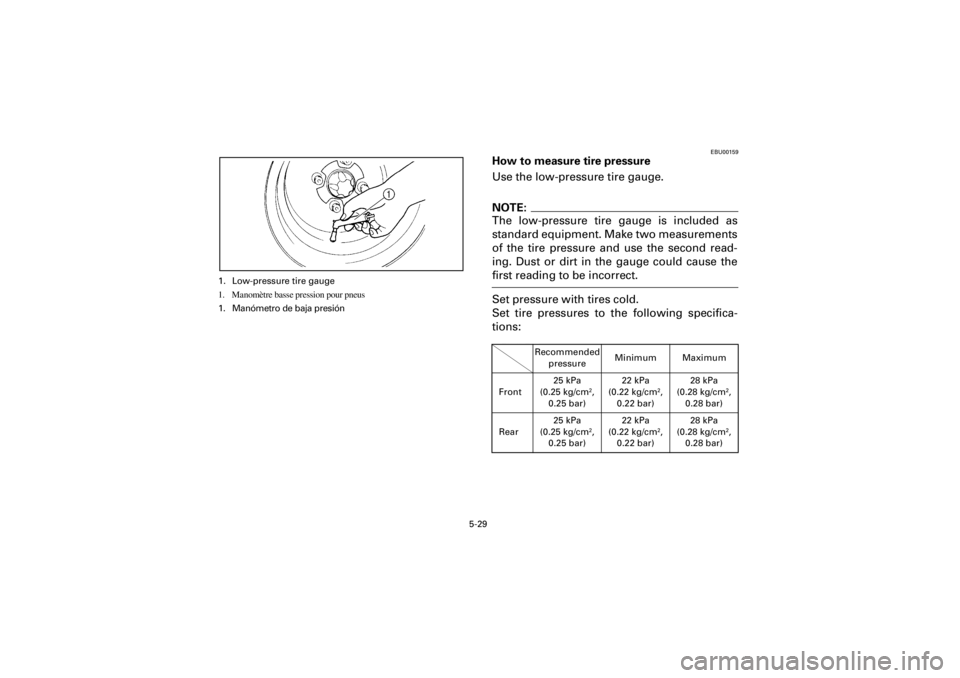
How to measure tire pressure
Use the low-pressure tire gauge.NOTE:The low-pressure tire gauge is included as
standard equipment. Make two measurements
of the tire pressure and use the second read-
ing. Dust or dirt in the gauge could cause thefirst reading to be incorrect.
Set pressure with tires cold.
Set tire pressures to the following specifica-
tions:ACE-02EACE-02E
Recommended
pressureMinimum Maximum
Front25 kPa
(0.25 kg/cm
2,
0.25 bar)22 kPa
(0.22 kg/cm
2,
0.22 bar)28 kPa
(0.28 kg/cm
2,
0.28 bar)
Rear25 kPa
(0.25 kg/cm
2,
0.25 bar)22 kPa
(0.22 kg/cm
2,
0.22 bar)28 kPa
(0.28 kg/cm
2,
0.28 bar)
1. Low-pressure tire gauge
1. Manomètre basse pression pour pneus
1. Manómetro de baja presión
Page 144 of 426
5-31
Yuki_Data:Yuki_data:Yuki:Yuki_1:ATV:HM00B061_YFM400FWA-61:YFM600-5.frame
EL
EBU00160
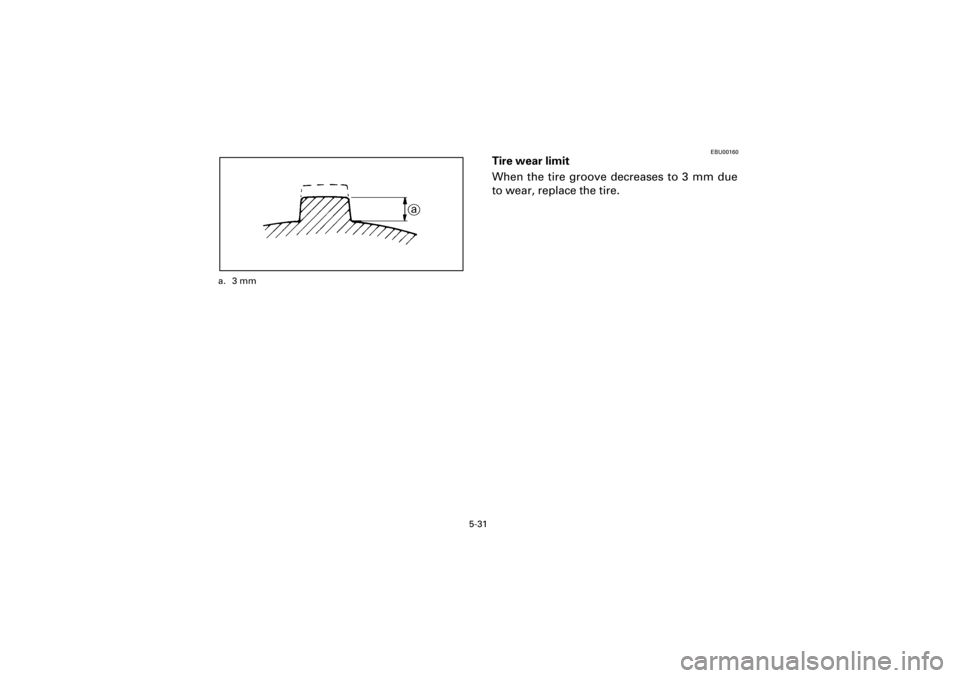
Tire wear limit
When the tire groove decreases to 3 mm due
to wear, replace the tire.
a. 3 mm
Page 153 of 426
6-8
Yuki_Data:Yuki_data:Yuki:Yuki_1:ATV:HM00B061_YFM400FWA-61:YFM600-6.frame
ER
N.B.:
l
Si le moteur ne se met pas en marche, relâcher le
contacteur du démarreur, puis appuyer à nouveau
sur celui-ci. Attendre quelques secondes entre cha-
que tentative. Chaque essai de mise en marche du
moteur doit être aussi court que possible afin de
préserver l’énergie de la batterie. Ne pas actionner
le démarreur pendant plus de 10 secondes d’affilée.
l
Si la batterie est déchargée, utiliser le lanceur à
réenroulement.
7. Si le moteur est mis en marche en plaçant le starter
sur la position
1
, placer celui-ci sur la position
2
pour réchauffer le moteur. Si le moteur est mis en
marche sur la position
2
, conserver cette position
pour réchauffer le moteur.
8. Continuer à faire chauffer le moteur jusqu’à ce que
le ralenti soit régulier et remettre le starter sur
3
avant de démarrer.
ATTENTION:ATTENTION:ATTENTION:ATTENTION:
Lire attentivement la section “Rodage du moteur”
avant la première utilisation du véhicule.
NOTA:
l
Si el motor no arranca, suelte el interruptor
de arranque, y presione de nuevo el inte-
rruptor de arranque. Espere algunos segun-
dos antes del intento siguiente. Cada viraje
del motor deberá ser lo más corto posible
para ahorrar energía de la batería. No vire el
motor más de 10 segundos seguidos en
cada intento.
l
Si la batería está descargada, tire del arran-
cador manual para arrancar el motor.
7. Si se arranca el motor con el arrancador
(choke) en la posición
1
, el arrancador
(choke) deberá girarse a la posición
2
para
calentar el motor. Si se arranca el motor con
el arrancador (choke) en la posición
2
,
mantenga el arrancador (choke) en esta po-
sición para calentar el motor.
8. Siga calentando el motor hasta que funcio-
ne con un ralentí suave y reponga el arran-
cador (choke) a la posición
3
antes de
circular.
ATENCION:
Consulte la sección “Rodaje del motor” antes de
poner en marcha el motor por primera vez.
Page 192 of 426
7-15
Yuki_Data:Yuki_data:Yuki:Yuki_1:ATV:HM00B061_YFM400FWA-61:YFM600-7.frame
EL
WARNING
Always use the size and type tires specified in
the Owner’s Manual for this vehicle on pages
5-25 ~ 5-27. Always maintain proper tire pres-
sure as described in the Owner’s Manual on
page 5-29. Use of improper tires on this ATV,
or operation of this ATV with improper or un-
even tire pressure, may cause loss of control,
increasing your risk of an accident.
Do not operate at speeds too fast for your
skills or the conditions.
WARNING
Always go at a speed that is proper for the ter-
rain, visibility and operating conditions, and
your experience. Operating this ATV at speeds
too fast for your skills or the conditions in-
creases your chances of losing control of the
ATV, which can result in an accident.
Page 214 of 426
7-37
Yuki_Data:Yuki_data:Yuki:Yuki_1:ATV:HM00B061_YFM400FWA-61:YFM600-7.frame
EL
With the engine idling, shift the drive select le-
ver into low or high. Then release the parking
brake. Apply the throttle slowly and smoothly.
The centrifugal clutch will engage and you will
start to accelerate. If the throttle is applied too
abruptly, the front wheels may lift off the
ground resulting in a loss of directional con-
trol. Avoid higher speeds until you are thor-
oughly familiar with the operation of your ATV.
When slowing down or stopping, release the
throttle and apply the brakes smoothly and
evenly. Improper use of the brakes can cause
the tires to lose traction, reducing control and
increasing the possibility of an accident.CAUTION:Do not shift from low to high or vice versa
without coming to a complete stop. Damageto the engine or drive train may occur.
Page 240 of 426
7-63
Yuki_Data:Yuki_data:Yuki:Yuki_1:ATV:HM00B061_YFM400FWA-61:YFM600-7.frame
EL
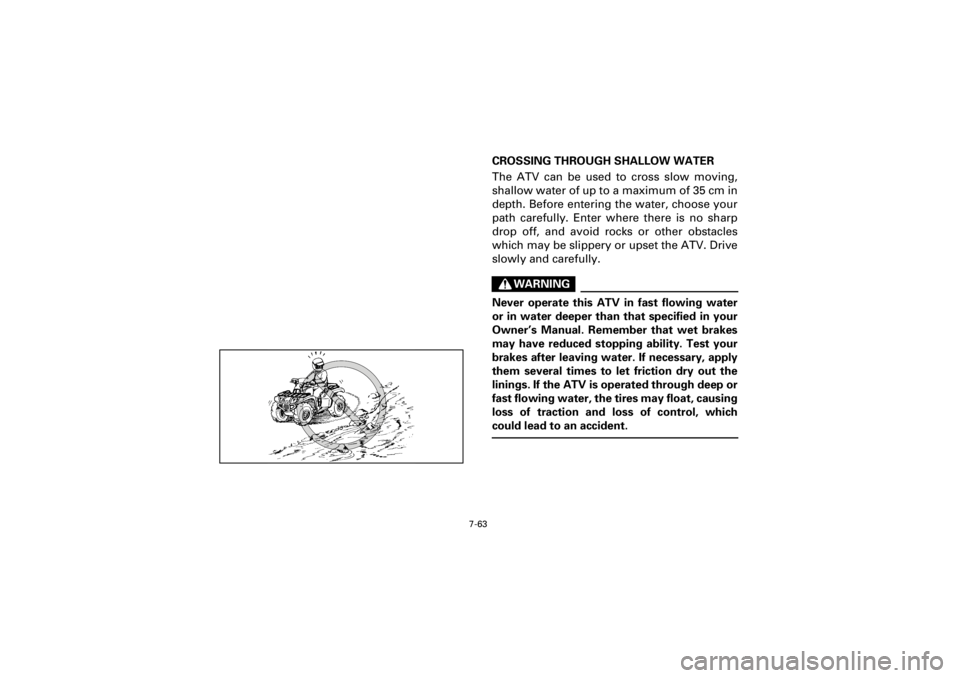
CROSSING THROUGH SHALLOW WATER
The ATV can be used to cross slow moving,
shallow water of up to a maximum of 35 cm in
depth. Before entering the water, choose your
path carefully. Enter where there is no sharp
drop off, and avoid rocks or other obstacles
which may be slippery or upset the ATV. Drive
slowly and carefully.
WARNING
Never operate this ATV in fast flowing water
or in water deeper than that specified in your
Owner’s Manual. Remember that wet brakes
may have reduced stopping ability. Test your
brakes after leaving water. If necessary, apply
them several times to let friction dry out the
linings. If the ATV is operated through deep or
fast flowing water, the tires may float, causing
loss of traction and loss of control, whichcould lead to an accident.
Page 260 of 426
8-3
Yuki_Data:Yuki_data:Yuki:Yuki_1:ATV:HM00B061_YFM400FWA-61:YFM600-8.frame
EL
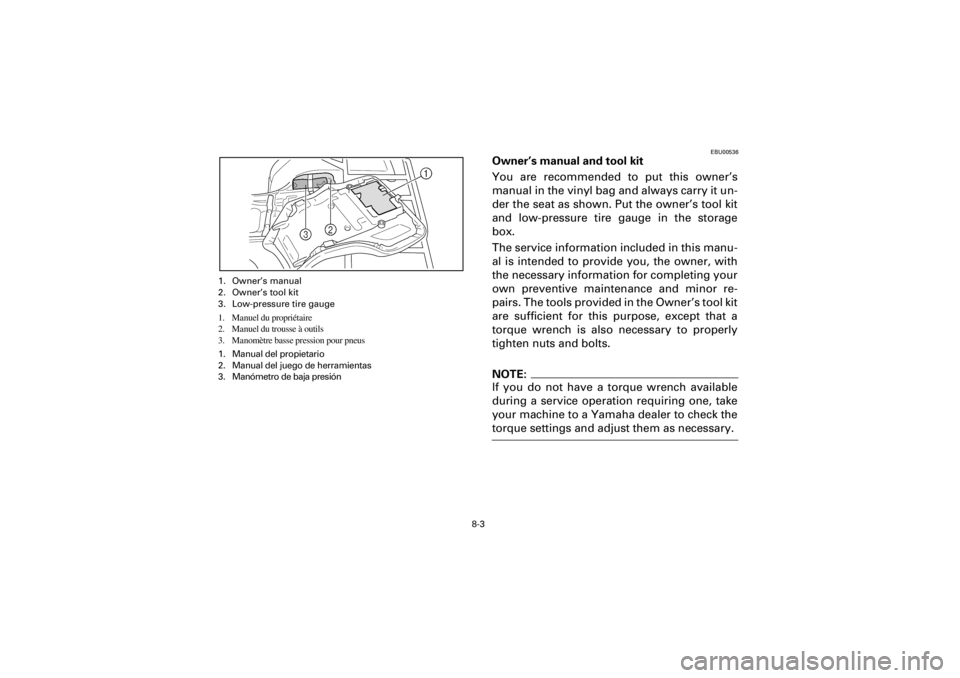
1. Owner’s manual
2. Owner’s tool kit
3. Low-pressure tire gauge
1. Manuel du propriétaire
2. Manuel du trousse à outils
3. Manomètre basse pression pour pneus
1. Manual del propietario
2. Manual del juego de herramientas
3. Manómetro de baja presión
EBU00536
Owner’s manual and tool kit
You are recommended to put this owner’s
manual in the vinyl bag and always carry it un-
der the seat as shown. Put the owner’s tool kit
and low-pressure tire gauge in the storage
box.
The service information included in this manu-
al is intended to provide you, the owner, with
the necessary information for completing your
own preventive maintenance and minor re-
pairs. The tools provided in the Owner’s tool kit
are sufficient for this purpose, except that a
torque wrench is also necessary to properly
tighten nuts and bolts.
NOTE:
If you do not have a torque wrench available
during a service operation requiring one, take
your machine to a Yamaha dealer to check the
torque settings and adjust them as necessary.
Page 275 of 426

8-18
Yuki_Data:Yuki_data:Yuki:Yuki_1:ATV:HM00B061_YFM400FWA-61:YFM600-8.frame
ER
FBU00700
Cache A, D
Dépose
1. Déposer la selle.
2. Tirer vers l’arrière aux endroits indiqués, puis tirer
vers le haut.
SBU00700
Panel A, D
Para la extracción
1. Extraiga el asiento.
2. Tire hacia fuera por la parte indicada, y en-
tonces tire hacia arriba.
Page 279 of 426

8-22
Yuki_Data:Yuki_data:Yuki:Yuki_1:ATV:HM00B061_YFM400FWA-61:YFM600-8.frame
ER
FBU00616
Cache B
Dépose
Retirer les boulons.
Mise en placeRemettre le cache à sa place, puis monter les boulons.
SBU00616
Panel B
Para extraerlo
Extraiga los pernos.
Para instalarloColoque el panel en su posición original e instale
los pernos.