engine YAMAHA YFM90R 2009 User Guide
[x] Cancel search | Manufacturer: YAMAHA, Model Year: 2009, Model line: YFM90R, Model: YAMAHA YFM90R 2009Pages: 120, PDF Size: 9.14 MB
Page 24 of 120
4-4
44
The vehicle speed limiter keeps the throttle from fully
opening, even when the throttle lever is pushed to the
maximum. The adjusting screw may be gradually
turned out as the beginner becomes more familiar with
operating the ATV. Parents should decide when to
adjust the ATV for more power as their youngster’s
riding skills improve. Once the ATV rider can operate
with skill at the top speed permitted by adjusting the
vehicle speed limiter alone, the engine speed limiter
plate can be removed. Since removal of this limiter
will result in a significant increase in power, turn the
vehicle speed limiter adjusting screw completely back
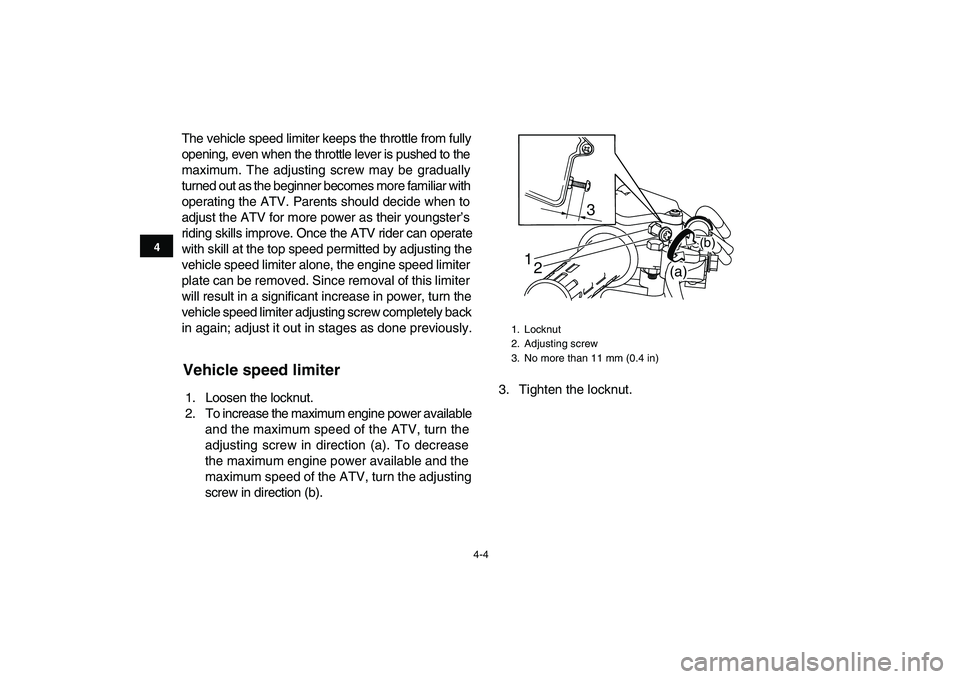
in again; adjust it out in stages as done previously.Vehicle speed limiter1. Loosen the locknut.
2. To increase the maximum engine power available
and the maximum speed of the ATV, turn the
adjusting screw in direction (a). To decrease
the maximum engine power available and the
maximum speed of the ATV, turn the adjusting
screw in direction (b).
(b)
(a)
1 2
3. Tighten the locknut.2. Adjusting screw1. Locknut
3. No more than 11 mm (0.4 in)
3
Page 25 of 120
4-5
4
WARNING
Improper adjustment of the speed limiter and
throttle could cause throttle cable damage or
improper throttle operation. You could lose
control, have an accident or be injured. Do not
turn the adjusting screw out more than 5 mm
(0.2 in).Engine speed limiter plate
TIPStore the speed limiter plate with the owner’s manual
so that it is readily available whenever you want to
reduce the top engine speed.
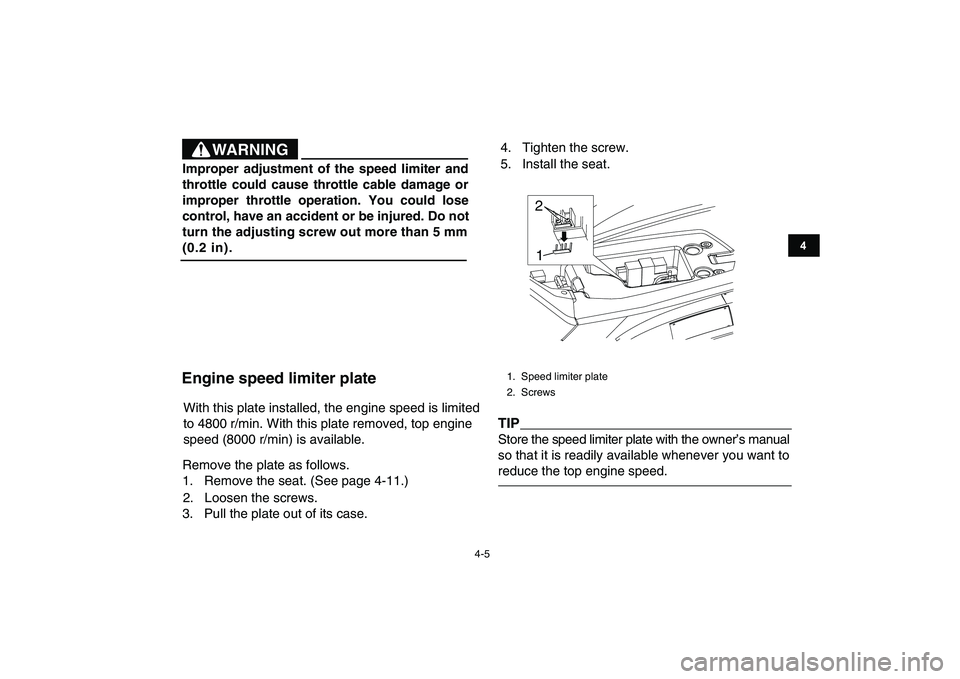
With this plate installed, the engine speed is limited
to 4800 r/min. With this plate removed, top engine
speed (8000 r/min) is available.
Remove the plate as follows.
1. Remove the seat. (See page 4-11.)
3. Pull the plate out of its case. 4. Tighten the screw.
2. Loosen the screws.
5. Install the seat.
1. Speed limiter plate
2. Screws
21
Page 27 of 120
4-7
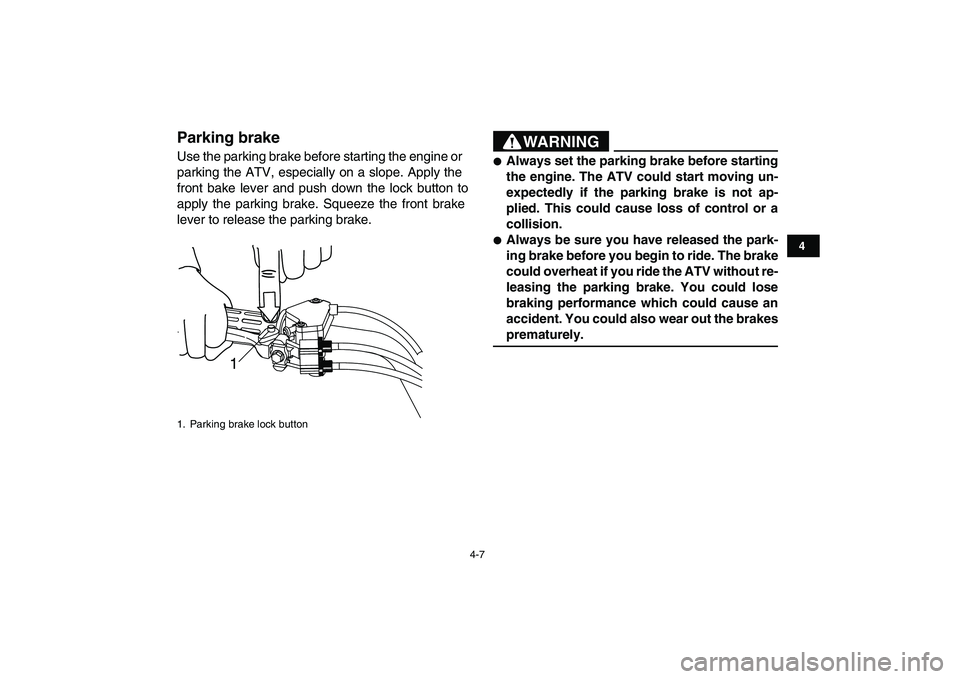
Parking brake Use the parking brake before starting the engine or
parking the ATV, especially on a slope. Apply the
front bake lever and push down the lock button to
apply the parking brake. Squeeze the front brake
lever to release the parking brake.1. Parking brake lock button
4
1
WARNING
Always set the parking brake before starting
the engine. The ATV could start moving un-
expectedly if the parking brake is not ap-
plied. This could cause loss of control or a
collision.Always be sure you have released the park-
ing brake before you begin to ride. The brake
could overheat if you ride the ATV without re-
leasing the parking brake. You could lose
braking performance which could cause an
accident. You could also wear out the brakesprematurely.
Page 29 of 120
4-9
N O T I C EUse only unleaded gasoline. The use of leaded
gasoline will cause severe damage to internal
engine parts, such as the valves and pistonrings, as well as to the exhaust system.
4
WARNING
Do not overfill the fuel tank. Fuel expands
when it heats up. If the fuel tank is overfilled,
fuel could spill out due to heat from the en-
gine or the sun.Be careful not to spill fuel, especially on the
engine or exhaust pipe which can cause a
fire and severe injury. Wipe up any spilled
fuel immediately.Do not refuel right after the engine has been
running and is still very hot.Be sure the fuel tank cap is closed securely.
Page 30 of 120
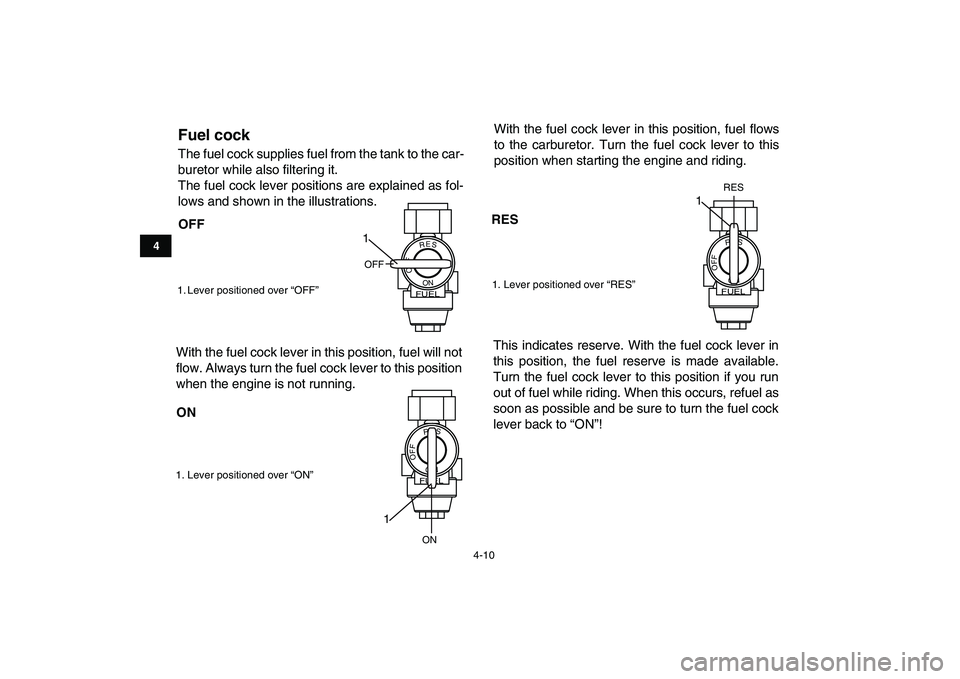
Fuel cock The fuel cock supplies fuel from the tank to the car-
buretor while also filtering it.
The fuel cock lever positions are explained as fol-
lows and shown in the illustrations.1. Lever positioned over “OFF”
RES
OFFWith the fuel cock lever in this position, fuel will not
flow. Always turn the fuel cock lever to this position
when the engine is not running.ONRES
5
1. Lever positioned over “RES”
1. Lever positioned over “ON” 4-10 With the fuel cock lever in this position, fuel flows
to the carburetor. Turn the fuel cock lever to this
position when starting the engine and riding.
This indicates reserve. With the fuel cock lever in
this position, the fuel reserve is made available.
Turn the fuel cock lever to this position if you run
out of fuel while riding. When this occurs, refuel as
soon as possible and be sure to turn the fuel cock
lever back to “ON”!
OFF
ON
RES
FUEL
1OFF
OFF
ON
RES
FUELRES
1
OFF
ON
RES
FUEL
1
ON
4
Page 31 of 120
4-11
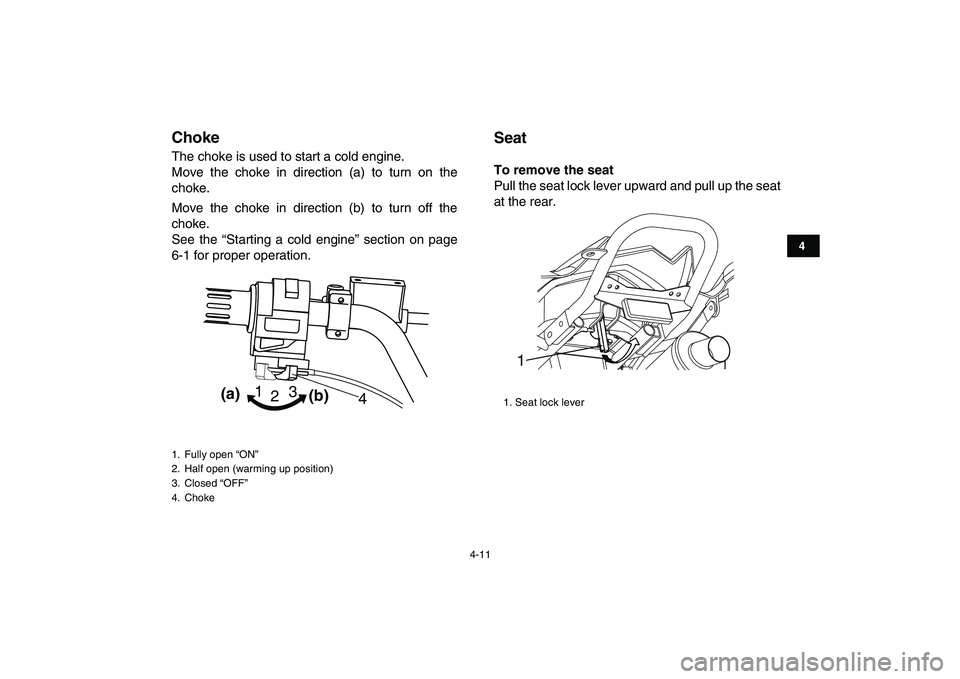
ChokeThe choke is used to start a cold engine.
Move the choke in direction (a) to turn on the
choke.
Move the choke in direction (b) to turn off the
choke.
See the “Starting a cold engine” section on page
6-1 for proper operation.1. Fully open “ON”
2. Half open (warming up position)
3. Closed “OFF”
4. Choke
1 2 3
(a)
(b)
4
4
SeatTo remove the seat
Pull the seat lock lever upward and pull up the seat
at the rear.
1
1. Seat lock lever
Page 34 of 120

9
Make sure that operation is smooth, and check cable free play.Lubricate cable and lever housing if necessary.
Control cablesMake sure that operation is smooth. Lubricate if necessary. 8-27
Wheels and tiresCheck wheel condition, and replace if damaged.Check tire condition and tread depth. Replace if necessary.Check air pressure. Correct if necessary. 5-4, 5-5, 5-6
Brake leversMake sure that operation is smooth. Lubricate lever pivoting points
if necessary. 8-27
Chassis fastenersMake sure that all nuts, bolts and screws are properly tightened. 5-7
Instruments and switchesCheck operation, and correct if necessary. 5-7
2
5-2
9
Throttle lever 5-4, 8-21
5
PAGE
ROUTINE
METIT
Fuel
Check fuel line for leakage. Correct if necessary . 4-8, 5-3Check A TV for oil leakage. Correct if necessary .5-3, 8-11
Final transmission oil
5-3, 8-14
Check ATV for oil leakage. Correct if necessary.
Front brake
Check operation, and correct if necessary.Lubricate cable if necessary .Check lever free play , and adjust if necessary. 5-3, 8-22, 8-23
Engine oil
Check fuel level in fuel tank, and add recommended fuel if neces-
sary.Check brake pads for wear, and replace if necessary.
Check brake fluid level in reservoir, and add recommended brake fluid to specified level if necessary.
Check hydraulic system for leakage. Correct if necessary. Check operation. If soft or spongy, have Yamaha dealer bleed
hydraulic system.
Rear brake 5-3, 8-25, 8-26
Check oil level in engine, and add recommended oil to specified
level if necessary.
Page 35 of 120

5-3
FuelMake sure that there is sufficient fuel in the tank.
(See page 4-8.)
Engine oilMake sure that the engine oil is at the specified lev-
el. Add oil as necessary. (See page 8-11.)
Final transmission oilMake sure that the final transmission oil is at the
specified level. Add oil as necessary.
(See page 8-14.)Front and rear brakesRecommended brake fluid:
DOT4
3
Brake fluid leakage
Check to see if any brake fluid is leaking out of the
pipe joint or brake fluid reservoir. Apply the brake
firmly for one minute. If there is any leakage, have a
Yamaha dealer check the brake system.Brake leversCheck for correct free play in the brake levers. If
the free play is incorrect, adjust it. (See pages
8-23 and 8-26.)Check operation of the levers. They should
move smoothly and there should be a firm feel-
ATV checked by a Yamaha dealer.
6
Brake fluid level
Check the brake fluid level. Add fluid if necessary.
(See page 8-25.)
15
WARNING
Do not overfill the fuel tank. Fuel expands
when it heats up. If the fuel tank is overfilled,
fuel could spill out due to heat from the en-
gine or the sun.Be careful not to spill fuel, especially on the
engine or exhaust pipe which can cause a
fire and severe injury. Wipe up any spilled
fuel immediately.Do not refuel right after the engine has been
running and is still very hot.Be sure the fuel tank cap is closed securely.
ing when the brakes are applied. If not, have the
Page 40 of 120

6-1
OPERATION
6
N O T I C E
See the “Engine break-in” section on page 6-4prior to operating the engine for the first time.1. Set the parking brake.
2. Turn the fuel cock to “ON”.
3. Turn the main switch to “ON” and the engine stop switch to “RUN”.
Read the Owner’s Manual carefully before riding
the ATV.
WARNING
Read the Owner’s Manual carefully to become
familiar with all controls in order to help pre-
vent any loss of control, which could cause an
accident or injury. If there is a control or func-
tion you do not understand, ask your Yamahadealer. Starting a cold engine
WARNING
Always make sure all control cables work
smoothly before you begin riding in cold
weather. If the control cables are frozen or do
not work smoothly, you could be unable to
control the ATV, which could lead to an acci-dent or collision.
Page 41 of 120
6-2
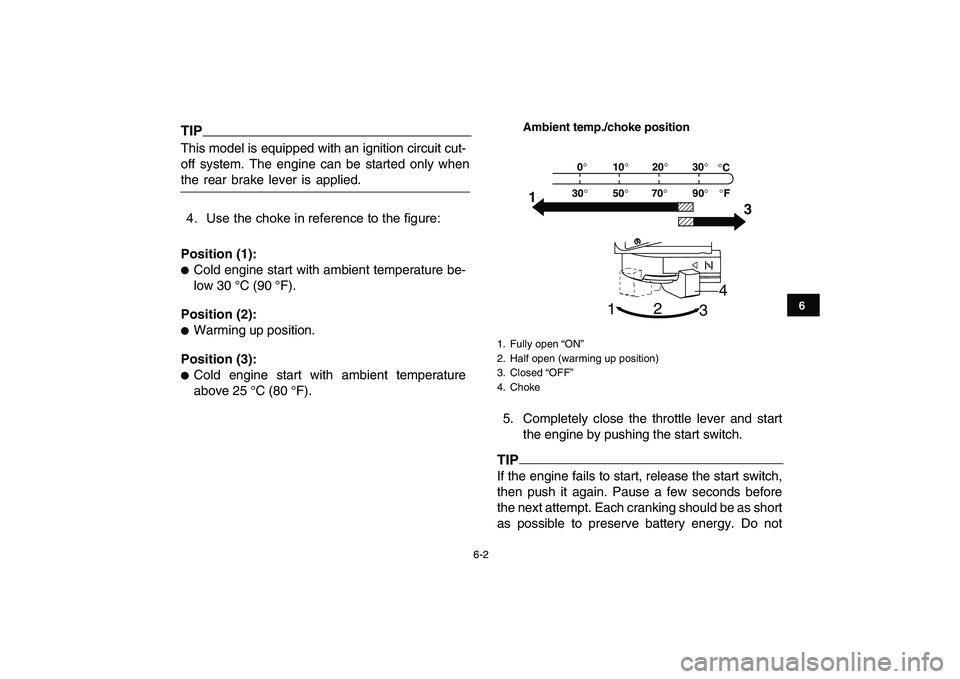
Ambient temp./choke position
5. Completely close the throttle lever and start
the engine by pushing the start switch.TIPIf the engine fails to start, release the start switch,
then push it again. Pause a few seconds before
the next attempt. Each cranking should be as short
as possible to preserve battery energy. Do not1. Fully open “ON”
2. Half open (warming up position)
3. Closed “OFF”
4. Choke
0°
30° 10°
20° 30°
50° 70° 90° °F
°C
1
3
TIPThis model is equipped with an ignition circuit cut-
off system. The engine can be started only when
the rear brake lever is applied.4. Use the choke in reference to the figure:
Position (1):Cold engine start with ambient temperature be-
low 30 °C (90 °F).
Position (2):Warming up position.
Position (3):Cold engine start with ambient temperature
above 25 °C (80 °F).
66
1 3
2 4