engine YAMAHA YFM90R 2009 Owner's Manual
[x] Cancel search | Manufacturer: YAMAHA, Model Year: 2009, Model line: YFM90R, Model: YAMAHA YFM90R 2009Pages: 120, PDF Size: 9.14 MB
Page 42 of 120

6-3
6
crank the engine more than 10 seconds on eachattempt.6. If the engine is started with the choke in posi- tion (1), the choke should be returned to posi-
tion (2) to warm up the engine. If the engine is
started with the choke in position (2), keep the
choke in this position to warm up the engine.
N O T I C E
For maximum engine life, always warm the en-
gine up before starting off. Never acceleratehard when the engine is cold!
7. Continue warming up the engine until it idles smoothly, then return the choke to position (3)
before riding.TIPThe engine is warm when it responds normally tothe throttle with the choke turned off. Starting a warm engine Follow the same procedure as for starting a cold
engine, with the exception that the choke is not re-
quired when the engine is warm. Instead, start the
engine with the throttle slightly open.
To start out and accelerate1. Squeeze the front brake lever to release the parking brake.
2. Gradually open the throttle while slowly re- leasing the rear brake lever. To decelerate
When slowing down or stopping, release the throt-
tle and apply the brakes smoothly and evenly. Im-
proper use of the brakes can cause the tires to lose
traction, reducing control and increasing the possi-
bility of an accident.
WARNING
Opening the throttle abruptly or releasing the
clutch lever too quickly could make the ATV
wheelie, which would increase the chance ofan accident, including an overturn.
Page 43 of 120

Engine break-in There is never a more important period in the life of
your engine than the first 320 km (200 mi) or 20
hours of riding. For this reason, you should read
the following material carefully.
Since the engine is brand new, do not put an ex-
cessive load on it for the first 320 km (200 mi) or 20
hours. The various parts in the engine wear and
N O T I C E Do not tow the ATV for long distances. The
transmission is properly lubricated only when
the engine is running. Inadequate lubrication
may damage the transmission.
160–320 km (100–200 mi) or 10–20 hours
Avoid prolonged operation above 3/4 throttle. Rev
the engine freely, but do not use full throttle at any
time.
N O T I C E
If any engine trouble should occur during the
engine break-in period, immediately have a ParkingWhen parking the ATV, stop the engine, shift the
drive select lever into the drive position, apply the
parking brake, and then turn the fuel cock to “OFF”. Yamaha dealer check the ATV. 320 km (200 mi) or 20 hours and beyond
The ATV can now be operated normally.0–160 km (0–100 mi) or 0–10 hours
Avoid prolonged operation above 1/2 throttle. Vary
the speed of the ATV regularly. Do not operate it at
one set throttle position.
polish themselves to the correct operating clear-
ances. During this period, prolonged full-throttle
operation or any condition that might result in en-
gine overheating must be avoided.
6-4
6
Page 44 of 120
6-5
Parking on a slope1. Bring the ATV to a stop by applying the brakesin the drive position.
2. Stop the engine.
3. Apply the parking brake.
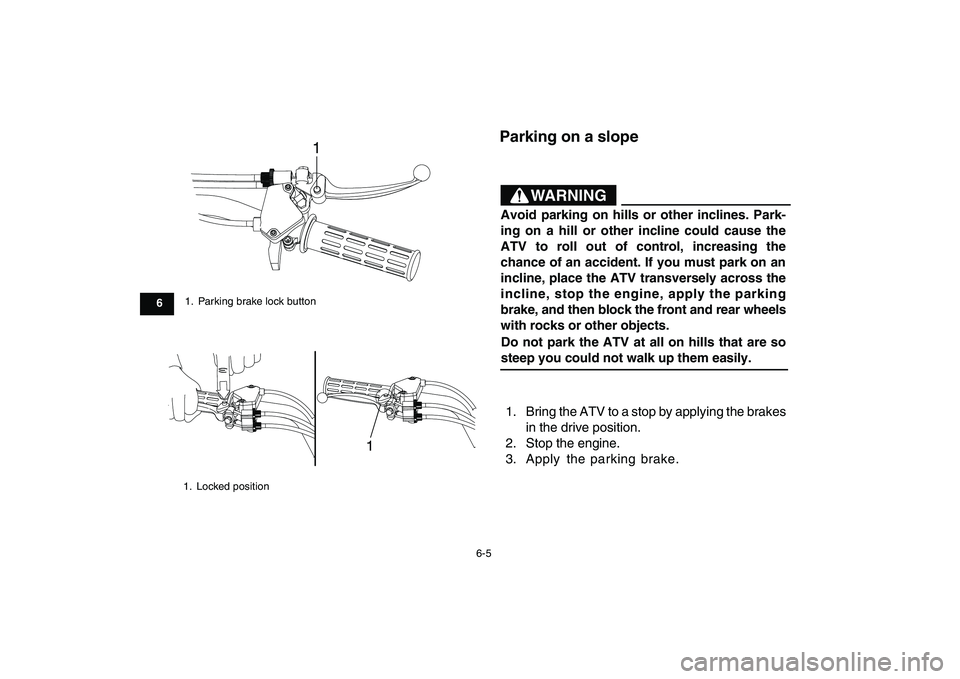
1. Parking brake lock button
1. Locked position
6
1
1
WARNING
Avoid parking on hills or other inclines. Park-
ing on a hill or other incline could cause the
ATV to roll out of control, increasing the
chance of an accident. If you must park on an
incline, place the ATV transversely across the
incline, stop the engine, apply the parking
brake, and then block the front and rear wheels
with rocks or other objects. Do not park the ATV at all on hills that are sosteep you could not walk up them easily.
Page 49 of 120
7-3
Riding your ATV requires skills acquired
through practice over a period of time.
Take the time to learn the basic techniques well
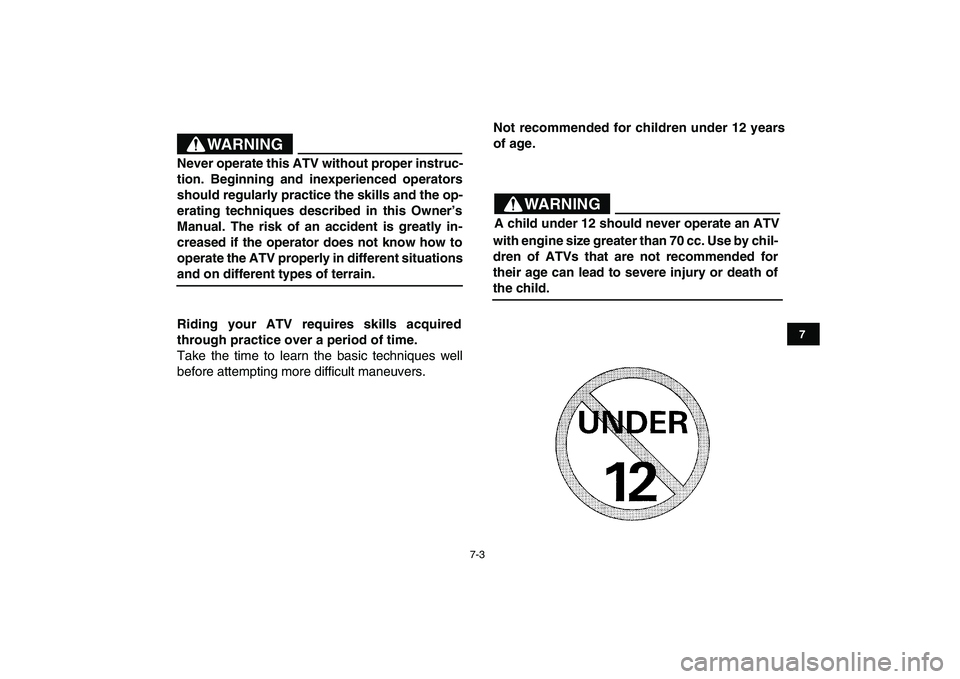
before attempting more difficult maneuvers.Not recommended for children under 12 years
of age.
7
WARNING
Never operate this ATV without proper instruc-
tion. Beginning and inexperienced operators
should regularly practice the skills and the op-
erating techniques described in this Owner’s
Manual. The risk of an accident is greatly in-
creased if the operator does not know how to
operate the ATV properly in different situationsand on different types of terrain.
WARNING
A child under 12 should never operate an ATV
with engine size greater than 70 cc. Use by chil-
dren of ATVs that are not recommended for
their age can lead to severe injury or death ofthe child.
Page 53 of 120
7-7
Do not operate at speeds too fast for your
skills or the conditions.Speed limiters
For riders less experienced with this model, the
throttle lever housing is equipped with a vehicle
speed limiter. This speed limiter keeps the throttle
from fully opening, even when the throttle lever is
pushed to the maximum. Turning in the adjusting
screw limits the maximum engine power available
and decreases the maximum speed of the ATV.
Turning in the adjusting screw decreases top speed,
and turning it out increases top speed.
(See pages 4-3 and 4-4.)
7
This model also has an engine speed limiter plate
to limit the amount of engine power available.
WARNING
Always use the size and type tires specified in
the Owner’s Manual for this ATV on page 5-4.
Always maintain proper tire pressure as de-
scribed in the Owner’s Manual on page 5-5.
Use of improper tires on this ATV, or operation
of this ATV with improper or uneven tire pres-
sure, may cause loss of control, increasingyour risk of an accident.
WARNING
Always go at a speed that is proper for the ter-
rain, visibility and operating conditions, and
your experience. Operating this ATV at speeds
too fast for your skills or the conditions in-
creases your chances of losing control of theATV, which can result in an accident.
Yamaha recommends that all beginning riders start
off with the vehicle speed limiter turned in and the
engine speed limiter plate installed to limit the amount
of speed available while they learn. The vehicle speed
limiter may be gradually adjusted to increase maximum
speed as the beginner becomes more familiar with
operating the ATV. Parents should decide when to
adjust the ATV for more power as their youngster’s
riding skills improve. Once the ATV rider can operate
with skill at the top speed permitted by adjusting the
vehicle speed limiter alone, the engine speed limiter
plate can be removed. Since removal of this plate will
Page 54 of 120
7-8
result in a significant increase in power, turn the vehicle
speed limiter adjusting screw back in again; adjust it
out in stages as you did before. For engine speed
limiter plate removal instructions, see page 4-4.Loading and accessories
Use extra caution when riding the ATV with addi-
tional loads, such as accessories or cargo. The
ATV’s handling may be adversely affected. Re-
duce your speed when adding additional loads.
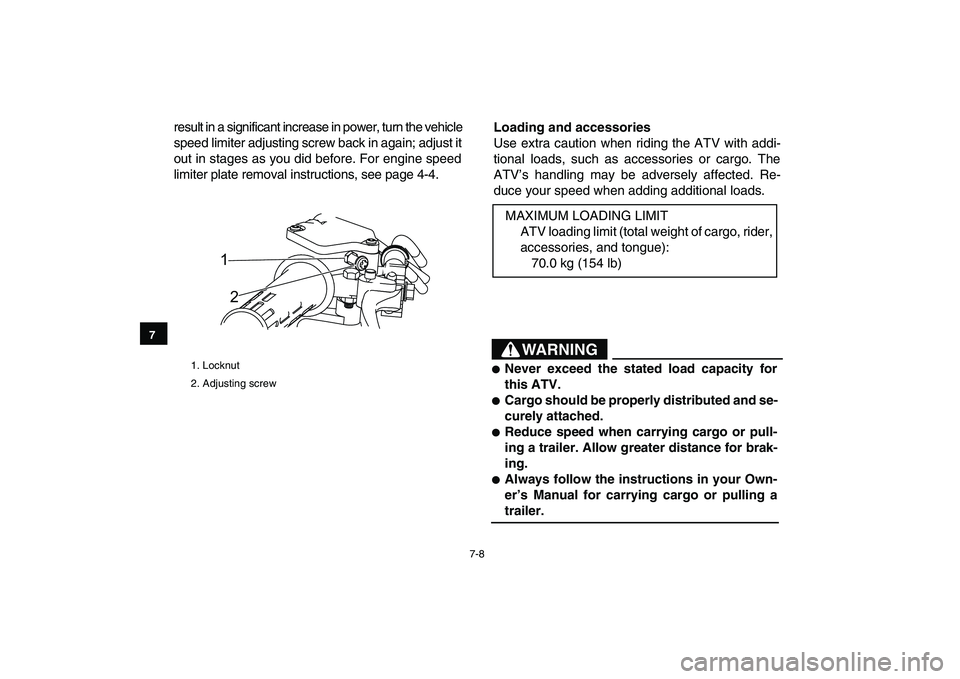
2. Adjusting screw
MAXIMUM LOADING LIMIT
ATV loading limit (total weight of cargo, rider,
accessories, and tongue):70.0 kg (154 lb)
7
1. Locknut
1
2
WARNING
Never exceed the stated load capacity for
this ATV.Cargo should be properly distributed and se-
curely attached.Reduce speed when carrying cargo or pull-
ing a trailer. Allow greater distance for brak-
ing.Always follow the instructions in your Own-
er’s Manual for carrying cargo or pulling atrailer.
Page 61 of 120

7-15
Do not ride in areas posted “no trespassing”.
Do not ride on private property without getting per-
mission.
Select a large, flat area off-road to become familiar
with your ATV. Make sure that this area is free of
obstacles and other riders. You should practice
control of the throttle, brakes, and turning tech-
niques in this area before trying more difficult ter-
rain. Always avoid riding on paved surfaces: the
ATV is designed for off-road use only, and han-
dling maneuvers are more difficult to perform on
pavement.
Set the parking brake and follow the instruction on
page 6-1 to start the engine. Once it has warmed
up you are ready to begin riding your ATV. Re-
7
member that the engine and exhaust pipe will be
hot when riding and afterwards; do not allow skin
or clothing to come in contact with these compo-
nents.
Apply the throttle slowly and smoothly. You will
start to accelerate. If the throttle is applied too
abruptly, the front wheels may lift off the ground,
resulting in a loss of directional control. Avoid
higher speeds until you are thoroughly familiar
with the operation of your ATV.
When slowing down or stopping, release the throt-
tle and apply the brakes smoothly and evenly. Im-
proper use of the brakes can cause the tires to lose
traction, reducing control and increasing the possi-
bility of an accident.
TURNING YOUR ATV
To achieve maximum traction while riding off-road,
the two rear wheels are mounted solidly on one
axle and turn together at the same speed. There-
fore, unless the wheel on the inside of the turn is al-
lowed to slip or lose some traction, the ATV will
resist turning. A special turning technique must be
used to allow the ATV to make turns quickly and
easily. It is essential that this skill be learned first at With the engine idling, release the parking brake.
Page 66 of 120
7-20
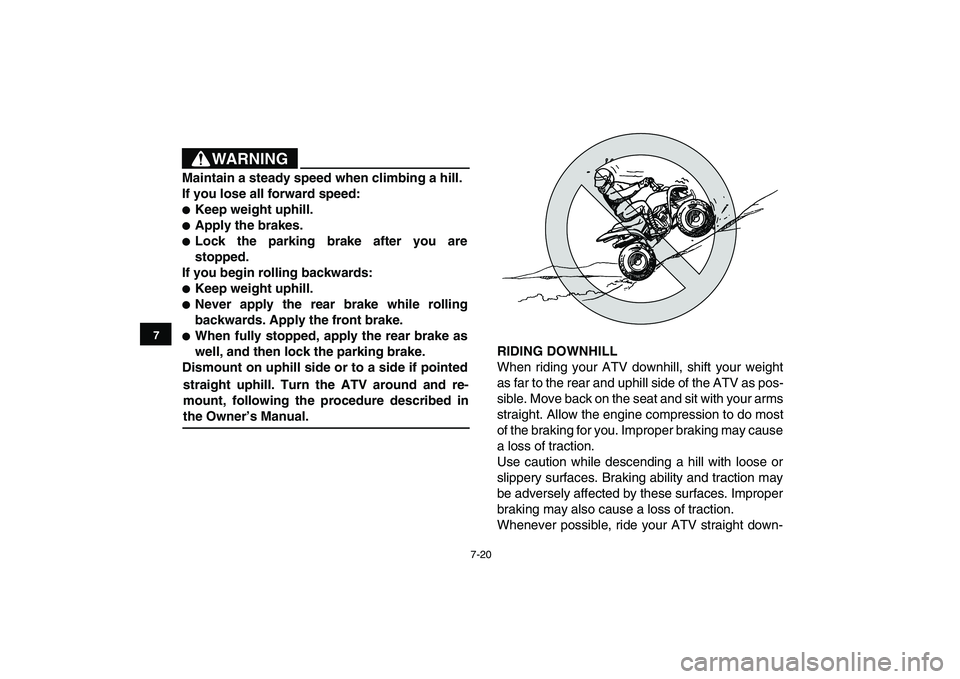
RIDING DOWNHILL
When riding your ATV downhill, shift your weight
as far to the rear and uphill side of the ATV as pos-
sible. Move back on the seat and sit with your arms
straight. Allow the engine compression to do most
of the braking for you. Improper braking may cause
a loss of traction.
Use caution while descending a hill with loose or
slippery surfaces. Braking ability and traction may
be adversely affected by these surfaces. Improper
braking may also cause a loss of traction.
Whenever possible, ride your ATV straight down-
7
WARNING
Maintain a steady speed when climbing a hill.
If you lose all forward speed:Keep weight uphill.Apply the brakes.Lock the parking brake after you are
stopped.
If you begin rolling backwards:Keep weight uphill.Never apply the rear brake while rolling
backwards. Apply the front brake.When fully stopped, apply the rear brake as
well, and then lock the parking brake.
Dismount on uphill side or to a side if pointed
straight uphill. Turn the ATV around and re-
mount, following the procedure described inthe Owner’s Manual.
Page 74 of 120
8-1
PERIODIC MAINTENANCE AND MINOR REPAIR
Safety is an obligation of the owner. Periodic in-
spection, adjustment and lubrication will keep your
ATV in the safest and best operating condition
possible. The most important points of inspection,
adjustment, and lubrication are explained on the
following pages.
The intervals given in the periodic maintenance
and lubrication chart should be considered as a
general guide under normal riding conditions.
However, DEPENDING ON THE WEATHER,
TERRAIN, GEOGRAPHICAL LOCATION, AND
INDIVIDUAL USE, THE MAINTENANCE INTER-
VALS MAY NEED TO BE SHORTENED.
Owner’s manual and tool kit Be sure to put this owner’s manual in the plastic
bag and to always carry it as well as the owner’s
tool kit and the low-pressure tire gauge in their re-
spective compartments under the seat.
8
WARNING
Never service an engine while it is running.
Moving parts can catch clothing or parts of the
body, causing injury. Electrical components
can cause shocks or start fires. Turn off the en-
gine when performing maintenance unlessotherwise specified. Have a Yamaha dealer
perform the service if you are not familiar with
maintenance work.
Page 76 of 120
8-3
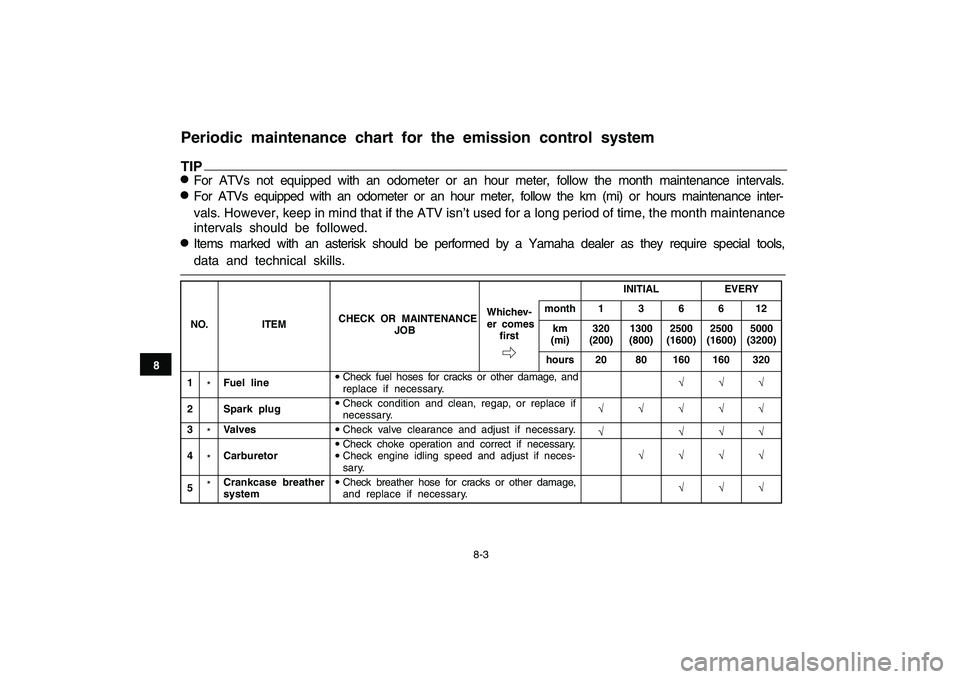
Periodic maintenance chart for the emission control system TIPFor ATVs not equipped with an odometer or an hour meter, follow the month maintenance intervals.For ATVs equipped with an odometer or an hour meter, follow the km (mi) or hours maintenance inter-
intervals should be followed.Items marked with an asterisk should be performed by a Yamaha dealer as they require special tools,data and technical skills.NO.ITEM CHECK OR MAINTENANCE
JOB INITIAL
EVERY
Whichev- er comes rst month 1 3 6 6 12
km
(mi) 320
(200) 1300
(800) 2500
(1600) 2500
(1600) 5000
(3200)
hours 20 80 160 160 3201 *Fuel line
Check fuel hoses for cracks or other damage, and
replace if necessary. √ √ √
2 Spark plugCheck condition and clean, regap, or replace if
necessary. √ √ √ √ √
3 *ValvesCheck valve clearance and adjust if necessary.
√√ √ √
4 *CarburetorCheck choke operation and correct if necessary.Check engine idling speed and adjust if neces-
sary. √ √ √ √
5 *
Crankcase breather
systemCheck breather hose for cracks or other damage,
and replace if necessary. √ √ √
8
vals. However, keep in mind that if the ATV isn’t used for a long period of time, the month maintenance