brakes YAMAHA YFM90R 2009 Owners Manual
[x] Cancel search | Manufacturer: YAMAHA, Model Year: 2009, Model line: YFM90R, Model: YAMAHA YFM90R 2009Pages: 120, PDF Size: 9.14 MB
Page 9 of 120
TABLE OF CONTENTS
SAFETY INFORMATION..............................1-1
LOCATION OF THE WARNING AND
SPECIFICATION LABELS............................2-1DESCRIPTION ..............................................3-1 Left view.....................................................3-1Right view...................................................3-1
Controls and instruments...........................3-2
INSTRUMENT AND CONTROL
FUNCTIONS..................................................4-1 Main switch...............................................4-1
Handlebar switches ................................... 4-2
Throttle lever ............................................. 4-3
Speed limiters............................................. 4-3
Front brake lever ........................................ 4-6
Rear brake lever ....................................... 4-6
Parking brake ............................................ 4-7
Fuel tank cap ............................................ 4-8 Fuel ........................................................... 4-8
Fuel cock .............................................. 4-10
Choke ..................................................... 4-11
Seat ........................................................ 4-11
PRE-OPERATION CHECKS.........................5-1 Pre-operation check list............................5-1
Fuel ........................................................... 5-3
Engine oil .................................................. 5-3
Final transmission oil ................................ 5-3
Front and rear brakes ............................... 5-3
Throttle lever ............................................. 5-4
Tires .......................................................... 5-4
Measuring the tire pressure ...................... 5-5
Tire wear limit ........................................... 5-6
Chassis fasteners ..................................... 5-7
Instruments and switches ......................... 5-7
OPERATION................................................6-1 Starting a cold engine ............................... 6-1
Starting a warm engine ............................. 6-3
Engine break-in ........................................ 6-4
Parking ..................................................... 6-4
Parking on a slope ................................... 6-5
Accessories and loading .......................... 6-6
Vehicle speed limiter ................................. 4-4
Engine speed limiter plate.......................... 4-5 Kick starter
............................................. 4-12
Page 10 of 120
Cleaning the spark arrester ...................... 8-19
Adjusting the carburetor ........................... 8-20
Adjusting the engine idling speed ............ 8-20
Checking the throttle cable free play ....... 8-21
Timing chain ............................................ 8-22
Valve clearance ....................................... 8-22
Checking the front brake shoes................ 8-22
Adjusting the front brake lever free play ....................................................... 8-23
Checking the rear brake pads ................. 8-25
Checking the brake fluid level ................. 8-25
Changing the rear brake fluid .................. 8-26
Checking the rear brake lever free play ........................................................8-26
Checking and lubricating the cables........ 8-27
Checking and lubricating the front and rear brake levers............................... 8-27
Checking the wheel hub bearings ............ 8-28
Battery ..................................................... 8-28
Replacing the fuse ................................... 8-30
Removing a wheel ................................... 8-32
Installing a wheel ..................................... 8-33
Troubleshooting ....................................... 8-34
Troubleshooting chart .............................. 8-35
RIDING YOUR ATV ...................................... 7-1
GETTING TO KNOW YOUR ATV...............7-2
RIDE WITH CARE AND GOOD JUDGEMENT ............................................ 7-2
BE CAREFUL WHERE YOU RIDE...........7-11
TURNING YOUR ATV..............................7-15
CLIMBING UPHILL....................................7-17
RIDING DOWNHILL..................................7-20
CROSSING A SLOPE................................7-21
CROSSING THROUGH SHALLOW WATER ................................................... 7-22
RIDING OVER ROUGH TERRAIN...........7-24
SLIDING AND SKIDDING.........................7-25
WHAT TO DO IF.......................................7-26
WHAT TO DO... ........................................ 7-26
PERIODIC MAINTENANCE AND MINOR
REPAIR..........................................................8-1 Owner’s manual and tool kit ...................... 8-1
Periodic maintenance chart for the emission control system .......................... 8-3
General maintenance and lubrication chart ........................................................ 8-5
Checking the spark plug ............................. 8-9
Engine oil ................................................. 8-11
Final transmission oil ................................ 8-14
Cleaning the air filter element .................. 8-15 CLEANING AND STORAGE.........................9-1
Cleaning ..................................................... 9-1
Storage ...................................................... 9-2 Brakes ..................................................... 8-22
Page 14 of 120

1-3
1
Avoid crossing the side of a steep hill if possible.Always use proper procedures if you stall or roll
backwards when climbing a hill. To avoid stall-
ing, use the proper gear and maintain a steady
speed when climbing a hill. If you stall or roll
backwards, follow the special procedure for
braking described in this manual. Dismount on
the uphill side or to a side if pointed straight up-
hill. Turn the ATV around and remount, following
the procedure described in this manual.Always check for obstacles before operating in a
new area.Never attempt to operate over large obstacles,
such as large rocks or fallen trees. Always follow
proper procedures when operating over obsta-
cles as described in this manual.Always be careful when skidding or sliding.
Learn to safely control skidding or sliding by
practicing at low speeds and on level, smooth
terrain. On extremely slippery surfaces, such as
ice, go slowly and be very cautious in order to re-
duce the chance of skidding or sliding out of con-
trol.Never operate an ATV in fast flowing water or in
water deeper than that recommended in this
manual. Remember that wet brakes may havereduced stopping ability. Test your brakes after
leaving water. If necessary, apply them several
times to let friction dry out the linings.
Always use the size and type of tires specified in
this manual.Always maintain proper tire pressure as de-
scribed in this manual.Never modify an ATV through improper installa-
tion or use of accessories.Never exceed the stated load capacity for an
ATV. Cargo should be properly distributed and
securely attached. Reduce speed and follow in-
structions in this manual for carrying cargo or
pulling a trailer. Allow greater distance for brak-
ing.
WARNING
Always turn off the engine when refueling.Do not refuel right after the engine has been
running and is still very hot.Do not spill gasoline on the engine or ex-
haust pipe/muffler when refueling. Never re-
fuel while smoking, or in the vicinity of
sparks, open flames, or other sources of ig-
nition such as the pilot lights of water heat-
ers and clothes dryers. Gasoline can catch
Page 27 of 120
4-7
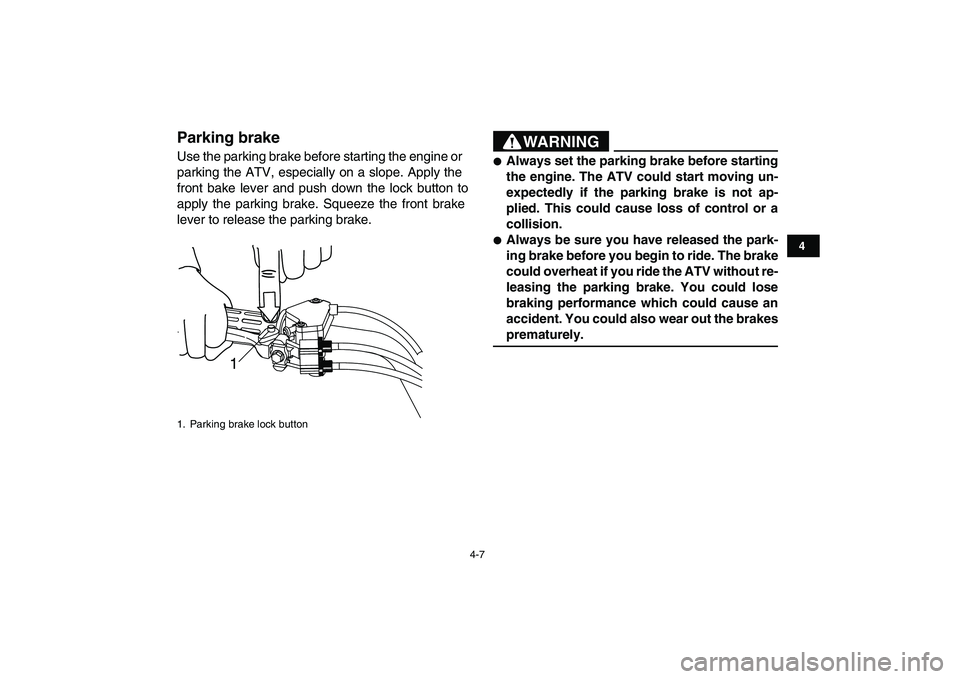
Parking brake Use the parking brake before starting the engine or
parking the ATV, especially on a slope. Apply the
front bake lever and push down the lock button to
apply the parking brake. Squeeze the front brake
lever to release the parking brake.1. Parking brake lock button
4
1
WARNING
Always set the parking brake before starting
the engine. The ATV could start moving un-
expectedly if the parking brake is not ap-
plied. This could cause loss of control or a
collision.Always be sure you have released the park-
ing brake before you begin to ride. The brake
could overheat if you ride the ATV without re-
leasing the parking brake. You could lose
braking performance which could cause an
accident. You could also wear out the brakesprematurely.
Page 35 of 120

5-3
FuelMake sure that there is sufficient fuel in the tank.
(See page 4-8.)
Engine oilMake sure that the engine oil is at the specified lev-
el. Add oil as necessary. (See page 8-11.)
Final transmission oilMake sure that the final transmission oil is at the
specified level. Add oil as necessary.
(See page 8-14.)Front and rear brakesRecommended brake fluid:
DOT4
3
Brake fluid leakage
Check to see if any brake fluid is leaking out of the
pipe joint or brake fluid reservoir. Apply the brake
firmly for one minute. If there is any leakage, have a
Yamaha dealer check the brake system.Brake leversCheck for correct free play in the brake levers. If
the free play is incorrect, adjust it. (See pages
8-23 and 8-26.)Check operation of the levers. They should
move smoothly and there should be a firm feel-
ATV checked by a Yamaha dealer.
6
Brake fluid level
Check the brake fluid level. Add fluid if necessary.
(See page 8-25.)
15
WARNING
Do not overfill the fuel tank. Fuel expands
when it heats up. If the fuel tank is overfilled,
fuel could spill out due to heat from the en-
gine or the sun.Be careful not to spill fuel, especially on the
engine or exhaust pipe which can cause a
fire and severe injury. Wipe up any spilled
fuel immediately.Do not refuel right after the engine has been
running and is still very hot.Be sure the fuel tank cap is closed securely.
ing when the brakes are applied. If not, have the
Page 36 of 120
5-4
Tires
Brake operation
Test the brakes at slow speed after starting out to
make sure they are working properly. If the brakes
do not provide proper braking performance, check
the brakes for wear. (See pages 8-22 and 8-25.)
5
WARNING
Throttle lever Check the operation of the throttle lever. It must
open smoothly and spring back to the idle position
when released. Have a Yamaha dealer correct if
necessary.
WARNING
Always check the brakes at the start of every
ride. Do not ride the ATV if you find any prob-
lem with the brakes or you could lose braking
ability, which could lead to an accident. If a
problem cannot be corrected by the adjust-
ment procedures provided in this manual, havea Yamaha dealer check for the cause.
WARNING
Use of improper tires on this ATV, or operation
of this ATV with improper or uneven tire pres-
sure, may cause loss of control, increasing
your risk of accident.
Pay attention to the following.The tires listed below have been approved
by Yamaha Motor Co., Ltd. for this model.
Other tire combinations are not recommend-
ed.Front: Manufacturer/model:MAXXIS/M939
Size: AT18 x 7-8
Type: Tubeless
Rear: Manufacturer/model:MAXXIS/M940
Page 42 of 120

6-3
6
crank the engine more than 10 seconds on eachattempt.6. If the engine is started with the choke in posi- tion (1), the choke should be returned to posi-
tion (2) to warm up the engine. If the engine is
started with the choke in position (2), keep the
choke in this position to warm up the engine.
N O T I C E
For maximum engine life, always warm the en-
gine up before starting off. Never acceleratehard when the engine is cold!
7. Continue warming up the engine until it idles smoothly, then return the choke to position (3)
before riding.TIPThe engine is warm when it responds normally tothe throttle with the choke turned off. Starting a warm engine Follow the same procedure as for starting a cold
engine, with the exception that the choke is not re-
quired when the engine is warm. Instead, start the
engine with the throttle slightly open.
To start out and accelerate1. Squeeze the front brake lever to release the parking brake.
2. Gradually open the throttle while slowly re- leasing the rear brake lever. To decelerate
When slowing down or stopping, release the throt-
tle and apply the brakes smoothly and evenly. Im-
proper use of the brakes can cause the tires to lose
traction, reducing control and increasing the possi-
bility of an accident.
WARNING
Opening the throttle abruptly or releasing the
clutch lever too quickly could make the ATV
wheelie, which would increase the chance ofan accident, including an overturn.
Page 44 of 120
6-5
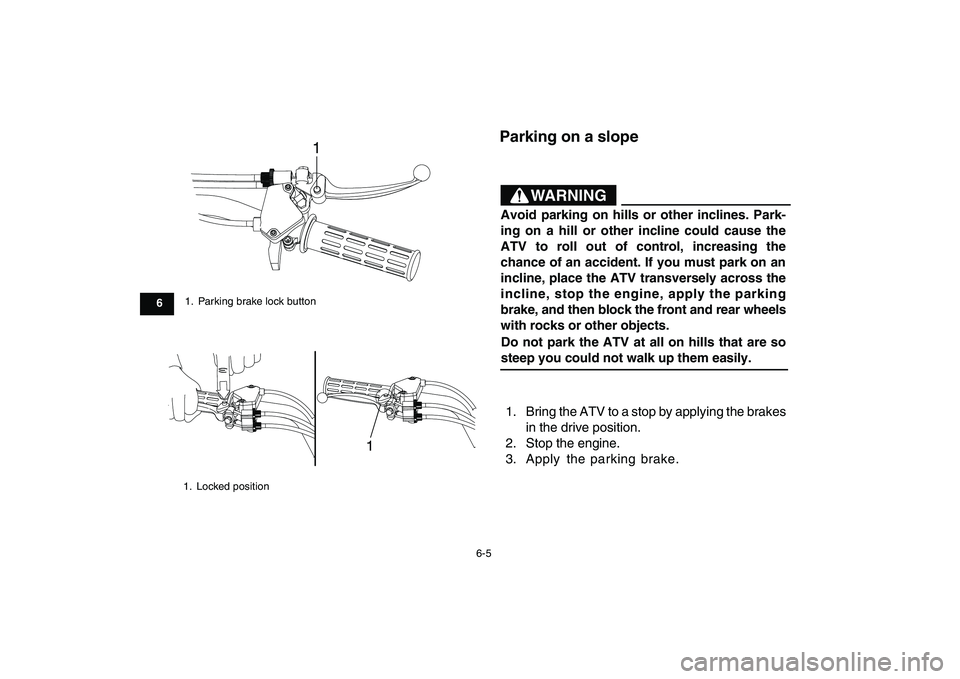
Parking on a slope1. Bring the ATV to a stop by applying the brakesin the drive position.
2. Stop the engine.
3. Apply the parking brake.
1. Parking brake lock button
1. Locked position
6
1
1
WARNING
Avoid parking on hills or other inclines. Park-
ing on a hill or other incline could cause the
ATV to roll out of control, increasing the
chance of an accident. If you must park on an
incline, place the ATV transversely across the
incline, stop the engine, apply the parking
brake, and then block the front and rear wheels
with rocks or other objects. Do not park the ATV at all on hills that are sosteep you could not walk up them easily.
Page 61 of 120

7-15
Do not ride in areas posted “no trespassing”.
Do not ride on private property without getting per-
mission.
Select a large, flat area off-road to become familiar
with your ATV. Make sure that this area is free of
obstacles and other riders. You should practice
control of the throttle, brakes, and turning tech-
niques in this area before trying more difficult ter-
rain. Always avoid riding on paved surfaces: the
ATV is designed for off-road use only, and han-
dling maneuvers are more difficult to perform on
pavement.
Set the parking brake and follow the instruction on
page 6-1 to start the engine. Once it has warmed
up you are ready to begin riding your ATV. Re-
7
member that the engine and exhaust pipe will be
hot when riding and afterwards; do not allow skin
or clothing to come in contact with these compo-
nents.
Apply the throttle slowly and smoothly. You will
start to accelerate. If the throttle is applied too
abruptly, the front wheels may lift off the ground,
resulting in a loss of directional control. Avoid
higher speeds until you are thoroughly familiar
with the operation of your ATV.
When slowing down or stopping, release the throt-
tle and apply the brakes smoothly and evenly. Im-
proper use of the brakes can cause the tires to lose
traction, reducing control and increasing the possi-
bility of an accident.
TURNING YOUR ATV
To achieve maximum traction while riding off-road,
the two rear wheels are mounted solidly on one
axle and turn together at the same speed. There-
fore, unless the wheel on the inside of the turn is al-
lowed to slip or lose some traction, the ATV will
resist turning. A special turning technique must be
used to allow the ATV to make turns quickly and
easily. It is essential that this skill be learned first at With the engine idling, release the parking brake.
Page 66 of 120
7-20
RIDING DOWNHILL
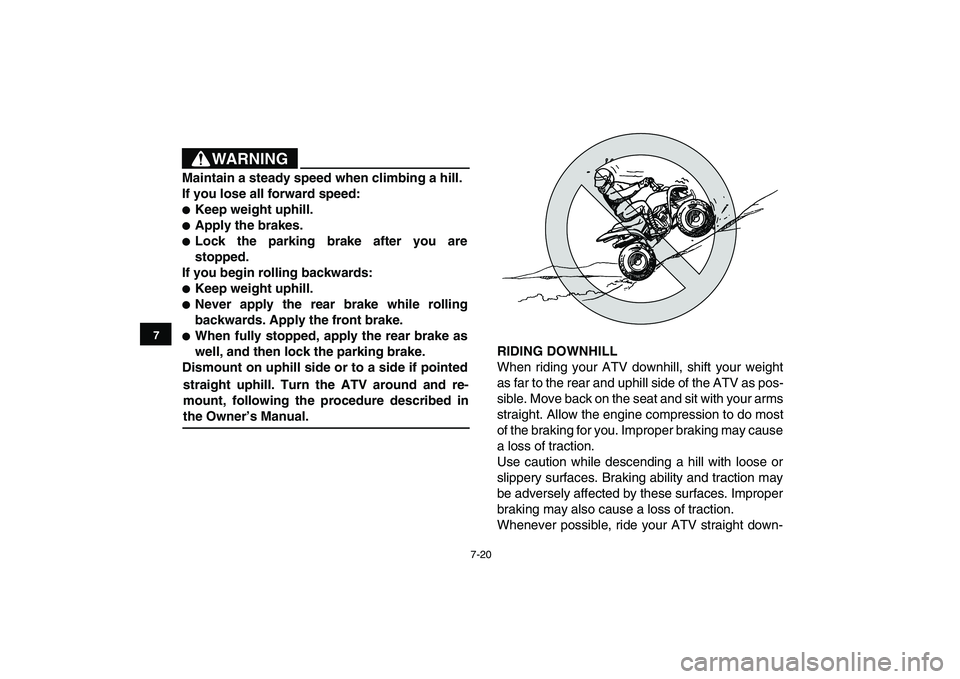
When riding your ATV downhill, shift your weight
as far to the rear and uphill side of the ATV as pos-
sible. Move back on the seat and sit with your arms
straight. Allow the engine compression to do most
of the braking for you. Improper braking may cause
a loss of traction.
Use caution while descending a hill with loose or
slippery surfaces. Braking ability and traction may
be adversely affected by these surfaces. Improper
braking may also cause a loss of traction.
Whenever possible, ride your ATV straight down-
7
WARNING
Maintain a steady speed when climbing a hill.
If you lose all forward speed:Keep weight uphill.Apply the brakes.Lock the parking brake after you are
stopped.
If you begin rolling backwards:Keep weight uphill.Never apply the rear brake while rolling
backwards. Apply the front brake.When fully stopped, apply the rear brake as
well, and then lock the parking brake.
Dismount on uphill side or to a side if pointed
straight uphill. Turn the ATV around and re-
mount, following the procedure described inthe Owner’s Manual.