brakes YAMAHA YFM90R 2009 User Guide
[x] Cancel search | Manufacturer: YAMAHA, Model Year: 2009, Model line: YFM90R, Model: YAMAHA YFM90R 2009Pages: 120, PDF Size: 9.14 MB
Page 69 of 120
7-23
carefully. Enter where there is no sharp drop off,
and avoid rocks or other obstacles which may be
slippery or upset the ATV. Drive slowly and care-
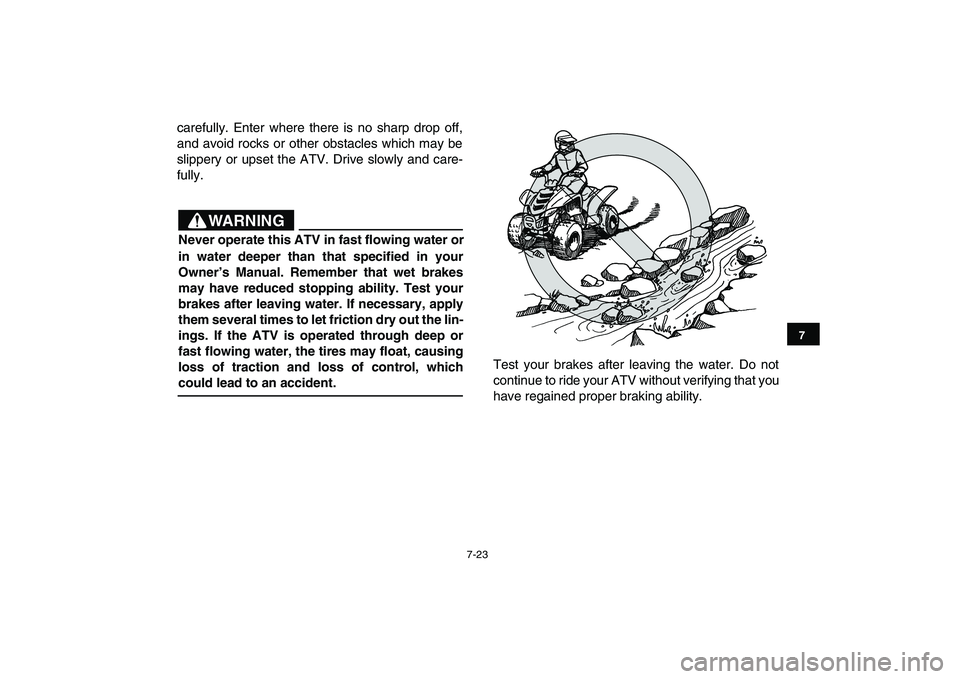
fully.Test your brakes after leaving the water. Do not
continue to ride your ATV without verifying that you
have regained proper braking ability.
7
WARNING
Never operate this ATV in fast flowing water or
in water deeper than that specified in your
Ow ner’ s Manual. Remember that wet brakes
may have reduced stopping ability. Test your
brakes after leaving water. If necessary, apply
them several times to let friction dry out the lin-
ings. If the ATV is operated through deep or
fast flowing water, the tires may float, causing
loss of traction and loss of control, whichcould lead to an accident.
Page 71 of 120
7-25
SLIDING AND SKIDDING
Care should be used when riding on loose or slip-
pery surfaces since the ATV may slide. If unex-
pected and uncorrected, sliding could lead to an
accident.
To reduce the tendency for the front wheels to slide
in loose or slippery conditions, positioning your
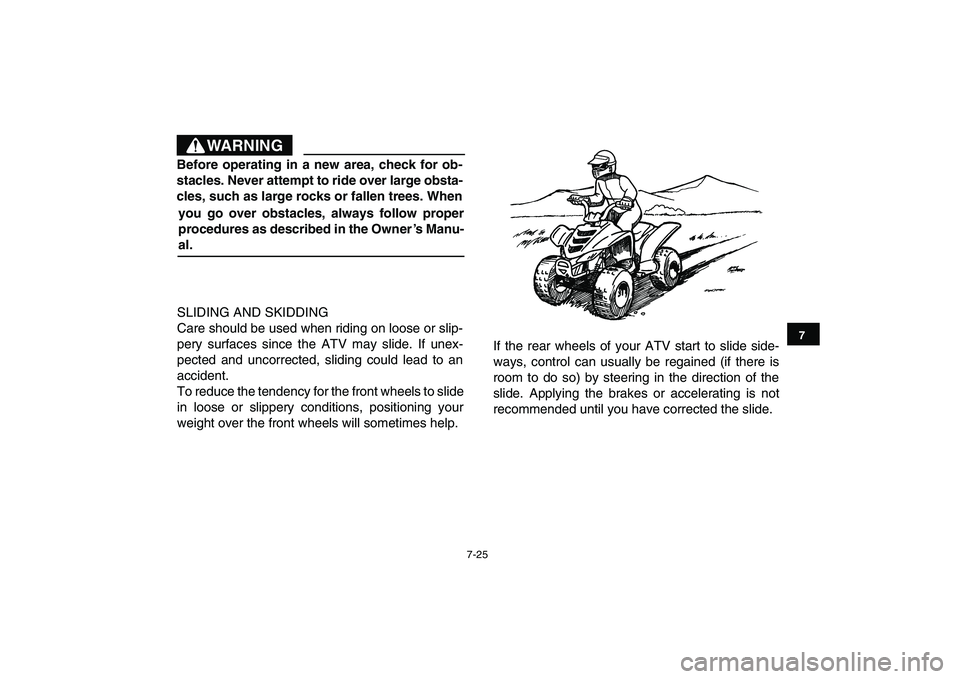
weight over the front wheels will sometimes help. If the rear wheels of your ATV start to slide side-
ways, control can usually be regained (if there is
room to do so) by steering in the direction of the
slide. Applying the brakes or accelerating is not
recommended until you have corrected the slide.
7
WARNING
Before operating in a new area, check for ob-
stacles. Never attempt to ride over large obsta-
cles, such as large rocks or fallen trees. When
you go over obstacles, always follow proper
procedures as described in the Owner ’s Manu-al.
Page 73 of 120

7-27
Lean more into the turn to regain balance. If nec-
essary, gradually let off the throttle and/or steer
to the outside of the turn. (See page 7-15.)If your ATV starts to slide sideways:
Steer in the direction of the slide if you have the
room. Applying the brakes or accelerating is not
recommended until you have corrected the
slide. (See page 7-25.)If your ATV can’t make it up a hill you are trying
to climb:
Turn the ATV around if you still have forward
speed. If not, stop, dismount on the uphill side of
the ATV and physically turn the ATV around. If
the ATV starts to slip backwards, DO NOT USE
THE REAR BRAKE – the ATV may tip over on
top of you. Instead, apply the front brake or dis-
mount the ATV on the uphill side. (See
page 7-17.)If your ATV is traversing a sloping surface:
Be sure to ride with your weight positioned to-
wards the uphill side of the ATV to maintain
proper balance. If the ATV starts to tip, steer
down the hill (if there are no obstacles in your
way) to regain balance. If you discover that the
ATV is going to tip over, dismount on the uphill
side. (See page 7-21.)
If your ATV encounters shallow water:
Ride slowly and carefully through slow moving
water, watching for obstacles. Be sure to let wa-
ter drain from the ATV and CHECK YOUR
BRAKES FOR PROPER OPERATION when
you come out of the water. Do not continue to
ride your ATV until you have regained adequate
braking ability. (See page 7-22.)
7
Page 95 of 120

8-22
The throttle cable free play should measure 1.0–
3.0 mm (0.04–0.12 in) at the throttle lever. Period-
ically check the throttle cable free play and, if nec-
essary, have a Yamaha dealer adjust it. Timing chainThe timing chain stretches with use, resulting in im-
proper valve timing and engine noise. To prevent
this from occurring, the timing chain tensioner
must be adjusted by a Yamaha dealer at the inter-
vals specified in the periodic maintenance and lu-
brication chart.
Valve clearanceThe valve clearance changes with use, resulting in
improper air-fuel mixture and/or engine noise. To
prevent this from occurring, the valve clearance
must be adjusted by a Yamaha dealer at the inter-
vals specified in the periodic maintenance and lu-
brication chart.
1. Throttle lever free play
1
BrakesReplacement of brake components requires
professional knowledge.Brake service should be
performed by a Yamaha dealer.
WARNING
Operating with improperly serviced or adjusted
brakes could lead to a loss
in braking ability
and an accident.
8
Checking the front brake shoesThe front brake shoes must be checked for wear at
the intervals specified in the periodic maintenance
and lubrication chart. Front brake is provided with a
wear indicator on front brake lever, which allows you
Page 97 of 120
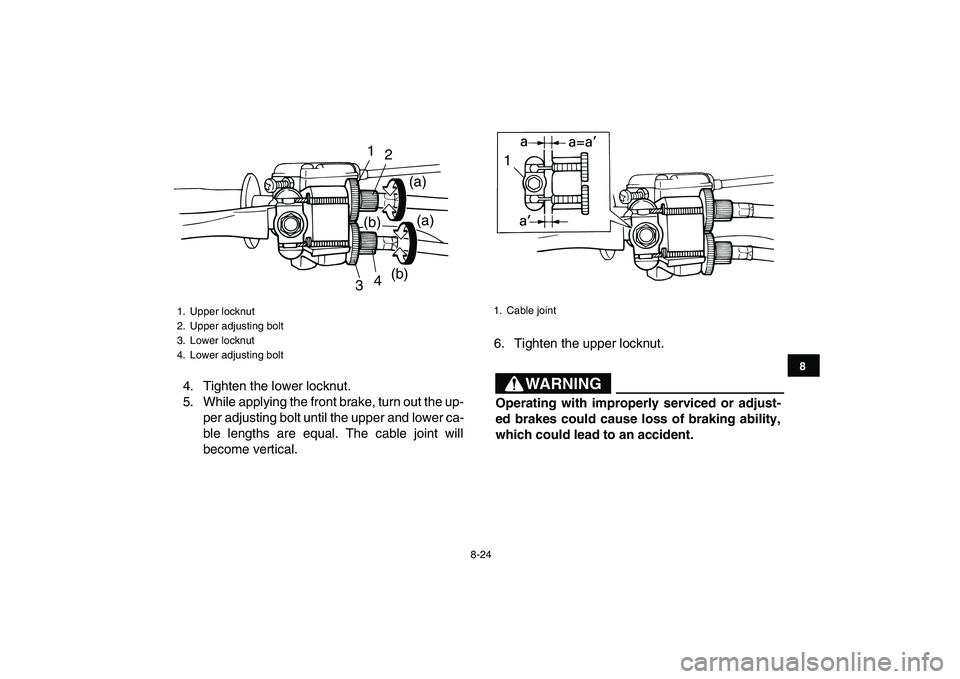
4. Tighten the lower locknut.
5. While applying the front brake, turn out the up-per adjusting bolt until the upper and lower ca-
ble lengths are equal. The cable joint will
become vertical.1. Upper locknut
2. Upper adjusting bolt
3. Lower locknut
4. Lower adjusting bolt
12
4
3 (a)(b)
(a)
(b)
11. Cable joint6. Tighten the upper locknut.
8-24
8
WARNING
Operating with improperly serviced or adjust-
ed brakes could cause loss of braking ability,
which could lead to an accident.
Page 98 of 120
8-25
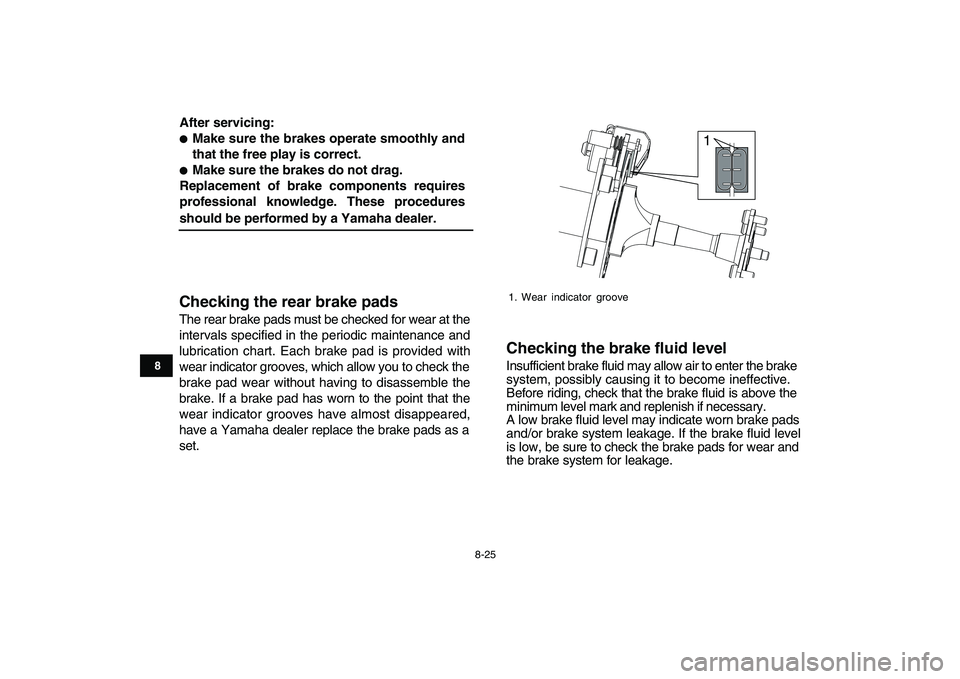
The rear brake pads must be checked for wear at the
intervals specified in the periodic maintenance and
lubrication chart. Each brake pad is provided with
wear indicator grooves, which allow you to check the
brake pad wear without having to disassemble the
brake. If a brake pad has worn to the point that the
wear indicator grooves have almost disappeared,
have a Yamaha dealer replace the brake pads as a
set.Checking the rear brake pads
Insufficient brake fluid may allow air to enter the brake
system, possibly causing it to become ineffective.
Before riding, check that the brake fluid is above the
minimum level mark and replenish if necessary.
A low brake fluid level may indicate worn brake pads
and/or brake system leakage. If the brake fluid level
is low, be sure to check the brake pads for wear and
the brake system for leakage.Checking the brake fluid level 1. Wear indicator groove
8
1
After servicing:Make sure the brakes operate smoothly and
that the free play is correct.Make sure the brakes do not drag.
Replacement of brake components requires
professional knowledge. These proceduresshould be performed by a Yamaha dealer.
Page 100 of 120

8-27
Checking and lubricating the cables The operation and the condition of all control ca-
bles should be checked before each ride, and the
cables and cable ends should be lubricated if nec-
essary. If a cable is damaged or does not move
smoothly, have a Yamaha dealer check or replace
it.
Checking and lubricating the front and
rear brake levers The operation of the front and rear brake levers
should be checked before each ride, and the lever
pivots should be lubricated if necessary.Recommended lubricant:
Engine oil
8
WARNING
Operating with improperly serviced or adjust-
ed brakes could cause loss of braking ability,
which could lead to an accident.
After servicing:Make sure the brakes operate smoothly and
that the free play is correct.Make sure the brakes do not drag.Make sure the brakes are not spongy. All air
must be bled from the brake system.
Replacement of brake components requires
professional knowledge. These proceduresshould be performed by a Yamaha dealer.
WARNING
Inspect cables frequently and replace if dam-
aged. Corrosion can result when the cable
sheaths become damaged, and cables can
also become frayed or kinked, which could re-
strict the operation of controls and lead to anaccident or injury.
Page 109 of 120
9-1
CLEANING AND STORAGE
CleaningFrequent, thorough cleaning of your ATV will not
only enhance its appearance but will improve its
general performance and extend the useful life of
many components.1. Before cleaning the ATV: a. Block off the end of the exhaust pipe toprevent water entry. A plastic bag and
strong rubber band may be used.
b. Make sure the spark plug and all filler caps are properly installed.
2. If the engine case is excessively greasy, apply degreaser with a paint brush. Do not apply de-
greaser to the wheel axles.
3. Rinse the dirt and degreaser off with a garden hose. Use only enough pressure to do the job.N O T I C EExcessive water pressure may cause water
seepage and deterioration of wheel bearings,
brakes, transmission seals and electrical de-
vices. Many expensive repair bills have result-
ed from improper high-pressure detergent applications such as those available in coin-
operated car washers.
4. Once most of the dirt has been hosed off, wash all surfaces with warm water and mild,
detergent-type soap. An old toothbrush or bot-
tle brush is handy for hard-to-reach places.
5. Rinse the ATV off immediately with clean wa- ter and dry all surfaces with a chamois, clean
towel or soft absorbing cloth.
6. Clean the seat with a vinyl upholstery cleaner to keep the cover pliable and glossy.
7. Automotive type wax may be applied to all painted and chrome plated surfaces. Avoid
combination cleaner-waxes. Many contain
abrasives which may mar the paint or protec-
tive finish. When finished cleaning, start the
engine and let it idle for several minutes.
9
Page 110 of 120
9-2
StorageShort-term
Always store your ATV in a cool, dry place and, if
necessary, protect it against dust with a porous
cover.N O T I C EStoring the ATV in a poorly ventilated room
or covering it with a tarp while it is still wet,
will allow water and humidity to seep in and
cause rust.To prevent corrosion, avoid damp cellars,
stables (because of the presence of ammo-nia) and areas where strong chemicals arestored. Long-term
Before storing your ATV for several months:
1. Follow all the instructions in the “Cleaning” section of this chapter.
2. Turn the fuel cock lever to “OFF”.
3. Drain the carburetor float chamber by loosen- ing the drain bolt; this will prevent fuel deposits
from building up. Pour the drained fuel into the
fuel tank.
4. Fill up the fuel tank and add fuel stabilizer (if available) to prevent the fuel from deteriorat-
ing.
5. Perform the following steps to protect the cyl- inder, piston rings, etc. from corrosion.
a. Remove the spark plug cap and sparkplug.
b. Pour a teaspoonful of engine oil into the spark plug bore.
c. Install the spark plug cap onto the spark
Specified amount:
7.5 ml of stabilizer to each liter of fuel (or 1 oz
of stabilizer to each gallon of fuel)
9
WARNING
Wet brakes may have reduced stopping ability,
increasing the chance of an accident. Test the
brakes after washing. Apply the brakes several
times at slow speeds to let friction dry out thelinings.
Page 118 of 120

INDEX
AAccessories and loading ................................................ 6-6
Air filter element, cleaning ............................................ 8-15BBattery ........................................................................\
...8-28
Brake lever, front.............................................................4-6Brake lever, rear............................................................4-6
Brake lever free play, checking the rear........................8-26
Brake levers, checking and lubricating .............. .......... 8-27
Brakes, front and rear....................................................5-3
Brake pads, checking the rear.......................................8-25
Brake fluid level, checking the rear...............................8-25
Brake fluid level, changing the rear..............................8-26 Brake lever free play, adjusting the front......................8-23CCables, checking and lubricating ................................. 8-27
Carburetor, adjusting.................................................... 8-20
Chassis fasteners........................................................... 5-7
Cleaning..........................................................................9-1EEngine break-in .............................................................. 6-4
Engine, cold start...........................................................6-1
Engine idling speed ...................................................... 8-20 Engine oil............................................................5-3, 8-11
Engine, starting a warm................................................6-3
Engine stop switch.......................................................4-2
Fuel........................................................................4-8, 5-3
Fuel cock......................................................................4-10
Fuel tank cap..................................................................4-8
Fuse, replacing.............................................................8-30
F
KKey identification number ............................................. 11-1LLabel locations...............................................................2-1HHandlebar switches ........................................................ 4-2IIdentification numbers .................................................. 11-1
Instruments and switches.............................................5-7MMain switch .................................................................... 4-1
Maintenance and lubrication chart.................................8-5
Maintenance chart, emission control system.................8-3
Model label...................................................................11-2
Choke ............................................................................ 4-11 Brake shoes, checking the front .................................. 8-22
Final transmission oil ........................................... 5-3, 8-14
Engine speed limiter plate............................................ 4-5
Kick starter ................................................................. 4-12