wheel YAMAHA YFZ450 2009 Owner's Manual
[x] Cancel search | Manufacturer: YAMAHA, Model Year: 2009, Model line: YFZ450, Model: YAMAHA YFZ450 2009Pages: 150, PDF Size: 7.13 MB
Page 133 of 150
8-53
1
2
3
4
5
6
78
9
10
11
EBU25580
Replacing the tail/brake light bulb
If the tail/brake light bulb burns out, have a Yama-
ha dealer replace it.
EBU25651
Removing a wheel
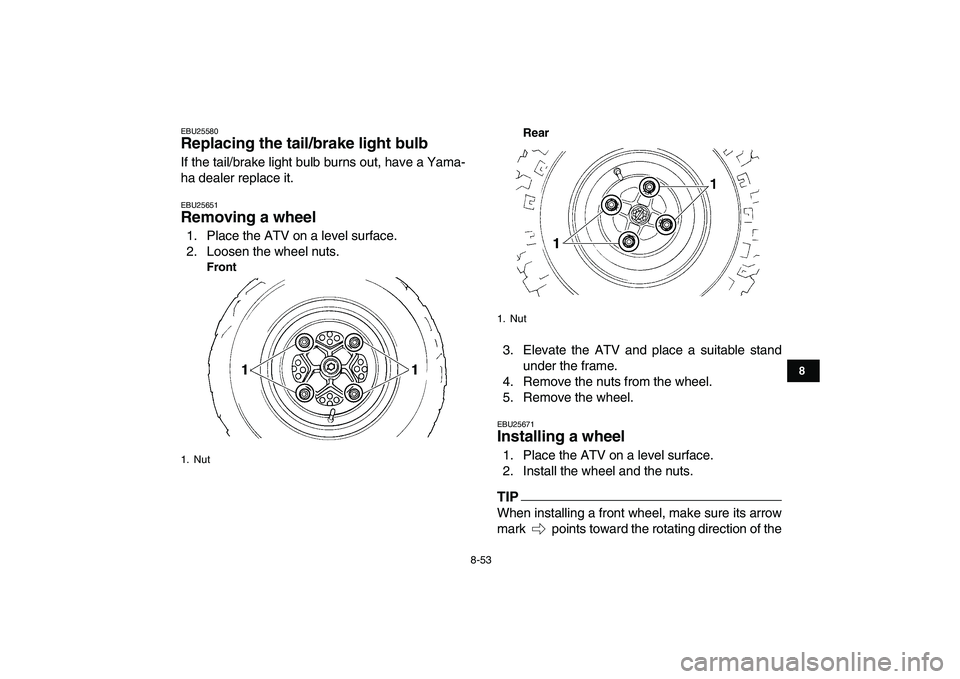
1. Place the ATV on a level surface.
2. Loosen the wheel nuts.
FrontRear
3. Elevate the ATV and place a suitable stand
under the frame.
4. Remove the nuts from the wheel.
5. Remove the wheel.
EBU25671
Installing a wheel
1. Place the ATV on a level surface.
2. Install the wheel and the nuts.
TIP
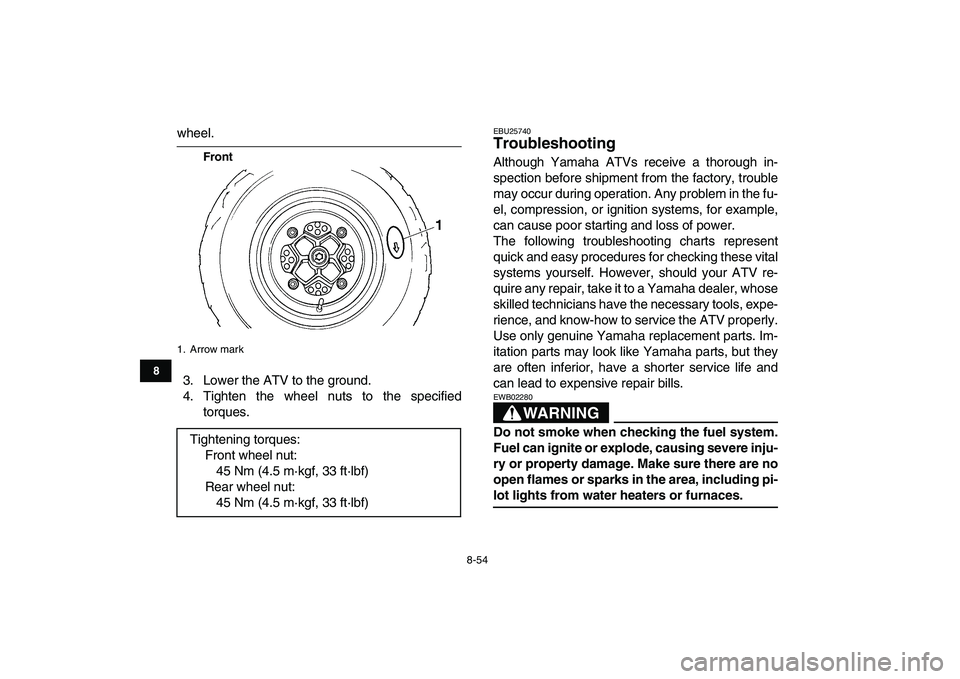
When installing a front wheel, make sure its arrow
mark points toward the rotating direction of the
1. Nut
1. Nut
Page 134 of 150
8-54
1
2
3
4
5
6
78
9
10
11
wheel.
Front
3. Lower the ATV to the ground.
4. Tighten the wheel nuts to the specified
torques.
EBU25740
Troubleshooting
Although Yamaha ATVs receive a thorough in-
spection before shipment from the factory, trouble
may occur during operation. Any problem in the fu-
el, compression, or ignition systems, for example,
can cause poor starting and loss of power.
The following troubleshooting charts represent
quick and easy procedures for checking these vital
systems yourself. However, should your ATV re-
quire any repair, take it to a Yamaha dealer, whose
skilled technicians have the necessary tools, expe-
rience, and know-how to service the ATV properly.
Use only genuine Yamaha replacement parts. Im-
itation parts may look like Yamaha parts, but they
are often inferior, have a shorter service life and
can lead to expensive repair bills.WARNING
EWB02280
Do not smoke when checking the fuel system.
Fuel can ignite or explode, causing severe inju-
ry or property damage. Make sure there are no
open flames or sparks in the area, including pi-
lot lights from water heaters or furnaces.
1. Arrow mark
Tightening torques:
Front wheel nut:
45 Nm (4.5 m·kgf, 33 ft·lbf)
Rear wheel nut:
45 Nm (4.5 m·kgf, 33 ft·lbf)
Page 137 of 150
9-1
1
2
3
4
5
6
7
89
10
11
EBU25860
CLEANING AND STORAGE
EBU25900
Cleaning
Frequent, thorough cleaning of your ATV will not
only enhance its appearance but will improve its
general performance and extend the useful life of
many components.
1. Before cleaning the ATV:
a. Block off the end of the exhaust pipe to
prevent water entry. A plastic bag and
strong rubber band may be used.
b. Make sure the spark plug and all filler caps
are properly installed.
2. If the engine case is excessively greasy, apply
degreaser with a paint brush. Do not apply de-
greaser to the chain, sprockets or wheel ax-
les.
3. Rinse the dirt and degreaser off with a garden
hose. Use only enough pressure to do the job.
NOTICE
ECB00710
Excessive water pressure may cause water
seepage and deterioration of wheel bearings,
brakes, transmission seals and electrical de-
vices. Many expensive repair bills have result-ed from improper high-pressure detergent
applications such as those available in coin-
operated car washers.
4. Once most of the dirt has been hosed off,
wash all surfaces with warm water and mild,
detergent-type soap. An old toothbrush or bot-
tle brush is handy for hard-to-reach places.
5. Rinse the ATV off immediately with clean wa-
ter and dry all surfaces with a chamois, clean
towel or soft absorbing cloth.
6. Dry the chain and lubricate it to prevent it from
rusting.
7. Clean the seat with a vinyl upholstery cleaner
to keep the cover pliable and glossy.
8. Automotive type wax may be applied to all
painted and chrome plated surfaces. Avoid
combination cleaner-waxes. Many contain
abrasives which may mar the paint or protec-
tive finish. When finished cleaning, start the
engine and let it idle for several minutes.
WARNING
EWB02310
Wet brakes may have reduced stopping ability,
Page 139 of 150
9-3
1
2
3
4
5
6
7
89
10
11
with oil.)
e. Remove the spark plug cap from the spark
plug, and then install the spark plug and
the spark plug cap.
6. Lubricate all control cables and the pivoting
points of all levers and pedals.
7. Check and, if necessary, correct the tire air
pressure, and then block up the ATV so that
all of its wheels are off the ground. Alternative-
ly, turn the wheels a little every month in order
to prevent the tires from becoming degraded
in one spot.
8. Cover the muffler outlet with a plastic bag to
prevent moisture from entering it.
9. Remove the battery and fully charge it. Store
it in a cool, dry place and charge it once a
month. Do not store the battery in an exces-
sively cold or warm place [less than 0 °C (30
°F) or more than 30 °C (90 °F)]. For more in-
formation on storing the battery, see page
8-47.
TIP
Make any necessary repairs before storing the
ATV.
Page 140 of 150
10-1
1
2
3
4
5
6
7
8
910
11
EBU25960
SPECIFICATIONS
EBU2597B
Dimensions:
Overall length:
1840 mm (72.4 in)
Overall width:
1170 mm (46.1 in)
Overall height:
1090 mm (42.9 in)
Seat height:
810 mm (31.9 in)
Wheelbase:
1280 mm (50.4 in)
Ground clearance:
255 mm (10.0 in)
Minimum turning radius:
3500 mm (138 in)
Weight:
With oil and fuel:
169.0 kg (373 lb)
Noise and vibration level:
Noise level (77/311/EEC):
84.5 dB(A)
Vibration on seat (EN1032, ISO5008):
Will not exceed 0.5 m/s
2
Vibration on handlebar (EN1032, ISO5008):
Will not exceed 2.5 m/s
2
Engine:
Engine type:
Liquid cooled 4-stroke, DOHCCylinder arrangement:
Forward-inclined single cylinder
Displacement:
449.0 cm 3
Bore
×
stroke:
95.0
×
63.4 mm (3.74
×
2.50 in)
Compression ratio:
11.40 :1
Starting system:
Electric starter
Lubrication system:
Dry sump
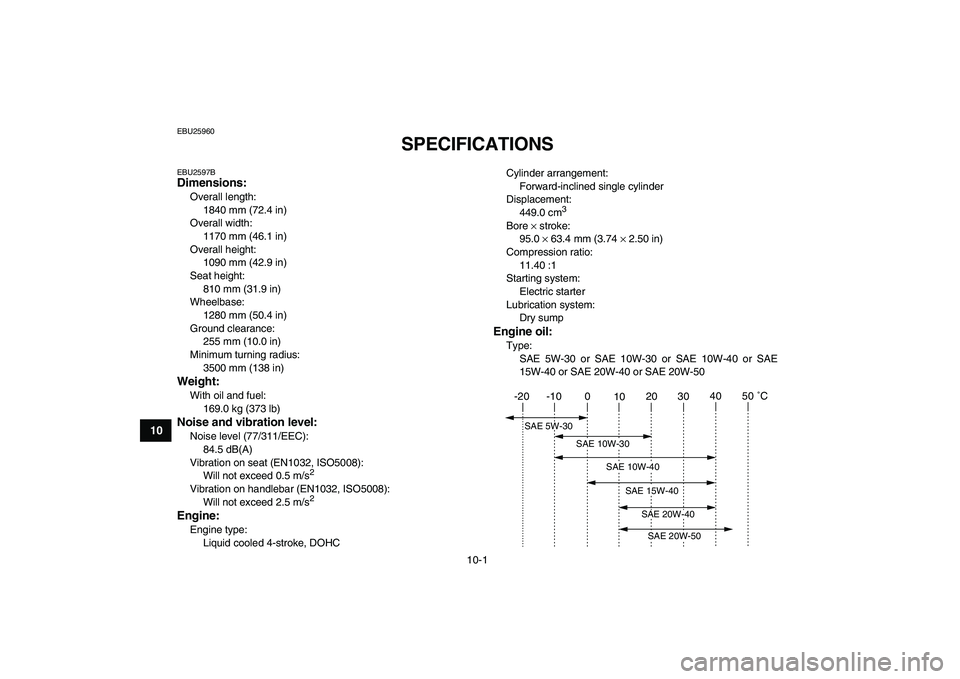
Engine oil:
Type:
SAE 5W-30 or SAE 10W-30 or SAE 10W-40 or SAE
15W-40 or SAE 20W-40 or SAE 20W-50
-20 -10 0
1020 304050 ˚C
SAE 15W-40
SAE 20W-40SAE 20W-50
SAE 10W-40
SAE 5W-30
SAE 10W-30
Page 142 of 150
10-3
1
2
3
4
5
6
7
8
910
11
3rd:
25/16 (1.562)
4th:
23/18 (1.277)
5th:
21/20 (1.050)
Chassis:
Frame type:
Steel tube frame
Caster angle:
5.0 °
Trail:
21.0 mm (0.83 in)
Front tire:
Type:
Tubeless
Size:
AT21 x 7-10
Manufacturer/model:
DUNLOP/KT341 Radial
Rear tire:
Type:
Tubeless
Size:
AT20 x 10-9
Manufacturer/model:
DUNLOP/KT355A Radial
Loading:
Maximum loading limit:
100.0 kg (220 lb)
(Total weight of rider, cargo, accessories, and tongue)
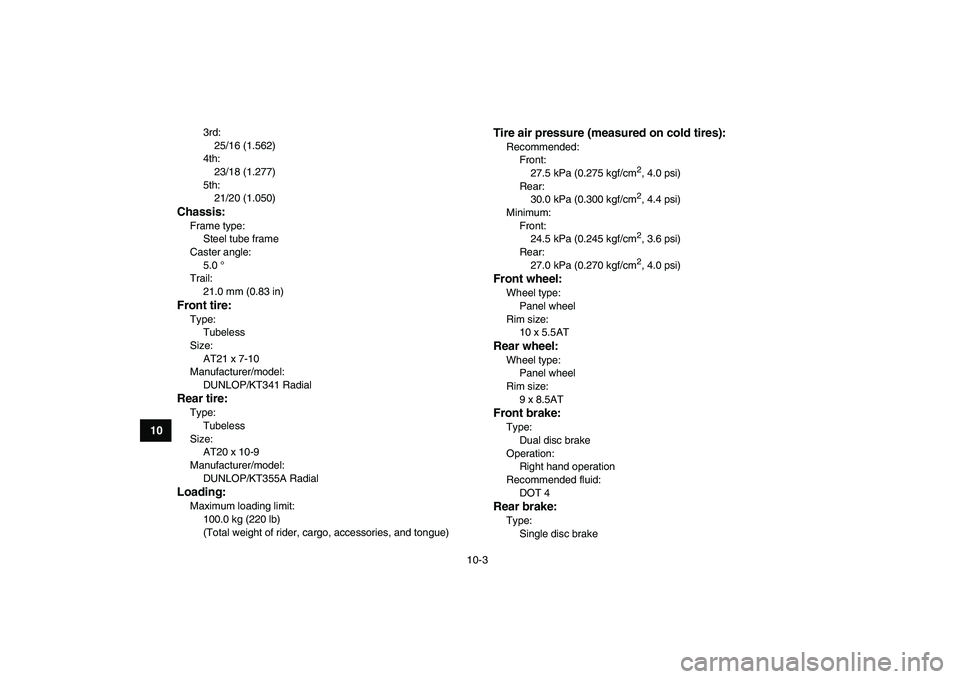
Tire air pressure (measured on cold tires):
Recommended:
Front:
27.5 kPa (0.275 kgf/cm
2
, 4.0 psi)
Rear:
30.0 kPa (0.300 kgf/cm
2
, 4.4 psi)
Minimum:
Front:
24.5 kPa (0.245 kgf/cm
2
, 3.6 psi)
Rear:
27.0 kPa (0.270 kgf/cm
2
, 4.0 psi)
Front wheel:
Wheel type:
Panel wheel
Rim size:
10 x 5.5AT
Rear wheel:
Wheel type:
Panel wheel
Rim size:
9 x 8.5AT
Front brake:
Type:
Dual disc brake
Operation:
Right hand operation
Recommended fluid:
DOT 4
Rear brake:
Type:
Single disc brake
Page 143 of 150
10-4
1
2
3
4
5
6
7
8
910
11
Operation:
Right foot operation
Recommended fluid:
DOT 4
Front suspension:
Type:
Double wishbone
Spring/shock absorber type:
Coil spring/gas-oil damper
Wheel travel:
230 mm (9.1 in)
Rear suspension:
Type:
Swingarm (link suspension)
Spring/shock absorber type:
Coil spring/gas-oil damper
Wheel travel:
270 mm (10.6 in)
Electrical system:
Ignition system:
DC. CDI
Charging system:
AC magneto
Battery:
Model:
GT7B-4
Voltage, capacity:
12 V, 6.5 Ah
Headlight:
Bulb type:
Krypton bulb
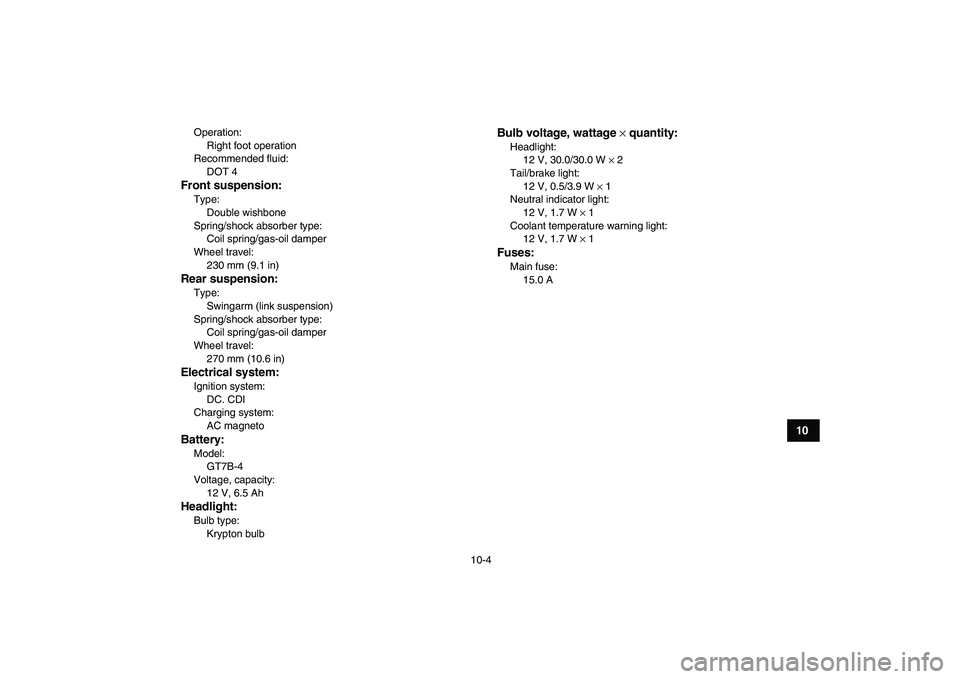
Bulb voltage, wattage
×
quantity:
Headlight:
12 V, 30.0/30.0 W
×
2
Tail/brake light:
12 V, 0.5/3.9 W
×
1
Neutral indicator light:
12 V, 1.7 W
×
1
Coolant temperature warning light:
12 V, 1.7 W
×
1
Fuses:
Main fuse:
15.0 A
Page 148 of 150
K
Key identification number ............................................. 11-1
L
Label locations ............................................................... 2-1
Light switch .................................................................... 4-3
M
Main switch .................................................................... 4-1
Maintenance and lubrication chart ................................. 8-5
Maintenance chart, emission control system ................. 8-3
Model label ................................................................... 11-2
N
Neutral indicator light ..................................................... 4-1
O
Owner’s manual and tool kit ........................................... 8-1
P
Panel, removing and installing ....................................... 8-9
Parking ........................................................................... 6-5
Parking brake free play, adjusting ................................ 8-37
Parking brake lever ........................................................ 4-6
Parking on a slope ......................................................... 6-6
Part locations ................................................................. 3-1
Pre-operation check list.................................................. 5-1
R
Riding your ATV ............................................................. 7-1
S
Safety information .......................................................... 1-1
Seat .............................................................................. 4-11
Shifting ........................................................................... 6-3
Shift pedal ...................................................................... 4-7
Shock absorber assemblies, adjusting the front .......... 4-12
Shock absorber assembly, adjusting the rear .............. 4-17Spark arrester, cleaning ............................................... 8-28
Spark plug, checking .................................................... 8-10
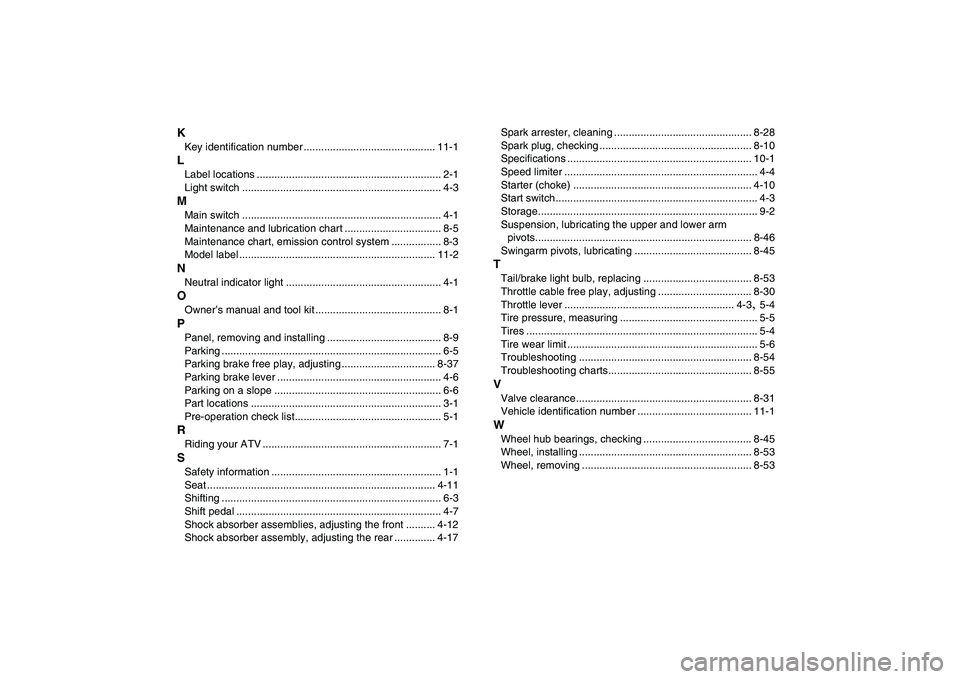
Specifications ............................................................... 10-1
Speed limiter .................................................................. 4-4
Starter (choke) ............................................................. 4-10
Start switch..................................................................... 4-3
Storage........................................................................... 9-2
Suspension, lubricating the upper and lower arm
pivots.......................................................................... 8-46
Swingarm pivots, lubricating ........................................ 8-45
T
Tail/brake light bulb, replacing ..................................... 8-53
Throttle cable free play, adjusting ................................ 8-30
Throttle lever .......................................................... 4-3
,
5-4
Tire pressure, measuring ............................................... 5-5
Tires ............................................................................... 5-4
Tire wear limit ................................................................. 5-6
Troubleshooting ........................................................... 8-54
Troubleshooting charts................................................. 8-55
V
Valve clearance............................................................ 8-31
Vehicle identification number ....................................... 11-1
W
Wheel hub bearings, checking ..................................... 8-45
Wheel, installing ........................................................... 8-53
Wheel, removing .......................................................... 8-53