wheel YAMAHA YFZ450 2013 User Guide
[x] Cancel search | Manufacturer: YAMAHA, Model Year: 2013, Model line: YFZ450, Model: YAMAHA YFZ450 2013Pages: 154, PDF Size: 3.77 MB
Page 74 of 154
7-15
7Do not attempt to climb hills until you have mas-
tered basic maneuvers on flat ground. Always
check the terrain carefully before attempting any
hill. In all cases avoid inclines with slippery or loose
surfaces, or obstacles that might cause you to lose
control.
To climb a hill, you need traction, momentum, and
steady throttle. Travel fast enough to maintain mo-
mentum, but not so fast that you cannot react to
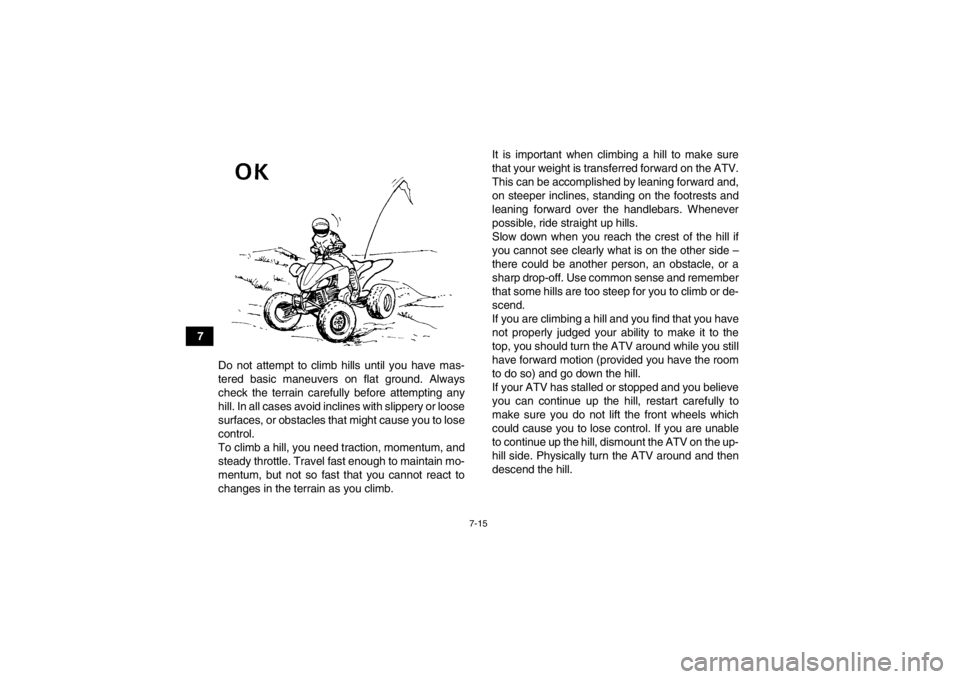
changes in the terrain as you climb. It is important when climbing a hill to make sure
that your weight is transferred forward on the ATV.
This can be accomplished by leaning forward and,
on steeper inclines, standing on the footrests and
leaning forward over the handlebars. Whenever
possible, ride straight up hills.
Slow down when you reach the crest of the hill if
you cannot see clearly what is on the other side –
there could be another person, an obstacle, or a
sharp drop-off. Use common sense and remember
that some hills are too steep for you to climb or de-
scend.
If you are climbing a hill and you find that you have
not properly judged your ability to make it to the
top, you should turn the ATV around while you still
have forward motion (provided you have the room
to do so) and go down the hill.
If your ATV has stalled or stopped and you believe
you can continue up the hill, restart carefully to
make sure you do not lift the front wheels which
could cause you to lose control. If you are unable
to continue up the hill, dismount the ATV on the up-
hill side. Physically turn the ATV around and then
descend the hill.
U1PD61E0.book Page 15 Tuesday, February 14, 2012 10:06 AM
Page 76 of 154
7-17
7
●Never operate the ATV on hills too steep for
the ATV or for your abilities. The ATV can
overturn more easily on extremely steep hills
than on level surfaces or small hills.●Shift your weight backward and to the up
side of the hill.●Never go down a hill at high speed.●Avoid going down a hill at an angle that
would cause the ATV to lean sharply to one
side. Go straight down the hill where possi-
ble.●Improper braking can cause the wheels on
the uphill side to come off the ground or
cause loss of traction. Gradually apply only
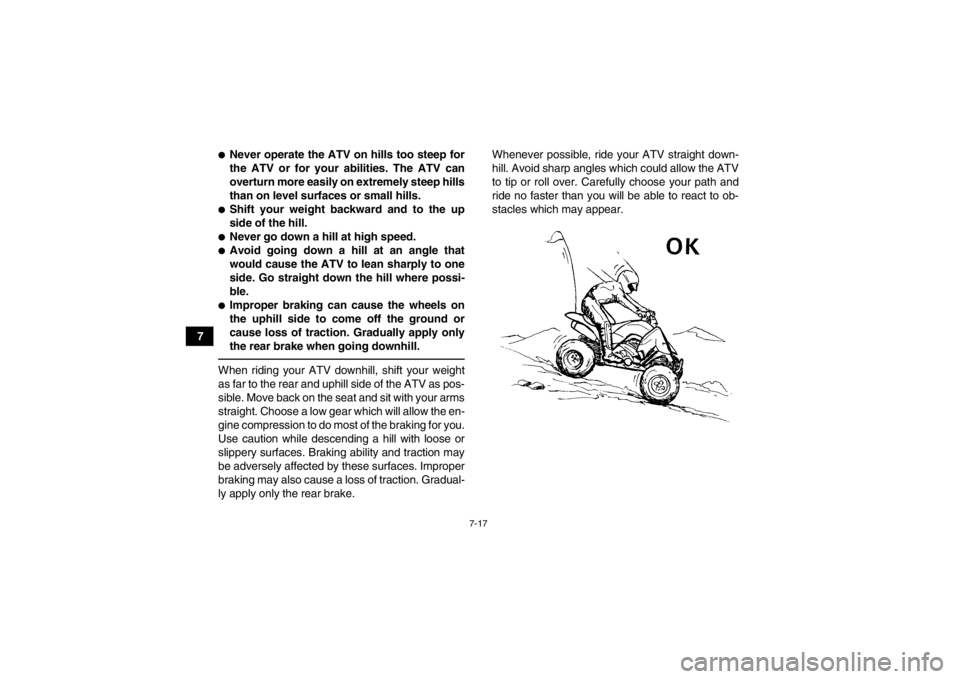
the rear brake when going downhill.When riding your ATV downhill, shift your weight
as far to the rear and uphill side of the ATV as pos-
sible. Move back on the seat and sit with your arms
straight. Choose a low gear which will allow the en-
gine compression to do most of the braking for you.
Use caution while descending a hill with loose or
slippery surfaces. Braking ability and traction may
be adversely affected by these surfaces. Improper
braking may also cause a loss of traction. Gradual-
ly apply only the rear brake.Whenever possible, ride your ATV straight down-
hill. Avoid sharp angles which could allow the ATV
to tip or roll over. Carefully choose your path and
ride no faster than you will be able to react to ob-
stacles which may appear.U1PD61E0.book Page 17 Tuesday, February 14, 2012 10:06 AM
Page 77 of 154
7-18
7
CROSSING A SLOPE
WARNING
EWB01632Improperly crossing hills or turning on hills
could cause loss of control or cause the ATV to
overturn.●Always follow proper procedures as de-
scribed in the Owner’s Manual.●Avoid hills with excessively slippery or loose
surfaces.●Avoid crossing the side of a steep hill.●Shift your weight to the uphill side of the
ATV.●Never attempt to turn the ATV around on any
hill until you have mastered the turning tech-
nique as described in the Owner’s Manual on
level ground. Be very careful when turning
on any hill.Traversing a sloping surface on your ATV requires
you to properly position your weight to maintain
proper balance. Be sure that you have learned the
basic riding skills on flat ground before attempting
to cross a sloping surface. Avoid slopes with slip-
pery surfaces or rough terrain that may upset your
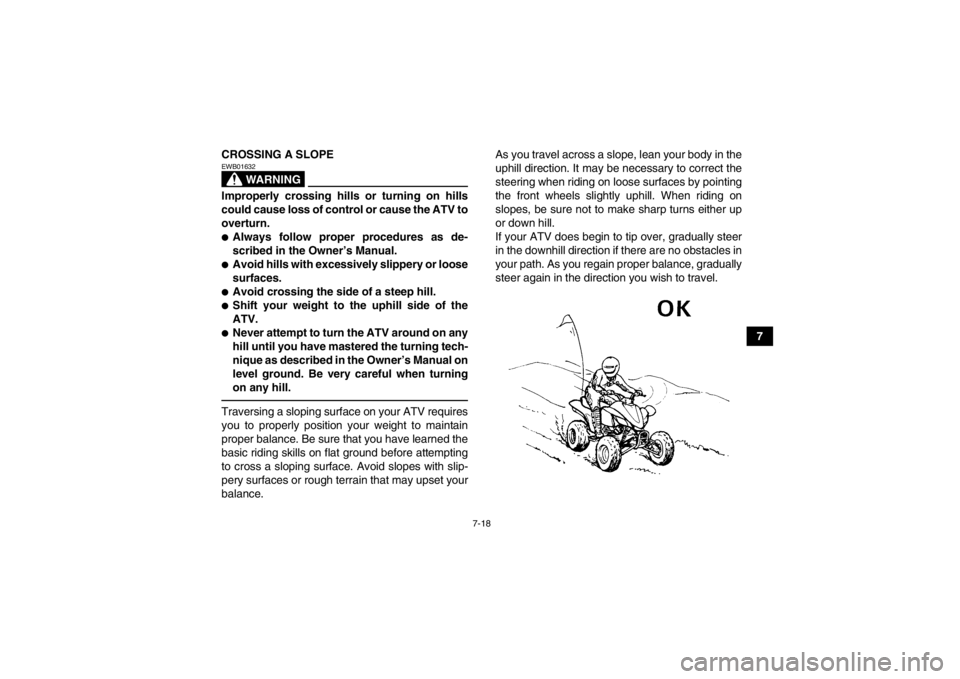
balance. As you travel across a slope, lean your body in the
uphill direction. It may be necessary to correct the
steering when riding on loose surfaces by pointing
the front wheels slightly uphill. When riding on
slopes, be sure not to make sharp turns either up
or down hill.
If your ATV does begin to tip over, gradually steer
in the downhill direction if there are no obstacles in
your path. As you regain proper balance, gradually
steer again in the direction you wish to travel.U1PD61E0.book Page 18 Tuesday, February 14, 2012 10:06 AM
Page 80 of 154
7-21
7cident. Be sure to keep your feet firmly mounted on
the footrests at all times. Avoid jumping the ATV as
loss of control and damage to the ATV may result.
SLIDING AND SKIDDING
WARNING
EWB01662Skidding or sliding improperly may cause you
to lose control of this ATV. You may also re-
gain traction unexpectedly, which may cause
the ATV to overturn.●Learn to safely control skidding or sliding by
practicing at low speeds and on level,
smooth terrain.●On extremely slippery surfaces, such as ice,
go slowly and be very cautious in order to re-
duce the chance of skidding or sliding out of
control.Care should be used when riding on loose or slip-
pery surfaces since the ATV may slide. If unex-
pected and uncorrected, sliding could lead to an
accident.
To reduce the tendency for the front wheels to slide
in loose or slippery conditions, positioning your
weight over the front wheels will sometimes help.
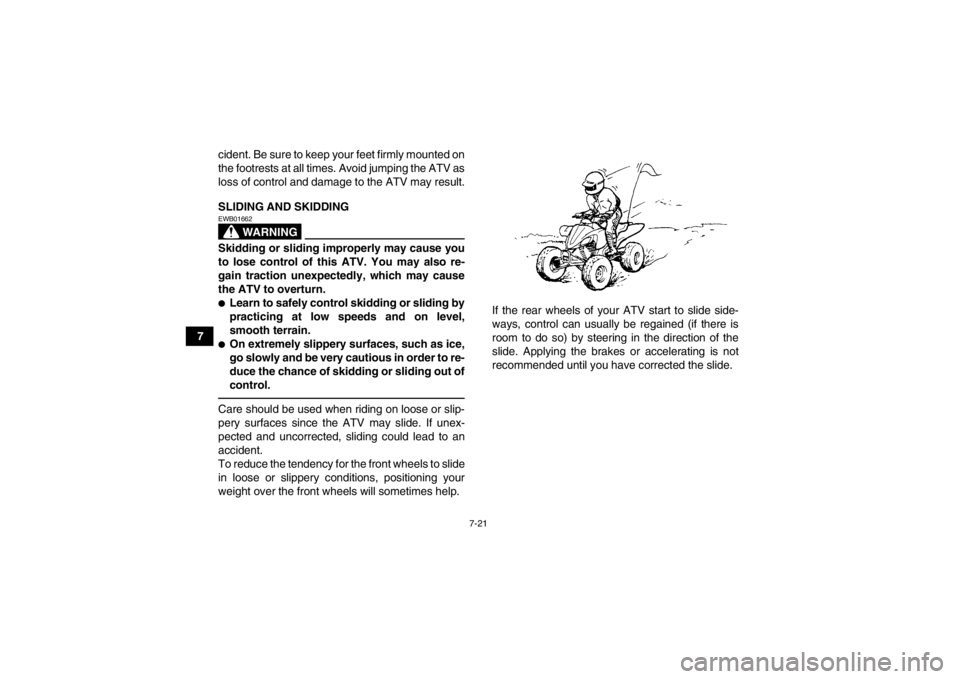
If the rear wheels of your ATV start to slide side-
ways, control can usually be regained (if there is
room to do so) by steering in the direction of the
slide. Applying the brakes or accelerating is not
recommended until you have corrected the slide.U1PD61E0.book Page 21 Tuesday, February 14, 2012 10:06 AM
Page 81 of 154
7-22
7
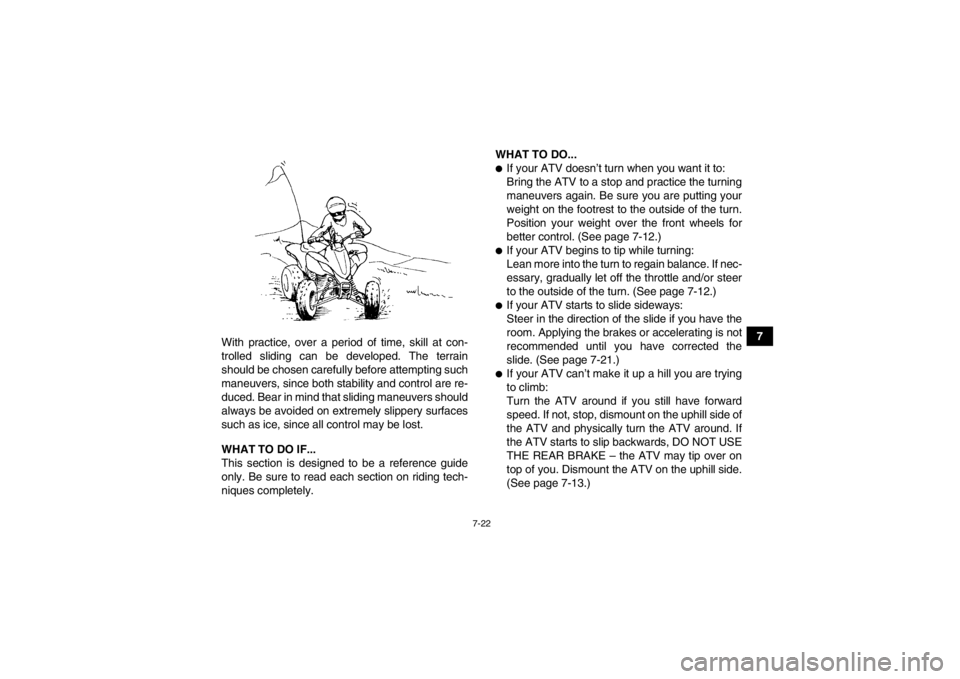
With practice, over a period of time, skill at con-
trolled sliding can be developed. The terrain
should be chosen carefully before attempting such
maneuvers, since both stability and control are re-
duced. Bear in mind that sliding maneuvers should
always be avoided on extremely slippery surfaces
such as ice, since all control may be lost.
WHAT TO DO IF...
This section is designed to be a reference guide
only. Be sure to read each section on riding tech-
niques completely. WHAT TO DO...
●If your ATV doesn’t turn when you want it to:
Bring the ATV to a stop and practice the turning
maneuvers again. Be sure you are putting your
weight on the footrest to the outside of the turn.
Position your weight over the front wheels for
better control. (See page 7-12.)●If your ATV begins to tip while turning:
Lean more into the turn to regain balance. If nec-
essary, gradually let off the throttle and/or steer
to the outside of the turn. (See page 7-12.)●If your ATV starts to slide sideways:
Steer in the direction of the slide if you have the
room. Applying the brakes or accelerating is not
recommended until you have corrected the
slide. (See page 7-21.)●If your ATV can’t make it up a hill you are trying
to climb:
Turn the ATV around if you still have forward
speed. If not, stop, dismount on the uphill side of
the ATV and physically turn the ATV around. If
the ATV starts to slip backwards, DO NOT USE
THE REAR BRAKE – the ATV may tip over on
top of you. Dismount the ATV on the uphill side.
(See page 7-13.)
U1PD61E0.book Page 22 Tuesday, February 14, 2012 10:06 AM
Page 88 of 154

8-6
8
5*Brake hoses Check for cracks or other damage, and replace if
necessary. √√√√
Replace. Every 4 years
6 *Parking brake Check operation and adjust if necessary. √√√√√
7 *Wheels Check runout and for damage, and replace if nec-
essary. √ √√√
8 *Tires Check tread depth and for damage, and replace if
necessary.
Check air pressure and balance, and correct if necessary. √ √√√
9 *Wheel hub bearings Check for looseness or damage, and replace if
necessary. √ √√√
10 *Swingarm pivots Check operation and for excessive play, and re-
place bearings if necessary.
Lubricate with lithium-soap-based grease. √√√
11 *Upper and lower
arm pivots
Lubricate with lithium-soap-based grease.
√√√
12 Drive chain Check chain slack and adjust if necessary.
Check rear wheel alignment and correct if neces-
sary.
Clean and lubricate. √√√√√
13 *Drive chain rollers Check for wear and replace if necessary. √√√
NO. ITEM
CHECK OR MAINTENANCE
JOB INITIAL EVERY
Whichev- er comes first month136612
km
(mi) 320
(200) 1300
(800) 2500
(1600) 2500
(1600) 5000
(3200)
hours 20 80 160 160 320U1PD61E0.book Page 6 Tuesday, February 14, 2012 10:06 AM
Page 114 of 154
8-32
8
EBU29601Brakes Replacement of brake components requires pro-
fessional knowledge. Brake service should be per-
formed by a Yamaha dealer.
WARNING
EWB02571Operating with improperly serviced or adjust-
ed brakes could lead to a loss in braking ability
and an accident.EBU24130Checking the front and rear brake pads The front and rear brake pads must be checked for
wear at the intervals specified in the periodic main-
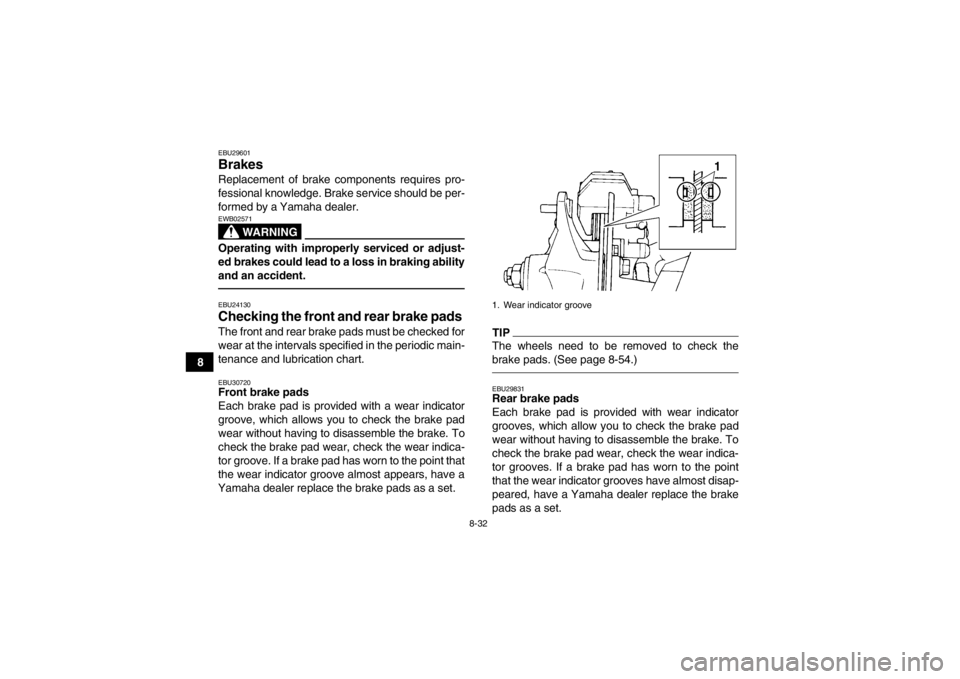
tenance and lubrication chart.EBU30720Front brake pads
Each brake pad is provided with a wear indicator
groove, which allows you to check the brake pad
wear without having to disassemble the brake. To
check the brake pad wear, check the wear indica-
tor groove. If a brake pad has worn to the point that
the wear indicator groove almost appears, have a
Yamaha dealer replace the brake pads as a set.
TIPThe wheels need to be removed to check the
brake pads. (See page 8-54.)EBU29831Rear brake pads
Each brake pad is provided with wear indicator
grooves, which allow you to check the brake pad
wear without having to disassemble the brake. To
check the brake pad wear, check the wear indica-
tor grooves. If a brake pad has worn to the point
that the wear indicator grooves have almost disap-
peared, have a Yamaha dealer replace the brake
pads as a set.1. Wear indicator groove
U1PD61E0.book Page 32 Tuesday, February 14, 2012 10:06 AM
Page 120 of 154
8-38
8
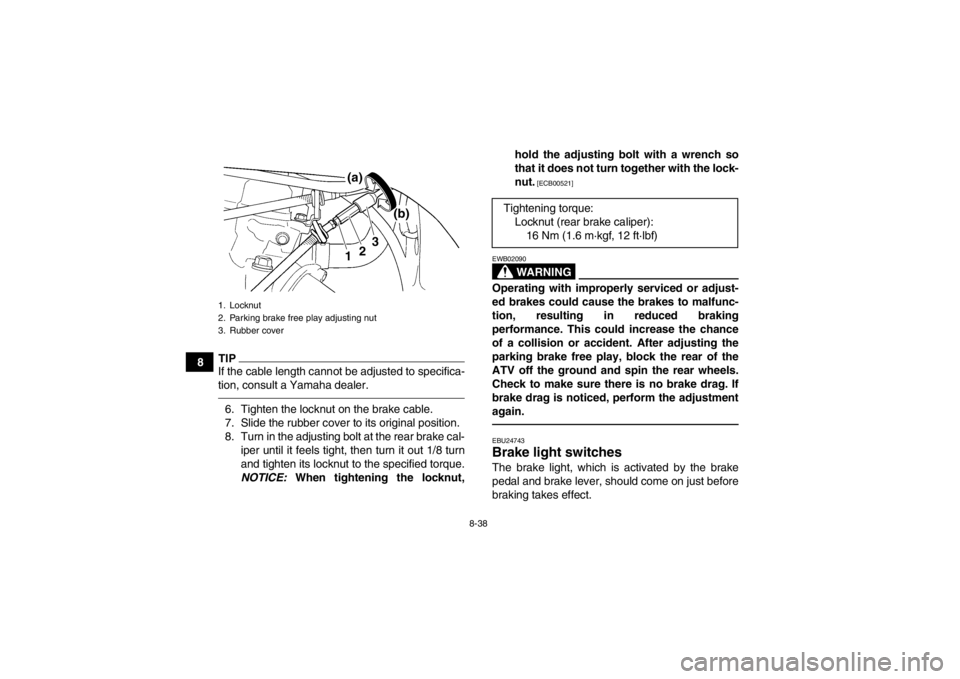
TIPIf the cable length cannot be adjusted to specifica-
tion, consult a Yamaha dealer.6. Tighten the locknut on the brake cable.
7. Slide the rubber cover to its original position.
8. Turn in the adjusting bolt at the rear brake cal-iper until it feels tight, then turn it out 1/8 turn
and tighten its locknut to the specified torque.
NOTICE: When tightening the locknut, hold the adjusting bolt with a wrench so
that it does not turn together with the lock-
nut.
[ECB00521]
WARNING
EWB02090Operating with improperly serviced or adjust-
ed brakes could cause the brakes to malfunc-
tion, resulting in reduced braking
performance. This could increase the chance
of a collision or accident. After adjusting the
parking brake free play, block the rear of the
ATV off the ground and spin the rear wheels.
Check to make sure there is no brake drag. If
brake drag is noticed, perform the adjustment
again.EBU24743Brake light switches The brake light, which is activated by the brake
pedal and brake lever, should come on just before
braking takes effect.
1. Locknut
2. Parking brake free play adjusting nut
3. Rubber cover
(a)
(b)
1
2
3
Tightening torque: Locknut (rear brake caliper):16 Nm (1.6 m·kgf, 12 ft·lbf)
U1PD61E0.book Page 38 Tuesday, February 14, 2012 10:06 AM
Page 123 of 154
8-41
8
EBU26864Drive chain slack The drive chain slack should be checked before
each ride and adjusted if necessary.
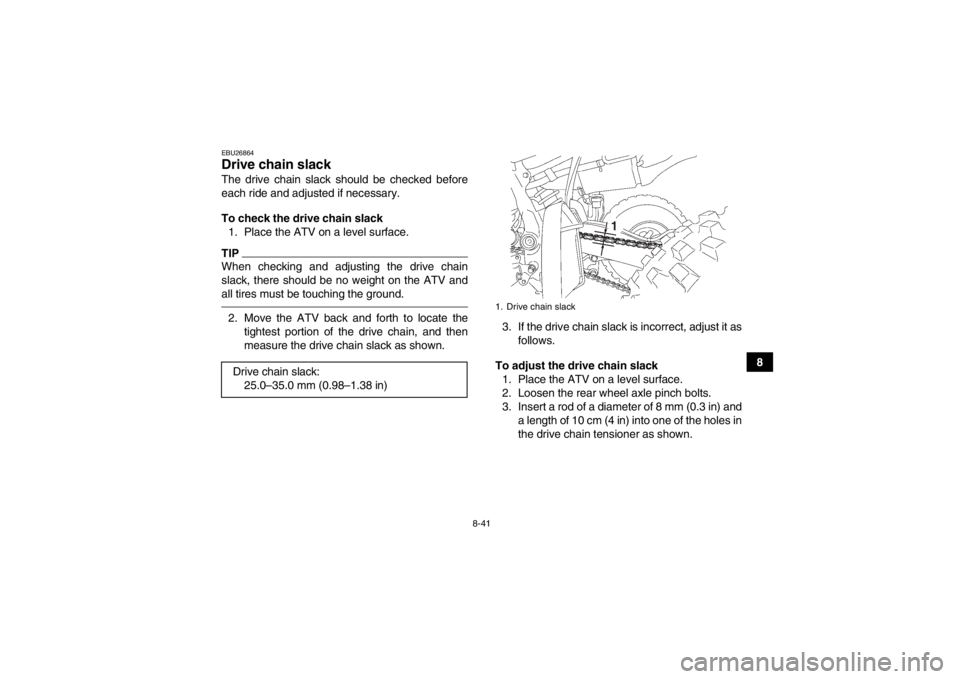
To check the drive chain slack1. Place the ATV on a level surface.TIPWhen checking and adjusting the drive chain
slack, there should be no weight on the ATV and
all tires must be touching the ground.2. Move the ATV back and forth to locate the tightest portion of the drive chain, and then
measure the drive chain slack as shown. 3. If the drive chain slack is incorrect, adjust it as
follows.
To adjust the drive chain slack 1. Place the ATV on a level surface.
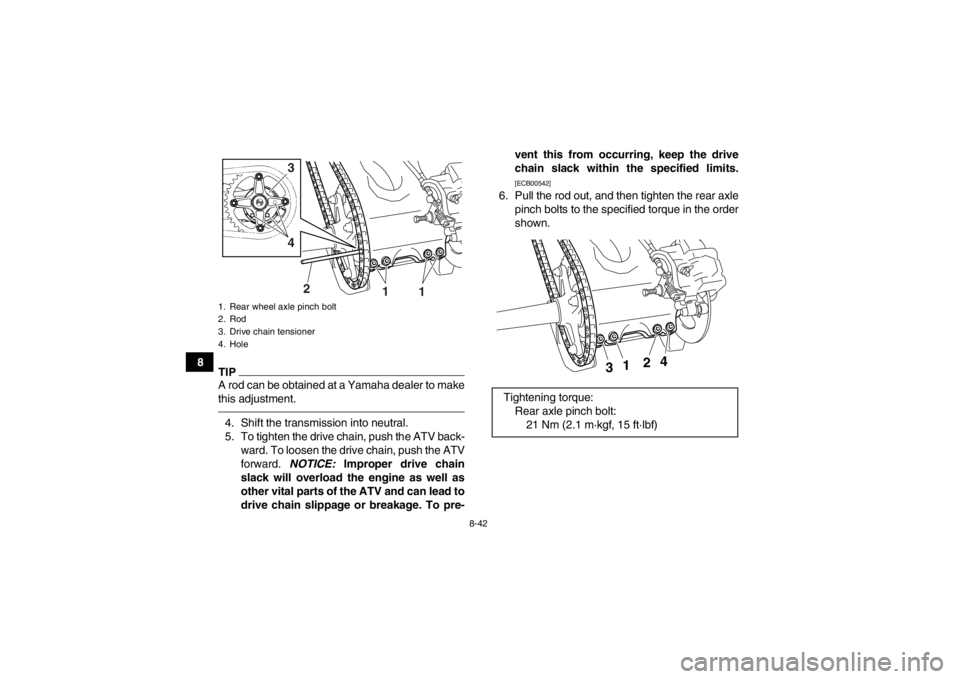
2. Loosen the rear wheel axle pinch bolts.
3. Insert a rod of a diameter of 8 mm (0.3 in) and a length of 10 cm (4 in) into one of the holes in
the drive chain tensioner as shown.
Drive chain slack:
25.0–35.0 mm (0.98–1.38 in)
1. Drive chain slack
1
U1PD61E0.book Page 41 Tuesday, February 14, 2012 10:06 AM
Page 124 of 154
8-42
8
TIPA rod can be obtained at a Yamaha dealer to make
this adjustment.4. Shift the transmission into neutral.
5. To tighten the drive chain, push the ATV back-ward. To loosen the drive chain, push the ATV
forward. NOTICE: Improper drive chain
slack will overload the engine as well as
other vital parts of the ATV and can lead to
drive chain slippage or breakage. To pre- vent this from occurring, keep the drive
chain slack within the specified limits.
[ECB00542]
6. Pull the rod out, and then tighten the rear axle
pinch bolts to the specified torque in the order
shown.
1. Rear wheel axle pinch bolt
2. Rod
3. Drive chain tensioner
4. Hole
3
4
2 11
Tightening torque:
Rear axle pinch bolt:21 Nm (2.1 m·kgf, 15 ft·lbf)
3 1 2
4
U1PD61E0.book Page 42 Tuesday, February 14, 2012 10:06 AM