valve YAMAHA YZ250F 2009 Owner's Guide
[x] Cancel search | Manufacturer: YAMAHA, Model Year: 2009, Model line: YZ250F, Model: YAMAHA YZ250F 2009Pages: 190, PDF Size: 12.83 MB
Page 151 of 190
5-20
FRONT FORK
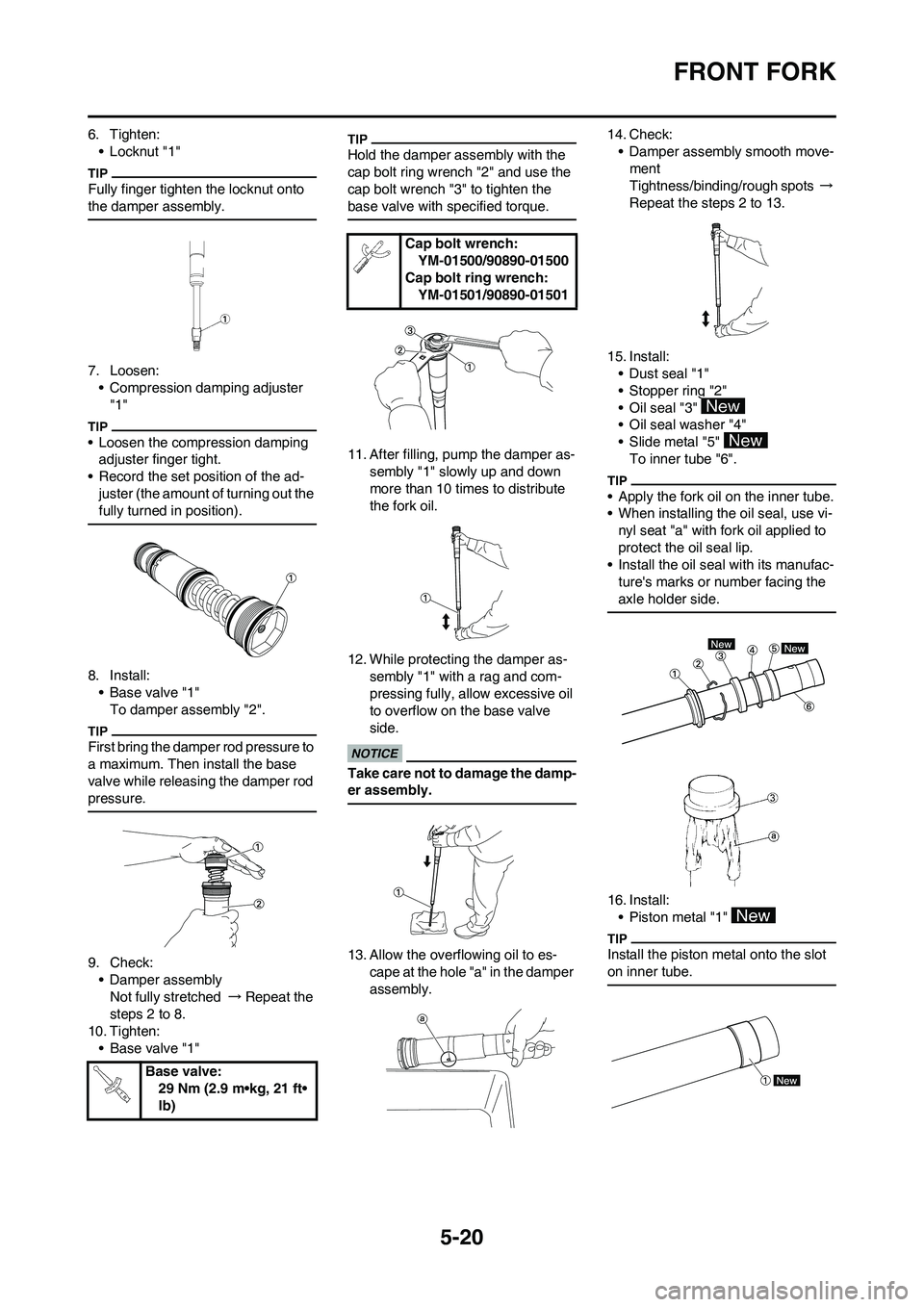
6. Tighten:
• Locknut "1"
Fully finger tighten the locknut onto
the damper assembly.
7. Loosen:
• Compression damping adjuster
"1"
• Loosen the compression damping
adjuster finger tight.
• Record the set position of the ad-
juster (the amount of turning out the
fully turned in position).
8. Install:
• Base valve "1"
To damper assembly "2".
First bring the damper rod pressure to
a maximum. Then install the base
valve while releasing the damper rod
pressure.
9. Check:
• Damper assembly
Not fully stretched → Repeat the
steps 2 to 8.
10. Tighten:
• Base valve "1"
Hold the damper assembly with the
cap bolt ring wrench "2" and use the
cap bolt wrench "3" to tighten the
base valve with specified torque.
11. After filling, pump the damper as-
sembly "1" slowly up and down
more than 10 times to distribute
the fork oil.
12. While protecting the damper as-
sembly "1" with a rag and com-
pressing fully, allow excessive oil
to overflow on the base valve
side.
Take care not to damage the damp-
er assembly.
13. Allow the overflowing oil to es-
cape at the hole "a" in the damper
assembly.14. Check:
• Damper assembly smooth move-
ment
Tightness/binding/rough spots →
Repeat the steps 2 to 13.
15. Install:
• Dust seal "1"
• Stopper ring "2"
•Oil seal "3"
• Oil seal washer "4"
• Slide metal "5"
To inner tube "6".
• Apply the fork oil on the inner tube.
• When installing the oil seal, use vi-
nyl seat "a" with fork oil applied to
protect the oil seal lip.
• Install the oil seal with its manufac-
ture's marks or number facing the
axle holder side.
16. Install:
• Piston metal "1"
Install the piston metal onto the slot
on inner tube.
Base valve:
29 Nm (2.9 m•kg, 21 ft•
lb)
Cap bolt wrench:
YM-01500/90890-01500
Cap bolt ring wrench:
YM-01501/90890-01501
Page 152 of 190
5-21
FRONT FORK
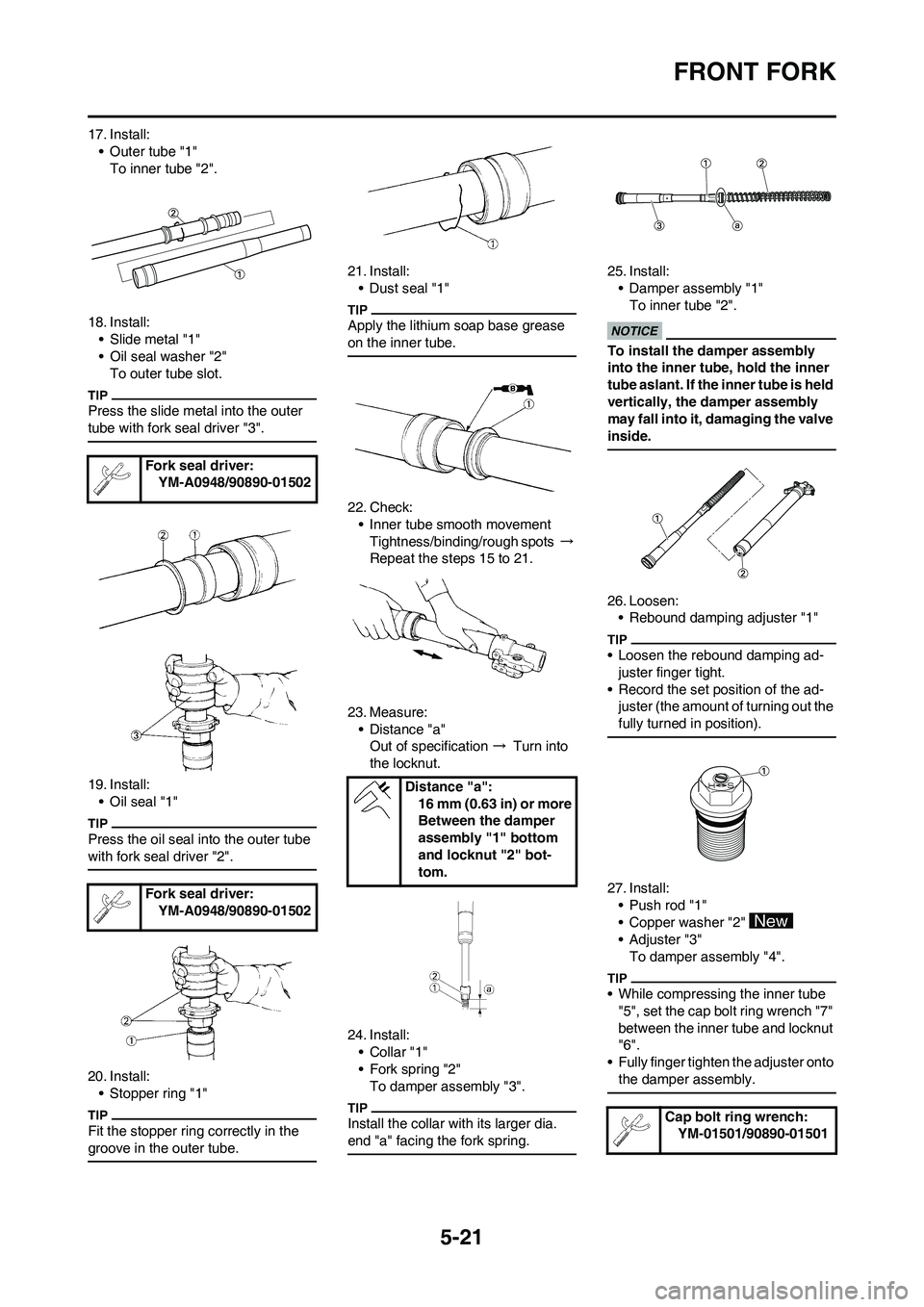
17. Install:
• Outer tube "1"
To inner tube "2".
18. Install:
• Slide metal "1"
• Oil seal washer "2"
To outer tube slot.
Press the slide metal into the outer
tube with fork seal driver "3".
19. Install:
•Oil seal "1"
Press the oil seal into the outer tube
with fork seal driver "2".
20. Install:
• Stopper ring "1"
Fit the stopper ring correctly in the
groove in the outer tube.
21. Install:
• Dust seal "1"
Apply the lithium soap base grease
on the inner tube.
22. Check:
• Inner tube smooth movement
Tightness/binding/rough spots →
Repeat the steps 15 to 21.
23. Measure:
• Distance "a"
Out of specification → Turn into
the locknut.
24. Install:
•Collar "1"
• Fork spring "2"
To damper assembly "3".
Install the collar with its larger dia.
end "a" facing the fork spring.
25. Install:
• Damper assembly "1"
To inner tube "2".
To install the damper assembly
into the inner tube, hold the inner
tube aslant. If the inner tube is held
vertically, the damper assembly
may fall into it, damaging the valve
inside.
26. Loosen:
• Rebound damping adjuster "1"
• Loosen the rebound damping ad-
juster finger tight.
• Record the set position of the ad-
juster (the amount of turning out the
fully turned in position).
27. Install:
• Push rod "1"
• Copper washer "2"
•Adjuster "3"
To damper assembly "4".
• While compressing the inner tube
"5", set the cap bolt ring wrench "7"
between the inner tube and locknut
"6".
• Fully finger tighten the adjuster onto
the damper assembly.
Fork seal driver:
YM-A0948/90890-01502
Fork seal driver:
YM-A0948/90890-01502
Distance "a":
16 mm (0.63 in) or more
Between the damper
assembly "1" bottom
and locknut "2" bot-
tom.
Cap bolt ring wrench:
YM-01501/90890-01501
Page 168 of 190
5-37
REAR SHOCK ABSORBER
HANDLING NOTE
• Support the machine securely so
there is no danger of it falling
over.
• This rear shock absorber is pro-
vided with a separate type tank
filled with high-pressure nitro-
gen gas. To prevent the danger
of explosion, read and under-
stand the following information
before handling the shock ab-
sorber. The manufacturer can
not be held responsible for prop-
erty damage or personal injury
that may result from improper
handling.
• Never tamper or attempt to dis-
assemble the cylinder or the
tank.
• Never throw the rear shock ab-
sorber into an open flame or
other high heat. The rear shock
absorber may explode as a re-
sult of nitrogen gas expansion
and/ or damage to the hose.
• Be careful not to damage any
part of the gas tank. A damaged
gas tank will impair the damp-
ing performance or cause a
malfunction.
• Take care not to scratch the
contact surface of the piston
rod with the cylinder; or oil
could leak out.
• Never attempt to remove the
plug at the bottom of the nitro-
gen gas tank. It is very danger-
ous to remove the plug.
• When scrapping the rear shock
absorber, follow the instruc-
tions on disposal.
NOTES ON DISPOSAL (YAMAHA
DEALERS ONLY)
Before disposing the rear shock ab-
sorber, be sure to extract the nitrogen
gas from valve "1". Wear eye protec-
tion to prevent eye damage from es-
caping gas and/or metal chips.
To dispose of a damaged or worn-
out rear shock absorber, take the
unit to your Yamaha dealer for this
disposal procedure.
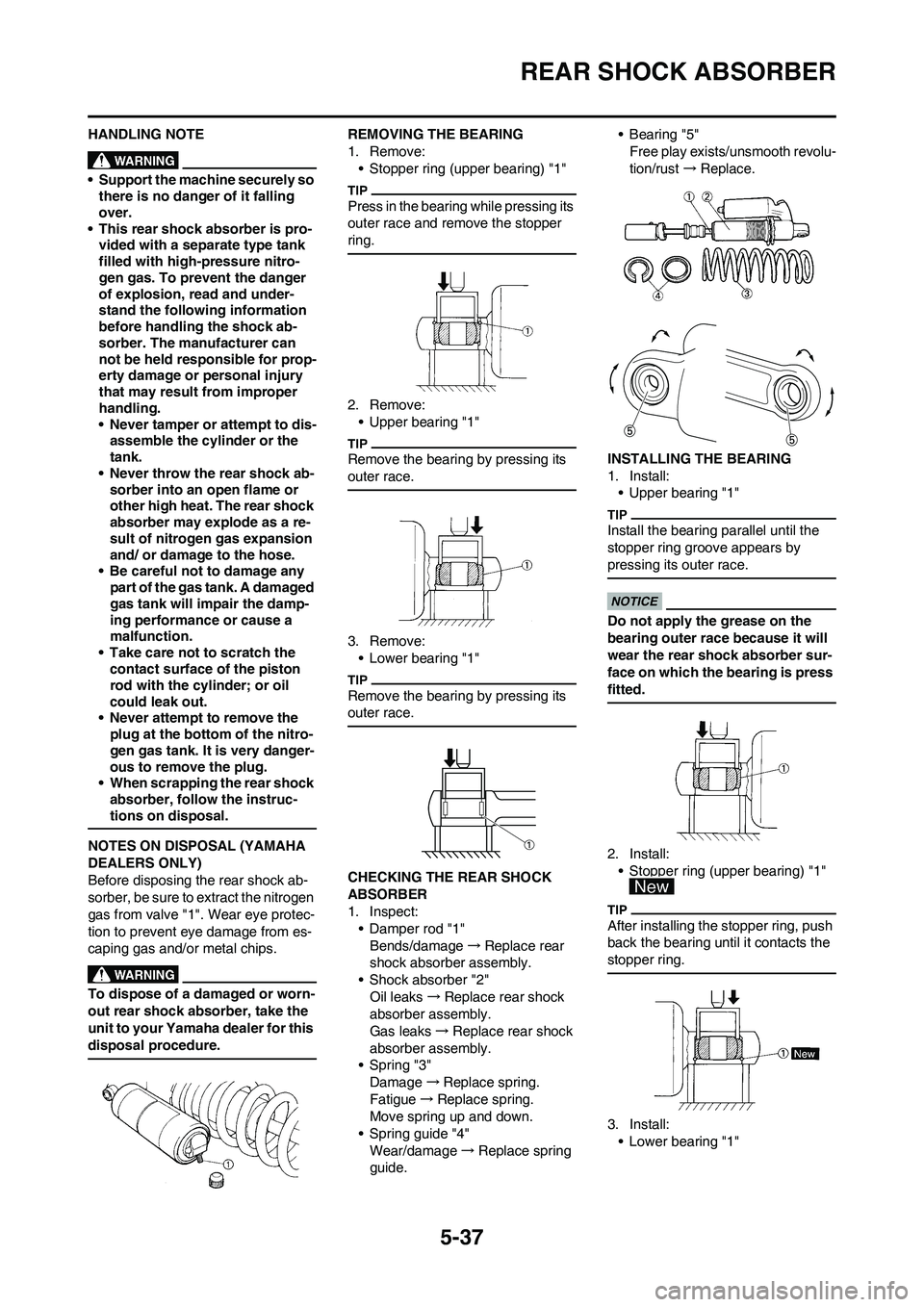
REMOVING THE BEARING
1. Remove:
• Stopper ring (upper bearing) "1"
Press in the bearing while pressing its
outer race and remove the stopper
ring.
2. Remove:
• Upper bearing "1"
Remove the bearing by pressing its
outer race.
3. Remove:
• Lower bearing "1"
Remove the bearing by pressing its
outer race.
CHECKING THE REAR SHOCK
ABSORBER
1. Inspect:
• Damper rod "1"
Bends/damage→Replace rear
shock absorber assembly.
• Shock absorber "2"
Oil leaks→Replace rear shock
absorber assembly.
Gas leaks→Replace rear shock
absorber assembly.
• Spring "3"
Damage→Replace spring.
Fatigue→Replace spring.
Move spring up and down.
• Spring guide "4"
Wear/damage→Replace spring
guide.• Bearing "5"
Free play exists/unsmooth revolu-
tion/rust →Replace.
INSTALLING THE BEARING
1. Install:
• Upper bearing "1"
Install the bearing parallel until the
stopper ring groove appears by
pressing its outer race.
Do not apply the grease on the
bearing outer race because it will
wear the rear shock absorber sur-
face on which the bearing is press
fitted.
2. Install:
• Stopper ring (upper bearing) "1"
After installing the stopper ring, push
back the bearing until it contacts the
stopper ring.
3. Install:
• Lower bearing "1"
Page 178 of 190
7-1
ENGINE
TUNING
ENGINE
CARBURETOR SETTING
• The air/fuel mixture will vary de-
pending on atmospheric conditions.
Therefore, it is necessary to take
into consideration the air pressure,
ambient temperature, humidity,
etc., when adjusting the carburetor.
• Perform a test run to check for prop-
er engine performance (e.g., throt-
tle response) and spark plug(-s)
discoloration or fouling. Use these
readings to determine the best pos-
sible carburetor setting.
It is recommended to keep a record of
all carburetor settings and external
conditions (e.g., atmospheric condi-
tions, track/surface conditions, lap
times) to make future carburetor set-
ting easier.
• The carburetor is a part of the
fuel line. Therefore, be sure to in-
stall it in a wellventilated area,
away from flammable objects
and any sources of fire.
• Never look into the carburetor in-
take. Flames may shoot out from
the pipe if the engine backfires
while it is being started. Gasoline
may be discharged from the ac-
celerator pump nozzle when the
carburetor has been removed.
• The carburetor is extremely sen-
sitive to foreign matter (dirt,
sand, water, etc.). During instal-
lation, do not allow foreign mat-
ter to get into the carburetor.
• Always handle the carburetor
and its components carefully.
Even slight scratches, bends or
damage to carburetor parts may
prevent the carburetor from
functioning correctly. Carefully
perform all servicing with the ap-
propriate tools and without ap-
plying excessive force.
• When the engine is stopped or
when riding at no load, do not
open and close the throttle un-
necessarily. Otherwise, too
much fuel may be discharged,
starting may become difficult or
the engine may not run well.• After installing the carburetor,
check that the throttle operates
correctly and opens and closes
smoothly.
ATMOSPHERIC CONDITIONS AND
CARBURETOR SETTINGS
The air density (i.e., concentration of
oxygen in the air) determines the rich-
ness or leanness of the air/fuel mix-
ture.
• Higher temperature expands the air
with its resultant reduced density.
• Higher humidity reduces the
amount of oxygen in the air by so
much of the water vapor in the
same air.
• Lower atmospheric pressure (at a
high altitude) reduces the density of
the air.
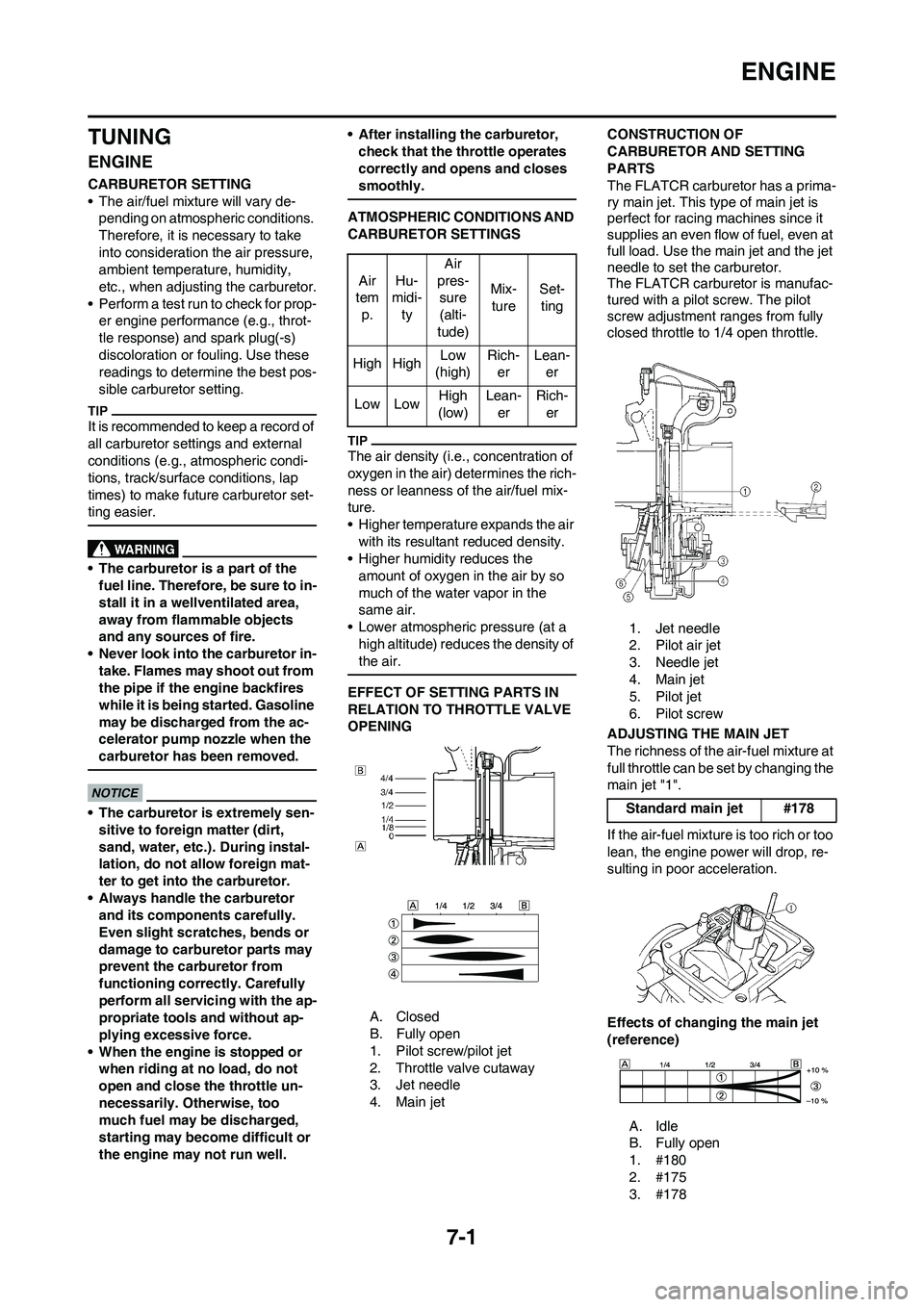
EFFECT OF SETTING PARTS IN
RELATION TO THROTTLE VALVE
OPENING
A. Closed
B. Fully open
1. Pilot screw/pilot jet
2. Throttle valve cutaway
3. Jet needle
4. Main jetCONSTRUCTION OF
CARBURETOR AND SETTING
PARTS
The FLATCR carburetor has a prima-
ry main jet. This type of main jet is
perfect for racing machines since it
supplies an even flow of fuel, even at
full load. Use the main jet and the jet
needle to set the carburetor.
The FLATCR carburetor is manufac-
tured with a pilot screw. The pilot
screw adjustment ranges from fully
closed throttle to 1/4 open throttle.
1. Jet needle
2. Pilot air jet
3. Needle jet
4. Main jet
5. Pilot jet
6. Pilot screw
ADJUSTING THE MAIN JET
The richness of the air-fuel mixture at
full throttle can be set by changing the
main jet "1".
If the air-fuel mixture is too rich or too
lean, the engine power will drop, re-
sulting in poor acceleration.
Effects of changing the main jet
(reference)
A. Idle
B. Fully open
1. #180
2. #175
3. #178 Air
tem
p.Hu-
midi-
tyAir
pres-
sure
(alti-
tude)Mix-
tureSet-
ting
High HighLow
(high)Rich-
erLean-
er
Low LowHigh
(low)Lean-
erRich-
er
Standard main jet #178
Page 182 of 190
7-5
ENGINE
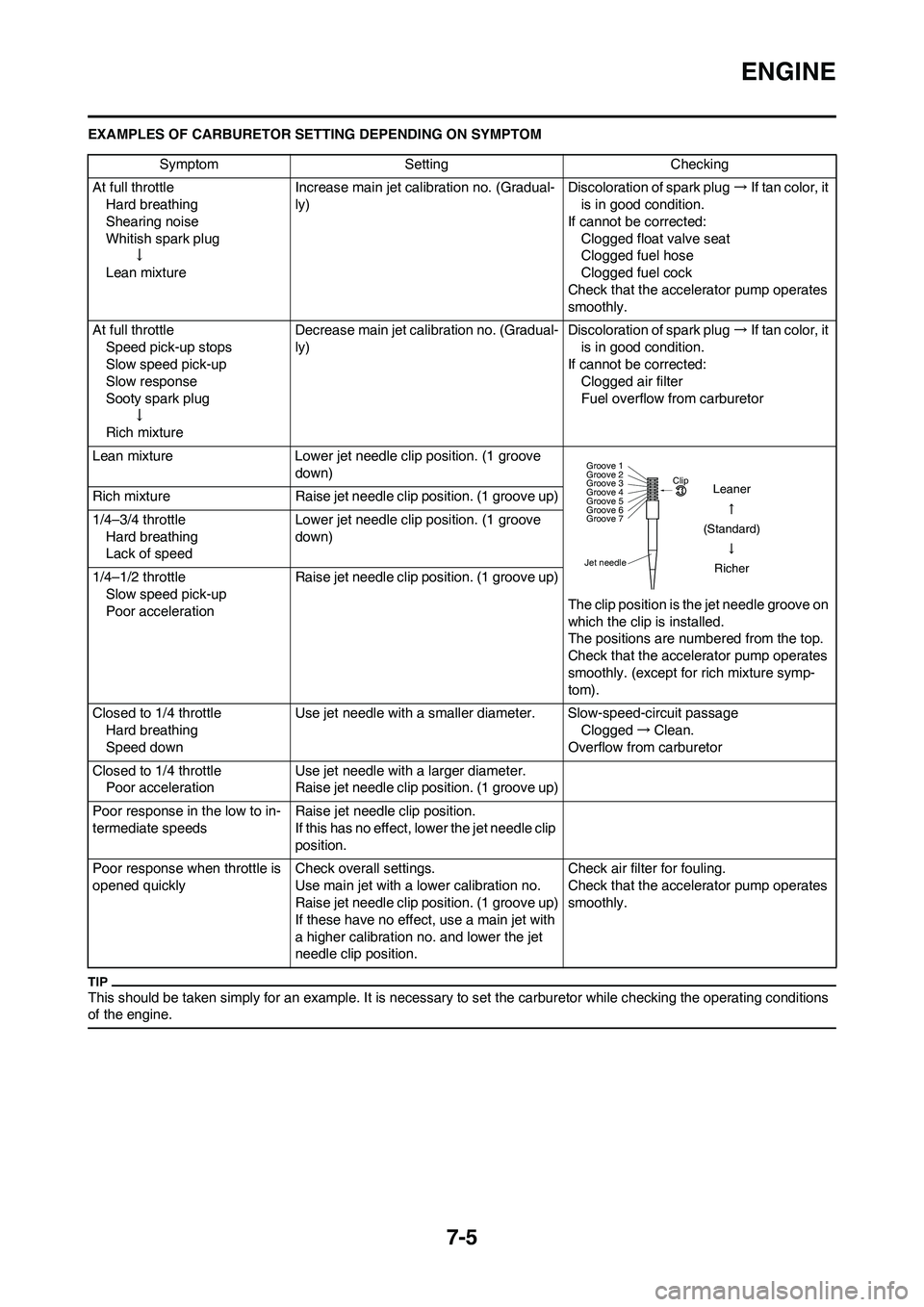
EXAMPLES OF CARBURETOR SETTING DEPENDING ON SYMPTOM
This should be taken simply for an example. It is necessary to set the carburetor while checking the operating conditions
of the engine.
Symptom Setting Checking
At full throttle
Hard breathing
Shearing noise
Whitish spark plug
↓
Lean mixtureIncrease main jet calibration no. (Gradual-
ly)Discoloration of spark plug→If tan color, it
is in good condition.
If cannot be corrected:
Clogged float valve seat
Clogged fuel hose
Clogged fuel cock
Check that the accelerator pump operates
smoothly.
At full throttle
Speed pick-up stops
Slow speed pick-up
Slow response
Sooty spark plug
↓
Rich mixtureDecrease main jet calibration no. (Gradual-
ly)Discoloration of spark plug→If tan color, it
is in good condition.
If cannot be corrected:
Clogged air filter
Fuel overflow from carburetor
Lean mixture Lower jet needle clip position. (1 groove
down)
The clip position is the jet needle groove on
which the clip is installed.
The positions are numbered from the top.
Check that the accelerator pump operates
smoothly. (except for rich mixture symp-
tom). Rich mixture Raise jet needle clip position. (1 groove up)
1/4–3/4 throttle
Hard breathing
Lack of speedLower jet needle clip position. (1 groove
down)
1/4–1/2 throttle
Slow speed pick-up
Poor accelerationRaise jet needle clip position. (1 groove up)
Closed to 1/4 throttle
Hard breathing
Speed downUse jet needle with a smaller diameter. Slow-speed-circuit passage
Clogged→Clean.
Overflow from carburetor
Closed to 1/4 throttle
Poor accelerationUse jet needle with a larger diameter.
Raise jet needle clip position. (1 groove up)
Poor response in the low to in-
termediate speedsRaise jet needle clip position.
If this has no effect, lower the jet needle clip
position.
Poor response when throttle is
opened quicklyCheck overall settings.
Use main jet with a lower calibration no.
Raise jet needle clip position. (1 groove up)
If these have no effect, use a main jet with
a higher calibration no. and lower the jet
needle clip position.Check air filter for fouling.
Check that the accelerator pump operates
smoothly.
Jet needleClip
Groove 7 Groove 6
Groove 5
Groove 4
Groove 3
Groove 2
Groove 1
Leaner
(Standard)
Richer