carb YAMAHA YZ450F 2008 User Guide
[x] Cancel search | Manufacturer: YAMAHA, Model Year: 2008, Model line: YZ450F, Model: YAMAHA YZ450F 2008Pages: 188, PDF Size: 11.75 MB
Page 40 of 188
2-18
CABLE ROUTING DIAGRAM
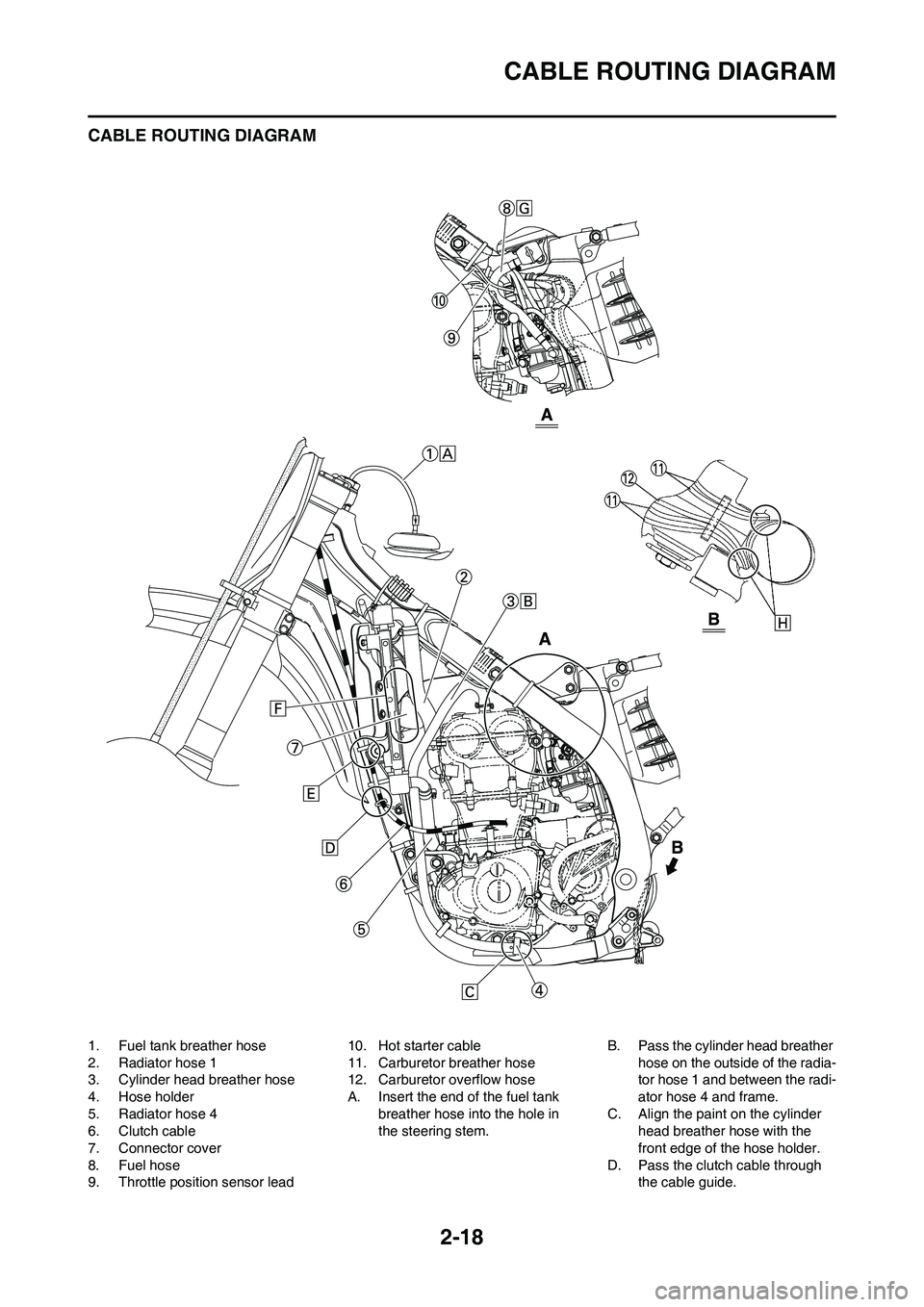
CABLE ROUTING DIAGRAM
1. Fuel tank breather hose
2. Radiator hose 1
3. Cylinder head breather hose
4. Hose holder
5. Radiator hose 4
6. Clutch cable
7. Connector cover
8. Fuel hose
9. Throttle position sensor lead10. Hot starter cable
11. Carburetor breather hose
12. Carburetor overflow hose
A. Insert the end of the fuel tank
breather hose into the hole in
the steering stem.B. Pass the cylinder head breather
hose on the outside of the radia-
tor hose 1 and between the radi-
ator hose 4 and frame.
C. Align the paint on the cylinder
head breather hose with the
front edge of the hose holder.
D. Pass the clutch cable through
the cable guide.
Page 41 of 188

2-19
CABLE ROUTING DIAGRAM
E. Pass the clutch cable in front of
the radiator mounting boss.
F. Install the connector cover so
that it does not come in between
the radiator hose 1 and radiator.
G. Pass the fuel hose between the
hot starter cable and throttle po-
sition sensor lead.
H. Pass the carburetor breather
hoses and overflow hose so that
all there hoses do not contact
the rear shock absorber.
Page 47 of 188
3-1
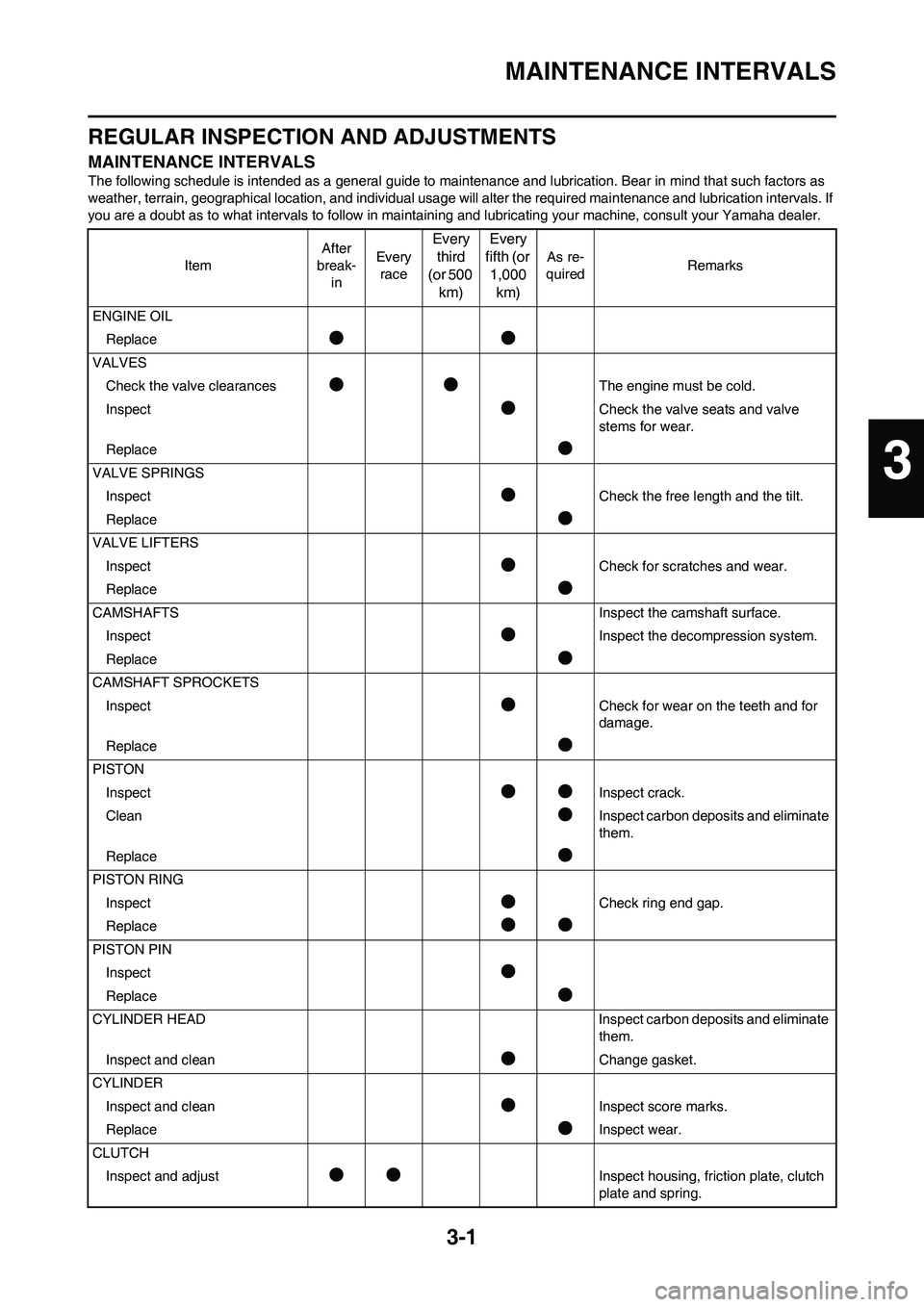
MAINTENANCE INTERVALS
REGULAR INSPECTION AND ADJUSTMENTS
MAINTENANCE INTERVALS
The following schedule is intended as a general guide to maintenance and lubrication. Bear in mind that such factors as
weather, terrain, geographical location, and individual usage will alter the required maintenance and lubrication intervals. If
you are a doubt as to what intervals to follow in maintaining and lubricating your machine, consult your Yamaha dealer.
ItemAfter
break-
inEvery
race
Every
third
(or 500
km)Every
fifth (or
1,000
km)
As re-
quiredRemarks
ENGINE OIL
Replace
●●
VALVES
Check the valve clearances
●●The engine must be cold.
Inspect
●Check the valve seats and valve
stems for wear.
Replace
●
VALVE SPRINGS
Inspect
●Check the free length and the tilt.
Replace
●
VALVE LIFTERS
Inspect
●Check for scratches and wear.
Replace
●
CAMSHAFTS Inspect the camshaft surface.
Inspect
●Inspect the decompression system.
Replace
●
CAMSHAFT SPROCKETS
Inspect
●Check for wear on the teeth and for
damage.
Replace
●
PISTON
Inspect
●●Inspect crack.
Clean
●Inspect carbon deposits and eliminate
them.
Replace
●
PISTON RING
Inspect
●Check ring end gap.
Replace
●●
PISTON PIN
Inspect
●
Replace●
CYLINDER HEAD Inspect carbon deposits and eliminate
them.
Inspect and clean
●Change gasket.
CYLINDER
Inspect and clean
●Inspect score marks.
Replace
●Inspect wear.
CLUTCH
Inspect and adjust
●●Inspect housing, friction plate, clutch
plate and spring.
3
Page 48 of 188

3-2
MAINTENANCE INTERVALS
Replace●
TRANSMISSION
Inspect
●
Replace bearing●
SHIFT FORK, SHIFT CAM,
GUIDE BAR
Inspect
●Inspect wear.
ROTOR NUT
Retighten
●●
EXHAUST PIPE, SILENCER,
PROTECTOR
Inspect and retighten
●●
Clean●
Replace●* Whichever comes first
CRANK
Inspect and clean
●●
CARBURETOR
Inspect, adjust and clean
●●
SPARK PLUG
Inspect and clean
●●
Replace●
DRIVE CHAIN Use chain lube.
Lubricate, slack, alignment
●●Chain slack: 48–58 mm (1.9–2.3 in)
Replace
●
COOLING SYSTEM
Check coolant level and leakage
●●
Check radiator cap operation●
Replace coolant●Every two years
Inspect hoses
●
OUTSIDE NUTS AND BOLTS
Retighten
●●Refer to "STARTING AND BREAK-
IN" section in the CHAPTER 1.
AIR FILTER
Clean and lubricate
●●Use foam air-filter oil or equivalent oil.
Replace
●
OIL FILTER
Replace
●●
FRAME
Clean and inspect
●●
FUEL TANK, COCK
Clean and inspect
●●
BRAKES
Adjust lever position and pedal
height
●●
ItemAfter
break-
inEvery
race
Every
third
(or 500
km)Every
fifth (or
1,000
km)
As re-
quiredRemarks
Page 56 of 188
3-10
ENGINE
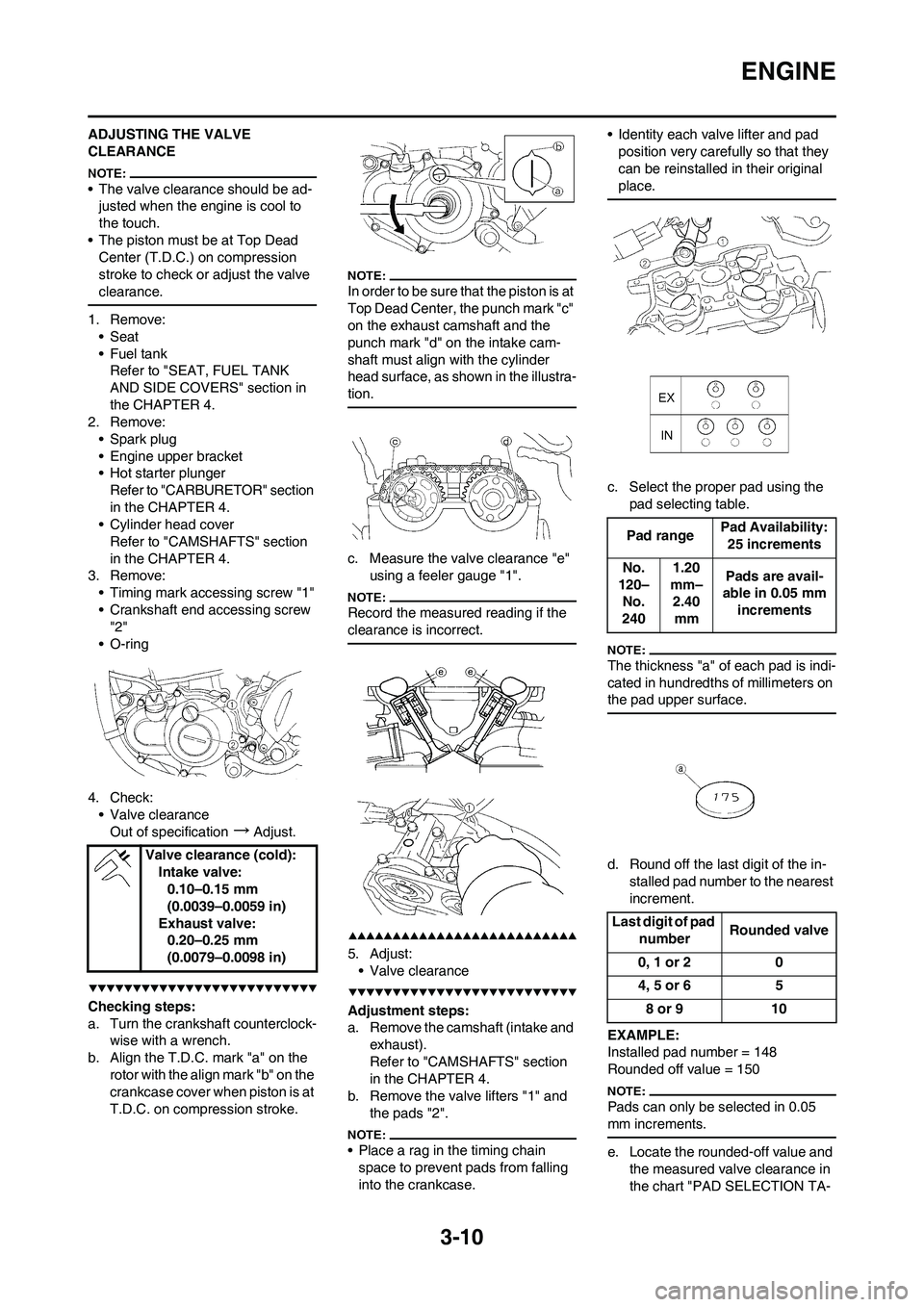
ADJUSTING THE VALVE
CLEARANCE
• The valve clearance should be ad-
justed when the engine is cool to
the touch.
• The piston must be at Top Dead
Center (T.D.C.) on compression
stroke to check or adjust the valve
clearance.
1. Remove:
• Seat
• Fuel tank
Refer to "SEAT, FUEL TANK
AND SIDE COVERS" section in
the CHAPTER 4.
2. Remove:
• Spark plug
• Engine upper bracket
• Hot starter plunger
Refer to "CARBURETOR" section
in the CHAPTER 4.
• Cylinder head cover
Refer to "CAMSHAFTS" section
in the CHAPTER 4.
3. Remove:
• Timing mark accessing screw "1"
• Crankshaft end accessing screw
"2"
• O-ring
4. Check:
• Valve clearance
Out of specification
→Adjust.
Checking steps:
a. Turn the crankshaft counterclock-
wise with a wrench.
b. Align the T.D.C. mark "a" on the
rotor with the align mark "b" on the
crankcase cover when piston is at
T.D.C. on compression stroke.
In order to be sure that the piston is at
Top Dead Center, the punch mark "c"
on the exhaust camshaft and the
punch mark "d" on the intake cam-
shaft must align with the cylinder
head surface, as shown in the illustra-
tion.
c. Measure the valve clearance "e"
using a feeler gauge "1".
Record the measured reading if the
clearance is incorrect.
5. Adjust:
• Valve clearance
Adjustment steps:
a. Remove the camshaft (intake and
exhaust).
Refer to "CAMSHAFTS" section
in the CHAPTER 4.
b. Remove the valve lifters "1" and
the pads "2".
• Place a rag in the timing chain
space to prevent pads from falling
into the crankcase.• Identity each valve lifter and pad
position very carefully so that they
can be reinstalled in their original
place.
c. Select the proper pad using the
pad selecting table.
The thickness "a" of each pad is indi-
cated in hundredths of millimeters on
the pad upper surface.
d. Round off the last digit of the in-
stalled pad number to the nearest
increment.
EXAMPLE:
Installed pad number = 148
Rounded off value = 150
Pads can only be selected in 0.05
mm increments.
e. Locate the rounded-off value and
the measured valve clearance in
the chart "PAD SELECTION TA- Valve clearance (cold):
Intake valve:
0.10–0.15 mm
(0.0039–0.0059 in)
Exhaust valve:
0.20–0.25 mm
(0.0079–0.0098 in)
Pad rangePad Availability:
25 increments
No.
120–
No.
2401.20
mm–
2.40
mmPads are avail-
able in 0.05 mm
increments
Last digit of pad
numberRounded valve
0, 1 or 2 0
4, 5 or 6 5
8 or 9 10
Page 68 of 188
3-22
ELECTRICAL
ELECTRICAL
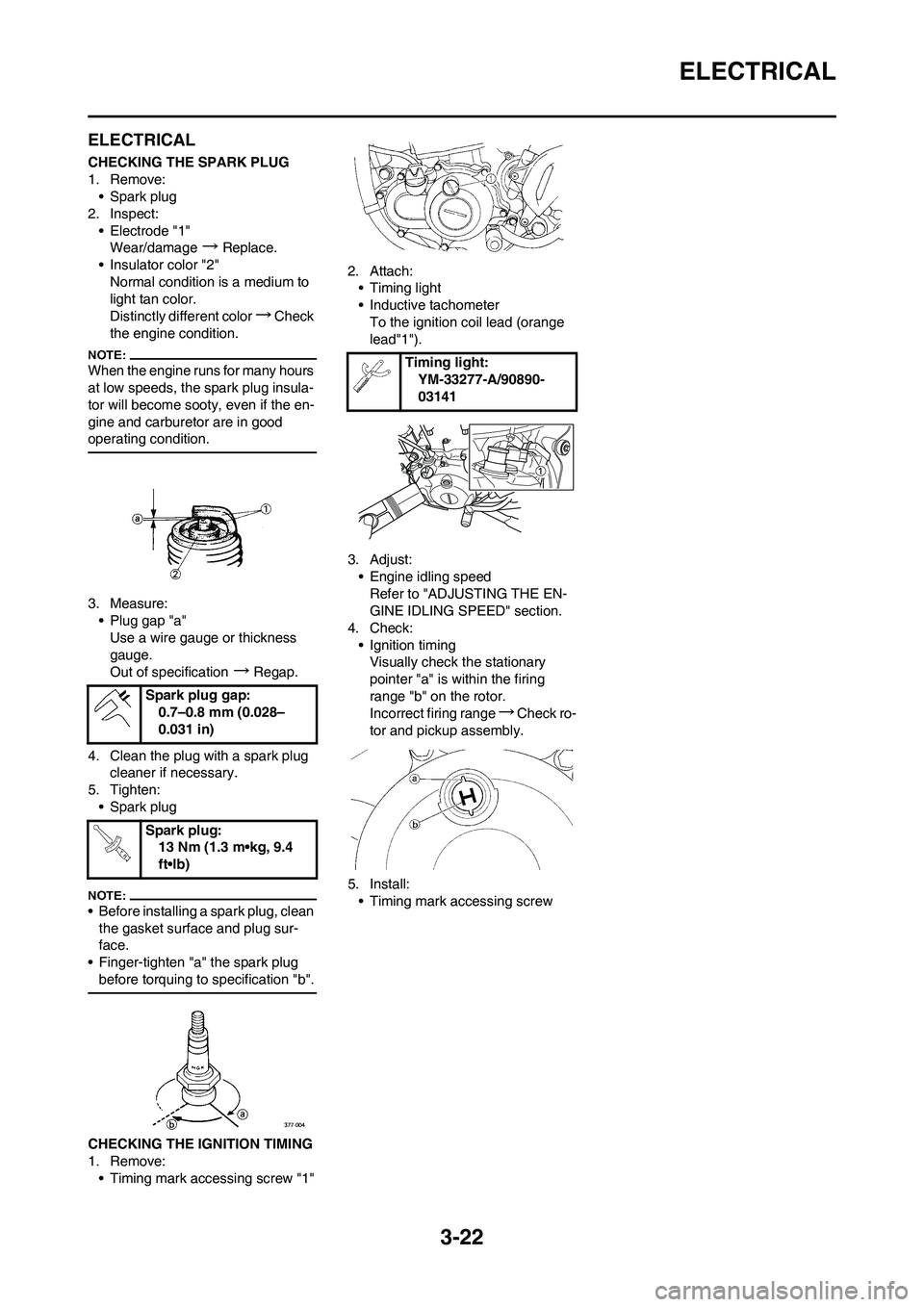
CHECKING THE SPARK PLUG
1. Remove:
• Spark plug
2. Inspect:
• Electrode "1"
Wear/damage
→Replace.
• Insulator color "2"
Normal condition is a medium to
light tan color.
Distinctly different color
→Check
the engine condition.
When the engine runs for many hours
at low speeds, the spark plug insula-
tor will become sooty, even if the en-
gine and carburetor are in good
operating condition.
3. Measure:
• Plug gap "a"
Use a wire gauge or thickness
gauge.
Out of specification
→Regap.
4. Clean the plug with a spark plug
cleaner if necessary.
5. Tighten:
• Spark plug
• Before installing a spark plug, clean
the gasket surface and plug sur-
face.
• Finger-tighten "a" the spark plug
before torquing to specification "b".
CHECKING THE IGNITION TIMING
1. Remove:
• Timing mark accessing screw "1"2. Attach:
• Timing light
• Inductive tachometer
To the ignition coil lead (orange
lead"1").
3. Adjust:
• Engine idling speed
Refer to "ADJUSTING THE EN-
GINE IDLING SPEED" section.
4. Check:
• Ignition timing
Visually check the stationary
pointer "a" is within the firing
range "b" on the rotor.
Incorrect firing range
→Check ro-
tor and pickup assembly.
5. Install:
• Timing mark accessing screw Spark plug gap:
0.7–0.8 mm (0.028–
0.031 in)
Spark plug:
13 Nm (1.3 m•kg, 9.4
ft•lb)
Timing light:
YM-33277-A/90890-
03141
Page 75 of 188
4-7
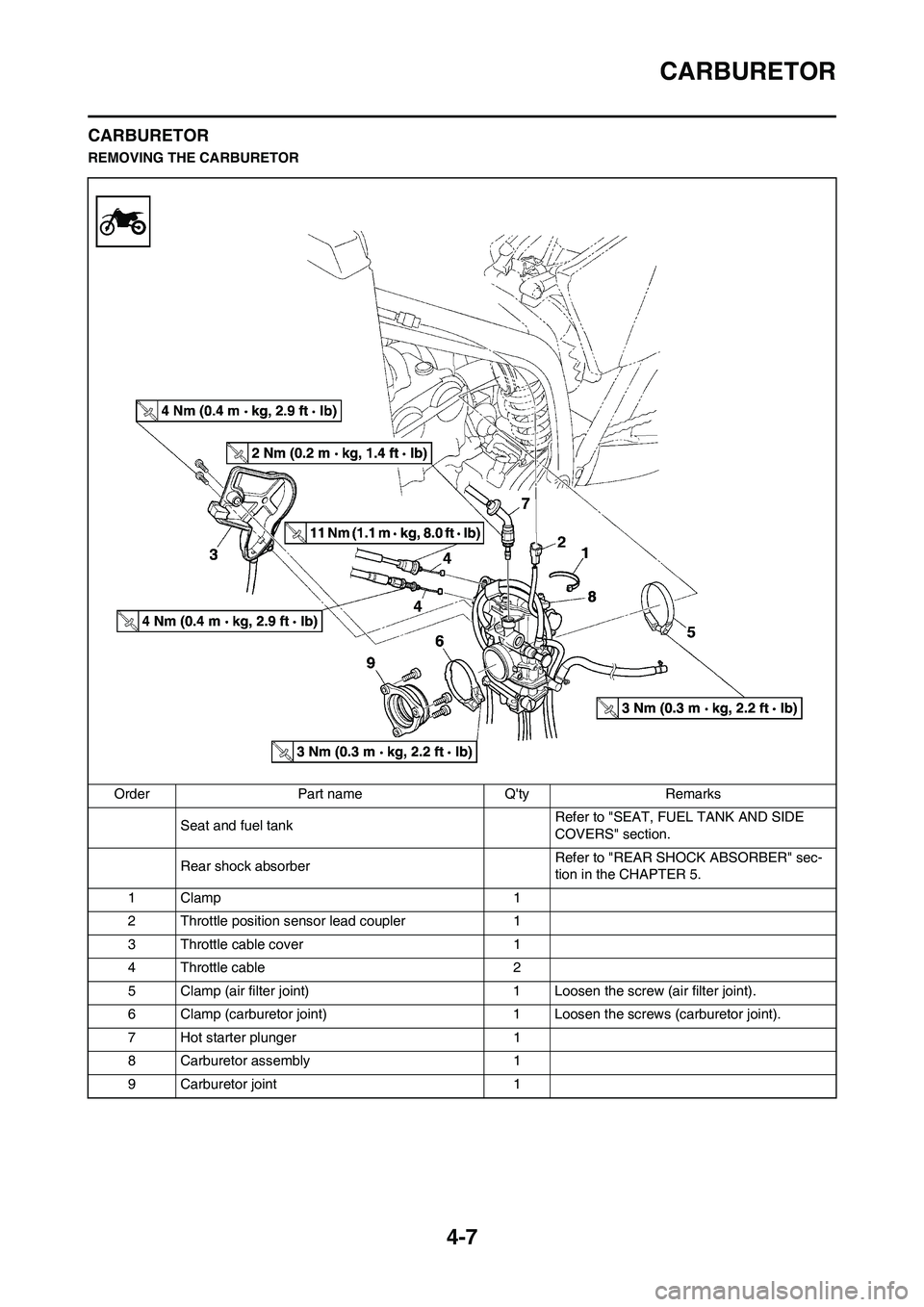
CARBURETOR
CARBURETOR
REMOVING THE CARBURETOR
Order Part name Q'ty Remarks
Seat and fuel tank Refer to "SEAT, FUEL TANK AND SIDE
COVERS" section.
Rear shock absorber Refer to "REAR SHOCK ABSORBER" sec-
tion in the CHAPTER 5.
1Clamp 1
2 Throttle position sensor lead coupler 1
3 Throttle cable cover 1
4 Throttle cable 2
5 Clamp (air filter joint) 1 Loosen the screw (air filter joint).
6 Clamp (carburetor joint) 1 Loosen the screws (carburetor joint).
7 Hot starter plunger 1
8 Carburetor assembly 1
9 Carburetor joint 1
Page 76 of 188
4-8
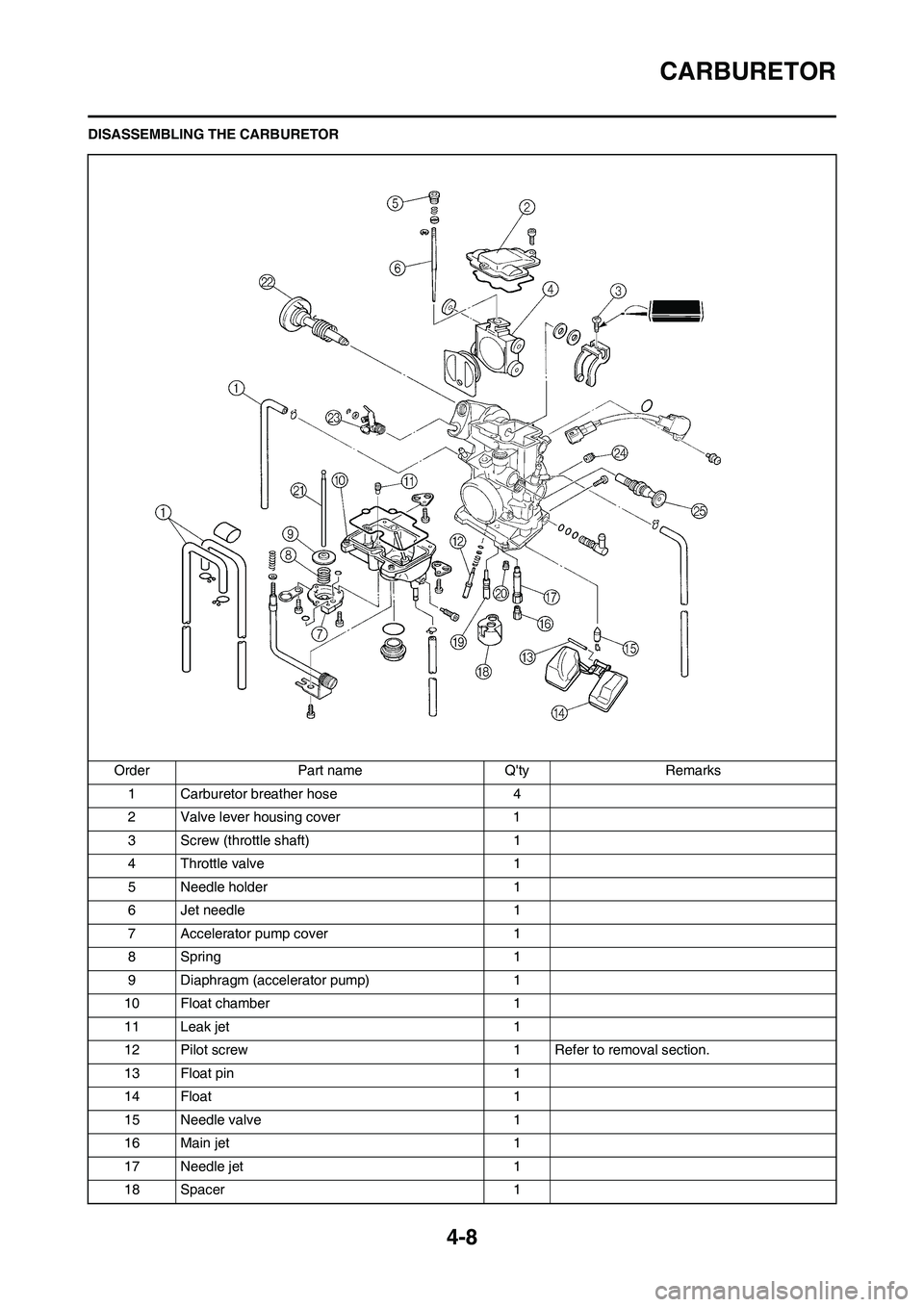
CARBURETOR
DISASSEMBLING THE CARBURETOR
Order Part name Q'ty Remarks
1 Carburetor breather hose 4
2 Valve lever housing cover 1
3 Screw (throttle shaft) 1
4 Throttle valve 1
5 Needle holder 1
6 Jet needle 1
7 Accelerator pump cover 1
8Spring 1
9 Diaphragm (accelerator pump) 1
10 Float chamber 1
11 Leak jet 1
12 Pilot screw 1 Refer to removal section.
13 Float pin 1
14 Float 1
15 Needle valve 1
16 Main jet 1
17 Needle jet 1
18 Spacer 1
Page 77 of 188
4-9
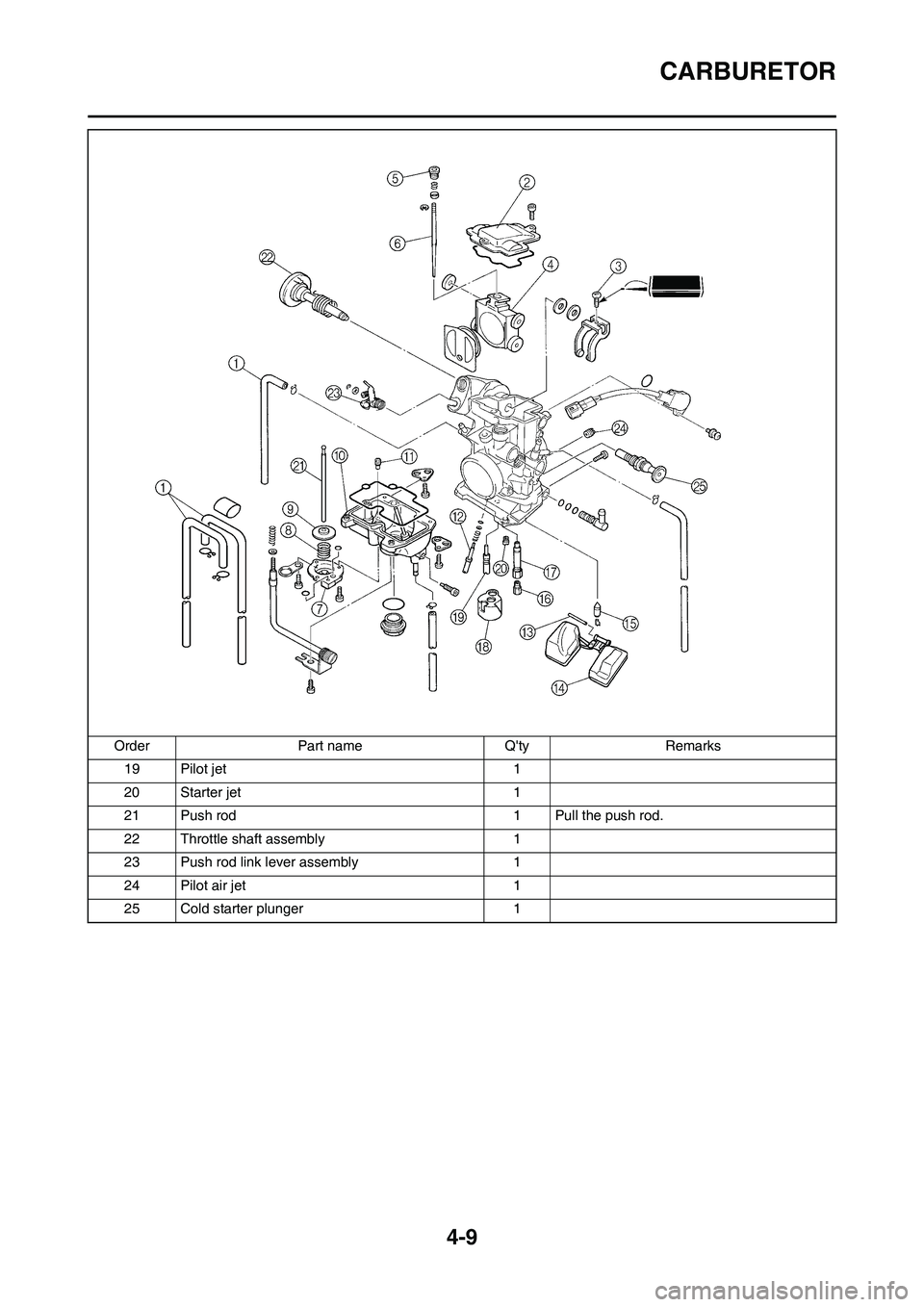
CARBURETOR
19 Pilot jet 1
20 Starter jet 1
21 Push rod 1 Pull the push rod.
22 Throttle shaft assembly 1
23 Push rod link lever assembly 1
24 Pilot air jet 1
25 Cold starter plunger 1 Order Part name Q'ty Remarks
Page 78 of 188
4-10
CARBURETOR
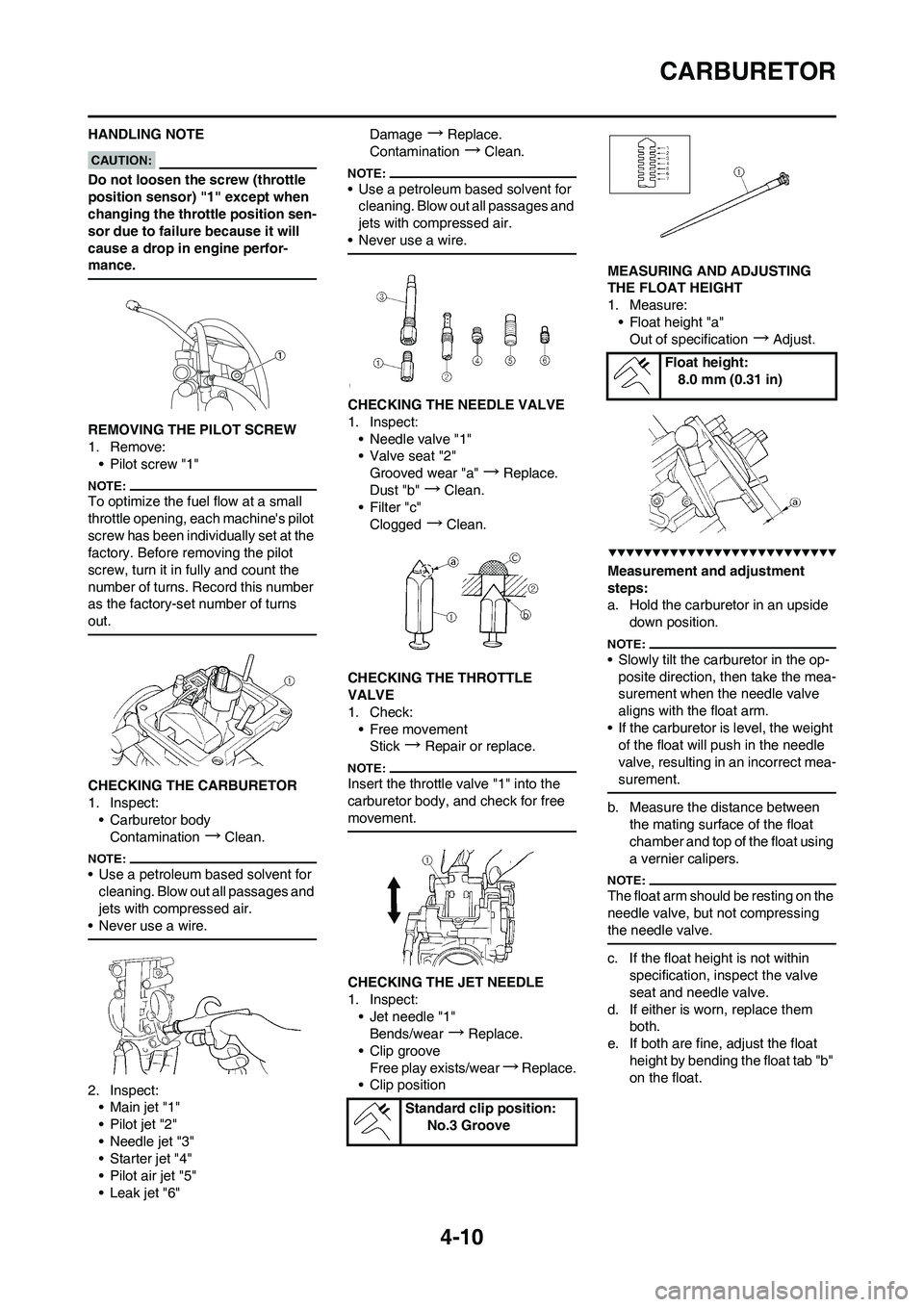
HANDLING NOTE
Do not loosen the screw (throttle
position sensor) "1" except when
changing the throttle position sen-
sor due to failure because it will
cause a drop in engine perfor-
mance.
REMOVING THE PILOT SCREW
1. Remove:
• Pilot screw "1"
To optimize the fuel flow at a small
throttle opening, each machine's pilot
screw has been individually set at the
factory. Before removing the pilot
screw, turn it in fully and count the
number of turns. Record this number
as the factory-set number of turns
out.
CHECKING THE CARBURETOR
1. Inspect:
• Carburetor body
Contamination
→Clean.
• Use a petroleum based solvent for
cleaning. Blow out all passages and
jets with compressed air.
• Never use a wire.
2. Inspect:
•Main jet "1"
• Pilot jet "2"
• Needle jet "3"
• Starter jet "4"
• Pilot air jet "5"
• Leak jet "6"Damage
→Replace.
Contamination
→Clean.
• Use a petroleum based solvent for
cleaning. Blow out all passages and
jets with compressed air.
• Never use a wire.
CHECKING THE NEEDLE VALVE
1. Inspect:
• Needle valve "1"
• Valve seat "2"
Grooved wear "a"
→Replace.
Dust "b"
→Clean.
• Filter "c"
Clogged
→Clean.
CHECKING THE THROTTLE
VALVE
1. Check:
• Free movement
Stick
→Repair or replace.
Insert the throttle valve "1" into the
carburetor body, and check for free
movement.
CHECKING THE JET NEEDLE
1. Inspect:
• Jet needle "1"
Bends/wear
→Replace.
• Clip groove
Free play exists/wear
→Replace.
• Clip positionMEASURING AND ADJUSTING
THE FLOAT HEIGHT
1. Measure:
• Float height "a"
Out of specification
→Adjust.
Measurement and adjustment
steps:
a. Hold the carburetor in an upside
down position.
• Slowly tilt the carburetor in the op-
posite direction, then take the mea-
surement when the needle valve
aligns with the float arm.
• If the carburetor is level, the weight
of the float will push in the needle
valve, resulting in an incorrect mea-
surement.
b. Measure the distance between
the mating surface of the float
chamber and top of the float using
a vernier calipers.
The float arm should be resting on the
needle valve, but not compressing
the needle valve.
c. If the float height is not within
specification, inspect the valve
seat and needle valve.
d. If either is worn, replace them
both.
e. If both are fine, adjust the float
height by bending the float tab "b"
on the float.
Standard clip position:
No.3 Groove
Float height:
8.0 mm (0.31 in)