carb YAMAHA YZ450F 2008 Owner's Manual
[x] Cancel search | Manufacturer: YAMAHA, Model Year: 2008, Model line: YZ450F, Model: YAMAHA YZ450F 2008Pages: 188, PDF Size: 11.75 MB
Page 79 of 188

4-11
CARBURETOR
f. Recheck the float height.
CHECKING THE FLOAT
1. Inspect:
• Float "1"
Damage
→Replace.
CHECKING THE STARTER
PLUNGER
1. Inspect:
• Cold starter plunger "1"
• Hot starter plunger "2"
Wear/damage
→Replace.
CHECKING THE ACCELERATOR
PUMP
1. Inspect:
• Diaphragm (accelerator pump)
"1"
• Spring (accelerator pump) "2"
• Accelerator pump cover "3"
• O-ring "4"
• Push rod "5"
Tears (diaphragm)/damage
→
Replace.
Dirt
→Clean.
2. Inspect:
• Throttle shaft "1"
• Spring "2"
• Lever 1 "3"
• Spring 1 "4"
• Lever 2 "5"• Spring 2 "6"
Dirt
→Clean.
ASSEMBLING THE CARBURETOR
1. Install:
• Cold starter plunger "1"
2. Install:
•Pilot air jet "1"
3. Install:
• Spring 1 "1"
• Lever 1 "2"
To lever 2 "3".
Make sure the spring 1 fits on the
stopper "a" of the lever 2.
4. Install:
• Spring 2 "1"
To lever 2 "2".
5. Install:
• Push rod link lever assembly "1"
Make sure the stopper "a" of the
spring 2 fits into the recess "b" in the carburetor.
6. Install:
• Washer "1"
• Circlip "2"
7. Install:
• Spring "1"
To throttle shaft "2".
Install the bigger hook "a" of the
spring fits on the stopper "b" of the
throttle shaft pulley.
8. Install:
• Throttle shaft assembly "1"
• Washer (metal) "2"
• Washer (resin) "3"
• Valve lever "4"
• Apply the fluorochemical grease on
the bearings.
• Fit the projection "a" on the throttle
shaft assembly into the slot "b" in
the throttle position sensor.
• Make sure the stopper "c" of the
spring fits into the recess in the car-
buretor.
• Turn the throttle shaft assembly left
while holding down the lever 1 "5"
and fit the throttle stop screw tip "d"
to the stopper "e" of the throttle
shaft assembly pulley.
Page 80 of 188

4-12
CARBURETOR
9. Install:
• Push rod "1"
While holding down the lever 1 "2", in-
sert the push rod farthest into the car-
buretor.
10. Install:
• Starter jet "1"
• Pilot jet "2"
• Spacer "3"
• Needle jet "4"
•Main jet "5"
11. Install:
• Needle valve "1"
• Float "2"
• Float pin "3"
• After installing the needle valve to
the float, install them to the carbure-
tor.• Check the float for smooth move-
ment.
12. Install:
• Pilot screw "1"
• Spring "2"
• Washer "3"
• O-ring "4"
Note the following installation
points:
a. Turn in the pilot screw until it is
lightly seated.
b. Turn out the pilot screw by the
number of turns recorded before
removing.
13. Install:
• O-ring
• Leak jet "1"
• Float chamber "2"
• Bolt (float chamber) "3"
• Cable holder (throttle stop screw
cable) "4"
• Hose holder (carburetor breather
hose) "5"
14. Install:
• Diaphragm (accelerator pump)
"1"
• Spring "2"
• O-ring "3"
• Accelerator pump cover "4"
• Hose holder (drain hose) "5"
• Screw (accelerator pump cover)
"6"
Install the diaphragm (accelerator
pump) with its mark "a" facing the
spring.
15. Install:
• Jet needle "1"
•Collar "2"
• Spring "3"
• Needle holder "4"
• Throttle valve plate "5"
To throttle valve "6".
16. Install:
• Throttle valve assembly "1"
• Screw (throttle shaft) "2"
Install the valve lever rollers "3" into
the slits "a" of the throttle valve.
17. Install:
• O-ring "1"
• Valve lever housing cover "2"
• Bolt (valve lever housing cover)
"3"
18. Install:
• Carburetor breather hose "1"
Refer to "CABLE ROUTING DIA-
GRAM"section in the CHAPTER
2.
Pilot screw (example):
1-1/2 turns out
Page 81 of 188
4-13
CARBURETOR
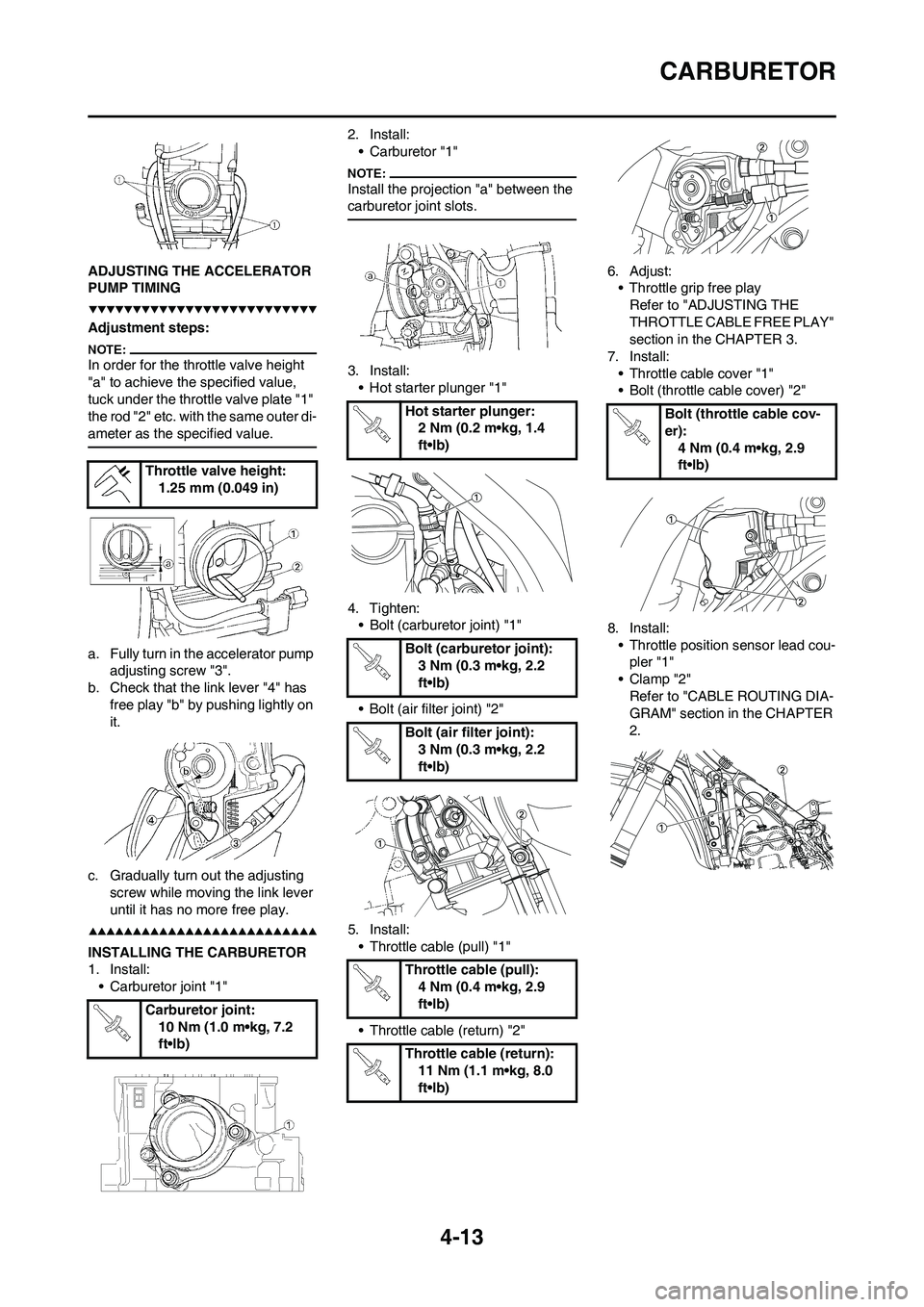
ADJUSTING THE ACCELERATOR
PUMP TIMING
Adjustment steps:
In order for the throttle valve height
"a" to achieve the specified value,
tuck under the throttle valve plate "1"
the rod "2" etc. with the same outer di-
ameter as the specified value.
a. Fully turn in the accelerator pump
adjusting screw "3".
b. Check that the link lever "4" has
free play "b" by pushing lightly on
it.
c. Gradually turn out the adjusting
screw while moving the link lever
until it has no more free play.
INSTALLING THE CARBURETOR
1. Install:
• Carburetor joint "1"2. Install:
• Carburetor "1"
Install the projection "a" between the
carburetor joint slots.
3. Install:
• Hot starter plunger "1"
4. Tighten:
• Bolt (carburetor joint) "1"
• Bolt (air filter joint) "2"
5. Install:
• Throttle cable (pull) "1"
• Throttle cable (return) "2"6. Adjust:
• Throttle grip free play
Refer to "ADJUSTING THE
THROTTLE CABLE FREE PLAY"
section in the CHAPTER 3.
7. Install:
• Throttle cable cover "1"
• Bolt (throttle cable cover) "2"
8. Install:
• Throttle position sensor lead cou-
pler "1"
• Clamp "2"
Refer to "CABLE ROUTING DIA-
GRAM" section in the CHAPTER
2. Throttle valve height:
1.25 mm (0.049 in)
Carburetor joint:
10 Nm (1.0 m•kg, 7.2
ft•lb)
Hot starter plunger:
2 Nm (0.2 m•kg, 1.4
ft•lb)
Bolt (carburetor joint):
3 Nm (0.3 m•kg, 2.2
ft•lb)
Bolt (air filter joint):
3 Nm (0.3 m•kg, 2.2
ft•lb)
Throttle cable (pull):
4 Nm (0.4 m•kg, 2.9
ft•lb)
Throttle cable (return):
11 Nm (1.1 m•kg, 8.0
ft•lb)Bolt (throttle cable cov-
er):
4 Nm (0.4 m•kg, 2.9
ft•lb)
Page 82 of 188
4-14
CAMSHAFTS
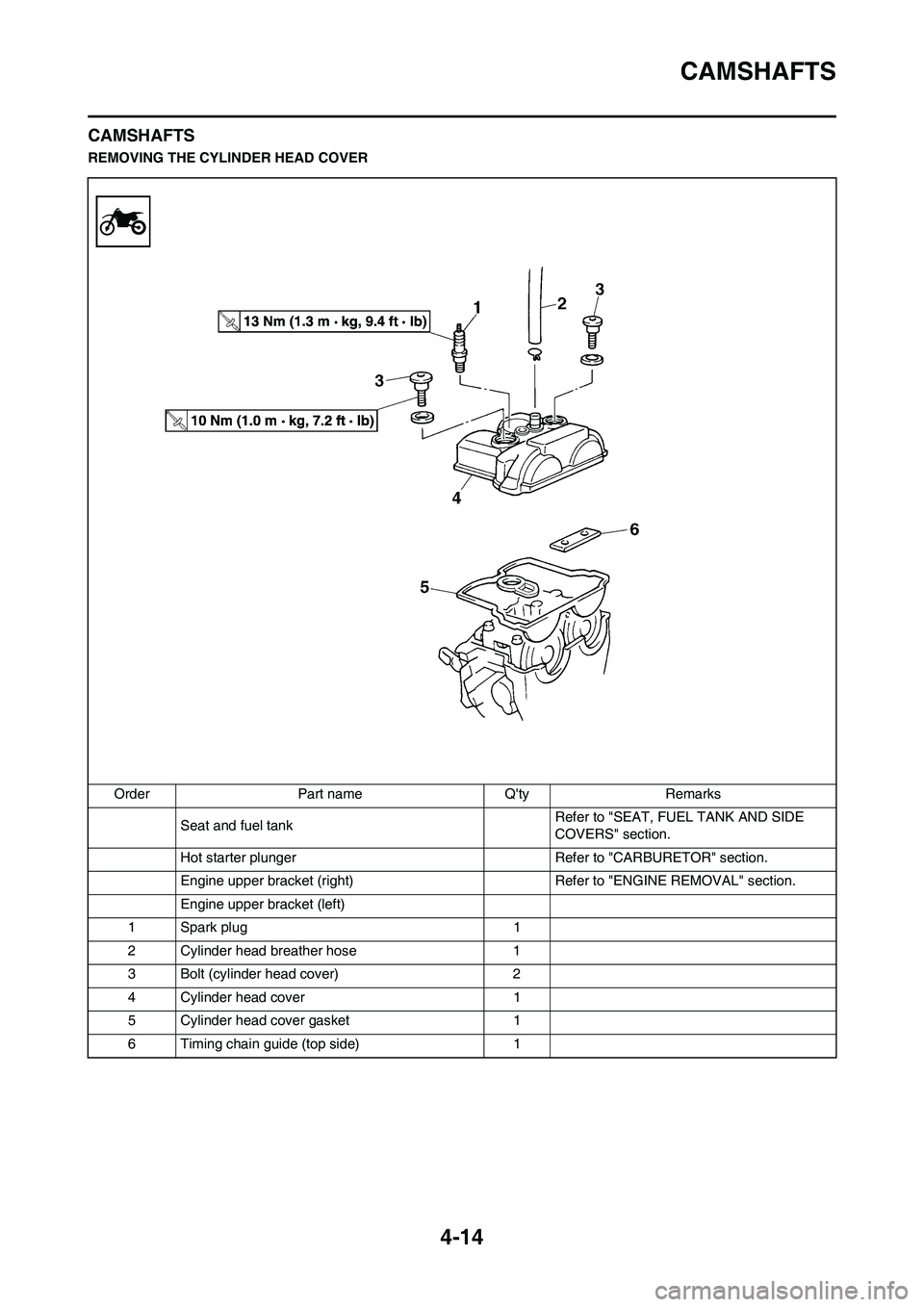
CAMSHAFTS
REMOVING THE CYLINDER HEAD COVER
Order Part name Q'ty Remarks
Seat and fuel tank Refer to "SEAT, FUEL TANK AND SIDE
COVERS" section.
Hot starter plunger Refer to "CARBURETOR" section.
Engine upper bracket (right) Refer to "ENGINE REMOVAL" section.
Engine upper bracket (left)
1 Spark plug 1
2 Cylinder head breather hose 1
3 Bolt (cylinder head cover) 2
4 Cylinder head cover 1
5 Cylinder head cover gasket 1
6 Timing chain guide (top side) 1
Page 87 of 188
4-19
CYLINDER HEAD
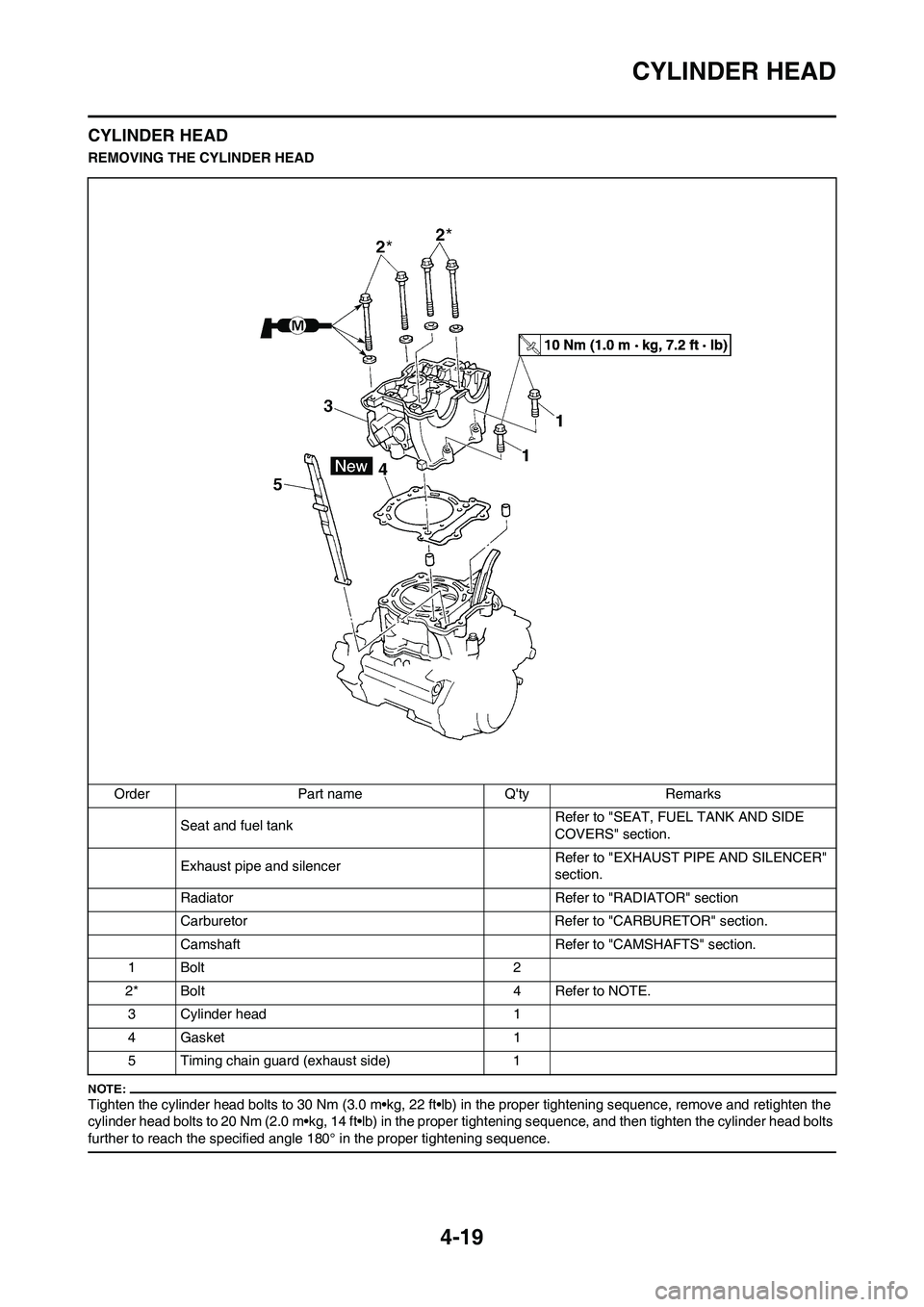
CYLINDER HEAD
REMOVING THE CYLINDER HEAD
Tighten the cylinder head bolts to 30 Nm (3.0 m•kg, 22 ft•lb) in the proper tightening sequence, remove and retighten the
cylinder head bolts to 20 Nm (2.0 m•kg, 14 ft•lb) in the proper tightening sequence, and then tighten the cylinder head bolts
further to reach the specified angle 180° in the proper tightening sequence.
Order Part name Q'ty Remarks
Seat and fuel tank Refer to "SEAT, FUEL TANK AND SIDE
COVERS" section.
Exhaust pipe and silencerRefer to "EXHAUST PIPE AND SILENCER"
section.
Radiator Refer to "RADIATOR" section
Carburetor Refer to "CARBURETOR" section.
Camshaft Refer to "CAMSHAFTS" section.
1Bolt 2
2* Bolt 4 Refer to NOTE.
3 Cylinder head 1
4 Gasket 1
5 Timing chain guard (exhaust side) 1
Page 88 of 188
4-20
CYLINDER HEAD
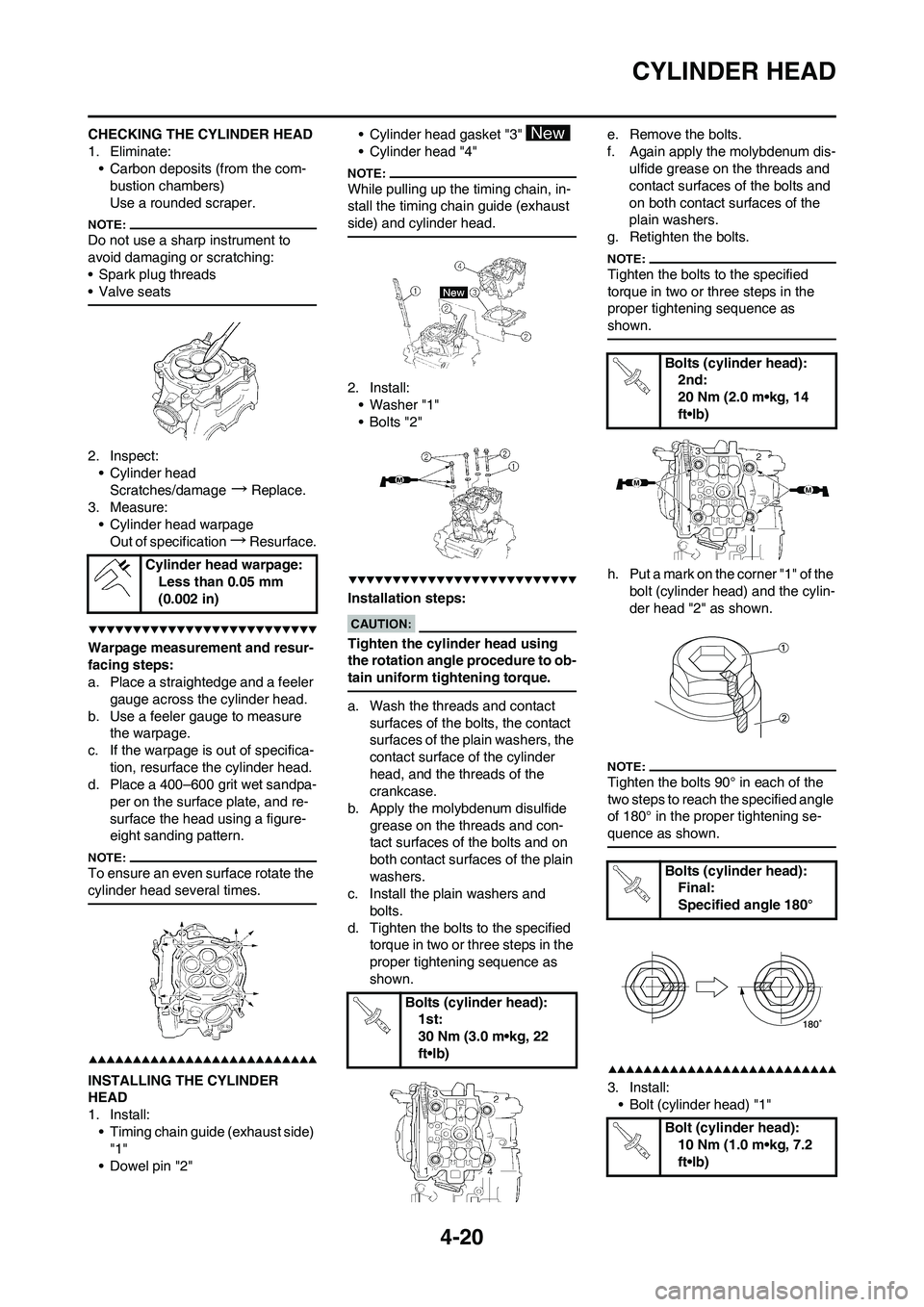
CHECKING THE CYLINDER HEAD
1. Eliminate:
• Carbon deposits (from the com-
bustion chambers)
Use a rounded scraper.
Do not use a sharp instrument to
avoid damaging or scratching:
• Spark plug threads
• Valve seats
2. Inspect:
• Cylinder head
Scratches/damage
→Replace.
3. Measure:
• Cylinder head warpage
Out of specification
→Resurface.
Warpage measurement and resur-
facing steps:
a. Place a straightedge and a feeler
gauge across the cylinder head.
b. Use a feeler gauge to measure
the warpage.
c. If the warpage is out of specifica-
tion, resurface the cylinder head.
d. Place a 400–600 grit wet sandpa-
per on the surface plate, and re-
surface the head using a figure-
eight sanding pattern.
To ensure an even surface rotate the
cylinder head several times.
INSTALLING THE CYLINDER
HEAD
1. Install:
• Timing chain guide (exhaust side)
"1"
• Dowel pin "2"• Cylinder head gasket "3"
• Cylinder head "4"
While pulling up the timing chain, in-
stall the timing chain guide (exhaust
side) and cylinder head.
2. Install:
• Washer "1"
• Bolts "2"
Installation steps:
Tighten the cylinder head using
the rotation angle procedure to ob-
tain uniform tightening torque.
a. Wash the threads and contact
surfaces of the bolts, the contact
surfaces of the plain washers, the
contact surface of the cylinder
head, and the threads of the
crankcase.
b. Apply the molybdenum disulfide
grease on the threads and con-
tact surfaces of the bolts and on
both contact surfaces of the plain
washers.
c. Install the plain washers and
bolts.
d. Tighten the bolts to the specified
torque in two or three steps in the
proper tightening sequence as
shown.e. Remove the bolts.
f. Again apply the molybdenum dis-
ulfide grease on the threads and
contact surfaces of the bolts and
on both contact surfaces of the
plain washers.
g. Retighten the bolts.
Tighten the bolts to the specified
torque in two or three steps in the
proper tightening sequence as
shown.
h. Put a mark on the corner "1" of the
bolt (cylinder head) and the cylin-
der head "2" as shown.
Tighten the bolts 90° in each of the
two steps to reach the specified angle
of 180° in the proper tightening se-
quence as shown.
3. Install:
• Bolt (cylinder head) "1" Cylinder head warpage:
Less than 0.05 mm
(0.002 in)
Bolts (cylinder head):
1st:
30 Nm (3.0 m•kg, 22
ft•lb)
Bolts (cylinder head):
2nd:
20 Nm (2.0 m•kg, 14
ft•lb)
Bolts (cylinder head):
Final:
Specified angle 180°
Bolt (cylinder head):
10 Nm (1.0 m•kg, 7.2
ft•lb)
Page 92 of 188
4-24
VALVES AND VALVE SPRINGS
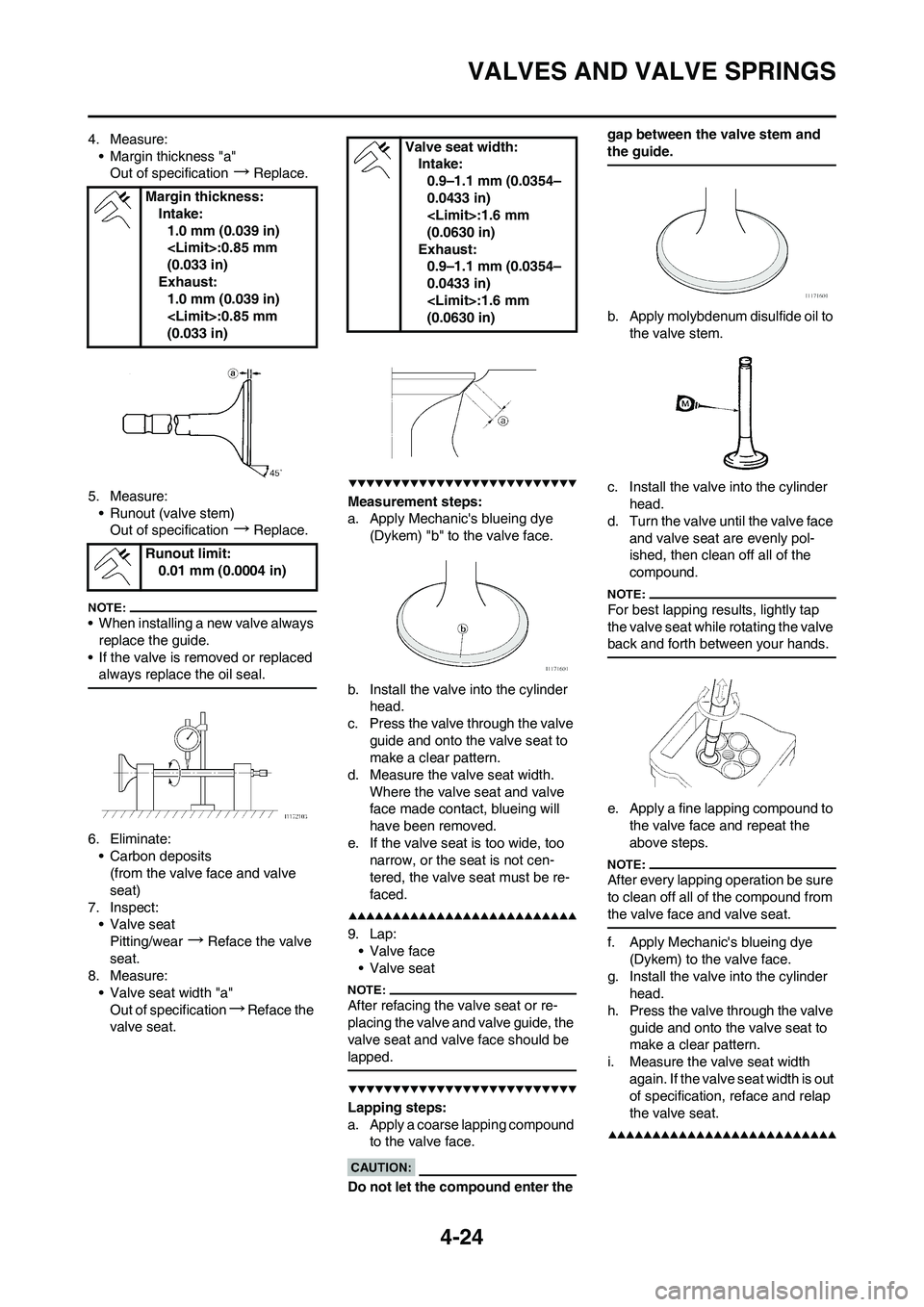
4. Measure:
• Margin thickness "a"
Out of specification
→Replace.
5. Measure:
• Runout (valve stem)
Out of specification
→Replace.
• When installing a new valve always
replace the guide.
• If the valve is removed or replaced
always replace the oil seal.
6. Eliminate:
• Carbon deposits
(from the valve face and valve
seat)
7. Inspect:
• Valve seat
Pitting/wear
→Reface the valve
seat.
8. Measure:
• Valve seat width "a"
Out of specification
→Reface the
valve seat.
Measurement steps:
a. Apply Mechanic's blueing dye
(Dykem) "b" to the valve face.
b. Install the valve into the cylinder
head.
c. Press the valve through the valve
guide and onto the valve seat to
make a clear pattern.
d. Measure the valve seat width.
Where the valve seat and valve
face made contact, blueing will
have been removed.
e. If the valve seat is too wide, too
narrow, or the seat is not cen-
tered, the valve seat must be re-
faced.
9. Lap:
• Valve face
• Valve seat
After refacing the valve seat or re-
placing the valve and valve guide, the
valve seat and valve face should be
lapped.
Lapping steps:
a. Apply a coarse lapping compound
to the valve face.
Do not let the compound enter the gap between the valve stem and
the guide.
b. Apply molybdenum disulfide oil to
the valve stem.
c. Install the valve into the cylinder
head.
d. Turn the valve until the valve face
and valve seat are evenly pol-
ished, then clean off all of the
compound.
For best lapping results, lightly tap
the valve seat while rotating the valve
back and forth between your hands.
e. Apply a fine lapping compound to
the valve face and repeat the
above steps.
After every lapping operation be sure
to clean off all of the compound from
the valve face and valve seat.
f. Apply Mechanic's blueing dye
(Dykem) to the valve face.
g. Install the valve into the cylinder
head.
h. Press the valve through the valve
guide and onto the valve seat to
make a clear pattern.
i. Measure the valve seat width
again. If the valve seat width is out
of specification, reface and relap
the valve seat.
Margin thickness:
Intake:
1.0 mm (0.039 in)
(0.033 in)
Exhaust:
1.0 mm (0.039 in)
(0.033 in)
Runout limit:
0.01 mm (0.0004 in)
Valve seat width:
Intake:
0.9–1.1 mm (0.0354–
0.0433 in)
(0.0630 in)
Exhaust:
0.9–1.1 mm (0.0354–
0.0433 in)
(0.0630 in)
Page 95 of 188
4-27
CYLINDER AND PISTON
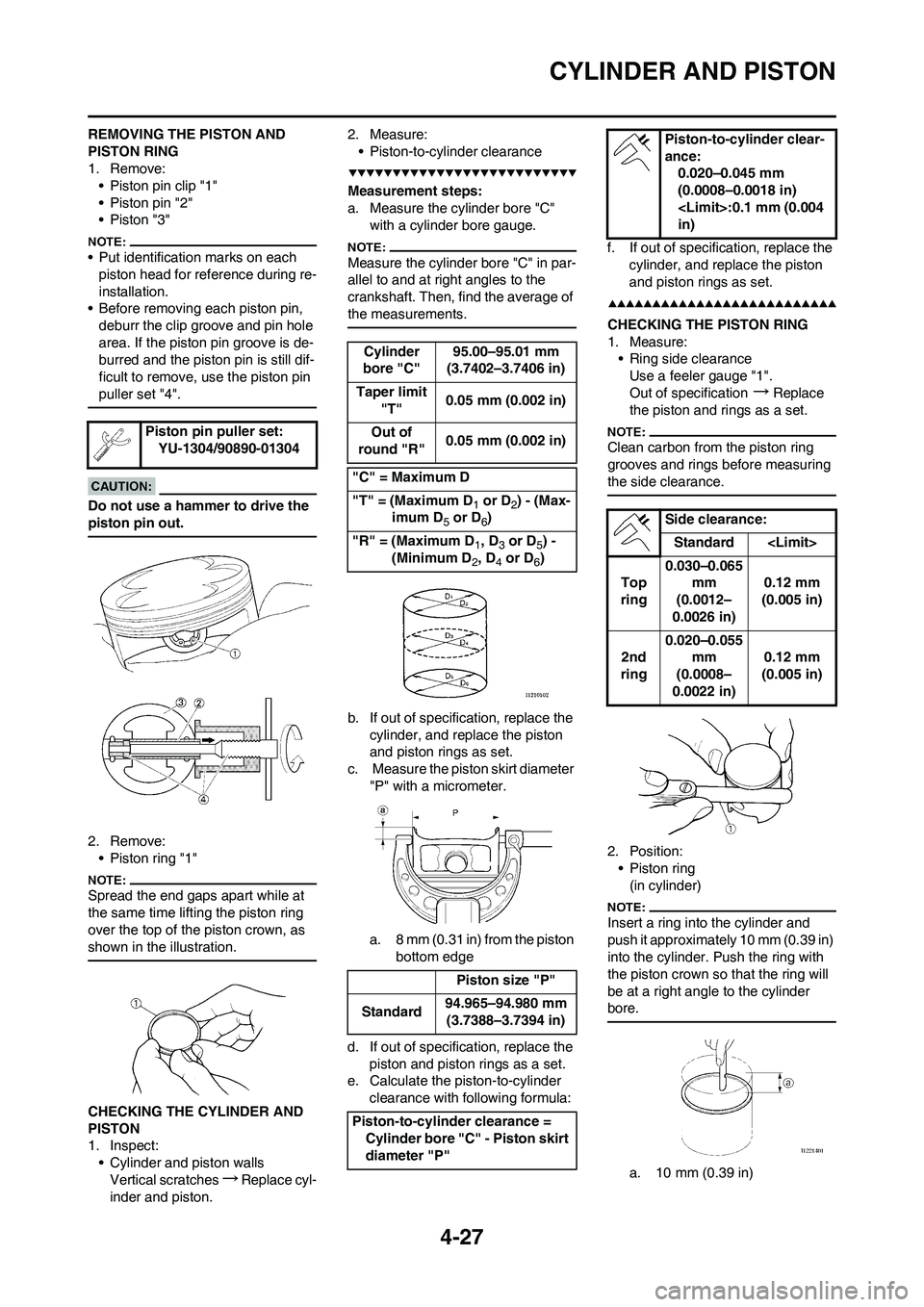
REMOVING THE PISTON AND
PISTON RING
1. Remove:
• Piston pin clip "1"
• Piston pin "2"
• Piston "3"
• Put identification marks on each
piston head for reference during re-
installation.
• Before removing each piston pin,
deburr the clip groove and pin hole
area. If the piston pin groove is de-
burred and the piston pin is still dif-
ficult to remove, use the piston pin
puller set "4".
Do not use a hammer to drive the
piston pin out.
2. Remove:
• Piston ring "1"
Spread the end gaps apart while at
the same time lifting the piston ring
over the top of the piston crown, as
shown in the illustration.
CHECKING THE CYLINDER AND
PISTON
1. Inspect:
• Cylinder and piston walls
Vertical scratches
→Replace cyl-
inder and piston.2. Measure:
• Piston-to-cylinder clearance
Measurement steps:
a. Measure the cylinder bore "C"
with a cylinder bore gauge.
Measure the cylinder bore "C" in par-
allel to and at right angles to the
crankshaft. Then, find the average of
the measurements.
b. If out of specification, replace the
cylinder, and replace the piston
and piston rings as set.
c. Measure the piston skirt diameter
"P" with a micrometer.
a. 8 mm (0.31 in) from the piston
bottom edge
d. If out of specification, replace the
piston and piston rings as a set.
e. Calculate the piston-to-cylinder
clearance with following formula:f. If out of specification, replace the
cylinder, and replace the piston
and piston rings as set.
CHECKING THE PISTON RING
1. Measure:
• Ring side clearance
Use a feeler gauge "1".
Out of specification
→Replace
the piston and rings as a set.
Clean carbon from the piston ring
grooves and rings before measuring
the side clearance.
2. Position:
• Piston ring
(in cylinder)
Insert a ring into the cylinder and
push it approximately 10 mm (0.39 in)
into the cylinder. Push the ring with
the piston crown so that the ring will
be at a right angle to the cylinder
bore.
a. 10 mm (0.39 in) Piston pin puller set:
YU-1304/90890-01304
Cylinder
bore "C"95.00–95.01 mm
(3.7402–3.7406 in)
Taper limit
"T"0.05 mm (0.002 in)
Out of
round "R"0.05 mm (0.002 in)
"C" = Maximum D
"T" = (Maximum D
1 or D2) - (Max-
imum D
5 or D6)
"R" = (Maximum D
1, D3 or D5) -
(Minimum D
2, D4 or D6)
Piston size "P"
Standard94.965–94.980 mm
(3.7388–3.7394 in)
Piston-to-cylinder clearance =
Cylinder bore "C" - Piston skirt
diameter "P"
Piston-to-cylinder clear-
ance:
0.020–0.045 mm
(0.0008–0.0018 in)
in)
Side clearance:
Standard
Top
ring0.030–0.065
mm
(0.0012–
0.0026 in)0.12 mm
(0.005 in)
2nd
ring0.020–0.055
mm
(0.0008–
0.0022 in)0.12 mm
(0.005 in)
Page 117 of 188
4-49
ENGINE REMOVAL
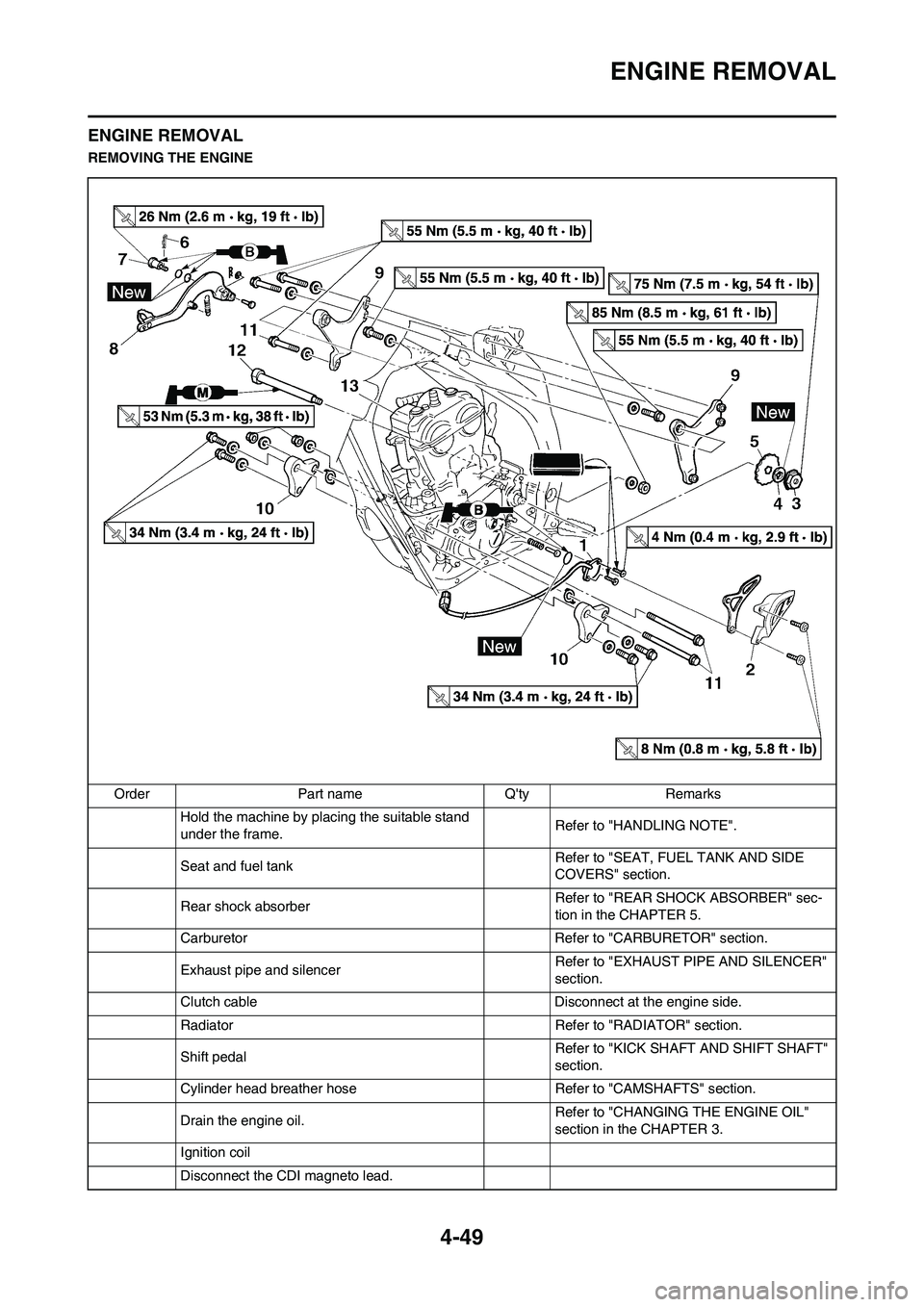
ENGINE REMOVAL
REMOVING THE ENGINE
Order Part name Q'ty Remarks
Hold the machine by placing the suitable stand
under the frame.Refer to "HANDLING NOTE".
Seat and fuel tank Refer to "SEAT, FUEL TANK AND SIDE
COVERS" section.
Rear shock absorber Refer to "REAR SHOCK ABSORBER" sec-
tion in the CHAPTER 5.
Carburetor Refer to "CARBURETOR" section.
Exhaust pipe and silencer Refer to "EXHAUST PIPE AND SILENCER"
section.
Clutch cable Disconnect at the engine side.
Radiator Refer to "RADIATOR" section.
Shift pedalRefer to "KICK SHAFT AND SHIFT SHAFT"
section.
Cylinder head breather hose Refer to "CAMSHAFTS" section.
Drain the engine oil.Refer to "CHANGING THE ENGINE OIL"
section in the CHAPTER 3.
Ignition coil
Disconnect the CDI magneto lead.
Page 176 of 188

6-6
THROTTLE POSITION SENSOR SYSTEM
HANDLING NOTE
Do not loosen the screw (throttle
position sensor) "1" except when
changing the throttle position sen-
sor due to failure because it will
cause a drop in engine perfor-
mance.
CHECKING THE COUPLERS AND
LEADS CONNECTION
1. Check:
• Couplers and leads connection
Rust/dust/looseness/short-circuit
→Repair or replace.
CHECKING THE THROTTLE
POSITION SENSOR COIL
1. Inspect:
• Throttle position sensor coil resis-
tance
Out of specification
→Replace.
2. Loosen:
• Throttle stop screw "1"
Turn out the throttle stop screw until
the throttle shaft is in the full close po-
sition.
3. Inspect:
• Throttle position sensor coil vari-
able resistance
Check that the resistance in in-
creased as the throttle grip is
moved from the full close position
to the full open position.
Out of specification
→Replace.
CHANGING AND ADJUSTING THE
THROTTLE POSITION SENSOR
1. Remove:
• Throttle position sensor coupler
• Carburetor
2. Remove:
• Screw (throttle position sensor)
"1"
• Throttle position sensor "2"
Loosen the screw (throttle position
sensor) using the T25 bit.
3. Replace:
• Throttle position sensor
4. Install:
• Throttle position sensor "1"
• Screw (throttle position sensor)
"2"
• Align the slot "a" in the throttle posi-
tion sensor with the projection "b"
on the carburetor.• Temporarily tighten the screw
(throttle position sensor).
5. Install:
•Carburetor
• Throttle position sensor coupler
6. Adjust:
• Engine idling speed
Refer to "ADJUSTING THE EN-
GINE IDLING SPEED" section in
the CHAPTER 3.
7. Insert the thin electric conductors
"2" (lead) into the throttle position
sensor coupler "1", as shown, and
connect the tester to them.
• Do not insert the electric conduc-
tors more than required because
it may reduce the waterproof
function of the coupler.
ŒMake sure that a short-circuit
does not develop between the
terminals because it may cause
damage to electrical compo-
nents.
8. Start the engine.
9. Adjust:
• Throttle position sensor output
voltage
Adjustment steps:
a. Adjust the installation angle of the
throttle position sensor "1" to ob-
tain the specified output voltage.
Measure the output voltage accurate-
ly with a digital electronic voltmeter
that gives an easy reading of a small
voltage.
Tester (+) lead→Blue lead "1"
Tester (-) lead
→Black lead "2"
Throttle po-
sition sen-
sor coil
resistanceTester se-
lector posi-
tion
4–6 k
Ω at
20°C (68 °F) kΩ×1
Tester (+) lead→Yellow lead "1"
Tester (-) lead
→Black lead "2"
Throttle position
sensor coil vari-
able resistanceTester
selec-
tor po-
sition
Full
closedFull
opened
k
Ω×1 Zero –2
kΩat
20°C
(68 °F)4–6
kΩat
20 °C
(68 °F)
Tester (+) lead→Yellow lead "3"
Tester (-) lead
→Black lead "4"