ECU YAMAHA YZ450F 2012 User Guide
[x] Cancel search | Manufacturer: YAMAHA, Model Year: 2012, Model line: YZ450F, Model: YAMAHA YZ450F 2012Pages: 228, PDF Size: 11.42 MB
Page 77 of 228
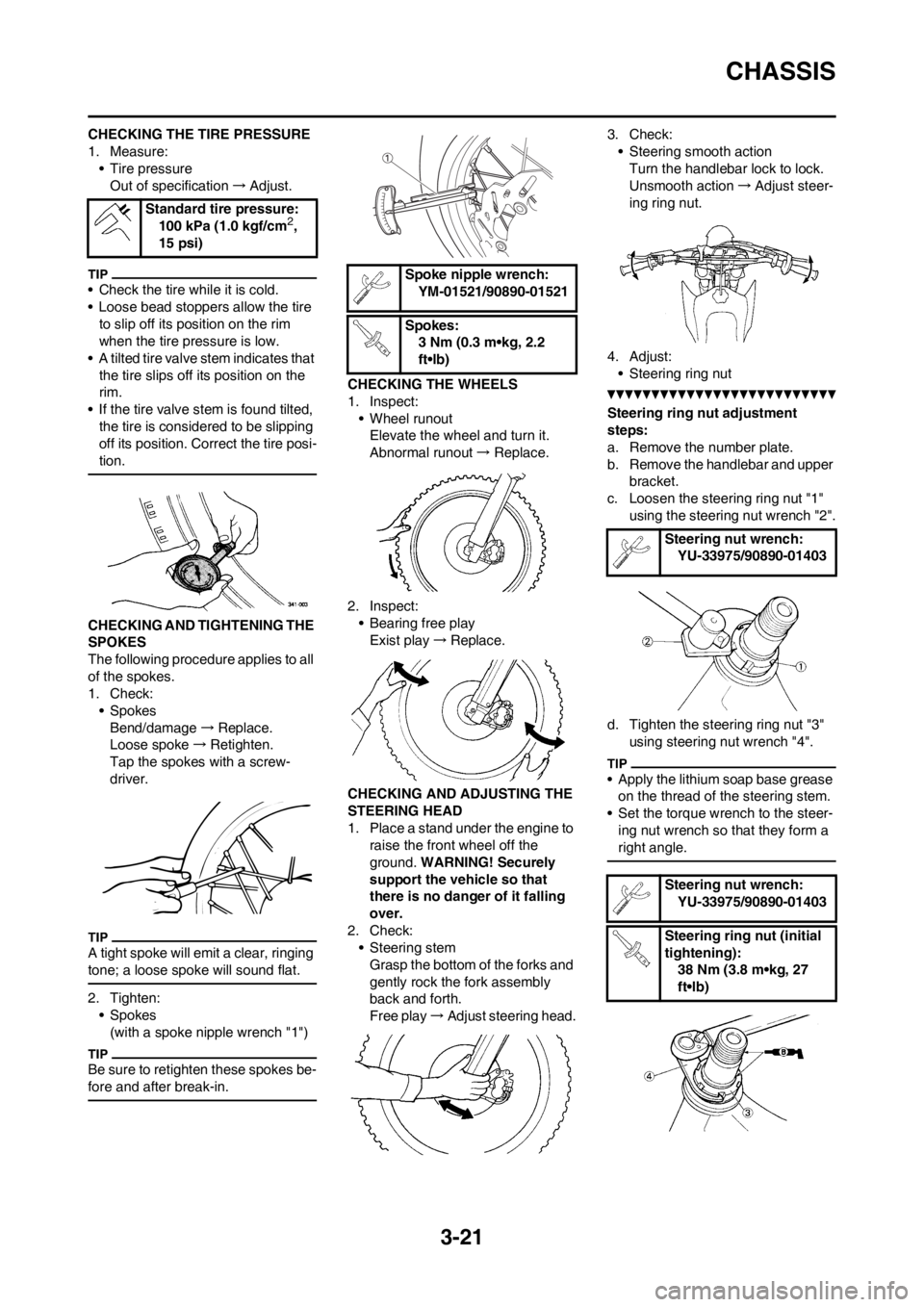
3-21
CHASSIS
CHECKING THE TIRE PRESSURE
1. Measure:• Tire pressureOut of specification →Adjust.
• Check the tire while it is cold.
• Loose bead stoppers allow the tire
to slip off its position on the rim
when the tire pressure is low.
• A tilted tire valve stem indicates that
the tire slips off its position on the
rim.
• If the tire valve st em is found tilted,
the tire is considered to be slipping
off its position. Correct the tire posi-
tion.
CHECKING AND TIGHTENING THE
SPOKES
The following procedure applies to all
of the spokes.
1. Check: • SpokesBend/damage →Replace.
Loose spoke →Retighten.
Tap the spokes with a screw-
driver.
A tight spoke will emit a clear, ringing
tone; a loose spoke will sound flat.
2. Tighten: • Spokes(with a spoke nipple wrench "1")
Be sure to retighten these spokes be-
fore and after break-in.
CHECKING THE WHEELS
1. Inspect:
• Wheel runoutElevate the wheel and turn it.
Abnormal runout → Replace.
2. Inspect: • Bearing free playExist play →Replace.
CHECKING AND ADJUSTING THE
STEERING HEAD
1. Place a stand under the engine to raise the front wheel off the
ground. WARNING! Securely
support the vehicle so that
there is no danger of it falling
over.
2. Check: • Steering stem
Grasp the bottom of the forks and
gently rock the fork assembly
back and forth.
Free play →Adjust steering head. 3. Check:
• Steering smooth actionTurn the handlebar lock to lock.
Unsmooth action →Adjust steer-
ing ring nut.
4. Adjust: • Steering ring nut
Steering ring nut adjustment
steps:
a. Remove the number plate.
b. Remove the handlebar and upper bracket.
c. Loosen the steering ring nut "1"
using the steering nut wrench "2".
d. Tighten the steering ring nut "3" using steering nut wrench "4".
• Apply the lithium soap base grease on the thread of the steering stem.
• Set the torque wrench to the steer- ing nut wrench so that they form a
right angle.
Standard tire pressure:
100 kPa (1.0 kgf/cm2,
15 psi)
Spoke nipple wrench: YM-01521/90890-01521
Spokes: 3 Nm (0.3 m•kg, 2.2
ft•lb)
Steering nut wrench:YU-33975/90890-01403
Steering nut wrench: YU-33975/90890-01403
Steering ring nut (initial
tightening): 38 Nm (3.8 m•kg, 27
ft•lb)
Page 81 of 228
3-25
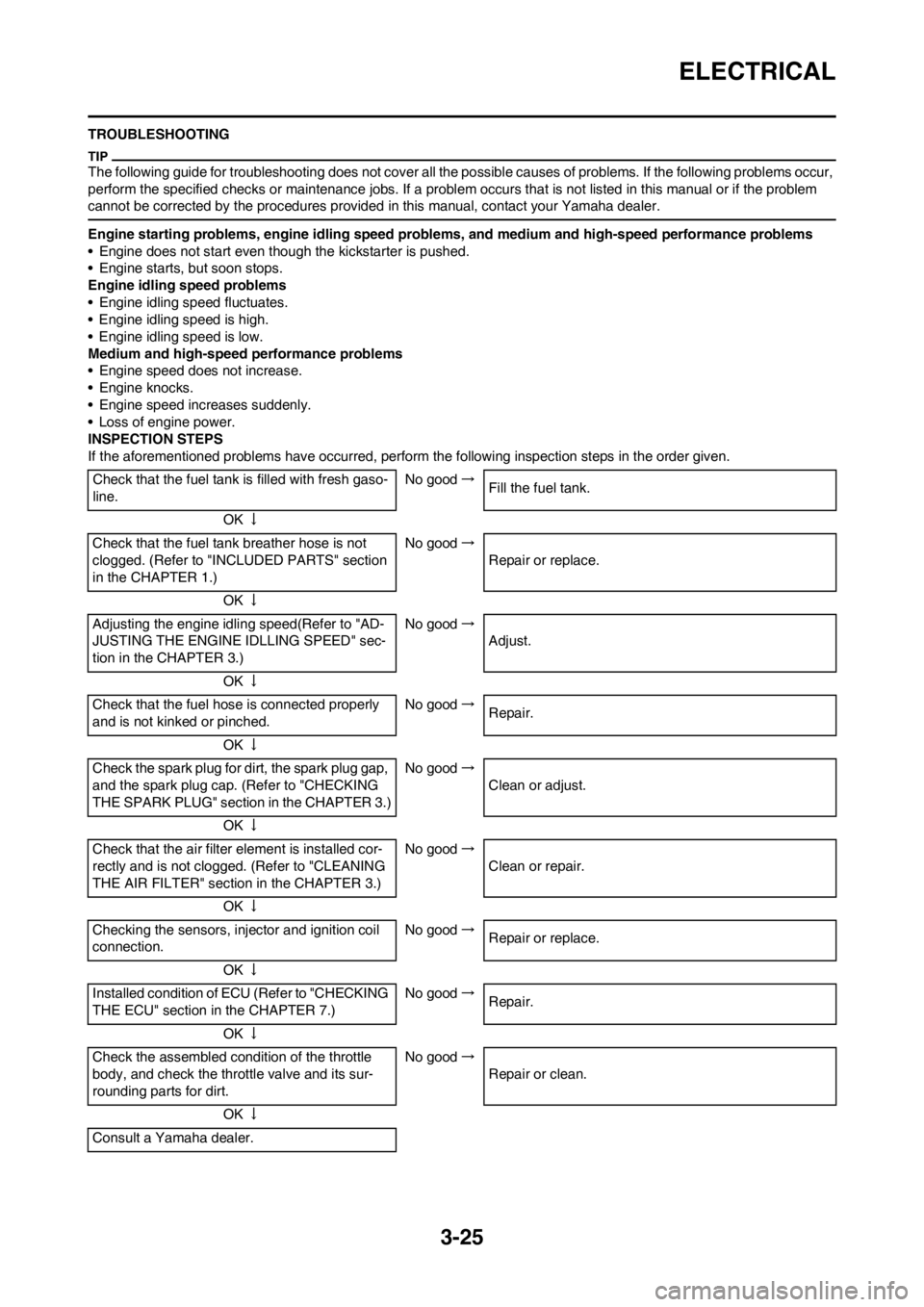
ELECTRICAL
TROUBLESHOOTING
The following guide for troubleshooting does not cover all the possible causes of problems. If the following problems occur,
perform the specified checks or maintenance jobs. If a problem occurs that is not listed in this manual or if the problem
cannot be corrected by the procedures provided in this manual, contact your Yamaha dealer.
Engine starting problems, engine idling speed problems, and medium and high-speed performance problems
• Engine does not start even though the kickstarter is pushed.
• Engine starts, but soon stops.
Engine idling speed problems
• Engine idling speed fluctuates.
• Engine idling speed is high.
• Engine idling speed is low.
Medium and high-speed performance problems
• Engine speed does not increase.
• Engine knocks.
• Engine speed increases suddenly.
• Loss of engine power.
INSPECTION STEPS
If the aforementioned problems have occurred, perform the following inspection steps in the order given.
Check that the fuel tank is filled with fresh gaso-
line.No good→
Fill the fuel tank.
OK↓
Check that the fuel tank breather hose is not
clogged. (Refer to "INCLUDED PARTS" section
in the CHAPTER 1.)No good→
Repair or replace.
OK↓
Adjusting the engine idling speed(Refer to "AD-
JUSTING THE ENGINE IDLLING SPEED" sec-
tion in the CHAPTER 3.)No good→
Adjust.
OK↓
Check that the fuel hose is connected properly
and is not kinked or pinched.No good→
Repair.
OK↓
Check the spark plug for dirt, the spark plug gap,
and the spark plug cap. (Refer to "CHECKING
THE SPARK PLUG" section in the CHAPTER 3.)No good→
Clean or adjust.
OK↓
Check that the air filter element is installed cor-
rectly and is not clogged. (Refer to "CLEANING
THE AIR FILTER" section in the CHAPTER 3.)No good→
Clean or repair.
OK↓
Checking the sensors, injector and ignition coil
connection.No good→
Repair or replace.
OK↓
Installed condition of ECU (Refer to "CHECKING
THE ECU" section in the CHAPTER 7.)No good→
Repair.
OK↓
Check the assembled condition of the throttle
body, and check the throttle valve and its sur-
rounding parts for dirt.No good→
Repair or clean.
OK↓
Consult a Yamaha dealer.
Page 101 of 228
4-20
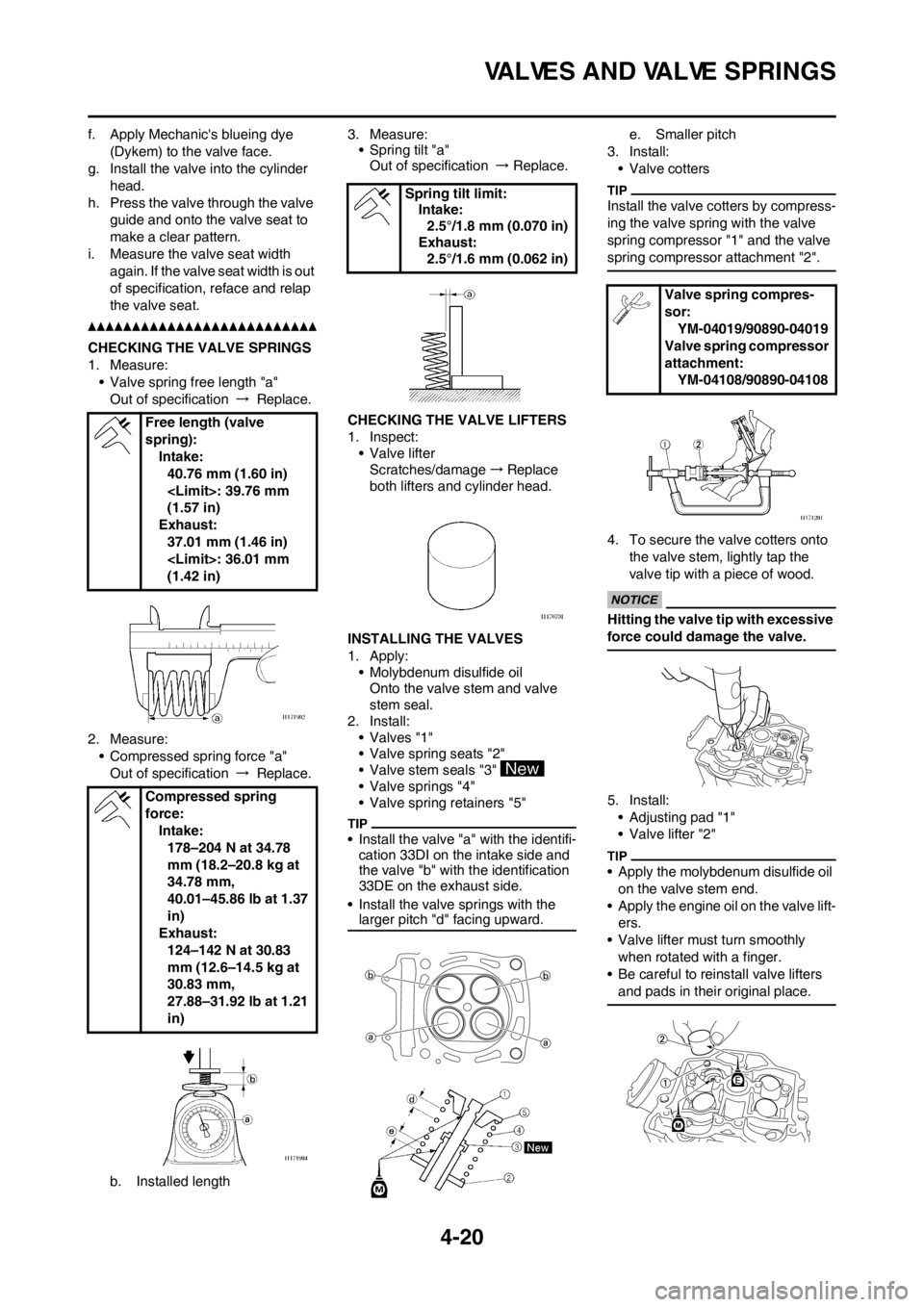
VALVES AND VALVE SPRINGS
f. Apply Mechanic's blueing dye
(Dykem) to the valve face.
g. Install the valve into the cylinder
head.
h. Press the valve through the valve
guide and onto the valve seat to
make a clear pattern.
i. Measure the valve seat width
again. If the valve seat width is out
of specification, reface and relap
the valve seat.
CHECKING THE VALVE SPRINGS
1. Measure:
• Valve spring free length "a"
Out of specification → Replace.
2. Measure:
• Compressed spring force "a"
Out of specification → Replace.
b. Installed length3. Measure:
• Spring tilt "a"
Out of specification → Replace.
CHECKING THE VALVE LIFTERS
1. Inspect:
• Valve lifter
Scratches/damage→Replace
both lifters and cylinder head.
INSTALLING THE VALVES
1. Apply:
• Molybdenum disulfide oil
Onto the valve stem and valve
stem seal.
2. Install:
• Valves "1"
• Valve spring seats "2"
• Valve stem seals "3"
• Valve springs "4"
• Valve spring retainers "5"
• Install the valve "a" with the identifi-
cation 33DI on the intake side and
the valve "b" with the identification
33DE on the exhaust side.
• Install the valve springs with the
larger pitch "d" facing upward.
e. Smaller pitch
3. Install:
• Valve cotters
Install the valve cotters by compress-
ing the valve spring with the valve
spring compressor "1" and the valve
spring compressor attachment "2".
4. To secure the valve cotters onto
the valve stem, lightly tap the
valve tip with a piece of wood.
Hitting the valve tip with excessive
force could damage the valve.
5. Install:
• Adjusting pad "1"
• Valve lifter "2"
• Apply the molybdenum disulfide oil
on the valve stem end.
• Apply the engine oil on the valve lift-
ers.
• Valve lifter must turn smoothly
when rotated with a finger.
• Be careful to reinstall valve lifters
and pads in their original place.
Free length (valve
spring):
Intake:
40.76 mm (1.60 in)
(1.57 in)
Exhaust:
37.01 mm (1.46 in)
(1.42 in)
Compressed spring
force:
Intake:
178–204 N at 34.78
mm (18.2–20.8 kg at
34.78 mm,
40.01–45.86 lb at 1.37
in)
Exhaust:
124–142 N at 30.83
mm (12.6–14.5 kg at
30.83 mm,
27.88–31.92 lb at 1.21
in)
Spring tilt limit:
Intake:
2.5°/1.8 mm (0.070 in)
Exhaust:
2.5°/1.6 mm (0.062 in)
Valve spring compres-
sor:
YM-04019/90890-04019
Valve spring compressor
attachment:
YM-04108/90890-04108
Page 129 of 228
4-48
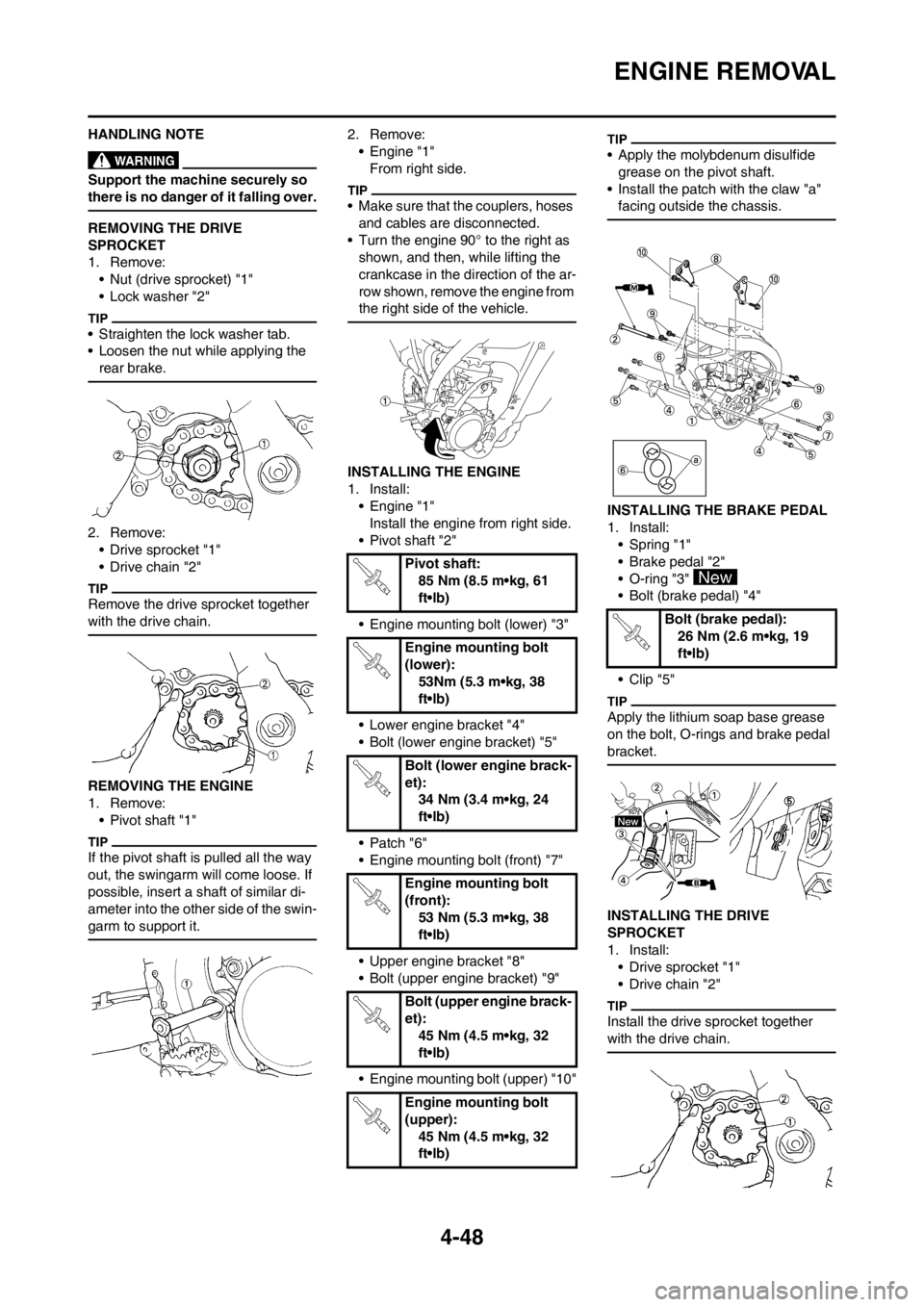
ENGINE REMOVAL
HANDLING NOTE
Support the machine securely so
there is no danger of it falling over.
REMOVING THE DRIVE
SPROCKET
1. Remove:
• Nut (drive sprocket) "1"
• Lock washer "2"
• Straighten the lock washer tab.
• Loosen the nut while applying the
rear brake.
2. Remove:
• Drive sprocket "1"
• Drive chain "2"
Remove the drive sprocket together
with the drive chain.
REMOVING THE ENGINE
1. Remove:
• Pivot shaft "1"
If the pivot shaft is pulled all the way
out, the swingarm will come loose. If
possible, insert a shaft of similar di-
ameter into the other side of the swin-
garm to support it.
2. Remove:
• Engine "1"
From right side.
• Make sure that the couplers, hoses
and cables are disconnected.
• Turn the engine 90° to the right as
shown, and then, while lifting the
crankcase in the direction of the ar-
row shown, remove the engine from
the right side of the vehicle.
INSTALLING THE ENGINE
1. Install:
• Engine "1"
Install the engine from right side.
• Pivot shaft "2"
• Engine mounting bolt (lower) "3"
• Lower engine bracket "4"
• Bolt (lower engine bracket) "5"
• Patch "6"
• Engine mounting bolt (front) "7"
• Upper engine bracket "8"
• Bolt (upper engine bracket) "9"
• Engine mounting bolt (upper) "10"
• Apply the molybdenum disulfide
grease on the pivot shaft.
• Install the patch with the claw "a"
facing outside the chassis.
INSTALLING THE BRAKE PEDAL
1. Install:
• Spring "1"
• Brake pedal "2"
• O-ring "3"
• Bolt (brake pedal) "4"
• Clip "5"
Apply the lithium soap base grease
on the bolt, O-rings and brake pedal
bracket.
INSTALLING THE DRIVE
SPROCKET
1. Install:
• Drive sprocket "1"
• Drive chain "2"
Install the drive sprocket together
with the drive chain.
Pivot shaft:
85 Nm (8.5 m•kg, 61
ft•lb)
Engine mounting bolt
(lower):
53Nm (5.3 m•kg, 38
ft•lb)
Bolt (lower engine brack-
et):
34 Nm (3.4 m•kg, 24
ft•lb)
Engine mounting bolt
(front):
53 Nm (5.3 m•kg, 38
ft•lb)
Bolt (upper engine brack-
et):
45 Nm (4.5 m•kg, 32
ft•lb)
Engine mounting bolt
(upper):
45 Nm (4.5 m•kg, 32
ft•lb)
Bolt (brake pedal):
26 Nm (2.6 m•kg, 19
ft•lb)
Page 142 of 228
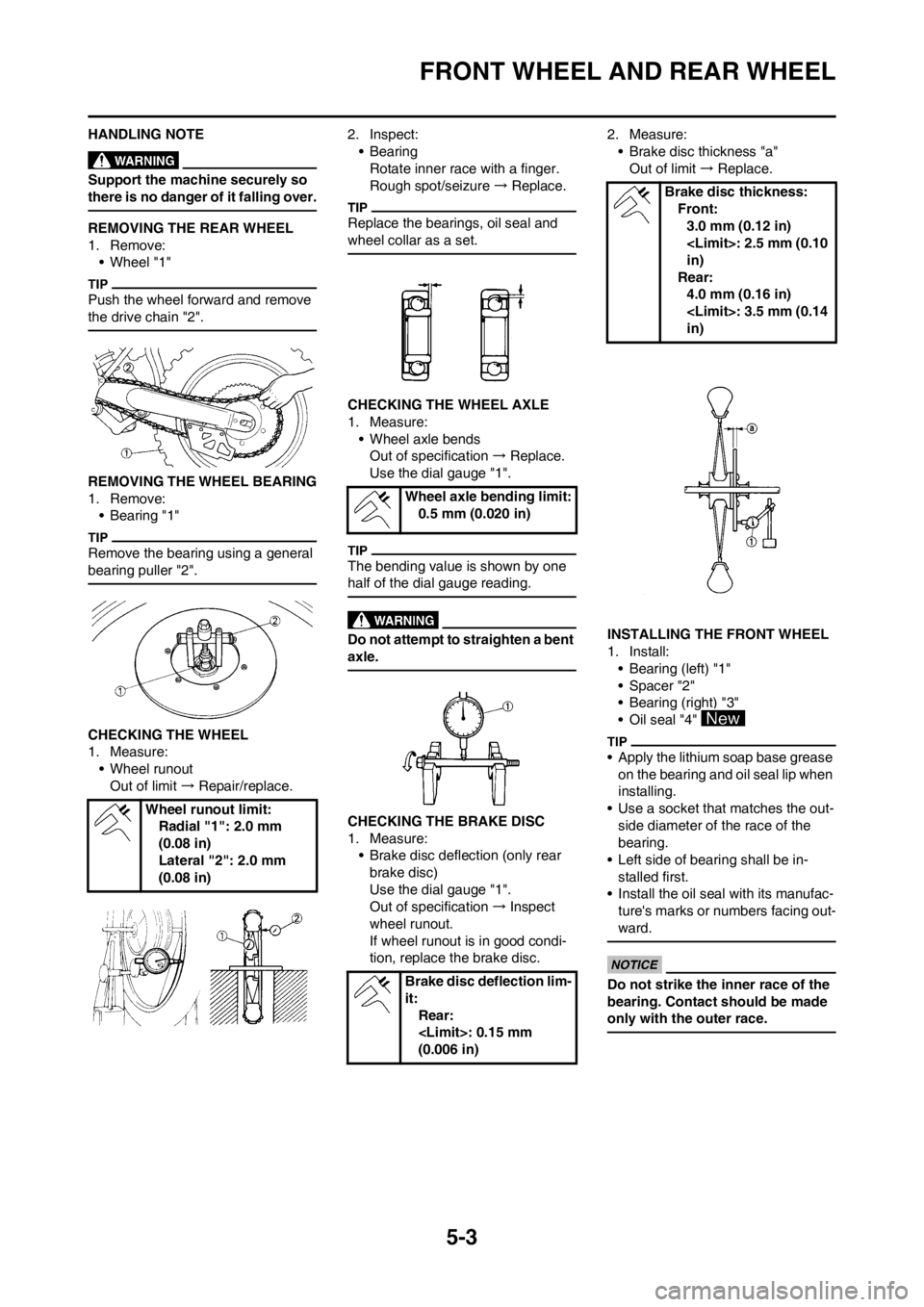
5-3
FRONT WHEEL AND REAR WHEEL
HANDLING NOTE
Support the machine securely so
there is no danger of it falling over.
REMOVING THE REAR WHEEL
1. Remove:
• Wheel "1"
Push the wheel forward and remove
the drive chain "2".
REMOVING THE WHEEL BEARING
1. Remove:
• Bearing "1"
Remove the bearing using a general
bearing puller "2".
CHECKING THE WHEEL
1. Measure:
• Wheel runout
Out of limit → Repair/replace.2. Inspect:
•Bearing
Rotate inner race with a finger.
Rough spot/seizure → Replace.
Replace the bearings, oil seal and
wheel collar as a set.
CHECKING THE WHEEL AXLE
1. Measure:
• Wheel axle bends
Out of specification → Replace.
Use the dial gauge "1".
The bending value is shown by one
half of the dial gauge reading.
Do not attempt to straighten a bent
axle.
CHECKING THE BRAKE DISC
1. Measure:
• Brake disc deflection (only rear
brake disc)
Use the dial gauge "1".
Out of specification → Inspect
wheel runout.
If wheel runout is in good condi-
tion, replace the brake disc.2. Measure:
• Brake disc thickness "a"
Out of limit → Replace.
INSTALLING THE FRONT WHEEL
1. Install:
• Bearing (left) "1"
• Spacer "2"
• Bearing (right) "3"
• Oil seal "4"
• Apply the lithium soap base grease
on the bearing and oil seal lip when
installing.
• Use a socket that matches the out-
side diameter of the race of the
bearing.
• Left side of bearing shall be in-
stalled first.
• Install the oil seal with its manufac-
ture's marks or numbers facing out-
ward.
Do not strike the inner race of the
bearing. Contact should be made
only with the outer race.
Wheel runout limit:
Radial "1": 2.0 mm
(0.08 in)
Lateral "2": 2.0 mm
(0.08 in)
Wheel axle bending limit:
0.5 mm (0.020 in)
Brake disc deflection lim-
it:
Rear:
(0.006 in)
Brake disc thickness:
Front:
3.0 mm (0.12 in)
in)
Rear:
4.0 mm (0.16 in)
in)
Page 149 of 228
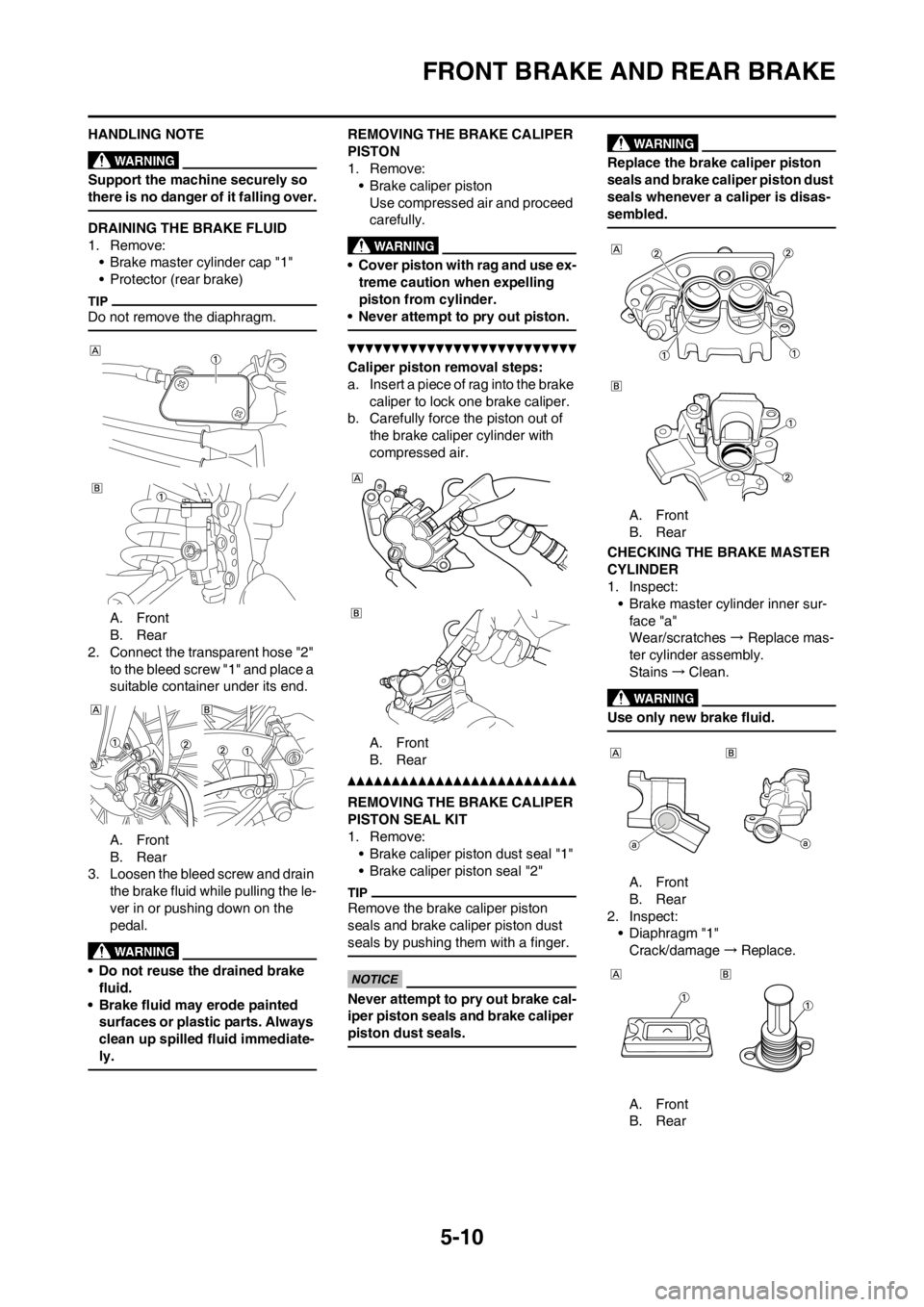
5-10
FRONT BRAKE AND REAR BRAKE
HANDLING NOTE
Support the machine securely so
there is no danger of it falling over.
DRAINING THE BRAKE FLUID
1. Remove:
• Brake master cylinder cap "1"
• Protector (rear brake)
Do not remove the diaphragm.
A. Front
B. Rear
2. Connect the transparent hose "2"
to the bleed screw "1" and place a
suitable container under its end.
A. Front
B. Rear
3. Loosen the bleed screw and drain
the brake fluid while pulling the le-
ver in or pushing down on the
pedal.
• Do not reuse the drained brake
fluid.
• Brake fluid may erode painted
surfaces or plastic parts. Always
clean up spilled fluid immediate-
ly.
REMOVING THE BRAKE CALIPER
PISTON
1. Remove:
• Brake caliper piston
Use compressed air and proceed
carefully.
• Cover piston with rag and use ex-
treme caution when expelling
piston from cylinder.
• Never attempt to pry out piston.
Caliper piston removal steps:
a. Insert a piece of rag into the brake
caliper to lock one brake caliper.
b. Carefully force the piston out of
the brake caliper cylinder with
compressed air.
A. Front
B. Rear
REMOVING THE BRAKE CALIPER
PISTON SEAL KIT
1. Remove:
• Brake caliper piston dust seal "1"
• Brake caliper piston seal "2"
Remove the brake caliper piston
seals and brake caliper piston dust
seals by pushing them with a finger.
Never attempt to pry out brake cal-
iper piston seals and brake caliper
piston dust seals.
Replace the brake caliper piston
seals and brake caliper piston dust
seals whenever a caliper is disas-
sembled.
A. Front
B. Rear
CHECKING THE BRAKE MASTER
CYLINDER
1. Inspect:
• Brake master cylinder inner sur-
face "a"
Wear/scratches → Replace mas-
ter cylinder assembly.
Stains→Clean.
Use only new brake fluid.
A. Front
B. Rear
2. Inspect:
• Diaphragm "1"
Crack/damage→Replace.
A. Front
B. Rear
Page 157 of 228
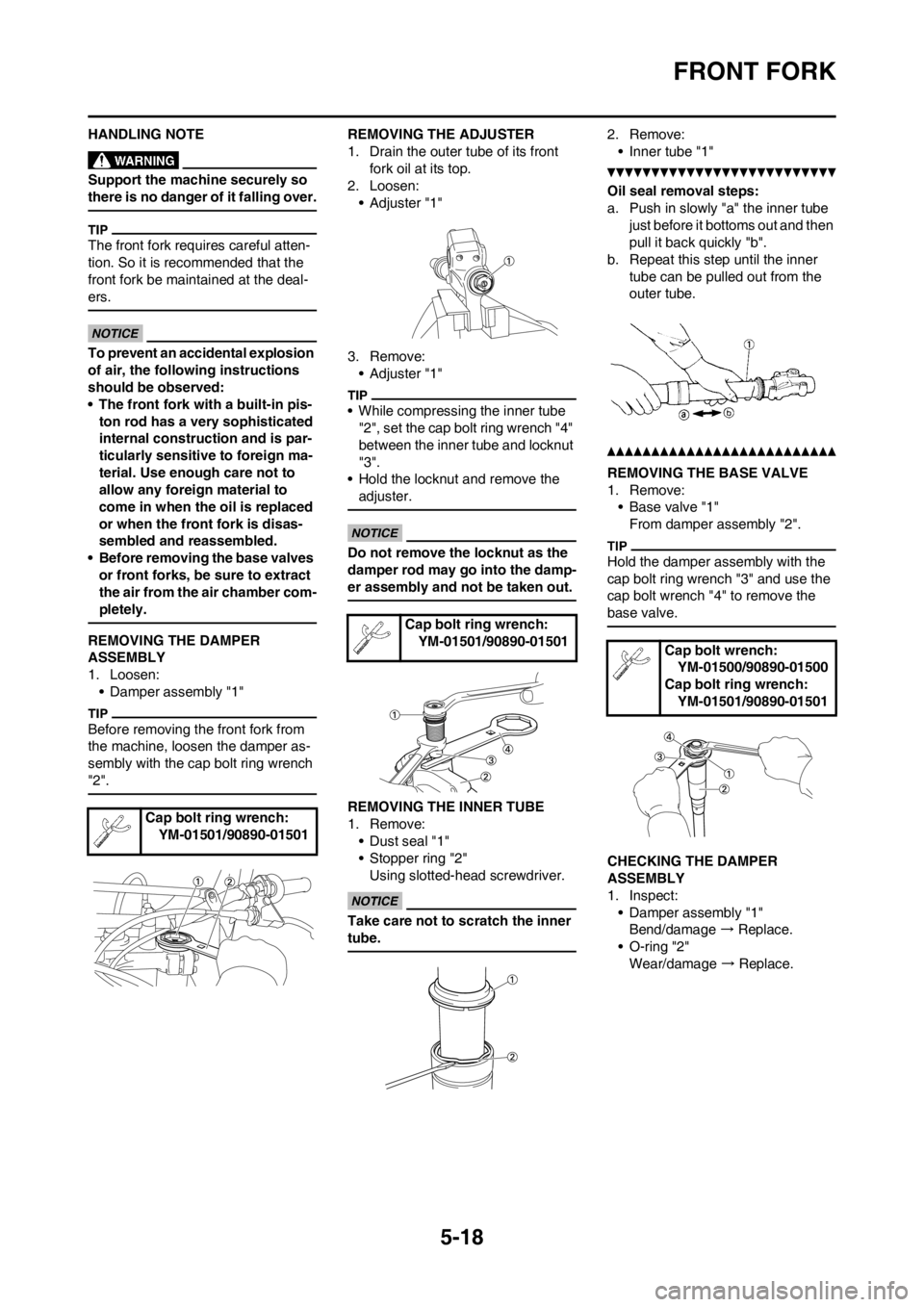
5-18
FRONT FORK
HANDLING NOTE
Support the machine securely so
there is no danger of it falling over.
The front fork requires careful atten-
tion. So it is recommended that the
front fork be maintained at the deal-
ers.
To prevent an accidental explosion
of air, the following instructions
should be observed:
• The front fork with a built-in pis-
ton rod has a very sophisticated
internal construction and is par-
ticularly sensitive to foreign ma-
terial. Use enough care not to
allow any foreign material to
come in when the oil is replaced
or when the front fork is disas-
sembled and reassembled.
• Before removing the base valves
or front forks, be sure to extract
the air from the air chamber com-
pletely.
REMOVING THE DAMPER
ASSEMBLY
1. Loosen:
• Damper assembly "1"
Before removing the front fork from
the machine, loosen the damper as-
sembly with the cap bolt ring wrench
"2".
REMOVING THE ADJUSTER
1. Drain the outer tube of its front
fork oil at its top.
2. Loosen:
•Adjuster "1"
3. Remove:
•Adjuster "1"
• While compressing the inner tube
"2", set the cap bolt ring wrench "4"
between the inner tube and locknut
"3".
• Hold the locknut and remove the
adjuster.
Do not remove the locknut as the
damper rod may go into the damp-
er assembly and not be taken out.
REMOVING THE INNER TUBE
1. Remove:
• Dust seal "1"
• Stopper ring "2"
Using slotted-head screwdriver.
Take care not to scratch the inner
tube.
2. Remove:
• Inner tube "1"
Oil seal removal steps:
a. Push in slowly "a" the inner tube
just before it bottoms out and then
pull it back quickly "b".
b. Repeat this step until the inner
tube can be pulled out from the
outer tube.
REMOVING THE BASE VALVE
1. Remove:
• Base valve "1"
From damper assembly "2".
Hold the damper assembly with the
cap bolt ring wrench "3" and use the
cap bolt wrench "4" to remove the
base valve.
CHECKING THE DAMPER
ASSEMBLY
1. Inspect:
• Damper assembly "1"
Bend/damage → Replace.
• O-ring "2"
Wear/damage → Replace. Cap bolt ring wrench:
YM-01501/90890-01501
Cap bolt ring wrench:
YM-01501/90890-01501
Cap bolt wrench:
YM-01500/90890-01500
Cap bolt ring wrench:
YM-01501/90890-01501
Page 169 of 228
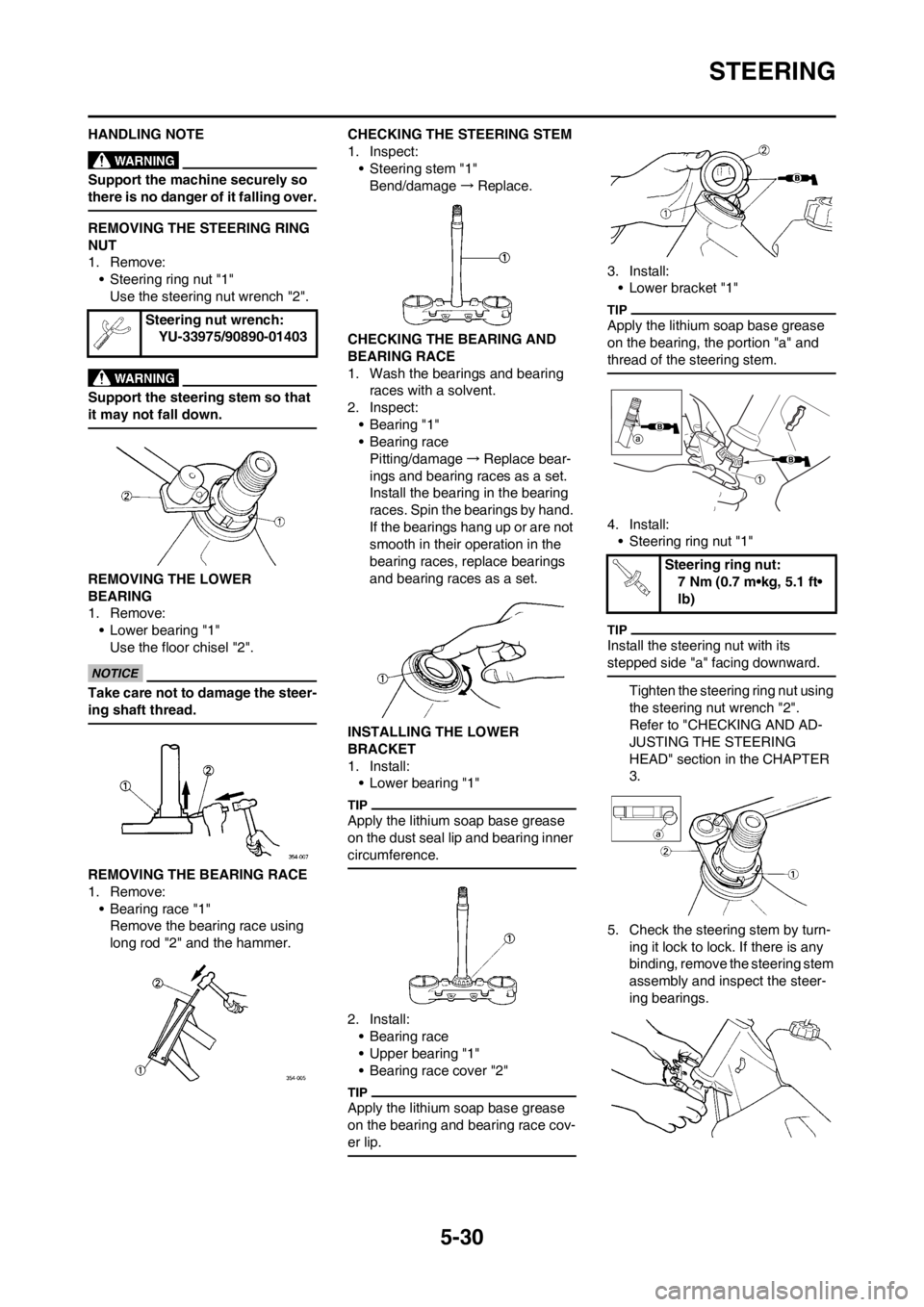
5-30
STEERING
HANDLING NOTE
Support the machine securely so
there is no danger of it falling over.
REMOVING THE STEERING RING
NUT
1. Remove:
• Steering ring nut "1"
Use the steering nut wrench "2".
Support the steering stem so that
it may not fall down.
REMOVING THE LOWER
BEARING
1. Remove:
• Lower bearing "1"
Use the floor chisel "2".
Take care not to damage the steer-
ing shaft thread.
REMOVING THE BEARING RACE
1. Remove:
• Bearing race "1"
Remove the bearing race using
long rod "2" and the hammer.CHECKING THE STEERING STEM
1. Inspect:
• Steering stem "1"
Bend/damage→Replace.
CHECKING THE BEARING AND
BEARING RACE
1. Wash the bearings and bearing
races with a solvent.
2. Inspect:
•Bearing "1"
• Bearing race
Pitting/damage→Replace bear-
ings and bearing races as a set.
Install the bearing in the bearing
races. Spin the bearings by hand.
If the bearings hang up or are not
smooth in their operation in the
bearing races, replace bearings
and bearing races as a set.
INSTALLING THE LOWER
BRACKET
1. Install:
• Lower bearing "1"
Apply the lithium soap base grease
on the dust seal lip and bearing inner
circumference.
2. Install:
• Bearing race
• Upper bearing "1"
• Bearing race cover "2"
Apply the lithium soap base grease
on the bearing and bearing race cov-
er lip.
3. Install:
• Lower bracket "1"
Apply the lithium soap base grease
on the bearing, the portion "a" and
thread of the steering stem.
4. Install:
• Steering ring nut "1"
Install the steering nut with its
stepped side "a" facing downward.
Tighten the steering ring nut using
the steering nut wrench "2".
Refer to "CHECKING AND AD-
JUSTING THE STEERING
HEAD" section in the CHAPTER
3.
5. Check the steering stem by turn-
ing it lock to lock. If there is any
binding, remove the steering stem
assembly and inspect the steer-
ing bearings. Steering nut wrench:
YU-33975/90890-01403
Steering ring nut:
7 Nm (0.7 m•kg, 5.1 ft•
lb)
Page 173 of 228
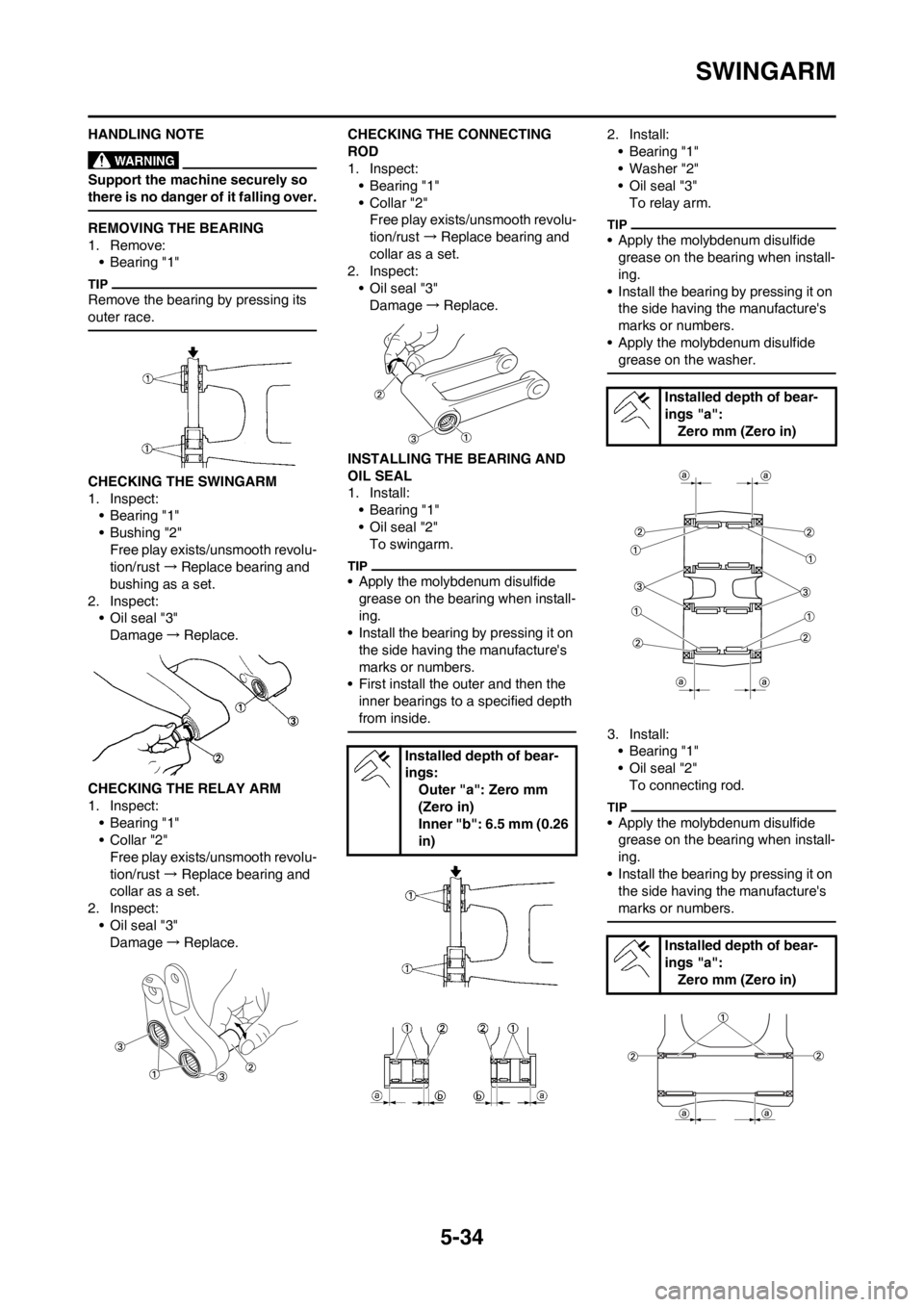
5-34
SWINGARM
HANDLING NOTE
Support the machine securely so
there is no danger of it falling over.
REMOVING THE BEARING
1. Remove:
• Bearing "1"
Remove the bearing by pressing its
outer race.
CHECKING THE SWINGARM
1. Inspect:
• Bearing "1"
• Bushing "2"
Free play exists/unsmooth revolu-
tion/rust →Replace bearing and
bushing as a set.
2. Inspect:
• Oil seal "3"
Damage→Replace.
CHECKING THE RELAY ARM
1. Inspect:
• Bearing "1"
•Collar "2"
Free play exists/unsmooth revolu-
tion/rust → Replace bearing and
collar as a set.
2. Inspect:
• Oil seal "3"
Damage→Replace.CHECKING THE CONNECTING
ROD
1. Inspect:
•Bearing "1"
• Collar "2"
Free play exists/unsmooth revolu-
tion/rust →Replace bearing and
collar as a set.
2. Inspect:
• Oil seal "3"
Damage→Replace.
INSTALLING THE BEARING AND
OIL SEAL
1. Install:
•Bearing "1"
• Oil seal "2"
To swingarm.
• Apply the molybdenum disulfide
grease on the bearing when install-
ing.
• Install the bearing by pressing it on
the side having the manufacture's
marks or numbers.
• First install the outer and then the
inner bearings to a specified depth
from inside.
2. Install:
• Bearing "1"
• Washer "2"
• Oil seal "3"
To relay arm.
• Apply the molybdenum disulfide
grease on the bearing when install-
ing.
• Install the bearing by pressing it on
the side having the manufacture's
marks or numbers.
• Apply the molybdenum disulfide
grease on the washer.
3. Install:
• Bearing "1"
• Oil seal "2"
To connecting rod.
• Apply the molybdenum disulfide
grease on the bearing when install-
ing.
• Install the bearing by pressing it on
the side having the manufacture's
marks or numbers.
Installed depth of bear-
ings:
Outer "a": Zero mm
(Zero in)
Inner "b": 6.5 mm (0.26
in)
Installed depth of bear-
ings "a":
Zero mm (Zero in)
Installed depth of bear-
ings "a":
Zero mm (Zero in)
Page 177 of 228
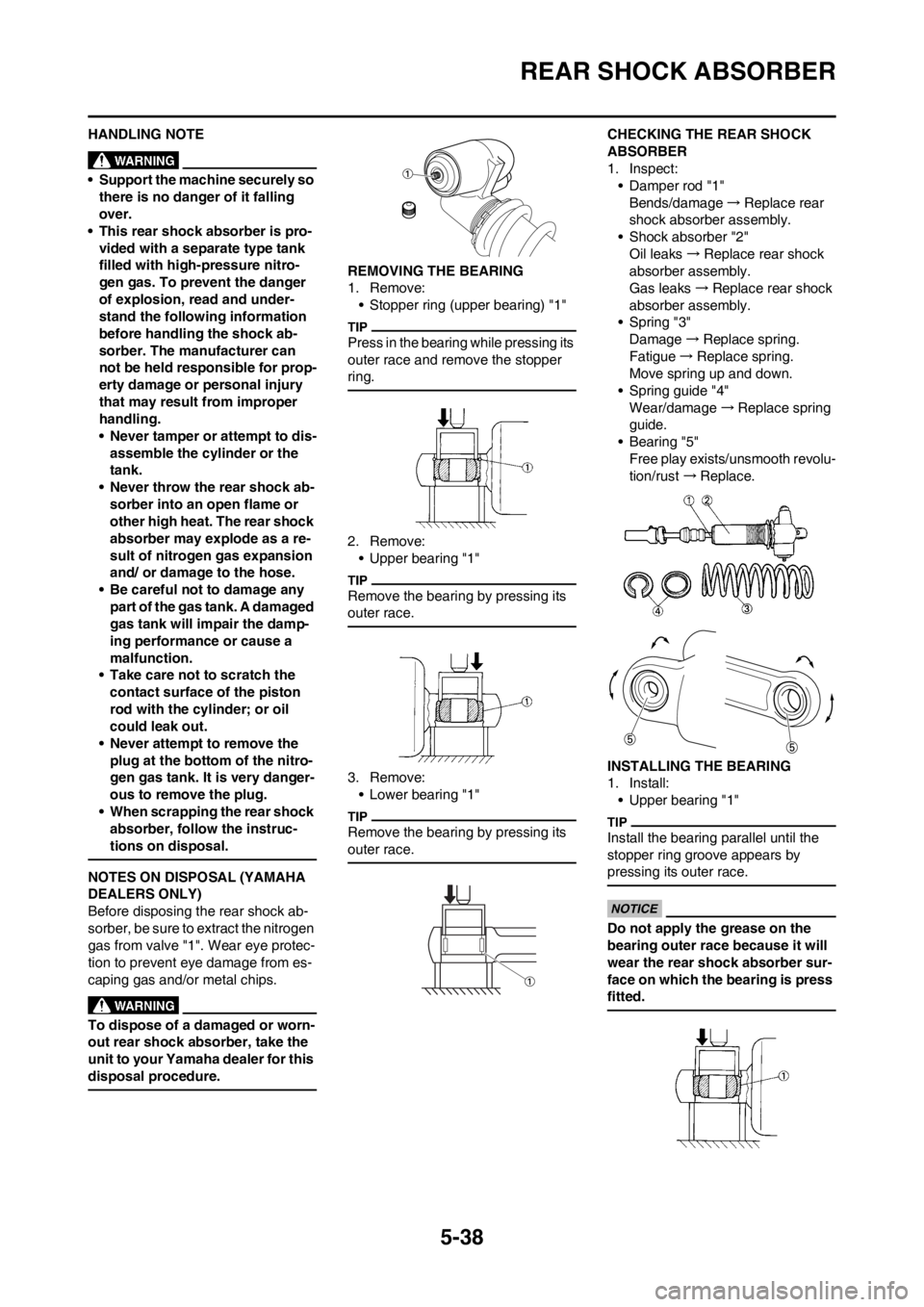
5-38
REAR SHOCK ABSORBER
HANDLING NOTE
• Support the machine securely so
there is no danger of it falling
over.
• This rear shock absorber is pro-
vided with a separate type tank
filled with high-pressure nitro-
gen gas. To prevent the danger
of explosion, read and under-
stand the following information
before handling the shock ab-
sorber. The manufacturer can
not be held responsible for prop-
erty damage or personal injury
that may result from improper
handling.
• Never tamper or attempt to dis-
assemble the cylinder or the
tank.
• Never throw the rear shock ab-
sorber into an open flame or
other high heat. The rear shock
absorber may explode as a re-
sult of nitrogen gas expansion
and/ or damage to the hose.
• Be careful not to damage any
part of the gas tank. A damaged
gas tank will impair the damp-
ing performance or cause a
malfunction.
• Take care not to scratch the
contact surface of the piston
rod with the cylinder; or oil
could leak out.
• Never attempt to remove the
plug at the bottom of the nitro-
gen gas tank. It is very danger-
ous to remove the plug.
• When scrapping the rear shock
absorber, follow the instruc-
tions on disposal.
NOTES ON DISPOSAL (YAMAHA
DEALERS ONLY)
Before disposing the rear shock ab-
sorber, be sure to extract the nitrogen
gas from valve "1". Wear eye protec-
tion to prevent eye damage from es-
caping gas and/or metal chips.
To dispose of a damaged or worn-
out rear shock absorber, take the
unit to your Yamaha dealer for this
disposal procedure.
REMOVING THE BEARING
1. Remove:
• Stopper ring (upper bearing) "1"
Press in the bearing while pressing its
outer race and remove the stopper
ring.
2. Remove:
• Upper bearing "1"
Remove the bearing by pressing its
outer race.
3. Remove:
• Lower bearing "1"
Remove the bearing by pressing its
outer race.
CHECKING THE REAR SHOCK
ABSORBER
1. Inspect:
• Damper rod "1"
Bends/damage→Replace rear
shock absorber assembly.
• Shock absorber "2"
Oil leaks→Replace rear shock
absorber assembly.
Gas leaks→Replace rear shock
absorber assembly.
• Spring "3"
Damage→Replace spring.
Fatigue→Replace spring.
Move spring up and down.
• Spring guide "4"
Wear/damage→Replace spring
guide.
• Bearing "5"
Free play exists/unsmooth revolu-
tion/rust →Replace.
INSTALLING THE BEARING
1. Install:
• Upper bearing "1"
Install the bearing parallel until the
stopper ring groove appears by
pressing its outer race.
Do not apply the grease on the
bearing outer race because it will
wear the rear shock absorber sur-
face on which the bearing is press
fitted.