lock YAMAHA YZ450F 2016 Owner's Manual
[x] Cancel search | Manufacturer: YAMAHA, Model Year: 2016, Model line: YZ450F, Model: YAMAHA YZ450F 2016Pages: 362, PDF Size: 10.49 MB
Page 108 of 362
CHASSIS
3-24
4. Install:
• Brake lever cover
EASB111092ADJUSTING THE REAR BRAKE
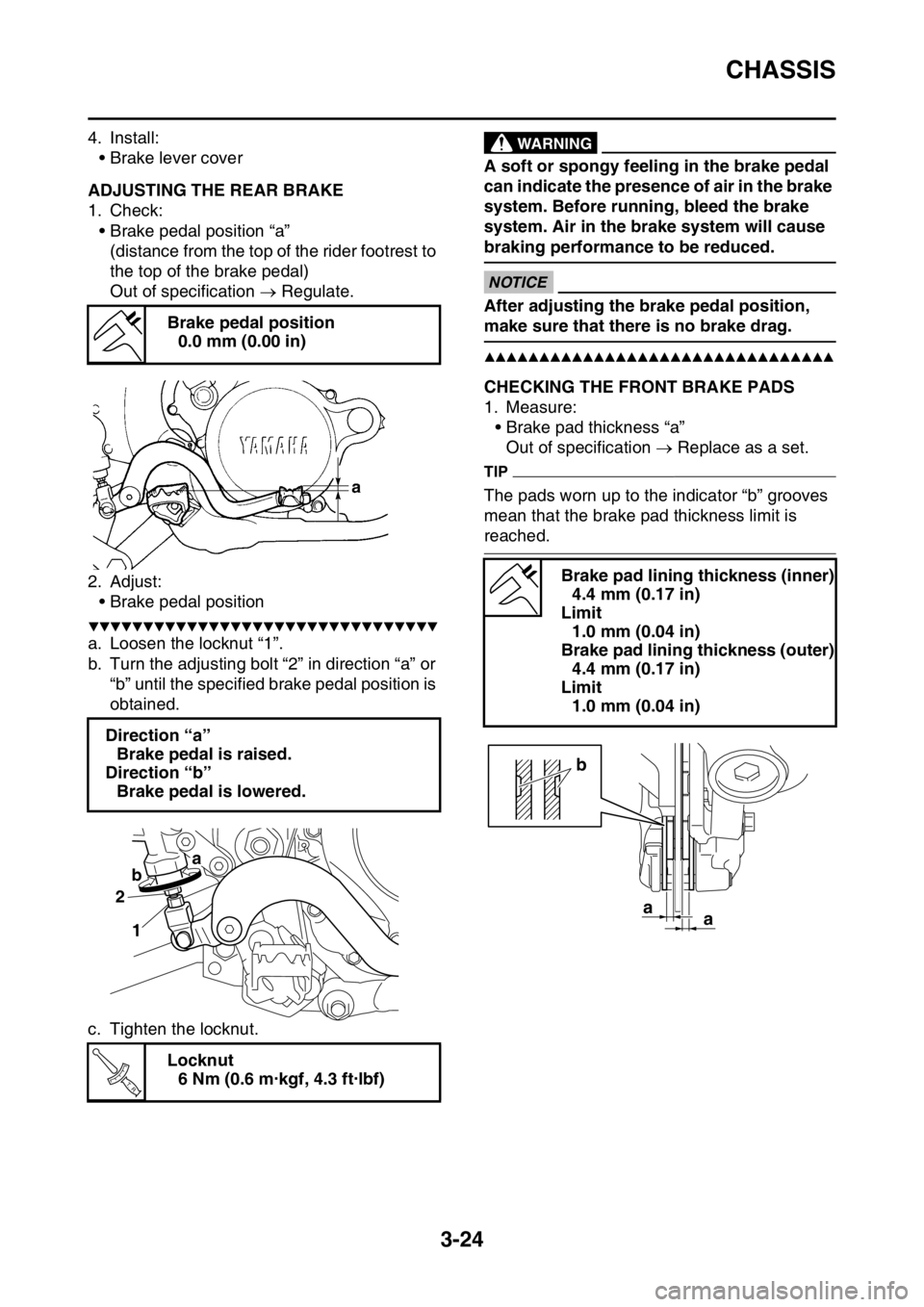
1. Check:
• Brake pedal position “a”
(distance from the top of the rider footrest to
the top of the brake pedal)
Out of specification Regulate.
2. Adjust:
• Brake pedal position
▼▼▼▼▼▼▼▼▼▼▼▼▼▼▼▼▼▼▼▼▼▼▼▼▼▼▼▼▼▼▼▼
a. Loosen the locknut “1”.
b. Turn the adjusting bolt “2” in direction “a” or
“b” until the specified brake pedal position is
obtained.
c. Tighten the locknut.
EWA
WARNING
A soft or spongy feeling in the brake pedal
can indicate the presence of air in the brake
system. Before running, bleed the brake
system. Air in the brake system will cause
braking performance to be reduced.
ECA
NOTICE
After adjusting the brake pedal position,
make sure that there is no brake drag.
▲▲▲▲▲▲▲▲▲▲▲▲▲▲▲▲▲▲▲▲▲▲▲▲▲▲▲▲▲▲▲▲
EASB111093CHECKING THE FRONT BRAKE PADS
1. Measure:
• Brake pad thickness “a”
Out of specification Replace as a set.
TIP
The pads worn up to the indicator “b” grooves
mean that the brake pad thickness limit is
reached. Brake pedal position
0.0 mm (0.00 in)
Direction “a”
Brake pedal is raised.
Direction “b”
Brake pedal is lowered.
Locknut
6 Nm (0.6 m·kgf, 4.3 ft·lbf)
1 2
a
b
T R..
Brake pad lining thickness (inner)
4.4 mm (0.17 in)
Limit
1.0 mm (0.04 in)
Brake pad lining thickness (outer)
4.4 mm (0.17 in)
Limit
1.0 mm (0.04 in)
a
b
a
Page 112 of 362
CHASSIS
3-28
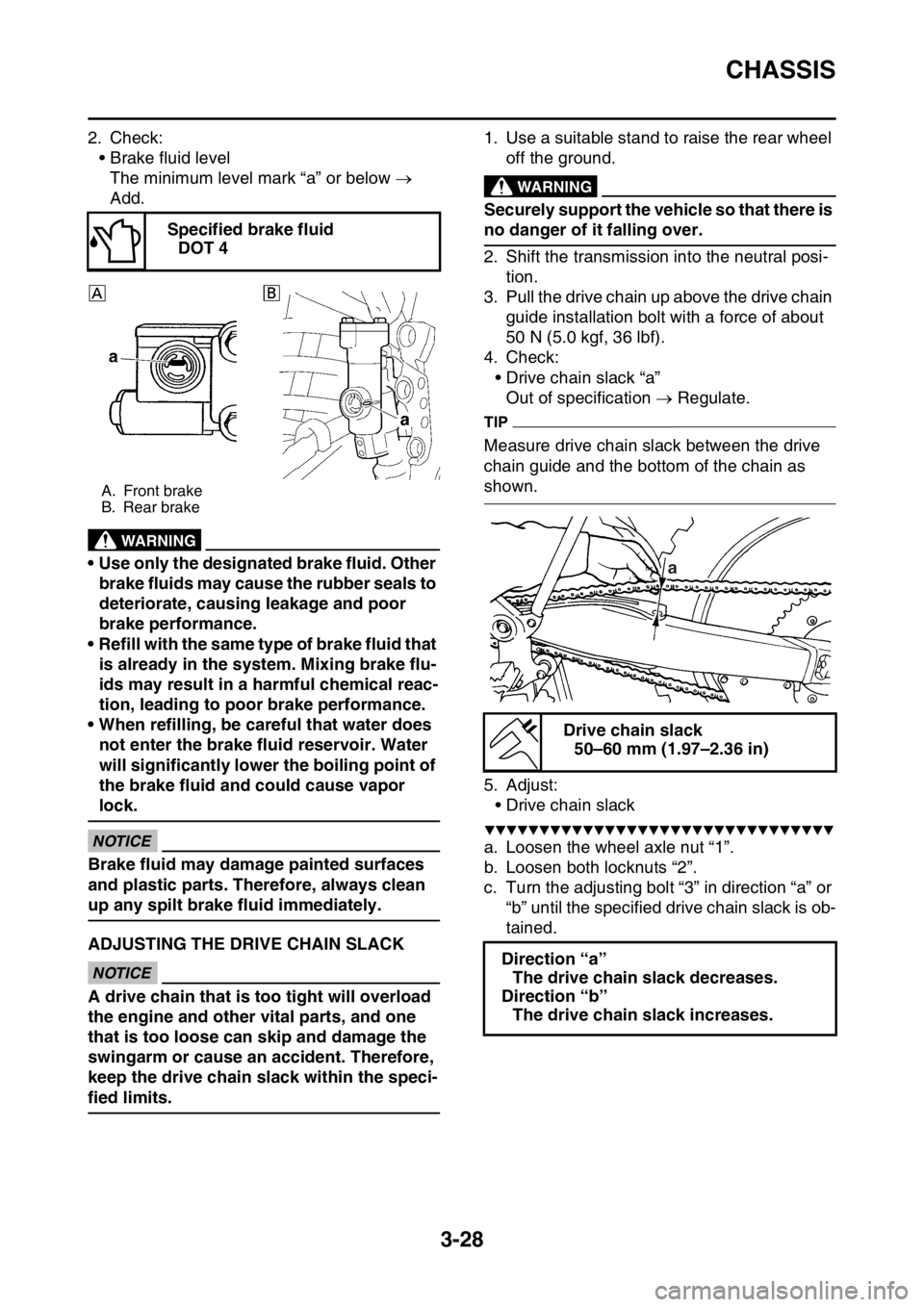
2. Check:
• Brake fluid level
The minimum level mark “a” or below
Add.
EWA
WARNING
• Use only the designated brake fluid. Other
brake fluids may cause the rubber seals to
deteriorate, causing leakage and poor
brake performance.
• Refill with the same type of brake fluid that
is already in the system. Mixing brake flu-
ids may result in a harmful chemical reac-
tion, leading to poor brake performance.
• When refilling, be careful that water does
not enter the brake fluid reservoir. Water
will significantly lower the boiling point of
the brake fluid and could cause vapor
lock.
ECA
NOTICE
Brake fluid may damage painted surfaces
and plastic parts. Therefore, always clean
up any spilt brake fluid immediately.
EASB111097ADJUSTING THE DRIVE CHAIN SLACKECA13550
NOTICE
A drive chain that is too tight will overload
the engine and other vital parts, and one
that is too loose can skip and damage the
swingarm or cause an accident. Therefore,
keep the drive chain slack within the speci-
fied limits.1. Use a suitable stand to raise the rear wheel
off the ground.
EWA13120
WARNING
Securely support the vehicle so that there is
no danger of it falling over.
2. Shift the transmission into the neutral posi-
tion.
3. Pull the drive chain up above the drive chain
guide installation bolt with a force of about
50 N (5.0 kgf, 36 lbf).
4. Check:
• Drive chain slack “a”
Out of specification Regulate.
TIP
Measure drive chain slack between the drive
chain guide and the bottom of the chain as
shown.
5. Adjust:
• Drive chain slack
▼▼▼▼▼▼▼▼▼▼▼▼▼▼▼▼▼▼▼▼▼▼▼▼▼▼▼▼▼▼▼▼
a. Loosen the wheel axle nut “1”.
b. Loosen both locknuts “2”.
c. Turn the adjusting bolt “3” in direction “a” or
“b” until the specified drive chain slack is ob-
tained. Specified brake fluid
DOT 4
A. Front brake
B. Rear brake
Drive chain slack
50–60 mm (1.97–2.36 in)
Direction “a”
The drive chain slack decreases.
Direction “b”
The drive chain slack increases.
a
Page 113 of 362
CHASSIS
3-29
TIP
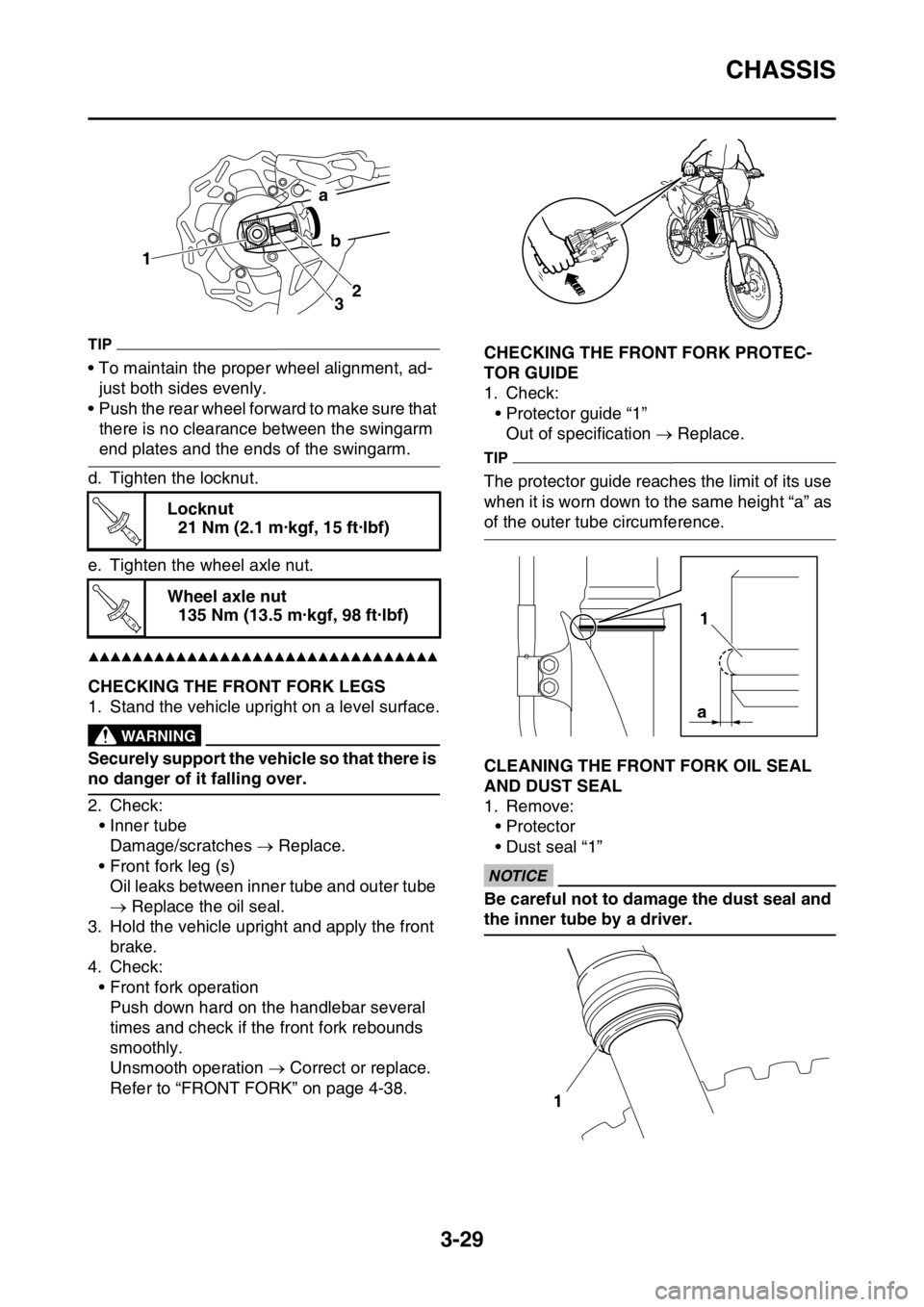
• To maintain the proper wheel alignment, ad-
just both sides evenly.
• Push the rear wheel forward to make sure that
there is no clearance between the swingarm
end plates and the ends of the swingarm.
d. Tighten the locknut.
e. Tighten the wheel axle nut.
▲▲▲▲▲▲▲▲▲▲▲▲▲▲▲▲▲▲▲▲▲▲▲▲▲▲▲▲▲▲▲▲
EASB111098CHECKING THE FRONT FORK LEGS
1. Stand the vehicle upright on a level surface.
EWA
WARNING
Securely support the vehicle so that there is
no danger of it falling over.
2. Check:
• Inner tube
Damage/scratches Replace.
• Front fork leg (s)
Oil leaks between inner tube and outer tube
Replace the oil seal.
3. Hold the vehicle upright and apply the front
brake.
4. Check:
• Front fork operation
Push down hard on the handlebar several
times and check if the front fork rebounds
smoothly.
Unsmooth operation Correct or replace.
Refer to “FRONT FORK” on page 4-38.
EASB111099CHECKING THE FRONT FORK PROTEC-
TOR GUIDE
1. Check:
• Protector guide “1”
Out of specification Replace.
TIP
The protector guide reaches the limit of its use
when it is worn down to the same height “a” as
of the outer tube circumference.
EASB111100CLEANING THE FRONT FORK OIL SEAL
AND DUST SEAL
1. Remove:
•Protector
• Dust seal “1”
ECA
NOTICE
Be careful not to damage the dust seal and
the inner tube by a driver. Locknut
21 Nm (2.1 m·kgf, 15 ft·lbf)
Wheel axle nut
135 Nm (13.5 m·kgf, 98 ft·lbf)
1
32
a
b
T R..
T R..1
a
1
Page 116 of 362
CHASSIS
3-32
2. Adjust:
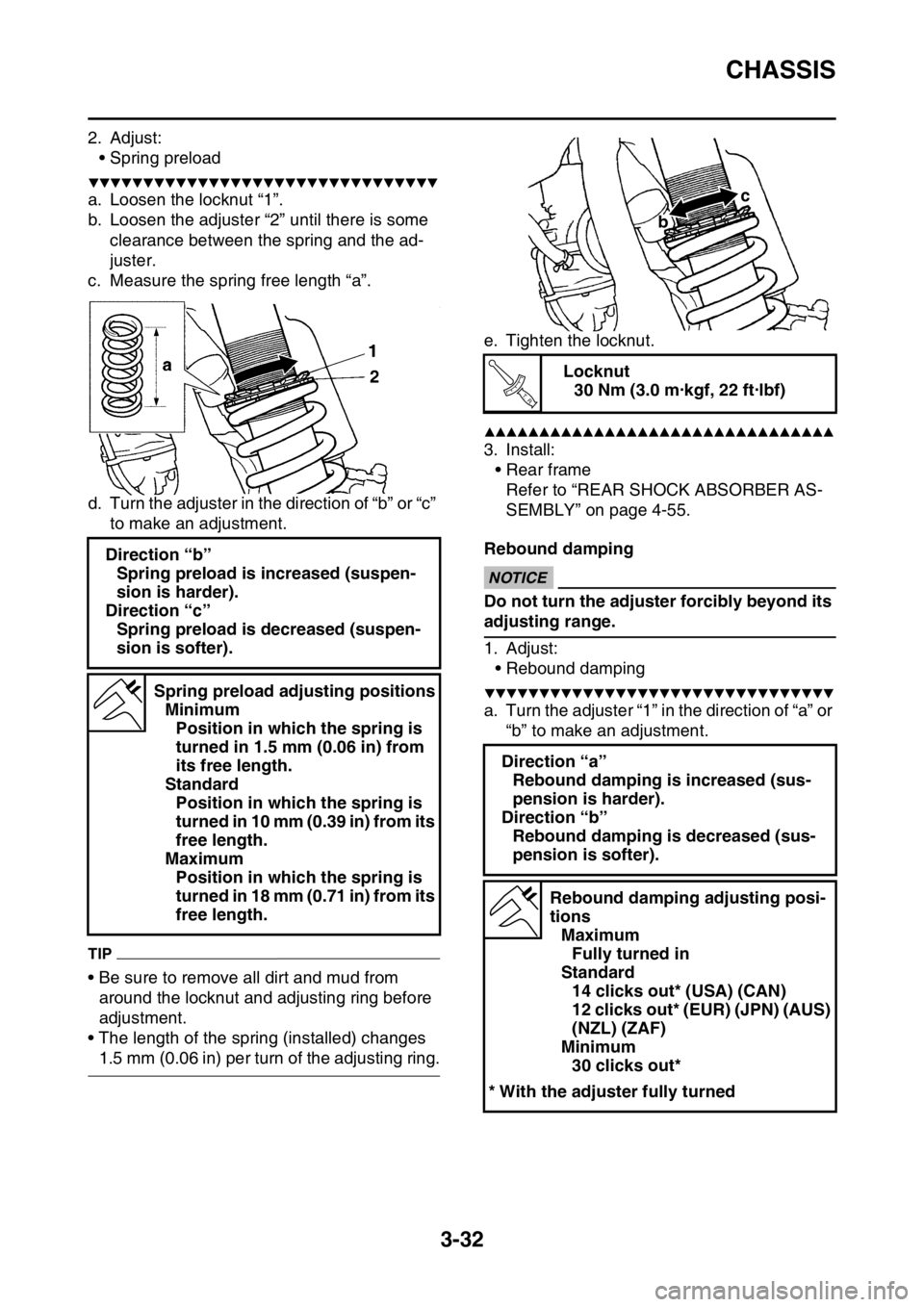
• Spring preload
▼▼▼▼▼▼▼▼▼▼▼▼▼▼▼▼▼▼▼▼▼▼▼▼▼▼▼▼▼▼▼▼
a. Loosen the locknut “1”.
b. Loosen the adjuster “2” until there is some
clearance between the spring and the ad-
juster.
c. Measure the spring free length “a”.
d. Turn the adjuster in the direction of “b” or “c”
to make an adjustment.
TIP
• Be sure to remove all dirt and mud from
around the locknut and adjusting ring before
adjustment.
• The length of the spring (installed) changes
1.5 mm (0.06 in) per turn of the adjusting ring.e. Tighten the locknut.
▲▲▲▲▲▲▲▲▲▲▲▲▲▲▲▲▲▲▲▲▲▲▲▲▲▲▲▲▲▲▲▲
3. Install:
• Rear frame
Refer to “REAR SHOCK ABSORBER AS-
SEMBLY” on page 4-55.
Rebound damping
ECA@
NOTICE
Do not turn the adjuster forcibly beyond its
adjusting range.
1. Adjust:
• Rebound damping
▼▼▼▼▼▼▼▼▼▼▼▼▼▼▼▼▼▼▼▼▼▼▼▼▼▼▼▼▼▼▼▼
a. Turn the adjuster “1” in the direction of “a” or
“b” to make an adjustment. Direction “b”
Spring preload is increased (suspen-
sion is harder).
Direction “c”
Spring preload is decreased (suspen-
sion is softer).
Spring preload adjusting positions
Minimum
Position in which the spring is
turned in 1.5 mm (0.06 in) from
its free length.
Standard
Position in which the spring is
turned in 10 mm (0.39 in) from its
free length.
Maximum
Position in which the spring is
turned in 18 mm (0.71 in) from its
free length.
Locknut
30 Nm (3.0 m·kgf, 22 ft·lbf)
Direction “a”
Rebound damping is increased (sus-
pension is harder).
Direction “b”
Rebound damping is decreased (sus-
pension is softer).
Rebound damping adjusting posi-
tions
Maximum
Fully turned in
Standard
14 clicks out* (USA) (CAN)
12 clicks out* (EUR) (JPN) (AUS)
(NZL) (ZAF)
Minimum
30 clicks out*
* With the adjuster fully turned
c
b
T R..
Page 121 of 362
ELECTRICAL SYSTEM
3-37
EASB111113
ELECTRICAL SYSTEM
EASB111114CHECKING THE SPARK PLUG
1. Remove:
• Seat
• Air scoop (left/right)
Refer to “GENERAL CHASSIS” on page 4-
1.
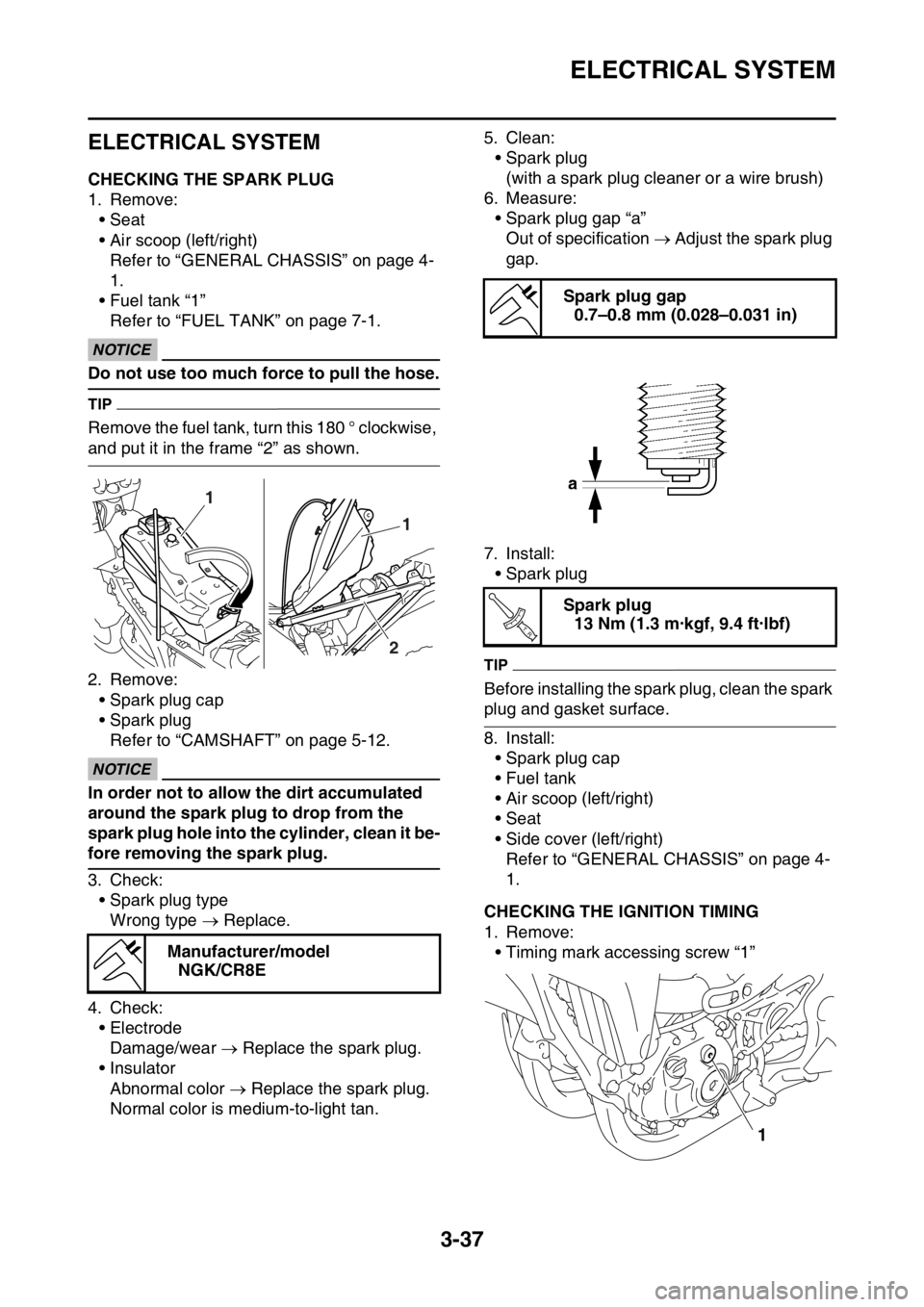
• Fuel tank “1”
Refer to “FUEL TANK” on page 7-1.
ECA
NOTICE
Do not use too much force to pull the hose.
TIP
Remove the fuel tank, turn this 180 ° clockwise,
and put it in the frame “2” as shown.
2. Remove:
• Spark plug cap
• Spark plug
Refer to “CAMSHAFT” on page 5-12.
ECA
NOTICE
In order not to allow the dirt accumulated
around the spark plug to drop from the
spark plug hole into the cylinder, clean it be-
fore removing the spark plug.
3. Check:
• Spark plug type
Wrong type Replace.
4. Check:
• Electrode
Damage/wear Replace the spark plug.
• Insulator
Abnormal color Replace the spark plug.
Normal color is medium-to-light tan.5. Clean:
• Spark plug
(with a spark plug cleaner or a wire brush)
6. Measure:
• Spark plug gap “a”
Out of specification Adjust the spark plug
gap.
7. Install:
• Spark plug
TIP
Before installing the spark plug, clean the spark
plug and gasket surface.
8. Install:
• Spark plug cap
• Fuel tank
• Air scoop (left/right)
• Seat
• Side cover (left/right)
Refer to “GENERAL CHASSIS” on page 4-
1.
EASB111115CHECKING THE IGNITION TIMING
1. Remove:
• Timing mark accessing screw “1” Manufacturer/model
NGK/CR8E
1
1
2
Spark plug gap
0.7–0.8 mm (0.028–0.031 in)
Spark plug
13 Nm (1.3 m·kgf, 9.4 ft·lbf)
T R..
1
Page 132 of 362
REAR WHEEL
4-8
EASB111128REMOVING THE REAR WHEEL
1. Use a suitable stand to raise the rear wheel
off the ground.
EWA
WARNING
Securely support the vehicle so that there is
no danger of it falling over.
2. Remove:
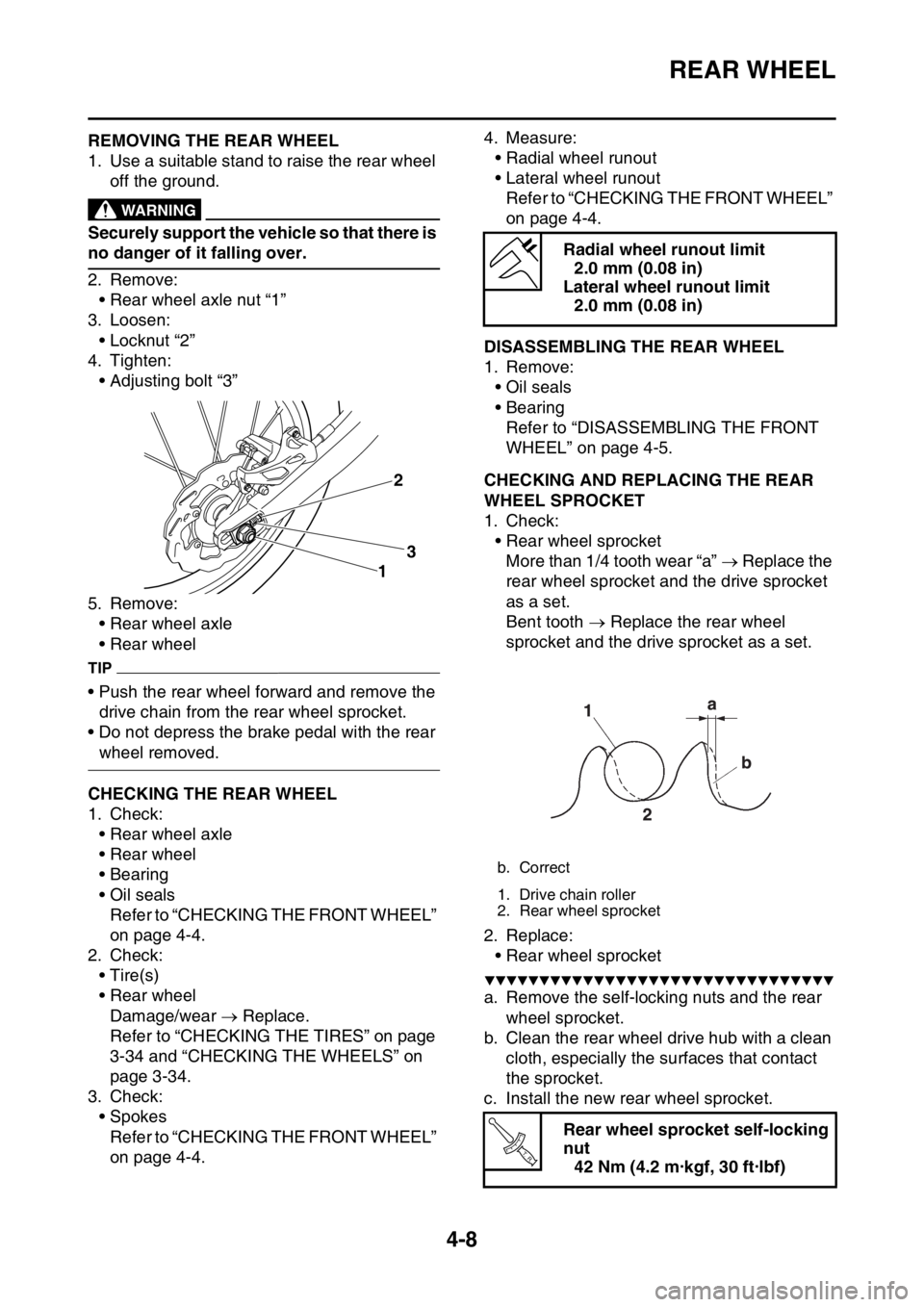
• Rear wheel axle nut “1”
3. Loosen:
• Locknut “2”
4. Tighten:
• Adjusting bolt “3”
5. Remove:
• Rear wheel axle
• Rear wheel
TIP
• Push the rear wheel forward and remove the
drive chain from the rear wheel sprocket.
• Do not depress the brake pedal with the rear
wheel removed.
EASB111129CHECKING THE REAR WHEEL
1. Check:
• Rear wheel axle
• Rear wheel
• Bearing
• Oil seals
Refer to “CHECKING THE FRONT WHEEL”
on page 4-4.
2. Check:
•Tire(s)
• Rear wheel
Damage/wear Replace.
Refer to “CHECKING THE TIRES” on page
3-34 and “CHECKING THE WHEELS” on
page 3-34.
3. Check:
• Spokes
Refer to “CHECKING THE FRONT WHEEL”
on page 4-4.4. Measure:
• Radial wheel runout
• Lateral wheel runout
Refer to “CHECKING THE FRONT WHEEL”
on page 4-4.
EASB111130DISASSEMBLING THE REAR WHEEL
1. Remove:
• Oil seals
• Bearing
Refer to “DISASSEMBLING THE FRONT
WHEEL” on page 4-5.
EASB111131CHECKING AND REPLACING THE REAR
WHEEL SPROCKET
1. Check:
• Rear wheel sprocket
More than 1/4 tooth wear “a” Replace the
rear wheel sprocket and the drive sprocket
as a set.
Bent tooth Replace the rear wheel
sprocket and the drive sprocket as a set.
2. Replace:
• Rear wheel sprocket
▼▼▼▼▼▼▼▼▼▼▼▼▼▼▼▼▼▼▼▼▼▼▼▼▼▼▼▼▼▼▼▼
a. Remove the self-locking nuts and the rear
wheel sprocket.
b. Clean the rear wheel drive hub with a clean
cloth, especially the surfaces that contact
the sprocket.
c. Install the new rear wheel sprocket.
3
12
Radial wheel runout limit
2.0 mm (0.08 in)
Lateral wheel runout limit
2.0 mm (0.08 in)
b. Correct
1. Drive chain roller
2. Rear wheel sprocket
Rear wheel sprocket self-locking
nut
42 Nm (4.2 m·kgf, 30 ft·lbf)
T R..
Page 133 of 362
REAR WHEEL
4-9
TIP
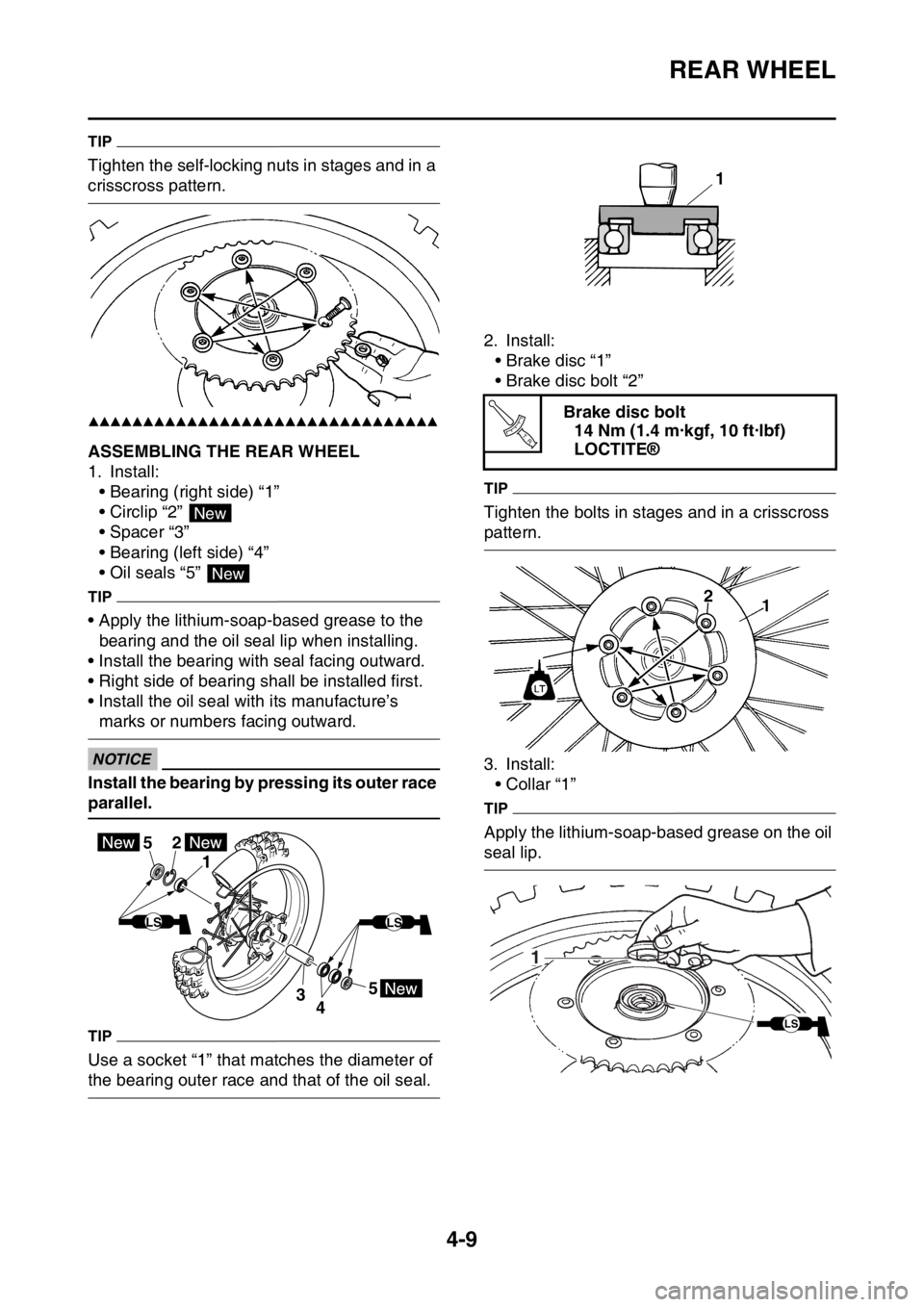
Tighten the self-locking nuts in stages and in a
crisscross pattern.
▲▲▲▲▲▲▲▲▲▲▲▲▲▲▲▲▲▲▲▲▲▲▲▲▲▲▲▲▲▲▲▲
EASB111132ASSEMBLING THE REAR WHEEL
1. Install:
• Bearing (right side) “1”
• Circlip “2”
• Spacer “3”
• Bearing (left side) “4”
• Oil seals “5”
TIP
• Apply the lithium-soap-based grease to the
bearing and the oil seal lip when installing.
• Install the bearing with seal facing outward.
• Right side of bearing shall be installed first.
• Install the oil seal with its manufacture’s
marks or numbers facing outward.
ECA
NOTICE
Install the bearing by pressing its outer race
parallel.
TIP
Use a socket “1” that matches the diameter of
the bearing outer race and that of the oil seal.2. Install:
• Brake disc “1”
• Brake disc bolt “2”
TIP
Tighten the bolts in stages and in a crisscross
pattern.
3. Install:
• Collar “1”
TIP
Apply the lithium-soap-based grease on the oil
seal lip.
New
New
5
43 1
25
LSLS
Brake disc bolt
14 Nm (1.4 m·kgf, 10 ft·lbf)
LOCTITE®
1
T R..
1
LS
Page 134 of 362
REAR WHEEL
4-10
EASB111133INSTALLING THE REAR WHEEL
1. Install:
• Rear wheel
TIP
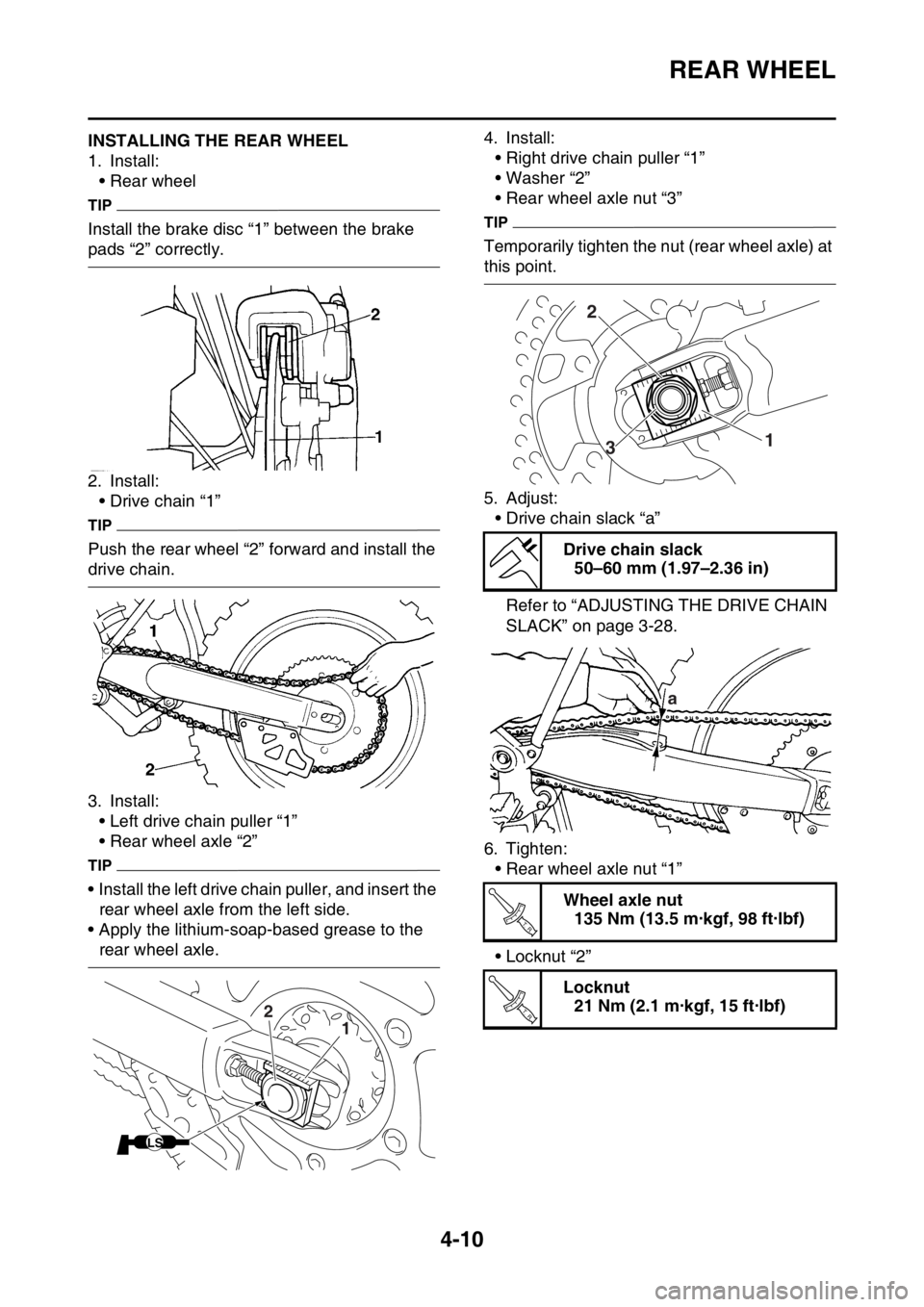
Install the brake disc “1” between the brake
pads “2” correctly.
2. Install:
• Drive chain “1”
TIP
Push the rear wheel “2” forward and install the
drive chain.
3. Install:
• Left drive chain puller “1”
• Rear wheel axle “2”
TIP
• Install the left drive chain puller, and insert the
rear wheel axle from the left side.
• Apply the lithium-soap-based grease to the
rear wheel axle.4. Install:
• Right drive chain puller “1”
• Washer “2”
• Rear wheel axle nut “3”
TIP
Temporarily tighten the nut (rear wheel axle) at
this point.
5. Adjust:
• Drive chain slack “a”
Refer to “ADJUSTING THE DRIVE CHAIN
SLACK” on page 3-28.
6. Tighten:
• Rear wheel axle nut “1”
• Locknut “2”
1 2
LS
Drive chain slack
50–60 mm (1.97–2.36 in)
Wheel axle nut
135 Nm (13.5 m·kgf, 98 ft·lbf)
Locknut
21 Nm (2.1 m·kgf, 15 ft·lbf)
2
1
3
a
T R..
T R..
Page 142 of 362
FRONT BRAKE
4-18
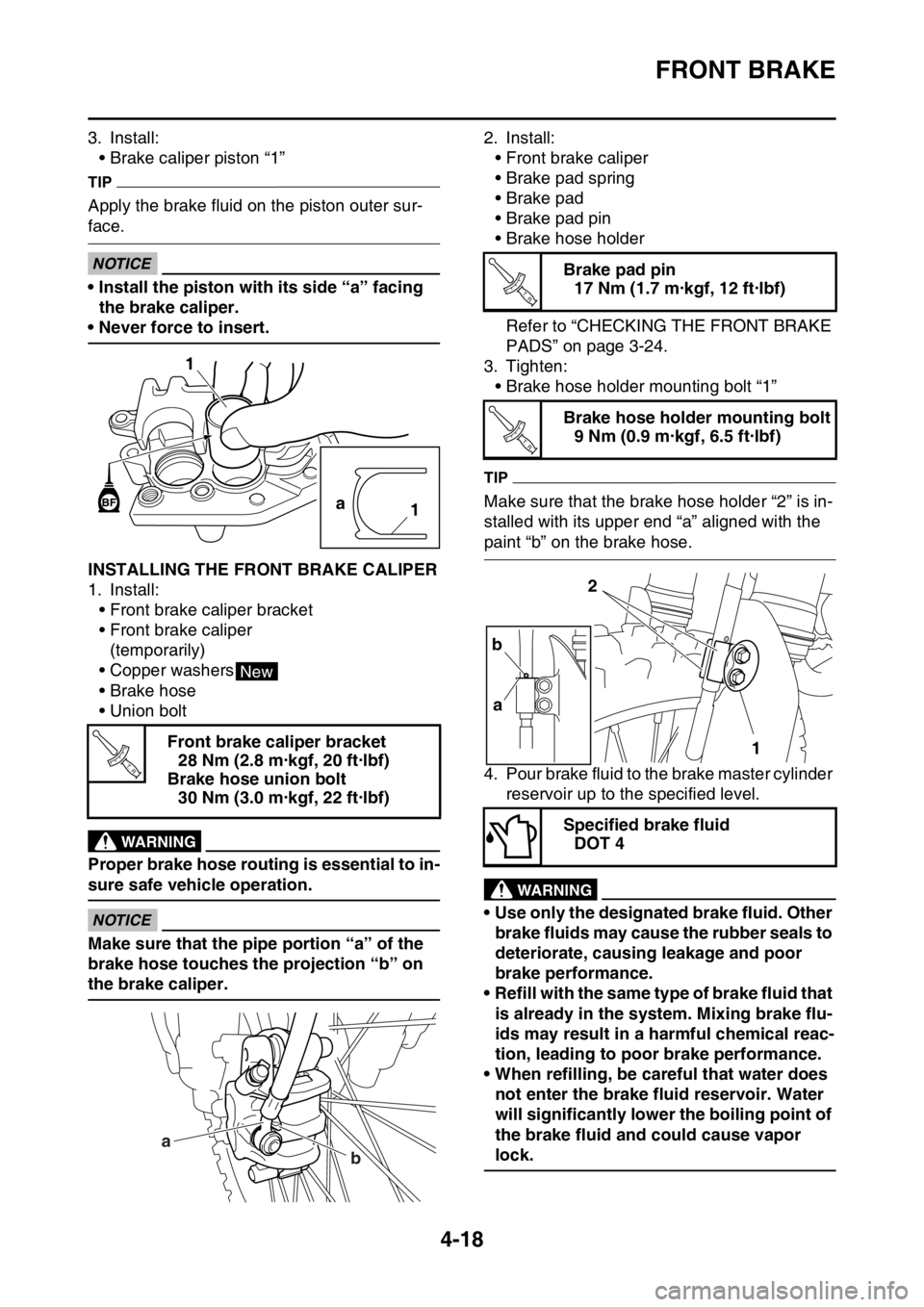
3. Install:
• Brake caliper piston “1”
TIP
Apply the brake fluid on the piston outer sur-
face.
ECA
NOTICE
• Install the piston with its side “a” facing
the brake caliper.
• Never force to insert.
EASB111142INSTALLING THE FRONT BRAKE CALIPER
1. Install:
• Front brake caliper bracket
• Front brake caliper
(temporarily)
• Copper washers
• Brake hose
• Union bolt
EWA
WARNING
Proper brake hose routing is essential to in-
sure safe vehicle operation.
ECA
NOTICE
Make sure that the pipe portion “a” of the
brake hose touches the projection “b” on
the brake caliper.2. Install:
• Front brake caliper
• Brake pad spring
• Brake pad
• Brake pad pin
• Brake hose holder
Refer to “CHECKING THE FRONT BRAKE
PADS” on page 3-24.
3. Tighten:
• Brake hose holder mounting bolt “1”
TIP
Make sure that the brake hose holder “2” is in-
stalled with its upper end “a” aligned with the
paint “b” on the brake hose.
4. Pour brake fluid to the brake master cylinder
reservoir up to the specified level.
EWA
WARNING
• Use only the designated brake fluid. Other
brake fluids may cause the rubber seals to
deteriorate, causing leakage and poor
brake performance.
• Refill with the same type of brake fluid that
is already in the system. Mixing brake flu-
ids may result in a harmful chemical reac-
tion, leading to poor brake performance.
• When refilling, be careful that water does
not enter the brake fluid reservoir. Water
will significantly lower the boiling point of
the brake fluid and could cause vapor
lock.
ECA
Front brake caliper bracket
28 Nm (2.8 m·kgf, 20 ft·lbf)
Brake hose union bolt
30 Nm (3.0 m·kgf, 22 ft·lbf)
1
a
1
New
T R..
a
b
Brake pad pin
17 Nm (1.7 m·kgf, 12 ft·lbf)
Brake hose holder mounting bolt
9 Nm (0.9 m·kgf, 6.5 ft·lbf)
Specified brake fluid
DOT 4
T R..
T R..
2
1 b
a
Page 145 of 362
FRONT BRAKE
4-21
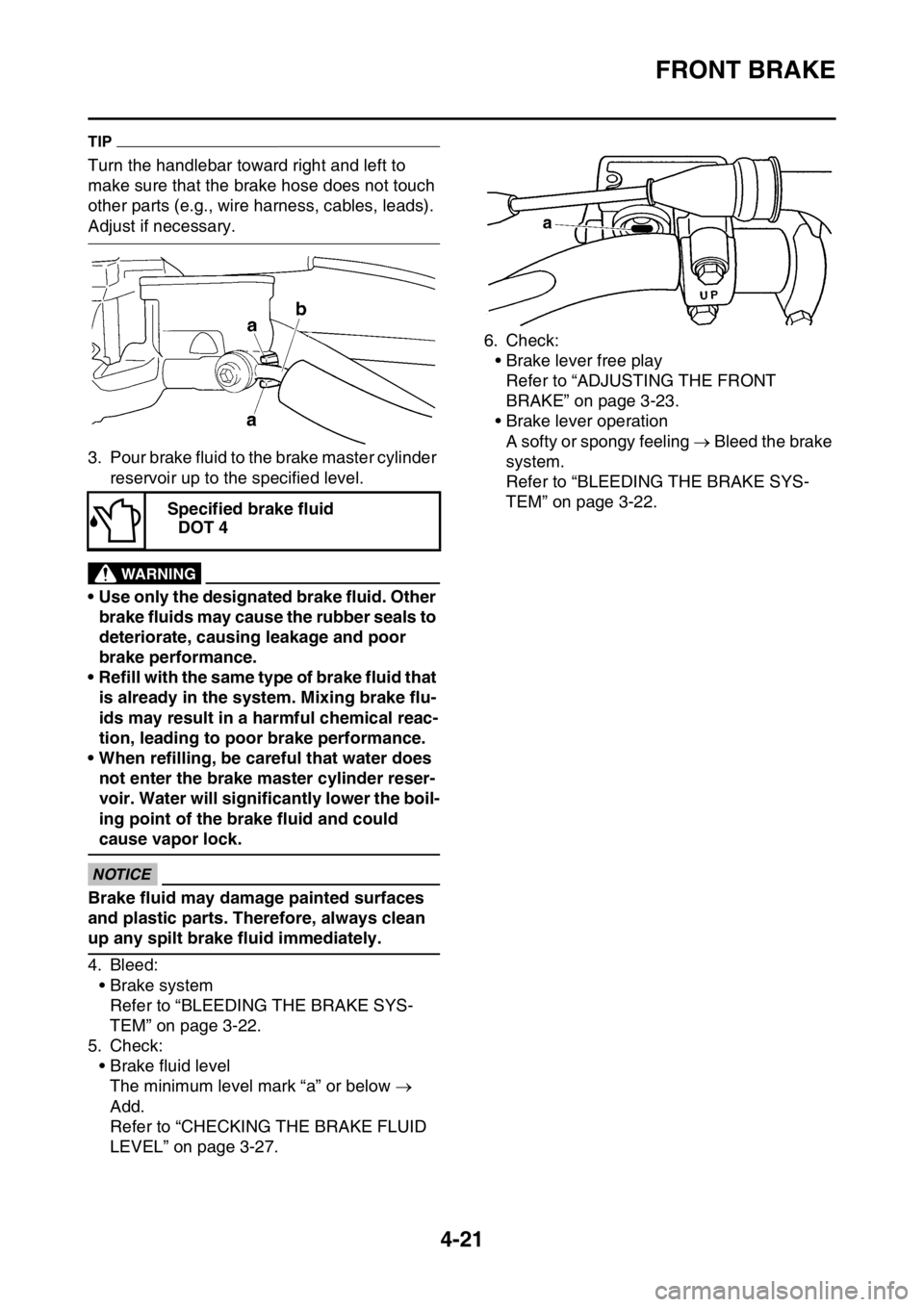
TIP
Turn the handlebar toward right and left to
make sure that the brake hose does not touch
other parts (e.g., wire harness, cables, leads).
Adjust if necessary.
3. Pour brake fluid to the brake master cylinder
reservoir up to the specified level.
EWA13540
WARNING
• Use only the designated brake fluid. Other
brake fluids may cause the rubber seals to
deteriorate, causing leakage and poor
brake performance.
• Refill with the same type of brake fluid that
is already in the system. Mixing brake flu-
ids may result in a harmful chemical reac-
tion, leading to poor brake performance.
• When refilling, be careful that water does
not enter the brake master cylinder reser-
voir. Water will significantly lower the boil-
ing point of the brake fluid and could
cause vapor lock.
ECA13540
NOTICE
Brake fluid may damage painted surfaces
and plastic parts. Therefore, always clean
up any spilt brake fluid immediately.
4. Bleed:
• Brake system
Refer to “BLEEDING THE BRAKE SYS-
TEM” on page 3-22.
5. Check:
• Brake fluid level
The minimum level mark “a” or below
Add.
Refer to “CHECKING THE BRAKE FLUID
LEVEL” on page 3-27.6. Check:
• Brake lever free play
Refer to “ADJUSTING THE FRONT
BRAKE” on page 3-23.
• Brake lever operation
A softy or spongy feeling Bleed the brake
system.
Refer to “BLEEDING THE BRAKE SYS-
TEM” on page 3-22.
Specified brake fluid
DOT 4