warning YAMAHA YZ450F 2016 Repair Manual
[x] Cancel search | Manufacturer: YAMAHA, Model Year: 2016, Model line: YZ450F, Model: YAMAHA YZ450F 2016Pages: 362, PDF Size: 10.49 MB
Page 351 of 362
CHASSIS
10-2
EASB111369TIRE PRESSURE
Tire pressure should be adjusted to suit the
road surface condition of the circuit.
• Under a rainy, a muddy, a sandy, or a slippery
condition, the tire pressure should be lower
for a larger area of contact with the road sur-
face.
• Under a stony or a hard road condition, the
tire pressure should be higher to prevent a flat
tire.
EASB111370FRONT FORK SETTING
The front fork setting should be made depend-
ing on the rider’s feeling of an actual run and
the circuit conditions.
The front fork setting includes the following
three factors:
1. Setting of air spring characteristics
• Change the fork oil amount.
2. Setting of spring preload
• Change the spring.
3. Setting of damping force
• Change the compression damping force.
• Change the rebound damping force.
The spring acts on the load and the damping
force acts on the cushion travel speed.
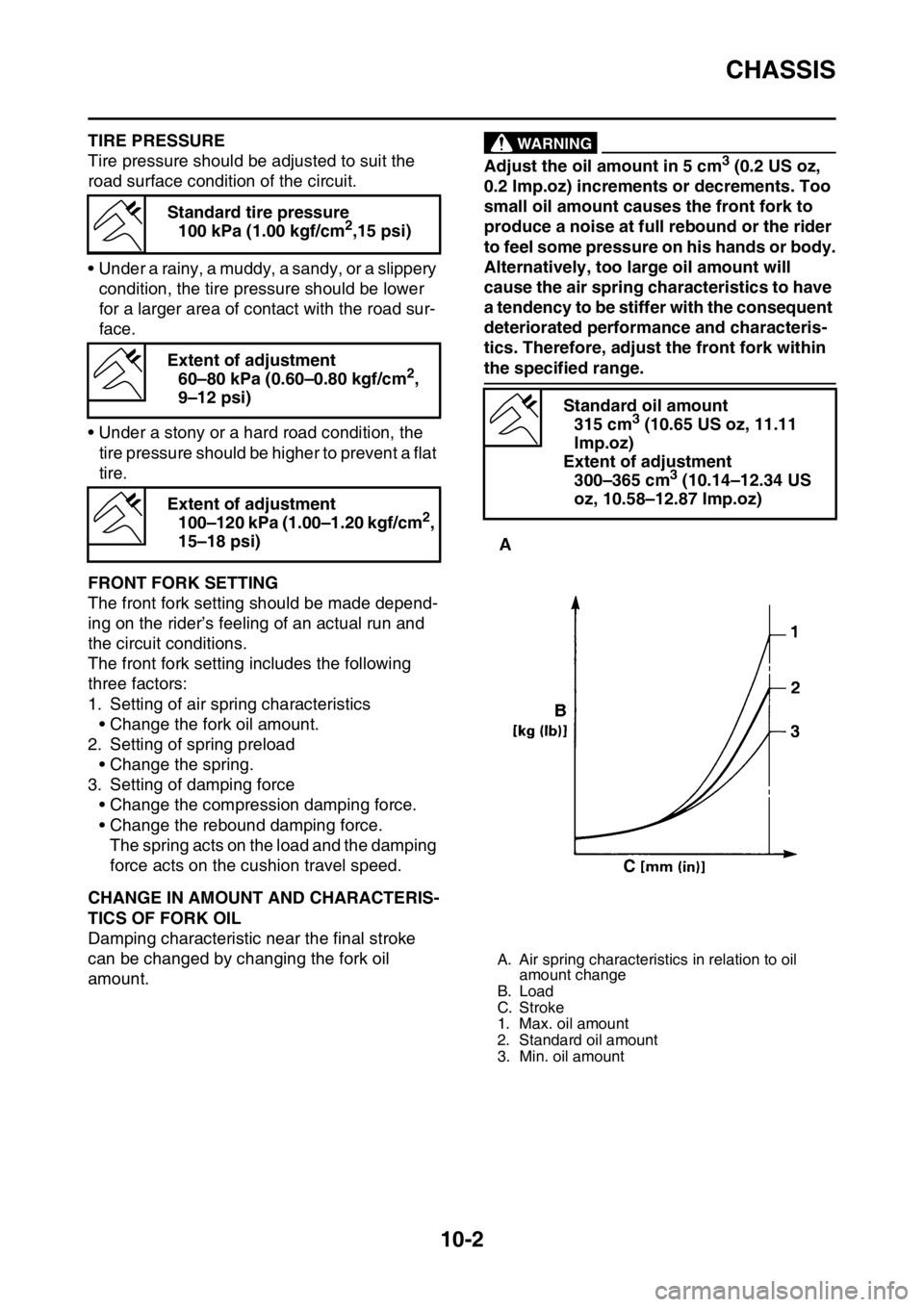
EASB111371CHANGE IN AMOUNT AND CHARACTERIS-
TICS OF FORK OIL
Damping characteristic near the final stroke
can be changed by changing the fork oil
amount.
EWA1DX4001
WARNING
Adjust the oil amount in 5 cm3 (0.2 US oz,
0.2 Imp.oz) increments or decrements. Too
small oil amount causes the front fork to
produce a noise at full rebound or the rider
to feel some pressure on his hands or body.
Alternatively, too large oil amount will
cause the air spring characteristics to have
a tendency to be stiffer with the consequent
deteriorated performance and characteris-
tics. Therefore, adjust the front fork within
the specified range. Standard tire pressure
100 kPa (1.00 kgf/cm
2,15 psi)
Extent of adjustment
60–80 kPa (0.60–0.80 kgf/cm
2,
9–12 psi)
Extent of adjustment
100–120 kPa (1.00–1.20 kgf/cm
2,
15–18 psi)
Standard oil amount
315 cm3 (10.65 US oz, 11.11
lmp.oz)
Extent of adjustment
300–365 cm
3 (10.14–12.34 US
oz, 10.58–12.87 Imp.oz)
A. Air spring characteristics in relation to oil
amount change
B. Load
C. Stroke
1. Max. oil amount
2. Standard oil amount
3. Min. oil amount
Page 353 of 362
CHASSIS
10-4
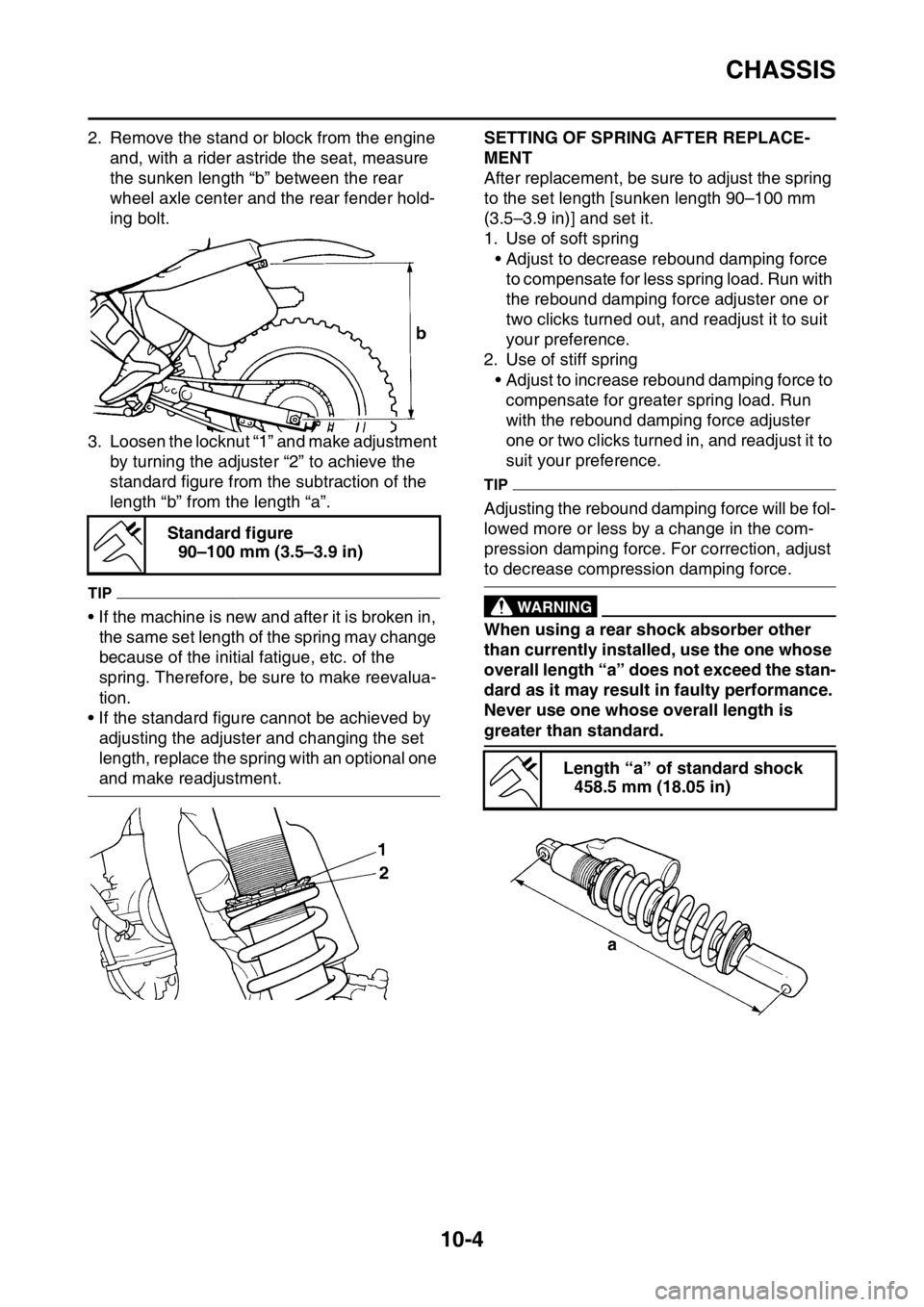
2. Remove the stand or block from the engine
and, with a rider astride the seat, measure
the sunken length “b” between the rear
wheel axle center and the rear fender hold-
ing bolt.
3. Loosen the locknut “1” and make adjustment
by turning the adjuster “2” to achieve the
standard figure from the subtraction of the
length “b” from the length “a”.
TIP
• If the machine is new and after it is broken in,
the same set length of the spring may change
because of the initial fatigue, etc. of the
spring. Therefore, be sure to make reevalua-
tion.
• If the standard figure cannot be achieved by
adjusting the adjuster and changing the set
length, replace the spring with an optional one
and make readjustment.
EASB111376
SETTING OF SPRING AFTER REPLACE-
MENT
After replacement, be sure to adjust the spring
to the set length [sunken length 90–100 mm
(3.5–3.9 in)] and set it.
1. Use of soft spring
• Adjust to decrease rebound damping force
to compensate for less spring load. Run with
the rebound damping force adjuster one or
two clicks turned out, and readjust it to suit
your preference.
2. Use of stiff spring
• Adjust to increase rebound damping force to
compensate for greater spring load. Run
with the rebound damping force adjuster
one or two clicks turned in, and readjust it to
suit your preference.
TIP
Adjusting the rebound damping force will be fol-
lowed more or less by a change in the com-
pression damping force. For correction, adjust
to decrease compression damping force.
EWA1DX4002
WARNING
When using a rear shock absorber other
than currently installed, use the one whose
overall length “a” does not exceed the stan-
dard as it may result in faulty performance.
Never use one whose overall length is
greater than standard. Standard figure
90–100 mm (3.5–3.9 in)
Length “a” of standard shock
458.5 mm (18.05 in)