fuel YAMAHA YZ85 2013 User Guide
[x] Cancel search | Manufacturer: YAMAHA, Model Year: 2013, Model line: YZ85, Model: YAMAHA YZ85 2013Pages: 88, PDF Size: 1.74 MB
Page 42 of 88
OPERATION AND IMPORTANT RIDING POINTS
6-1
6
EAU15951
Read the Owner’s Manual carefully to
become familiar with all controls. If
there is a control or function you do not
understand, ask your Yamaha dealer.
WARNING
EWA10271
Failure to familiarize yourself with
the controls can lead to loss of con-
trol, which could cause an accident
or injury.
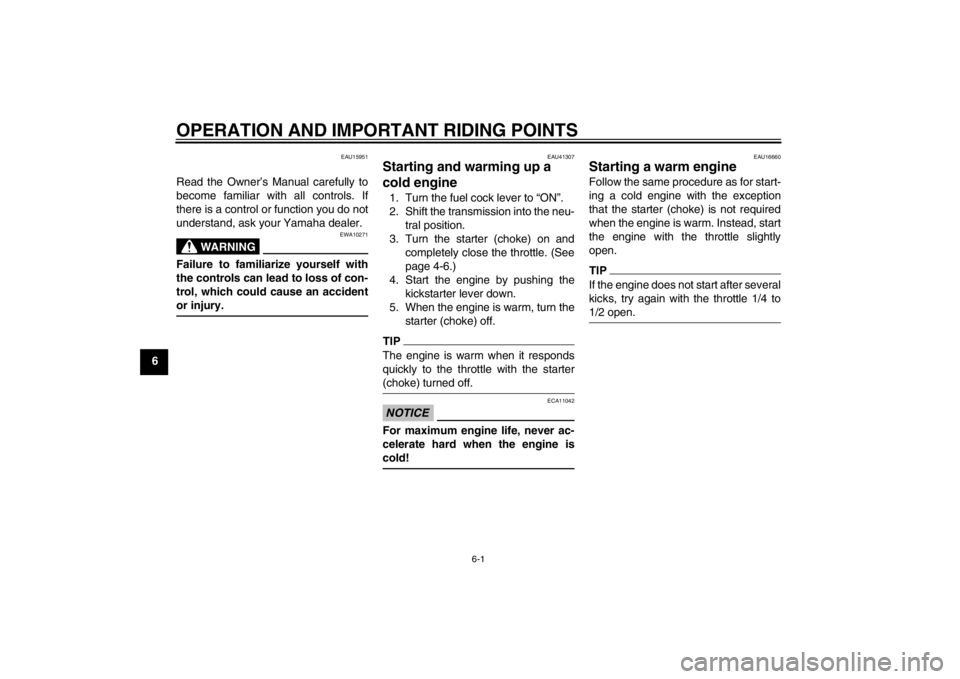
EAU41307
Starting and warming up a
cold engine 1. Turn the fuel cock lever to “ON”.
2. Shift the transmission into the neu-tral position.
3. Turn the starter (choke) on and completely close the throttle. (See
page 4-6.)
4. Start the engine by pushing the kickstarter lever down.
5. When the engine is warm, turn the starter (choke) off.TIPThe engine is warm when it responds
quickly to the throttle with the starter
(choke) turned off.NOTICE
ECA11042
For maximum engine life, never ac-
celerate hard when the engine is
cold!
EAU16660
Starting a warm engine Follow the same procedure as for start-
ing a cold engine with the exception
that the starter (choke) is not required
when the engine is warm. Instead, start
the engine with the throttle slightly
open.TIPIf the engine does not start after several
kicks, try again with the throttle 1/4 to
1/2 open.
U1SN81E0.book Page 1 Tuesday, June 12, 2012 3:17 PM
Page 44 of 88
OPERATION AND IMPORTANT RIDING POINTS
6-3
6
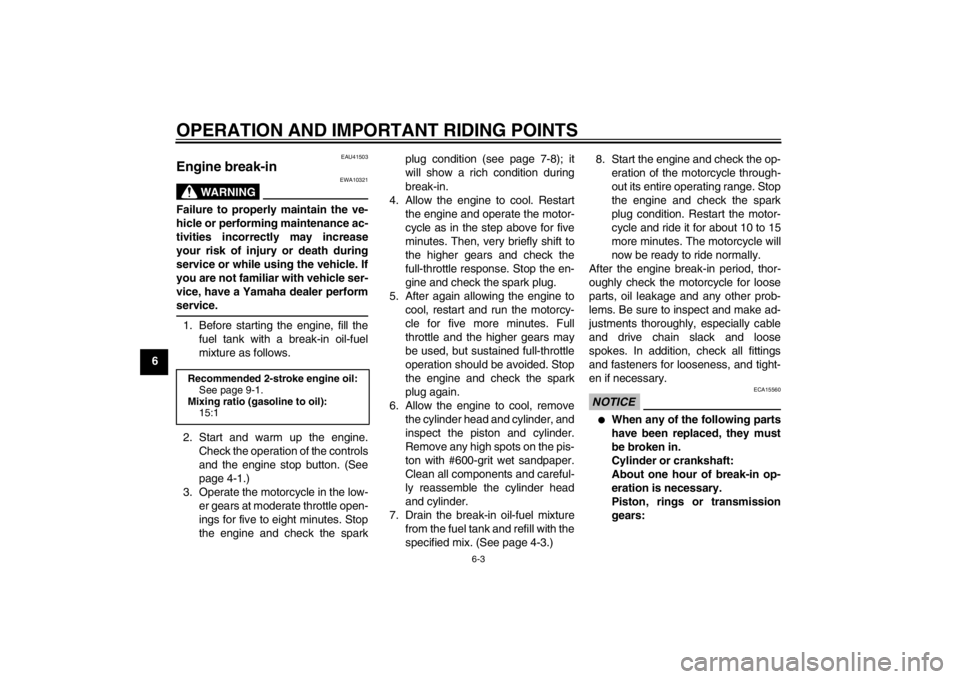
EAU41503
Engine break-in
WARNING
EWA10321
Failure to properly maintain the ve-
hicle or performing maintenance ac-
tivities incorrectly may increase
your risk of injury or death during
service or while using the vehicle. If
you are not familiar with vehicle ser-
vice, have a Yamaha dealer perform
service.1. Before starting the engine, fill thefuel tank with a break-in oil-fuel
mixture as follows.
2. Start and warm up the engine. Check the operation of the controls
and the engine stop button. (See
page 4-1.)
3. Operate the motorcycle in the low- er gears at moderate throttle open-
ings for five to eight minutes. Stop
the engine and check the spark plug condition (see page 7-8); it
will show a rich condition during
break-in.
4. Allow the engine to cool. Restart the engine and operate the motor-
cycle as in the step above for five
minutes. Then, very briefly shift to
the higher gears and check the
full-throttle response. Stop the en-
gine and check the spark plug.
5. After again allowing the engine to cool, restart and run the motorcy-
cle for five more minutes. Full
throttle and the higher gears may
be used, but sustained full-throttle
operation should be avoided. Stop
the engine and check the spark
plug again.
6. Allow the engine to cool, remove the cylinder head and cylinder, and
inspect the piston and cylinder.
Remove any high spots on the pis-
ton with #600-grit wet sandpaper.
Clean all components and careful-
ly reassemble the cylinder head
and cylinder.
7. Drain the break-in oil-fuel mixture from the fuel tank and refill with the
specified mix. (See page 4-3.) 8. Start the engine and check the op-
eration of the motorcycle through-
out its entire operating range. Stop
the engine and check the spark
plug condition. Restart the motor-
cycle and ride it for about 10 to 15
more minutes. The motorcycle will
now be ready to ride normally.
After the engine break-in period, thor-
oughly check the motorcycle for loose
parts, oil leakage and any other prob-
lems. Be sure to inspect and make ad-
justments thoroughly, especially cable
and drive chain slack and loose
spokes. In addition, check all fittings
and fasteners for looseness, and tight-
en if necessary.
NOTICE
ECA15560
●
When any of the following parts
have been replaced, they must
be broken in.
Cylinder or crankshaft:
About one hour of break-in op-
eration is necessary.
Piston, rings or transmission
gears:
Recommended 2-stroke engine oil: See page 9-1.
Mixing ratio (gasoline to oil): 15:1
U1SN81E0.book Page 3 Tuesday, June 12, 2012 3:17 PM
Page 45 of 88
OPERATION AND IMPORTANT RIDING POINTS
6-4
6
These parts require about 30
minutes of break-in operation at
half-throttle or less. Observe the
condition of the engine carefully
during operation.
●
If any engine trouble should oc-
cur during the engine break-in
period, immediately have a
Yamaha dealer check the vehi- cle.
EAU17191
Parking When parking, stop the engine, and
then turn the fuel cock lever to “OFF”.
WARNING
EWA10311
●
Since the engine and exhaust
system can become very hot,
park in a place where pedestri-
ans or children are not likely to
touch them and be burned.
●
Do not park on a slope or on soft
ground, otherwise the vehicle
may overturn, increasing the
risk of a fuel leak and fire.
●
Do not park near grass or other
flammable materials which
might catch fire.
U1SN81E0.book Page 4 Tuesday, June 12, 2012 3:17 PM
Page 49 of 88
PERIODIC MAINTENANCE AND ADJUSTMENT
7-4
7
NO.ITEM ROUTINEAfter
break-in Every
race Every
third race Every
fifth race As
required
√
√
√
13
*Carburetor Check carburetor settings and for obstructions.
√
Adjust and clean. √
14 Spark plug Check condition.
Clean and regap.
√
Replace. √
15 Drive chain Check chain slack, alignment and condition.
Adjust and thoroughly lubricate chain with Yamaha
chain and cable lube or equivalent. √
√
√
√
√
Replace. √
16 * *
Cooling system Check coolant level and for leakage.
√
√
Check hoses for cracks or damage. √
Check radiator cap spring operation. √
Change coolant. Every 2 years√
17 *Chassis fasteners Check all chassis fitting and fasteners.
Correct or tighten if necessary. √
18 Air filter element Clean.
√
Replace. √
19 *Frame Clean and check for damage. √
20 *Fuel line Clean and check for leakage. √√
U1SN81E0.book Page 4 Tuesday, June 12, 2012 3:17 PM
Page 76 of 88

PERIODIC MAINTENANCE AND ADJUSTMENT
7-31
7
EAU25871
Troubleshooting Although Yamaha motorcycles receive
a thorough inspection before shipment
from the factory, trouble may occur dur-
ing operation. Any problem in the fuel,
compression, or ignition systems, for
example, can cause poor starting and
loss of power.
The following troubleshooting charts
represent quick and easy procedures
for checking these vital systems your-
self. However, should your motorcycle
require any repair, take it to a Yamaha
dealer, whose skilled technicians have
the necessary tools, experience, and
know-how to service the motorcycle
properly.
Use only genuine Yamaha replace-
ment parts. Imitation parts may look like
Yamaha parts, but they are often inferi- or, have a shorter service life and can
lead to expensive repair bills.
WARNING
EWA15141
When checking the fuel system, do
not smoke, and make sure there are
no open flames or sparks in the ar-
ea, including pilot lights from water heaters or furnaces. Gasoline or
gasoline vapors can ignite or ex-
plode, causing severe injury or
property damage.U1SN81E0.book Page 31 Tuesday, June 12, 2012 3:17 PM
Page 77 of 88

PERIODIC MAINTENANCE AND ADJUSTMENT
7-32
7
EAU41493
Troubleshooting charts Starting problems or poor engine performance
Check the fuel level in
the fuel tank.1. Fuel
There is
enough fuel.
There is
no fuel.
Supply fuel.
Operate the kickstarter.2. Compression
There is compression.
There is
no compression. Check the ignition.
Have a Yamaha dealer
check the vehicle.
Remove the spark plug
and check the electrodes.3. Ignition
Wet
Dry Wipe off with a dry cloth and correct the
spark plug gap, or replace the spark plug.
Have a Yamaha dealer check the vehicle.
The engine does not start.
Have a Yamaha dealer check the vehicle.
Open the throttle halfway and operate
the kickstarter.
Check the compression.
The engine does not start.
Check the compression.
U1SN81E0.book Page 32 Tuesday, June 12, 2012 3:17 PM
Page 80 of 88

MOTORCYCLE CARE AND STORAGE
8-2
8sure to rinse off any detergent
residue using plenty of water, as
it is harmful to plastic parts.
●
Do not use any harsh chemical
products on plastic parts. Be
sure to avoid using cloths or
sponges which have been in
contact with strong or abrasive
cleaning products, solvent or
thinner, fuel (gasoline), rust re-
movers or inhibitors, brake flu-
id, antifreeze or electrolyte.
●
Do not use high-pressure wash-
ers or steam-jet cleaners since
they cause water seepage and
deterioration in the following ar-
eas: seals (of wheel and swing-
arm bearings, fork and brakes),
electric components (couplers,
connectors, and switches),
breather hoses and vents.
After normal useRemove dirt with warm water, a mild
detergent, and a soft, clean sponge,
and then rinse thoroughly with clean
water. Use a toothbrush or bottlebrush
for hard-to-reach areas. Stubborn dirt and insects will come off more easily if
the area is covered with a wet cloth for
a few minutes before cleaning.
After riding in the rain or near the sea
Since sea salt is extremely corrosive,
carry out the following steps after each
ride in the rain or near the sea.
1. Clean the motorcycle with cold wa- ter and a mild detergent, after the
engine has cooled down.
NOTICE: Do not use warm water
since it increases the corrosive
action of the salt.
[ECA10791]
2. Apply a corrosion protection spray on all metal, including chrome- and
nickel-plated, surfaces to prevent
corrosion.
After cleaning 1. Dry the motorcycle with a chamois or an absorbing cloth.
2. Immediately dry the drive chain and lubricate it to prevent it from
rusting.
3. Use a chrome polish to shine chrome, aluminum and stainless-
steel parts, including the exhaust
system. 4. To prevent corrosion, it is recom-
mended to apply a corrosion pro-
tection spray on all metal,
including chrome- and nickel-plat-
ed, surfaces.
5. Use spray oil as a universal clean- er to remove any remaining dirt.
6. Touch up minor paint damage caused by stones, etc.
7. Wax all painted surfaces.
8. Let the motorcycle dry completely before storing or covering it.
WARNING
EWA11131
Contaminants on the brakes or tires
can cause loss of control.●
Make sure that there is no oil or
wax on the brakes or tires.
●
If necessary, clean the brake
discs and brake linings with a
regular brake disc cleaner or ac-
etone, and wash the tires with
warm water and a mild deter-
gent. Before riding at higher
speeds, test the motorcycle’s
braking performance and cor-
nering behavior.
U1SN81E0.book Page 2 Tuesday, June 12, 2012 3:17 PM
Page 81 of 88
MOTORCYCLE CARE AND STORAGE
8-3
8
NOTICE
ECA10800
●
Apply spray oil and wax spar-
ingly and make sure to wipe off
any excess.
●
Never apply oil or wax to any
rubber and plastic parts, but
treat them with a suitable care
product.
●
Avoid using abrasive polishing
compounds as they will wear
away the paint.
TIPConsult a Yamaha dealer for advice on
what products to use.
EAU41514
Storage Short-term
Always store your motorcycle in a cool,
dry place and, if necessary, protect it
against dust with a porous cover. Be
sure the engine and the exhaust sys-
tem are cool before covering the motor-
cycle.NOTICE
ECA10810
●
Storing the motorcycle in a
poorly ventilated room or cover-
ing it with a tarp, while it is still
wet, will allow water and humid-
ity to seep in and cause rust.
●
To prevent corrosion, avoid
damp cellars, stables (because
of the presence of ammonia)
and areas where strong chemi-
cals are stored.
Long-term
Before storing your motorcycle for sev-
eral months:1. Follow all the instructions in the “Care” section of this chapter. 2. For motorcycles equipped with a
fuel cock that has an “OFF” posi-
tion: Turn the fuel cock lever to
“OFF”.
3. Drain the fuel tank and fuel lines, and the carburetor float chamber
by loosening the drain bolt; this will
prevent fuel deposits from building
up.
4. Perform the following steps to pro- tect the cylinder, piston rings, etc.
from corrosion.a. Remove the spark plug cap and spark plug.
b. Pour a teaspoonful of engine oil into the spark plug bore.
c. Install the spark plug cap onto the spark plug, and then place
the spark plug on the cylinder
head so that the electrodes are
grounded. (This will limit spark-
ing during the next step.)
d. Turn the engine over several times with the starter. (This will
coat the cylinder wall with oil.)
e. Remove the spark plug cap from the spark plug, and then
install the spark plug and the
spark plug cap. WARNING! To
U1SN81E0.book Page 3 Tuesday, June 12, 2012 3:17 PM
Page 83 of 88

SPECIFICATIONS
9-1
9
Dimensions:Overall length:YZ85 1818 mm (71.6 in)
YZ85D 1818 mm (71.6 in)
YZ85LW 1903 mm (74.9 in)
YZ85LWD 1903 mm (74.9 in)
Overall width:
758 mm (29.8 in)
Overall height: YZ85 1161 mm (45.7 in)
YZ85D 1161 mm (45.7 in)
YZ85LW 1205 mm (47.4 in)
YZ85LWD 1205 mm (47.4 in)
Seat height: YZ85 864 mm (34.0 in)
YZ85D 864 mm (34.0 in)
YZ85LW 904 mm (35.6 in)
YZ85LWD 904 mm (35.6 in)
Wheelbase:
YZ85 1255 mm (49.4 in)
YZ85D 1255 mm (49.4 in)
YZ85LW 1286 mm (50.6 in)
YZ85LWD 1286 mm (50.6 in)
Ground clearance: YZ85 351 mm (13.82 in)
YZ85D 351 mm (13.82 in)
YZ85LW 393 mm (15.47 in)
YZ85LWD 393 mm (15.47 in)Weight:Curb weight:
YZ85 71 kg (157 lb)
YZ85D 71 kg (157 lb)
YZ85LW 73 kg (161 lb)
YZ85LWD 73 kg (161 lb)
Engine:Engine type:Liquid cooled 2-stroke
Cylinder arrangement:
Single cylinder
Displacement: 84 cm³
Bore × stroke:
47.5 × 47.8 mm (1.87 × 1.88 in)
Compression ratio:
8.20 : 1
Starting system: Kickstarter
Lubrication system: PremixEngine oil:Type:YAMALUBE 2RTransmission oil:Type:
YAMALUBE 4 (10W-40) or SAE 10W-40
Oil change quantity: 0.50 L (0.53 US qt, 0.44 Imp.qt)Cooling system:Radiator capacity (including all routes):
0.54 L (0.57 US qt, 0.48 Imp.qt)Air filter:Air filter element:Wet elementFuel:Recommended fuel:Premium unleaded gasoline only
Fuel tank capacity: 5.0 L (1.32 US gal, 1.10 Imp.gal)
Carburetor:Type × quantity:
PWK28 x 1Spark plug(s):Manufacturer/model: NGK/BR10EG
Spark plug gap: 0.5–0.6 mm (0.020–0.024 in)Clutch:Clutch type:Wet, multiple-discTransmission:Primary reduction ratio:
3.611 (65/18)
Final drive: Chain
Secondary reduction ratio: YZ85 3.428 (48/14)
YZ85D 3.428 (48/14)
YZ85LW 3.714 (52/14)
YZ85LWD 3.714 (52/14)
Transmission type:
Constant mesh 6-speed
Operation: Left foot operation
Gear ratio: 1st:2.454 (27/11)
2nd: 1.882 (32/17)
3rd:
1.529 (26/17)
4th: 1.294 (22/17)
U1SN81E0.book Page 1 Tuesday, June 12, 2012 3:17 PM
Page 86 of 88

INDEXAAir filter element, cleaning..................... 7-12BBrake and clutch levers, checking and lubricating ..................... 7-24
Brake fluid, changing ............................ 7-22
Brake fluid level, checking .................... 7-20
Brake lever .............................................. 4-2
Brake lever free play, checking ............. 7-19
Brake pedal ............................................. 4-2
Brake pedal, checking and lubricating ..................... 7-25CCables, checking and lubricating .......... 7-24
Carburetor, adjusting ............................ 7-14
Care ........................................................ 8-1
Clutch lever ............................................. 4-1
Clutch lever free play, adjusting ............ 7-18
Coolant.................................................. 7-10DDrive chain, cleaning and lubricating .... 7-23
Drive chain slack ................................... 7-22EEngine break-in ....................................... 6-3
Engine idling speed............................... 7-14
Engine, starting a warm .......................... 6-1
Engine stop button .................................. 4-1FFront and rear brake pads, checking .... 7-20
Front fork, adjusting ................................ 4-7
Front fork, bleeding ................................. 4-9
Front fork, checking .............................. 7-26
Fuel ......................................................... 4-3
Fuel cock................................................. 4-5 Fuel tank breather hose.......................... 4-5
Fuel tank cap .......................................... 4-3
HHandlebar switch .................................... 4-1IIdentification numbers .......................... 10-1KKickstarter............................................... 4-6LLabels, location....................................... 1-1MMatte color, caution ................................ 8-1
Model label ........................................... 10-1PParking ................................................... 6-4
Part locations .......................................... 3-1
Periodic maintenance and
lubrication chart .................................... 7-2RRear suspension, lubricating ................ 7-25SSafety information................................... 2-1
Seat ........................................................ 4-7
Shifting.................................................... 6-2
Shift pedal............................................... 4-1
Shift pedal, checking ............................ 7-19
Shock absorber assembly, adjusting ...... 4-9
Sidestand.............................................. 4-12
Spark plug, checking .............................. 7-8
Specifications ......................................... 9-1
Starter (choke) knob ............................... 4-6
Starting and warming up a cold engine ........................................ 6-1
Steering, checking ................................ 7-27 Storage.................................................... 8-3
Supporting the motorcycle .................... 7-27
Swingarm pivots, lubricating ................. 7-26
TThrottle grip and cable,
checking and lubricating ..................... 7-24
Throttle grip free play, adjusting ............ 7-15
Tires ...................................................... 7-15
Transmission oil ...................................... 7-9
Troubleshooting .................................... 7-31
Troubleshooting charts.......................... 7-32VVehicle identification number ................ 10-1WWheel bearings, checking ..................... 7-27
Wheel (front) ......................................... 7-28
Wheel (rear) .......................................... 7-29
Wheels .................................................. 7-17
U1SN81E0.book Page 1 Tuesday, June 12, 2012 3:17 PM