fuel YAMAHA YZ85 2013 Owners Manual
[x] Cancel search | Manufacturer: YAMAHA, Model Year: 2013, Model line: YZ85, Model: YAMAHA YZ85 2013Pages: 88, PDF Size: 1.74 MB
Page 9 of 88

TABLE OF CONTENTS
LOCATION OF IMPORTANT
LABELS ............................................1-1
SAFETY INFORMATION .................. 2-1
DESCRIPTION .................................. 3-1
Left view .......................................... 3-1
Right view ........................................ 3-2
Controls and instruments ................3-3
INSTRUMENT AND CONTROL
FUNCTIONS ....................................... 4-1
Handlebar switch ............................ 4-1
Clutch lever .................................... 4-1
Shift pedal ......................................4-1
Brake lever ..................................... 4-2
Brake pedal .................................... 4-2
Fuel tank cap .................................. 4-3
Fuel ................................................ 4-3
Fuel tank breather hose ................. 4-5
Fuel cock ........................................ 4-5
Starter (choke) knob ....................... 4-6
Kickstarter ......................................4-6
Seat ................................................ 4-7
Adjusting the front fork ................... 4-7
Front fork bleeding ......................... 4-9
Adjusting the shock absorber assembly ..................................... 4-9
Removable sidestand ................... 4-12 FOR YOUR SAFETY –
PRE-OPERATION CHECKS
............. 5-1
OPERATION AND IMPORTANT
RIDING POINTS ................................ 6-1
Starting and warming up a cold engine .............................. 6-1
Starting a warm engine .................. 6-1
Shifting ........................................... 6-2
Engine break-in .............................. 6-3
Parking ........................................... 6-4
PERIODIC MAINTENANCE AND
ADJUSTMENT ................................... 7-1
Periodic maintenance and lubrication chart .......................... 7-2
Checking the spark plug ................ 7-8
Transmission oil ............................. 7-9
Coolant ........................................ 7-10
Cleaning the air filter element ...... 7-12
Adjusting the carburetor ............... 7-14
Adjusting the engine idling speed ........................................ 7-14
Adjusting the throttle grip free play ........................................... 7-15
Tires ............................................. 7-15
Spoke wheels .............................. 7-17
Adjusting the clutch lever free play ........................................... 7-18
Checking the brake lever free play ........................................... 7-19 Checking the shift pedal ............... 7-19
Checking the front and rear brake
pads .......................................... 7-20
Checking the brake fluid level ...... 7-20
Changing the brake fluid .............. 7-22
Drive chain slack .......................... 7-22
Cleaning and lubricating the drive chain .......................... 7-23
Checking and lubricating the cables ................................. 7-24
Checking and lubricating
the throttle grip and cable ......... 7-24
Checking and lubricating the brake and clutch levers ....... 7-24
Checking and lubricating the brake pedal ......................... 7-25
Lubricating the rear suspension ... 7-25
Lubricating the swingarm pivots ... 7-26
Checking the front fork ................. 7-26
Checking the steering .................. 7-27
Checking the wheel bearings ....... 7-27
Supporting the motorcycle ........... 7-27
Front wheel .................................. 7-28
Rear wheel ................................... 7-29
Troubleshooting ........................... 7-31
Troubleshooting charts ................. 7-32
MOTORCYCLE CARE AND
STORAGE .......................................... 8-1
Matte color caution ......................... 8-1
Care ............................................... 8-1
U1SN81E0.book Page 1 Tuesday, June 12, 2012 3:17 PM
Page 23 of 88

SAFETY INFORMATION
2-4
2
motorcycle’s electrical system, an
electric failure could result, which
could cause a dangerous loss of
lights or engine power.
Aftermarket Tires and Rims
The tires and rims that came with your
motorcycle were designed to match the
performance capabilities and to provide
the best combination of handling, brak-
ing, and comfort. Other tires, rims, siz-
es, and combinations may not be
appropriate. Refer to page 7-15 for tire
specifications and more information on
replacing your tires.
Transporting the Motorcycle
Be sure to observe following instruc-
tions before transporting the motorcy-
cle in another vehicle.
●
Remove all loose items from the
motorcycle.
●
Check that the fuel cock (if
equipped) is in the “OFF” position
and that there are no fuel leaks.
●
Point the front wheel straight
ahead on the trailer or in the truck
bed, and choke it in a rail to pre-
vent movement.
●
Shift the transmission in gear (for
models with a manual transmis-
sion).
●
Secure the motorcycle with tie-
downs or suitable straps that are
attached to solid parts of the mo-
torcycle, such as the frame or up-
per front fork triple clamp (and not,
for example, to rubber-mounted
handlebars or turn signals, or parts
that could break). Choose the lo-
cation for the straps carefully so
the straps will not rub against
painted surfaces during transport.
●
The suspension should be com-
pressed somewhat by the tie-
downs, if possible, so that the mo-
torcycle will not bounce excessive-
ly during transport.
U1SN81E0.book Page 4 Tuesday, June 12, 2012 3:17 PM
Page 24 of 88

DESCRIPTION
3-1
3
EAU10410
Left view1. Radiator cap (page 7-10)
2. Fuel cock (page 4-5)
3. Shock absorber assembly spring preload adjusting nut (page 4-9)
4. Air filter element (page 7-12)
5. Seat (page 4-7)
6. Shift pedal (page 4-1)
7. Throttle stop screw (page 7-14)
8. Starter (choke) knob (page 4-6)U1SN81E0.book Page 1 Tuesday, June 12, 2012 3:17 PM
Page 26 of 88

DESCRIPTION
3-3
3
EAU10430
Controls and instruments
1
2
3
4
5
1. Clutch lever (page 4-1)
2. Engine stop button (page 4-1)
3. Brake lever (page 4-2)
4. Throttle grip (page 7-15)
5. Fuel tank cap (page 4-3)U1SN81E0.book Page 3 Tuesday, June 12, 2012 3:17 PM
Page 29 of 88
INSTRUMENT AND CONTROL FUNCTIONS
4-3
4
EAU13182
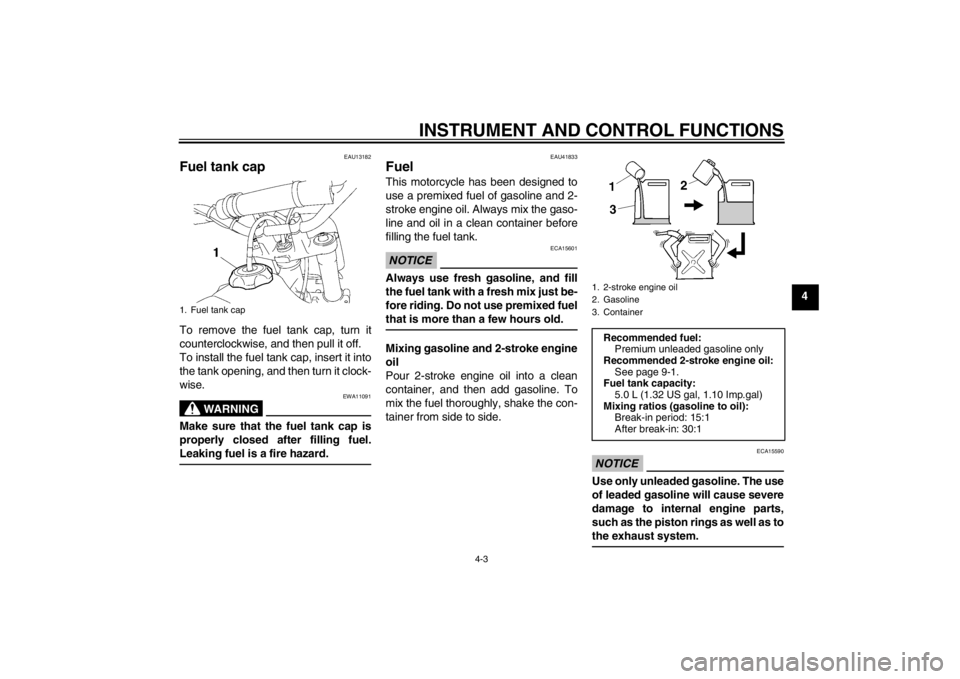
Fuel tank cap To remove the fuel tank cap, turn it
counterclockwise, and then pull it off.
To install the fuel tank cap, insert it into
the tank opening, and then turn it clock-
wise.
WARNING
EWA11091
Make sure that the fuel tank cap is
properly closed after filling fuel.
Leaking fuel is a fire hazard.
EAU41833
Fuel This motorcycle has been designed to
use a premixed fuel of gasoline and 2-
stroke engine oil. Always mix the gaso-
line and oil in a clean container before
filling the fuel tank.NOTICE
ECA15601
Always use fresh gasoline, and fill
the fuel tank with a fresh mix just be-
fore riding. Do not use premixed fuel
that is more than a few hours old.Mixing gasoline and 2-stroke engine
oil
Pour 2-stroke engine oil into a clean
container, and then add gasoline. To
mix the fuel thoroughly, shake the con-
tainer from side to side.
NOTICE
ECA15590
Use only unleaded gasoline. The use
of leaded gasoline will cause severe
damage to internal engine parts,
such as the piston rings as well as to
the exhaust system.
1. Fuel tank cap
1. 2-stroke engine oil
2. Gasoline
3. Container
Recommended fuel:Premium unleaded gasoline only
Recommended 2-stroke engine oil: See page 9-1.
Fuel tank capacity:
5.0 L (1.32 US gal, 1.10 Imp.gal)
Mixing ratios (gasoline to oil): Break-in period: 15:1
After break-in: 30:1
U1SN81E0.book Page 3 Tuesday, June 12, 2012 3:17 PM
Page 30 of 88
![YAMAHA YZ85 2013 Owners Manual INSTRUMENT AND CONTROL FUNCTIONS
4-4
4Your Yamaha engine has been de-
signed to use premium unleaded gaso-
line with a pump octane number
[(R+M)/2] of 91 or higher, or a research
octane number of 95 o](/img/51/54045/w960_54045-29.png "YAMAHA YZ85 2013 Owners Manual INSTRUMENT AND CONTROL FUNCTIONS
4-4
4Your Yamaha engine has been de-
signed to use premium unleaded gaso-
line with a pump octane number
[(R+M)/2] of 91 or higher, or a research
octane number of 95 o")
INSTRUMENT AND CONTROL FUNCTIONS
4-4
4Your Yamaha engine has been de-
signed to use premium unleaded gaso-
line with a pump octane number
[(R+M)/2] of 91 or higher, or a research
octane number of 95 or higher. If
knocking (or pinging) occurs, use a
gasoline of a different brand.
If the recommended 2-stroke engine oil
is not available, use an equivalent oil.
NOTICE
ECA15551
Never mix two brands of 2-stroke en-
gine oil in the same batch. Always
use the same type of oil to ensure
maximum engine performance.
Should it be necessary to use a dif-
ferent oil brand, be sure to drain the
fuel tank and the carburetor float
chamber of the old premixed fuel
prior to filling with the new type.
Filling the fuel tank
Make sure there is sufficient gasoline in
the tank.
WARNING
EWA10881
Gasoline and gasoline vapors are
extremely flammable. To avoid fires
and explosions and to reduce the
risk of injury when refueling, follow
these instructions.1. Before refueling, turn off the en-
gine and be sure that no one is sit-
ting on the vehicle. Never refuel
while smoking, or while in the vi-
cinity of sparks, open flames, or other sources of ignition such as
the pilot lights of water heaters and
clothes dryers.
2. Do not overfill the fuel tank. Stop filling when the fuel reaches the
bottom of the filler tube. Because
fuel expands when it heats up,
heat from the engine or the sun
can cause fuel to spill out of the
fuel tank.
3. Wipe up any spilled fuel immedi- ately. NOTICE: Immediately wipe
off spilled fuel with a clean, dry,
soft cloth, since fuel may deteri-
orate painted surfaces or plastic
parts.
[ECA10071]
4. Be sure to securely close the fuel tank cap.
WARNING
EWA15151
Gasoline is poisonous and can
cause injury or death. Handle gaso-
line with care. Never siphon gaso-
line by mouth. If you should swallow
some gasoline or inhale a lot of gas-
oline vapor, or get some gasoline in
your eyes, see your doctor immedi-
ately. If gasoline spills on your skin,
1. Maximum fuel level
2. Fuel tank filler tube
U1SN81E0.book Page 4 Tuesday, June 12, 2012 3:17 PM
Page 31 of 88
INSTRUMENT AND CONTROL FUNCTIONS
4-5
4
wash with soap and water. If gaso-
line spills on your clothing, change
your clothes.
EAU41360
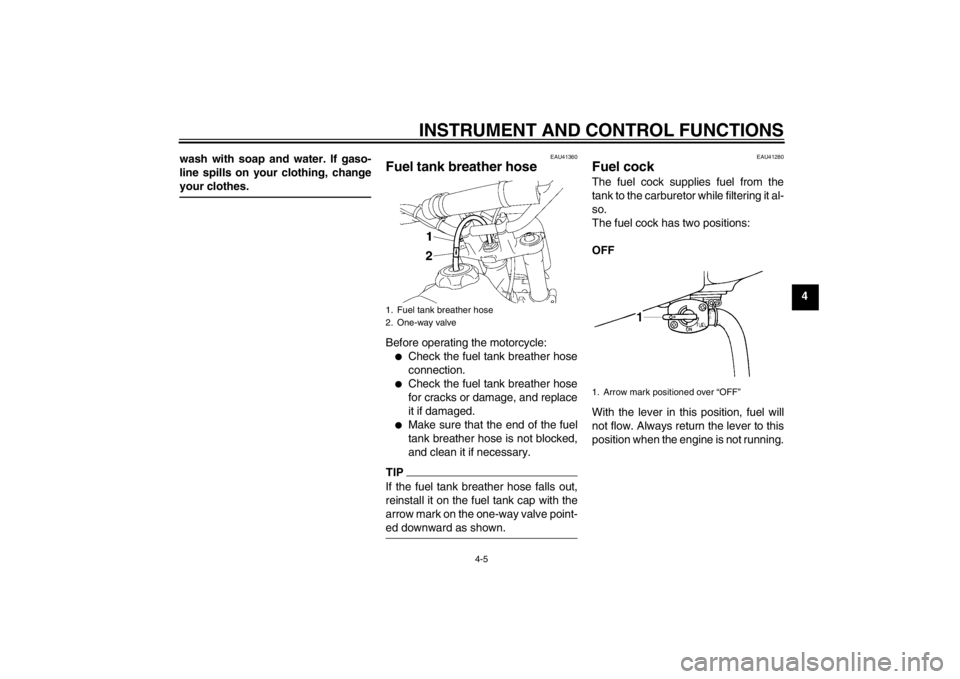
Fuel tank breather hose Before operating the motorcycle:●
Check the fuel tank breather hose
connection.
●
Check the fuel tank breather hose
for cracks or damage, and replace
it if damaged.
●
Make sure that the end of the fuel
tank breather hose is not blocked,
and clean it if necessary.
TIPIf the fuel tank breather hose falls out,
reinstall it on the fuel tank cap with the
arrow mark on the one-way valve point-
ed downward as shown.
EAU41280
Fuel cock The fuel cock supplies fuel from the
tank to the carburetor while filtering it al-
so.
The fuel cock has two positions:
OFF
With the lever in this position, fuel will
not flow. Always return the lever to this
position when the engine is not running.
1. Fuel tank breather hose
2. One-way valve
1. Arrow mark positioned over “OFF”
U1SN81E0.book Page 5 Tuesday, June 12, 2012 3:17 PM
Page 32 of 88
INSTRUMENT AND CONTROL FUNCTIONS
4-6
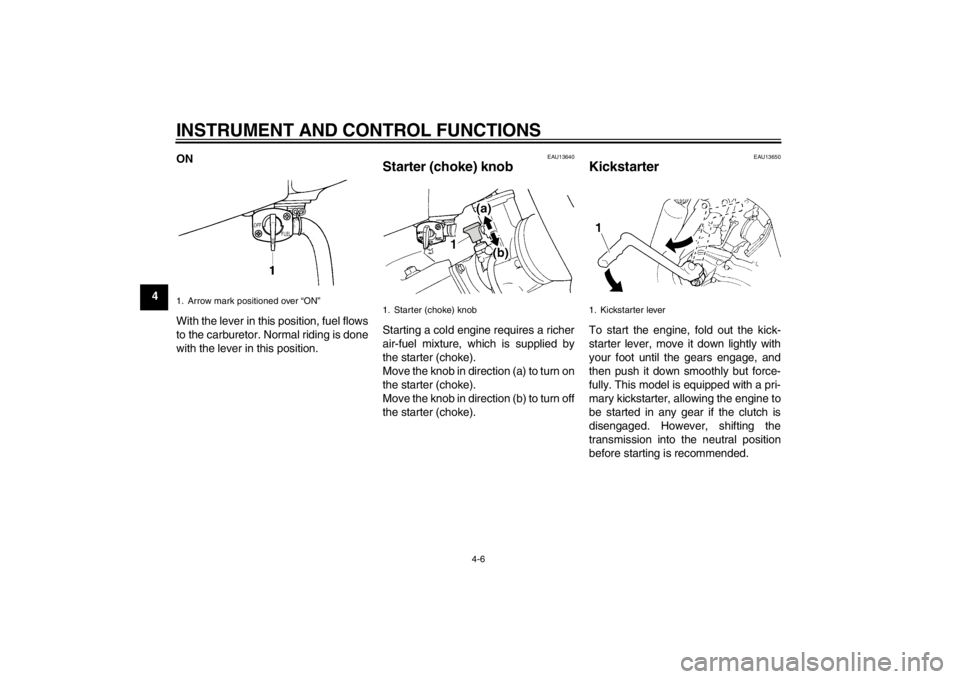
4ON
With the lever in this position, fuel flows
to the carburetor. Normal riding is done
with the lever in this position.
EAU13640
Starter (choke) knob Starting a cold engine requires a richer
air-fuel mixture, which is supplied by
the starter (choke).
Move the knob in direction (a) to turn on
the starter (choke).
Move the knob in direction (b) to turn off
the starter (choke).
EAU13650
Kickstarter To start the engine, fold out the kick-
starter lever, move it down lightly with
your foot until the gears engage, and
then push it down smoothly but force-
fully. This model is equipped with a pri-
mary kickstarter, allowing the engine to
be started in any gear if the clutch is
disengaged. However, shifting the
transmission into the neutral position
before starting is recommended.
1. Arrow mark positioned over “ON”
1. Starter (choke) knob
1. Kickstarter lever
U1SN81E0.book Page 6 Tuesday, June 12, 2012 3:17 PM
Page 33 of 88
INSTRUMENT AND CONTROL FUNCTIONS
4-7
4
EAU46282
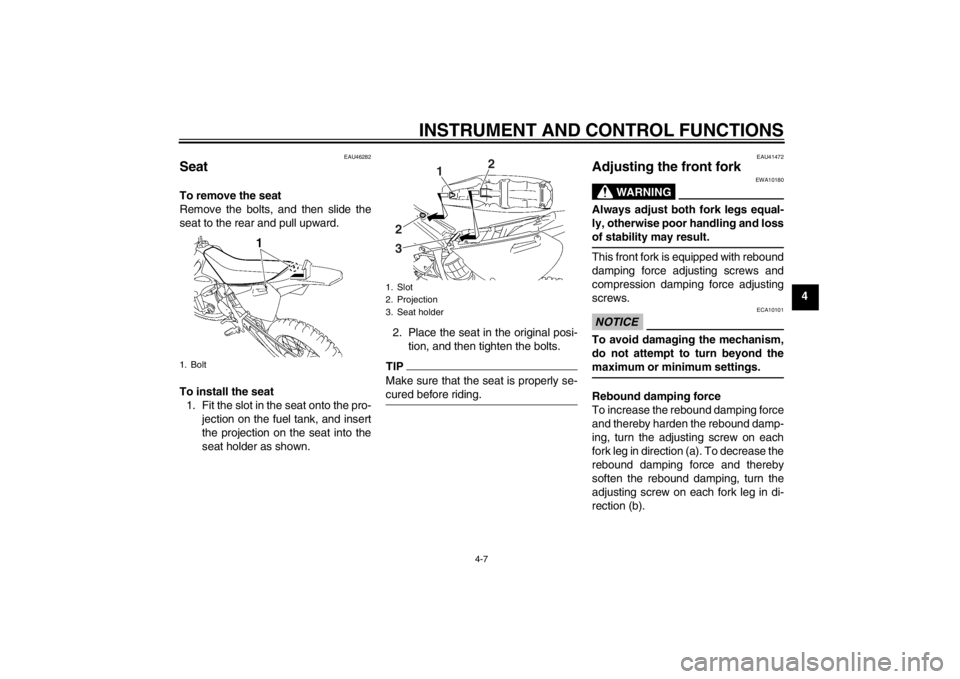
Seat To remove the seat
Remove the bolts, and then slide the
seat to the rear and pull upward.
To install the seat1. Fit the slot in the seat onto the pro- jection on the fuel tank, and insert
the projection on the seat into the
seat holder as shown. 2. Place the seat in the original posi-
tion, and then tighten the bolts.
TIPMake sure that the seat is properly se-
cured before riding.
EAU41472
Adjusting the front fork
WARNING
EWA10180
Always adjust both fork legs equal-
ly, otherwise poor handling and loss
of stability may result.This front fork is equipped with rebound
damping force adjusting screws and
compression damping force adjusting
screws.NOTICE
ECA10101
To avoid damaging the mechanism,
do not attempt to turn beyond the
maximum or minimum settings.Rebound damping force
To increase the rebound damping force
and thereby harden the rebound damp-
ing, turn the adjusting screw on each
fork leg in direction (a). To decrease the
rebound damping force and thereby
soften the rebound damping, turn the
adjusting screw on each fork leg in di-
rection (b).
1. Bolt
1. Slot
2. Projection
3. Seat holder
1 2
2
3
U1SN81E0.book Page 7 Tuesday, June 12, 2012 3:17 PM
Page 39 of 88
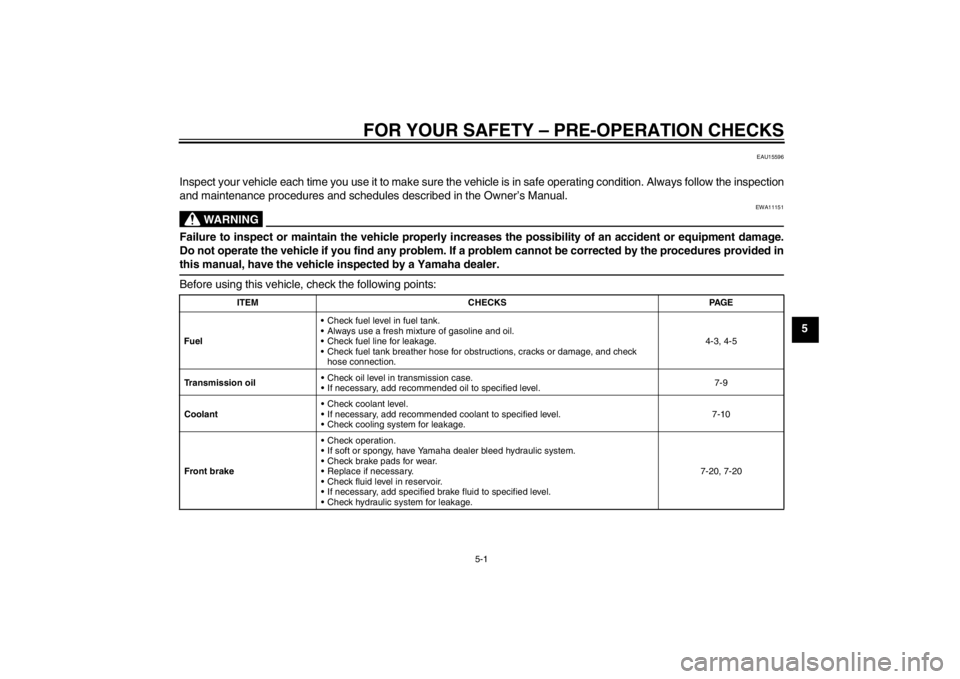
FOR YOUR SAFETY – PRE-OPERATION CHECKS
5-1
5
EAU15596
Inspect your vehicle each time you use it to make sure the vehicle is in safe operating condition. Always follow the inspection
and maintenance procedures and schedules described in the Owner’s Manual.
WARNING
EWA11151
Failure to inspect or maintain the vehicle properly increases the possibility of an accident or equipment damage.
Do not operate the vehicle if you find any problem. If a problem cannot be corrected by the procedures provided in
this manual, have the vehicle inspected by a Yamaha dealer.Before using this vehicle, check the following points:
ITEMCHECKS PAGE
Fuel Check fuel level in fuel tank.
Always use a fresh mixture of gasoline and oil.
Check fuel line for leakage.
Check fuel tank breather hose for ob
structions, cracks or damage, and check
hose connection. 4-3, 4-5
Transmission oil Check oil level in transmission case.
If necessary, add recommended oil to specified level. 7-9
Coolant Check coolant level.
If necessary, add recommended coolant to specified level.
Check cooling system for leakage. 7-10
Front brake Check operation.
If soft or spongy, have Yamaha dealer bleed hydraulic system.
Check brake pads for wear.
Replace if necessary.
Check fluid level in reservoir.
If necessary, add specified brake fluid to specified level.
Check hydraulic system for leakage. 7-20, 7-20
U1SN81E0.book Page 1 Tuesday, June 12, 2012 3:17 PM