lock YAMAHA YZF-R1M 2015 User Guide
[x] Cancel search | Manufacturer: YAMAHA, Model Year: 2015, Model line: YZF-R1M, Model: YAMAHA YZF-R1M 2015Pages: 126, PDF Size: 9.02 MB
Page 48 of 126

INSTRUMENT AND CONTROL FUNCTIONS
4-29
1
2
34
5
6
7
8
9
10
11
12 4. The minutes figure will become
highlighted.
5. Set the minutes figure by rotating and then short push the wheel
switch. 6. Short push the wheel switch again
to exit and go back to the MENU
screen.
“All Reset”
This function resets everything, except
the odometer and clock, to its factory
preset or default setting.
Select YES to reset all items. After se-
lecting YES, all items will be reset and
the screen will automatically return to
the MENU screen.
EAU12821
Clutch leverThe clutch lever is located at the left
handlebar grip. To disengage the
clutch, pull the lever toward the handle-
bar grip. To engage the clutch, release
the lever. The lever should be pulled
rapidly and released slowly for smooth
clutch operation.
The clutch lever is equipped with a
clutch switch, which is part of the igni-
tion circuit cut-off system. (See
page 4-46.)1. Clutch lever
1
2CR-9-E0_1.book 29 ページ 2015年1月5日 月曜日 午前11時54分
Page 50 of 126
INSTRUMENT AND CONTROL FUNCTIONS
4-31
1
2
34
5
6
7
8
9
10
11
12
EAU12944
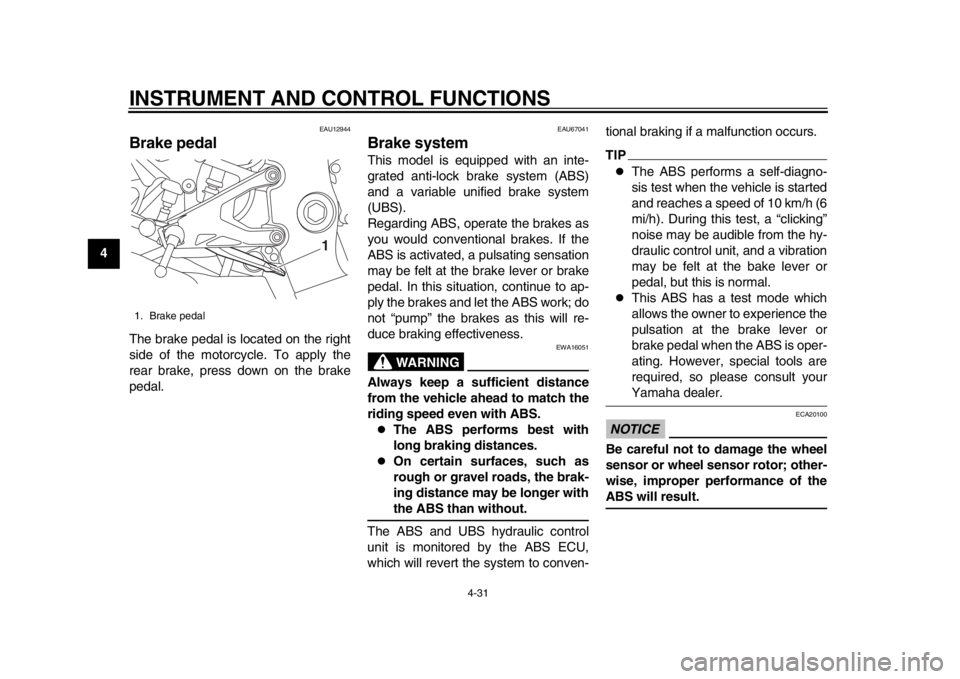
Brake pedalThe brake pedal is located on the right
side of the motorcycle. To apply the
rear brake, press down on the brake
pedal.
EAU67041
Brake systemThis model is equipped with an inte-
grated anti-lock brake system (ABS)
and a variable unified brake system
(UBS).
Regarding ABS, operate the brakes as
you would conventional brakes. If the
ABS is activated, a pulsating sensation
may be felt at the brake lever or brake
pedal. In this situation, continue to ap-
ply the brakes and let the ABS work; do
not “pump” the brakes as this will re-
duce braking effectiveness.
WARNING
EWA16051
Always keep a sufficient distance
from the vehicle ahead to match the
riding speed even with ABS.
The ABS performs best with
long braking distances.
On certain surfaces, such as
rough or gravel roads, the brak-
ing distance may be longer withthe ABS than without.
The ABS and UBS hydraulic control
unit is monitored by the ABS ECU,
which will revert the system to conven- tional braking if a malfunction occurs.
TIP
The ABS performs a self-diagno-
sis test when the vehicle is started
and reaches a speed of 10 km/h (6
mi/h). During this test, a “clicking”
noise may be audible from the hy-
draulic control unit, and a vibration
may be felt at the bake lever or
pedal, but this is normal.
This ABS has a test mode which
allows the owner to experience the
pulsation at the brake lever or
brake pedal when the ABS is oper-
ating. However, special tools are
required, so please consult yourYamaha dealer.
NOTICE
ECA20100
Be careful not to damage the wheel
sensor or wheel sensor rotor; other-
wise, improper performance of theABS will result.
1. Brake pedal
1
2CR-9-E0_1.book 31 ページ 2015年1月5日 月曜日 午前11時54分
Page 52 of 126

INSTRUMENT AND CONTROL FUNCTIONS
4-33
1
2
34
5
6
7
8
9
10
11
12
EAU13075
Fuel tank capTo open the fuel tank cap
Open the fuel tank cap lock cover, in-
sert the key into the lock, and then turn
it 1/4 turn clockwise. The lock will be re-
leased and the fuel tank cap can be
opened.
To close the fuel tank cap 1. Push the fuel tank cap into position with the key inserted in the lock.
2. Turn the key counterclockwise to the original position, remove it, and
then close the lock cover.
TIPThe fuel tank cap cannot be closed un-
less the key is in the lock. In addition,
the key cannot be removed if the cap isnot properly closed and locked.
WARNING
EWA11092
Make sure that the fuel tank cap is
properly closed after filling fuel.Leaking fuel is a fire hazard.
EAU13222
FuelMake sure there is sufficient gasoline in
the tank.
WARNING
EWA10882
Gasoline and gasoline vapors are
extremely flammable. To avoid fires
and explosions and to reduce the
risk of injury when refueling, followthese instructions.
1. Before refueling, turn off the en- gine and be sure that no one is sit-
ting on the vehicle. Never refuel
while smoking, or while in the vi-
cinity of sparks, open flames, or
other sources of ignition such as
the pilot lights of water heaters and
clothes dryers.
2. Do not overfill the fuel tank. When refueling, be sure to insert the
pump nozzle into the fuel tank filler
hole. Stop filling when the fuel
reaches the bottom of the filler
tube. Because fuel expands when
it heats up, heat from the engine or
the sun can cause fuel to spill out
of the fuel tank.
1. Fuel tank cap lock cover
2. Unlock.
1
2
2CR-9-E0_1.book 33 ページ 2015年1月5日 月曜日 午前11時54分
Page 54 of 126

INSTRUMENT AND CONTROL FUNCTIONS
4-35
1
2
34
5
6
7
8
9
10
11
12
EAU58081
Fuel tank breather hose and
overflow hoseBefore operating the motorcycle:
Check each hose connection.
Check each hose for cracks or
damage, and replace if necessary.
Make sure that the end of each
hose is not blocked, and clean if
necessary.
Make sure that the end of each
hose is positioned outside of the
cowling.
Make sure that each hose is rout-
ed through the clamp or guide.
EAU13434
Catalytic converterThis model is equipped with a catalytic
converter in the exhaust system.
WARNING
EWA10863
The exhaust system is hot after op-
eration. To prevent a fire hazard or
burns:
Do not park the vehicle near
possible fire hazards such as
grass or other materials that
easily burn.
Park the vehicle in a place
where pedestrians or children
are not likely to touch the hot
exhaust system.
Make sure that the exhaust sys-
tem has cooled down before do-
ing any maintenance work.
Do not allow the engine to idle
more than a few minutes. Long
idling can cause a build-up ofheat.
NOTICE
ECA10702
Use only unleaded gasoline. The use
of leaded gasoline will cause unre- pairable damage to the catalytic
converter.
1. Clamp
2. Fuel tank overflow hose
3. Fuel tank breather hose
1
2
3
2CR-9-E0_1.book 35 ページ 2015年1月5日 月曜日 午前11時54分
Page 55 of 126

INSTRUMENT AND CONTROL FUNCTIONS
4-36
1
2
345
6
7
8
9
10
11
12
EAU66570
SeatsPassenger seat
To remove the passenger seat1. Insert the key into the seat lock, and then turn it clockwise.
2. Lift the front of the passenger seat and pull it forward.
To install the passenger seat1. Insert the projection on the rear of the passenger seat into the seat
holder as shown, and then push
the front of the seat down to lock it
in place. 2. Remove the key.
Rider seat
To remove the rider seat
1. Remove the passenger seat.
2. Pull up the corners on the rear of the rider seat as shown, remove
the bolts with the hexagon wrench
located under the passenger seat,
and then pull the seat off. To install the rider seat
1. Insert the projections into the seat
holders as shown, then place the
seat in the original position.
1. Seat lock
2. Unlock.
12
1. Projection
2. Seat holder
1
2
1. Bolt
1. Hexagon wrench
1
1
2CR-9-E0_1.book 36 ページ 2015年1月5日 月曜日 午前11時54分
Page 61 of 126
INSTRUMENT AND CONTROL FUNCTIONS
4-42
1
2
345
6
7
8
9
10
11
12
NOTICE
ECA10102
To avoid damaging the mechanism,
do not attempt to turn beyond themaximum or minimum settings.
For YZF-R1:
This model is equipped with adjustable
suspension. The spring preload, re-
bound damping force, fast compres-
sion damping force, and slow
compression damping force can be ad-
justed.
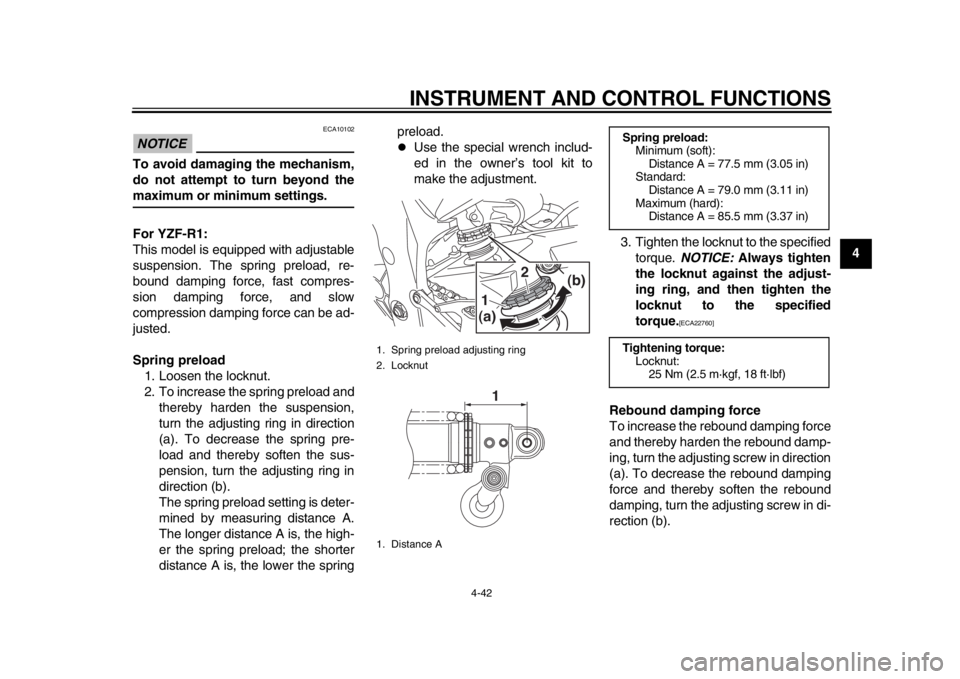
Spring preload 1. Loosen the locknut.
2. To increase the spring preload and thereby harden the suspension,
turn the adjusting ring in direction
(a). To decrease the spring pre-
load and thereby soften the sus-
pension, turn the adjusting ring in
direction (b).
The spring preload setting is deter-
mined by measuring distance A.
The longer distance A is, the high-
er the spring preload; the shorter
distance A is, the lower the spring preload.
Use the special wrench includ-
ed in the owner’s tool kit to
make the adjustment.
3. Tighten the locknut to the specifiedtorque. NOTICE: Always tighten
the locknut against the adjust-
ing ring, and then tighten the
locknut to the specified
torque.
[ECA22760]
Rebound damping force
To increase the rebound damping force
and thereby harden the rebound damp-
ing, turn the adjusting screw in direction
(a). To decrease the rebound damping
force and thereby soften the rebound
damping, turn the adjusting screw in di-
rection (b).
1. Spring preload adjusting ring
2. Locknut
1. Distance A
(a) (b)1
2
1
Spring preload:
Minimum (soft):Distance A = 77.5 mm (3.05 in)
Standard:
Distance A = 79.0 mm (3.11 in)
Maximum (hard): Distance A = 85.5 mm (3.37 in)
Tightening torque: Locknut:25 Nm (2.5 m·kgf, 18 ft·lbf)
2CR-9-E0_1.book 42 ページ 2015年1月5日 月曜日 午前11時54分
Page 63 of 126
INSTRUMENT AND CONTROL FUNCTIONS
4-44
1
2
345
6
7
8
9
10
11
12
adjusting mechanism. This adjustment
range may not exactly match the spec-
ifications listed due to small differences
in production.
For YZF-R1M:
This model is is equipped with ÖHLINS
electronic racing suspension.
Compression damping force and
rebound damping force
The compression and rebound damp-
ing forces are electronically controlled
and can be adjusted from the MENU
screen. See ERS on page 4-18 for in-
formation on how to adjust these set-
tings.
Spring preload
The spring preload adjustment is per-
formed manually.NOTICE
ECA10102
To avoid damaging the mechanism,
do not attempt to turn beyond themaximum or minimum settings.
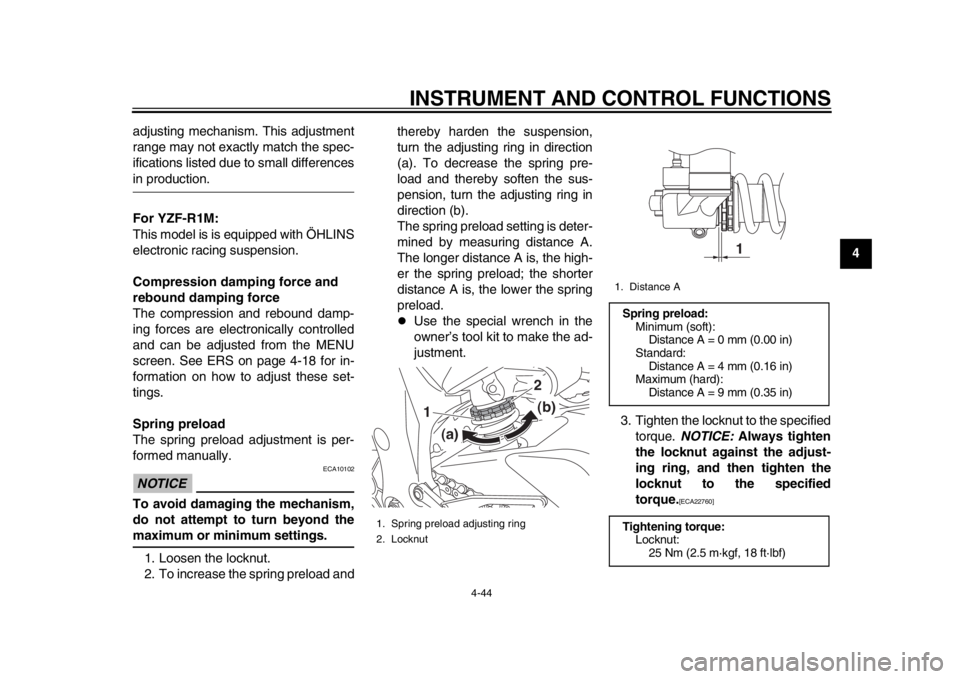
1. Loosen the locknut.
2. To increase the spring preload and thereby harden the suspension,
turn the adjusting ring in direction
(a). To decrease the spring pre-
load and thereby soften the sus-
pension, turn the adjusting ring in
direction (b).
The spring preload setting is deter-
mined by measuring distance A.
The longer distance A is, the high-
er the spring preload; the shorter
distance A is, the lower the spring
preload.
Use the special wrench in the
owner’s tool kit to make the ad-
justment.
3. Tighten the locknut to the specifiedtorque. NOTICE: Always tighten
the locknut against the adjust-
ing ring, and then tighten the
locknut to the specified
torque.
[ECA22760]
1. Spring preload adjusting ring
2. Locknut
1
(a) (b)
2
1. Distance ASpring preload:
Minimum (soft):
Distance A = 0 mm (0.00 in)
Standard: Distance A = 4 mm (0.16 in)
Maximum (hard): Distance A = 9 mm (0.35 in)
Tightening torque: Locknut:
25 Nm (2.5 m·kgf, 18 ft·lbf)
1
2CR-9-E0_1.book 44 ページ 2015年1月5日 月曜日 午前11時54分
Page 70 of 126

FOR YOUR SAFETY – PRE-OPERATION CHECKS
5-3
1
2
3
45
6
7
8
9
10
11
12
Air intake duct Make sure that the air intake duct is not blocked.
Remove any foreign objects from the screen if necessary. —
Instruments, lights, signals
and switches Check operation.
Correct if necessary.
—
Sidestand switch Check operation of ignition circuit cut-off system.
If system is not working correctly, have Yamaha dealer check vehicle. 4-45
ITEM CHECKS PAGE
2CR-9-E0_1.book 3 ページ 2015年1月5日 月曜日 午前11時54分
Page 97 of 126
PERIODIC MAINTENANCE AND ADJUSTMENT
7-22
1
2
3
4
5
678
9
10
11
12
EAU67341
Adjusting the clutch lever free
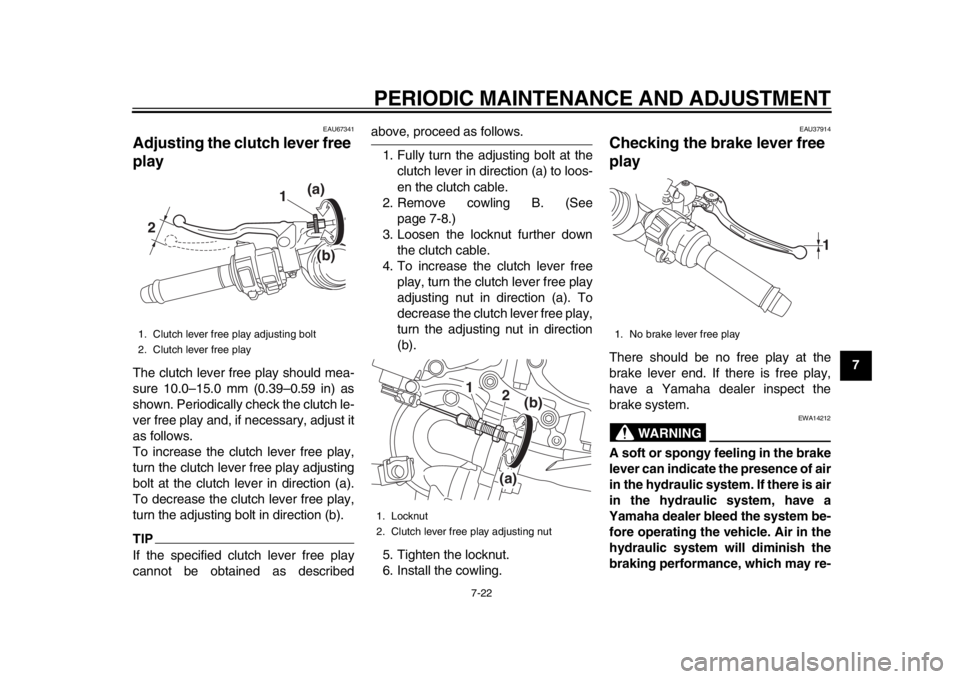
playThe clutch lever free play should mea-
sure 10.0–15.0 mm (0.39–0.59 in) as
shown. Periodically check the clutch le-
ver free play and, if necessary, adjust it
as follows.
To increase the clutch lever free play,
turn the clutch lever free play adjusting
bolt at the clutch lever in direction (a).
To decrease the clutch lever free play,
turn the adjusting bolt in direction (b).TIPIf the specified clutch lever free play
cannot be obtained as described
above, proceed as follows. 1. Fully turn the adjusting bolt at the clutch lever in direction (a) to loos-
en the clutch cable.
2. Remove cowling B. (See page 7-8.)
3. Loosen the locknut further down the clutch cable.
4. To increase the clutch lever free play, turn the clutch lever free play
adjusting nut in direction (a). To
decrease the clutch lever free play,
turn the adjusting nut in direction
(b).
5. Tighten the locknut.
6. Install the cowling.
EAU37914
Checking the brake lever free
playThere should be no free play at the
brake lever end. If there is free play,
have a Yamaha dealer inspect the
brake system.
WARNING
EWA14212
A soft or spongy feeling in the brake
lever can indicate the presence of air
in the hydraulic system. If there is air
in the hydraulic system, have a
Yamaha dealer bleed the system be-
fore operating the vehicle. Air in the
hydraulic system will diminish the
braking performance, which may re-
1. Clutch lever free play adjusting bolt
2. Clutch lever free play
1
2 (a)
(b)
1. Locknut
2. Clutch lever free play adjusting nut
1
2
(a)(b)
1. No brake lever free play
1
2CR-9-E0_1.book 22 ページ 2015年1月5日 月曜日 午前11時54分
Page 100 of 126
PERIODIC MAINTENANCE AND ADJUSTMENT
7-25
1
2
3
4
5
67
8
9
10
11
12 may deteriorate, causing leak-
age.
Refill with the same type of
brake fluid. Adding a brake fluid
other than DOT 4 may result in a
harmful chemical reaction.
Be careful that water does not
enter the brake fluid reservoir
when refilling. Water will signifi-
cantly lower the boiling point of
the fluid and may result in vaporlock.
NOTICE
ECA17641
Brake fluid may damage painted sur-
faces or plastic parts. Always cleanup spilled fluid immediately.
As the brake pads wear, it is normal for
the brake fluid level to gradually go
down. A low brake fluid level may indi-
cate worn brake pads and/or brake sys-
tem leakage; therefore, be sure to
check the brake pads for wear and the
brake system for leakage. If the brake
fluid level goes down suddenly, have a
Yamaha dealer check the cause before
further riding.
EAU22733
Changing the brake fluidHave a Yamaha dealer change the
brake fluid at the intervals specified in
the periodic maintenance and lubrica-
tion chart. In addition, have the oil seals
of the master cylinders and calipers as
well as the brake hoses replaced at the
intervals listed below or whenever they
are damaged or leaking.
Oil seals: Replace every two
years.
Brake hoses: Replace every four
years.
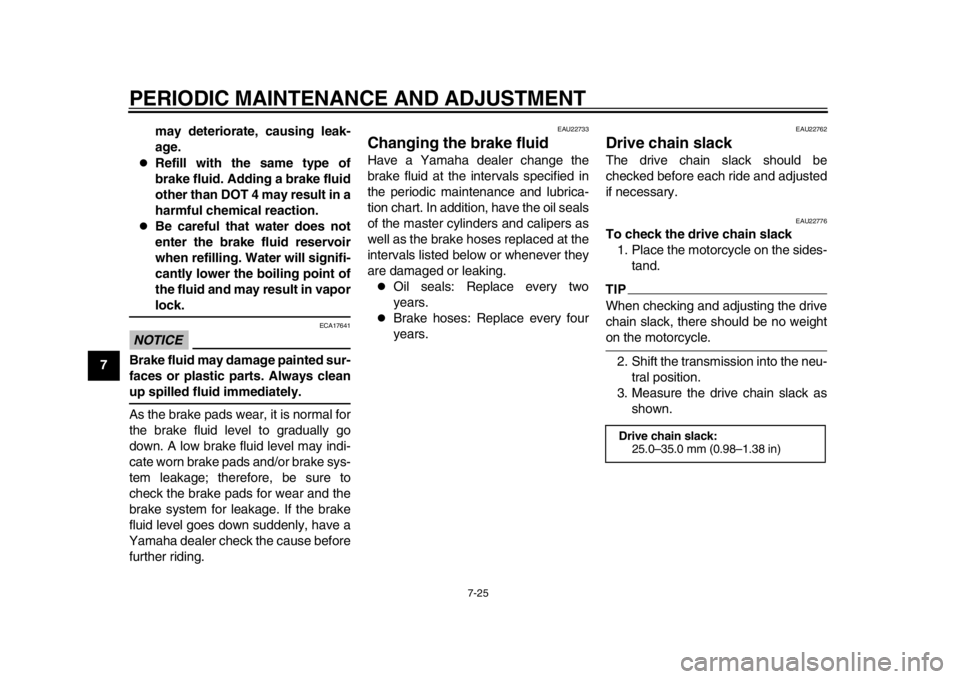
EAU22762
Drive chain slackThe drive chain slack should be
checked before each ride and adjusted
if necessary.
EAU22776
To check the drive chain slack
1. Place the motorcycle on the sides- tand.TIPWhen checking and adjusting the drive
chain slack, there should be no weighton the motorcycle.
2. Shift the transmission into the neu- tral position.
3. Measure the drive chain slack as shown.Drive chain slack:25.0–35.0 mm (0.98–1.38 in)
2CR-9-E0_1.book 25 ページ 2015年1月5日 月曜日 午前11時54分