warning YAMAHA YZF-R3 2018 Owner's Manual
[x] Cancel search | Manufacturer: YAMAHA, Model Year: 2018, Model line: YZF-R3, Model: YAMAHA YZF-R3 2018Pages: 100, PDF Size: 3.79 MB
Page 43 of 100

Operation and important ri din g points
5-2
5
EAU67610
Startin g the eng ine
In order for the ignition circuit cut-off
system to enable starting, one of the
following conditions must be met:
The transmission is in the neutral
position.
The transmission is in gear with
the clutch lever pulled and the
sidestand up.
See page 3-24 for more informa-
tion.
1. Turn the key to “ ” and make sure that the engine stop switch is
set to “ ”.
The engine trouble warning light
should come on for a few sec-
onds, then go off. NOTICE: If the
warnin g li ght does not go off,
have a Yamaha dealer check its
electrical circuit.
[ECAT1121]
The ABS warning light should
come on when the main switch is
turned to “ON” and then go off af-
ter traveling at a speed 10 km/h (6
mi/h) or higher.
NOTICE
ECA17682
If the ABS warnin g li ght does not
come on an d then g o off as ex-
plained above, see pag e 3-2 for the
warnin g li ght circuit check.
2. Shift the transmission into the
neutral position. The neutral indi-
cator light should come on. If not,
ask a Yamaha dealer to check the
electrical circuit.
3. Start the engine by pushing the start switch.
If the engine fails to start, release
the start switch, wait a few sec-
onds, and then try again. Each starting attempt should be as
short as possible to preserve the
battery. Do not crank the engine
more than 10 seconds on any one
attempt.
NOTICE
ECA11043
For maximum en
gine life, never ac-
celerate har d when the en gine is
col d!
UBR5E0E0.book Page 2 Wednesday, July 5, 2017 11:10 AM
Page 45 of 100

Operation and important ri din g points
5-4
5
EAU16842
En gine break-in
There is never a more important period
in the life of your engine than the period
between 0 and 1600 km (1000 mi). For
this reason, you should read the fol-
lowing material carefully.
Since the engine is brand new, do not
put an excessive load on it for the first
1600 km (1000 mi). The various parts in
the engine wear and polish themselves
to the correct operating clearances.
During this period, prolonged full-throt-
tle operation or any condition that
might result in engine overheating
must be avoided.
EAU17094
0–1000 km (0–600 mi)
Avoid prolonged operation above 7000
r/min. NOTICE: After 1000 km (600
mi) of operation, the en gine oil must
b e chan ged an d the oil filter car-
tri dge or element replace d.
[ECA10303]
1000–1600 km (600–1000 mi)
Avoid prolonged operation above 8400
r/min.
1600 km (1000 mi) an d b eyon d
The vehicle can now be operated nor-
mally.
NOTICE
ECA10311
Keep the en gine spee d out of
the tachometer red zone.
If any en gine trou ble shoul d oc-
cur during the en gine break-in
perio d, imme diately have a
Yamaha dealer check the vehi-
cle.
EAU17214
Parkin g
When parking, stop the engine, and
then remove the key from the main
switch.
WARNING
EWA10312
Since the en gine an d exhaust
system can become very hot,
park in a place where ped estri-
ans or chil dren are not likely to
touch them and b e burne d.
Do not park on a slope or on soft
groun d, otherwise the vehicle
may overturn, increasin g the
risk of a fuel leak an d fire.
Do not park near grass or other
flammab le materials which
mi ght catch fire.
UBR5E0E0.book Page 4 Wednesday, July 5, 2017 11:10 AM
Page 46 of 100
Periodic maintenance an d a djustment
6-1
6
EAU17246
Periodic inspection, adjustment, and
lubrication will keep your vehicle in the
safest and most efficient condition
possible. Safety is an obligation of the
vehicle owner/operator. The most im-
portant points of vehicle inspection,
adjustment, and lubrication are ex-
plained on the following pages.
The intervals given in the periodic
maintenance charts should be simply
considered as a general guide under
normal riding conditions. However, de-
pending on the weather, terrain, geo-
graphical location, and individual use,
the maintenance intervals may need to
be shortened.
WARNING
EWA10322
Failure to properly maintain the vehi-
cle or performin g maintenance ac-
tivities incorrectly may increase
your risk of injury or d eath durin g
service or while usin g the vehicle. If
you are not familiar with vehicle ser-
vice, have a Yamaha d ealer perform
service.
WARNING
EWA15123
Turn off the en gine when performin g
maintenance unless otherwise
specified .
A runnin g en gine has movin g
parts that can catch on body
parts or clothin g an d electrical
parts that can cause shocks or
fires.
Runnin g the en gine while ser-
vicin g can lead to eye injury,
b urns, fire, or car bon monoxi de
poisonin g – possi bly lea din g to d
eath. See pag e 1-3 for more in-
formation a bout car bon monox-
i d e.
WARNING
EWA15461
Brake discs, calipers, drums, an d
linin gs can b ecome very hot during
use. To avoi d possi ble burns, let
b rake components cool before
touchin g them.
UBR5E0E0.book Page 1 Wednesday, July 5, 2017 11:10 AM
Page 55 of 100

Periodic maintenance an d a djustment
6-10
6
8. Install the engine oil drain bolt and
its new gasket, and then tighten
the bolt to the specified torque.TIP
Install the new gasket as shown.
9. Refill with the specified amount ofthe recommended engine oil, and
then install and tighten the oil filler
cap.
TIP
Be sure to wipe off spilled oil on any
parts after the engine and exhaust sys-
tem have cooled down.
NOTICE
ECA11621
In or der to prevent clutch slip-
pa ge (since the en gine oil also
lu bricates the clutch), do not
mix any chemical additives. Do
not use oils with a diesel speci-
fication of “CD” or oils of a hi gh-
er quality than specified . In
a dd ition, do not use oils la bele d
“ENERGY CONSERVING II” or
hi gher.
Make sure that no forei gn mate-
rial enters the crankcase.
10. Start the engine, and then let it idle for several minutes while checking
it for oil leakage. If oil is leaking,
immediately turn the engine off
and check for the cause.
TIP
After the engine is started, the engine
oil pressure warning light should go off.
1. Torque wrench
Tightening torque:
Oil filter cartridge: 17 N·m (1.7 kgf·m, 13 lb·ft)
1. Engine oil drain bolt
2. Gasket
Tightening torque:
Engine oil drain bolt: 20 N·m (2.0 kgf·m, 15 lb·ft)
1
2
1
Recommen ded en gine oil:
See page 8-1.
Oil quantity: Oil change:
1.80 L (1.90 US qt, 1.58 Imp.qt)
With oil filter removal: 2.10 L (2.22 US qt, 1.85 Imp.qt)
UBR5E0E0.book Page 10 Wednesday, July 5, 2017 11:10 AM
Page 57 of 100
Periodic maintenance an d a djustment
6-12
6
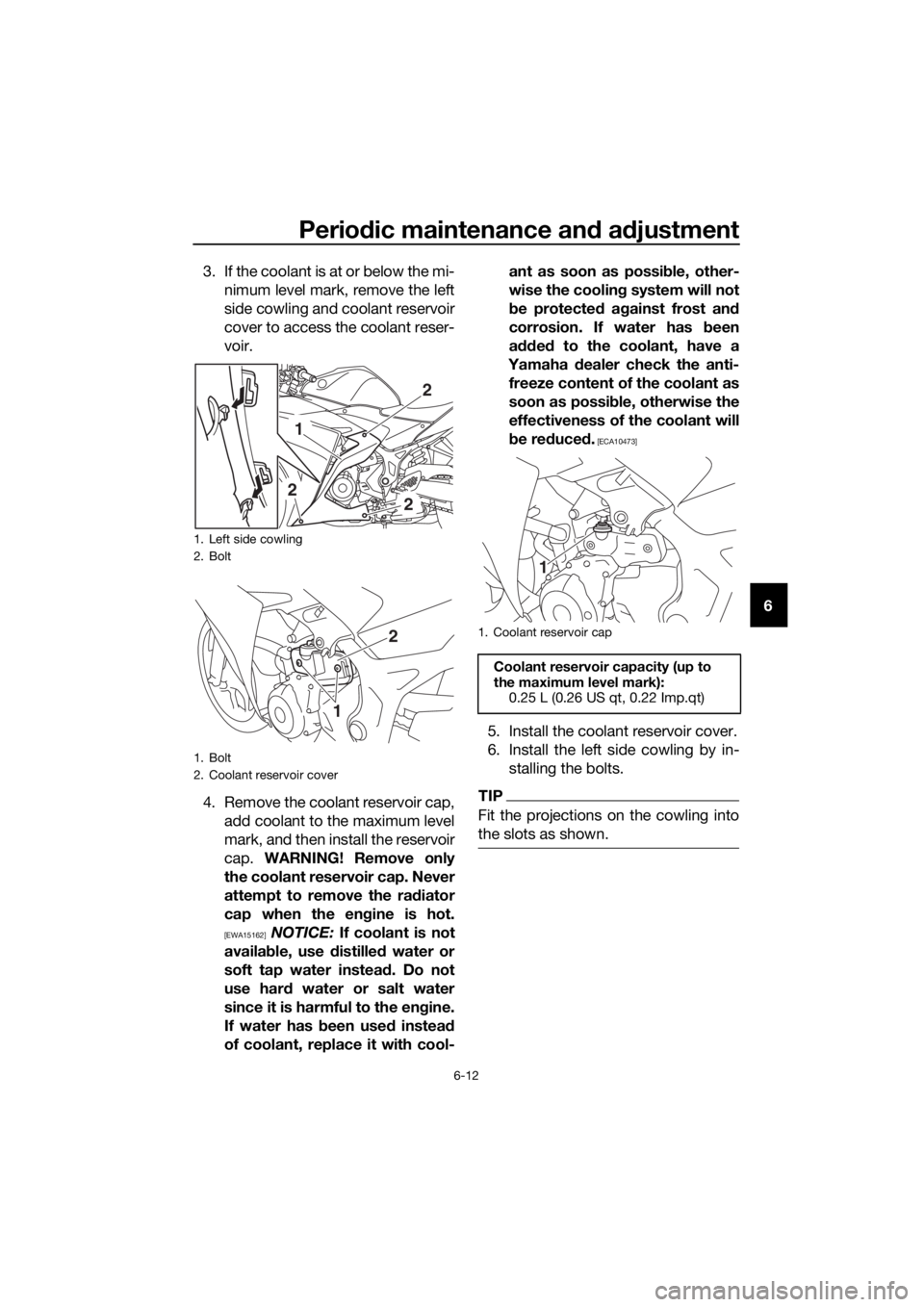
3. If the coolant is at or below the mi-
nimum level mark, remove the left
side cowling and coolant reservoir
cover to access the coolant reser-
voir.
4. Remove the coolant reservoir cap, add coolant to the maximum level
mark, and then install the reservoir
cap. WARNING! Remove only
the coolant reservoir cap. Never
attempt to remove the ra diator
cap when the en gine is hot.
[EWA15162] NOTICE: If coolant is not
availa ble, use distille d water or
soft tap water instea d. Do not
use har d water or salt water
since it is harmful to the en gine.
If water has been used instead
of coolant, replace it with cool- ant as soon as possi
ble, other-
wise the coolin g system will not
b e protecte d a gainst frost an d
corrosion. If water has been
a dd ed to the coolant, have a
Yamaha dealer check the anti-
freeze content of the coolant as
soon as possi ble, otherwise the
effectiveness of the coolant will
b e red uced.
[ECA10473]
5. Install the coolant reservoir cover.
6. Install the left side cowling by in-
stalling the bolts.
TIP
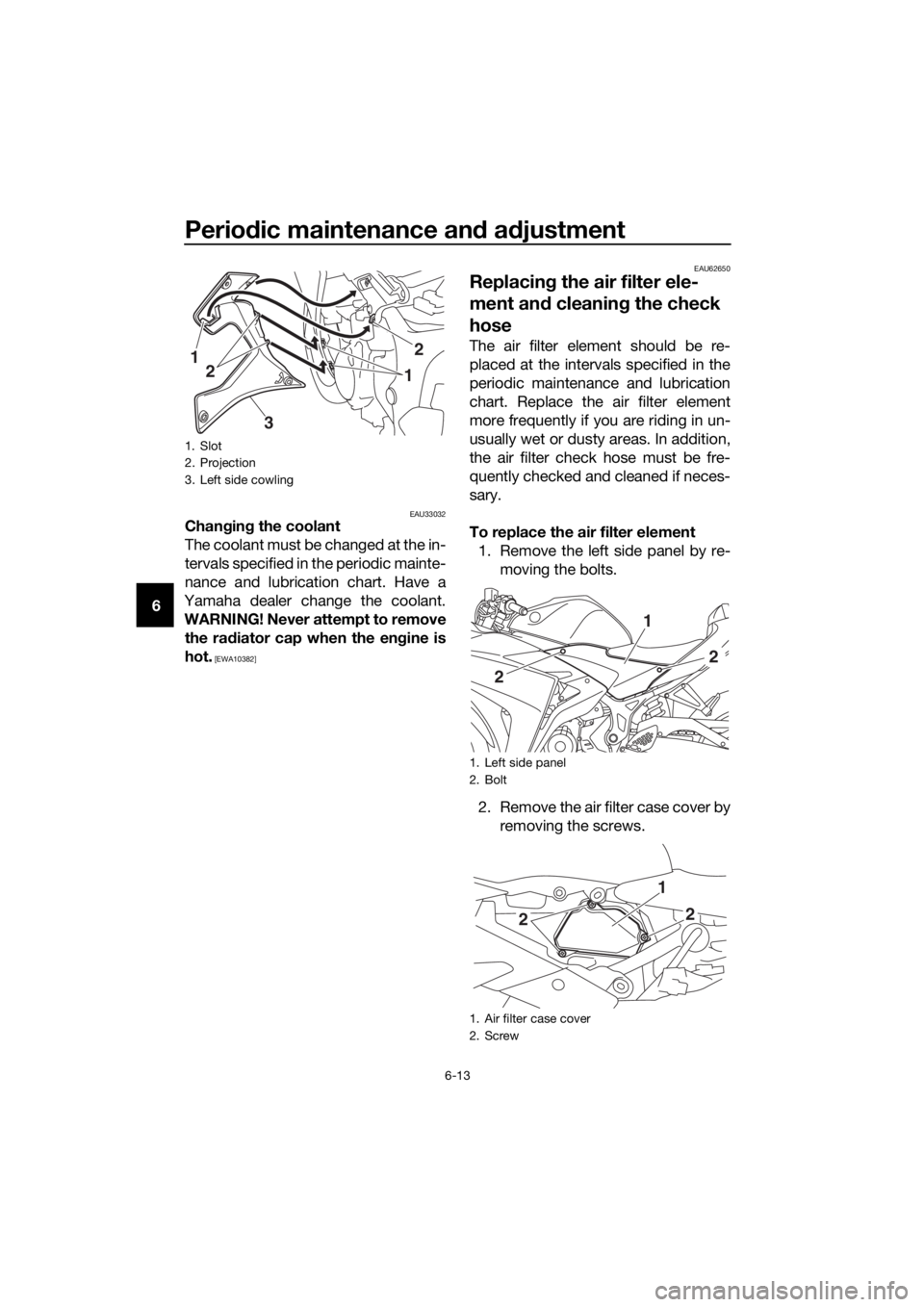
Fit the projections on the cowling into
the slots as shown.
1. Left side cowling
2. Bolt
1. Bolt
2. Coolant reservoir cover
2
1
22
2
1
1. Coolant reservoir cap
Coolant reservoir capacity (up to
the maximum level mark):
0.25 L (0.26 US qt, 0.22 Imp.qt)
1
UBR5E0E0.book Page 12 Wednesday, July 5, 2017 11:10 AM
Page 58 of 100
Periodic maintenance an d a djustment
6-13
6
EAU33032Chan gin g the coolant
The coolant must be changed at the in-
tervals specified in the periodic mainte-
nance and lubrication chart. Have a
Yamaha dealer change the coolant.
WARNING! Never attempt to remove the ra diator cap when the en gine is
hot.
[EWA10382] EAU62650
Replacin
g the air filter ele-
ment an d cleanin g the check
hose
The air filter element should be re-
placed at the intervals specified in the
periodic maintenance and lubrication
chart. Replace the air filter element
more frequently if you are riding in un-
usually wet or dusty areas. In addition,
the air filter check hose must be fre-
quently checked and cleaned if neces-
sary.
To replace the air filter element
1. Remove the left side panel by re- moving the bolts.
2. Remove the air filter case cover by removing the screws.
1. Slot
2. Projection
3. Left side cowling
3
12
2
1
1. Left side panel
2. Bolt
1. Air filter case cover
2. Screw
2
2
1
1
2
2
UBR5E0E0.book Page 13 Wednesday, July 5, 2017 11:10 AM
Page 61 of 100
Periodic maintenance an d a djustment
6-16
6
EAU69760
Tires
Tires are the only contact between the
vehicle and the road. Safety in all con-
ditions of riding depends on a relatively
small area of road contact. Therefore, it
is essential to maintain the tires in good
condition at all times and replace them
at the appropriate time with the speci-
fied tires.
Tire air pressure
The tire air pressure should be
checked and, if necessary, adjusted
before each ride.
WARNING
EWA10504
Operation of this vehicle with im-
proper tire pressure may cause se-
vere injury or d eath from loss of
control. The tire air pressure must be
checked and a djuste d on col d
tires (i.e., when the temperature
of the tires equals the am bient
temperature).
The tire air pressure must be
a d juste d in accor dance with the
ri din g speed and with the total
wei ght of ri der, passen ger, car-
g o, an d accessories approve d
for this mo del.
WARNING
EWA10512
Never overloa d your vehicle. Opera-
tion of an overloa ded vehicle coul d
cause an acci dent.
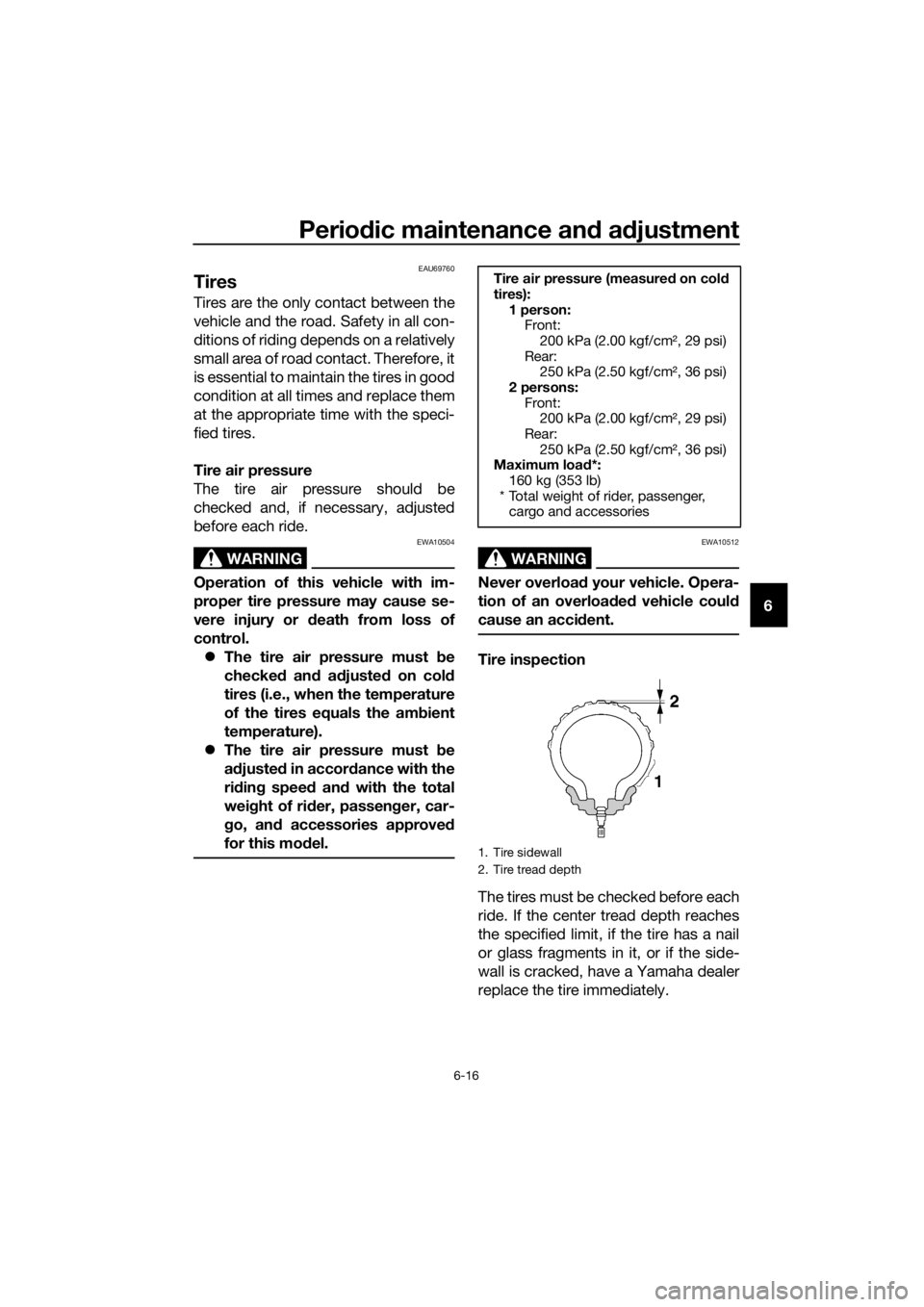
Tire inspection
The tires must be checked before each
ride. If the center tread depth reaches
the specified limit, if the tire has a nail
or glass fragments in it, or if the side-
wall is cracked, have a Yamaha dealer
replace the tire immediately.
Tire air pressure (measure d on col d
tires): 1 person: Front:
200 kPa (2.00 kgf/cm2, 29 psi)
Rear: 250 kPa (2.50 kgf/cm2, 36 psi)
2 persons: Front:200 kPa (2.00 kgf/cm2, 29 psi)
Rear: 250 kPa (2.50 kgf/cm2, 36 psi)
Maximum loa d*:
160 kg (353 lb)
* Total weight of rider, passenger, cargo and accessories
1. Tire sidewall
2. Tire tread depth
UBR5E0E0.book Page 16 Wednesday, July 5, 2017 11:10 AM
Page 62 of 100

Periodic maintenance an d a djustment
6-17
6
TIP
The tire tread depth limits may differ
from country to country. Always com-
ply with the local regulations.
WARNING
EWA10472
Have a Yamaha dealer replace
excessively worn tires. Besi des
b ein g ille gal, operatin g the vehi-
cle with excessively worn tires
d ecreases ri din g sta bility an d
can lead to loss of control.
The replacement of all wheel
and b rake-relate d parts, inclu d-
in g the tires, shoul d b e left to a
Yamaha dealer, who has the
necessary professional knowl-
e dge an d experience to do so.
Ride at mo derate spee ds after
chan gin g a tire since the tire
surface must first be “ broken
in” for it to develop its optimal
characteristics.
Tire information
This model is equipped with tubeless
tires and rubber tire air valves.
Tires age, even if they have not been
used or have only been used occasion-
ally. Cracking of the tread and sidewall
rubber, sometimes accompanied by
carcass deformation, is an evidence of
ageing. Old and aged tires shall be
checked by tire specialists to ascertain
their suitability for further use.
WARNING
EWA10462
The front an d rear tires shoul d b e of
the same make an d d esi gn, other-
wise the han dlin g characteristics of
the vehicle may be different, which
coul d lea d to an acci dent.
After extensive tests, only the tires list-
ed below have been approved for this
model by Yamaha.
Minimum tire trea d d epth (front an d
rear): 1.6 mm (0.06 in)
Front tire:Size:
110/70-17M/C (54H)
Manufacturer/model: MICHELIN/PILOT STREET
Rear tire: Size:140/70-17M/C (66H)
Manufacturer/model: MICHELIN/PILOT STREET
UBR5E0E0.book Page 17 Wednesday, July 5, 2017 11:10 AM
Page 65 of 100
Periodic maintenance an d a djustment
6-20
6
EAU37914
Checkin g the brake lever free
play
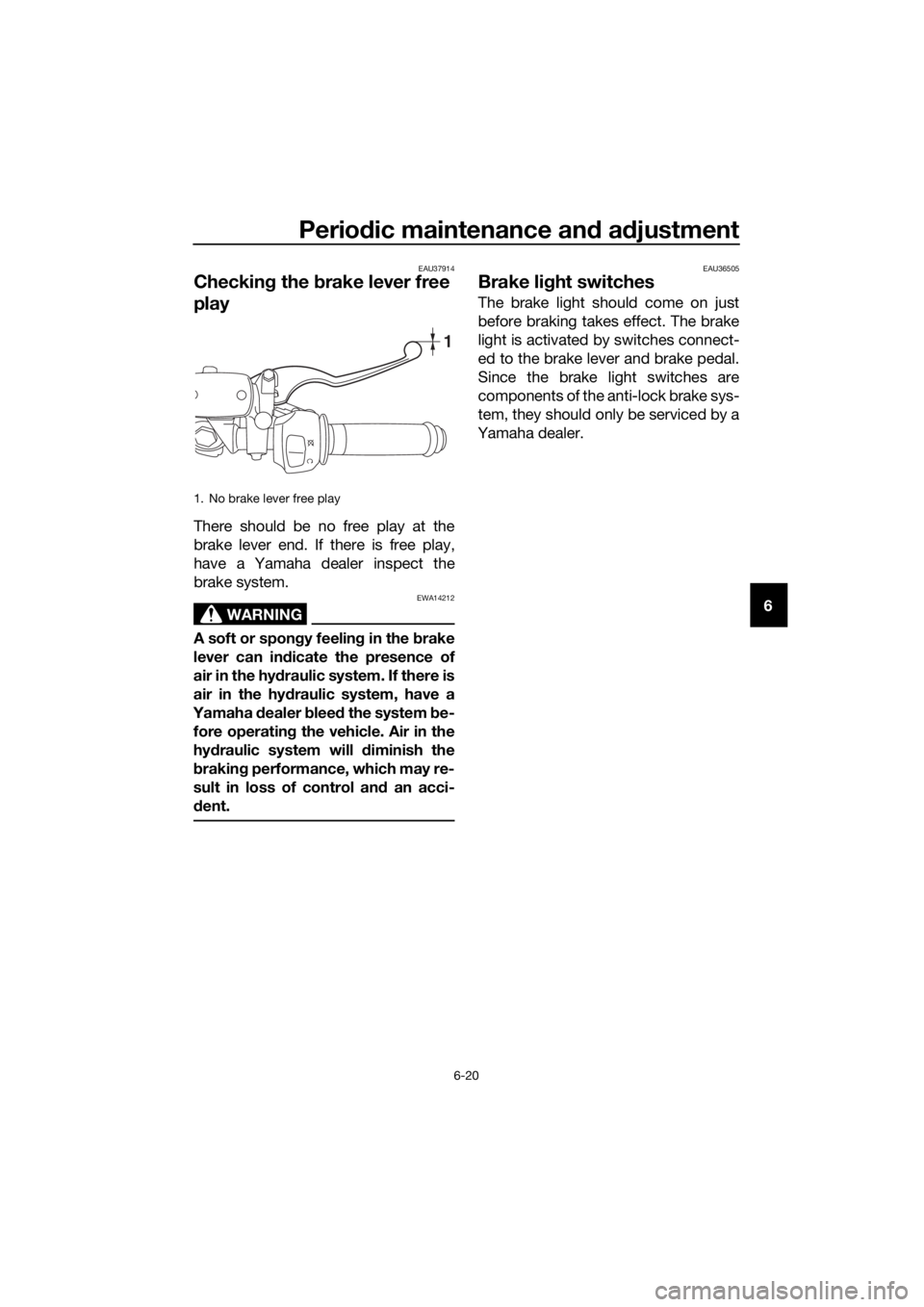
There should be no free play at the
brake lever end. If there is free play,
have a Yamaha dealer inspect the
brake system.
WARNING
EWA14212
A soft or spon gy feelin g in the brake
lever can in dicate the presence of
air in the hy draulic system. If there is
air in the hy draulic system, have a
Yamaha dealer blee d the system be-
fore operatin g the vehicle. Air in the
hy draulic system will diminish the
b rakin g performance, which may re-
sult in loss of control an d an acci-
d ent.
EAU36505
Brake li ght switches
The brake light should come on just
before braking takes effect. The brake
light is activated by switches connect-
ed to the brake lever and brake pedal.
Since the brake light switches are
components of the anti-lock brake sys-
tem, they should only be serviced by a
Yamaha dealer.
1. No brake lever free play
1
UBR5E0E0.book Page 20 Wednesday, July 5, 2017 11:10 AM
Page 67 of 100
Periodic maintenance an d a djustment
6-22
6
EAU40262
Checkin g the brake flui d level
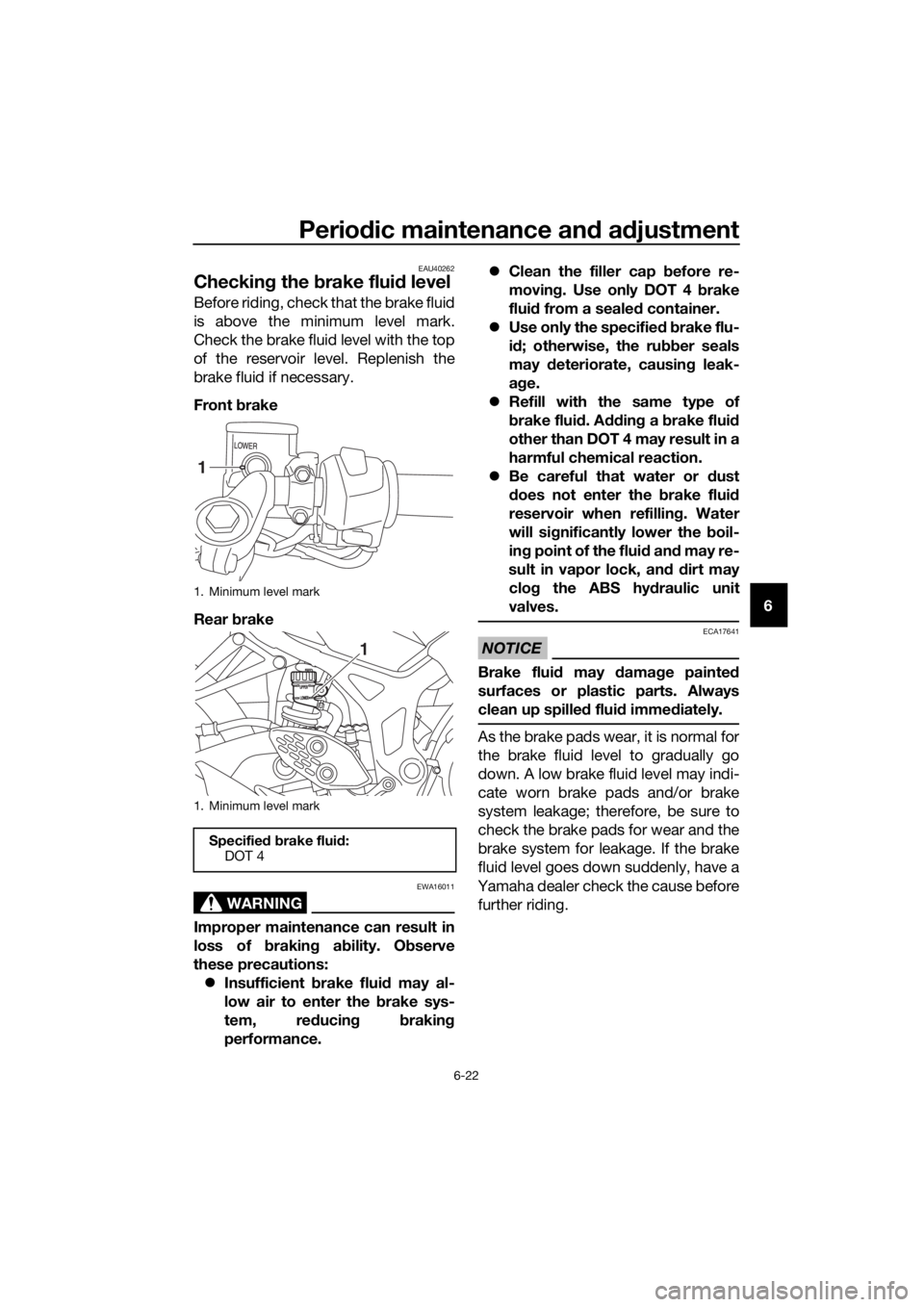
Before riding, check that the brake fluid
is above the minimum level mark.
Check the brake fluid level with the top
of the reservoir level. Replenish the
brake fluid if necessary.
Front brake
Rear brake
WARNING
EWA16011
Improper maintenance can result in
loss of brakin g a bility. O bserve
these precautions: Insufficient brake flui d may al-
low air to enter the brake sys-
tem, re ducing brakin g
performance.
Clean the filler cap before re-
moving . Use only DOT 4 b rake
flui d from a seale d container.
Use only the specifie d b rake flu-
i d ; otherwise, the ru bber seals
may deteriorate, causin g leak-
a g e.
Refill with the same type of
brake flui d. A ddin g a brake flui d
other than DOT 4 may result in a
harmful chemical reaction.
Be careful that water or dust
d oes not enter the brake flui d
reservoir when refilling . Water
will si gnificantly lower the boil-
in g point of the flui d an d may re-
sult in vapor lock, an d d ir
t may
clo g the ABS hy draulic unit
valves.
NOTICE
ECA17641
Brake flui d may d amage painte d
surfaces or plastic parts. Always
clean up spille d flui d imme diately.
As the brake pads wear, it is normal for
the brake fluid level to gradually go
down. A low brake fluid level may indi-
cate worn brake pads and/or brake
system leakage; therefore, be sure to
check the brake pads for wear and the
brake system for leakage. If the brake
fluid level goes down suddenly, have a
Yamaha dealer check the cause before further riding.
1. Minimum level mark
1. Minimum level mark
Specified b rake flui d:
DOT 4
1
1
UBR5E0E0.book Page 22 Wednesday, July 5, 2017 11:10 AM