ABS Abarth 500 2015 Owner handbook (in English)
[x] Cancel search | Manufacturer: ABARTH, Model Year: 2015, Model line: 500, Model: Abarth 500 2015Pages: 215, PDF Size: 19.08 MB
Page 90 of 215

Warning lights on
panelWhat it means What to do
amberABS FAILURE
When the key is turned to MAR-ON, the warning
light switches on but it should switch off after a
few seconds.
The warning light switches on to indicate a
system fault. In this case the braking system will
work as normal, but without the extra
performance offered by the ABS.
The display shows the dedicated message.Drive carefully and contact an Abarth Dealership
as soon as possible.
amberPASSENGER SIDE AIRBAG DEACTIVATED
The
warning light switches on when the front
passenger airbag is deactivated.
With the front passenger airbag enabled, when
the ignition key is turned to MAR-ON the warning
light
switches on constantly for about 4
seconds, flashes for another 4 seconds and then
should switch off.
If the warning light flashes, this indicates an
airbag warning light fault.Before driving off, contact an Abarth Dealership to
have the system checked immediately.63)
86
KNOWING THE INSTRUMENT PANEL
Page 127 of 215
20) A quick burst on the accelerator
before turning off the engine
serves absolutely no practical
purpose; it wastes fuel and is
especially damaging to
turbocharged engines.
WARNING
96) It is dangerous to run the engine
in enclosed areas. The engine
takes in oxygen and releases
carbon dioxide, carbon monoxide
and other toxic gases.
97) Remember that the brake servo
and electric power steering are
not active until the engine is
started. A much greater effort will
therefore be required to use the
brake pedal or turn the steering
wheel.
PARKING
Proceed as follows:
❒stop the engine and engage the
handbrake;
❒engage a gear (first gear if parked
uphill or reverse if facing downhill)
and leave the wheels turned.
Block the wheels with a wedge or a
stone if the car is parked on a steep
slope.
Do not leave the ignition key on
MAR-ON to avoid draining the battery.
Always remove the key when you
leave the car.
98)
HANDBRAKE
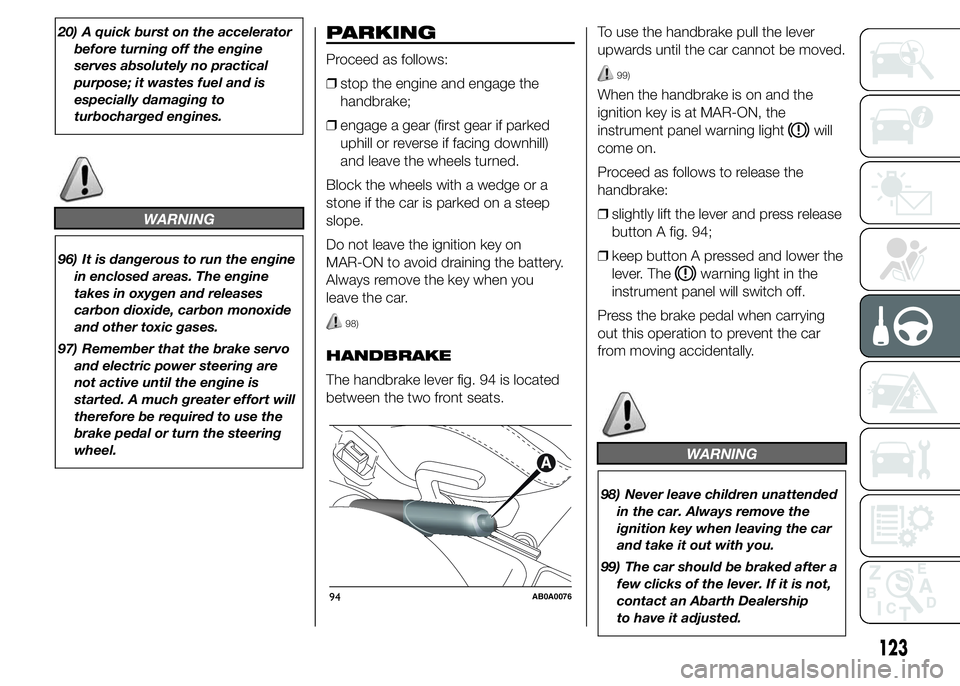
The handbrake lever fig. 94 is located
between the two front seats.To use the handbrake pull the lever
upwards until the car cannot be moved.
99)
When the handbrake is on and the
ignition key is at MAR-ON, the
instrument panel warning light
will
come on.
Proceed as follows to release the
handbrake:
❒slightly lift the lever and press release
button A fig. 94;
❒keep button A pressed and lower the
lever. The
warning light in the
instrument panel will switch off.
Press the brake pedal when carrying
out this operation to prevent the car
from moving accidentally.
WARNING
98) Never leave children unattended
in the car. Always remove the
ignition key when leaving the car
and take it out with you.
99) The car should be braked after a
few clicks of the lever. If it is not,
contact an Abarth Dealership
to have it adjusted.
94AB0A0076
123
Page 130 of 215

CONDITIONS OF USE
Cold starting
Short journeys and frequent cold starts
do not allow the engine to reach
optimum operating temperature. This
results in a significant increase in
consumption levels (from +15 to +30%
on the urban cycle) and emissions.
Traffic and road
conditions
High fuel consumption is caused by
heavy traffic, for instance when
travelling in a queue with frequent use
of low gears or in cities with many traffic
lights. Winding mountain roads and
rough road surfaces also adversely
affect consumption.
Stops in traffic
During prolonged hold-ups (e.g. level
crossings) switch off the engine.TOWING TRAILERS
IMPORTANT
INFORMATION
For towing caravans or trailers the car
must be fitted with a certified tow hook
and an adequate electrical system.
Installation should be carried out by
specialised personnel who will issue the
required papers for travelling on roads.
Install any specific and/or additional
door mirrors as specified by the
Highway Code.
Remember that when towing a trailer,
steep hills are harder to climb, braking
distances increase and overtaking
takes longer depending on the overall
weight of the trailer.
Engage a low gear when driving
downhill, rather than constantly using
the brake.
The weight the trailer exerts on the car
tow hook reduces the car's loading
capacity by the same amount. To make
sure that the maximum towable weight
is not exceeded (given in the car
registration document) account should
be taken of the fully laden trailer,
including accessories and luggage.Respect the speed limits specific to
each country for vehicles towing
trailers.
In any case, the top speed must not
exceed 100 km/h.
101) 102)
WARNING
101) The ABS with which the car is
equipped will not control the
braking system of the trailer.
Particular caution is therefore
required on slippery surfaces.
102) Never modify the braking
system of the car to control the
trailer brake. The trailer braking
system must be fully independent
of the car’s hydraulic system.
126
STARTING AND DRIVING
Page 142 of 215

WARNING
114) Changes or repairs to the electrical system carried out incorrectly and without due consideration for the technical
specifications of the system may lead to malfunctioning and generate a fire hazard.
115) Halogen bulbs contain pressurised gas. If they break, glass fragments could fly everywhere.
IMPORTANT
25) Halogen bulbs must be handled by holding the metallic part only. Touching the transparent part of the bulb with
your fingers may reduce the intensity of the emitted light and even reduce the lifespan of the bulb. In the event of
accidental contact, wipe the bulb with a cloth moistened with alcohol and let the bulb dry.
26) Where possible, it is advisable to have bulbs changed at an Abarth Dealership. The correct operation and alignment
of the external lights are absolutely essential for the safety of the car and of compliance with the law.
138
IN AN EMERGENCY
Page 145 of 215
REAR LIGHT CLUSTERS
To replace the bulb proceed as follows:
❒open the tailgate;
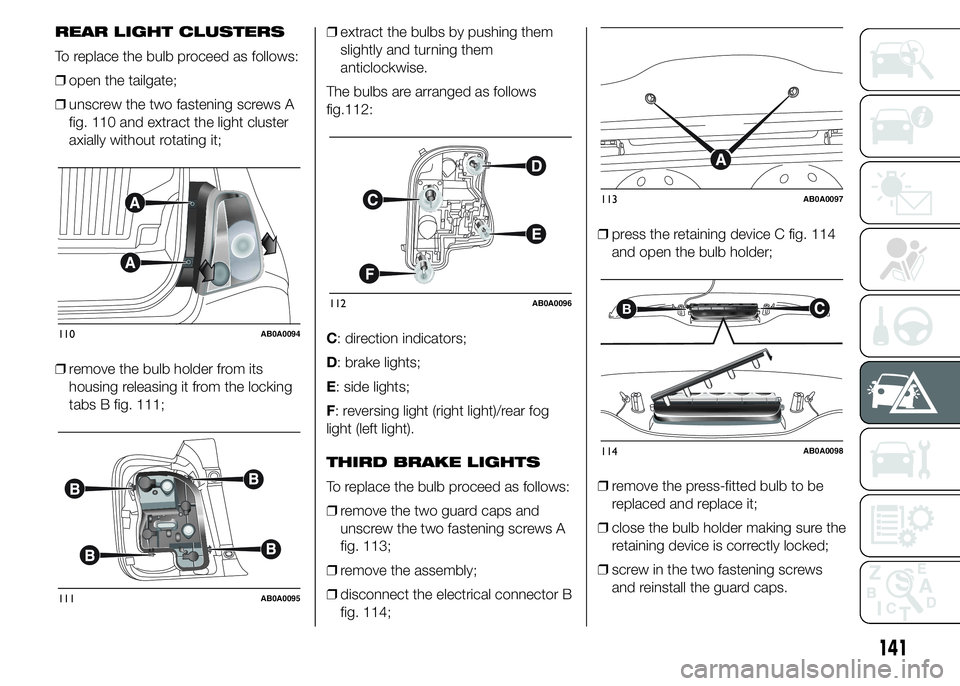
❒unscrew the two fastening screws A
fig. 110 and extract the light cluster
axially without rotating it;
❒remove the bulb holder from its
housing releasing it from the locking
tabs B fig. 111;❒extract the bulbs by pushing them
slightly and turning them
anticlockwise.
The bulbs are arranged as follows
fig. 112:
C: direction indicators;
D: brake lights;
E: side lights;
F: reversing light (right light)/rear fog
light (left light).
THIRD BRAKE LIGHTS
To replace the bulb proceed as follows:
❒remove the two guard caps and
unscrew the two fastening screws A
fig. 113;
❒remove the assembly;
❒disconnect the electrical connector B
fig. 114;❒press the retaining device C fig. 114
and open the bulb holder;
❒remove the press-fitted bulb to be
replaced and replace it;
❒close the bulb holder making sure the
retaining device is correctly locked;
❒screw in the two fastening screws
and reinstall the guard caps.
110AB0A0094
111AB0A0095
112AB0A0096
113AB0A0097
B
114AB0A0098
141
Page 149 of 215
Engine compartment
fuse box
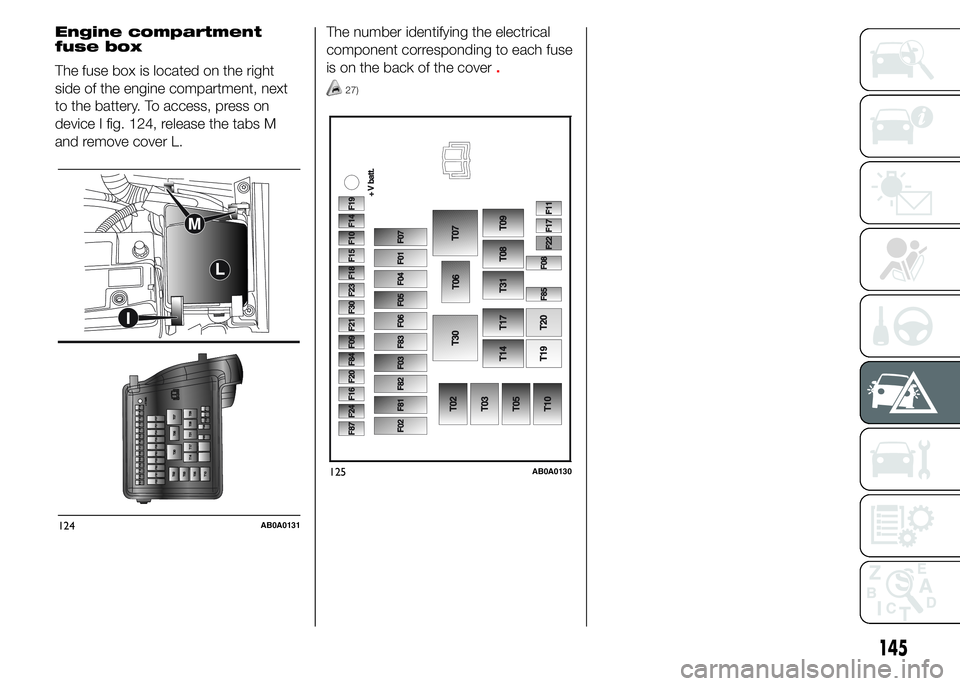
The fuse box is located on the right
side of the engine compartment, next
to the battery. To access, press on
device I fig. 124, release the tabs M
and remove cover L.The number identifying the electrical
component corresponding to each fuse
is on the back of the cover
.
27)
124AB0A0131
125AB0A0130
145
Page 164 of 215
ENGINE OIL
30)
3)
Check the oil level a few minutes (about
five) after the engine has stopped,
with the car parked on level ground.
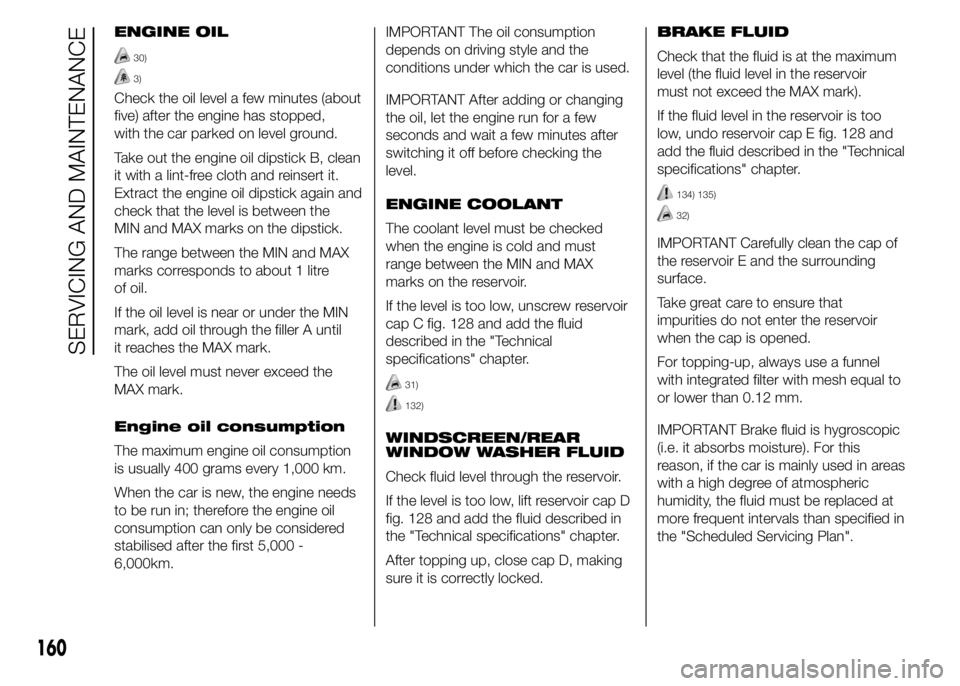
Take out the engine oil dipstick B, clean
it with a lint-free cloth and reinsert it.
Extract the engine oil dipstick again and
check that the level is between the
MIN and MAX marks on the dipstick.
The range between the MIN and MAX
marks corresponds to about 1 litre
of oil.
If the oil level is near or under the MIN
mark, add oil through the filler A until
it reaches the MAX mark.
The oil level must never exceed the
MAX mark.
Engine oil consumption
The maximum engine oil consumption
is usually 400 grams every 1,000 km.
When the car is new, the engine needs
to be run in; therefore the engine oil
consumption can only be considered
stabilised after the first 5,000 -
6,000 km.IMPORTANT The oil consumption
depends on driving style and the
conditions under which the car is used.
IMPORTANT After adding or changing
the oil, let the engine run for a few
seconds and wait a few minutes after
switching it off before checking the
level.
ENGINE COOLANT
The coolant level must be checked
when the engine is cold and must
range between the MIN and MAX
marks on the reservoir.
If the level is too low, unscrew reservoir
cap C fig. 128 and add the fluid
described in the "Technical
specifications" chapter.
31)
132)
WINDSCREEN/REAR
WINDOW WASHER FLUID
Check fluid level through the reservoir.
If the level is too low, lift reservoir cap D
fig. 128 and add the fluid described in
the "Technical specifications" chapter.
After topping up, close cap D, making
sure it is correctly locked.BRAKE FLUID
Check that the fluid is at the maximum
level (the fluid level in the reservoir
must not exceed the MAX mark).
If the fluid level in the reservoir is too
low, undo reservoir cap E fig. 128 and
add the fluid described in the "Technical
specifications" chapter.
134) 135)
32)
IMPORTANT Carefully clean the cap of
the reservoir E and the surrounding
surface.
Take great care to ensure that
impurities do not enter the reservoir
when the cap is opened.
For topping-up, always use a funnel
with integrated filter with mesh equal to
or lower than 0.12 mm.
IMPORTANT Brake fluid is hygroscopic
(i.e. it absorbs moisture). For this
reason, if the car is mainly used in areas
with a high degree of atmospheric
humidity, the fluid must be replaced at
more frequent intervals than specified in
the "Scheduled Servicing Plan".
160
SERVICING AND MAINTENANCE
Page 182 of 215

SUSPENSION
Version 1.4 TB PETROL ABARTH
FrontMacPherson independent wheels, mechanical crossmember, shock
absorbers and coil springs; anti-roll bar.
Reartorsion beam with interconnected wheels consisting of a torsion axle,
anti-roll bar and two tubular arms with shock absorbers and coil
springs.
178
TECHNICAL SPECIFICATIONS
Page 200 of 215
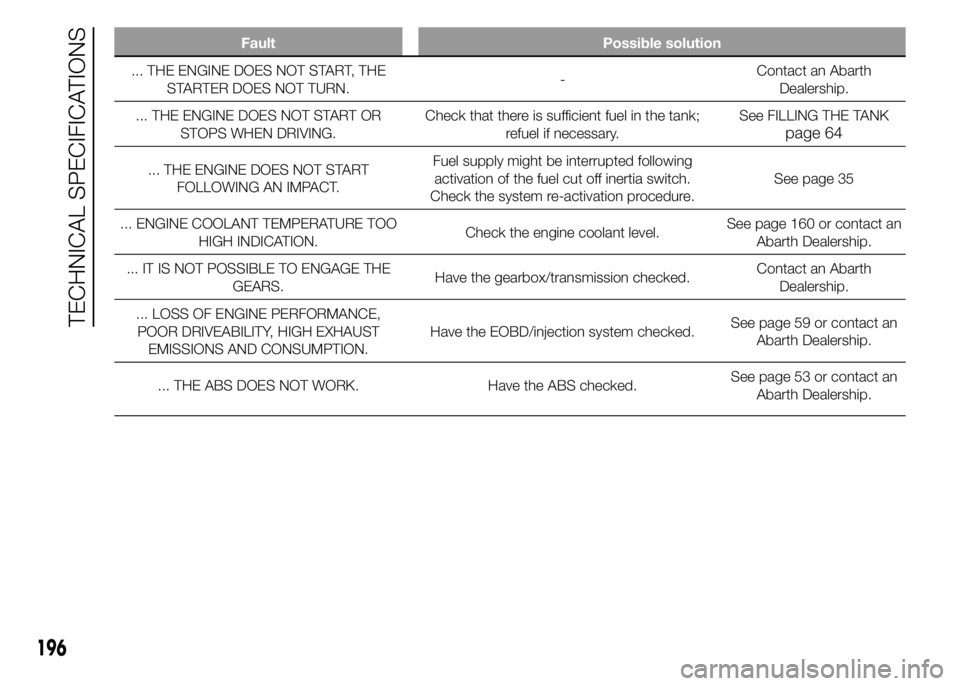
Fault Possible solution
... THE ENGINE DOES NOT START, THE
STARTER DOES NOT TURN.-Contact an Abarth
Dealership.
... THE ENGINE DOES NOT START OR
STOPS WHEN DRIVING.Check that there is sufficient fuel in the tank;
refuel if necessary.See FILLING THE TANK
page 64
... THE ENGINE DOES NOT START
FOLLOWING AN IMPACT.Fuel supply might be interrupted following
activation of the fuel cut off inertia switch.
Check the system re-activation procedure.See page 35
... ENGINE COOLANT TEMPERATURE TOO
HIGH INDICATION.Check the engine coolant level.See page 160 or contact an
Abarth Dealership.
... IT IS NOT POSSIBLE TO ENGAGE THE
GEARS.Have the gearbox/transmission checked.Contact an Abarth
Dealership.
... LOSS OF ENGINE PERFORMANCE,
POOR DRIVEABILITY, HIGH EXHAUST
EMISSIONS AND CONSUMPTION.Have the EOBD/injection system checked.See page 59 or contact an
Abarth Dealership.
... THE ABS DOES NOT WORK. Have the ABS checked.See page 53 or contact an
Abarth Dealership.
196
TECHNICAL SPECIFICATIONS
Page 211 of 215
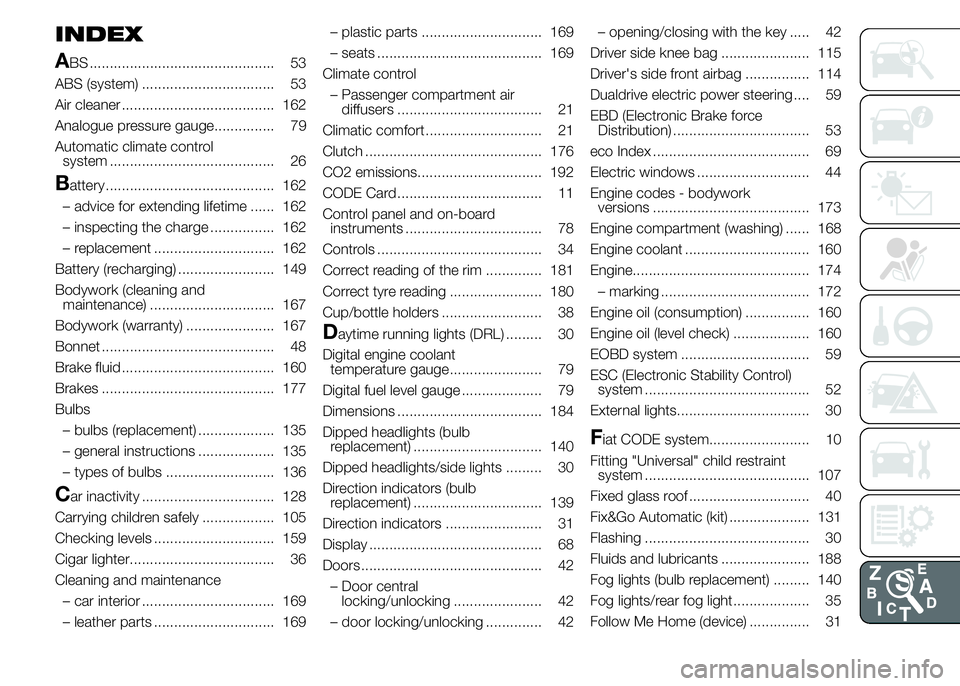
INDEX
A
BS .............................................. 53
ABS (system) ................................. 53
Air cleaner ...................................... 162
Analogue pressure gauge............... 79
Automatic climate control
system ......................................... 26
Battery .......................................... 162
– advice for extending lifetime ...... 162
– inspecting the charge ................ 162
– replacement .............................. 162
Battery (recharging) ........................ 149
Bodywork (cleaning and
maintenance) ............................... 167
Bodywork (warranty) ...................... 167
Bonnet ........................................... 48
Brake fluid ...................................... 160
Brakes ........................................... 177
Bulbs
– bulbs (replacement) ................... 135
– general instructions ................... 135
– types of bulbs ........................... 136
Car inactivity ................................. 128
Carrying children safely .................. 105
Checking levels .............................. 159
Cigar lighter.................................... 36
Cleaning and maintenance
– car interior ................................. 169
– leather parts .............................. 169– plastic parts .............................. 169
– seats ......................................... 169
Climate control
– Passenger compartment air
diffusers .................................... 21
Climatic comfort ............................. 21
Clutch ............................................ 176
CO2 emissions............................... 192
CODE Card .................................... 11
Control panel and on-board
instruments .................................. 78
Controls ......................................... 34
Correct reading of the rim .............. 181
Correct tyre reading ....................... 180
Cup/bottle holders ......................... 38
Daytime running lights (DRL) ......... 30
Digital engine coolant
temperature gauge....................... 79
Digital fuel level gauge .................... 79
Dimensions .................................... 184
Dipped headlights (bulb
replacement) ................................ 140
Dipped headlights/side lights ......... 30
Direction indicators (bulb
replacement) ................................ 139
Direction indicators ........................ 31
Display ........................................... 68
Doors ............................................. 42
– Door central
locking/unlocking ...................... 42
– door locking/unlocking .............. 42– opening/closing with the key ..... 42
Driver side knee bag ...................... 115
Driver's side front airbag ................ 114
Dualdrive electric power steering .... 59
EBD (Electronic Brake force
Distribution) .................................. 53
eco Index ....................................... 69
Electric windows ............................ 44
Engine codes - bodywork
versions ....................................... 173
Engine compartment (washing) ...... 168
Engine coolant ............................... 160
Engine............................................ 174
– marking ..................................... 172
Engine oil (consumption) ................ 160
Engine oil (level check) ................... 160
EOBD system ................................ 59
ESC (Electronic Stability Control)
system ......................................... 52
External lights................................. 30
Fiat CODE system......................... 10
Fitting "Universal" child restraint
system ......................................... 107
Fixed glass roof .............................. 40
Fix&Go Automatic (kit) .................... 131
Flashing ......................................... 30
Fluids and lubricants ...................... 188
Fog lights (bulb replacement) ......... 140
Fog lights/rear fog light................... 35
Follow Me Home (device) ............... 31