lock Abarth 500 2015 Owner handbook (in English)
[x] Cancel search | Manufacturer: ABARTH, Model Year: 2015, Model line: 500, Model: Abarth 500 2015Pages: 215, PDF Size: 19.08 MB
Page 39 of 215

IMPORTANT When the SPORT button
is pressed, the function is activated
about 5 seconds later.
IMPORTANT During acceleration using
the SPORT function the steering may
shudder which is typical of a sports
setting.
HAZARD WARNING
LIGHTS
They are turned on by pressing the
button B fig. 31, regardless of the
position of the ignition key.
With the device on, warning lights
andlight up in the instrument
panel.
Press button B again to switch the
lights off.
IMPORTANT The use of hazard warning
lights is governed by the highway
code of the country you are driving in:
comply with legal requirements.Emergency braking
In the event of an emergency braking,
the hazard warning light switch on
automatically together with warning
lights
andon the instrument
panel.
The lights switch off automatically when
emergency braking ceases.
FRONT FOG
LIGHTS/REAR FOG
LIGHTS
(for versions/markets, where provided)
The fog lights can be activated only
when the dipped headlamps are on.
To turn on the front/rear fog lights, use
the button C fig. 31 as follows:
❒First pressing: front fog lights on;
❒second pressing: rear fog lamps
on;
❒third pressing: front/rear fog lights
off.
With front fog lights on, the
warning
light on the instrument panel will come
on at the same time.
With rear fog lights on, the
warning
light on the instrument panel will come
on at the same time.REAR FOG LIGHTS
When the dipped beam headlights are
on, these can be activated by pressing
button
fig. 32.
With lights on, the warning light
on
the instrument panel will come on at the
same time.
Press the button again to switch the
lights off.
FUEL CUT-OFF SYSTEM
This intervenes in the case of an impact
causing:
❒the fuel supply cut-off with the engine
consequently switching off
❒the automatic unlocking of the doors
❒turning on the lights inside the
vehicle.
32AB0A0030
35
Page 42 of 215
STORAGE
COMPARTMENT UNDER
PASSENGER SEAT
(for versions/markets, where provided)
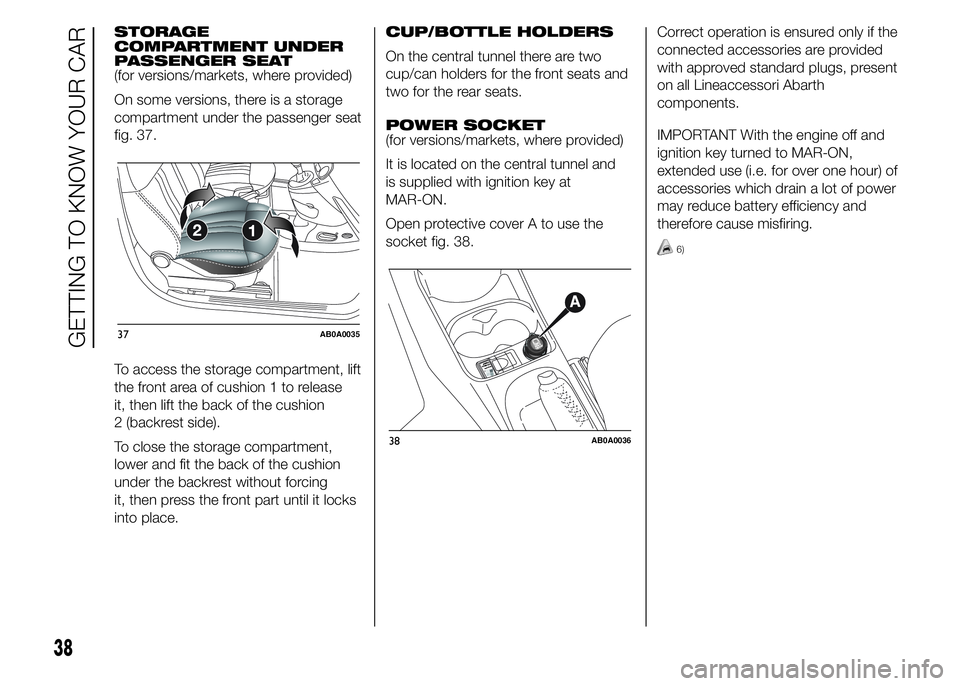
On some versions, there is a storage
compartment under the passenger seat
fig. 37.
To access the storage compartment, lift
the front area of cushion 1 to release
it, then lift the back of the cushion
2 (backrest side).
To close the storage compartment,
lower and fit the back of the cushion
under the backrest without forcing
it, then press the front part until it locks
into place.CUP/BOTTLE HOLDERS
On the central tunnel there are two
cup/can holders for the front seats and
two for the rear seats.
POWER SOCKET
(for versions/markets, where provided)
It is located on the central tunnel and
is supplied with ignition key at
MAR-ON.
Open protective cover A to use the
socket fig. 38.Correct operation is ensured only if the
connected accessories are provided
with approved standard plugs, present
on all Lineaccessori Abarth
components.
IMPORTANT With the engine off and
ignition key turned to MAR-ON,
extended use (i.e. for over one hour) of
accessories which drain a lot of power
may reduce battery efficiency and
therefore cause misfiring.
6)
37AB0A0035
38AB0A0036
38
GETTING TO KNOW YOUR CAR
Page 45 of 215
CLOSING
Keep the button A fig. 42 pressed: the
roof will move to "spoiler" position.
The roof will stop in the position
reached when the button is released.
Press the button A again and hold it
down until the roof is completely
closed.
ANTI-PINCH SAFETY
DEVICE
The sun roof has an anti-pinch safety
system capable of detecting the
presence of an obstacle whilst the roof
is closing. When this happens, the
system stops and the movement of the
roof is immediately reversed.INITIALISATION
PROCEDURE
After the battery has been
disconnected or the protective fuse has
blown, the operation of the sun roof
must be initialised again.
Proceed as follows:
❒keep the button A fig. 42 pressed so
that the roof closes completely in
stages
❒after full closing, wait for the sun roof
motor to stop.EMERGENCY OPERATION
If the electrical device for moving the
roof fails, the sun roof can be moved
manually proceeding as described
below:
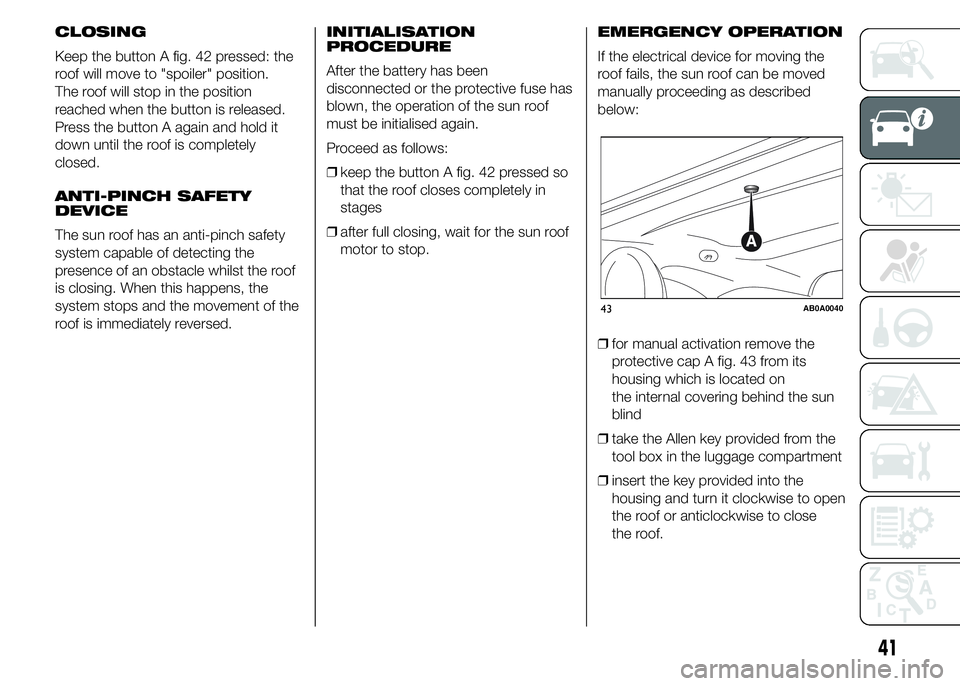
❒for manual activation remove the
protective cap A fig. 43 from its
housing which is located on
the internal covering behind the sun
blind
❒take the Allen key provided from the
tool box in the luggage compartment
❒insert the key provided into the
housing and turn it clockwise to open
the roof or anticlockwise to close
the roof.
43AB0A0040
41
Page 46 of 215

IMPORTANT
7) Do not open the sun roof if there
is snow or ice on it: you may
damage it.
8) Use the sun roof only at "spoiler"
position if a transverse roof rack is
fitted.
WARNING
18) When leaving the car, always
remove the key from the ignition
to avoid the risk of injury due
to accidental operation of the sun
roof. Improper use of the roof
can be dangerous. Before and
during operation, always check
that nobody is at risk of being
injured by the moving sun roof or
by objects getting caught or hit by
it.
DOORS
19)
DOOR CENTRAL
LOCKING/UNLOCKING
Unlocking doors from
the outside
Press the
button on the key or turn
the metal insert (located inside the key)
to position 1 fig. 44 in the driver side
door lock.
When the key is turned the doors and
the tailgate are simultaneously
unlocked.Locking doors from the
outside
With the doors closed, press the
button on the key or fit and then turn
the metal insert (located inside the
key) to position 2 fig. 44 in the driver
side door lock.
IMPORTANT If one of the doors is not
completely closed or if there is a fault in
the system, the central locking will not
be activated. If the operation is
repeated 10/11 times in quick
succession, the device is excluded for
approximately 30 seconds.
44AB0A0041
42
GETTING TO KNOW YOUR CAR
Page 47 of 215
Door locking/unlocking
from the inside
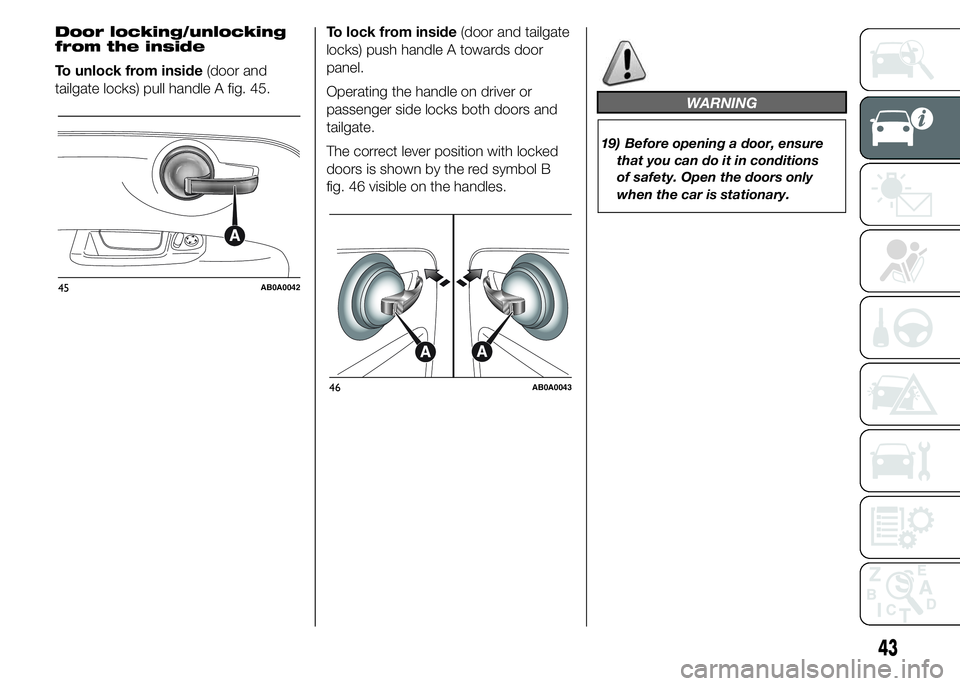
To unlock from inside(door and
tailgate locks) pull handle A fig. 45.To lock from inside(door and tailgate
locks) push handle A towards door
panel.
Operating the handle on driver or
passenger side locks both doors and
tailgate.
The correct lever position with locked
doors is shown by the red symbol B
fig. 46 visible on the handles.
WARNING
19) Before opening a door, ensure
that you can do it in conditions
of safety. Open the doors only
when the car is stationary.
45AB0A0042
46AB0A0043
43
Page 49 of 215
LUGGAGE
COMPARTMENT
22) 23)
OPENING THE TAILGATE
WITH THE REMOTE
CONTROL
Press button
on the key with the
remote control.
The direction indicators will blink twice
when the tailgate is opened.
Tailgate opening is eased by the action
of the side gas struts.
On some versions, opening the tailgate
will switch the luggage compartment
light on: the light will switch off
automatically when the tailgate is
closed.
The light will stay on for about 15
minutes after turning the key to STOP:
if during this time, a door or the tailgate
is opened, the light will switch on again
for 15 minutes.
9)
24)
ELECTRIC HANDLE
(SOFT TOUCH)
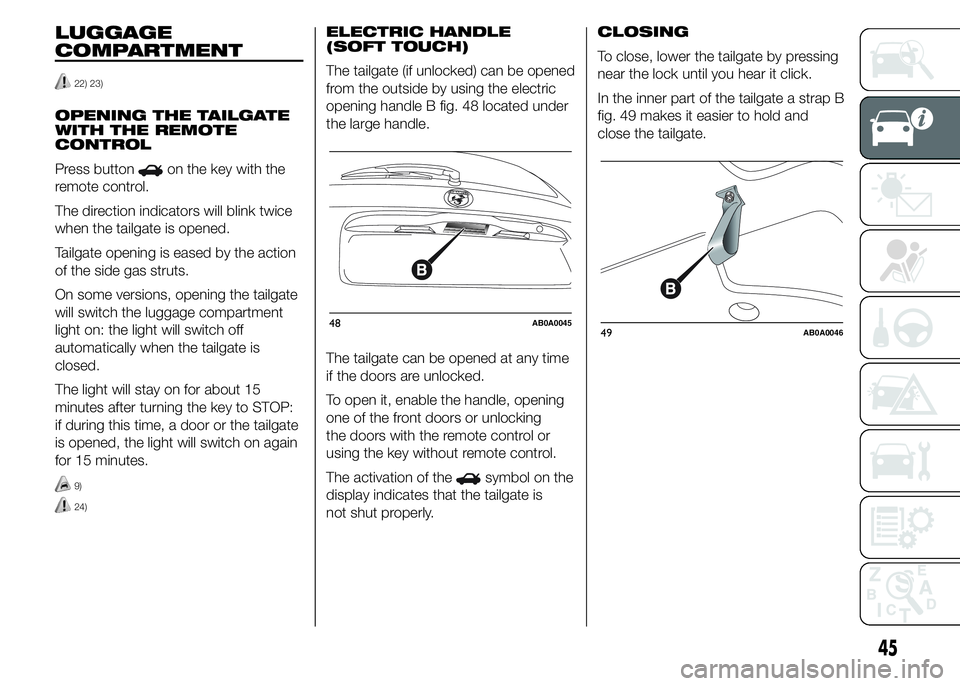
The tailgate (if unlocked) can be opened
from the outside by using the electric
opening handle B fig. 48 located under
the large handle.
The tailgate can be opened at any time
if the doors are unlocked.
To open it, enable the handle, opening
one of the front doors or unlocking
the doors with the remote control or
using the key without remote control.
The activation of the
symbol on the
display indicates that the tailgate is
not shut properly.CLOSING
To close, lower the tailgate by pressing
near the lock until you hear it click.
In the inner part of the tailgate a strap B
fig. 49 makes it easier to hold and
close the tailgate.
48AB0A004549AB0A0046
45
Page 50 of 215
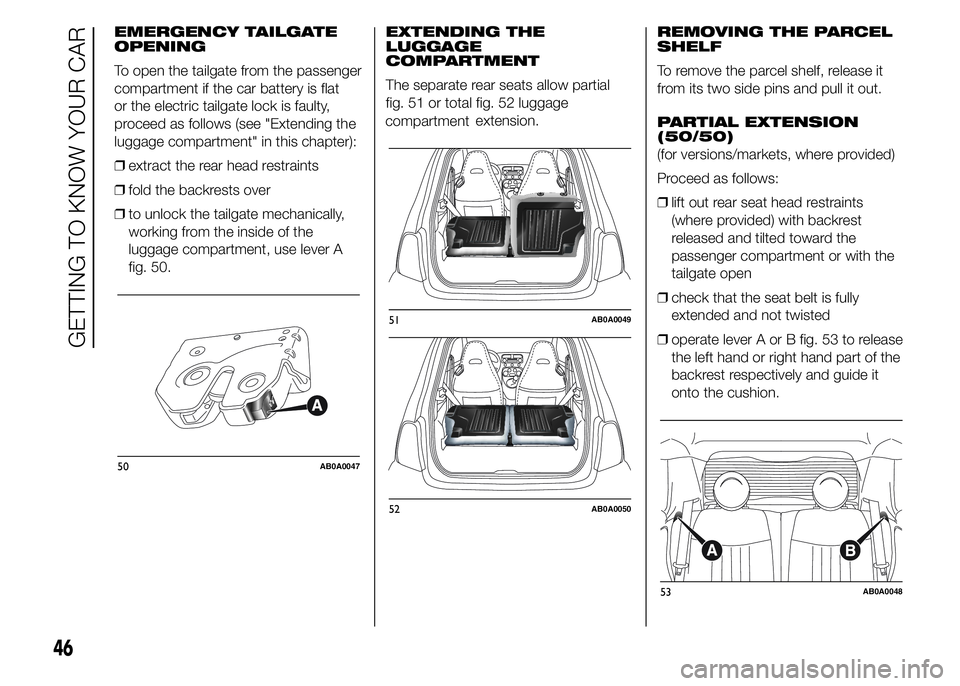
EMERGENCY TAILGATE
OPENING
To open the tailgate from the passenger
compartment if the car battery is flat
or the electric tailgate lock is faulty,
proceed as follows (see "Extending the
luggage compartment" in this chapter):
❒extract the rear head restraints
❒fold the backrests over
❒to unlock the tailgate mechanically,
working from the inside of the
luggage compartment, use lever A
fig. 50.EXTENDING THE
LUGGAGE
COMPARTMENT
The separate rear seats allow partial
fig. 51 or total fig. 52 luggage
extension.REMOVING THE PARCEL
SHELF
To remove the parcel shelf, release it
from its two side pins and pull it out.
PARTIAL EXTENSION
(50/50)
(for versions/markets, where provided)
Proceed as follows:
❒lift out rear seat head restraints
(where provided) with backrest
released and tilted toward the
passenger compartment or with the
tailgate open
❒check that the seat belt is fully
extended and not twisted
❒operate lever A or B fig. 53 to release
the left hand or right hand part of the
backrest respectively and guide it
onto the cushion.
50AB0A0047
51AB0A0049
52AB0A0050
53AB0A0048
46
GETTING TO KNOW YOUR CAR
compartment
Page 51 of 215

IMPORTANT To return the backrest to
its correct position, we recommend
operating from the outside through the
doors.
TOTAL EXTENSION
Tilting the rear seat completely forwards
allows maximum loading volume.
Proceed as follows:
❒remove the rear seat head restraints
(where provided)
❒check that the seat belts are correctly
extended and not twisted
❒operate the levers A and B fig. 53 to
release the backrests and guide
them onto the cushion.
IMPORTANT To return the backrest to
its correct position, we recommend
operating from the outside through the
doors.REPOSITIONING THE
REAR SEAT
Raise the backrests and push them
back until the locking click of both
retainers is heard.
Position the seat belt buckles upwards
and set the cushion to the position of
normal use.
IMPORTANT When returning the
backrest to its normal position, make
sure that it is correctly fastened and
that you hear the lock click.
Make sure the backrest is properly
secured at both sides to prevent it
moving forward in the event of sharp
braking that may cause injuries to
passengers.
WARNING
22) Never exceed the maximum
allowed load in the luggage
compartment (see "Technical
specifications" chapter). Also
make sure that the objects you
place in the luggage compartment
have been properly secured, to
avoid them from being thrown
forward consequent to sudden
braking and injuring your
passengers.
23) If you are travelling in areas with
few filling stations and you want
to transport fuel in a spare tank,
comply with the law by using only
an approved, suitably secured
tank. Anyway, by doing so, you
increase the risk of fire in the
event of an accident with your
vehicle.
24) Do not travel with the tailgate
open: exhaust gas may enter
the passenger compartment.
47
Page 53 of 215

CLOSING
Proceed as follows:
❒hold the bonnet up with one hand
and with the other remove rod C
fig. 56 from housing E and fit it back
into its catch D
❒lower the bonnet to approximately 20
centimetres above the engine
compartment and let it come down.
Make sure that the bonnet is
completely closed and not just
secured in safety position. If it is not
perfectly closed, do not try to press
the bonnet down but open it and
repeat the procedure.
28)
WARNING
25) Incorrect positioning of the
supporting rod may cause the
bonnet to drop suddenly. Only
perform these operations when
the car is stationary.
26) When the engine is warm, work
carefully inside the engine
compartment to avoid getting
burnt. Do not place your hands
near the engine fan as it may be
activated even when the key is
removed. Wait for the engine
to cool down.
27) Pay attention to scarves, ties and
other loose-fitting garments. If
they accidentally come into
contact with moving parts, they
may get caught up and dragged
with serious risks for those
wearing them.28) For safety reasons, the bonnet
must always be properly closed
while driving. Make sure that the
bonnet is perfectly closed and
that the lock is engaged. If you
notice when driving that the
bonnet has not been properly
locked, stop immediately
and close the bonnet correctly.
IMPORTANT
10) Before opening the bonnet,
make sure that windscreen wiper
arm is not raised, but is rather
positioned against the
windscreen.
49
Page 57 of 215

EBD (Electronic
Brakeforce Distribution)
SYSTEM
This system (which cannot be
deactivated) recognises emergency
braking conditions according to the
speed of operation of the brake pedal
and provides an additional hydraulic
braking pressure to support that
provided by the driver. This allows
faster and more powerful operation of
the braking system.
ABS
This system, which is an integral part of
the braking system, prevents one or
more wheels from locking and slipping
on all road surface conditions,
irrespective of the intensity of the
braking action, ensuring that the car
can be controlled even during
emergency braking thus optimising
stopping distances.The system intervenes when braking
and the wheels are about to lock,
typically in emergency braking or
low-grip conditions, when locking may
be more frequent.
The system also improves control and
stability of the car when braking on a
surface where the grip of the left and
right wheels varies, or on corners.
System intervention
A slight pulsing of the brake pedal and
noise indicates the intervention of the
ABS: this is completely normal when
the system intervenes
31) 32) 33) 34) 35) 36) 37)
ASR (AntiSlip
Regulation) SYSTEM
This is an integral part of the ESC
system and automatically operates in
the event of one or both drive wheels
slipping, loss of grip on wet roads
(aquaplaning) and acceleration
on slippery, snowy or icy roads, etc.Depending on the slipping conditions,
two different control systems are
activated:
❒if the slipping involves both drive
wheels, the ASR system intervenes,
reducing the power transmitted by
the engine;
❒if the slipping only involves one of the
drive wheels, it also intervenes
automatically, braking the wheel that
is slipping.
System intervention
This is indicated by the flashing of the
warning light on the instrument panel,
to inform the driver that the car is in
critical stability and grip conditions.38) 39) 40) 41)
53