handbrake Abarth 500 2015 Owner handbook (in English)
[x] Cancel search | Manufacturer: ABARTH, Model Year: 2015, Model line: 500, Model: Abarth 500 2015Pages: 215, PDF Size: 19.08 MB
Page 6 of 215
VERY IMPORTANT
REFUELLING
Only refuel with unleaded petrol with octane rating (RON) not less than 95, in compliance with the European specification EN 228. The use of
other products or mixtures may damage the engine beyond repair and consequently invalidate the warranty, due to the damage caused.
STARTING THE ENGINE
Make sure that the handbrake is engaged; set the gear lever to neutral, fully depress the clutch pedal without pressing the accelerator, then
turn the ignition key to AVV and release it as soon as the engine has started.
PARKING ON FLAMMABLE MATERIAL
The catalytic converter develops high temperatures during operation. Do not park the car on grass, dry leaves, pine needles or other
flammable material: fire hazard.
RESPECTING THE ENVIRONMENT
The car is fitted with a system that carries out a continuous diagnosis of the emission-related components in order to help protect the
environment.
ELECTRICAL ACCESSORIES
If, after buying the car, you decide to install electrical accessories (with the risk of gradually draining the battery), contact an Abarth
Dealership. They will calculate the overall electrical consumption and check that the car’s electrical system can support the required load.
CODE Card
(for versions/markets, where provided)
Keep it in a safe place, not in the car. We recommend that you always carry the electronic code provided on the CODE Card with you, in
case you need to perform an emergency start.
SCHEDULED SERVICING
Correct maintenance of the car is essential for ensuring that it maintains its performance and its safety features, its environmental friendliness
and low running costs for a long time to come.
THE OWNER HANDBOOK CONTAINS
... important information, advice and warnings for correct use, driving safety and maintenance of your car over time. Particular attention
should be paid to information marked with the following symbols:(personal safety)(environmental protection)(car integrity).
Page 18 of 215
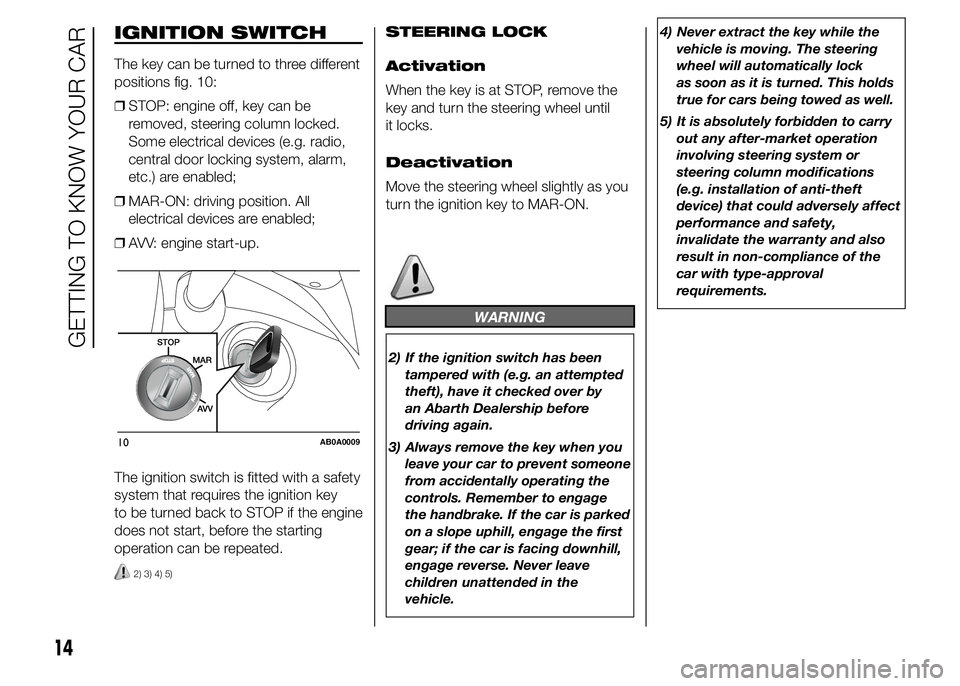
IGNITION SWITCH
The key can be turned to three different
positions fig. 10:
❒STOP: engine off, key can be
removed, steering column locked.
Some electrical devices (e.g. radio,
central door locking system, alarm,
etc.) are enabled;
❒MAR-ON: driving position. All
electrical devices are enabled;
❒AVV: engine start-up.
The ignition switch is fitted with a safety
system that requires the ignition key
to be turned back to STOP if the engine
does not start, before the starting
operation can be repeated.
2) 3) 4) 5)
STEERING LOCK
Activation
When the key is at STOP, remove the
key and turn the steering wheel until
it locks.
Deactivation
Move the steering wheel slightly as you
turn the ignition key to MAR-ON.
WARNING
2) If the ignition switch has been
tampered with (e.g. an attempted
theft), have it checked over by
an Abarth Dealership before
driving again.
3) Always remove the key when you
leave your car to prevent someone
from accidentally operating the
controls. Remember to engage
the handbrake. If the car is parked
on a slope uphill, engage the first
gear; if the car is facing downhill,
engage reverse. Never leave
children unattended in the
vehicle.4) Never extract the key while the
vehicle is moving. The steering
wheel will automatically lock
as soon as it is turned. This holds
true for cars being towed as well.
5) It is absolutely forbidden to carry
out any after-market operation
involving steering system or
steering column modifications
(e.g. installation of anti-theft
device) that could adversely affect
performance and safety,
invalidate the warranty and also
result in non-compliance of the
car with type-approval
requirements.
10AB0A0009
14
GETTING TO KNOW YOUR CAR
Page 40 of 215
The intervention of the system is
indicated by a message shown on the
display.
IMPORTANT Carefully check the car for
fuel leaks, for instance in the engine
compartment, under the car or near the
tank area.
14)
After a collision, turn the ignition key to
STOP position to prevent the battery
from running down.
To restore the correct operation of the
car, proceed as follows:
❒turn the ignition key to the MAR-ON
position
❒activate the right direction indicator
❒deactivate the right direction indicator
❒activate the left direction indicator
❒deactivate the left direction indicator
❒activate the right direction indicator
❒deactivate the right direction indicator
❒activate the left direction indicator
❒deactivate the left direction indicator
❒turn the ignition key to the STOP
position
❒turn the ignition key to the MAR-ON
position.
WARNING
14) If, after an impact, you smell fuel
or notice leaks from the fuel
system, do not reactivate the
system to avoid the risk of fire.
INTERIOR FITTINGS
CIGAR LIGHTER
(for versions/markets, where provided)
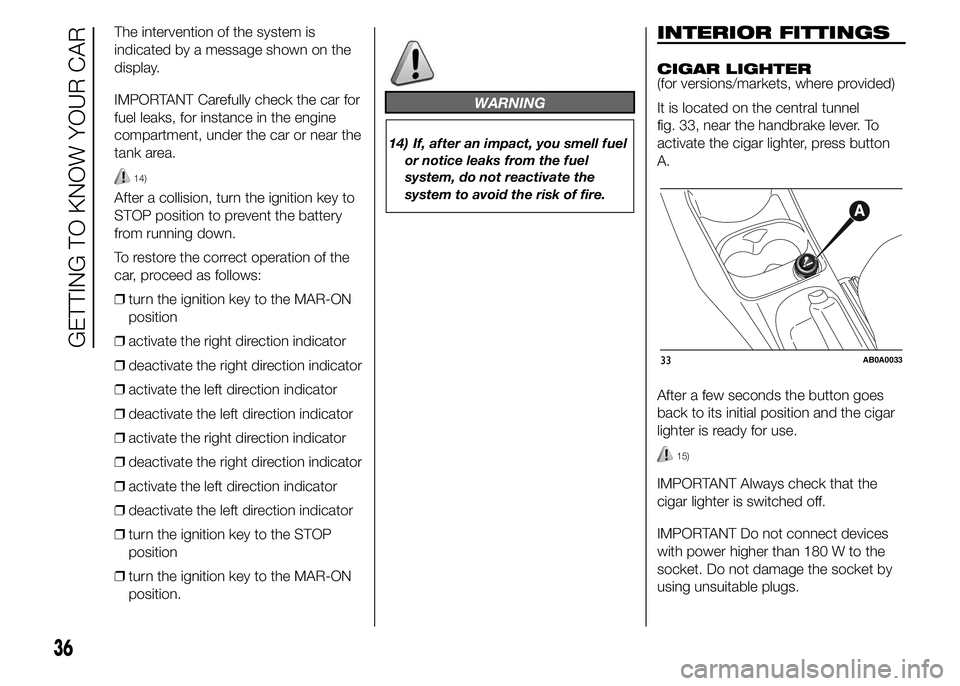
It is located on the central tunnel
fig. 33,near the handbrake lever. To
activate the cigar lighter, press button
A.
After a few seconds the button goes
back to its initial position and the cigar
lighter is ready for use.
15)
IMPORTANT Always check that the
cigar lighter is switched off.
IMPORTANT Do not connect devices
with power higher than 180 W to the
socket. Do not damage the socket by
using unsuitable plugs.
33AB0A0033
36
GETTING TO KNOW YOUR CAR
Page 60 of 215
41) The capability of the ESC system
must never be tested irresponsibly
and dangerously, in such a way
as to compromise personal safety
and the safety of others.
42) The HH system is not a parking
brake; therefore, never leave the
car without having engaged the
handbrake, turned the engine off
and engaged first gear, so that
it is parked in safe conditions (for
further information read the
"Parking" paragraph in the
"Starting and driving" chapter).
43) There may be situations on small
gradients (less than 8%), with car
laden or a trailer attached to it
(where provided), in which the HH
system may not activate, causing
a slight reversing motion and
increasing the risk of collision
with another vehicle or object.
The driver is, in any case,
responsible for safe driving.
44) The HBA system cannot increase
tyre grip on the road over the
limits imposed by laws of physics:
always drive carefully according
to the conditions of the road
surface.45) The HBA system cannot prevent
accidents, including those due to
excessive speed on bends,
travelling on low-grip surfaces or
aquaplaning.
46) The HBA system is an aid for the
driver, who must always pay full
attention while driving. The
responsibility always rests with
the driver.
47) The capability of the HBA system
must never be tested irresponsibly
and dangerously in such a way
as to compromise the safety of
the driver, occupants or other
road users.iTPMS (indirect Tyre
Pressure
Monitoring System)
(for versions/markets, where provided)
DESCRIPTION
The vehicle can be equipped with the
iTPMS (indirect Tyre Pressure
Monitoring System) which monitors the
tyre inflation status thanks to wheel
speed sensors.
To access the iTPMS ( fig. 61 - fig. 62)
screens press the TRIP button.
The fig. 62 screen will be displayed only
if one or more tyres are flat.
Correct tyre pressure
(versions with colour
display)
If pressure of all the tyres corresponds
to the correct value, the display shows
the following screen fig. 61.
56
GETTING TO KNOW YOUR CAR
Page 71 of 215
KNOWING THE INSTRUMENT PANEL
This section of the handbook gives you
all the information you need to
understand, interpret and use the
instrument panel correctly.DISPLAY ......................................... 68
MENU ITEMS .................................. 71
CONTROL PANEL AND
ON-BOARD INSTRUMENTS ........... 78
TRIP COMPUTER ........................... 80
WARNING LIGHTS AND
MESSAGES .................................... 83
- LOW BRAKE FLUID/HANDBRAKE
ENGAGED .......................................... 83
- EBD FAILURE .................................. 84
- AIRBAG FAILURE ............................. 84
- SEAT BELTS NOT FASTENED .......... 85
- ABS FAILURE ................................... 86
- PASSENGER SIDE AIRBAG
DEACTIVATED .................................... 86
- INJECTION/EOBD SYSTEM
FAILURE ............................................. 87
- ELECTRONIC STABILITY CONTROL
(ESC) SYSTEM ................................... 88
- SIDE LIGHTS AND DIPPED
HEADLIGHTS ..................................... 89
- FOLLOW ME HOME ........................ 89
- LEFT-HAND DIRECTION INDICATOR
............................................................ 89
- RIGHT-HAND DIRECTION
INDICATOR ........................................ 90
- MAIN BEAM HEADLIGHTS .............. 90
-FOG LIGHTS ..................................... 90
-REAR FOG LIGHT ............................. 90
-WORN BRAKE PADS ........................ 91
-DUALDRIVE ELECTRIC POWER
STEERING FAILURE ........................... 91
- INSUFFICIENT ENGINE OIL
PRESSURE/ENGINE OIL
DETERIORATED ................................. 92
-ENGINE OIL DETERIORATED ........... 93
- ENGINE COOLANT TEMPERATURE
TOO HIGH .......................................... 94-LOW BATTERY CHARGE .................. 95
-HILL HOLDER FAILURE .................... 95
- FIAT CODE SYSTEM FAILURE ......... 95
- FUEL RESERVE/LIMITED RANGE .... 96
- FUEL CUT-OFF ................................ 96
- FUEL CUT-OFF SYSTEM FAILURE ... 96
-INCOMPLETE DOOR LOCKING ........ 96
-EXTERIOR LIGHTS FAILURE ............. 97
-ASR SYSTEM ................................... 97
- POSSIBLE ICE ON ROAD ................ 97
- BRAKE LIGHT FAILURE ................... 97
- PARKING SENSOR FAILURE ........... 97
-iTPMS ............................................... 98
-SERVICE (SCHEDULED SERVICING)
............................................................ 99
-SPEED LIMIT EXCEEDED ................. 99
-ENGAGEMENT OF SPORT
FUNCTION ......................................... 99
67
Page 87 of 215

WARNING LIGHTS AND MESSAGES
IMPORTANT The warning light switches on on the instrument panel together with a dedicated message and/or acoustic signal
when applicable. These indications are indicative and precautionary and as such must not be considered as exhaustive and/or
alternative to the information contained in the Owner Handbook, which you are advised to read carefully in all cases. Always
refer to the information in this chapter in the event of a failure indication.
IMPORTANT Failure indications displayed are divided into two categories: serious and less serious failures. Serious faults are
indicated by a repeated and prolonged warning "cycle". Less serious faults are indicated by a warning "cycle" with a shorter
duration. The display cycle of both categories can be interrupted. The instrument panel warning light will stay on until the cause
of the malfunction is eliminated.
WARNING LIGHTS ON INSTRUMENT PANEL
Warning lights on
panelWhat it means What to do
redLOW BRAKE FLUID/HANDBRAKE ENGAGED
The warning light switches on when the key is
turned to MAR-ON, but it should switch off after a
few seconds.
Low brake fluid
The warning light switches on when the brake
fluid in the reservoir falls below the minimum level,
possibly due to a leak in the circuit.
The display shows the dedicated message.Restore the brake fluid level, then check that the
warning light has switched off.
If the warning light stays on, contact an Abarth
Dealership.
Handbrake engaged
The warning light switches on when the
handbrake is engaged. If the car is moving an
acoustic signal is also emitted on some versions.Release the handbrake, then check that the
warning light has switched off.
If the warning light stays on, contact an Abarth
Dealership.
60)
83
Page 126 of 215
STARTING THE
ENGINE
The car is fitted with an electronic
engine lock device: if the engine fails to
start, see the paragraph "Fiat CODE
system" in the "Knowing your car"
chapter.
The engine may be noisier during the
first few seconds of operation,
especially after a long period of
inactivity. This characteristic feature of
the hydraulic tappet system does
not compromise functionality or
reliability: the system chosen for your
car was designed to limit maintenance
interventions.
PROCEDURE
Proceed as follows:
❒engage the handbrake and place the
gear lever in neutral;
❒fully press the clutch pedal without
touching the accelerator;
❒turn the ignition key to AVV and
release it as soon as the engine
starts.
If the engine does not start at the first
attempt, return the ignition key to STOP
before repeating the starting procedure.If, with key at MAR-ON, the
symbol
on the display stays on together with
the
warning light on the instrument
panel, it is advisable to turn the key
to STOP and then back to MAR-ON. If
the warning light remains on, try with
the other keys provided with the car.
Contact an Abarth Dealership if you still
cannot start the engine.
17) 18)
96) 97)
WARMING UP THE
ENGINE JUST AFTER IT
HAS STARTED
Proceed as follows:
❒drive off slowly, letting the engine turn
at medium revs. Do not accelerate
abruptly;
❒do not demand full performance at
first. It is advisable to wait until the
engine coolant temperature indicator
starts moving.
19)
STOPPING THE ENGINE
Turn the ignition key to STOP while the
engine is idling.IMPORTANT After a taxing drive, you
should allow the engine to "catch
its breath" before turning it off by letting
it idle to allow the temperature in the
engine compartment to fall.
20)
IMPORTANT
17) It is advisable not to demand
maximum performance from
your car (e.g. excessive
acceleration, long distances at
maximum rpm, excessively
intense braking, etc.) when it is
first used.
18) When the engine is off, do not
leave the key turned to MAR-ON
to prevent unnecessary electrical
consumption from draining the
battery.
19) Never bump start the engine by
pushing, towing or coasting
downhill. This could cause fuel to
flow into the catalytic converter
and damage it beyond repair.
122
STARTING AND DRIVING
Page 127 of 215
20) A quick burst on the accelerator
before turning off the engine
serves absolutely no practical
purpose; it wastes fuel and is
especially damaging to
turbocharged engines.
WARNING
96) It is dangerous to run the engine
in enclosed areas. The engine
takes in oxygen and releases
carbon dioxide, carbon monoxide
and other toxic gases.
97) Remember that the brake servo
and electric power steering are
not active until the engine is
started. A much greater effort will
therefore be required to use the
brake pedal or turn the steering
wheel.
PARKING
Proceed as follows:
❒stop the engine and engage the
handbrake;
❒engage a gear (first gear if parked
uphill or reverse if facing downhill)
and leave the wheels turned.
Block the wheels with a wedge or a
stone if the car is parked on a steep
slope.
Do not leave the ignition key on
MAR-ON to avoid draining the battery.
Always remove the key when you
leave the car.
98)
HANDBRAKE
The handbrake lever fig. 94 is located
between the two front seats.To use the handbrake pull the lever
upwards until the car cannot be moved.
99)
When the handbrake is on and the
ignition key is at MAR-ON, the
instrument panel warning light
will
come on.
Proceed as follows to release the
handbrake:
❒slightly lift the lever and press release
button A fig. 94;
❒keep button A pressed and lower the
lever. The
warning light in the
instrument panel will switch off.
Press the brake pedal when carrying
out this operation to prevent the car
from moving accidentally.
WARNING
98) Never leave children unattended
in the car. Always remove the
ignition key when leaving the car
and take it out with you.
99) The car should be braked after a
few clicks of the lever. If it is not,
contact an Abarth Dealership
to have it adjusted.
94AB0A0076
123
Page 132 of 215
CAR INACTIVITY
If the car is to be left inactive for longer
than a month, the following precautions
should be noted:
❒park the car in covered, dry and if
possible well-ventilated premises and
slightly open the windows;
❒check that the handbrake is not
engaged;
❒engage a gear;
❒disconnect the negative battery
terminal and check the battery
charge. Repeat this check once
every three months during storage;
❒if the battery is not disconnected
from the electrical system, check
its state of charge every thirty days;
❒clean and protect the painted parts
using protective wax;
❒clean and protect the shiny metal
parts using special compounds
available commercially;
❒sprinkle talcum powder on the
windscreen and rear window wiper
rubber blades and lift them off the
glass;❒cover the car with a cloth or
perforated plastic sheet. Do not use
compact plastic sheets which do
not allow humidity to evaporate from
the surface of the car;
❒inflate tyres to +0.5 bar above the
standard prescribed pressure and
check it periodically;
❒do not drain the engine cooling
system;
128
STARTING AND DRIVING
Page 135 of 215

"Fix&Go Automatic"
kit
The kit (see fig. 97) in the luggage
compartment consists of:
❒a spray bottle A with the sealant,
equipped with filling pipe B,
separated by the compressor C;
❒compressor C with pressure gauge,
fitting valve to couple the bottle A,
cable with supply socket D and pipe
N to restore pressure (this is inside
the body as shown);
❒adhesive label under the spray bottle
A, with the message "max. 80 km/h"
to be placed where the driver can
easily see it (for example on the
dashboard) after repairing the tyre;
❒instruction booklet fig. 98, for using
the Fix&Go quickly and correctly;
❒a pair of protective gloves.
24)
105) 106) 107)
IMPORTANT
INFORMATION
The sealant of the Fix&Go kit is effective
at external temperatures of between
-20°C and +50°C.
The sealant has an expiry date.
108) 109)
2)
INFLATION PROCEDURE
110)
Proceed as follows:
❒engage the handbrake;
❒place the Fix&Go kit close to the tyre
to be repaired;
❒locate the fig. 100 filling pipe B
already connected to the spray bottle
A;
❒open the side lid E then connect the
spray bottle A to the fitting, following
the direction of the arrow;
❒undo the cap of the tyre valve F and
connect the filling pipe B, tightening
the relevant ring nut on the tyre valve;
❒make sure that the switch G fig. 101
is in position0(off), then start the
engine;
❒place the electric plug H fig. 102 in
the cigar lighter socket of the car
(12 V);
97AB0A0079
98AB0A0080
ON
OFF
99AB0A0081
131