light Acura Integra 2001 Workshop Manual
[x] Cancel search | Manufacturer: ACURA, Model Year: 2001, Model line: Integra, Model: Acura Integra 2001Pages: 285, PDF Size: 3.79 MB
Page 157 of 285

Towin
g a Traile r
Trailer Brakes
Acura recommends that any trailer having a total weight of 1,000 Ibs (450 kg) or more be equipped with
its own electric or surge-type brakes.
If you choose electric brakes, besure they are electronically actuated.
Do not attempt to tap into your
vehicle's hydraulic system. No matter how successful it may seem,any attempt to attach trailer brakes
to your vehicle's hydraulic system
will lower braking effectiveness and create a potential hazard.
Trailer Lights
If you use a converter, you can get
the connector and pins that mate
with the connector in your vehicle from your Acura dealer.
Your vehicle has a trailer lighting connector located behind the leftside panel in the cargo area. Refer to
the drawing above for the wiring color code and purpose of each pin. Since lighting and wiring vary in
trailer type and brand, you should also have a qualified mechanic install
a suitable connector between the
vehicle and the trailer.
Drivin g
GROUN
D
(BLACK )
BACK-U
P LIGH T
(GREEN/BLACK )LEF
T TUR N SIGNA L
(GREEN/BLUE )
TAILLIGH T
(RED/BLACK )
BRAK
E LIGH T
(GREEN/WHITE )
RIGH
T TUR N SIGNA L
(GREEN/YELLOW )
Page 158 of 285

Towin
g a Traile r
Additional Trailer Equipment
Many states and Canadian provinces
require special outside mirrors when
towing a trailer. Even if they don't,
you should install special mirrors if
you cannot clearly see behind you, or if the trailer creates a blind spot.
Ask your trailer sales or rental agency if any other items are
recommended or required for your
towing situation.
Pre-To
w Checklis t
When preparing to tow, and before driving away, be sure to check the
following: The vehicle has been properly
serviced, and the tires, brakes,
suspension, and cooling system
are in good operating condition. All weights and loads are within
limits (see pages 151 and 152). The hitch, safety chains, and any
other attachments are secure. All items on and in the trailer are
properly secured and cannot shift
while you drive. The lights and brakes on your
vehicle and the trailer are workingproperly. Your vehicle tires and spare are
properly inflated (see page 255),and the trailer tires and spare are
inflated as recommended by the
trailer maker.
Driving
Page 162 of 285
Maintenanc
e
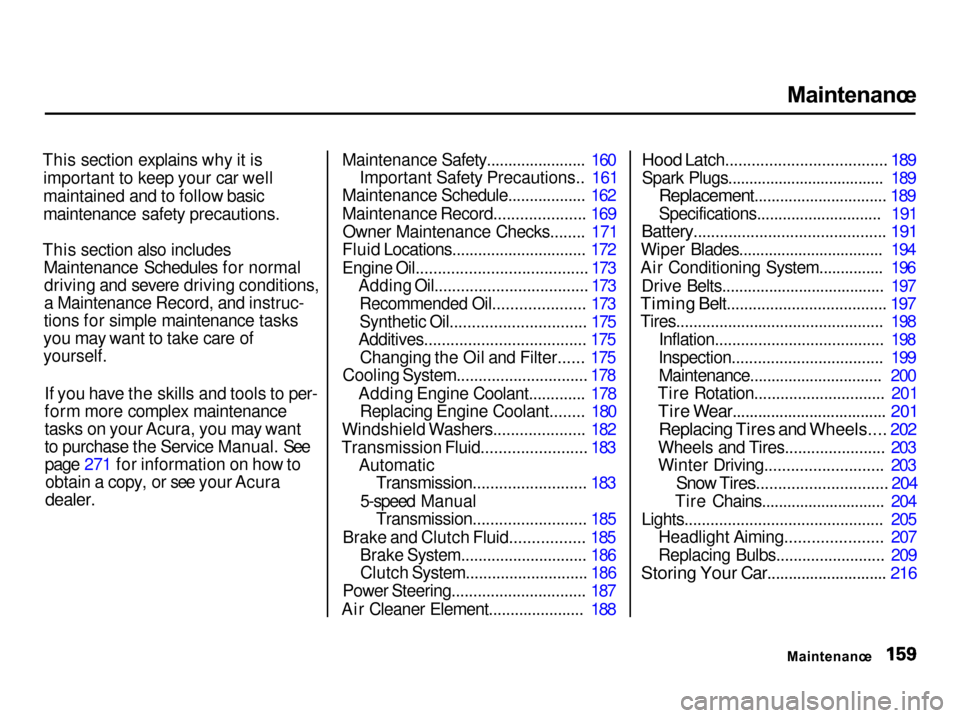
This section explains why it is important to keep your car well
maintained and to follow basic
maintenance safety precautions.
This section also includes Maintenance Schedules for normaldriving and severe driving conditions,
a Maintenance Record, and instruc-
tions for simple maintenance tasks
you may want to take care of
yourself.
If you have the skills and tools to per-
form more complex maintenance
tasks on your Acura, you may want
to purchase the Service Manual. Seepage 271 for information on how toobtain a copy, or see your Acura
dealer.
Maintenance Safety....................... 160
Important Safety Precautions.. 161
Maintenance Schedule.................. 162
Maintenance Record..................... 169
Owner Maintenance Checks........ 171
Fluid Locations............................... 172
Engine Oil....................................... 173 Adding Oil................................... 173
Recommended Oil..................... 173
Synthetic Oil............................... 175
Additives..................................... 175
Changing the Oil and Filter...... 175
Cooling System.............................. 178
Adding Engine Coolant............. 178Replacing Engine Coolant........ 180
Windshield Washers..................... 182
Transmission Fluid........................ 183 AutomaticTransmission.......................... 183
5-speed Manual Transmission.......................... 185
Brake and Clutch Fluid................. 185 Brake System............................. 186Clutch System............................ 186
Power Steering............................... 187
Air Cleaner Element...................... 188
Hood Latch..................................... 189
Spark Plugs..................................... 189
Replacement............................... 189
Specifications............................. 191
Battery............................................ 191
Wiper Blades.................................. 194
Air Conditioning System............... 196
Drive Belts...................................... 197
Timing Belt..................................... 197
Tires................................................ 198
Inflation....................................... 198
Inspection................................... 199 Maintenance............................... 200
Tire Rotation.............................. 201
Tire Wear.................................... 201
Replacing Tires and Wheels.... 202
Wheels and Tires....................... 203
Winter Driving........................... 203
Snow Tires.............................. 204
Tire Chains............................. 204
Lights.............................................. 205 Headlight Aiming...................... 207
Replacing Bulbs......................... 209
Storing Your Car............................ 216
Maintenance
Page 174 of 285
Owne
r Maintenanc e Check s
You should check the following items at the specified intervals. If
you are unsure of how to perform any check, turn to the page given. Engine oil level — Check every
time you fill the fuel tank. See page 127. Engine coolant level — Check the
radiator reserve tank every time
you fill the fuel tank. See page 128. Windshield washer fluid — Check
the level in the reservoir monthly.If weather conditions cause you to
use the washers frequently, check
the reservoir each time you stop
for fuel. See page 182. Automatic transmission — Check
the fluid level monthly. See page
183.
Brakes — Check the fluid level
monthly. See page 185. Tires — Check the tire pressure
monthly. Examine the tread for
wear and foreign objects. See page
198.
Lights — Check the operation of
the headlights, parking lights,
taillights, high-mount brake light,
turn signals, brake lights, and
license plate lights monthly. See
page 205.
Maintenance
Page 180 of 285
Engin
e Oi l
5. Put a new washer on the drain bolt, then reinstall the drain bolt.
Tighten it to:33 Ibf.ft (44 N.m , 4.5 kgf.m)
6. Refil
l the engine with the recom-
mended oil.
Engine oil change capacity
(including filter):
(SE,
LS,
GS)
4.0 US qt (3.8 ,3.3 Imp qt)
(GS-R,Type-R)
4.2 US qt (4.0 , 3.5 Imp qt)
7. Replac
e the engine oil fill cap.
Start the engine. The oil pressure
indicator light should go out within
five seconds. If it does not, turn off
the engine and reinspect your
work.
8. Let the engine run for several minutes and check the drain boltand oil filter for leaks.
9. Turn off the engine, let it sit for several minutes, then check the oil
level. If necessary, add oil to bring
the level to the upper mark on the
dipstick.
Improper disposal of engine oil can be
harmful to the environment. If you
change your own oil, please dispose ofthe used oil properly. Put it in a sealed
container and take it to a recycling center. Do not discard it in a trash bin
or dump it on the ground.
Maintenance
NOTIC
E
Page 186 of 285

Windshiel
d Washers , Transmissio n Flui d
The windshield washer reservoir is located behind the driver's side
headlight. Check the reservoir's fluid
level by removing the cap and
looking at the level gauge attached
to the
cap.
Fill the reservoir with a good-quality
windshield washer fluid. This increases the cleaning capability and
prevents freezing in cold weather. When you refill the reservoir, clean
the edges of the windshield wiper
blades with windshield washer fluidon a clean cloth. This will help to
condition the blade edges.
Do not use engine antifreeze or a vinegar/water solution in the
windshield washer reservoir.
Antifreeze can damage your car's paint, while a vinegar/water solution can
damage the windshield washer pump.
Use only commercially-available
windshield washer fluid.
Automati
c Transmissio n
Check the fluid level with the engine
at normal operating temperature.
1. Park the car on level ground. Shut off the engine.
2. Remove the dipstick (yellow loop) from the transmission and wipe it
with a clean cloth.
CONTINUED
Maintenanc e
DIPSTIC
K
LEVE L GAUG E
WINDSHIEL
D WASHE R RESERVOI R
NOTICE
Page 199 of 285

Ai
r Conditionin g Syste m
Optional for Canadian Type-R model
Your car's air conditioning is a sealed system. Any major maintenance,
such as recharging, should be done
by a qualified mechanic. You can do a couple of things to make sure the
air conditioning works efficiently. Periodically check the engine's
radiator and air conditioning condenser for leaves, insects, and
dirt stuck to the front surface. These
block the air flow and reduce cooling efficiency. Use a light spray from a
hose or a soft brush to remove them.
The condenser and radiator fins bend
easily. Only use a low-pressure spray
or soft-bristle brush to clean them.
Run the air conditioning at least once a week during the cold weather
months. Run it for at least ten
minutes while you are driving at asteady speed with the engine at
normal operating temperature. This circulates the lubricating oil con-
tained in the refrigerant. If the air conditioning does not get as
cold as before, have your dealer
check the system. Recharge the
system with Refrigerant HFC-134a
(R-134a). (See Specifications on page 254.)
Whenever you have the air conditioning
system serviced, make sure the service
facility uses a refrigerant recycling
system. This system captures the
refrigerant for reuse. Releasing
refrigerant into the atmosphere can
damage the environment.
Maintenanc e
NOTIC
E
NOTIC E
AI
R CONDITIONIN G
CONDENSE R
Page 208 of 285

Light
s
Check the operation of your car's
exterior lights at least once a month.
A burned out bulb can create an unsafe condition by reducing yourcar's visibility and the ability tosignal your intentions to other
drivers. HEADLIGH
T HIG H BEA M HEADLIGHT LO W BEA M
PARKING/TUR N SIGNA L LIGH T SIDE MARKE R LIGH T
Maintenanc e
CONTINUED
Page 209 of 285
Light
s
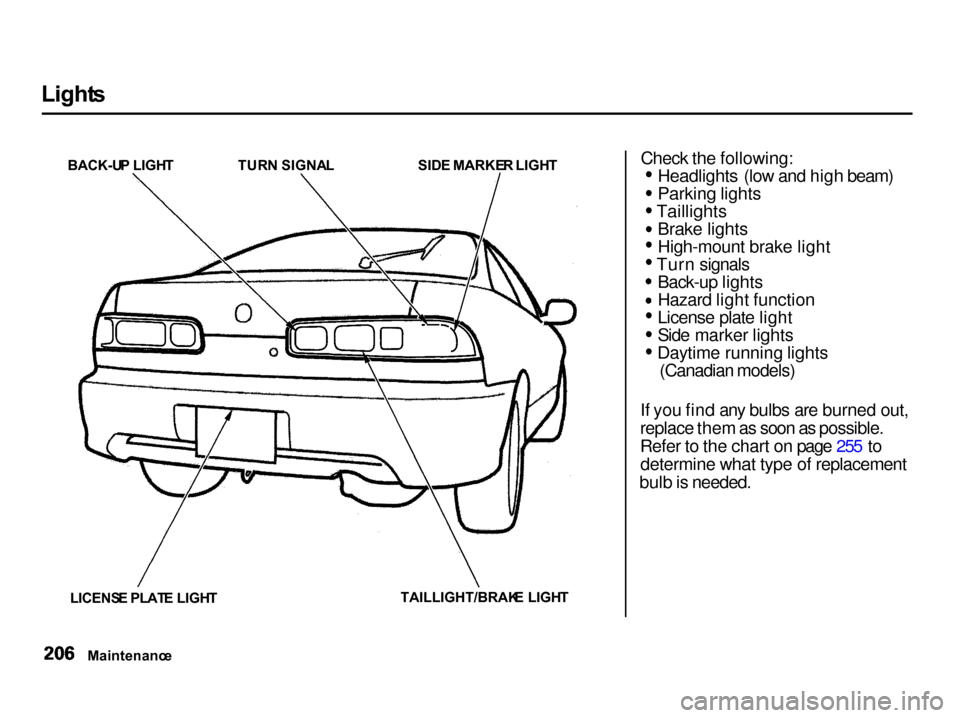
BACK-U P LIGH T TURN SIGNA L
SIDE MARKE R LIGH T
LICENS E PLAT E LIGH T TAILLIGHT/BRAK
E LIGH T
Check the following:
Headlights (low and high beam) Parking lights
Taillights
Brake lights
High-mount brake light
Turn signals
Back-up lights
Hazard light function
License plate light
Side marker lights
Daytime running lights
(Canadian models)
If you find any bulbs are burned out,
replace them as soon as possible.
Refer to the chart on page 255 to determine what type of replacement
bulb is needed.
Maintenanc e
Page 210 of 285

Light
s
Headligh t Aimin g
The headlights were properly aimed when your car was new. You should check their aim if you regularly carry
heavy items in the cargo area or pull a trailer. Each headlight assembly
has horizontal and vertical adjust- ment indicators. These are set to
their "0" positions after the head-
lights are aimed at the factory. To check these settings:
1. Make sure the fuel tank is full. Park the car on level ground.
2. The driver or someone who weighs the same should be sittingin the driver's seat for all checksand adjustments.
Load your vehicle with the items
you normally carry.
If you usually pull a trailer, load it as
you would normally and attach it to the car. Push down on the front andrear bumpers several times to makesure the car is sitting normally. 4. Check the horizontal angle gauge.
The line on the adjustment screwindicator should line up with the
"0" mark on the gauge.
CONTINUED
Maintenanc e
HORIZONTA
L ANGL E GAUG E
Lef t headligh tRigh
t headligh t
3. Open the hood.