sensor ACURA NSX 1991 Service Repair Manual
[x] Cancel search | Manufacturer: ACURA, Model Year: 1991, Model line: NSX, Model: ACURA NSX 1991Pages: 1640, PDF Size: 60.48 MB
Page 1403 of 1640
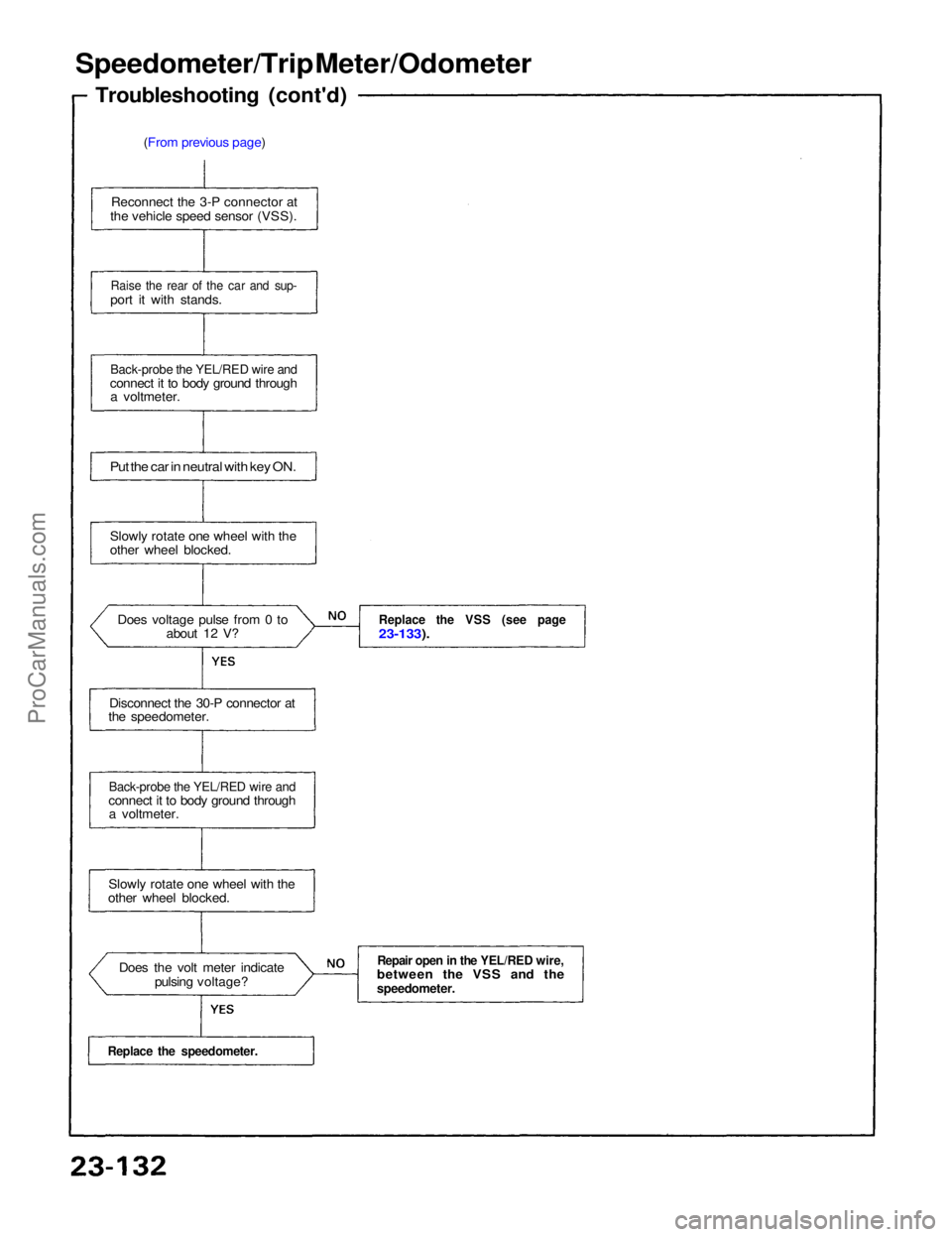
Speedometer/Trip Meter/Odometer
Troubleshooting (cont'd)
(From previous page)
Reconnect the 3-P connector at
the vehicle speed sensor (VSS).
Raise the rear of the car and sup-
port it with stands.
Back-probe the YEL/RED wire and
connect it to body ground through a voltmeter.
Put the car in neutral with key ON.
Slowly rotate one wheel with the
other wheel blocked. Does voltage pulse from 0 to about 12 V?
Disconnect the 30-P connector at
the speedometer.
Back-probe the YEL/RED wire and
connect it to body ground through a voltmeter.
Slowly rotate one wheel with the
other wheel blocked.
Does the volt meter indicate pulsing voltage?
Replace the speedometer.
Repair open in the YEL/RED wire,
between the VSS and the
speedometer.
Replace the VSS (see page
23-133).ProCarManuals.com
Page 1404 of 1640
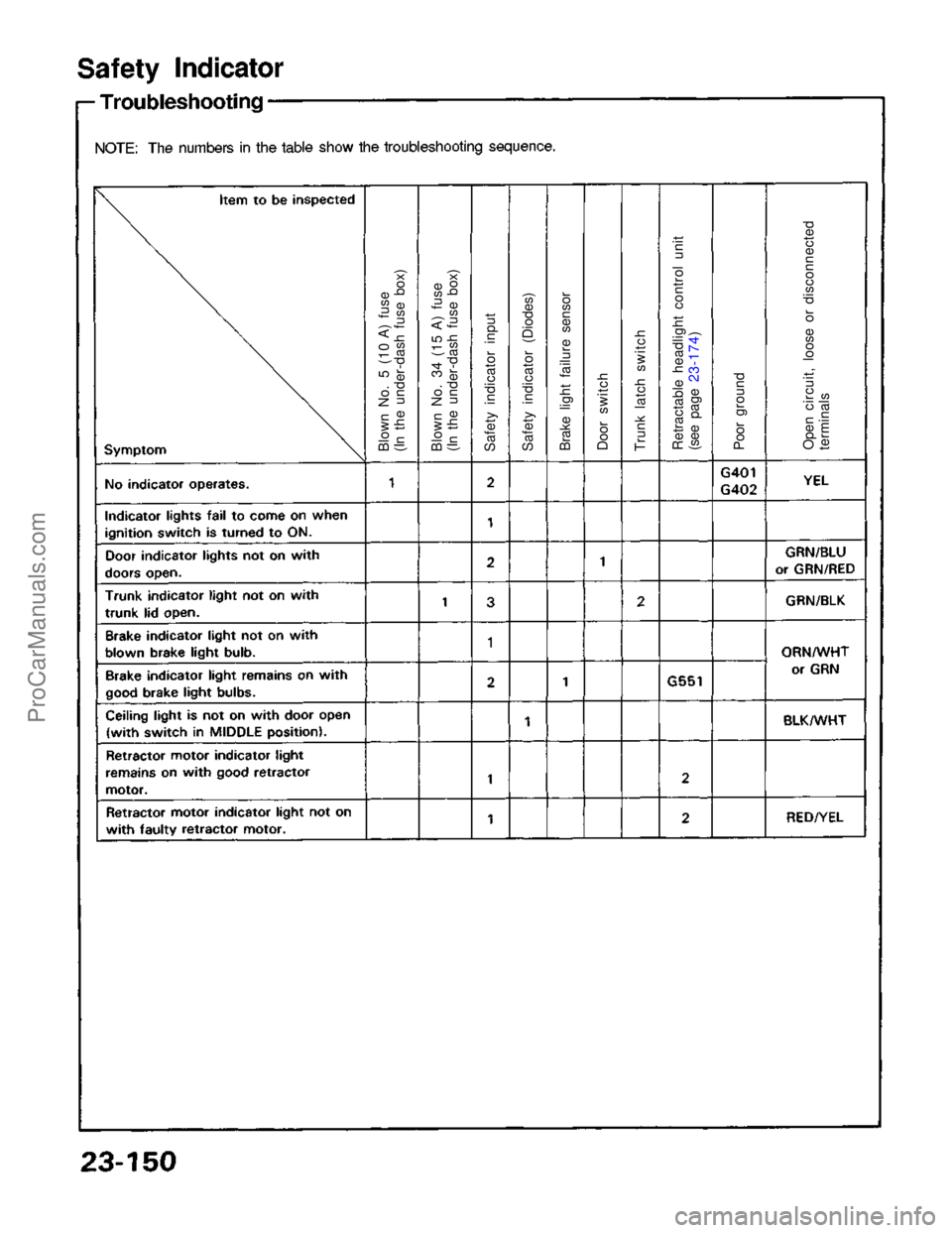
Blown No. 5 (10 A) fuse
(In the under-dash fuse box)
Blown No. 34 (15 A) fuse
(In the under-dash fuse box)
Safety indicator input
Safety indicator (Diodes)Brake light failure sensorDoor switch
Trunk latch switch
Retractable headlight control unit
(see page 23-174)
Poor ground
Open circuit, loose or disconnected
terminalsProCarManuals.com
Page 1438 of 1640
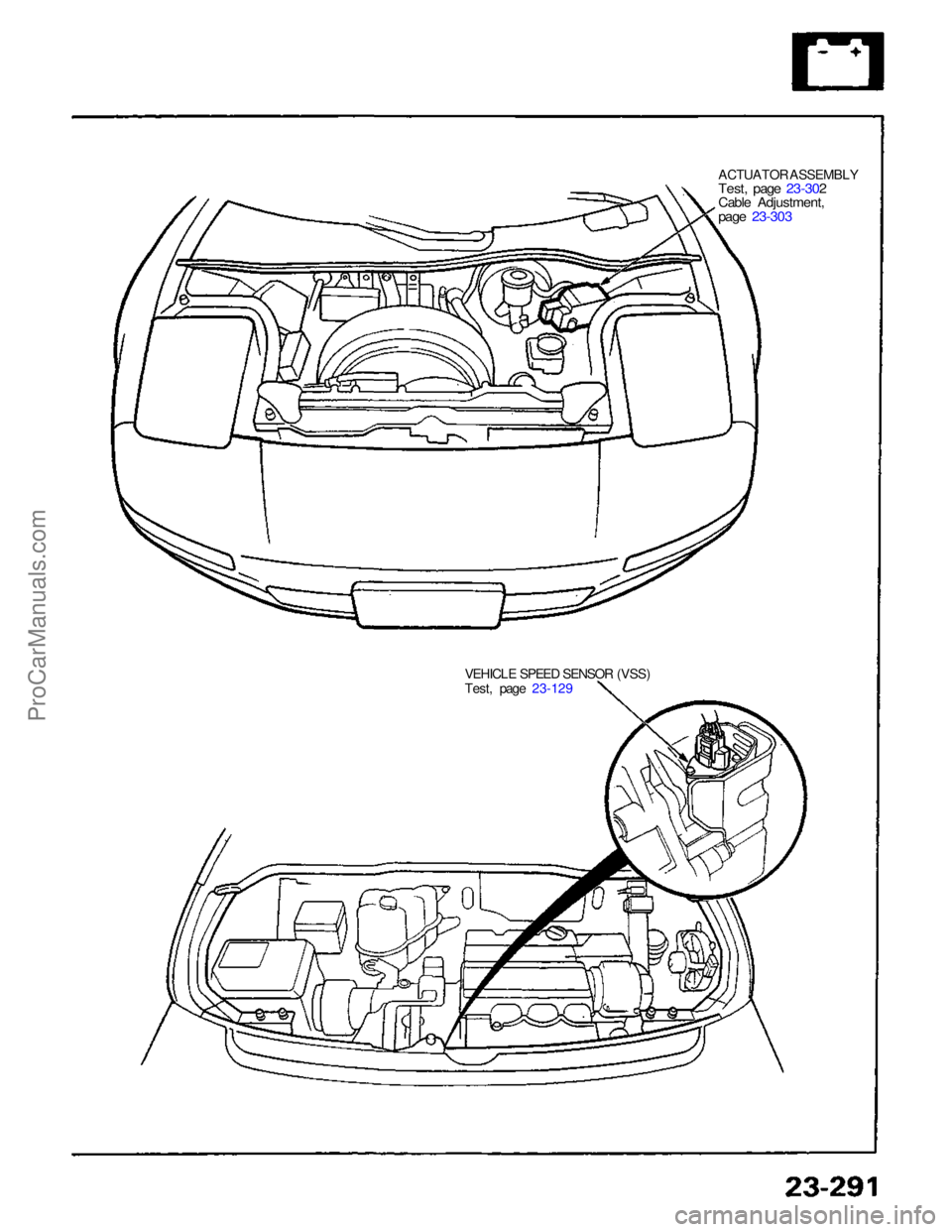
ACTUATOR ASSEMBLY
Test, page 23-302
Cable Adjustment,
page 23-303
VEHICLE SPEED SENSOR (VSS)
Test, page 23-129ProCarManuals.com
Page 1439 of 1640
Cruise Control
Description
The cruise control system uses mechanically and elec-
trically operated devices to maintain vehicle speed at a
setting selected by the driver.
The cruise control unit receives command signals from
the cruise control main switch and the cruise control
set/resume switch. It receives information about
operating conditions from the brake switch, ECM, vehi-
cle speed sensor (VSS), the clutch switch (with manual
transmission), or the A/T gear position switch (with
automatic transmission). The cruise control unit sends
operational signals to the devices that regulate the
throttle position. The throttle position maintains the
selected vehicle speed. Essentially, the control unit
compares the actual speed of the vehicle to the
selected speed. Then, the control unit uses the result of
that comparison to open or close the throttle.
The brake switch releases the system's control of the
throttle at the instant the driver depresses the brake
pedal. The switch sends an electronic signal to the con-
trol unit when the brake pedal is depressed; the control
unit responds by allowing the throttle to close. The
clutch switch (manual transmission) or the A/T gear
position switch (automatic transmission) sends a
disengage signal to the control unit that also allows the
throttle to close.
Operation:
The cruise control system will set and automatically
maintain any speed above 30 mph (45 kph). To set,
make sure that the main switch is in the "ON" position.
After reaching the desired speed, press the set switch.
The cruise control unit will receive a set signal and, in
turn, will actuate the cruise control actuator. When the
set switch is depressed and the cruise control system is
on, the "cruise control" ON indicator in the gauge
assembly will light up. You can cancel the cruise control
system by pushing the main switch to "OFF". This
removes power to the control unit and erases the set
speed from memory. If the system is disengaged tem-
porarily by the brake switch, clutch switch, or A/T gear
position switch and vehicle speed is still above 30 mph,
press the resume switch. With the resume switch
depressed and the set memory retained, the vehicle
automatically returns to the previous set speed.
For gradual acceleration without depressing the ac-
celerator pedal, push the resume switch down and hold
it there until the desired speed is reached. This will send
an acceleration signal to the control unit. When the
switch is released, the system will be reprogrammed for
the new speed. To slow down, depress the set switch.
This will send a deceleration signal to the control unit
causing the car to coast until the desired speed is reach-
ed. When the desired speed is reached, release the set
switch. This will reprogram the system for the new
speed.ProCarManuals.com
Page 1464 of 1640
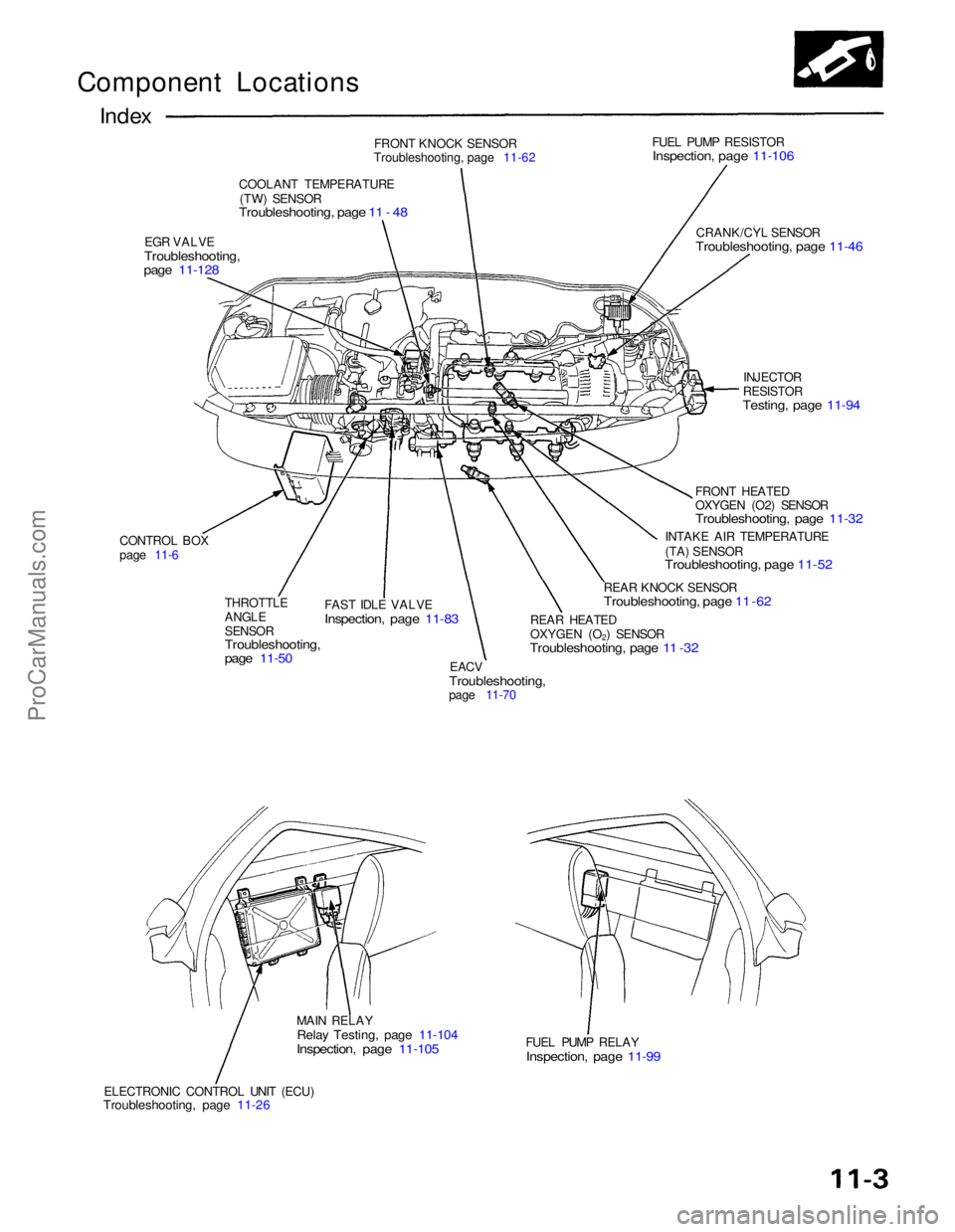
Component Locations
Index
FRONT KNOCK SENSOR
Troubleshooting, page 11-62
COOLANT TEMPERATURE (TW) SENSOR
Troubleshooting, page 11 - 48
EGR VALVE
Troubleshooting,
page 11-128
FUEL PUMP RESISTOR
Inspection, page 11-106
CRANK/CYL SENSOR
Troubleshooting, page 11-46
CONTROL BOX
page 11-6 THROTTLE
ANGLE
SENSOR
Troubleshooting,
page 11-50
FAST IDLE VALVE
Inspection, page 11-83
EACV
Troubleshooting,
page 11-70 INJECTOR
RESISTOR
Testing, page 11-94
FRONT HEATED
OXYGEN (O2) SENSOR
Troubleshooting, page 11-32
INTAKE AIR TEMPERATURE
(TA) SENSOR
Troubleshooting, page 11-52
REAR KNOCK SENSOR
Troubleshooting, page 11 -62
REAR HEATED
OXYGEN (O2) SENSOR
Troubleshooting, page 11 -32
MAIN RELAY
Relay Testing, page 11-104
Inspection, page 11-105
ELECTRONIC CONTROL UNIT (ECU)
Troubleshooting, page 11-26
FUEL PUMP RELAY
Inspection, page 11-99ProCarManuals.com
Page 1466 of 1640
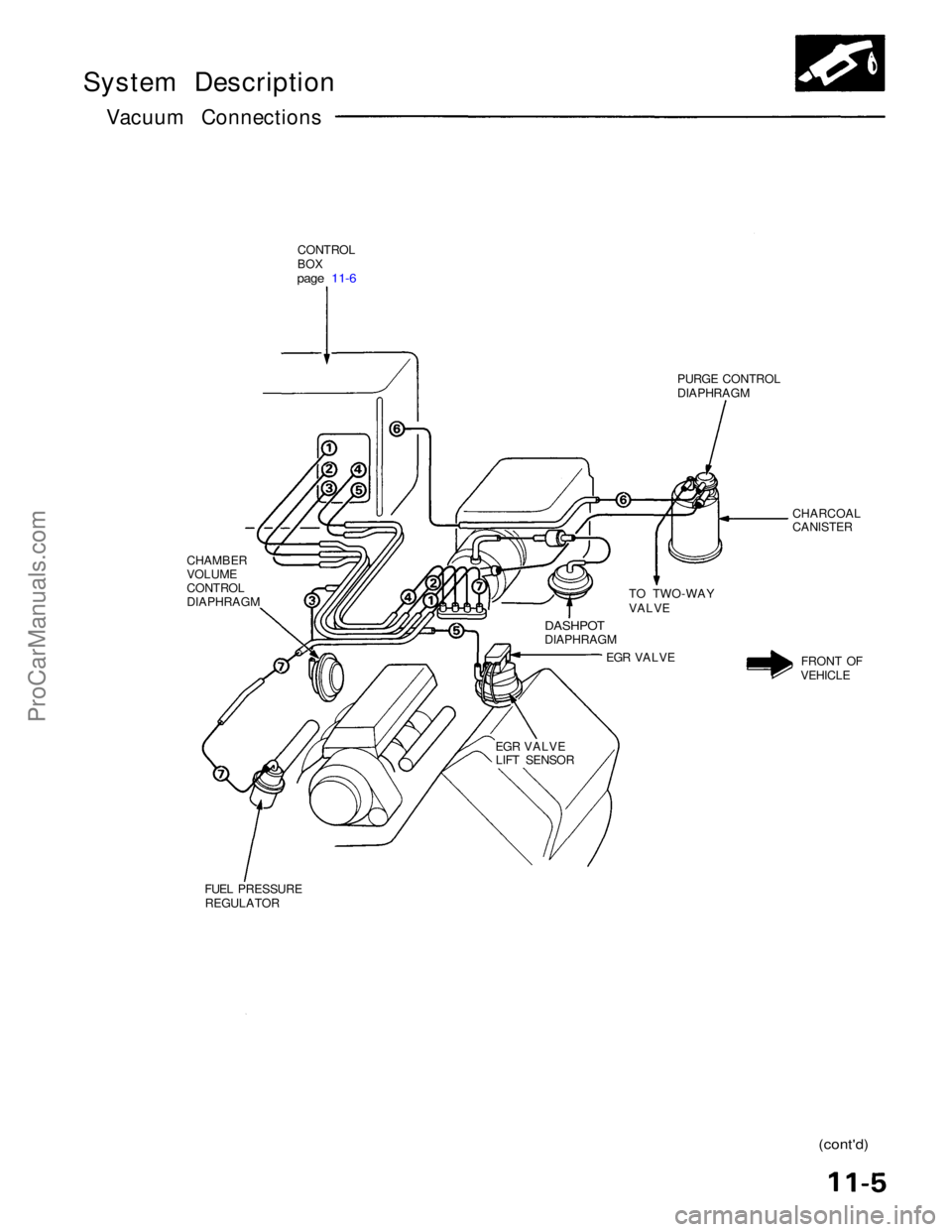
System Description
Vacuum Connections
CONTROL
BOX
page 11-6
PURGE CONTROL
DIAPHRAGM
CHARCOAL
CANISTER
TO TWO-WAY
VALVE
CHAMBER
VOLUME
CONTROL
DIAPHRAGM
DASHPOT
DIAPHRAGMEGR VALVE FRONT OF
VEHICLE
EGR VALVE LIFT SENSOR
FUEL PRESSURE
REGULATOR
(cont'd)ProCarManuals.com
Page 1467 of 1640
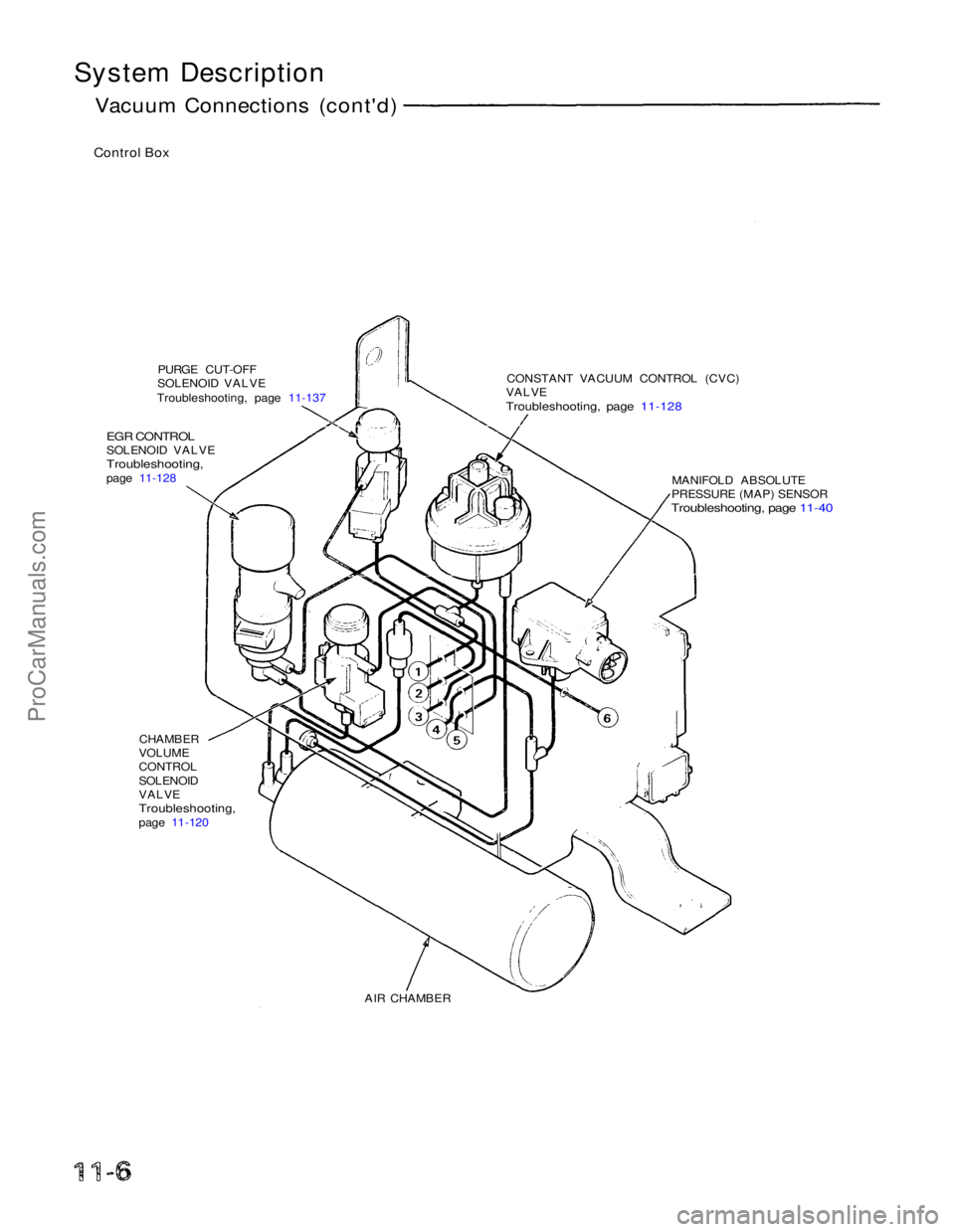
System Description
Vacuum Connections (cont'd)
Control Box
PURGE CUT-OFF
SOLENOID VALVE
Troubleshooting, page 11-137 CONSTANT VACUUM CONTROL (CVC)
VALVE
Troubleshooting, page 11-128
EGR CONTROL
SOLENOID VALVE
Troubleshooting,
page 11-128 MANIFOLD ABSOLUTE
PRESSURE (MAP) SENSOR
Troubleshooting, page 11-40
CHAMBER
VOLUME
CONTROL
SOLENOID
VALVE
Troubleshooting,
page 11-120
AIR CHAMBERProCarManuals.com
Page 1468 of 1640
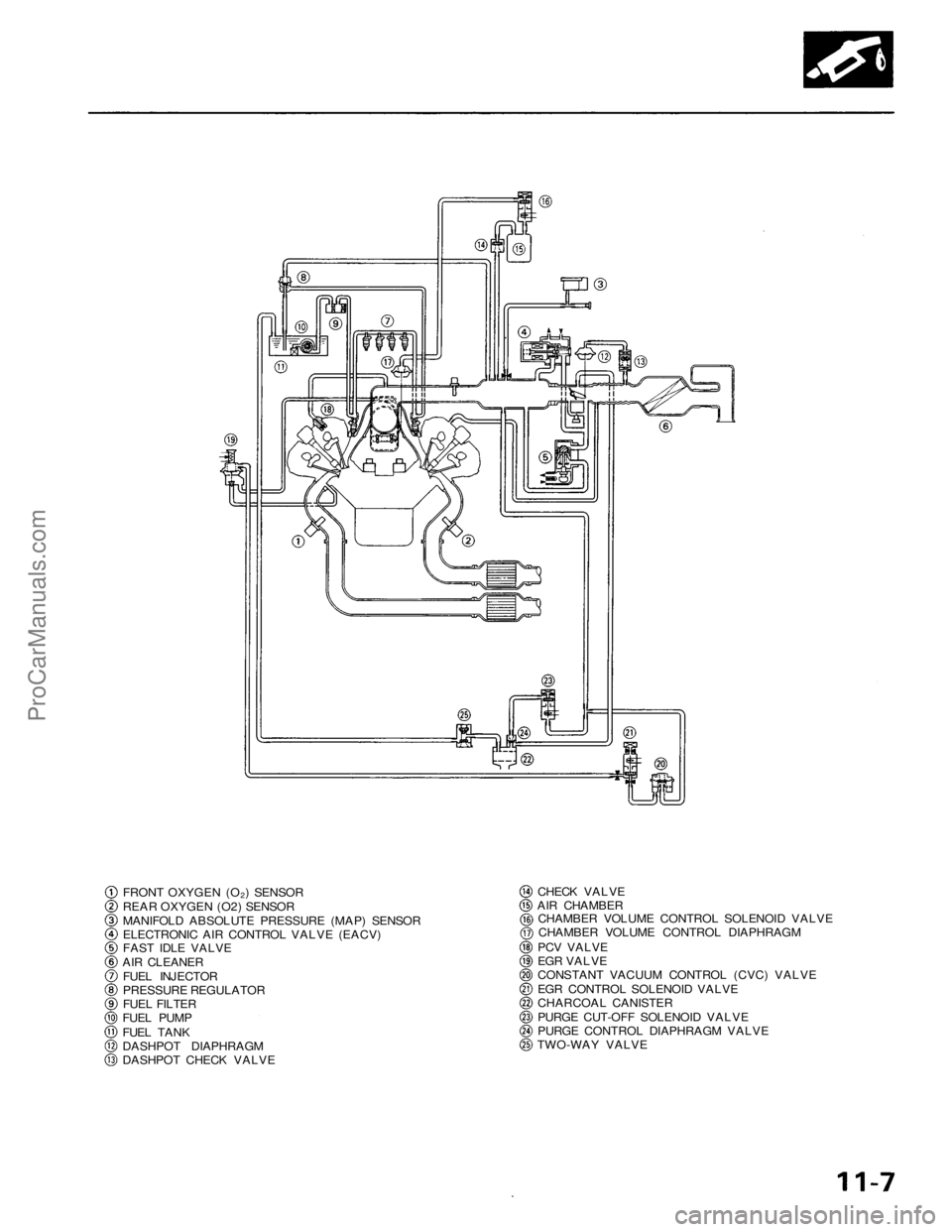
CHECK VALVE
AIR CHAMBER
CHAMBER VOLUME CONTROL SOLENOID VALVE
CHAMBER VOLUME CONTROL DIAPHRAGM
PCV VALVE
EGR VALVE
CONSTANT VACUUM CONTROL (CVC) VALVE
EGR CONTROL SOLENOID VALVE
CHARCOAL CANISTER
PURGE CUT-OFF SOLENOID VALVE
PURGE CONTROL DIAPHRAGM VALVE
TWO-WAY VALVE
FRONT OXYGEN (O2) SENSOR
REAR OXYGEN (O2) SENSOR
MANIFOLD ABSOLUTE PRESSURE (MAP) SENSOR
ELECTRONIC AIR CONTROL VALVE (EACV)
FAST IDLE VALVE
AIR CLEANER
FUEL INJECTOR
PRESSURE REGULATOR
FUEL FILTER
FUEL PUMP
FUEL TANK
DASHPOT DIAPHRAGM
DASHPOT CHECK VALVEProCarManuals.com
Page 1480 of 1640
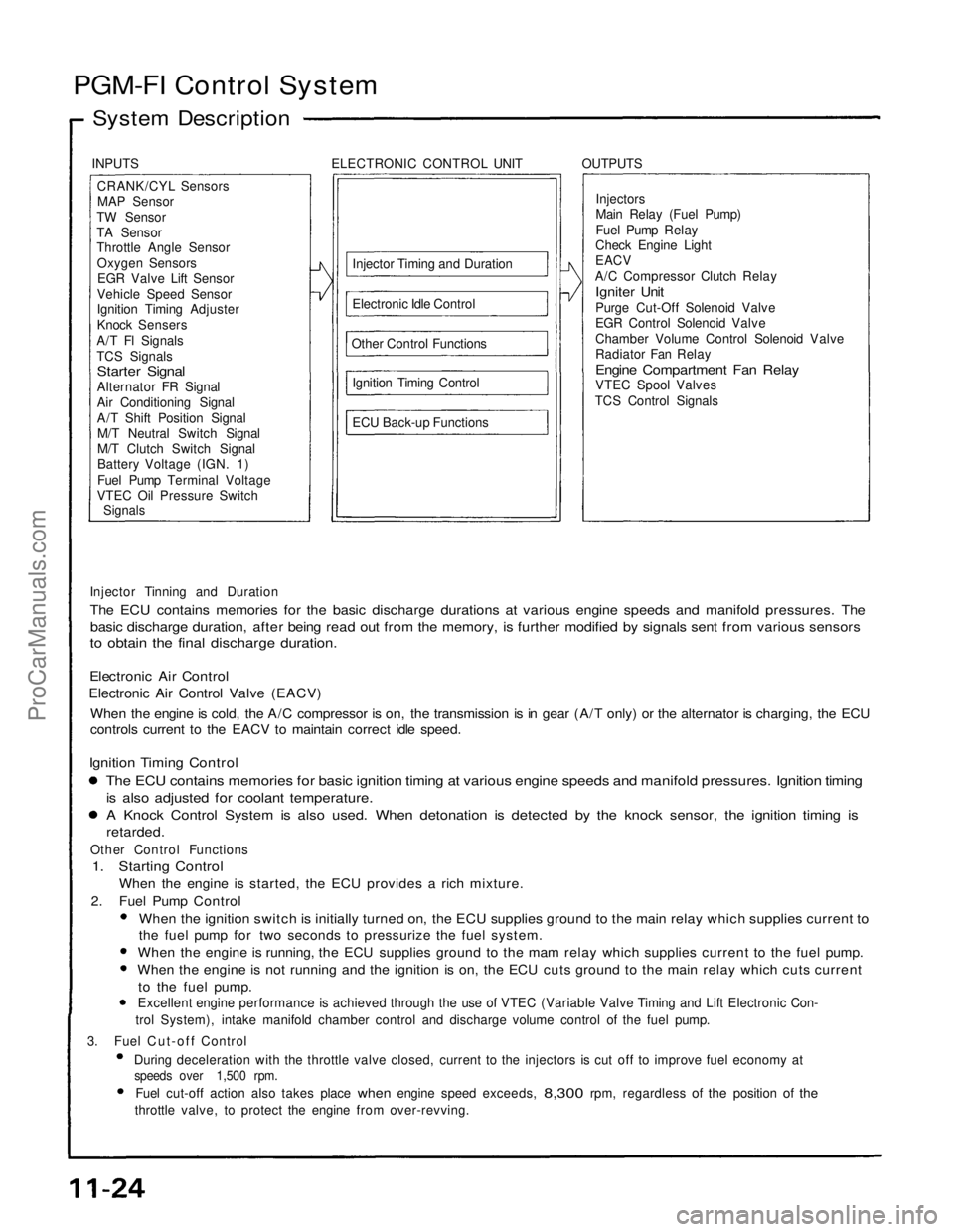
PGM-FI Control System
System Description
INPUTS ELECTRONIC CONTROL UNIT OUTPUTSCRANK/CYL SensorsMAP Sensor
TW Sensor
TA Sensor
Throttle Angle Sensor Oxygen SensorsEGR Valve Lift Sensor
Vehicle Speed Sensor
Ignition Timing Adjuster
Knock Sensers
A/T Fl Signals
TCS Signals
Starter Signal
Alternator FR Signal
Air Conditioning Signal
A/T Shift Position Signal M/T Neutral Switch Signal
M/T Clutch Switch Signal
Battery Voltage (IGN. 1)
Fuel Pump Terminal Voltage
VTEC Oil Pressure Switch
Signals
Injector Timing and Duration
Electronic Idle Control
Other Control Functions Ignition Timing Control
ECU Back-up Functions Injectors
Main Relay (Fuel Pump)
Fuel Pump Relay
Check Engine Light
EACV
A/C Compressor Clutch Relay
Igniter Unit
Purge Cut-Off Solenoid Valve
EGR Control Solenoid Valve
Chamber Volume Control Solenoid Valve
Radiator Fan Relay
Engine Compartment Fan Relay
VTEC Spool Valves
TCS Control Signals
Injector Tinning and Duration
The ECU contains memories for the basic discharge durations at various engine speeds and manifold pressures. The
basic discharge duration, after being read out from the memory, is further modified by signals sent from various sensors
to obtain the final discharge duration.
Electronic Air Control
Electronic Air Control Valve (EACV)
When the engine is cold, the A/C compressor is on, the transmission is in gear (A/T only) or the alternator is charging, the ECU
controls current to the EACV to maintain correct idle speed.
Ignition Timing Control
The ECU contains memories for basic ignition timing at various engine speeds and manifold pressures. Ignition timing
is also adjusted for coolant temperature.
A Knock Control System is also used. When detonation is detected by the knock sensor, the ignition timing is
retarded.
Other Control Functions
1. Starting Control
When the engine is started, the ECU provides a rich mixture.
2. Fuel Pump Control
When the ignition switch is initially turned on, the ECU supplies ground to the main relay which supplies current to
the fuel pump for two seconds to pressurize the fuel system.
When the engine is running, the ECU supplies ground to the mam relay which supplies current to the fuel pump.
When the engine is not running and the ignition is on, the ECU cuts ground to the main relay which cuts current
to the fuel pump.
Excellent engine performance is achieved through the use of VTEC (Variable Valve Timing and Lift Electronic Con-
trol System), intake manifold chamber control and discharge volume control of the fuel pump.
3. Fuel Cut-off Control During deceleration with the throttle valve closed, current to the injectors is cut off to improve fuel economy at
speeds over 1,500 rpm.
Fuel cut-off action also takes place
when
engine speed exceeds,
8,300
rpm, regardless
of the
position
of the
throttle valve, to protect the engine from over-revving.ProCarManuals.com
Page 1481 of 1640
4. A/C Compressor Clutch Relay
When the ECU receives a demand for cooling from the air conditioning system (compressor control unit), it delays
the compressor from being energized, and enriches the mixture to assure smooth transition to the A/C mode.
5. Purge Cut-off Solenoid Valve
When the coolant temperature is below 70 °C (158 °F), the ECU supplies a ground to the purge cut-off solenoid valve
which cuts vacuum to the purge control valve.
6. Chamber Volume Control Solenoid Valve (CVCSV)
When the engine rpm is below 4,800 rpm the CVCSV is activated by a signal from the ECU, intake air flows through
a smaller chamber, then high torque is delivered. At speeds higher than 4,800 rpm, both solenoid valves are deac-
tivated by the ECU, and intake air flows through the a larger chamber in order to increase airflow.
7. EGR Control Solenoid Valve (EGR CSV)
When the EGR is required for control of oxides of nitrogen (NOx) emissions, the ECU supplies ground to the EGR CSV
which supplies regulated vacuum to the EGR valve.
ECU Back-up Functions
1. Fail-Safe Function
When an abnormality occurs in a signal from a sensor, the ECU ignores that signal and assumes a pre-programmed
value that allows the engine to continue to run.
2. Back-up Function
When an abnormality occurs in the ECU itself, the injectors are controlled by a back-up circuit independent of the
system in order to permit minimal diving.
3. Self-diagnosis Function (Check Engine light)
When an abnormality occurs in a signal from a sensor, the ECU lights the Check Engine light and stores the failure
code in erasable memory. When the ignition is initially turned on, the ECU supplies ground for the Check Engine light
for two seconds.ProCarManuals.com