sensor ACURA NSX 1991 Service Repair Manual
[x] Cancel search | Manufacturer: ACURA, Model Year: 1991, Model line: NSX, Model: ACURA NSX 1991Pages: 1640, PDF Size: 60.48 MB
Page 1330 of 1640
Self-Diagnosis Function
The EPS control unit monitors the system inputs and outputs, and the driving current of the motor. If there is a problem
in the system, the control unit turns the system off by actuating the relay in the power unit. Power assist stops and
normal manual steering operation resumes. The control unit also turns the EPS indicator light on to alert the driver, and
memorizes the problem in the form of a code. Connecting the terminals of the service check connector with a jumper
wire enables the EPS indicator light to blink the problem code when the ignition switch is turned on.
Unloader Control
If the steering wheel is turned fully and held in the full-lock position, the steering torque reaches the maximum point,
and an over-current flows to the motor and the power unit. The control unit detects this and reduces the current flow
to the motor.
Average Moving Current Control
The electric current flow to the motor is estimated from the current values detected by the current sensor, and the aver-
age current is obtained at two second intervals. The motor driving current is suppressed when the average current value
exceeds a predetermined marginal value. The control unit regurates the motor current during continuous loading to sup-
press any excessive temperature rise in the power unit and the motor.
Over-Voltage Control
If there is an excessive increase in power source voltage due to a poor battery condition, an alternator voltage regulator
problem, etc., the motor assisting force increases, resulting in excessive control. To prevent this, the control unit signals
to the power unit are corrected to ensure that adequate assisting force is generated.ProCarManuals.com
Page 1331 of 1640

System Description
Power Unit
The power unit consists of a driving circuit, current sensor, field effect transistor (FET) bridge circuit, and two relays.
It receives control signals from the CPU and controls the driving current of the motor. The driving circuit controls the
rotational direction and speed of the motor by driving the FET bridge circuit with a pulse width modulation (PWM) method
on receipt of an input of driving signals from the EPS control unit.
< Rotational Speed Control >
The PWM driving signal is a digital signal repeating the process of voltage ON/OFF at a constant frequency, which changes the ratio of ON time per one cycle of this signal. The ratio is called the duty ratio. When there is a change in duty ratio,
the average voltage changes as smoothly as an analog type. The ratio of digital signal voltage (E) and the average voltage
(Motor rotational speed fast)
ONE CYCLE
AVERAGE
VOLTAGE (60%)
VOLTAGE APPLIED RATIO
IN ONE CYCLE: 60%
CURRENT
SENSOR
POWER
RELAY
FROM
BATTERY
RELAY
CONTROL
SIGNALS
VOLTAGE APPLIED RATIO
IN ONE CYCLE: 40%
AVERAGE
VOLTAGE (40%)
(Motor rotational speed slow)
DIGITAL VOLTAGE
ONE CYCLE
CURRENT
FEED BACK
DRIVE
SIGNAL
< Rotational Direction Control >
Normal Mode Control:
The table below shows the normal control mode to con-
trol the flow of current from the battery:
("PWM" in the table indicates PWM control based on
torque sensor data). Return Control Mode:
Return control mode improves the steering return charac-
teristics. ("PWM" in the table denotes PWM control based on torque sensor data while "PWM-r" PWM con-
trol based on rotation sensor).
POWER UNIT
FET DRIVE
CIRCUIT
GROND
FAIL SAFE
RELAY
Damper Control Mode:
The damper mode control which improves the convergence of steering, is performed with damper mode signals from
the control unit. In this mode, a short current circuit is formed on the motor side by turning off FET (1) and (2), and on FET (3) and (4), which suppresses the returning speed of the steering. < Motor Driving Current Control >
A current sensor, power relay and fail-safe relay are built into the power unit. The current sensor detects motor driving
current and transmits data to the EPS control unit. If there is a problem in the system, a cut-off signal is sent from the EPS
control unit to relay, then the relay cuts off motor current to switch to manual steering operation. (V) is called the duty ratio
of motor is slow. As the duty ratio increases, the rotational speed increases to increase the torque. When the duty ratio is low, the rotational speed
Its relationship is expressed by V = E x
Steering
condition Steering to
rightStraight
ahead
Steering to
left
OFFOFF
ON
FET
(1)
FET
(2)
FET
(3)
FET
(4)
OFF
OFF
OFF
ON
OFF
PWM
OFF
OFF
PWM
Motor operation
Stops
Operates in direction
steering to the left Operates in direction
steering to the right
Steering condition
Return from right steering
to straight ahead
Return from left steering
to straight ahead
FET (1)
PWM-r
OFF
FET (2)
OFF
PWM-r
FET (3)
OFF
PWM
OFF
PWM
FET (4)
MOTORProCarManuals.com
Page 1332 of 1640
Steering Gearbox
< Motor and Power Assist Mechanism >
A motor is housed inside the gearbox housing. It consists of a yoke with a permanent magnet fixed in it, a rotor with
a field coil, and brushes which pass electricity to rotor commutators. The motor is on the rack shaft of the steering gear-
box. The drive current from the power unit flows through the power relay and fail-safe relay to the brushes of the motor.
The drive current flows to rotor commutators through brushes, exciting the field coil of the rotor and rotates the rotor
with the magnetic action of the permanent magnet inside the yoke. The rotor rotates in the opposite direction when
the direction of drive current is reversed.
The rotation torque of the motor is transmitted to the ball screw throught the helical gear. The rotation torque on the
ball screw is converted into assist thrust in the direction of steering rack by the recirculating ball screw. The recirculating
ball screw acts to reduce the steering thrust put into the steering rack through the joint to lessen the steering force re-
quired at the steering wheel.
< Recirculating Ball Screw >
The recirculating ball screw is constructed so that balls roll between the screw shaft and the nut, and those coming out
of the screw face enter the screw groove again through a tube for recirculation. The rotation torque on the shaft is con-
verted into thrust in axial direction as the slope of the screw shaft presses against the nut through balls. Since the torque
conversion is made in this method through the screw shaft and balls, the friction is small, high transmission efficiency is
obtained for both the forward and backward directions, and the steering feels identical to the ordinary manual steering.
Furthermore, since the force from the backward direction (force pressing the steering rack) is converted into the rotation,
torque of the screw shaft, instantaneous kick-back from road surface will rapidly rotate the motor. In such a rapid rota-
tion, the inertia of the motor increases, which acts to reduce the kick-back. Any great kick-back will be transmitted from
the steering rack to the torque sensor on the pinion, which acts to twist the pinion shaft in the same direction as the input
direction of kick-back. As a result, the motor operates the kick-back to reduce asist force.
BALL SCREW
ROTOR
NUT
TUBE
STEEL BALL
HELICAL GEAR
BALL SCREW
RECIRCULATING
BALL SCREW
RACKProCarManuals.com
Page 1333 of 1640
Wiring Locations
EPS CONTROL UNIT
MAIN RELAY BOX
POWER UNIT
TORQUE SENSOR 6-P CONNECTOR/
STEERING WHEEL SPEED SENSOR
4-P CONNECTOR
STEERING GEARBOX
(TORQUE SENSOR/STEERING WHEEL
SPEED SENSOR)
UNDER-DASH FUSE/RELAY BOX
TRANSMISSION CONTROL MODULE (TCM)
22-P CONNECTOR
VEHICLE SPEED SENSOR
(VSS)
ALTERNATOR 4-P CONNECTOR
EPS INDICATOR LIGHTProCarManuals.com
Page 1334 of 1640
Troubleshooting
Troubleshooting Precautions
Always use the test harness to verify the resistance, voltage, current and other electrical characteristics for the EPS
control unit, torque sensor, steering wheel speed sensor, power unit, and their connectors.
The test probe must not make direct contact with the connector terminals. Make sure that the terminals are not bent or damaged in any way when a test harness is installed.
A digital circuit tester must be used to perform the inspections.
An analog circuit tester must be used only when this procedure is indicated in the specification figures.
The EPS system connector should not be disconnected except when necessary.
Inspect the connection condition and ground of each EPS system connector before peforming the troubleshooting
procedures.ProCarManuals.com
Page 1337 of 1640
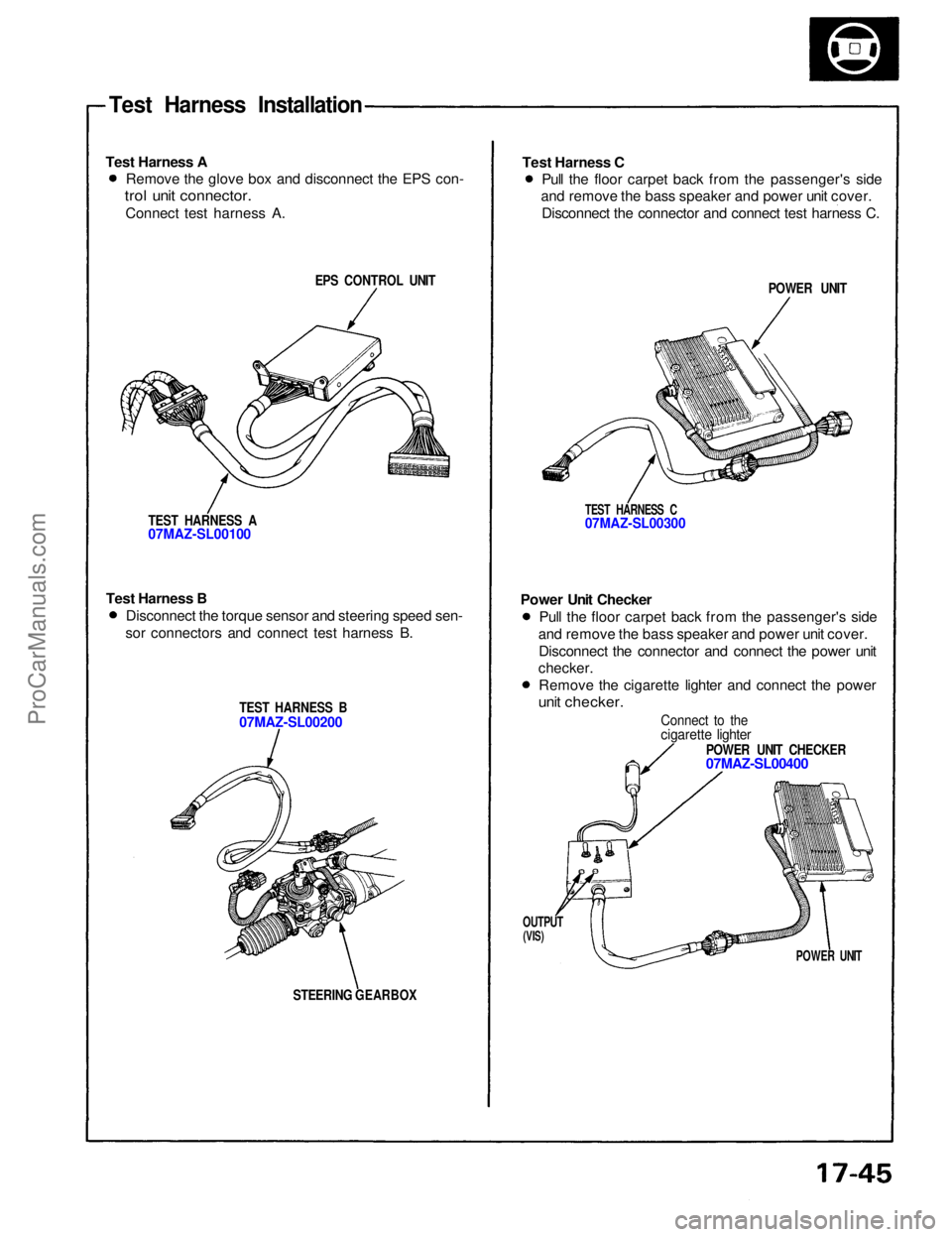
Test Harness Installation
Test Harness A
EPS CONTROL UNIT
TEST HARNESS A
07MAZ-SL00100
Test Harness B
TEST HARNESS B
07MAZ-SL00200
STEERING GEARBOX
Test Harness C
POWER UNIT
TEST HARNESS C
07MAZ-SL00300
Power Unit Checker
Connect to the
cigarette lighter
POWER UNIT CHECKER
07MAZ-SL00400
POWER UNIT
OUTPUT
(VIS)
Remove the glove box and disconnect the EPS con-
trol unit connector.
Connect test harness A.
Disconnect the torque sensor and steering speed sen-
sor connectors and connect test harness B. Pull the floor carpet back from the passenger's side
and remove the bass speaker and power unit cover.
Disconnect the connector and connect test harness C.
Pull the floor carpet back from the passenger's side
and remove the bass speaker and power unit cover. Disconnect the connector and connect the power unit
checker.
Remove the cigarette lighter and connect the power
unit checker.ProCarManuals.com
Page 1352 of 1640
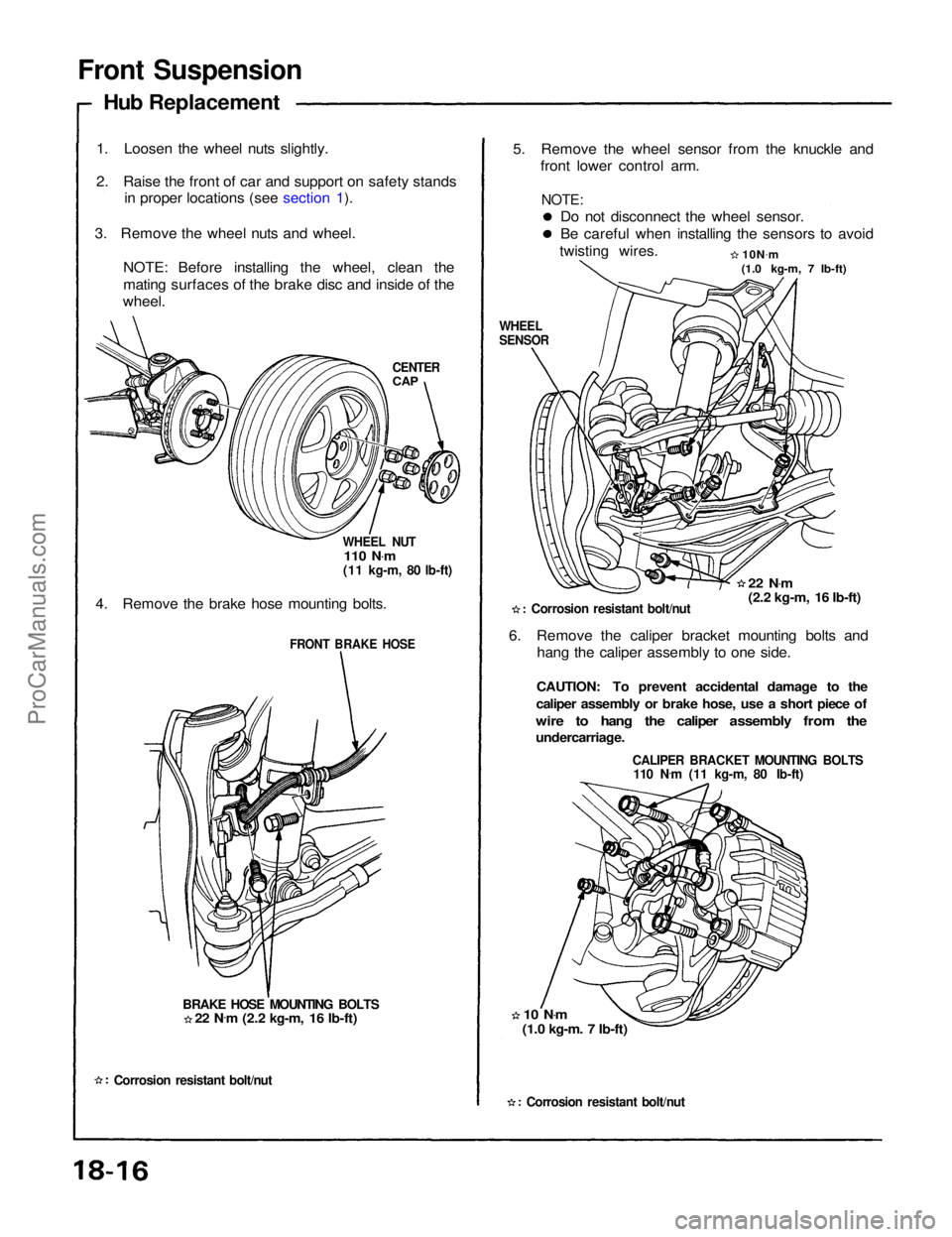
Front Suspension
Hub Replacement
1. Loosen the wheel nuts slightly.
2. Raise the front of car and support on safety stands in proper locations (see section 1).
3. Remove the wheel nuts and wheel. NOTE: Before installing the wheel, clean the
mating surfaces of the brake disc and inside of the
wheel.
CENTER
CAP
WHEEL NUT
110 N .
m
(11 kg-m, 80 lb-ft)
4. Remove the brake hose mounting bolts.
FRONT BRAKE HOSE
BRAKE HOSE MOUNTING BOLTS
Corrosion resistant bolt/nut
5. Remove the wheel sensor from the knuckle and
front lower control arm.
Do not disconnect the wheel sensor.
Be careful when installing the sensors to avoid
twisting wires. 10N.
m
(1.0 kg-m, 7 lb-ft)
WHEEL
SENSOR
22 N.
m
(2.2 kg-m, 16 Ib-ft)
Corrosion resistant bolt/nut
6. Remove the caliper bracket mounting bolts and hang the caliper assembly to one side.
CAUTION: To prevent accidental damage to the
caliper assembly or brake hose, use a short piece of
wire to hang the caliper assembly from the
undercarriage.
CALIPER BRACKET MOUNTING BOLTS
110 N .
m (11 kg-m, 80 Ib-ft)
10 N .
m
(1.0 kg-m. 7 Ib-ft)
Corrosion resistant bolt/nut
22 N
.
m (2.2 kg-m, 16 Ib-ft)
NOTE:ProCarManuals.com
Page 1357 of 1640
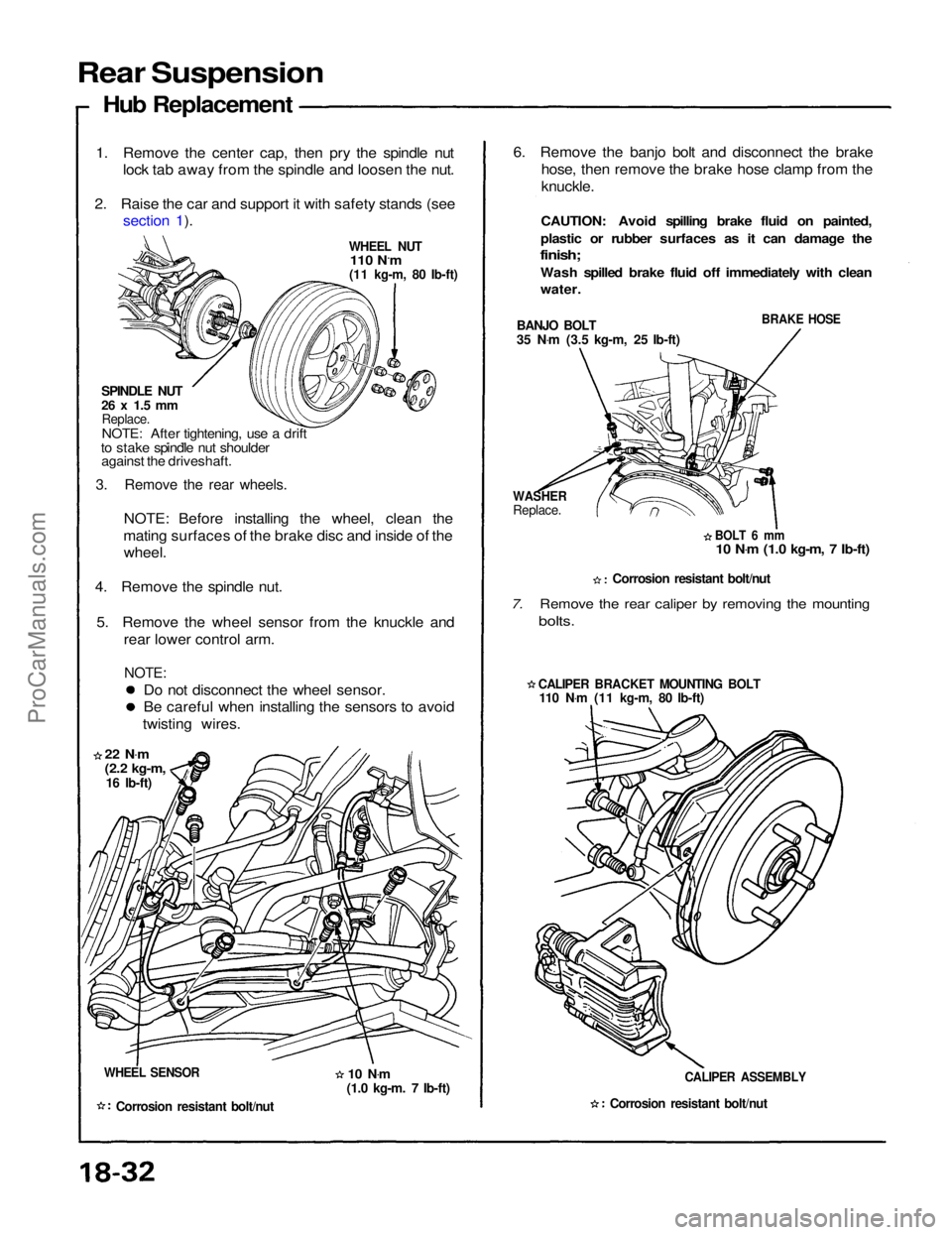
Rear Suspension
Hub Replacement
1. Remove the center cap, then pry the spindle nut
lock tab away from the spindle and loosen the nut.
2. Raise the car and support it with safety stands (see section 1).
WHEEL NUT
110 N.m
(11 kg-m, 80 Ib-ft)
SPINDLE NUT
26 x 1.5 mm
Replace.
NOTE: After tightening, use a drift
to stake spindle nut shoulder against the driveshaft.
3. Remove the rear wheels.
NOTE: Before installing the wheel, clean the
mating surfaces of the brake disc and inside of the wheel.
4. Remove the spindle nut.
5. Remove the wheel sensor from the knuckle and rear lower control arm.
NOTE:
Do not disconnect the wheel sensor.
Be careful when installing the sensors to avoid
twisting wires.
22 N .
m
(2.2 kg-m,
16 Ib-ft)
WHEEL SENSOR
Corrosion resistant bolt/nut
6. Remove the banjo bolt and disconnect the brake
hose, then remove the brake hose clamp from the
knuckle.
CAUTION: Avoid spilling brake fluid on painted,
plastic or rubber surfaces as it can damage the
finish;
Wash spilled brake fluid off immediately with clean
water.
BANJO BOLT
35 N .
m (3.5 kg-m, 25 Ib-ft)
BRAKE HOSE
WASHER
Replace.
BOLT 6 mm
10 N .
m (1.0 kg-m, 7 Ib-ft)
Corrosion resistant bolt/nut
7. Remove the rear caliper by removing the mounting
bolts.
CALIPER BRACKET MOUNTING BOLT
110 N .
m (11 kg-m, 80 Ib-ft)
CALIPER ASSEMBLY
Corrosion resistant bolt/nut
10 N
.
m
(1.0 kg-m. 7 Ib-ft)ProCarManuals.com
Page 1361 of 1640
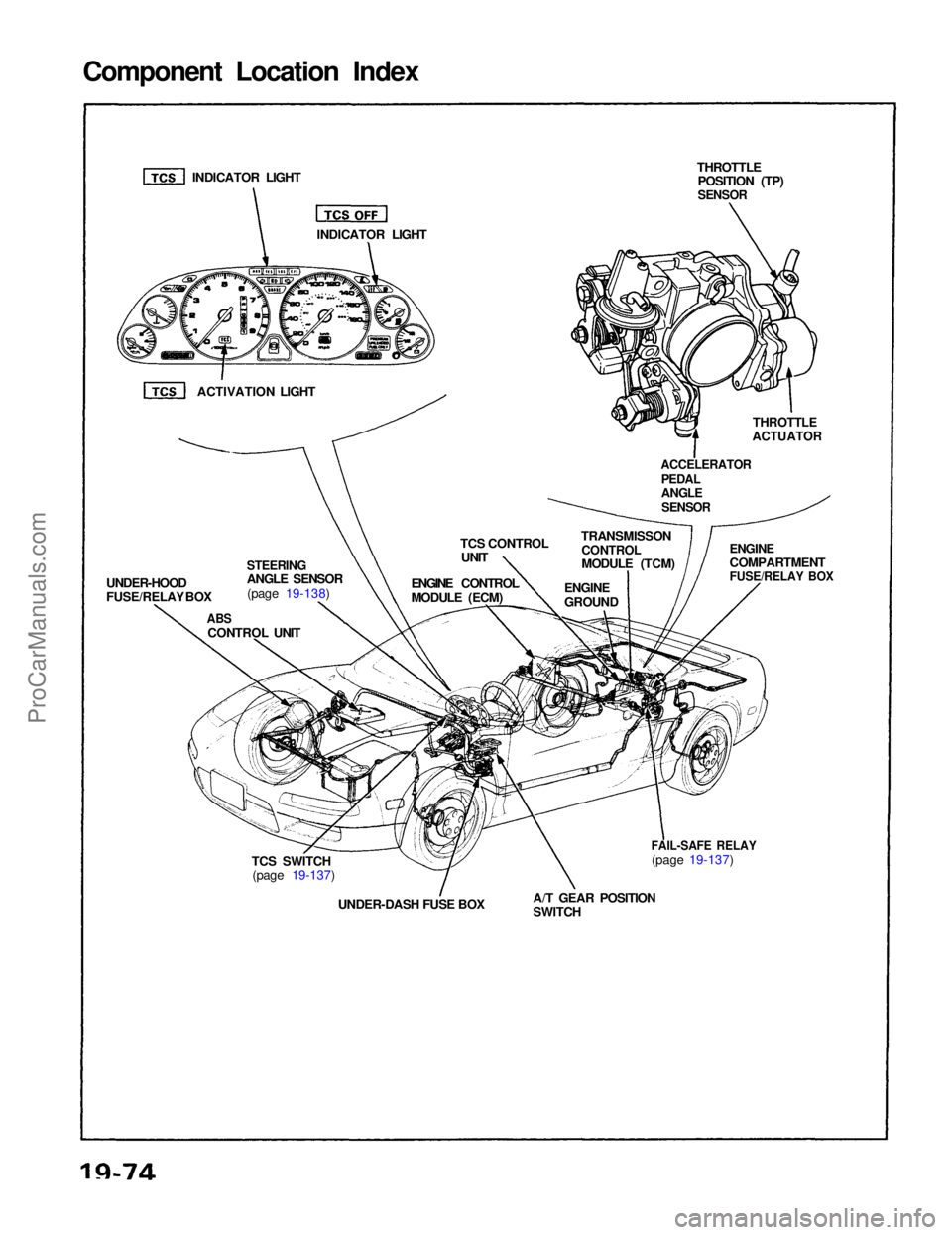
Component Location Index
INDICATOR LIGHT
ACTIVATION LIGHT INDICATOR LIGHT
UNDER-HOOD
FUSE/RELAY BOX
ABS
CONTROL UNIT
STEERING
ANGLE SENSOR
(page 19-138)
TCS SWITCH(page 19-137)
UNDER-DASH FUSE BOX
A/T GEAR POSITION
SWITCH
FAIL-SAFE RELAY
(page 19-137)
ENGINE
COMPARTMENT
FUSE/RELAY BOX
TRANSMISSON
CONTROL
MODULE (TCM)
ENGINE
GROUND
TCS CONTROL
UNIT
ENGINE CONTROL
MODULE (ECM)
ACCELERATOR
PEDAL
ANGLE
SENSOR
THROTTLE
ACTUATOR
THROTTLE
POSITION (TP)
SENSORProCarManuals.com
Page 1362 of 1640
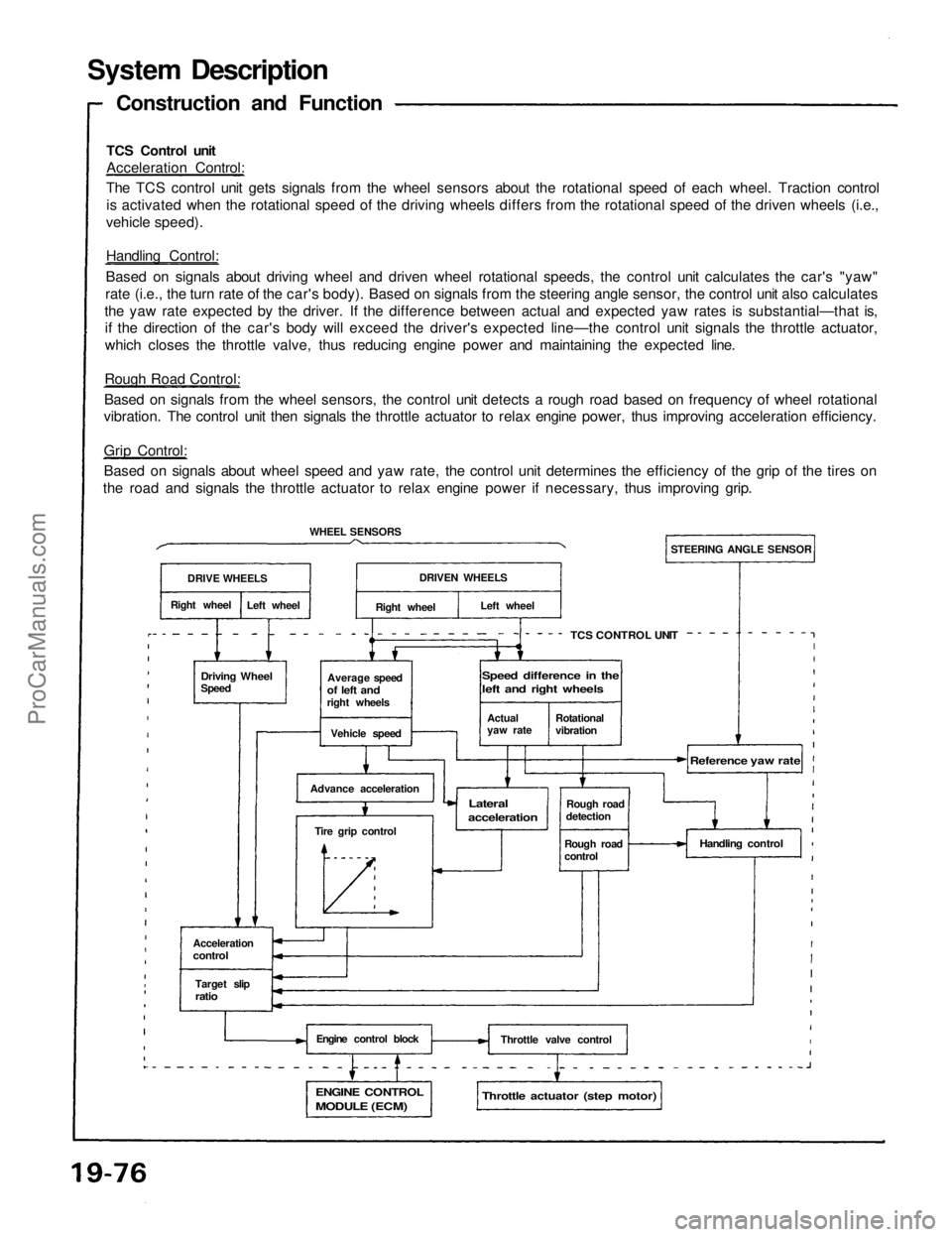
System Description
TCS Control unit
Acceleration Control:
The TCS control unit gets signals from the wheel sensors about the rotational speed of each wheel. Traction control
is activated when the rotational speed of the driving wheels differs from the rotational speed of the driven wheels (i.e.,
vehicle speed).
Handling Control:
Based on signals about driving wheel and driven wheel rotational speeds, the control unit calculates the car's "yaw"
rate (i.e., the turn rate of the car's body). Based on signals from the steering angle sensor, the control unit also calculates
the yaw rate expected by the driver. If the difference between actual and expected yaw rates is substantial—that is,
if the direction of the car's body will exceed the driver's expected line—the control unit signals the throttle actuator,
which closes the throttle valve, thus reducing engine power and maintaining the expected line.
Rough Road Control:
Based on signals from the wheel sensors, the control unit detects a rough road based on frequency of wheel rotational
vibration. The control unit then signals the throttle actuator to relax engine power, thus improving acceleration efficiency.
Grip Control:
Based on signals about wheel speed and yaw rate, the control unit determines the efficiency of the grip of the tires on
the road and signals the throttle actuator to relax engine power if necessary, thus improving grip.
Construction and Function
DRIVE WHEELS
Right wheel
Left wheel
WHEEL SENSORS
Driving Wheel
Speed
Average speed
of left and
right wheels
Vehicle speed
Advance acceleration
Tire grip control
Acceleration
control
Target slip
ratio
Engine control block
ENGINE CONTROL
MODULE (ECM)
Throttle actuator (step motor)
Throttle valve control
Handling control
Rough road
detection
Rough road
control
Reference yaw rate
Lateral
acceleration
TCS CONTROL UNIT
STEERING ANGLE SENSOR
DRIVEN WHEELS
Right wheel
Left wheel
Actual
yaw rate
Rotational
vibration
Speed difference in the
left and right wheelsProCarManuals.com