engine ACURA NSX 1991 Service Repair Manual
[x] Cancel search | Manufacturer: ACURA, Model Year: 1991, Model line: NSX, Model: ACURA NSX 1991Pages: 1640, PDF Size: 60.48 MB
Page 1535 of 1640
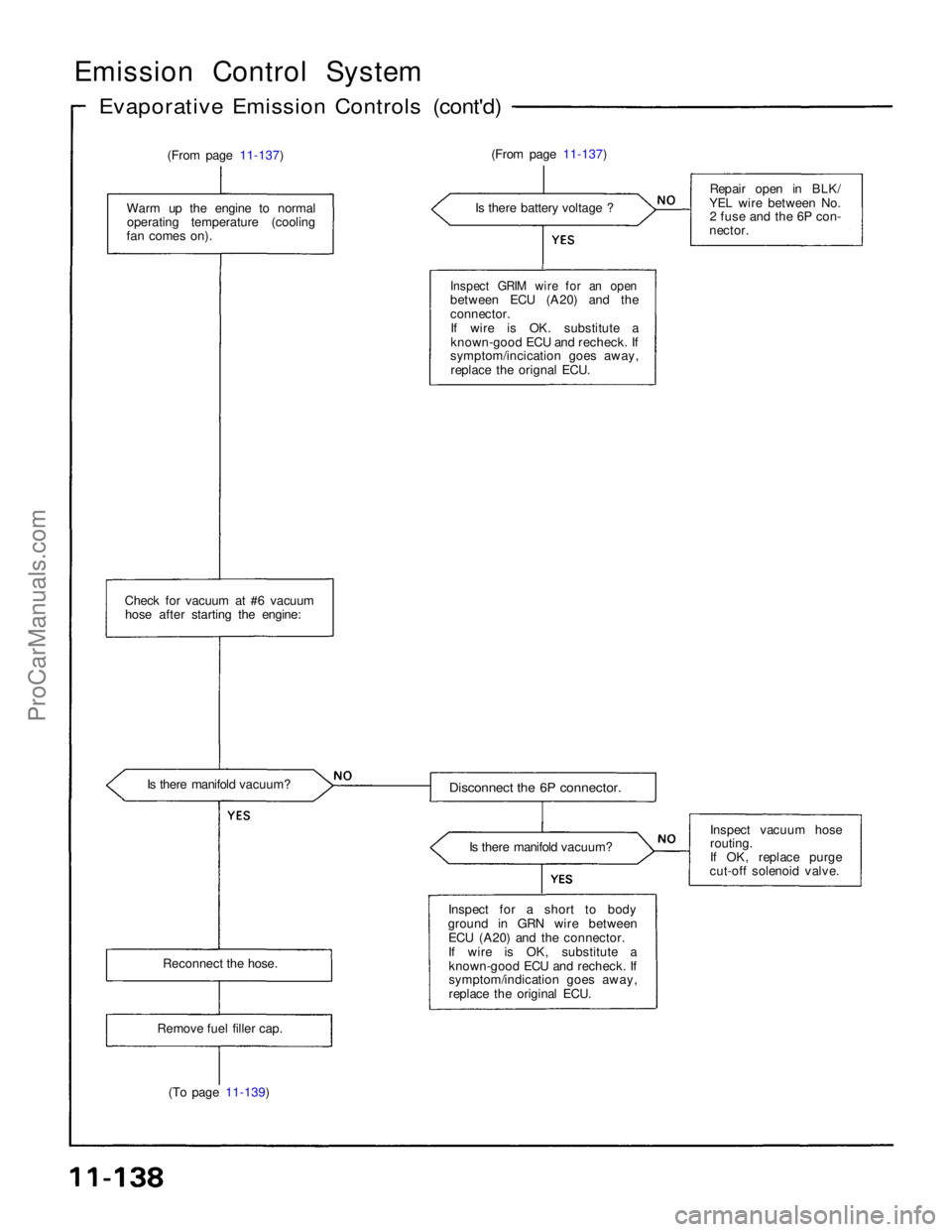
Emission Control System
Evaporative Emission Controls (cont'd)
(From page 11-137)
Warm up the engine to normal operating temperature (cooling
fan comes on). (From page 11-137)
Is there battery voltage ?
Inspect GRIM wire for an open
between ECU (A20) and the
connector. If wire is OK. substitute a
known-good ECU and recheck. If
symptom/incication goes away,
replace the orignal ECU.
Check for vacuum at #6 vacuum hose after starting the engine:
Is there manifold vacuum?
Disconnect the 6P connector.
Is there manifold vacuum?
Reconnect the hose. Inspect for a short to body
ground in GRN wire between ECU (A20) and the connector.
If wire is OK, substitute aknown-good ECU and recheck. If
symptom/indication goes away,
replace the original ECU.
Remove fuel filler cap.
(To page 11-139) Inspect vacuum hose
routing.
If OK, replace purge
cut-off solenoid valve. Repair open in BLK/
YEL wire between No. 2 fuse and the 6P con-
nector.ProCarManuals.com
Page 1536 of 1640
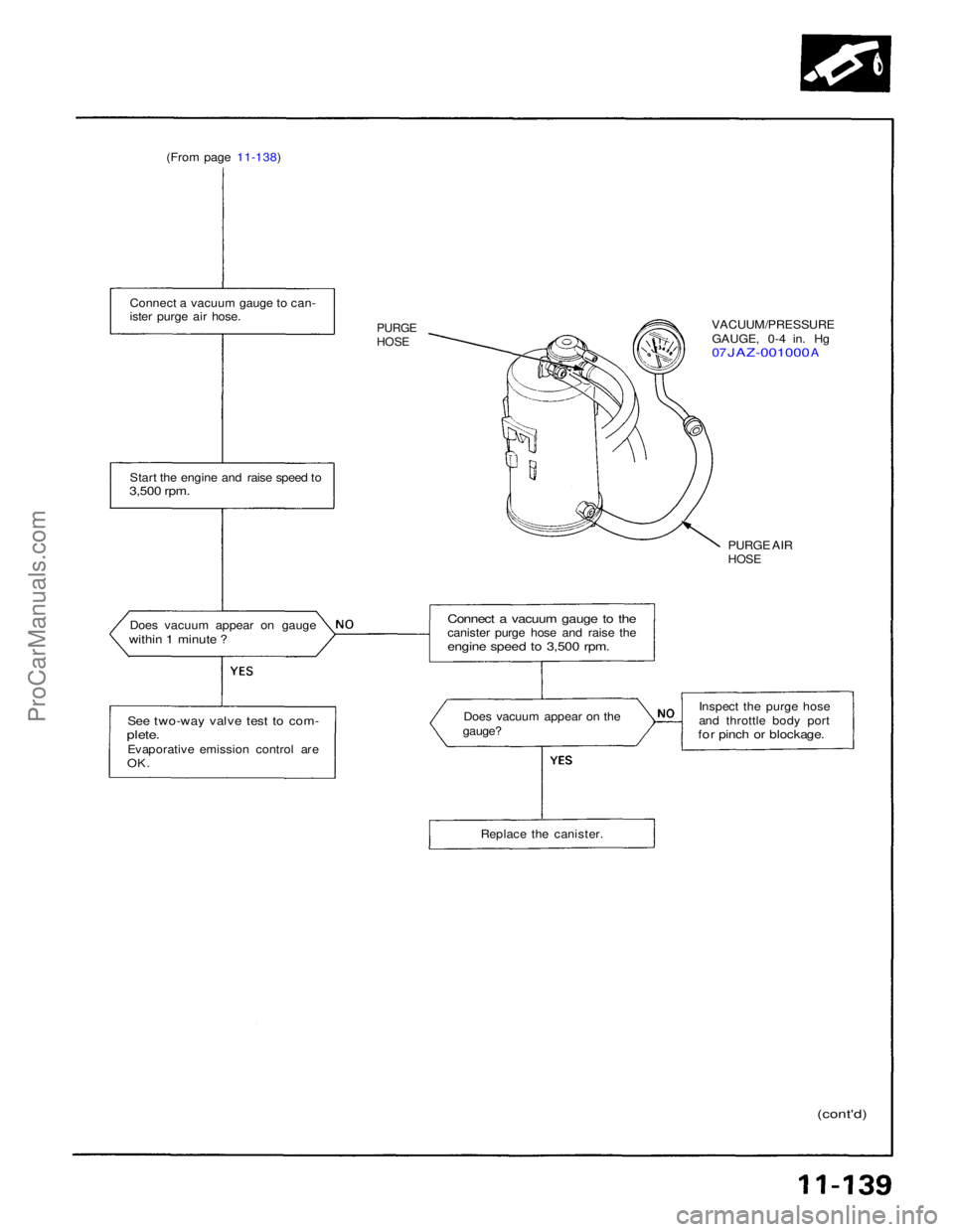
(From page 11-138)
Connect a vacuum gauge to can-
ister purge air hose.
PURGE
HOSE
Start the engine and raise speed to
3,500 rpm.
Does vacuum appear on gauge
within 1 minute ?
See two-way valve test to com-
plete.
Evaporative emission control are
OK.
Connect a vacuum gauge to the
canister purge hose and raise the
engine speed to 3,500 rpm.
Does vacuum appear on the
gauge?
Replace the canister.
(cont'd)
Inspect the purge hose
and throttle body port
for pinch or blockage.
PURGE AIR
HOSE
VACUUM/PRESSURE
GAUGE, 0-4 in. Hg
07
JAZ-001000
AProCarManuals.com
Page 1541 of 1640
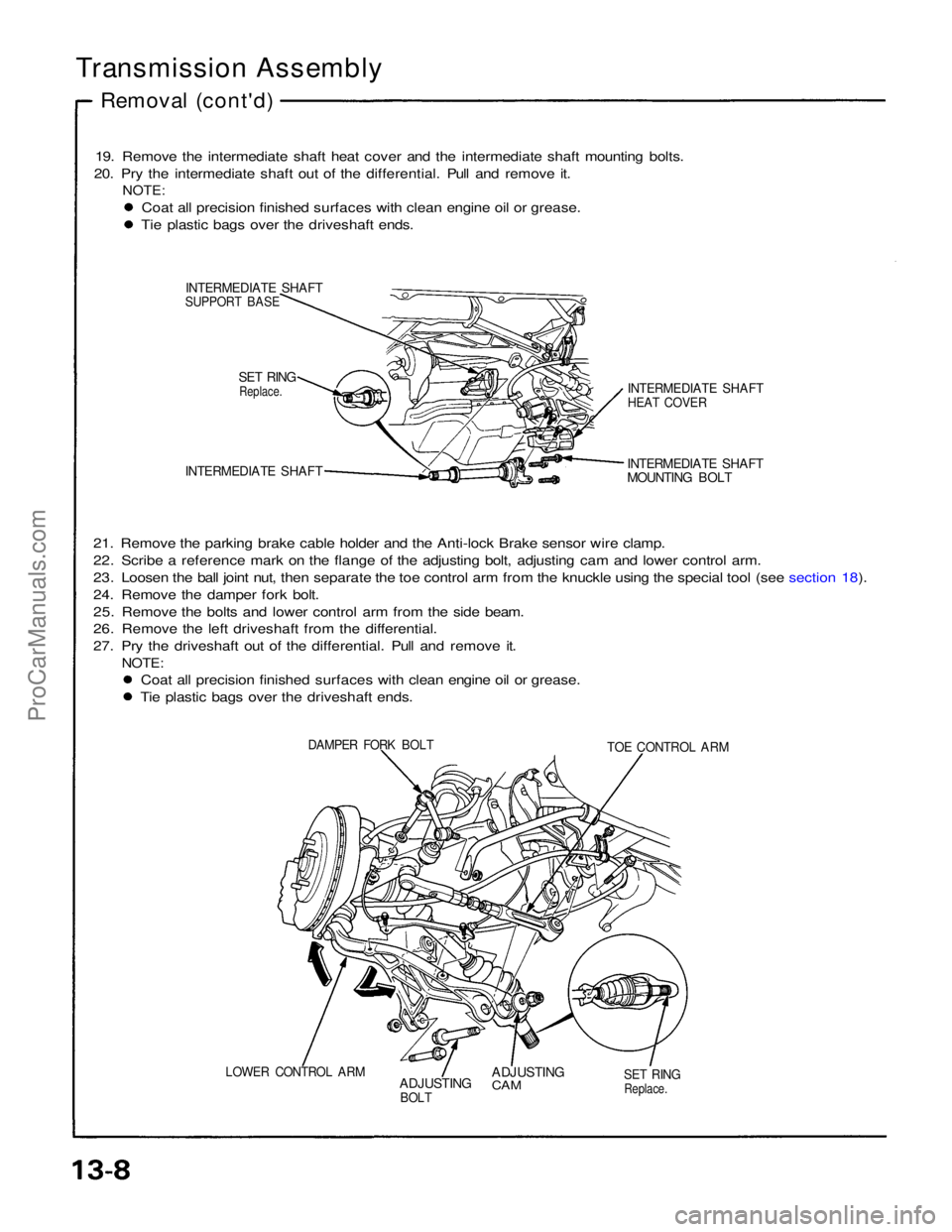
Transmission Assembly
Removal (cont'd)
19. Remove the intermediate shaft heat cover and the intermediate shaft mounting bolts.
20. Pry the intermediate shaft out of the differential. Pull and remove it.
NOTE:
Coat all precision finished surfaces with clean engine oil or grease. Tie plastic bags over the driveshaft ends.
INTERMEDIATE SHAFT
SUPPORT BASE
SET RING
Replace.
INTERMEDIATE SHAFT
21. Remove the parking brake cable holder and the Anti-lock Brake sensor wire clamp.
22. Scribe a reference mark on the flange of the adjusting bolt, adjusting cam and lower control arm.
23. Loosen the ball joint nut, then separate the toe control arm from the knuckle using the special tool (see section 18).
24. Remove the damper fork bolt.
25. Remove the bolts and lower control arm from the side beam.
26. Remove the left driveshaft from the differential.
27. Pry the driveshaft out of the differential. Pull and remove it.
NOTE:
Coat all precision finished surfaces with clean engine oil or grease.
Tie plastic bags over the driveshaft ends.
INTERMEDIATE SHAFT
MOUNTING BOLT
INTERMEDIATE SHAFT
HEAT COVER
DAMPER FORK BOLT
TOE CONTROL ARM
LOWER CONTROL ARM
ADJUSTING
BOLT
ADJUSTING
CAM
SET RING
Replace.
ProCarManuals.com
Page 1542 of 1640
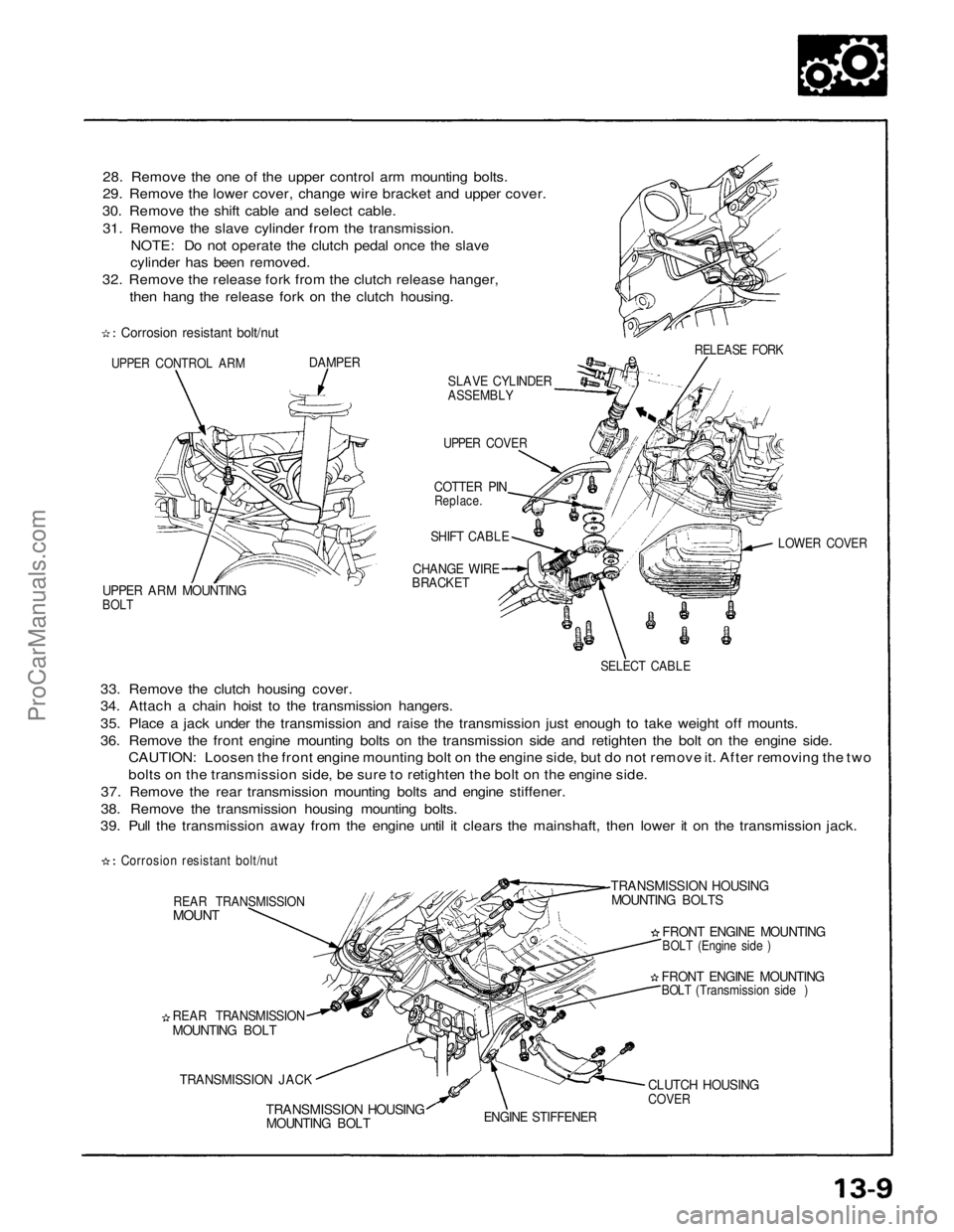
28. Remove the one of the upper control arm mounting bolts.
29. Remove the lower cover, change wire bracket and upper cover.
30. Remove the shift cable and select cable.
31. Remove the slave cylinder from the transmission. NOTE: Do not operate the clutch pedal once the slave
cylinder has been removed.
32. Remove the release fork from the clutch release hanger, then hang the release fork on the clutch housing.
Corrosion resistant bolt/nut
UPPER CONTROL ARM
DAMPER
SLAVE CYLINDER
ASSEMBLY
UPPER COVER
COTTER PIN
Replace.
SHIFT CABLE
UPPER ARM MOUNTING
BOLT
CHANGE WIRE
BRACKET
33. Remove the clutch housing cover.
34. Attach a chain hoist to the transmission hangers.
35. Place a jack under the transmission and raise the transmission just enough to take weight off mounts.
36. Remove the front engine mounting bolts on the transmission side and retighten the bolt on the engine side. CAUTION: Loosen the front engine mounting bolt on the engine side, but do not remove it. After removing the two
bolts on the transmission side, be sure to retighten the bolt on the engine side.
37. Remove the rear transmission mounting bolts and engine stiffener.
38. Remove the transmission housing mounting bolts.
39. Pull the transmission away from the engine until it clears the mainshaft, then lower it on the transmission jack.
SELECT CABLE
LOWER COVER
RELEASE FORK
Corrosion resistant bolt/nut
REAR TRANSMISSION
MOUNT
REAR TRANSMISSION
MOUNTING BOLT
TRANSMISSION JACK
TRANSMISSION HOUSING
MOUNTING BOLT
ENGINE STIFFENER
CLUTCH HOUSING
COVER
FRONT ENGINE MOUNTING
BOLT (Transmission side
)
FRONT ENGINE MOUNTING
BOLT (Engine side
)
TRANSMISSION HOUSING
MOUNTING BOLTSProCarManuals.com
Page 1551 of 1640
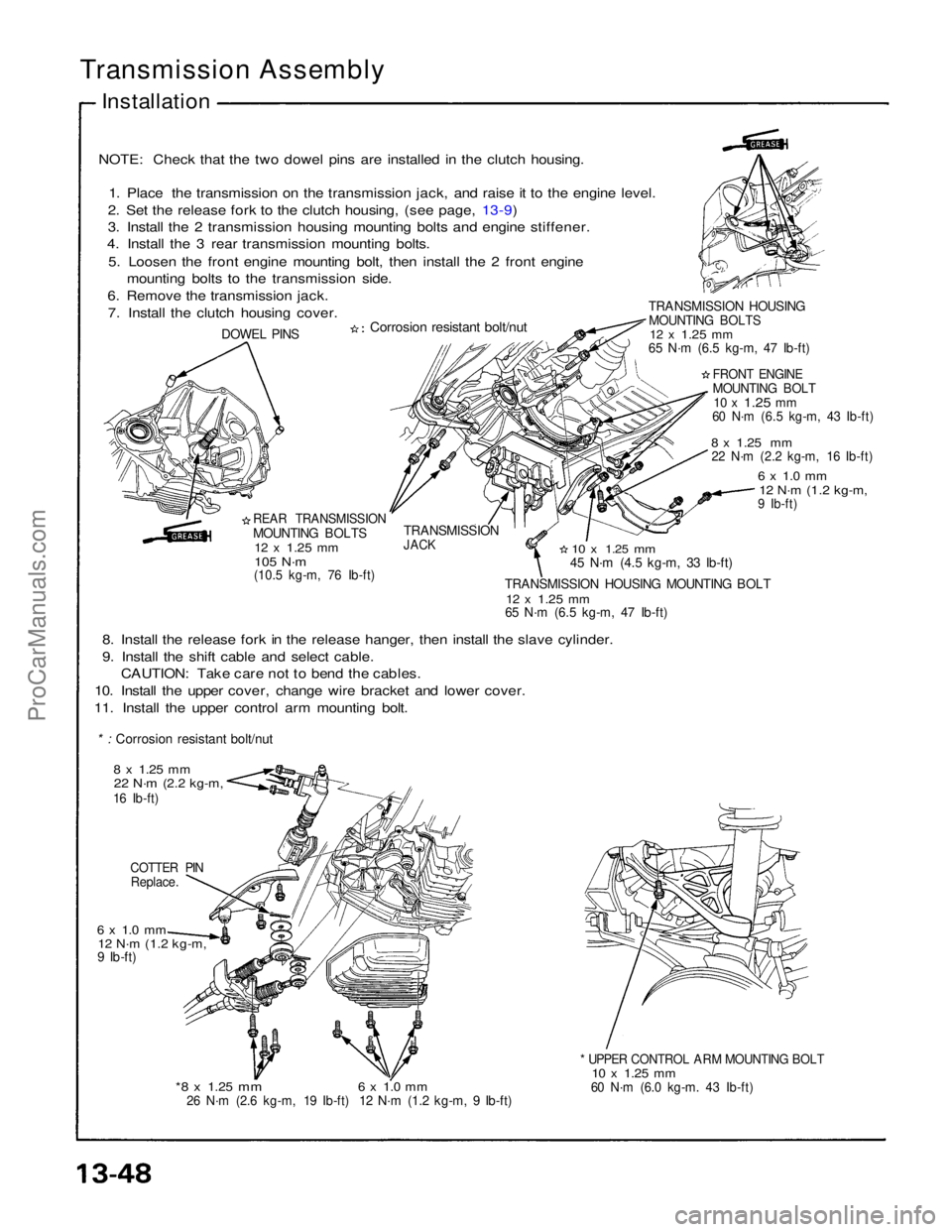
Transmission Assembly
Installation
NOTE: Check that the two dowel pins are installed in the clutch housing. 1. Place the transmission on the transmission jack, and raise it to the engine level.
2. Set the release fork to the clutch housing, (see page, 13-9)
3. Install the 2 transmission housing mounting bolts and engine stiffener.
4. Install the 3 rear transmission mounting bolts.
5. Loosen the front engine mounting bolt, then install the 2 front engine mounting bolts to the transmission side.
6. Remove the transmission jack. 7. Install the clutch housing cover.
DOWEL PINS
REAR TRANSMISSION
MOUNTING BOLTS
12 x
1.25
mm
105 N·m
(10.5 kg-m, 76 Ib-ft)
TRANSMISSION
JACK
8. Install the release fork in the release hanger, then install the slave cylinder.
9. Install the shift cable and select cable. CAUTION: Take care not to bend the cables.
10. Install the upper cover, change wire bracket and lower cover.
11. Install the upper control arm mounting bolt.
*: Corrosion resistant bolt/nut
8 x
1.25
mm
22 N·m
(2.2 kg-m,
16 Ib-ft)
COTTER PIN
Replace.
6 x 1.0 mm 12 N·m
(1.2 kg-m,
9 Ib-ft)
*8 x
1.25
mm
26 N·m (2.6 kg-m, 19 Ib-ft)
* UPPER CONTROL ARM MOUNTING BOLT
10 x
1.25
mm
60 N·m (6.0 kg-m. 43 Ib-ft)
Corrosion resistant bolt/nut
TRANSMISSION HOUSING
MOUNTING BOLTS
12 x
1.25
mm
65 N·m (6.5 kg-m, 47 Ib-ft)
FRONT ENGINE
MOUNTING BOLT
10 x
1.25
mm
60 N·m (6.5 kg-m, 43 Ib-ft)
8 x
1.25
mm
22 N·m (2.2 kg-m, 16 Ib-ft)
6 x 1.0 mm
12 N·m
(1.2 kg-m,
9 Ib-ft)
10 x
1.25
mm
45 N·m (4.5 kg-m, 33 Ib-ft)
TRANSMISSION HOUSING MOUNTING BOLT
12 x
1.25
mm
65 N·m (6.5 kg-m, 47 Ib-ft)
6 x 1.0 mm
12 N·m (1.2 kg-m, 9 Ib-ft)ProCarManuals.com
Page 1569 of 1640
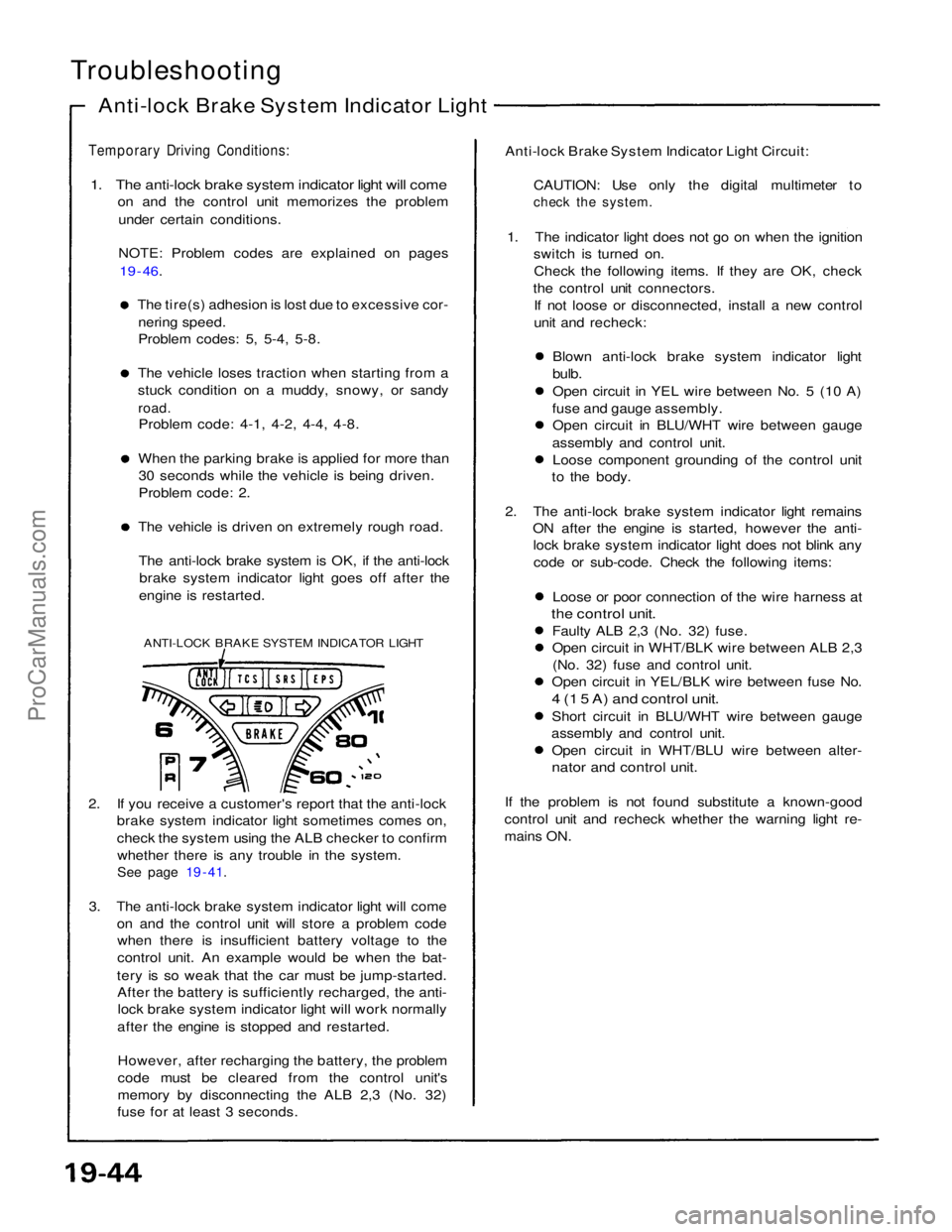
Troubleshooting
Anti-lock Brake System Indicator Light
Temporary Driving Conditions:
1. The anti-lock brake system indicator light will come
on and the control unit memorizes the problem
under certain conditions.
NOTE: Problem codes are explained on pages
19 - 46.
The tire(s) adhesion is lost due to excessive cor-
nering speed.
Problem codes: 5, 5-4, 5-8. The vehicle loses traction when starting from a
stuck condition on a muddy, snowy, or sandy
road.
Problem code: 4-1, 4-2, 4-4, 4-8. When the parking brake is applied for more than
30 seconds while the vehicle is being driven.
Problem code: 2. The vehicle is driven on extremely rough road.
The anti-lock brake system is OK, if the anti-lock brake system indicator light goes off after the
engine is restarted.
ANTI-LOCK BRAKE SYSTEM INDICATOR LIGHT
2. If you receive a customer's report that the anti-lock brake system indicator light sometimes comes on,
check the system using the ALB checker to confirm
whether there is any trouble in the system.
See page 19 - 41.
3. The anti-lock brake system indicator light will come on and the control unit will store a problem codewhen there is insufficient battery voltage to the
control unit. An example would be when the bat-
tery is so weak that the car must be jump-started. After the battery is sufficiently recharged, the anti-lock brake system indicator light will work normally
after the engine is stopped and restarted.
However, after recharging the battery, the problem
code must be cleared from the control unit's
memory by disconnecting the ALB 2,3 (No. 32)
fuse for at least 3 seconds. Anti-lock Brake System Indicator Light Circuit:
CAUTION: Use only the digital multimeter to
check the system.
1. The indicator light does not go on when the ignition switch is turned on.
Check the following items. If they are OK, check
the control unit connectors. If not loose or disconnected, install a new control
unit and recheck:
Blown anti-lock brake system indicator light
bulb.
Open circuit in YEL wire between No. 5 (10 A)
fuse and gauge assembly. Open circuit in BLU/WHT wire between gauge
assembly and control unit. Loose component grounding of the control unit
to the body.
2. The anti-lock brake system indicator light remains ON after the engine is started, however the anti-lock brake system indicator light does not blink any
code or sub-code. Check the following items:
Loose or poor connection of the wire harness at
the control unit.
Faulty ALB 2,3 (No. 32) fuse.
Open circuit in WHT/BLK wire between ALB 2,3(No. 32) fuse and control unit.
Open circuit in YEL/BLK wire between fuse No.
4 (1 5 A) and control unit.
Short circuit in BLU/WHT wire between gauge
assembly and control unit. Open circuit in WHT/BLU wire between alter-
nator and control unit.
If the problem is not found substitute a known-good
control unit and recheck whether the warning light re-
mains ON.ProCarManuals.com
Page 1570 of 1640
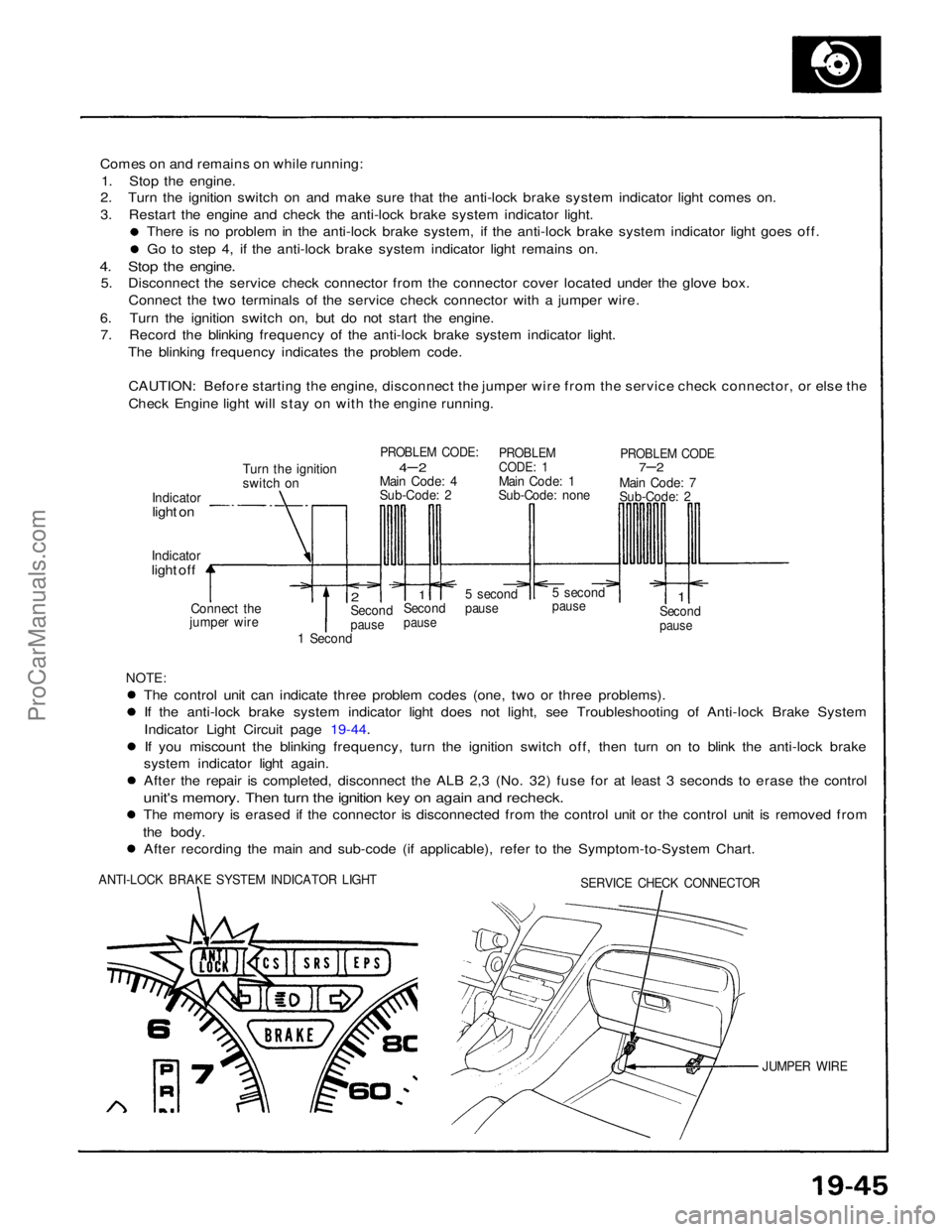
Comes on and remains on while running:
1. Stop the engine.
2. Turn the ignition switch on and make sure that the anti-lock brake system indicator light comes on.
3. Restart the engine and check the anti-lock brake system indicator light.
There is no problem in the anti-lock brake system, if the anti-lock brake system indicator light goes off. Go to step 4, if the anti-lock brake system indicator light remains on.
4. Stop the engine.
5. Disconnect the service check connector from the connector cover located under the glove box.
Connect the two terminals of the service check connector with a jumper wire.
6. Turn the ignition switch on, but do not start the engine. 7. Record the blinking frequency of the anti-lock brake system indicator light.
The blinking frequency indicates the problem code.
CAUTION: Before starting the engine, disconnect the jumper wire from the service check connector, or else the
Check Engine light will stay on with the engine running.
Turn the ignition
switch on
PROBLEM CODE:
4– 2
Main Code: 4
Sub-Code: 2
PROBLEM
CODE: 1
Main Code: 1
Sub-Code: none
PROBLEM CODE
7–2
Main Code: 7
Sub-Code: 2
Indicator
light on
Indicator
light off
Connect the
jumper wire
2
Second
pause
1
Second
pause
5 second
pause
5 second
pause
1
Second
pause
1 Second
NOTE:
The control unit can indicate three problem codes (one, two or three problems). If the anti-lock brake system indicator light does not light, see Troubleshooting of Anti-lock Brake System
Indicator Light Circuit page 19-44.
If you miscount the blinking frequency, turn the ignition switch off, then turn on to blink the anti-lock brake
system indicator light again. After the repair is completed, disconnect the ALB 2,3 (No. 32) fuse for at least 3 seconds to erase the control
unit's memory. Then turn the ignition key on again and recheck.
The memory is erased if the connector is disconnected from the control unit or the control unit is removed from
the body. After recording the main and sub-code (if applicable), refer to the Symptom-to-System Chart.
ANTI-LOCK BRAKE SYSTEM INDICATOR LIGHT
SERVICE CHECK CONNECTOR
JUMPER WIREProCarManuals.com
Page 1574 of 1640
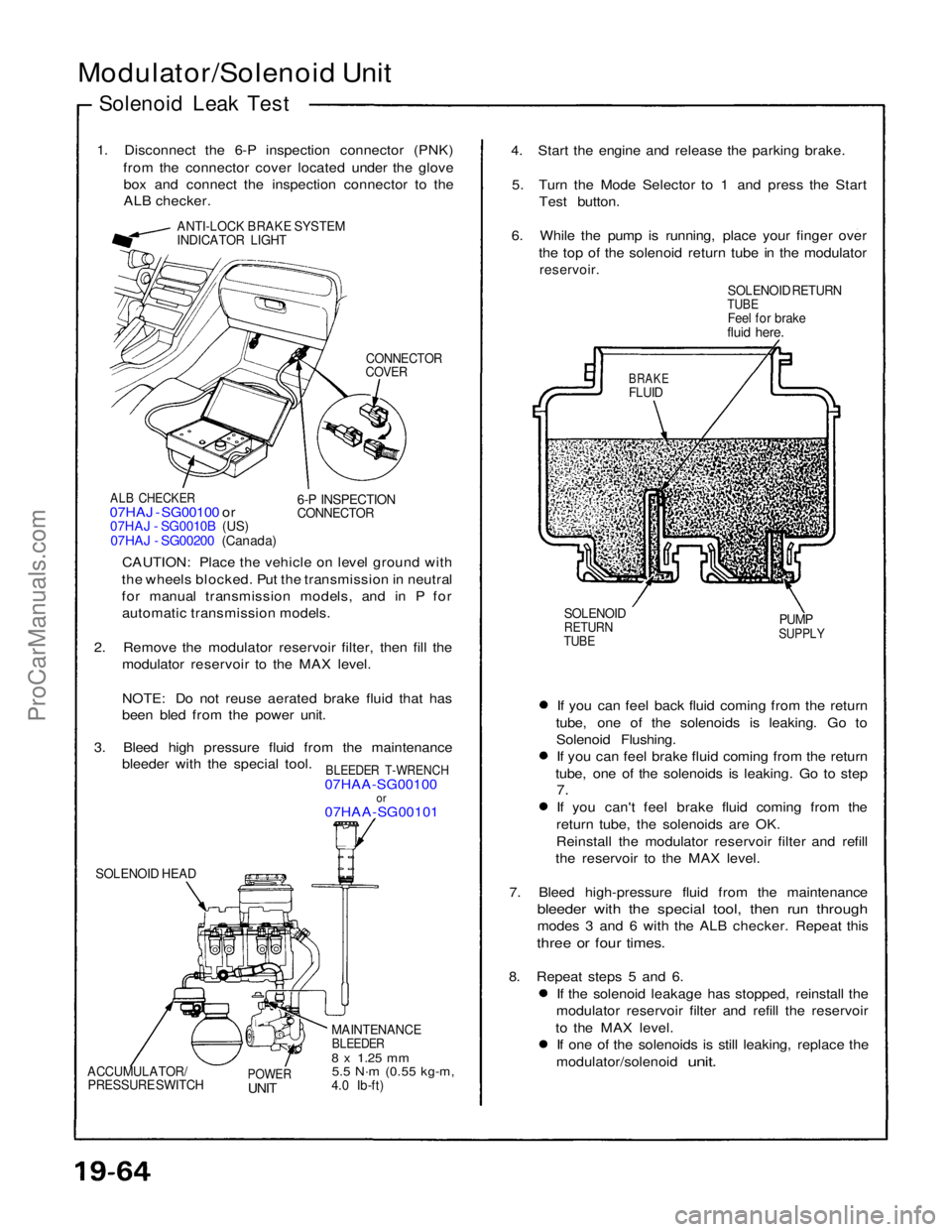
Modulator/Solenoid Unit
Solenoid Leak Test
1. Disconnect the 6-P inspection connector (PNK) from the connector cover located under the glovebox and connect the inspection connector to the
ALB checker.
ANTI-LOCK BRAKE SYSTEM
INDICATOR LIGHT
CONNECTOR
COVER
ALB CHECKER
07HAJ - SG00100 or
07HAJ - SG0010B (US)
07HAJ - SG00200 (Canada)
6-P INSPECTION
CONNECTOR
CAUTION: Place the vehicle on level ground with
the wheels blocked. Put the transmission in neutral
for manual transmission models, and in P for automatic transmission models.
2. Remove the modulator reservoir filter, then fill the modulator reservoir to the MAX level.
NOTE: Do not reuse aerated brake fluid that has
been bled from the power unit.
3. Bleed high pressure fluid from the maintenance bleeder with the special tool.
BLEEDER T-WRENCH
07HAA-SG00100
or
07HAA-SG00101
SOLENOID HEAD
MAINTENANCE
BLEEDER
8 x
1.25
mm
5.5 N·m
(0.55 kg-m,
4.0 Ib-ft)
POWER
UNIT
ACCUMULATOR/
PRESSURE SWITCH
If you can feel back fluid coming from the return
tube, one of the solenoids is leaking. Go to Solenoid Flushing.If you can feel brake fluid coming from the return
tube, one of the solenoids is leaking. Go to step
7.
If you can't feel brake fluid coming from the return tube, the solenoids are OK.
Reinstall the modulator reservoir filter and refill
the reservoir to the MAX level.
7. Bleed high-pressure fluid from the maintenance
bleeder with the special tool, then run through
modes 3 and 6 with the ALB checker. Repeat this
three or four times.
8. Repeat steps 5 and 6. If the solenoid leakage has stopped, reinstall the
modulator reservoir filter and refill the reservoir
to the MAX level. If one of the solenoids is still leaking, replace the
modulator/solenoid
unit.
SOLENOID
RETURN
TUBE
PUMP
SUPPLY
BRAKE
FLUID
SOLENOID RETURN
TUBE
Feel for brake
fluid here.
4. Start the engine and release the parking brake.
5. Turn the Mode Selector to 1 and press the Start Test button.
6. While the pump is running, place your finger over the top of the solenoid return tube in the modulator
reservoir.ProCarManuals.com
Page 1575 of 1640
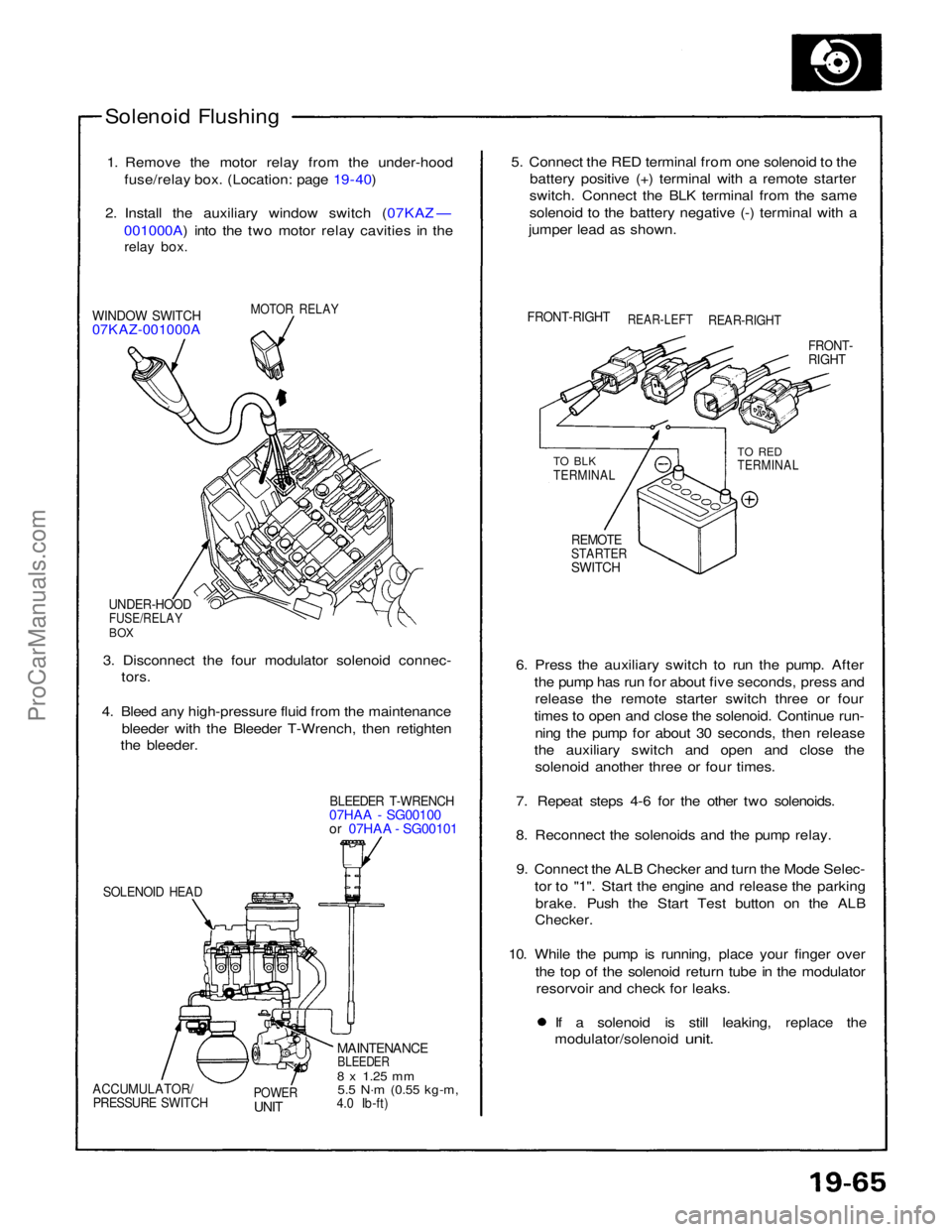
Solenoid Flushing
1. Remove the motor relay from the under-hood fuse/relay box. (Location: page 19 - 40)
2. Install the auxiliary window switch (07KAZ — 001000A) into the two motor relay cavities in the
relay box.
MOTOR RELAY
WINDOW SWITCH
07KAZ-001000A
UNDER-HOOD
FUSE/RELAY
BOX
3. Disconnect the four modulator solenoid connec- tors.
4. Bleed any high-pressure fluid from the maintenance bleeder with the Bleeder T-Wrench, then retighten
the bleeder.
BLEEDER T-WRENCH
07HAA - SG00100
or 07HAA - SG00101
SOLENOID HEAD
MAINTENANCE
BLEEDER
8 x
1.25
mm
5.5 N·m
(0.55 kg-m,
4.0 Ib-ft)
POWER
UNIT
ACCUMULATOR/
PRESSURE SWITCH
6. Press the auxiliary switch to run the pump. After
the pump has run for about five seconds, press andrelease the remote starter switch three or four
times to open and close the solenoid. Continue run- ning the pump for about 30 seconds, then release
the auxiliary switch and open and close the solenoid another three or four times.
7. Repeat steps 4-6 for the other two solenoids.
8. Reconnect the solenoids and the pump relay. 9. Connect the ALB Checker and turn the Mode Selec- tor to "1". Start the engine and release the parkingbrake. Push the Start Test button on the ALB
Checker.
10. While the pump is running, place your finger over the top of the solenoid return tube in the modulatorresorvoir and check for leaks. If a solenoid is still leaking, replace the
modulator/solenoid
unit.
REMOTE
STARTER
SWITCH
TO BLK
TERMINAL
TO RED
TERMINAL
FRONT-
RIGHT
FRONT-RIGHT
REAR-LEFT
REAR-RIGHT
5. Connect the RED terminal from one solenoid to the
battery positive (+) terminal with a remote starter
switch. Connect the BLK terminal from the same
solenoid to the battery negative (-) terminal with a
jumper lead as shown.ProCarManuals.com
Page 1576 of 1640
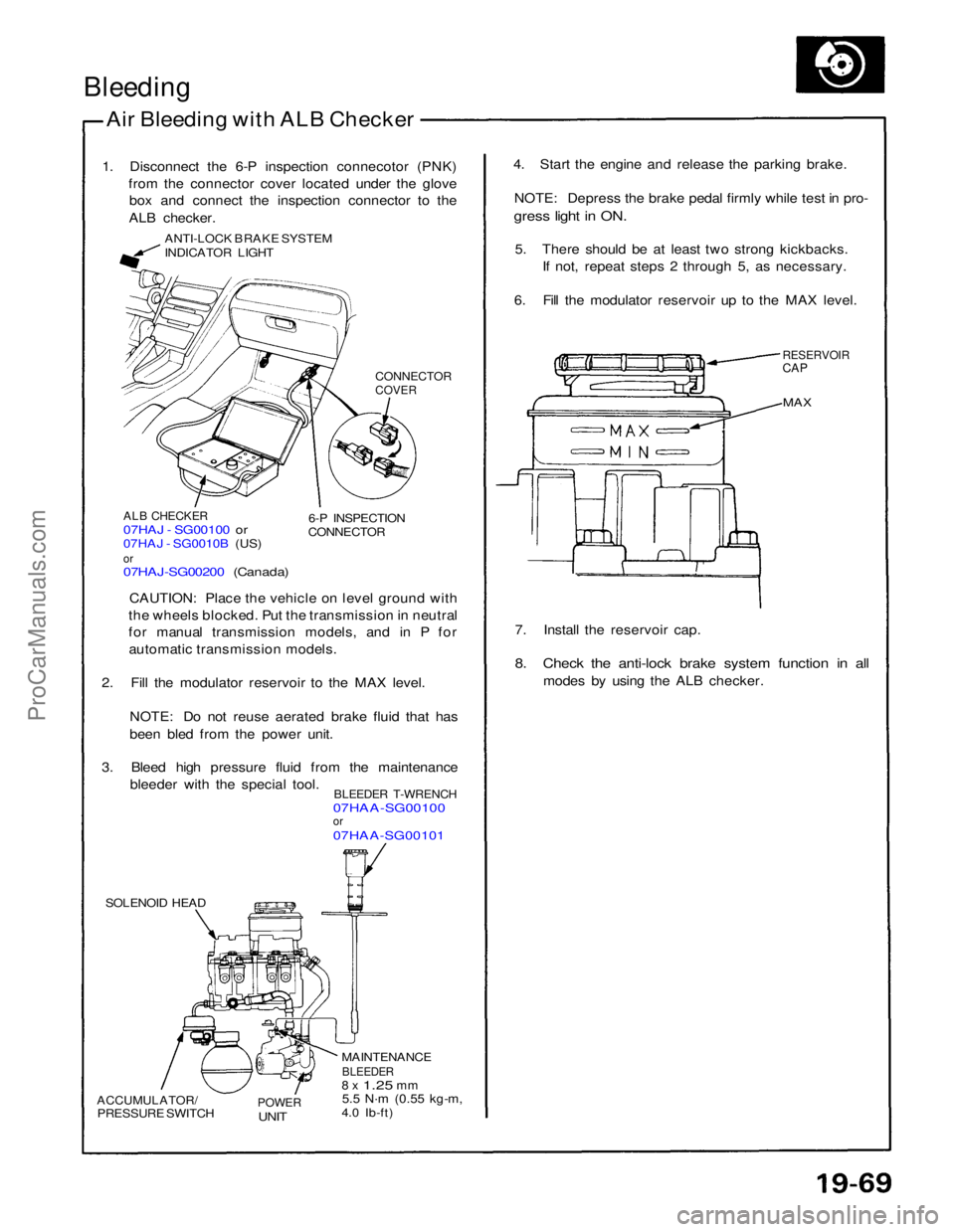
Bleeding
Air Bleeding with ALB Checker
1. Disconnect the 6-P inspection connecotor (PNK) from the connector cover located under the glovebox and connect the inspection connector to the
ALB checker.
ANTI-LOCK BRAKE SYSTEM
INDICATOR LIGHT
CONNECTOR
COVER
ALB CHECKER
07HAJ - SG00100 or
07HAJ - SG0010B (US)
or
07HAJ-SG00200 (Canada)
6-P INSPECTION
CONNECTOR
CAUTION: Place the vehicle on level ground with
the wheels blocked. Put the transmission in neutral
for manual transmission models, and in P for automatic transmission models.
2. Fill the modulator reservoir to the MAX level.
NOTE: Do not reuse aerated brake fluid that has
been bled from the power unit.
3. Bleed high pressure fluid from the maintenance bleeder with the special tool.
BLEEDER T-WRENCH
07HAA-SG00100
or
07HAA-SG00101
SOLENOID HEAD
ACCUMULATOR/
PRESSURE SWITCH
POWER
UNIT
MAINTENANCE
BLEEDER
8 x
1.25
mm
5.5 N·m
(0.55 kg-m,
4.0 Ib-ft) 7. Install the reservoir cap.
8. Check the anti-lock brake system function in all
modes by using the ALB checker.
MAX
RESERVOIR
CAP
4. Start the engine and release the parking brake.
NOTE: Depress the brake pedal firmly while test in pro-
gress light in ON.
5. There should be at least two strong kickbacks. If not, repeat steps 2 through 5, as necessary.
6. Fill the modulator reservoir up to the MAX level.ProCarManuals.com