fuse chart ACURA NSX 1991 Service Repair Manual
[x] Cancel search | Manufacturer: ACURA, Model Year: 1991, Model line: NSX, Model: ACURA NSX 1991Pages: 1640, PDF Size: 60.48 MB
Page 420 of 1640
Troubleshooting Precautions
EPS Indicator Light
Under normal conditions, the EPS indicator light in the gauge assembly comes on when the ignition switch is turned to
the ON (II) position, then goes off after the engine is started. This indicates that the bulb and its circuits are operating cor-
rectly. If there is any trouble in the system, the EPS indicator light turns on during driving, and the power steering assist is
turned off. When the EPS indicator light comes on, the control unit memorizes the DTC. In this case, the control unit does
not activate the EPS system after the engine starts again but it keeps the EPS indicator light on.
Diagnostic Trouble Code (DTC)
• The lowest DTC is indicated first.
• The DTCs continue blinking until the ignition switch is turned off.
• The DTCs are erased from the control unit when the EPS control unit VBU power supply or connector is disconnected.
• The EPS system can be reset and the control unit's memory can be erased by disconnecting the CLOCK (7.5 A) fuse for
more than ten seconds.
Self-diagnosis:
The CPU (central processing unit) controls the following when it detects a problem during self-diagnosis:
1. Turns the EPS indicator light ON to alert the driver.
2. Power assist stops, and normal manual steering operation resumes (except DTC 21 and DTC 33).
3. The EPS control unit memorizes the diagnostic trouble code (DTC).
4. After the DTC is stored in the control unit, the CPU stops self-diagnosis.
Troubleshooting:
• Before starting the troubleshooting, clear the DTC by disconnecting the CLOCK (7.5 A) fuse for ten seconds or more,
and test-drive the car. Check that the symptom of the trouble appears again, and then troubleshoot. If the problem is an
intermittent problem, the system does not become active after the engine starts even though the problem is solved.
• When both EPS indicator light and A/T "D" indicator light come on, perform the A/T troubleshooting first.
• When the customer's reported problem cannot be verified in the car, ask the customer about the conditions when the
EPS indicator light came ON, then test-drive the car under those conditions, if possible. If the EPS indicator light does
not come ON during the test, check for loose connections or poor contacts at the connectors by wiggling the harness,
etc.
• The connector terminal numbers are viewed from the wire side for the female terminals and from the terminal side for
the male terminals.
• After the repair, test-drive the car and check that the EPS indicator light does not come ON again during the test. (Refer
to the Symptom-to-System Chart for diagnostic period.)ProCarManuals.com
Page 531 of 1640
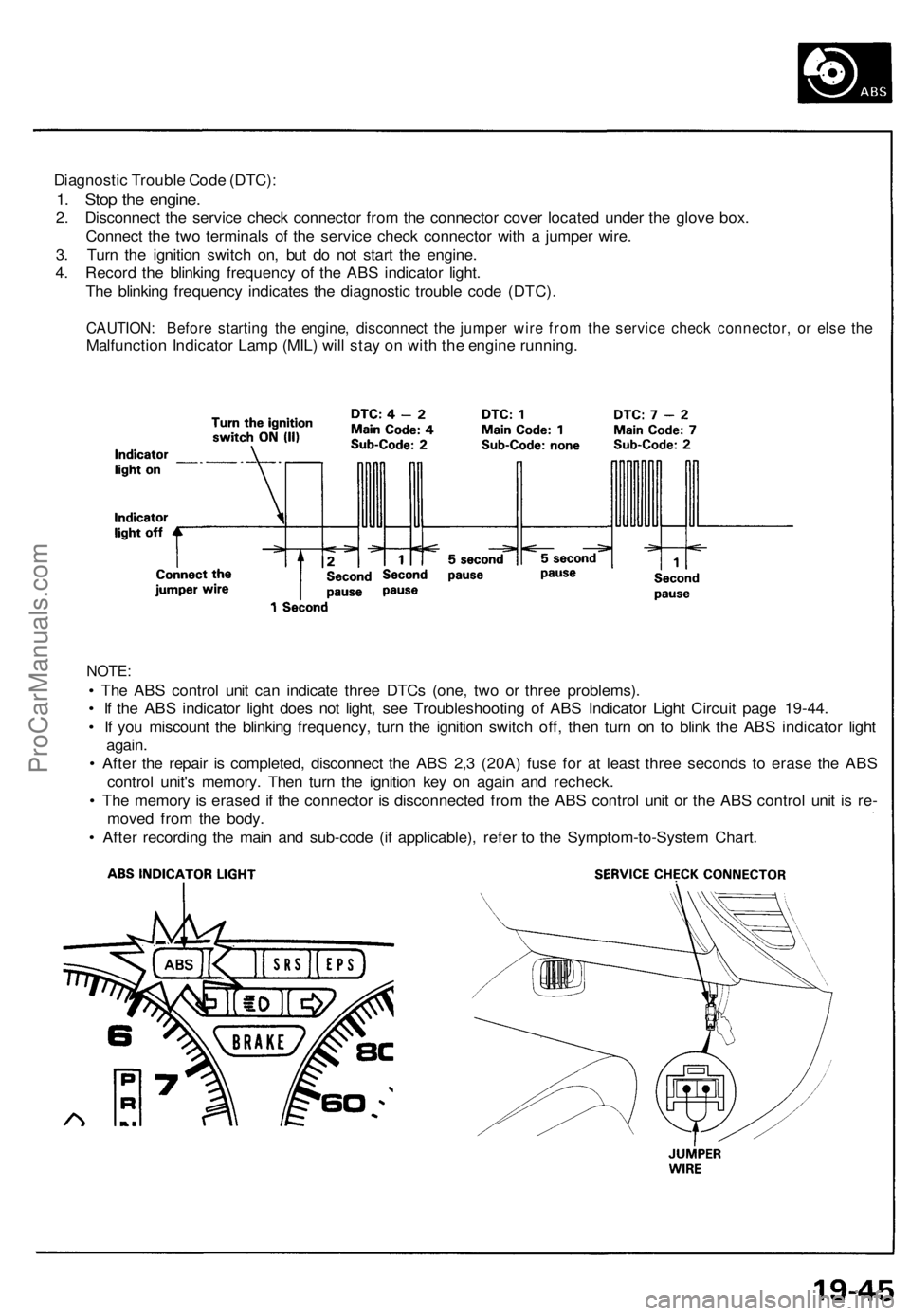
Diagnostic Trouble Code (DTC):
1. Stop the engine.
2. Disconnect the service check connector from the connector cover located under the glove box.
Connect the two terminals of the service check connector with a jumper wire.
3. Turn the ignition switch on, but do not start the engine.
4. Record the blinking frequency of the ABS indicator light.
The blinking frequency indicates the diagnostic trouble code (DTC).
CAUTION: Before starting the engine, disconnect the jumper wire from the service check connector, or else the
Malfunction Indicator Lamp (MIL) will stay on with the engine running.
NOTE:
• The ABS control unit can indicate three DTCs (one, two or three problems).
• If the ABS indicator light does not light, see Troubleshooting of ABS Indicator Light Circuit page 19-44.
• If you miscount the blinking frequency, turn the ignition switch off, then turn on to blink the ABS indicator light
again.
• After the repair is completed, disconnect the ABS 2,3 (20A) fuse for at least three seconds to erase the ABS
control unit's memory. Then turn the ignition key on again and recheck.
• The memory is erased if the connector is disconnected from the ABS control unit or the ABS control unit is re-
moved from the body.
• After recording the main and sub-code (if applicable), refer to the Symptom-to-System Chart.ProCarManuals.com
Page 1087 of 1640
Troubleshooting Flowchart
Engine Control Module (ECM)
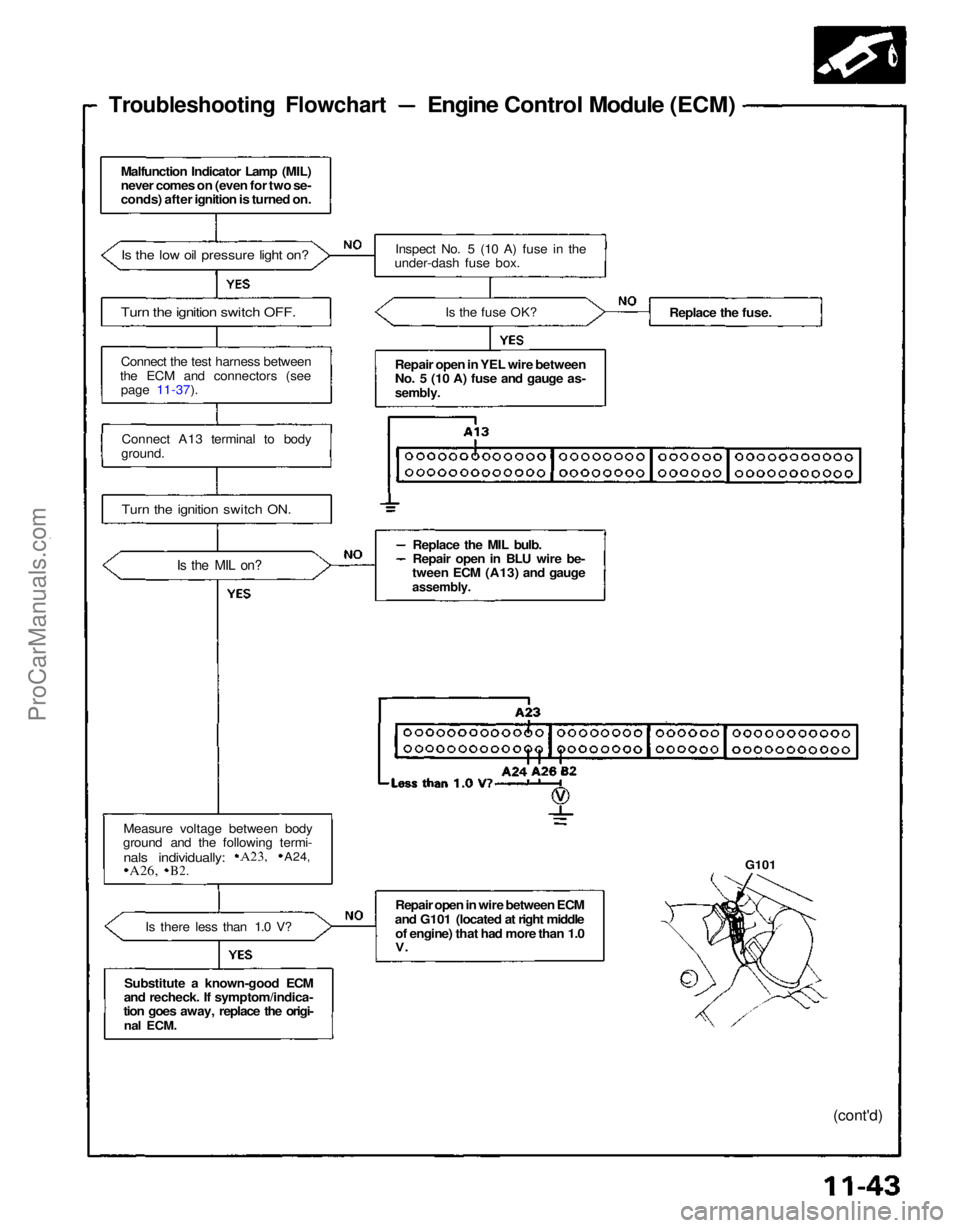
Malfunction Indicator Lamp (MIL)
never comes on (even for two se-
conds) after ignition is turned on.
Is the low oil pressure light on?
Turn the ignition switch OFF.
Connect the test harness between
the ECM and connectors (see page 11-37).
Connect A13 terminal to body
ground.
Turn the ignition switch ON.
Is the MIL on?
Measure voltage between body
ground and the following termi-
Is there less than 1.0 V?
Substitute a known-good ECM
and recheck. If symptom/indica-
tion goes away, replace the origi-
nal
ECM. Inspect No. 5 (10 A) fuse in the
under-dash fuse box.
Is the fuse OK?
Repair open in YEL wire between
No. 5 (10 A) fuse and gauge as-
sembly.
Replace the MIL bulb.
Repair open in BLU wire be-
tween ECM (A13) and gauge
assembly.
Repair open in wire between ECM
and G101 (located at right middle of engine) that had more than 1.0
V.
Replace the fuse.
G101
(cont'd)
nals individually:
A23,
A24,
A26,
B2.ProCarManuals.com
Page 1088 of 1640
PGM-FI System
Troubleshooting Flowchart
Engine Control Module (ECM) (cont'd)
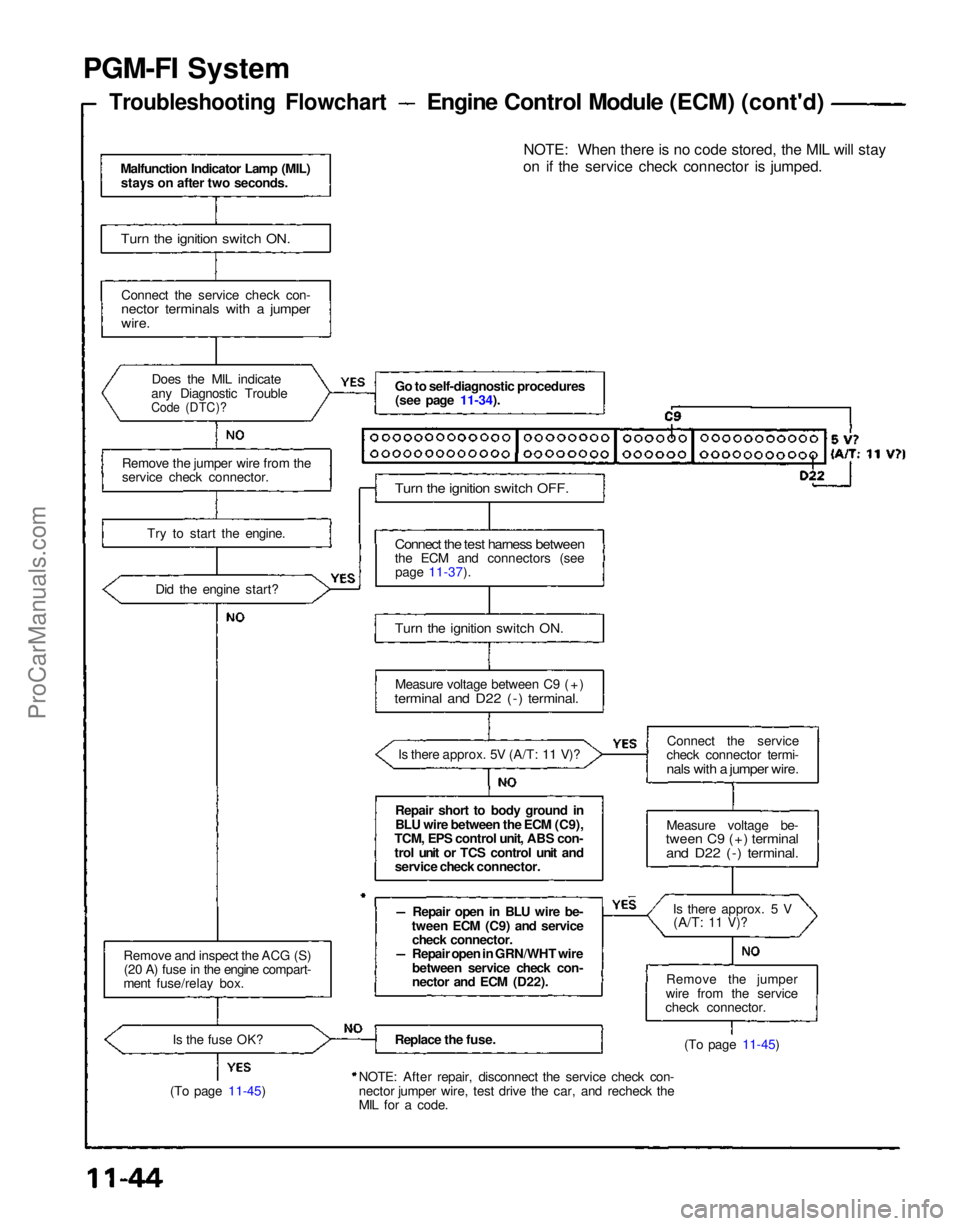
Malfunction Indicator Lamp (MIL) stays on after two seconds.
Turn the ignition switch ON.
Connect the service check con-
nector terminals with a jumper
wire.
Does the MIL indicate
any Diagnostic Trouble
Code (DTC)?
Remove the jumper wire from the
service check connector.
Try to start the engine.Did the engine start?
Remove and inspect the ACG (S) (20 A) fuse in the engine compart-
ment fuse/relay box.
Is the fuse OK?
(To page 11-45) Go to self-diagnostic procedures
(see page 11-34).
Turn the ignition switch OFF.
Connect the test harness between
the ECM and connectors (see page 11-37).
Turn the ignition switch ON.
Measure voltage between C9 (+)
terminal and D22 (-) terminal.
Is there approx. 5V (A/T: 11 V)?
Repair short to body ground in
BLU wire between the ECM (C9),
TCM, EPS control unit, ABS con-
trol unit or TCS control unit and service check connector.
Repair open in BLU wire be-
tween ECM (C9) and service check connector.
Repair open in GRN/WHT wire
between service check con-
nector and ECM (D22).
Replace the fuse.
NOTE: After repair, disconnect the service check con-
nector jumper wire, test drive the car, and recheck the
MIL for a code. NOTE: When there is no code stored, the MIL will stay
on if the service check connector is jumped.
Connect the service
check connector termi-
nals with a jumper wire.
Measure voltage be-
tween C9 (+) terminal
and D22 (-) terminal.
Is there approx. 5 V(A/T:
11 V)?
Remove the jumper
wire from the service
check connector.
(To page 11-45)ProCarManuals.com
Page 1104 of 1640
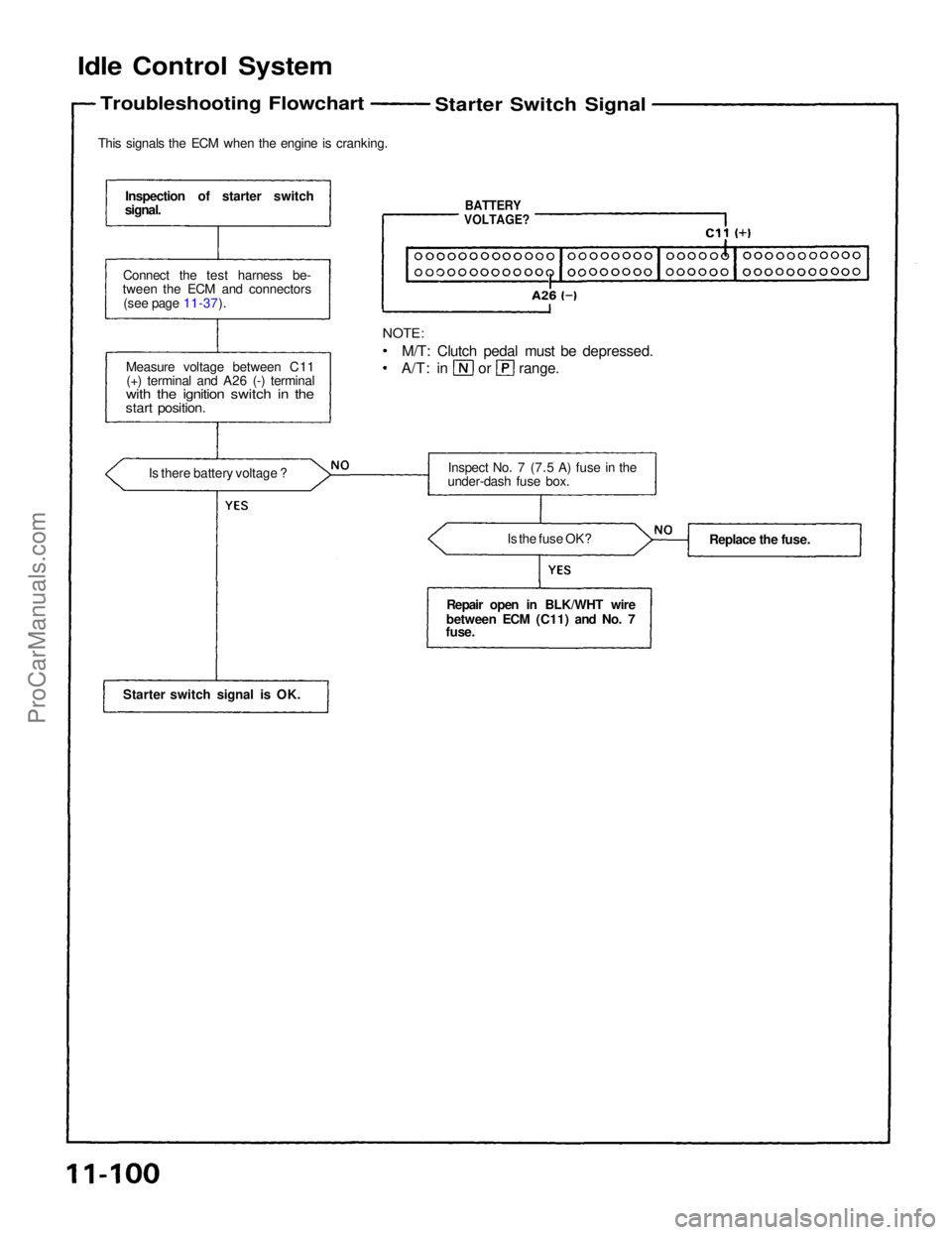
Idle Control System
Troubleshooting Flowchart
This signals the ECM when the engine is cranking.
Inspection of starter switch
signal.
Connect the test harness be-
tween the ECM and connectors
(see page 11-37).
Measure voltage between C11(+) terminal and A26 (-) terminal
with the ignition switch in the
start position.
Is there battery voltage ?
Starter switch signal is OK.
NOTE:
M/T: Clutch pedal must be depressed. A/T: in or range.
Inspect No. 7 (7.5 A) fuse in the
under-dash fuse box.
Is the fuse OK?
Repair open in BLK/WHT wire
between ECM (C11) and No. 7
fuse. Replace the fuse.
Starter Switch Signal
BATTERY
VOLTAGE?ProCarManuals.com
Page 1120 of 1640
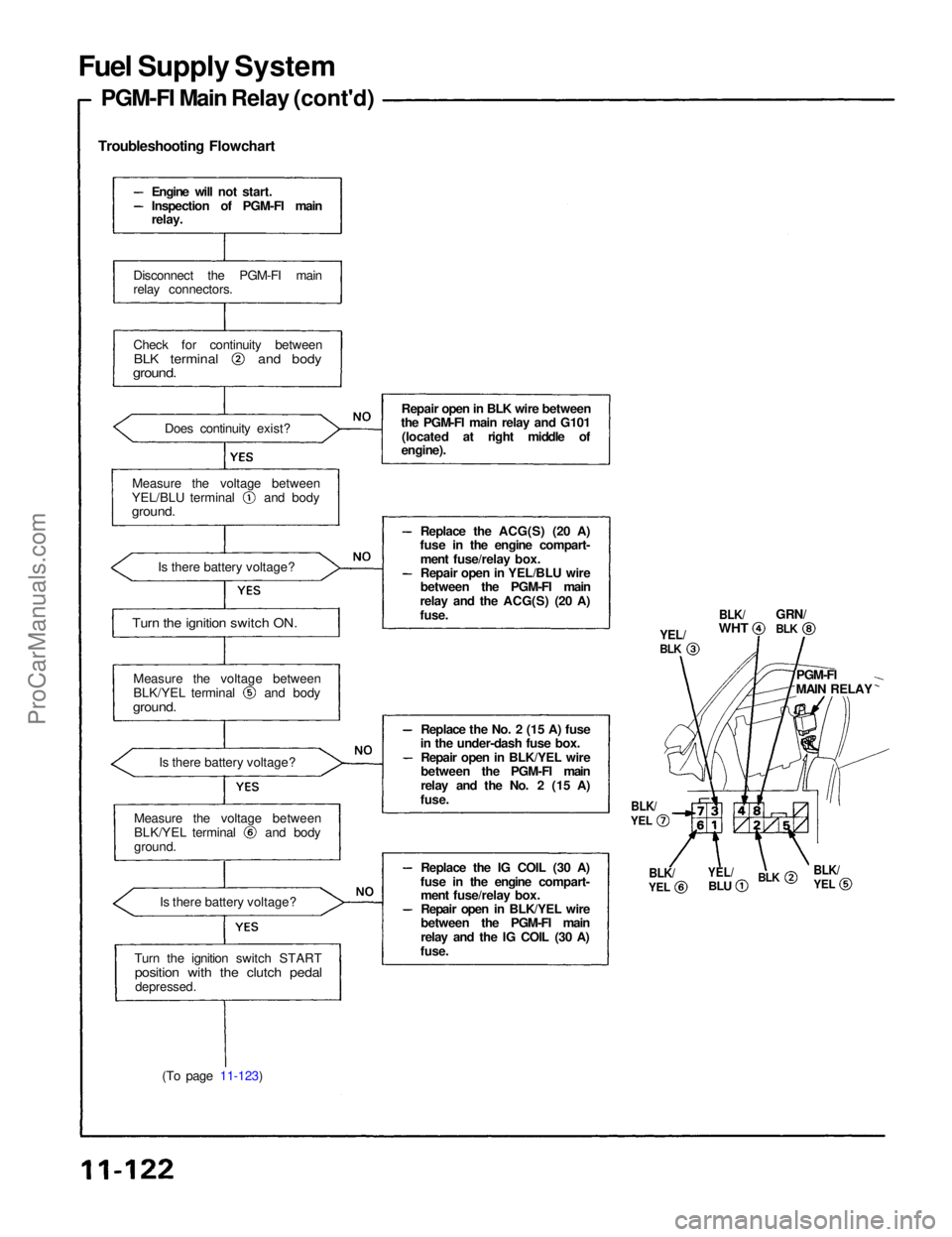
Fuel Supply System
PGM-FI Main Relay (cont'd)
Troubleshooting Flowchart
(To page 11-123)
BLK/
WHT
GRN/
YEL/
BLK
PGM-FI
MAIN RELAY
BLK/
YEL
BLK
YEL/
BLU
BLK/
YEL
BLK/
YEL
BLK
Engine will not start.
Inspection of PGM-FI main
relay.
Disconnect the PGM-FI main
relay connectors.
Check for continuity between
BLK terminal and body
ground.
Does continuity exist?
Measure the voltage between YEL/BLU terminal and body
ground.
Is there battery voltage?
Turn the ignition switch ON.
Measure the voltage between BLK/YEL terminal and body
ground.
Is there battery voltage?
Measure the voltage between BLK/YEL terminal and body
ground.
Is there battery voltage?
Turn the ignition switch START
position with the clutch pedal
depressed.
Repair open in BLK wire between
the PGM-FI main relay and G101
(located at right middle of
engine).
Replace the ACG(S) (20 A)
fuse in the engine compart-
ment fuse/relay box.
Repair open in YEL/BLU wire
between the PGM-FI main
relay and the ACG(S) (20 A)
fuse.
Replace the No. 2 (15 A) fuse
in the under-dash fuse box.
Repair open in BLK/YEL wire
between the PGM-FI main
relay and the No. 2 (15 A)
fuse.
Replace the IG COIL (30 A)
fuse in the engine compart- ment fuse/relay box.
Repair open in BLK/YEL wire
between the PGM-FI main
relay and the IG COIL (30 A)
fuse.ProCarManuals.com
Page 1208 of 1640
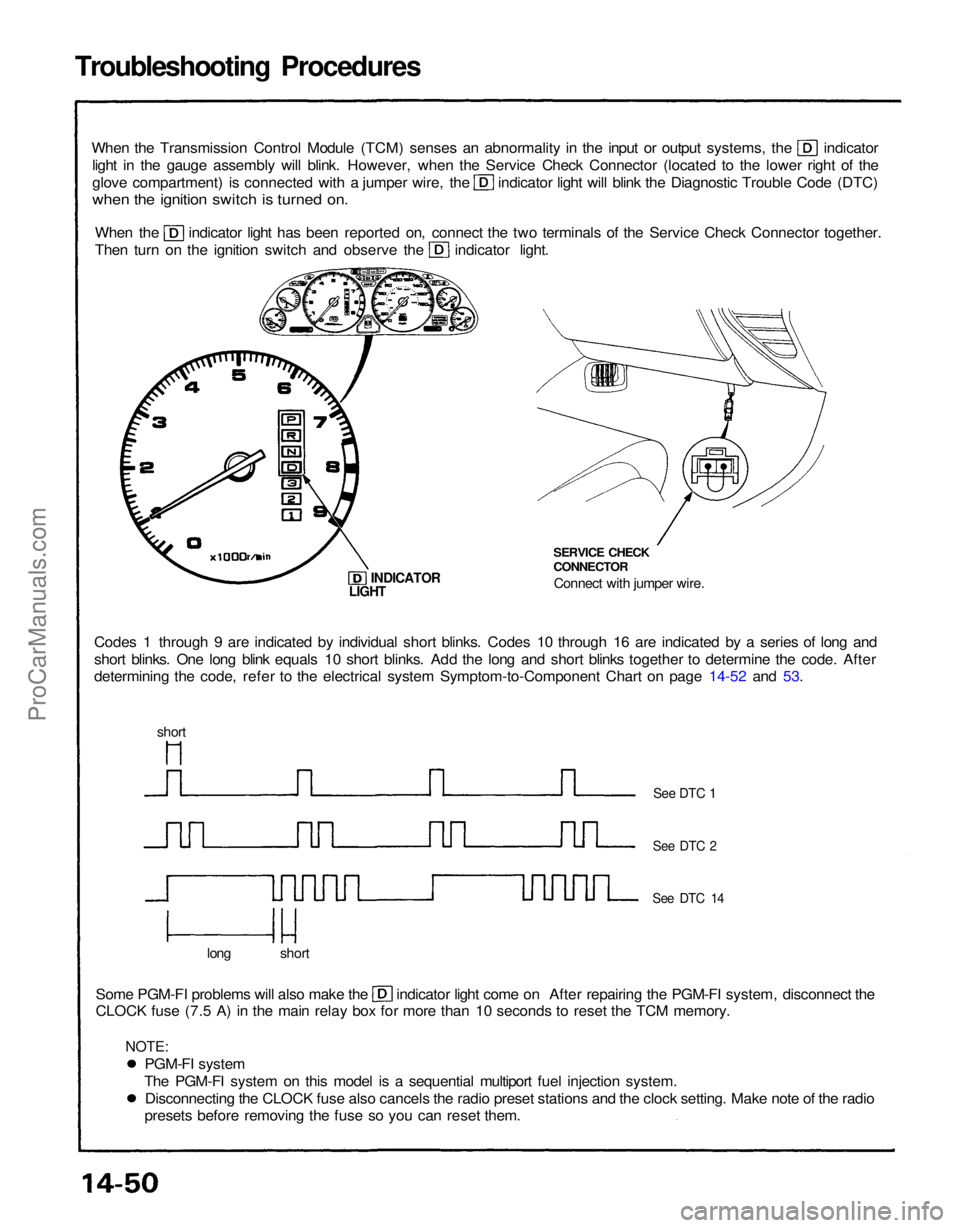
Troubleshooting Procedures
When the Transmission Control Module (TCM) senses an abnormality in the input or output systems, the indicator
light in the gauge assembly will blink. However, when the Service Check Connector (located to the lower right of the glove compartment) is connected with a jumper wire, the indicator light will blink the Diagnostic Trouble Code (DTC)
when the ignition switch is turned on.
When the indicator light has been reported on, connect the two terminals of the Service Check Connector together.
Then turn on the ignition switch and observe the indicator light.
Codes 1 through 9 are indicated by individual short blinks. Codes 10 through 16 are indicated by a series of long and
short blinks. One long blink equals 10 short blinks. Add the long and short blinks together to determine the code. After
determining the code, refer to the electrical system Symptom-to-Component Chart on page 14-52 and 53. SERVICE CHECK
CONNECTOR
Connect with jumper wire.
INDICATOR
Some PGM-FI problems will also make the indicator light come on After repairing the PGM-FI system, disconnect the
CLOCK fuse (7.5 A) in the main relay box for more than 10 seconds to reset the TCM memory.
long short
See DTC 1
See DTC 2
See DTC 14
LIGHT
short
PGM-FI system
The PGM-FI system on this model is a sequential multiport fuel injection system. Disconnecting the CLOCK fuse also cancels the radio preset stations and the clock setting. Make note of the radio
presets before removing the fuse so you can reset them.
NOTE:ProCarManuals.com
Page 1209 of 1640
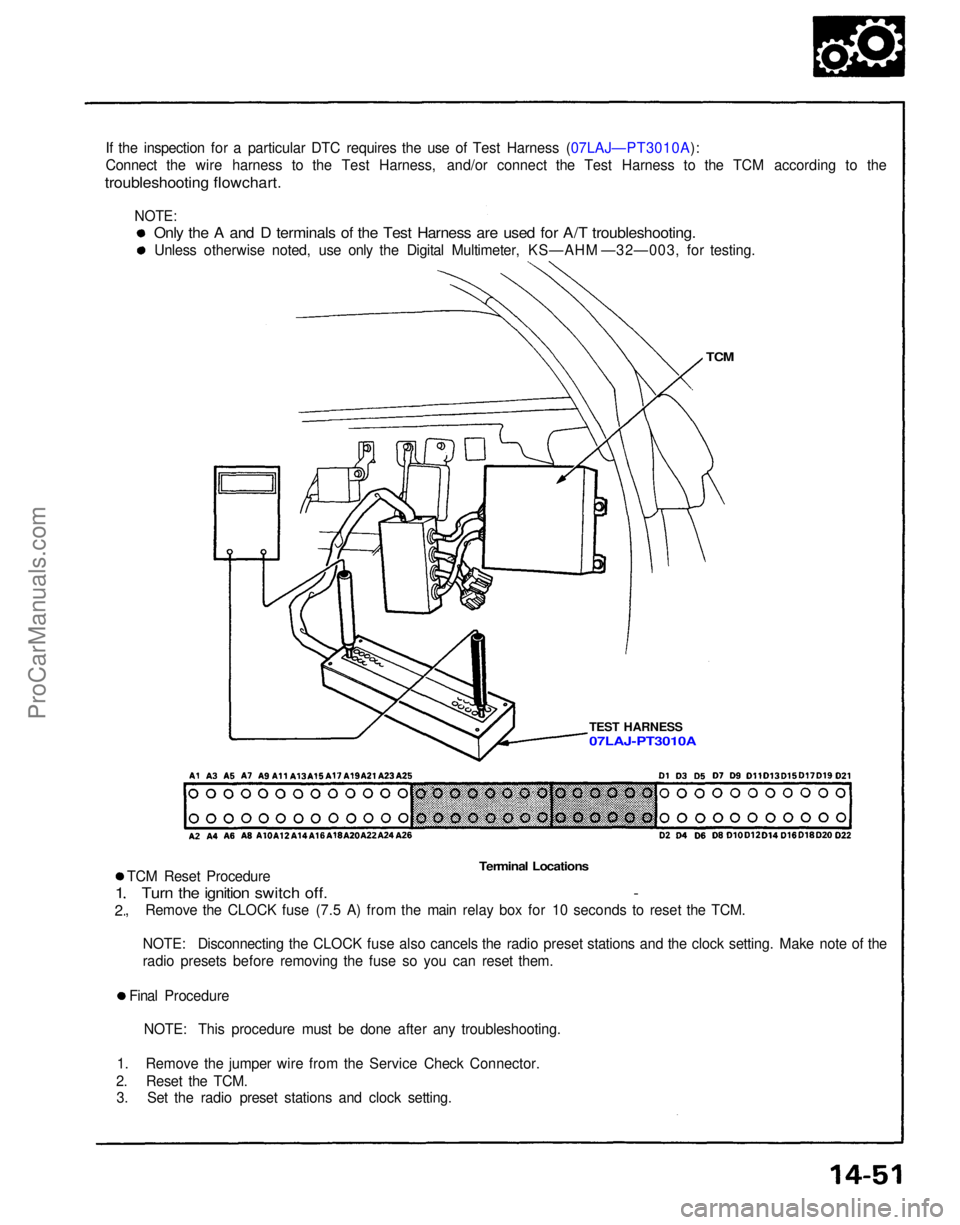
If the inspection for a particular DTC requires the use of Test Harness (07LAJ—PT3010A):
Connect the wire harness to the Test Harness, and/or connect the Test Harness to the TCM according to the
troubleshooting flowchart.
TCM
TEST HARNESS
Terminal Locations
TCM Reset Procedure
Turn the ignition switch off. -
, Remove the CLOCK fuse (7.5 A) from the main relay box for 10 seconds to reset the TCM.
1
2
NOTE: Disconnecting the CLOCK fuse also cancels the radio preset stations and the clock setting. Make note of the
radio presets before removing the fuse so you can reset them.
Final Procedure NOTE: This procedure must be done after any troubleshooting.
1. Remove the jumper wire from the Service Check Connector.
2. Reset the TCM. 3. Set the radio preset stations and clock setting.
Only the A and D terminals of the Test Harness are used for A/T troubleshooting.
Unless otherwise noted, use only the Digital Multimeter, KS—AHM —32—003, for testing.
07LAJ-PT3010A
NOTE:ProCarManuals.com
Page 1336 of 1640
Troubleshooting
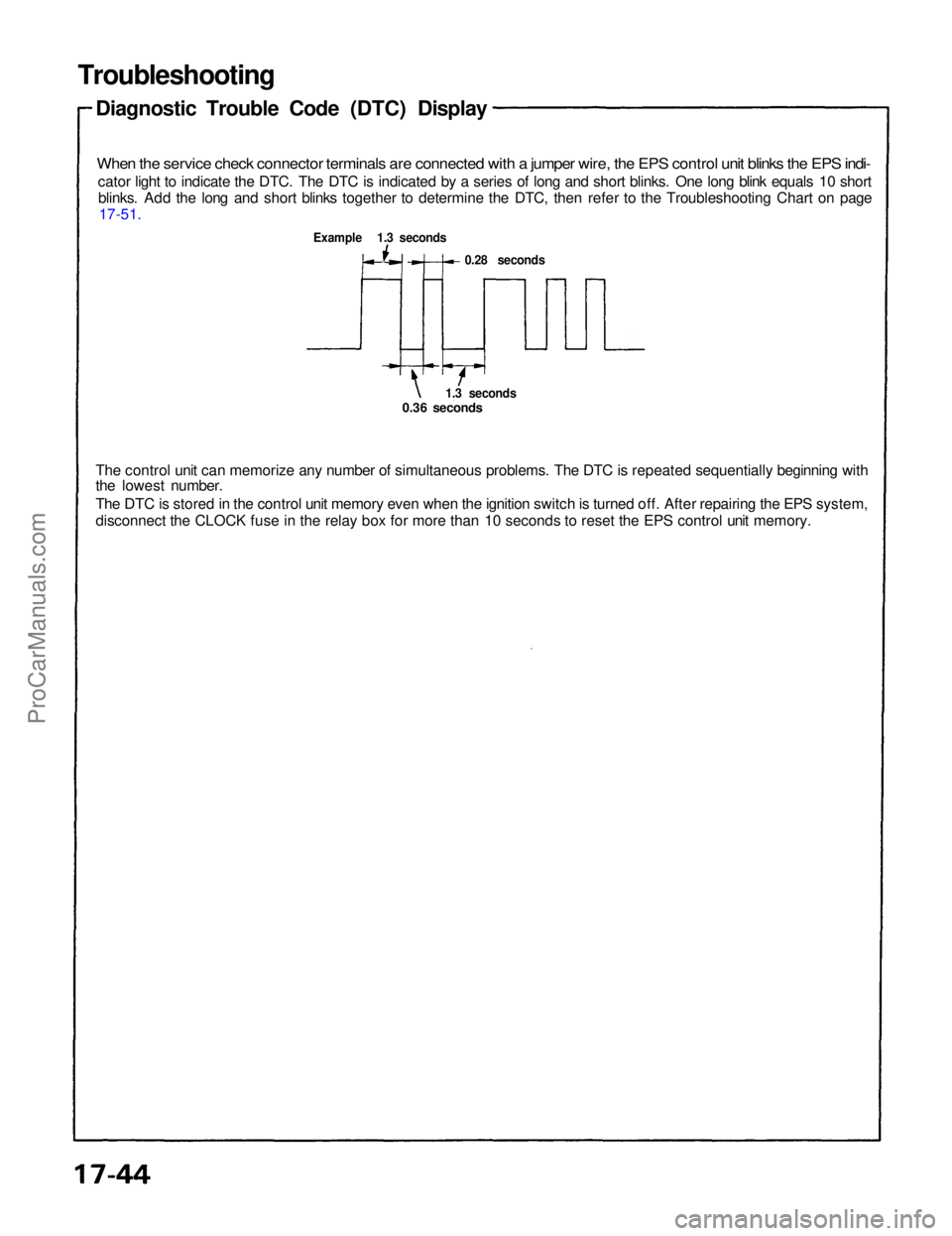
Diagnostic Trouble Code (DTC) Display
When the service check connector terminals are connected with a jumper wire, the EPS control unit blinks the EPS indi-
cator light to indicate the DTC. The DTC is indicated by a series of long and short blinks. One long blink equals 10 shortblinks. Add the long and short blinks together to determine the DTC, then refer to the Troubleshooting Chart on page 17-51.
Example 1.3 seconds
0.28 seconds
1.3 seconds
0.36 seconds
The control unit can memorize any number of simultaneous problems. The DTC is repeated sequentially beginning with
the lowest number.
The DTC is stored in the control unit memory even when the ignition switch is turned off. After repairing the EPS system,
disconnect the CLOCK fuse in the relay box for more than 10 seconds to reset the EPS control unit memory.ProCarManuals.com
Page 1482 of 1640

PGM-FI Control System
Troubleshooting Flowchart
ECU
Check Engine light never comes
on (even for two seconds) after
ignition is turned on.
Is the oil pressure light on?
Turn the ignition switch OFF.
Inspect No. 5 fuse.
Is No. 5 fuse OK? Replace fuse.
Connect the ECU test harness
between the ECU and connector
(page 11-21).
Connect A13 terminal to body
ground.
Repair open in YEL between
No. 5 fuse and gauge assembly.
A13
Turn the ignition switch ON. Replace the light
bulb.
Repair open in BLU
wire between ECU
(A13) and gauge
assembly.
A23
A24 A26 B2
G101
Less than 1 V
Is Check Engine light on?
Measure voltage between body
ground and the following ter-
minals individually: A23, A24,
A26,
B2.
Is there less than 1V?
Repair open in wire
between ECU and in-
take manifold (G101)
that had more than 1V.
Substitute a known-good ECU and recheck. If symp-
tom/ indication goes away,
replace the original ECU.ProCarManuals.com