check engine ACURA NSX 1997 Service Owner's Guide
[x] Cancel search | Manufacturer: ACURA, Model Year: 1997, Model line: NSX, Model: ACURA NSX 1997Pages: 1503, PDF Size: 57.08 MB
Page 1039 of 1503
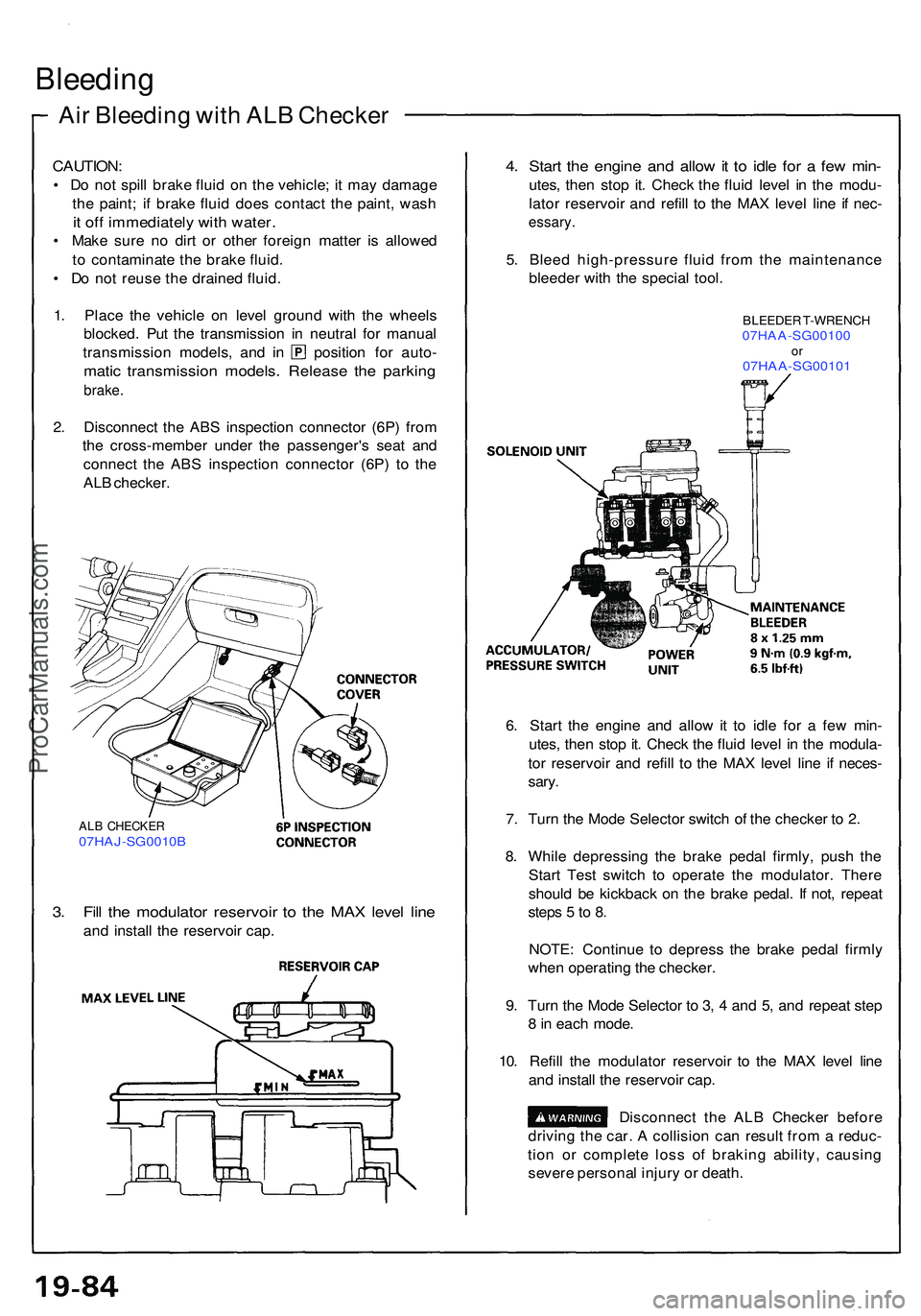
Air Bleedin g wit h AL B Checke r
Bleeding
CAUTION :
• D o no t spil l brak e flui d o n th e vehicle ; i t ma y damag e
th e paint ; i f brak e flui d doe s contac t th e paint , was h
it of f immediatel y wit h water .
• Mak e sur e n o dir t o r othe r foreig n matte r i s allowe d
t o contaminat e th e brak e fluid .
• D o no t reus e th e draine d fluid .
1 . Plac e th e vehicl e o n leve l groun d wit h th e wheel s
blocked . Pu t th e transmissio n i n neutra l fo r manua l
transmissio n models , an d i n positio n fo r auto -
matic transmissio n models . Releas e th e parkin g
brake.
2. Disconnec t th e AB S inspectio n connecto r (6P ) fro m
th e cross-membe r unde r th e passenger' s sea t an d
connec t th e AB S inspectio n connecto r (6P ) t o th e
AL B checker .
4. Star t th e engin e an d allo w it t o idl e fo r a fe w min -
utes, the n sto p it . Chec k th e flui d leve l i n th e modu -
lato r reservoi r an d refil l t o th e MA X leve l lin e i f nec -
essary .
5. Blee d high-pressur e flui d fro m th e maintenanc e
bleede r wit h th e specia l tool .
BLEEDE R T-WRENC H07HAA-SG0010 0or07HAA-SG0010 1
6. Star t th e engine and allo w it t o idl e fo r a fe w min -
utes , the n sto p it . Chec k th e flui d leve l i n th e modula -
to r reservoi r an d refil l t o th e MA X leve l lin e i f neces -
sary .
7 . Tur n th e Mod e Selecto r switc h o f th e checke r t o 2 .
8 . Whil e depressin g th e brak e peda l firmly , pus h th e
Star t Tes t switc h t o operat e th e modulator . Ther e
shoul d b e kickbac k o n th e brak e pedal . I f not , repea t
step s 5 to 8 .
NOTE : Continu e t o depres s th e brak e peda l firml y
whe n operatin g th e checker .
9 . Tur n th e Mod e Selecto r t o 3 , 4 an d 5 , an d repea t ste p
8 in eac h mode .
10 . Refil l th e modulato r reservoi r t o th e MA X leve l lin e
an d instal l th e reservoi r cap .
Disconnec t th e AL B Checke r befor e
drivin g th e car . A collisio n ca n resul t fro m a reduc -
tio n o r complete loss o f brakin g ability , causin g
sever e persona l injur y o r death .
ALB CHECKE R07HAJ-SG0010 B
3. Fil l th e modulato r reservoi r t o th e MA X leve l lin e
and instal l th e reservoi r cap .
ProCarManuals.com
Page 1052 of 1503
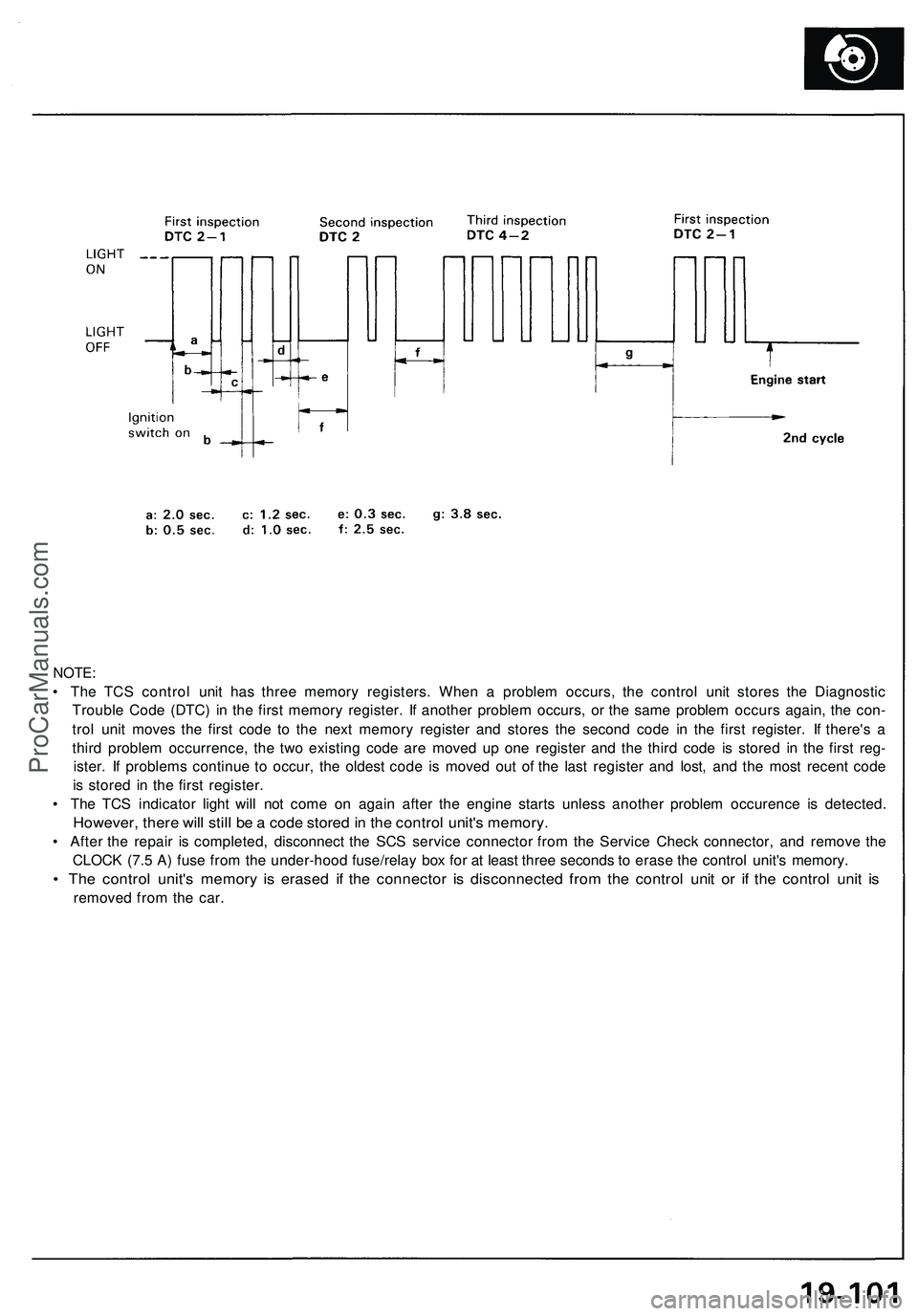
NOTE:
• The TCS control unit has three memory registers. When a problem occurs, the control unit stores the Diagnostic
Trouble Code (DTC) in the first memory register. If another problem occurs, or the same problem occurs again, the con-
trol unit moves the first code to the next memory register and stores the second code in the first register. If there's a
third problem occurrence, the two existing code are moved up one register and the third code is stored in the first reg-
ister. If problems continue to occur, the oldest code is moved out of the last register and lost, and the most recent code
is stored in the first register.
• The TCS indicator light will not come on again after the engine starts unless another problem occurence is detected.
However, there will still be a code stored in the control unit's memory.
• After the repair is completed, disconnect the SCS service connector from the Service Check connector, and remove the
CLOCK (7.5 A) fuse from the under-hood fuse/relay box for at least three seconds to erase the control unit's memory.
• The control unit's memory is erased if the connector is disconnected from the control unit or if the control unit is
removed from the car.ProCarManuals.com
Page 1056 of 1503
Steering angl e senso r syste m chec k
1 . Star t th e engine .
2 . Pus h th e TC S switc h thre e time s withi n thre e seconds .
NOTE : Alway s maintai n th e sam e numbe r o f rota -
tions .
3 . Tur n th e steerin g whee l slowl y fro m lef t t o righ t mor e
tha n 1. 5 turns .
NOTE :
• Star t checkin g afte r th e steerin g whee l move s a t
leas t 1. 5 turn s fro m righ t t o left .
• Tur n th e steerin g whee l slowly , n o faste r tha n
on e tur n in fou r seconds .
4 . Pus h th e TC S switc h twic e withi n thre e seconds .
NOTE : Alway s maintai n th e sam e numbe r o f rota -
tions .
5 . Retur n th e steerin g whee l t o th e lef t sid e slowly , an d
chec k th e numbe r o f time s th e TC S indicato r ligh t
flashe s afte r th e whee l ha s move d approximatel y
on e turn .
NOTE :
• Star t th e chec k fro m th e beginnin g whe n th e steer -
in g whee l move s a t leas t on e tur n fro m lef t t o
right .
• Tur n th e steerin g whee l slowly , n o faste r tha n on e
tur n in fou r seconds .
Standar d numbe r o f time s th e TC S indicato r ligh t
flashes :
Manual Transmission : 5 time s
Automati c Transmission : 2 time s
6 . I f ther e is a n abnormality , chec k th e troubleshootin g
flowchar t (se e pag e 19-114 ). Selectio
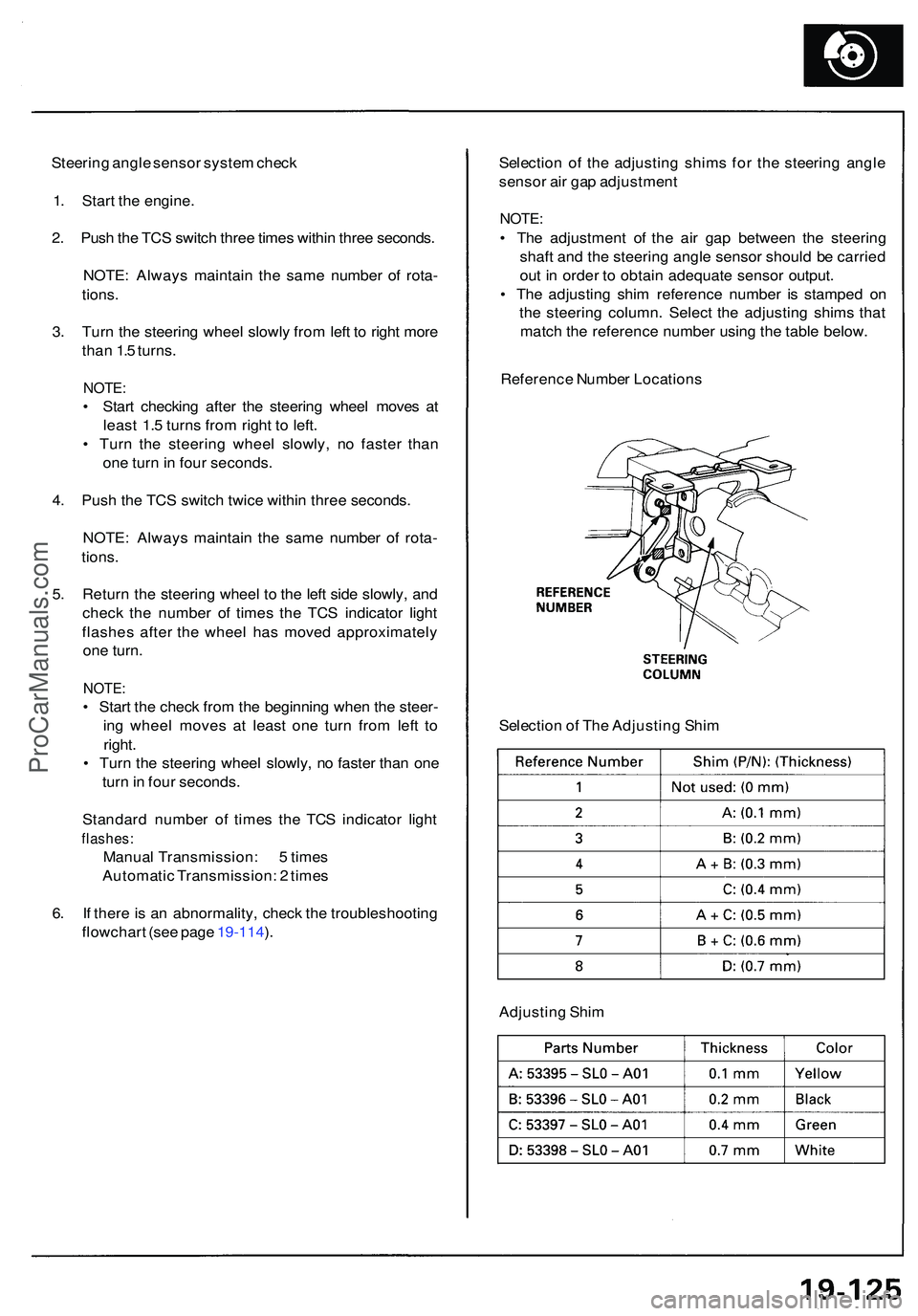
n o f th e adjustin g shim s fo r th e steerin g angl e
senso r ai r ga p adjustmen t
NOTE:
• Th e adjustmen t o f th e ai r ga p betwee n th e steerin g
shaf t an d th e steerin g angl e senso r shoul d b e carrie d
ou t i n orde r t o obtai n adequat e senso r output .
• Th e adjustin g shi m referenc e numbe r i s stampe d o n
th e steerin g column . Selec t th e adjustin g shim s tha t
matc h th e referenc e numbe r usin g th e tabl e below .
Referenc e Numbe r Location s
Selectio n o f Th e Adjustin g Shi m
Adjustin g Shi m
ProCarManuals.com
Page 1121 of 1503
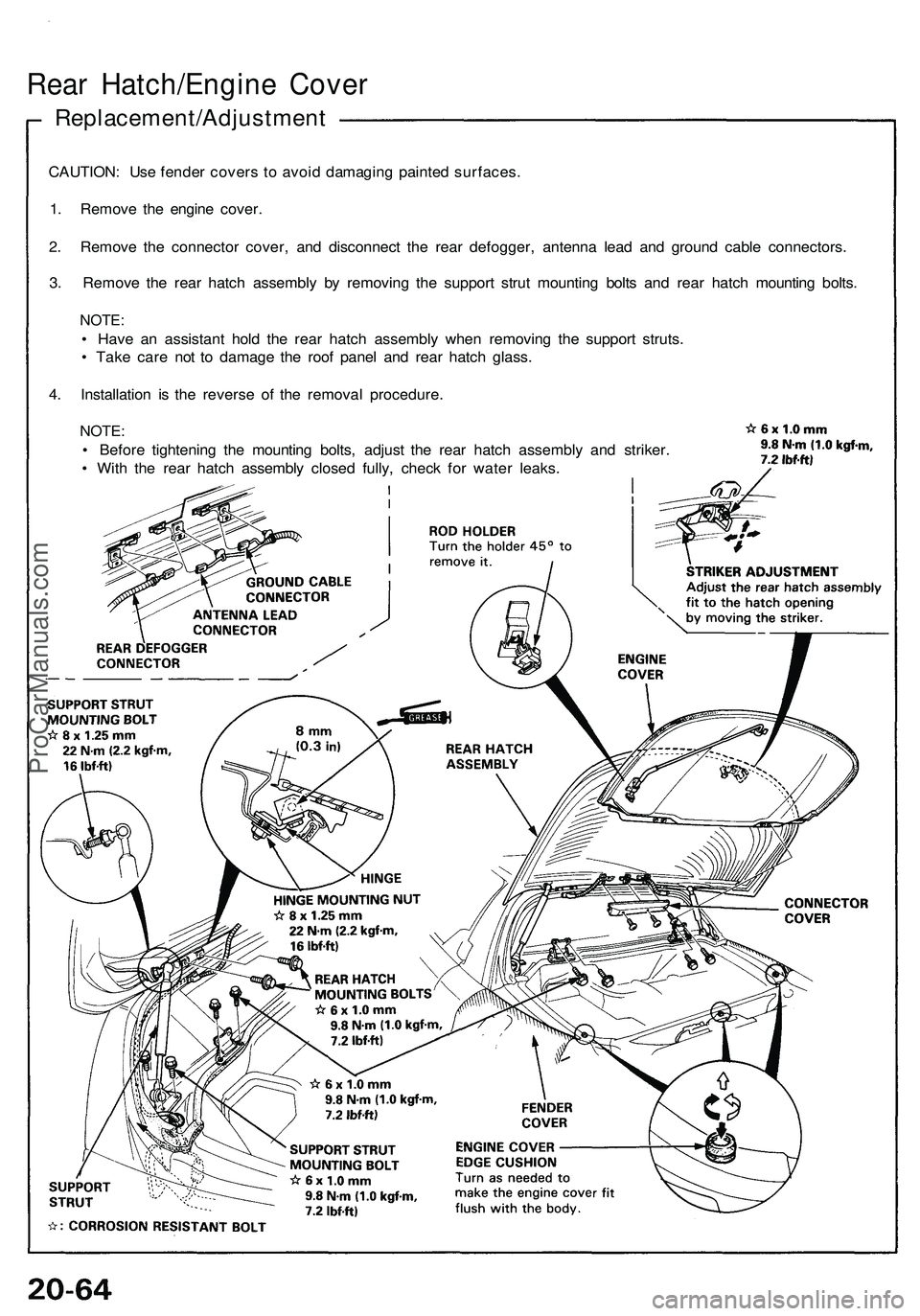
Rear Hatch/Engine Cover
Replacement/Adjustment
CAUTION: Use fender covers to avoid damaging painted surfaces.
1. Remove the engine cover.
2. Remove the connector cover, and disconnect the rear defogger, antenna lead and ground cable connectors.
3. Remove the rear hatch assembly by removing the support strut mounting bolts and rear hatch mounting bolts.
NOTE:
• Have an assistant hold the rear hatch assembly when removing the support struts.
• Take care not to damage the roof panel and rear hatch glass.
4. Installation is the reverse of the removal procedure.
NOTE:
• Before tightening the mounting bolts, adjust the rear hatch assembly and striker.
• With the rear hatch assembly closed fully, check for water leaks.ProCarManuals.com
Page 1187 of 1503
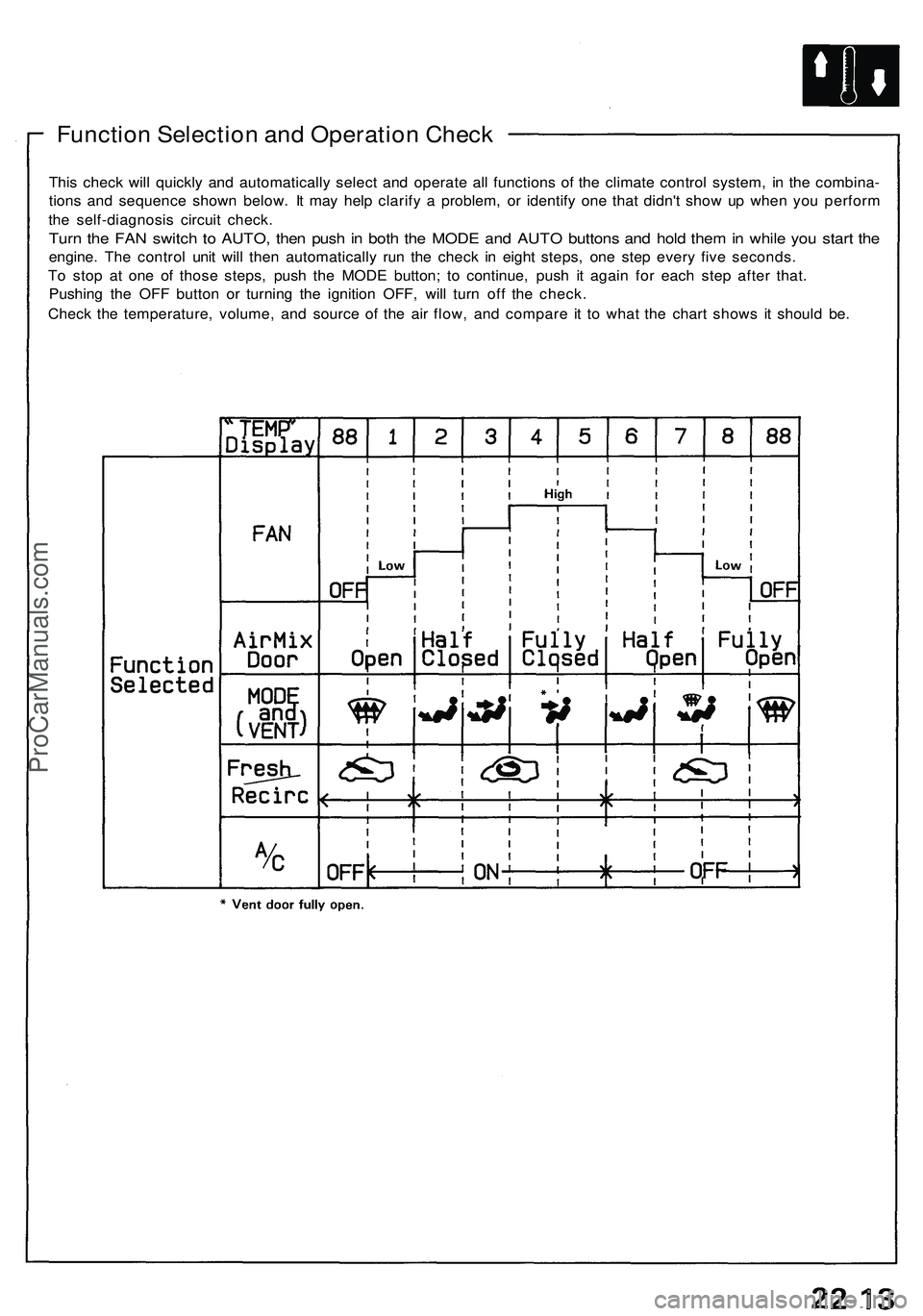
Function Selection and Operation Check
This check will quickly and automatically select and operate all functions of the climate control system, in the combina-
tions and sequence shown below. It may help clarify a problem, or identify one that didn't show up when you perform
the self-diagnosis circuit check.
Turn the FAN switch to AUTO, then push in both the MODE and AUTO buttons and hold them in while you start the
engine. The control unit will then automatically run the check in eight steps, one step every five seconds.
To stop at one of those steps, push the MODE button; to continue, push it again for each step after that.
Pushing the OFF button or turning the ignition OFF, will turn off the check.
Check the temperature, volume, and source of the air flow, and compare it to what the chart shows it should be.ProCarManuals.com
Page 1231 of 1503
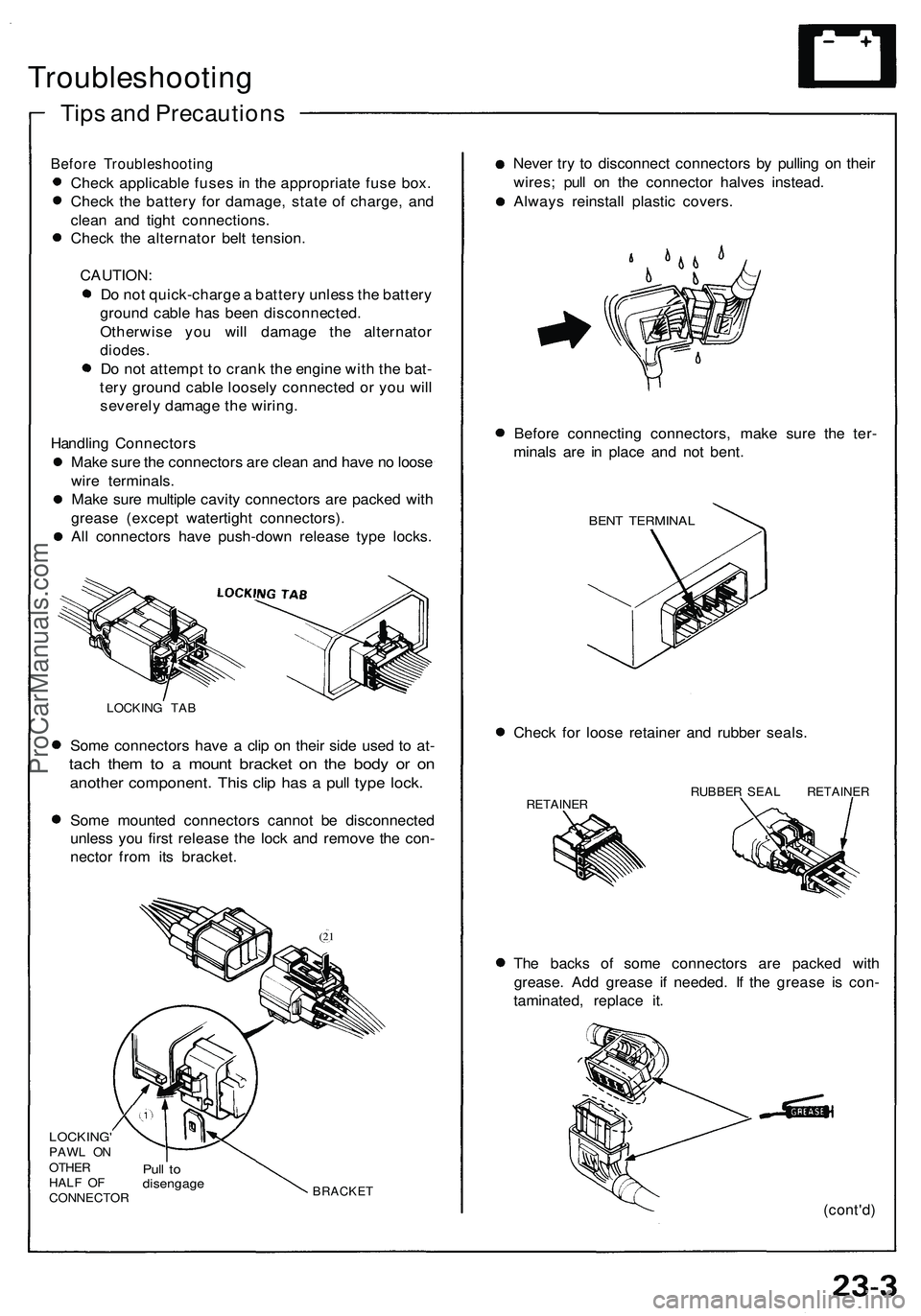
Troubleshooting
Tips and Precautions
Before Troubleshooting
Check applicable fuses in the appropriate fuse box.
Check the battery for damage, state of charge, and
clean and tight connections.
Check the alternator belt tension.
CAUTION:
Do not quick-charge a battery unless the battery
ground cable has been disconnected.
Otherwise you will damage the alternator
diodes.
Do not attempt to crank the engine with the bat-
tery ground cable loosely connected or you will
severely damage the wiring.
Handling Connectors
Make sure the connectors are clean and have no loose
wire terminals.
Make sure multiple cavity connectors are packed with
grease (except watertight connectors).
All connectors have push-down release type locks.
LOCKING TAB
Some connectors have a clip on their side used to at-
tach them to a mount bracket on the body or on
another component. This clip has a pull type lock.
Some mounted connectors cannot be disconnected
unless you first release the lock and remove the con-
nector from its bracket.
(21
LOCKING'
PAWL ON
OTHER
HALF OF
CONNECTOR
Pull to
disengage
BRACKET
Never try to disconnect connectors by pulling on their
wires; pull on the connector halves instead.
Always reinstall plastic covers.
Before connecting connectors, make sure the ter-
minals are in place and not bent.
BENT TERMINAL
Check for loose retainer and rubber seals.
RETAINER
RUBBER SEAL RETAINER
The backs of some connectors are packed with
grease. Add grease if needed. If the grease is con-
taminated, replace it.
(cont'd)ProCarManuals.com
Page 1251 of 1503
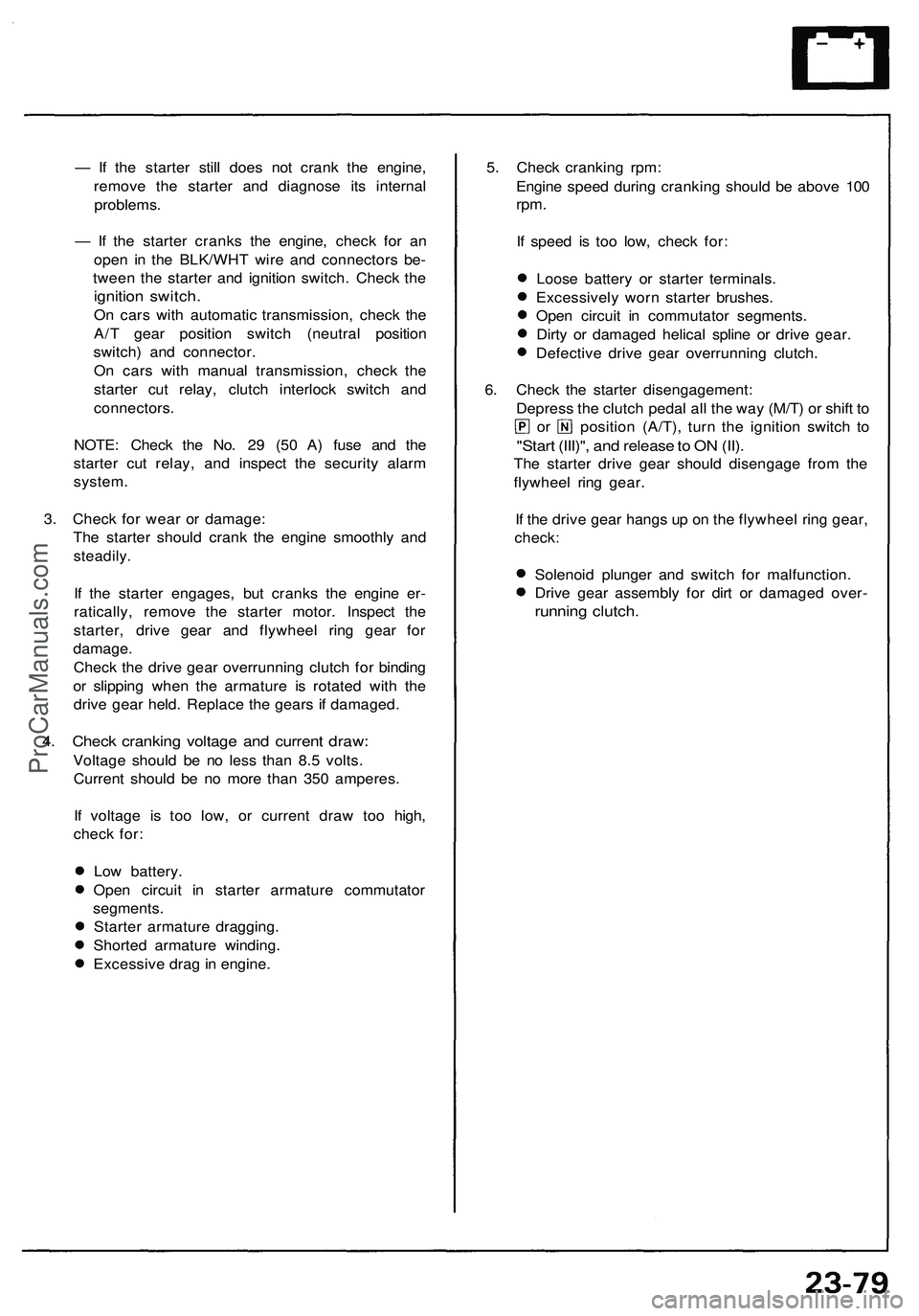
— If the starter still does not crank the engine,
remove the starter and diagnose its internal
problems.
— If the starter cranks the engine, check for an
open in the BLK/WHT wire and connectors be-
tween the starter and ignition switch. Check the
ignition switch.
On cars with automatic transmission, check the
A/T gear position switch (neutral position
switch) and connector.
On cars with manual transmission, check the
starter cut relay, clutch interlock switch and
connectors.
NOTE: Check the No. 29 (50 A) fuse and the
starter cut relay, and inspect the security alarm
system.
3. Check for wear or damage:
The starter should crank the engine smoothly and
steadily.
If the starter engages, but cranks the engine er-
ratically, remove the starter motor. Inspect the
starter, drive gear and flywheel ring gear for
damage.
Check the drive gear overrunning clutch for binding
or slipping when the armature is rotated with the
drive gear held. Replace the gears if damaged.
4. Check cranking voltage and current draw:
Voltage should be no less than 8.5 volts.
Current should be no more than 350 amperes.
If voltage is too low, or current draw too high,
check for:
Low battery.
Open circuit in starter armature commutator
segments.
Starter armature dragging.
Shorted armature winding.
Excessive drag in engine.
5. Check cranking rpm:
Engine speed during cranking should be above 100
rpm.
If speed is too low, check for:
Loose battery or starter terminals.
Excessively worn starter brushes.
Open circuit in commutator segments.
Dirty or damaged helical spline or drive gear.
Defective drive gear overrunning clutch.
6. Check the starter disengagement:
Depress the clutch pedal all the way (M/T) or shift to
or position (A/T), turn the ignition switch to
"Start (III)", and release to ON (II).
The starter drive gear should disengage from the
flywheel ring gear.
If the drive gear hangs up on the flywheel ring gear,
check:
Solenoid plunger and switch for malfunction.
Drive gear assembly for dirt or damaged over-
running clutch.ProCarManuals.com
Page 1253 of 1503
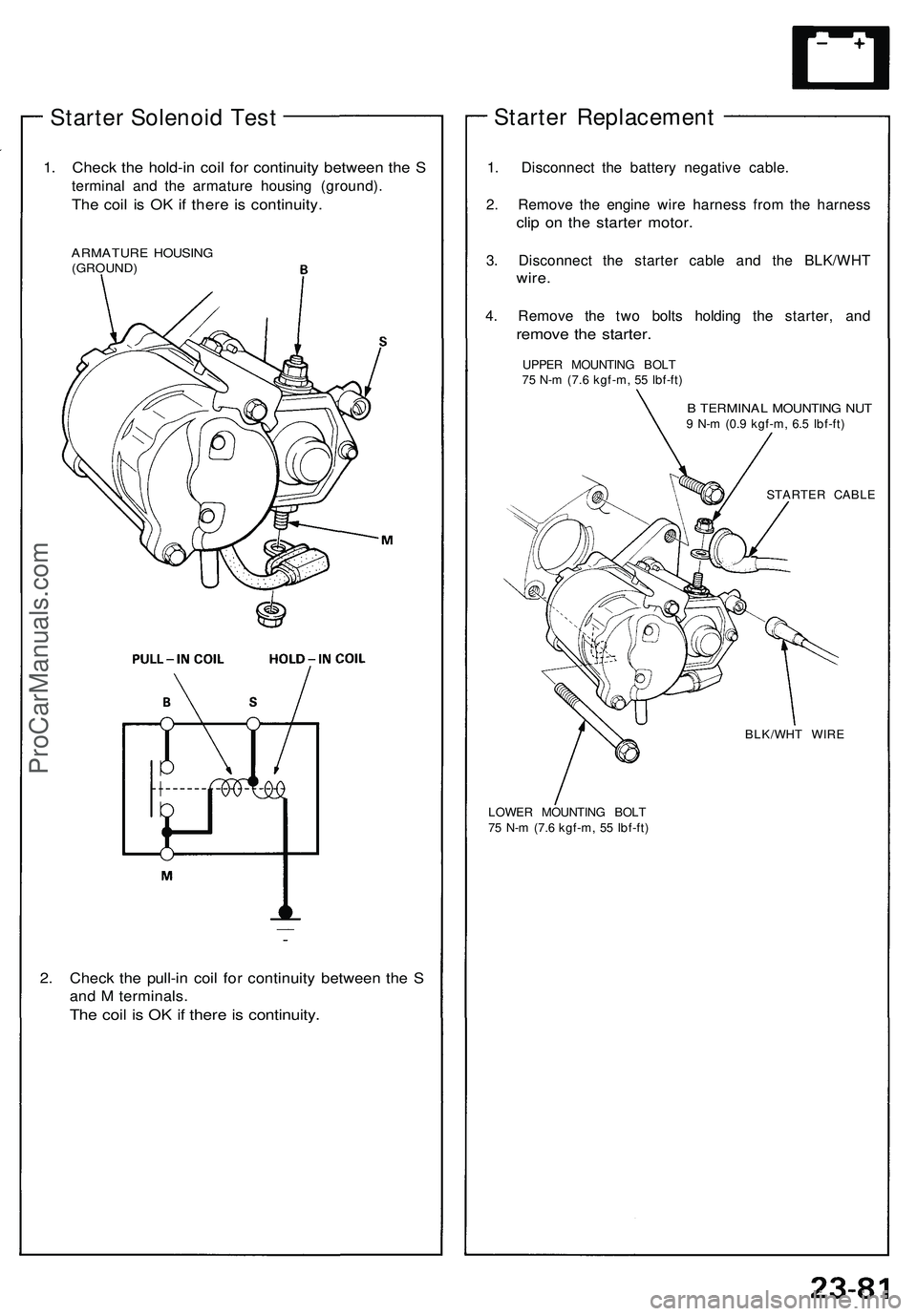
Starter Solenoid Test
1. Check the hold-in coil for continuity between the S
terminal and the armature housing (ground).
The coil is OK if there is continuity.
ARMATURE HOUSING
(GROUND)
2. Check the pull-in coil for continuity between the S
and M terminals.
The coil is OK if there is continuity.
Starter Replacement
1. Disconnect the battery negative cable.
2. Remove the engine wire harness from the harness
clip on the starter motor.
3. Disconnect the starter cable and the BLK/WHT
wire.
4. Remove the two bolts holding the starter, and
remove the starter.
UPPER MOUNTING BOLT
75 N-m (7.6 kgf-m, 55 Ibf-ft)
B TERMINAL MOUNTING NUT
9 N-m (0.9 kgf-m, 6.5 Ibf-ft)
STARTER CABLE
LOWER MOUNTING BOLT
75 N-m (7.6 kgf-m, 55 Ibf-ft)
BLK/WHT WIREProCarManuals.com
Page 1287 of 1503
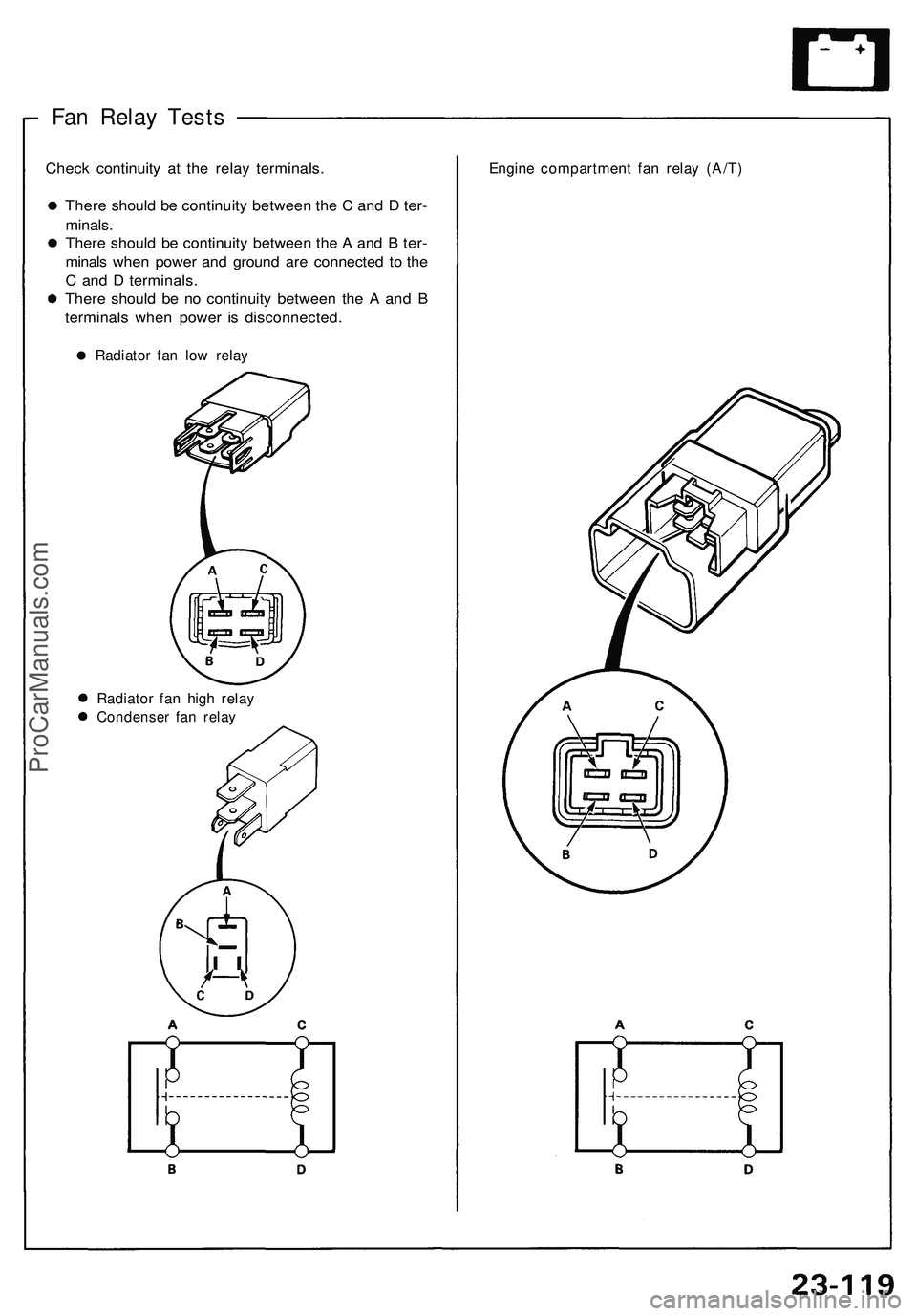
Fan Relay Tests
Check continuity at the relay terminals.
There should be continuity between the C and D ter-
minals.
There should be continuity between the A and B ter-
minals when power and ground are connected to the
C and D terminals.
There should be no continuity between the A and B
terminals when power is disconnected.
Radiator fan low relay
Engine compartment fan relay (A/T)
Radiator fan high relay
Condenser fan relayProCarManuals.com
Page 1323 of 1503
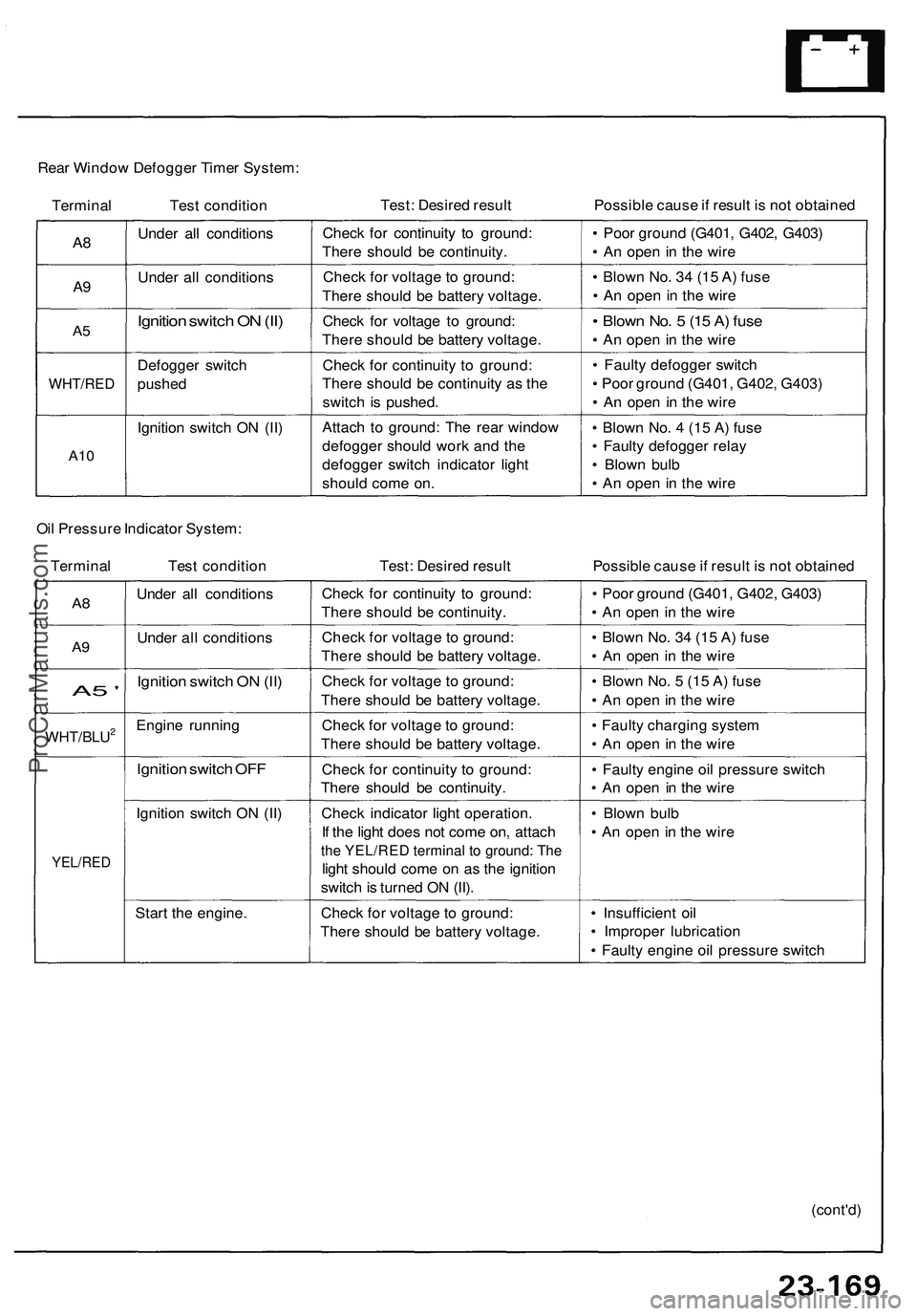
Rear Window Defogger Timer System:
Terminal Test condition
Test: Desired result
Possible cause if result is not obtained
A8
A9
A5
WHT/RED
A10
Under all conditions
Under all conditions
Ignition switch ON (II)
Defogger switch
pushed
Ignition switch ON (II)
Check for continuity to ground:
There should be continuity.
Check for voltage to ground:
There should be battery voltage.
Check for voltage to ground:
There should be battery voltage.
Check for continuity to ground:
There should be continuity as the
switch is pushed.
Attach to ground: The rear window
defogger should work and the
defogger switch indicator light
should come on.
• Poor ground (G401, G402, G403)
• An open in the wire
• Blown No. 34 (15 A) fuse
• An open in the wire
• Blown No. 5 (15 A) fuse
• An open in the wire
• Faulty defogger switch
• Poor ground (G401, G402, G403)
• An open in the wire
• Blown No. 4 (15 A) fuse
• Faulty defogger relay
• Blown bulb
• An open in the wire
Oil Pressure Indicator System:
Terminal Test condition
Test: Desired result
Possible cause if result is not obtained
A8
A9
A5 '
WHT/BLU2
YEL/RED
Under all conditions
Under all conditions
Ignition switch ON (II)
Engine running
Ignition switch OFF
Ignition switch ON (II)
Start the engine.
Check for continuity to ground:
There should be continuity.
Check for voltage to ground:
There should be battery voltage.
Check for voltage to ground:
There should be battery voltage.
Check for voltage to ground:
There should be battery voltage.
Check for continuity to ground:
There should be continuity.
Check indicator light operation.
If the light does not come on, attach
the YEL/RED terminal to ground: The
light should come on as the ignition
switch is turned ON (II).
Check for voltage to ground:
There should be battery voltage.
• Poor ground (G401, G402, G403)
• An open in the wire
• Blown No. 34 (15 A) fuse
• An open in the wire
• Blown No. 5 (15 A) fuse
• An open in the wire
• Faulty charging system
• An open in the wire
• Faulty engine oil pressure switch
• An open in the wire
• Blown bulb
• An open in the wire
• Insufficient oil
• Improper lubrication
• Faulty engine oil pressure switch
(cont'd)ProCarManuals.com